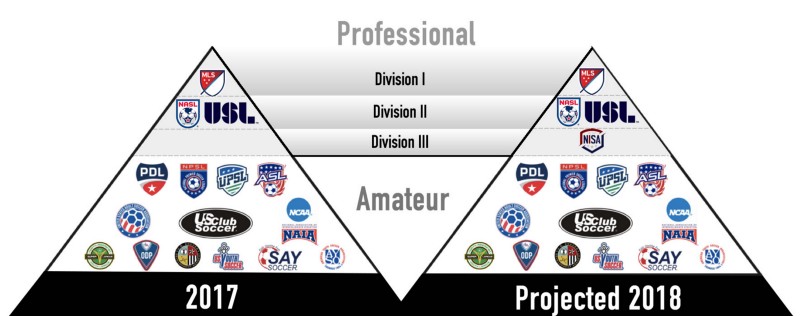
At SoccerWire, Charles Boehm has news of a new D.C. United partnership and a nice pyramid graphic showing players progressing from these partner clubs to the new USL side in exurban Loudoun County to the Chris Durkin-esque heights of the senior side. (A few stray thoughts on this later.)
On a local message board, one anonymous parent reacted to this news by asking which Academy kids get to play for the USL side.
My first reaction: What do you mean — who gets to play for the USL side? It’s pro soccer. Who gets to play pro soccer? Really good players!
Second reaction: Wait a minute. Who does get to play for the USL side?
So I figured I’d do a case study on Will’s No. 1 academy — New York Red Bulls. Who’s playing for NYRB II?
The results:
Former Academy players – 8
Amando Moreno (signed directly from Academy; years ago)
Ben Mines (signed directly from Academy)
John Murphy (signed directly from Academy)
Evan Louro (homegrown contract after college)
Kevin Politz (homegrown contract after college)
Steven Echevarria (homegrown contract after college)
Andrew Lombard (free agent after college)
Chris Lema (free agent after college)
Played for PDL Under-23 team – 3, all from 2018 draft
Brian White
Jared Stroud
Jose Aguinaga
(also: Lema, Louro, Politz, Echevarria, Murphy)
Lived in NY/NJ, then drafted – 3
Ryan Meara
Ethan Kutler
Jordan Scarlett
Developed in OTHER MLS academies – 2
Jean-Christophe Koffi (D.C. United)
Tommy Redding (Orlando)
Then two other draftees, four free agents who just finished college, and six from foreign clubs.
I used a loose definition of an NYRB II player. A couple of these guys have recently been called up to the MLS side, and they’re not the only players to move up in the last few years. (Think Tyler Adams.)
So that’s eight Academy alumni out of a pool of 28 players. The ages of those players: 23, 22, 22, 22, 22, 21, 18, 18.
Virginia Development Academy (itself a partnership that includes my hometown club, Vienna): Current DA through U19
So what does this mean for VDA’s older age groups?
(Side note here: VDA’s girls moved from the DA to the ECNL, but they didn’t rename themselves “VECNL,” which sounds like a horrible health insurance company. I didn’t include girls’ DA teams in the breakdown above because United’s program here is boys-only. We’ll talk about the Spirit some other time.)
At SocTakes, Nipun Chopra has done a deep dive into USL spending, which has really ramped up over the last decade.
You could say that’s a strong rebuttal to the notion that people are unwilling to spend money on lower-division clubs that have no pathway to the upper divisions unless they have a spare couple hundred million to spend. But it’s not that simple, and Nipun suggests we could be looking at another USL bubble as we had in the late 90s. (He actually uses the analogy of a Shepard tone, which is brilliant.)
The figure that stands out: Player salaries per team are somewhere in the $250,000-$500,000 range. That’s maybe $10,000-$20,000 per player. More likely — a few players are making a living range while a lot of others are filler.
In the grand scheme of things, I’ll always argue that I’m more concerned about women’s national team pool players barely making $10,000 in the NWSL, and I’d love to know why all these owners are more willing to spend this kind of money on the 21st through 40th best men’s teams in the United States instead of the top 10 women’s teams. Doesn’t make a lot of sense to me.
But let’s see if we can make things a bit better for the men. If the NASL had one legitimate point, it was the idea that the Cosmos and a couple of other teams (look, if you’re going to say MLS operations with sprawling youth programs aren’t “clubs,” then I’m not going to call Miami FC a “club,” either) were able to pay a bit more. I’m not going to say “what they deserve” because, for the umpteenth time, I’m not going to weep for Danny Szetela wrapping up his professional career after 15 years and 100 chances while Tori Huster and other potential *World Cup players* have to play the offseason in Australia and risk overuse injuries just to keep playing into their mid-20s.
Sorry … sorry … you can tell this sort of nonsense is difficult to swallow. But anyway …
Paradoxically, I think we can create more high-paying jobs for non-MLS players if we have fewer Division 2 teams. Here’s how:
Let D2 teams be freed from whatever central management the USL is imposing. You may need a salary cap (I actually prefer the luxury-tax model) to keep at least a little bit of parity, but put it really high — say, $1.5 million for a luxury tax or $2 million for a cap. That might actually convince NASL holdouts to come over and play. (If Commisso and Silva don’t like it, fine. Sell the teams.)
Everyone else drops to D3, which would retain a stronger central league management.
What we’re headed toward now doesn’t make a lot of sense. Thirty-some D2 teams and barely eight D3 teams? Let’s leave the inverted pyramid to journalists, shall we?
So we might have, say, 16 teams playing D2. Top of my head, drawing heavily from an attendance chart and some belief in markets that deserve better (St. Louis, for instance) — Cosmos, Miami FC, Jacksonville, North Carolina, Sacramento, Indy, Louisville, Las Vegas, San Antonio, Las Vegas, Phoenix, Tampa Bay, St. Louis, Oklahoma City.
That’s 14. I’m not sure USL stalwarts Richmond, Charleston and Pittsburgh would want to spend that much.
Yes, you in the back? You have a question? Let me guess — what about promotion/relegation?
I think it’s feasible here. Start D2 with the 14 clubs (and yes, some of them are clubs — look at the Richmond Kickers and tell me otherwise) and two others.
You’d need some caveats. If the Kickers, who have opted on multiple occasions not to go big-time, don’t want to go up, don’t force them. But if the top two teams in D3 think they’re ready to try D2, go for it. Perhaps those teams would include an MLS reserve side — the USA certainly wouldn’t be the only country with reserve sides on these tiers of a functional pyramid.
And you might need some bolsters for relegated teams. If they have academies, perhaps they should have a specially designated parachute payment to keep those academies running. (I still can’t believe someone related to the Cosmos once mocked such a suggestion with a Helen Lovejoy-esque “Think of the children!” motif. If we’re not trying to develop young players, what the hell are we doing? Let’s just shut it all down and watch the EPL on TV.)
Perhaps then we could see the following steps:
NPSL-Pro and NISA join up with this model to give us even more D3 fun.
A top-tier amateur division, which could officially D4, has promotion opportunities to D3. (I don’t think relegation from D3 to D4 is necessary or advisable unless we have hundreds of clubs at D3 — at this stage in the USA’s development, it makes no sense whatsoever to bump a pro club with an academy of any sort down to an amateur league.)
Then, yes, perhaps pro/rel between D1 and D2.
The latter would have some criteria involved. Not just the usual “pile of money to ensure club doesn’t fold midseason” but also stringent academy criteria such as the ones Germany imposed.
And a women’s pro team. So many we can finally start paying Tori Huster what she deserves as a nice side benefit to giving a few hundred more guys a chance to earn a living in this game.
I’m not going to try to write something coherent out of all the accounts of today’s NASLpalooza in a New York courtroom.
First, I’m going to send my hopes for speedy recoveries for those injured and comfort for those who mourn after today’s senseless attack in Manhattan. I’m going to suggest we look into simple ways to make public spaces safer — bollards would help in this case — without resorting to outrageous racial and religious scapegoating or some sick fantasy that “good guys with guns” can stop this sort of thing from happening.
Then, I’m going to direct you to some first-hand accounts:
Michael Lewis, who has covered all leagues called NASL, has a summary.
Chris Kivlehan, writing for Midfield Press, has what you might call a play-by-play.
And you’ll want to follow Miki Turner, who has an advantage over most of us in that he’s an attorney. Another advantage: He has the transcript.
So what I’m really doing here is leaving a few breadcrumbs to find our way back through the Labyrinth. Or something like that. In simpler terms, I want to capture a few thoughts before the day is done.
1. The “USSF has no right to regulate squat” apocalyptic vision is probably moot.
And that’s good because I think USSF lawyers may have missed an opportunity to point out that there’s a difference between “amateur” as defined in most of the world (someone who is not paid to play) and “amateur” as clumsily redefined in the USA’s Stevens Act when someone realized a lot of Olympians are now raking in the dough.
If that is so the ussf lawyers failed to make the argument. Kessler's argument on that issue seemed spot on.
So legal nerds hoping for The Ultimate Answer to Life, the Universe and Whether the Stevens Act Covers Professional Leagues might have to wait until the inevitable suit against some other National Governing Body. (If I were making odds, I’d say it’ll happen in rugby. Or volleyball.)
If you want a bit more on this, here’s Midfield Press: “Judge Brodie asks for clarification on whether Sauer (USSF lawyer) is taking the position that Congress has given USSF the authority to regulate professional soccer. Sauer clarifies that the Stevens Act does not limit their authority. Sauer traces the USSF’s authority from the Olympic charter, from which FIFA draws its authority. USSF is recognized by FIFA. “Bottom line” is that USSF believes it has the authority to govern pro soccer and the Stevens Act does not limit it.”
And finally …
Stevens Act amended in 1998. Changed def of amateur to not exclude pros (rather than delete all the refs to amateurs) b/c Olympics allowed
2. I’ll never understand why Jeffrey Kessler gets into soccer lawsuits and tosses out things that are easily refuted by anyone with a shred of outside knowledge (such an opposing counsel).
In Fraser v MLS, we actually had people arguing about whether the Premier League and The Division Now Known As The Championship are equal or whether the bottom three teams in the Premier League are sent down. (See pages 318-321 here, then pages 421-425 here. It actually reached a point of absurdity — page 2190 onward — at which Kessler was forced to backtrack from an assault on the credibility of one Sunil Gulati, who is once again involved in this case and seems to be Kessler’s white whale.)
Today, he brought up the sad story of a family upset over the prospect of losing the San Francisco Deltas. It didn’t take USSF lawyers long to point out that the Deltas’ survival ain’t at stake in this courtroom.
USSF lawyer jumped in and basically said something to the tune of "Why didn't you tell her Deltas were folding as of September 1st?"
3. Judge Margo K. Brodie has done a remarkable job getting up to speed on soccer.
From the Midfield Press account: “(Kessler) suggests that no other FIFA affiliated federation in the world has standards like USSF’s PLS. Judge Brodie suggests that is because soccer in those other countries is the number one sport, which is not the case here in the United States.”
Do you hear that, Soccer Twitter?
And she seems like one of those stereotypical New York judges from Law & Order who makes the lawyers behave.
4. I still don’t have a good handle on when this case will discuss whether the NASL can reasonably have D2 status.
We know from earlier filings — and from the reporting by Midfield Press and Nipun Chopra — that the NASL is grabbing some NPSL teams and flinging them up the pyramid to bolster their numbers. Follow-up info on that front is redacted, but it was discussed in court today:
FURTHER, USSF lawyers said the new #NASL LOI's, in paragraph three, state that the teams cannot financially thrive on their own.
Coincidentally, the Ranting Soccer Dad podcast posting tomorrow morning is an interview with NPSL Managing Director Jef Thiffault. We refer to the clubs considering an NASL move, but given the pending legal action, don’t expect a ton of detail.
5. I have no idea who’s going to win.
Or at what stage. Would the judge grant an injunction, giving the NASL a stay of execution, only to grant the USSF’s Motion to Dismiss, which is following a separate schedule and will take a few more weeks to discuss? I’ve heard convincing arguments either way, and I can’t pretend to be a lawyer.
I can tell you from a journalist/historian’s point of view, the NASL side has piled on more arguments that set off my b.s. detectors. They have eight teams — no, wait, make that 14, even though it’s well-established that a couple of these teams aren’t likely to return, and several others are currently playing before crowds of hundreds (when reported) in the NPSL with amateur players. They made bold claims about competing with MLS well before they were ready to do so, and now that they’ve declined, they’re blaming the system. They could’ve differentiated themselves from MLS by creating the promotion/relegation system they claimed to support, and not long ago, NPSL was interested in doing that. NASL pushed them away, only to latch onto a few NPSL clubs now.
If I were an NASL fan — and if I lived in Indianapolis or Puerto Rico right now, I would be — I’d be embarrassed by this insistence on propping up a brand name instead of joining up with NISA or regrouping some other way in Division III and working back up.
But that doesn’t mean they’re wrong, legally. It doesn’t mean they can’t convince a judge who appears to be quite reasonable that they should be given, like Delta House after the Faber parade, just one more chance.
There’s no organization in the world quite like U.S. Soccer.
That’s not a compliment. That’s not an insult. It just … is.
U.S. Soccer is unique among major U.S. sports federations in that its mandate goes beyond organizing national teams and developmental programs. It’s responsible, by FIFA fiat, for regulating professional soccer competitions. (Or, in the case of the U.S. Open Cup, running those competitions outright.)
U.S. Soccer is unique among soccer federations in that the nation it serves is a massive economic power on a giant land mass in which soccer is not the most popular sport. The USA isn’t the only country that has its own indigenous offshoot of “football” that rivals or exceeds soccer in popularity — see Australia and, to a lesser extent, Ireland — but it’s the only one that has multiple team sports that garner more attention. As far as I know, it’s the only soccer federation in a country that has been openly hostile to the sport for generations.
And to my knowledge, it’s the only federation that was charged by FIFA with getting an honest-to-goodness professional league running in the 1990s. Every other major country already had one.
The most important election in U.S. Soccer to date was in the summer of 1990, when Alan Rothenberg unseated Werner Fricker. Rothenberg was under a bit of pressure to run. From 1994, here’s Steve Berkowitz, then of The Washington Postand later a demanding but fair editor who made some of my USA TODAY stories a lot better:
Rothenberg said FIFA officials, familiar with him because of his involvement with the 1984 Olympic soccer competition, initially contacted him about chairing the World Cup organizing committee. When he said he was interested in doing so, he was told that he also would have to become USSF president. He agreed, and lo and behold, Rothenberg unseated Fricker in August 1990.
And so Rothenberg went to work on getting FIFA’s cash cow, the World Cup, up to speed. He also had to fulfill U.S. Soccer’s other promise to FIFA, a pro soccer league. Rothenberg needed a plan, and so he went about hiring people — including economist Sunil Gulati and attorney Mark Abbott, on loan from Rothenberg’s law firm, Latham & Watkins.
Abbott sat with me for an interview when I was writing Long-Range Goals: The Success Story of Major League Soccer (please note: I did not choose that subtitle). Here’s what he said about Rothenberg’s unusually sprawling role:
At that time, there were very stringent procedures that were put in place to ensure that although Alan was the head of the soccer federation and leading the effort to make a presentation with respect to the league, he had been recused from the decision-making system in U.S. Soccer. There was a big meeting in December 1993 where we made our presentations. Alan was not part of the Federation board in making that decision. Also, and I think this gets overlooked, FIFA in awarding the World Cup to the United States did so very expressly for the purpose of using it as a springboard for a professional league. That’s what he was supposed to be doing, using this event to help start the league.
Still, the federation’s board voted to decide which of three bids would be awarded Division I status. In addition to Rothenberg’s group, the existing Division II-ish APSL put in a bid, as did Jim Paglia on behalf of League One America, which would take the old NASL’s Americanization of soccer rules to new extremes. (Jim, I know you’re out there — if you still have the video of the test games, I’d love to see them.)
The vote wasn’t unanimous. The tally was 18 MLS, 5 APSL, 0 League One America.
More from my book (because I can’t find Hersh’s story online):
Veteran national-team defender and U.S. Soccer board member Desmond Armstrong, who cast a ballot for MLS in the Division I vote, said his decision was strictly on merit. “I don’t have any love lost for the federation,” Armstrong told the Chicago Tribune‘s Philip Hersh. … “It wasn’t a matter of playing favorites, but of getting the best proposal out there so we can have jobs. I voted for Alan’s plan because it had all the t’s crossed and i’s dotted.”
The APSL grumbled a bit and for a short time was a legitimate competitor to MLS, signing quite a few players who were clearly good enough for the top tier but balked at the salary structure.
The next year (1994), Rothenberg ran for re-election. It got ugly, but he won.
The election was close in 1998. “Dr. Bob” Contiguglia defeated Larry Monaco 57.6% to 42.4%. Even closer was the race for executive VP, in which John Motta defeated … Sunil Gulati, then serving as MLS deputy commissioner. That was 372 (50.8%) to 361.
Maybe that was a rebuke of MLS officials gaining too much power in U.S. Soccer (though, note, this was before MLS hired Don Garber and well before MLS formed Soccer United Marketing). But such sentiment didn’t last long. U.S. Soccer then started staggering the terms of its top board members, and Gulati came back two years later to win the seat from Motta. And Gulati was able to point out in Fraser v MLS testimony that U.S. Soccer didn’t just rubber-stamp whatever MLS wanted.
Then Gulati succeeded Dr. Bob as U.S. Soccer president, and elections have come and gone with little fanfare or fire since then. The 2016 vice-presidential election was contested in gentlemanly fashion, with longtime independent director (board member) Carlos Cordeiro ousting Mike Edwards. Gulati hasn’t been opposed.
(This is an image of a Google search. Don’t click.)
Wait, wait … you’re saying. What does this have to do with promotion and relegation?
Nothing. Because it wasn’t an issue.
We’re about the have the next biggest presidential election in USSF history. Is pro/rel an issue now? Or is it more about general arrogance and an unwillingness to push Major League Soccer to be more open, whether that means pro/rel or a looser salary cap? Or perhaps the historical view that the close ties between USSF, MLS and Soccer United Marketing that may have been necessary for survival in the mid-2000s are no longer necessary and perhaps harmful?
Gulati has often been painted as ruthless — player testimony in Fraser v MLS certainly made him look like a tough negotiator, to put it nicely. In my experience, he’s a pragmatic idealist. He has devoted thousands of volunteer hours to making the sport succeed, and he has laudable intent (and action) on trying to diversify the typically homogeneous Federation. Whether he has handled every situation in his long tenures in various roles is up to everyone to decide.
Gans is pragmatic as well. He announced his candidacy only after going on a “listening tour” of various constituencies, and he’s concerned about youth soccer dysfunction and the decision-making that led the Fed to renew Jurgen Klinsmann’s contract and then fire him. As mentioned in Part 1 of this series, his take on pro/rel is cautious.
“It’s not the rules of the game that people came in on,” Gulati said. “When you buy into a particular structure, that’s what you expect the rules to be. … But if the leagues or a league wants to engage, we’re happy to be support that.”
Lapointe is more prone to throw stuff at the wall and see what sticks. His approach to Twitter, to which he’s still relatively new, resembles another president in the United States:
Well your $450,000 behind schedule. And that is just one Employee.
NWSL supporters on a lively Facebook group said “let’s get the NWSL in order first” and “technically, we have national Cups for women, but no one enters.” The latter point was emphasized by none other than John Motta, the former USSF VP who is now president of the U.S. Adult Soccer Association.
And Motta is himself considering a run. So is Jerome de Bontin, the former president of French club Monaco and general manager of the New York Red Bulls who is now the chairman of the sprawling Rush Soccer youth organization (sadly, not named after Geddy, Neil and Alex — or Cartman, Stan, Kyle and Kenny, though like Rush Soccer, they hail from Colorado).
So will any of these presidential candidates bring forth promotion and relegation?
It’s complicated.
Like the United States themselves, U.S. Soccer is a representative democracy. Not a dictatorship. The president must contend with the rest of the board, the general membership and perhaps even the U.S. courts.
And even Lapointe sees a need to phase into promotion and relegation, not just throw open the whole pyramid at once. That might not reassure the PRZ (Pro/Rel Zealots), who insist any incremental step suggested by me or Peter Wilt is simply doing the bidding of Evil MLS.
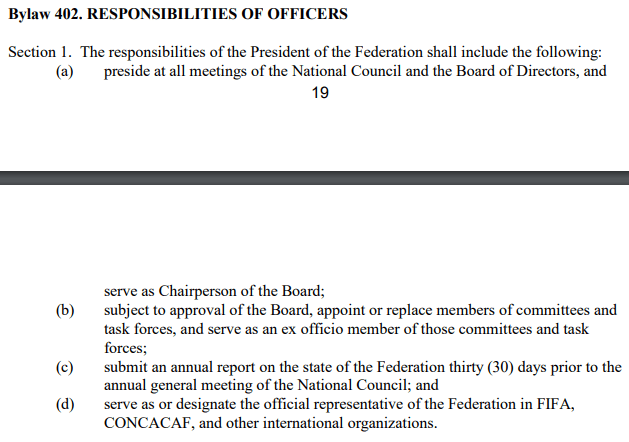
In any case, pro/rel may be the least of the next U.S. Soccer president’s concern. As mentioned many times in the past week or so, the NASL lawsuit calls into question U.S. Soccer’s legal authority to regulate professional soccer, and it’s not the first. But the bylaws clearly state U.S. Soccer’s firm belief that it can’t simply let someone else take over any aspect of the game.
(Except, apparently, indoor soccer. The boarded version of the game is operating outside USSF right now. For a while, it was associated with an organization called the Federation Internacional de Futbol Rapido, whose acronym FIFRA was hilariously close to FIFA. And except, apparently, college and high school soccer, neither of which is governed by U.S. Soccer. But I digress …)
So the Federation, and its president, must walk some difficult political lines. Filip Bondy, a longtime soccer writer now contributing to Forbes, put it best when he described the presidency as “a job opening you might want to pass on.”
Summing up Bondy’s take — the president gets to:
Accept blame for national team downturns
Deal with men’s and women’s national team contract disputes and potential work stoppages
Deal with FIFA and other officials of potentially dubious credentials and ethics (to me, this might be the toughest — how long can you swim in the FIFA cesspool without starting to stink?)
Collect a salary of $0.
Oh, and you have to put up with the NASL and Stefan Szymanski. If you didn’t see my Twitter thread on Szymanski’s declaration in favor of the NASL tweaking U.S. Soccer, check it out. Allow some time.
And it’s not as if U.S. Soccer simply rubber-stamps everything the president wants. (Also in that link: Note that U.S. Soccer changed the way it runs election, asking candidates to declare in advance instead of just presenting themselves on the meeting floor, and it instituted term limits. If Gulati runs and wins re-election in 2018, he’s out in 2022.)
So who votes? Let’s see if we can sum up Bylaw 302:
State association reps, both youth and adult. Their votes are weighted by the number of people they represent. (In other words, New York East is going to have a more heavily weighted vote than Alaska.)
Athlete delegates. There’s usually only a few, but by U.S. law, their votes have to be weighted to count for 20 percent of the final tally.
Board members.
Past presidents.
Life members of U.S. Soccer (weighted so that they have no more than 12 total votes, which isn’t much)
Delegates from pro leagues, national associations, national affiliates, other affiliates, disabled service organizations, etc.
Adult Council and Youth Council administrative commissioners (I have no idea who this is)
Further weighting: The Youth, Adult and Professional Councils will all end up with equal votes.
Here’s how it broke down in 2015:
You know what I don’t see in the bylaws? Is the election “first past the post” (top vote-getter is president, even without a majority) or a runoff system (top two hold a runoff)? In elections for the “at large” representative on the board (which is rarely of interest), the bylaws specify a runoff. I haven’t seen anything about a presidential race with more than two candidates.
And as I’ve been writing this, Eric Wynalda has jumped into the race. Maybe. His platform seems to be simple: Sunil Out. Yet even he suggests promotion/relegation needs to start in the lower divisions before going up to Division I.
So will any of this bring about pro/rel? I don’t know. How’s Trump doing on draining the swamp? Or building the wall? Or ending Obamacare while making sure everyone has access to health insurance?
Overthrowing a dictator is a fairly simple process. Overhauling a democratic organization is much more difficult.
For more than a decade, promotion/relegation talk has been the bane of the U.S. soccer community’s existence. It wasn’t going to happen any time soon, and some people reacted to that news by harassing and slandering the people who explained the reasons why.
But now? We have a former Chicago Fire president — Peter Wilt, who has plenty of experience in other soccer leagues and U.S. sports endeavors — writing a manifesto on how we can make it happen, and he’s starting a league with the goal of making it happen.
In other words, the grownups are talking about it now.
In this week’s podcast, Peter Wilt and I go through history and FIFA statutes (starting around the 5:30 mark), argue the merits of pro/rel (18:15) and talk about what’s changed to make it more likely (31:30).
Quick note: This was recorded before Miami FC and the Kingston Stockade appealed to the Court of Arbitration for Sport to ramp up the pressure on U.S. Soccer to force pro/rel into being, an action I fear will be counterproductive. But perhaps we can talk about that on a future podcast.
BEAU: Riccardo Silva offered MLS $4 billion for media rights if it would institute promotion/relegation? And people like Jeff Carlisle have already done the heavy lifting in reporting what did and didn’t happen? Great! Time to do a quick opinion piece.
BEAU’S CONSCIENCE: What are we, all clickbait now? You know that offer was just a PR stunt. MLS can’t negotiate its media rights for several years, by which both Silva’s team and David Beckham’s proposed team may literally be underwater thanks to climate change and everyone may be watching sports on AmazonTube.
BEAU: Well aren’t WE Debbie Downer this morning! Come on — we’ve been saying for years that pro/rel talk is just an academic argument until people put their money where their mouths are. Now they are! It’s not just Silva — Peter Wilt is planning a Division 3 league that would evolve into the cornerstone of a pro/rel pyramid. The reasonable voices are winning.
BEAU’S CONSCIENCE: We’ve tried to be reasonable for years. We all know the drill:
Something “new” happens in the world of pro/rel.
You write a blog post dissecting the nonsense arguments — MLS is conspiring to keep soccer smaller than the NFL, a lack of pro/rel is the only thing keeping the USA from dominating world soccer, etc. — and STILL suggest a way to ease into a pro/rel pyramid.
No one pays attention except Twitter trolls whose lives are so pathetic that they try to goad you into pro/rel arguments months after the fact. And then newbies pop up lecturing you about “Economics 101,” as if you haven’t been following sports business since before these dudes were born.
You’re just trying to stir something up so people will notice your new podcast, you sellout.
BEAU: You mean Ranting Soccer Dad? It just so happens we’ve booked a guest on promotion/relegation for Aug. 10.
BEAU’S CONSCIENCE: Is it someone reasonable, at least?
BEAU: It’s a Twitter troll who keeps accusing me of being on the MLS payroll to keep down pro/rel even though it’s been about 15 years since I wrote the MLSNet fantasy column and I keep coming up with plans FOR pro/rel.
(silence)
BEAU: No, I’m kidding. Geez, lighten up! It’ll be a rare chance to have a *substantive discussion* with someone who is actually doing something to make pro/rel a reality.
BEAU’S CONSCIENCE: Fine. Whatever. And I suppose today you’re going to suggest a modification to your latest pro/rel plan that no one will discuss?
BEAU: Glad you asked! Here goes …
I still like my last plan, especially given the number of viable MLS expansion candidates at the moment. The executive summary:
Division 1: 16 teams, single table, no playoffs (see separate Cup competition), bottom three clubs relegated.
Division 2: Initially 14-16 teams in one table but eventually splitting into regions with minimal playoffs. Promotion to D1 but no forced relegation to D3, at least not based on a single season’s results. Clubs can always self-relegate if they can’t compete at D2 — this is an alternative to folding.
Division 3: The top tier of regional pyramids. D3 clubs must meet professional standards. D1/D2 reserve teams are eligible to play (as in Europe, you pseudo-purist know-nothings). No automatic promotion to D2, but clubs can apply to move up based on performance on and off the field.
Division 4: The highest a club can climb while still remaining amateur (which many clubs will opt to do). Some pro (or semi-pro) clubs as well.
Then each league can go lower as it sees fit, just as current amateur leagues have multiple tiers.
I believe I mentioned a Cup competition to replace MLS Cup. This will have 12 teams — eight from Division 1, three from Division 2, and the team from Division 3 that progressed the farthest in the Open Cup.
So why does the clickbait headline say we can do pro/rel better than England? Here’s why:
Until recently, England kept a strict barrier between “League” and “Non-League.” The Non-League clubs could apply to replace the last-place League club (92nd on the four-division English ladder), but they rarely were admitted. Now they’re a bit more fluid, with a fifth tier (formerly called the Conference, now called the National League just to confuse everyone) that’s professional-ish.
We can do it better by being more flexible in Division 3 (and to an extent in Division 2). As more clubs are able to move from amateur to professional, we can add more D3 regional leagues.
For decades, professional soccer in England was a zero-sum game. Add one club, and you had to subtract another.
Leaving Division 3 open-ended gives every club a chance to move into the professional ranks when they demonstrate that they’re ready to do so.
And THAT will help youth soccer, too. More professional clubs. More academies.
So we’ll talk about it in more detail on the Ranting Soccer Dad podcast, assuming my conscience doesn’t take revenge somehow for grabbing the third rail of U.S. soccer once again.
Also: I’m doing a survey. If you are a coach or general manager of a USL, NASL, NPSL, PDL, WPSL, UWS, UPSL or high-level USASA team and have not received a survey by the end of the day, please check with your communications manager (to whom I’m emailing the surveys). If that person didn’t receive one, let me know.
Two months ago, would anyone have bet on the former Carolina Railhawks landing an NWSL team before the men’s team got out of divisional limbo?
The news that the Western New York Flash will be moving to the Triangle (reported overnight by FourFourTwo, with follow-ups from local soccer-media veterans in Rochester and the Triangle) has shocked the women’s soccer world. Many of us are struggling for coherent responses. The NWSL has been stable through four seasons, adding two teams and moving/losing none. Now the defending champions, a holdover from previous WoSo leagues, have skipped town.
But it also puts some focus on the current turmoil in the lower divisions of men’s professional soccer, which has dragged on and on and on …
In fact, both ends of the Flash-to-Carolina move are still awaiting news on divisional sanctioning. The USL, which includes the Rochester Rhinos, seemed all but set to move up to the second division while the NASL, which includes NCFC (for now — they’re bidding for MLS expansion), was all but dead.
Thanks to the indomitable Peter Wilt, the NASL may no longer be dead. It also may no longer be the NASL, but something with six or seven or 20 teams may continue to occupy the second tier of the U.S. soccer’s pyramid next year.
Now that it’s January, it’s pretty clear whatever happens with D2 and D3 men’s soccer next year will be a stopgap. NASL 3.1 will need to follow through on those expansion plans if it wants to keep fending off the USL for D2 status, and I’m under no illusions that the USA will suddenly go to pro/rel in lower divisions, as much as I think the plans are getting more and more realistic.
And there are some legitimate issues that confuse things here — business models, league ownership groups, etc.
But the longer the divisional-sanctioning and NASL-Walking Dead sagas drag out, the absurd it looks.
Attendance isn’t the only measure of a soccer club’s health, but when you look at Kenn Tomasch’s diligently gathered attendance tables, it’s easy to spot the clubs that really ought to be playing each other at the D2 level:
FC Cincinnati (USL)
Sacramento Republic (USL)
Indy Eleven (NASL)
Louisville City (USL)
San Antonio FC (USL)
Tampa Bay Rowdies (leaving NASL for USL)
Ottawa Fury FC (leaving NASL for USL)
Miami FC (NASL, though wild spending may be an issue)
North Carolina FC (NASL, formerly Carolina Railhawks)
Oklahoma City Energy FC (USL)
Saint Louis FC (USL)
Add the San Francisco Deltas, the NASL expansion team, and that’s 12. Then pick from a few more possibilities:
Richmond Kickers (USL, two decades and counting, just made a facility deal to make roots even stronger but has had pragmatic approach counter to, say, the New York Cosmos)
New York Cosmos (NASL, with an apparent white knight bidding to save the team and perhaps with it the entire league)
Rochester Rhinos (USL, which once averaged more than 10,000 fans and now has its name on the stadium it has been sharing with the Flash)
Charleston Battery (USL — like the Rhinos and Kickers, a staple of lower-division soccer with a good place to play)
That’s 12-16 teams. That’s a viable league out of the gate, and it should attract more teams.
So the message here should be clear:
Just get it done.
Whatever you have to do — give USL’s league owners a stake in D2 revenues, drop the twice-poisoned NASL name, keep the strangely alluring NASL name, pay lip service to promotion/relegation as the NASL has done for a few years … whatever.
Because if there’s one coherent lesson from U.S. soccer history, it’s this: Soccer Wars are not a good thing.
Someone needs to play peacemaker and dealmaker. The sooner, the better.
Imagine there’s no NASL. Imagine there’s no USL. The brand names and any baggage associated with them are gone.
Instead, you have the U.S. Pro League. (OK, I’m not good at coming up with names, but I think it should be something generic, and “the Football League” is taken. Maybe just get the sponsor’s name: “The Bud League” or something like that.)
This would be the league that fills the USA’s D2 and D3 designations.
And yes, it would have promotion/relegation.
With caveats. The MLS reserve teams would stay in D3, which would be largely regional. But the top D3 teams could move up to D2, and the bottom D2 teams would drop.
Here’s what we accomplish with this system:
We have a clearly defined top level of play below MLS for clubs that aren’t quite ready for MLS but maybe a little too big to consider “LA Galaxy II” a rival.
That top level of play is defined by how well a club is doing at that period in time. The 1999 Rochester Rhinos would clearly be in that top level. The 2015 Rochester Rhinos might not. (Or maybe they would — they’re leading their USL division at the moment.) If my beloved Wilmington Hammerheads put together a good run, they get to run with the relatively big dogs.
We get a chance to experiment with pro/rel at the highest level possible before we consider doing with MLS, which has, it bears repeating, invested hundreds of billions of dollars to jump-start professional soccer in this country. (I took out the “hundreds of.” Not sure it would add up to that much. But I think 10 figures is safe. MLS had lost $250 million at one point — lost, not just spent — and it’s still investing at a loss today.)
After a couple of years of this system, perhaps we ease into some pro/rel with MLS. I’d suggest doing it the same way England did for years — not with full-fledged pro/rel but with elections.
A few things I’d suggest:
U.S. Pro League clubs have the option of declaring themselves promotion candidates. That would mean, over a two- or three-year period, they have to meet certain criteria for Division 1.
MLS can put certain underperforming clubs (“underperforming” in many senses — financial, lack of academy development, etc.) on notice that they risk being voted out.
When you have a year in which a promotion candidate is in the top three of USPL and an underperforming club is in the bottom three of MLS, you have an election. Could have multiple clubs involved in a given year.
So this way, you’re not simply tossing down a club that’s having a bad year and decided to experiment with young players and new tactics in its last few games. A relegated club will be one that clearly deserves it. A promoted club, conversely, will be up to MLS standards.
Eventually, perhaps, you move into simpler pro/rel — three up, three down. But then you’d do what I think the Premier League desperately needs to do, forming a second tier of the top league so that the drop is not so perilous.
That said, maybe we make the drop “not so perilous” in the first place by offering up a good revenue stream — shares in Soccer United Marketing. An MLS promotion candidate would be expected to buy a share in SUM, which would entitle it to the revenue it produces whether the club is promoted on not.
This isn’t the first pro/rel idea I’ve suggested, and no, I’m not really sure why I do it. We’ve established there’s no pleasing the contingent within the pro/rel advocacy subset that defines itself has smarter or hipper than thou. If we suddenly re-created the German league structure in the USA, they’d probably become rugby fans.
But it’s fun to kick around ideas every once in a while. Have fun with this one.
The United States is, in addition to all the things mentioned in my soccer culture post, a nation of tinkerers. We want to fix things or improve them.
That’s not to say Europe is bereft of innovation — they’ve certainly done a better job of, say, integrating alternative power sources. But when it comes to sports, we’re far more likely to take things that already work and rethink them. The NFL changes rules more often than I shop for shoes. Wake up an NHL fan who was cryogenically frozen in 2002, and he or she might not make sense of the standings.
In soccer, we’ve often been a laboratory — sometimes with FIFA’s assistance or insistence, sometimes not. Shootouts. Bonus points. For old-time USL/USISL fans, the blue card.
These days, all our ideas veer toward the more traditional. Shootouts are gone. Overtime is gone. As much as I would love to see what League One America rules look like in action, it’s not going to happen. We debate single table and single entity, and we even the occasional promotion/relegation idea that’s nearly workable. (It just needs some way to even things out between clubs that made megamillion investments and those who would play their way in. I’m not a big fan of giant expansion fees, either, but you do have to consider that we’re trying to build the same infrastructure in 20 years that has been built in other countries — where soccer is the dominant sport — over a century or more.)
So here’s an idea borrowed from Brazil with a bit of a twist to solve a couple of uniquely North American problems …
Regional leagues running part of the year.
In Brazil, clubs play in state leagues for the first few months of the year before shifting to national competition. The state pyramids and the national pyramid are mostly separate — a team could theoretically be in the first division nationally and a lower division in its state league. (I can’t find a current example, though.)
The climate in the USA and Canada won’t let us play year-round as they do in Brazil. A regional league in the spring and national leagues (MLS, NASL, USL) in the summer and fall won’t leave enough time.
But we have an interesting window for regional leagues — the international break that we currently aren’t taking in MLS.
This year, CONCACAF’s Gold Cup runs through most of July. National teams will assemble a couple of weeks before that, so figure on about a five-week window. MLS will muddle through without its CONCACAF internationals. In other years, we have the World Cup or the upcoming pan-American Copa America. (Yes, I know the winter Qatar World Cup will mess everything up, but let’s ignore that for the moment.)
During that stretch, suppose we suspended the national leagues and played regional leagues?
And yes, I’m talking about leagues with promotion/relegation. Why not? These leagues wouldn’t affect the structure of MLS. A club with a 5,000-seat stadium that couldn’t play in MLS could still compete with MLS clubs in a short regional league system.
So we solve several problems:
1. MLS finally gets a full international break.
2. Players who aren’t on international duty get to keep playing.
3. Stadiums still get meaningful games, and not just the one-offs of the Open Cup. (Incidentally, this is the year an NASL club wins the Open Cup. MLS teams will be weakened for the fifth round and quarterfinals, and it’s clear the NASL really wants that trophy.)
4. Lower-division teams get to test themselves against the big pro clubs, albeit weakened versions of those clubs. They should be able to sell a few tickets for those games, too.
5. “Summer league” teams in the PDL and NPSL get more interesting competition.
6. Pro/rel fans get to see pro/rel leagues. Maybe it’ll open the door for national pro/rel down the road, maybe not.
Five weeks doesn’t give us a lot of time, so we’re probably talking about four teams playing a double round-robin or maybe seven teams playing a single round-robin.
A couple of sample leagues with the initial divisional setup (based mostly on last year’s standings, so I haven’t verified to see if all these clubs … you know … still exist):
TEXAS/OKLAHOMA LEAGUE
Division 1: Dallas (MLS), Houston (MLS), San Antonio (NASL), Oklahoma City (USL)
Division 3: King’s Warriors (PDL), Gate City (NPSL), Virginia Beach (NPSL), Maryland Bays (USASA)
I’m not sure about including reserve teams here, given the already-weakened senior squads. If they play, I’d limit them to Division 3 or lower.
Within a couple of years, maybe we’d see some amateur teams establish themselves in D2. Maybe an MLS coach will be grousing about relegation to D2, and we’ll all yell at that guy to win a few games and get back up.
Maybe it’s a crazy idea. But if there’s a negative other than giving up a couple of MLS games when the teams are missing their internationals, I don’t see it.
Through May 23, 2014, lower-division teams have beaten MLS teams 66 times. (MLS teams have won 160.) And based on a whole lot of spreadsheets, we can declare one particular lower-division team the most accomplished team in the Open Cup.
The PDL is 38-87 against non-MLS pro leagues. But other amateur leagues are less successful against D2 and D3: 10-72.
For purposes of these upset lists, I haven’t separated D2 from D3. To my surprise, D2 (A-League/USL-1/USSF D-2/NASL) is 38-12 against D3 (D3 Pro/USL-2/USL Pro) since 1997. But the difference today is debatable. The Cup gives us scant evidence: Since 2010, when USSF D-2 split from the USL, D2 and D3 are 3-3 against each other. But against MLS teams, NASL teams (6-9, 40%) are more successful than USL Pro teams (9-21, 30%).
That’s assuming I didn’t miss anything in copying and pasting all the results from 1996 to 2014 from TheCup.us, cleaning up the data for easy sorting and searching, writing formulas to take each league name into account, etc.
Here is, to the best of my knowledge and spreadsheeting ability, a list of every U.S. Open Cup upset since MLS teams joined in 1996:
As with the FA Cup, once a top-tier team gets to the later rounds, it gets a bit more serious about the competition. That shows when we look at the quarterfinalists and semifinalists:
In typical soccer fashion, I’m going to take a whole bunch of data and then make a subjective judgment. I added up all the wins and all the runs, then ranked each team’s accomplishments based on how much they overachieved. In other words, a PDL team beating a couple of pro teams is roughly equivalent to an MLS team reaching the final.
Here goes, in reverse order:
14. Carolina RailHawks (USL-1/USSF D-2/NASL): 13 wins in seven years (through 2013). 1-time semifinalist. 4 wins over MLS teams.
2007 (USL-1): Semifinalist. Beat Chicago Fire.
2012 (NASL): Beat Los Angeles.
2013 (NASL): Quarterfinalist. Beat Los Angeles and Chivas USA.
2012: Beat Pittsburgh Riverhounds (USL Pro) 1-0 away; beat Chicago Fire (MLS) 3-2 after extra time.
8. Richmond Kickers (USL top leagues/USL-2/USL Pro): 22 wins. Champions in 1995, the first year of the pro era and the year before MLS launched. 1-time semifinalist.
2000 (A-League): Beat Colorado Rapids.
2001 (A-League): Quarterfinalist
2004 (A-League): Quarterfinalist. Beat D.C. United.
2007 (USL-2): Quarterfinalist. Beat Los Angeles.
2011 (USL-2): Semifinalist. Beat Columbus and Sporting Kansas City.
2004 (A-League): Semifinalist. Upset MetroStars (MLS) in round of 16, beat Rochester (A-League) in quarterfinals. Fell to Chicago (MLS) in extra time, just missing the final.
1996 (A-League): Runner-up. Upset Tampa Bay Mutiny in extra time (quarterfinals), upset Colorado Rapids 3-0, lost final to D.C. United.
1999 (A-League): Champion. Four straight wins over MLS teams. 1-0 over Chicago Fire, 2-1 (ET) over Dallas Burn, 3-2 over Columbus Crew and 2-0 over Colorado Rapids.
2004 (A-League): Quarterfinalist
2005 (A-League): Quarterfinalist
2009 (USL-1): Semifinalist
NOTEWORTHY RUNS/HONORABLE MENTION
1997: San Francisco Bay Seals (D3) beat two MLS teams (Kansas City Wizards, San Jose Clash) to reach semifinals.
2003: Fresno Fuego (PDL) beat Utah Blitzz (PSL) and El Paso Patriots (A-League) to reach round of 16, losing to LA Galaxy in quarterfinals. Came back in 2014 with win over Orange County Blues (USL Pro).
2005: Minnesota Thunder (A-League) beat PDL’s Chicago Fire Premier, won a wild 6-4 game in extra time over Real Salt Lake, then beat the Colorado Rapids and Kansas City Wizards (away) to reach semifinals. The year before, the Thunder beat the Los Angeles Galaxy. That’s four wins over MLS teams.
2006: Dallas Roma FC (USASA) beat PDL’s Laredo Heat on PKs, then USL-1’s Miami FC 1-0, then Chivas USA on PKs, falling in fourth round.
2006: Carolina Dynamo (PDL) beat two pro teams: Richmond Kickers (USL-2) in second round, Seattle Sounders (USL-1) in third, setting up Dynamo-Dynamo matchup vs. Houston. As a pro team, reached quarterfinals in 1996.
2007: New England Revolution (MLS) made a rare run in the Cup and won it all. Next best runs: final in 2001, semifinal in 2008.
2012: Cal FC (USASA) beat Wilmington Hammerheads (USL Pro) 4-0 away and Portland Timbers (MLS) 1-0 away.
TEAMS WITH 10 OR MORE WINS
34 Chicago Fire (2nd in the ranking above)
33 Rochester Rhinos (1st)
32 DC United (4th)
30 Seattle Sounders (3rd)
29 Charleston Battery (5th)
27 Dallas Burn / FC Dallas (7th)
23 Los Angeles Galaxy (6th)
22 Richmond Kickers (8th)
19 Columbus Crew (13th)
18 Kansas City Wizards / Sporting KC (12th)
16 MetroStars / New York Red Bulls
15 Harrisburg City Islanders (11th)
15 Wilmington Hammerheads (10th)
14 New England Revolution
13 Carolina RailHawks (14th)
12 Mid-Michigan Bucks / Michigan Bucks (9th)
12 Minnesota Thunder
12 San Jose Clash / Earthquakes
11 Carolina Dynamo
11 Des Moines Menace
10 Charlotte Eagles
10 Portland Timbers
Corrections? Comments? Commiseration for staring at spreadsheets for so long? Share below.


 Duresport.com