The first time I met Grant Wahl was at an MLS playoff game in Kansas City in 2000. He was there because it was near his family in Kansas. I was there because I had a choice of games to cover and chose that one.
As the game meandered back and forth before a small crowd scattered in Arrowhead Stadium, Grant turned to me and said, “Are you sure you chose the right game?”
Grant got soccer. He understood the rhythms of the game and of its supporters. We’re a bantering bunch, sometimes cantankerous. He could disagree without being disagreeable. He had the acerbic wit we journalists strive to maintain, but he never drifted off into cynicism.
I didn’t always agree with his analysis for one simple reason. We’re soccer journalists. We don’t agree with each other 100% of the time.
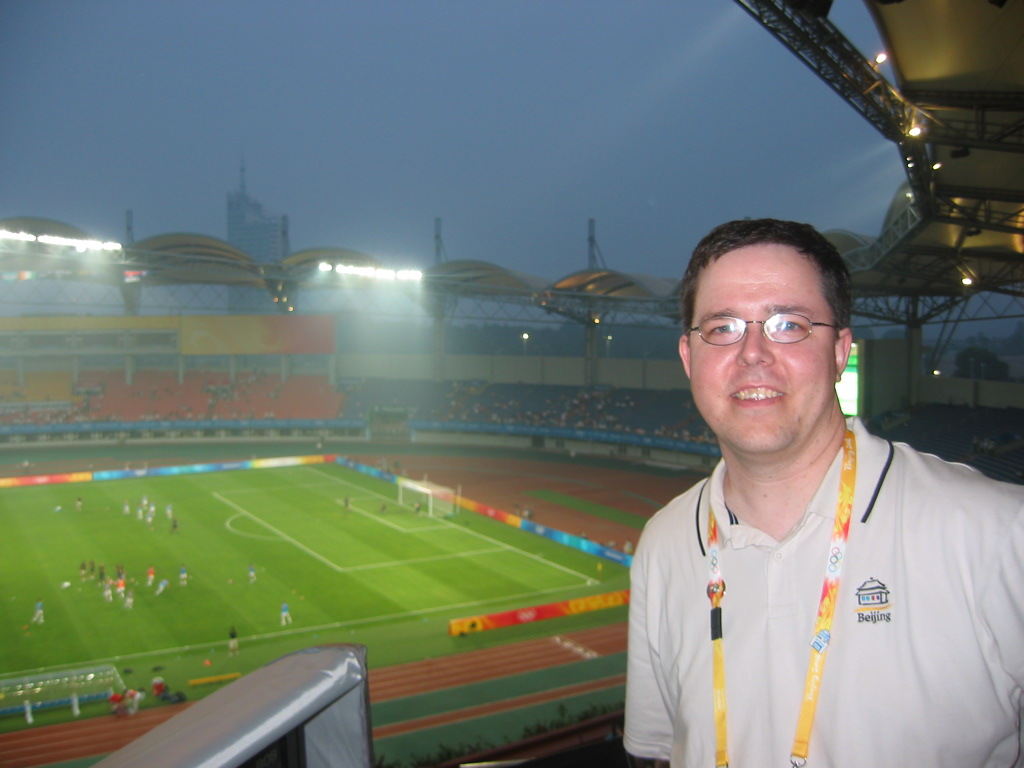
But I enjoyed his company 100% of the time. The memory that has been in my mind today is of traveling at the 2008 Olympics and wandering around a distant stadium a few hours before game time. I have two memorable photos from that day. First, he and I marveled at a bunch of fish in some sort of feeding frenzy.
Second, he took what is, to this day, my favorite photo of myself.
I’m not showing this picture out of vanity. I think he simply composed it perfectly.
After that game, I had the Big Olympics Travel Misadventure that resulted in me taking a standing-room-only overnight train back to Beijing. He, of course, was nestled nicely in a hotel in Qinhuangdao. That was emblematic of the difference between Sports Illustrated and USA TODAY. He also reminded me of the difference in our publications at a media availability later in the Olympics in which he asked me to give him space to do a one-on-one chat with Hope Solo. He was working on a magazine feature-length piece, and USA TODAY was going to give me a tiny space in which to summarize everything.
I would have been mad if not for two things. First, he was right. USA TODAY was still in its milquetoast days, cranking out brief content for hotel-goers nationwide. Second, he was so damn nice. He had gone out of his way to tell me I was one of the people in soccer journalism who knew what I was talking about, praise that I still cherish.
And though his magazine, boasting a formidable 1-2 combo with him and Brian Straus, was more glamorous than USA TODAY, he and I bonded over our status as soccer writers before the “soccer writer” job existed. We had other responsibilities. He was a great basketball writer, too. We had to push for more soccer coverage, not just so we could focus on the sport we loved but because we felt the sport we loved deserved more love.
This may sound like Grumpy Old Man talk here. But this gets to why yesterday’s news is so shocking. Grant wasn’t old. He wasn’t even 50. I’ve written my share of remembrances — my mother (well after the fact, because she didn’t live long enough to see the internet), my father, my dog, my music teacher, Duke’s jazz ensemble director, Duke’s Wind Symphony director (aged 101), etc. I was in tears when I wrote one for my stepmom because she was too young, and I had just attended a memorial service that reminded me what she meant in my hometown.
The only time I’ve written one for someone younger than I am was the one for USA TODAY’s Dave Teeuwen, and that was mostly one anecdote that hopefully captured his spirit a little bit. Dave’s death was tragic but less of a surprise. He had dealt with cancer for several years and had defied his doctors by continuing to live.
The only time I’ve written one for someone whose passing came from out of the blue was for Dan Borislow, whose complexities I attempted to capture. As I said in the opening, I couldn’t make sense of his sudden death, and I still expected him to text me to gripe about the media.
In Grant’s case, I keep thinking that I should send him a message to express my sympathy. I can’t process that the fact that he can’t answer. When my wife came running up to say, “Grant Wahl died,” I heard what she said but couldn’t understand those three words in that order.
I try to make these things positive and uplifting. This one is difficult. I hope I’ve captured a bit of his spirit. As easygoing as he was, he could also be tenacious, as exemplified best in the last days of his life when he stood up to the discrimination and cruelties of Qatar.
As ridiculous as it is to hold a World Cup in Qatar, he couldn’t miss it. But in a just world, he would’ve seen the next one, and the next one and many more after that.
Instead, in all of these World Cups, we’ll be the ones missing out. We’ll be missing him.
With the settlement of the WNT lawsuit (pending CBA) and the upcoming AGM, it’s time to CYA and BYOB and too many abbreviations.
Let’s try that again …
The women’s lawsuit is over as long as they can finish up their contract. Also, the Annual General Meeting is coming up, where the big event will be the alliterative presidential election between Cindy Cone and Carlos Cordeiro, but other orders of business include some intriguing proposals.
How to digest this?
First: Read my Guardian story on the lawsuit settlement and why there’s still a lot to do it. I won’t rest easy until the CBA is signed.
Second: Check out the women’s pay resource page, which has a lot of analysis that gives the lawsuit’s history and an analysis of why the suit was doomed. I’ve added a tl;dr high-level summary.
Next: Dig through the updated financial numbers as best you can. They’ve completely changed the way they report the numbers in the AGM book this year, so I just punted on that part, but you can still compare 990s and Audited Financial Statements for the last … many years.
Observations on those numbers:
There’s a case to be made that the Cindy Cone/Will Wilson cuts were too drastic. Yes, revenues fell by more than 50%. But so did expenses. Funny how that happens when the national teams aren’t playing.
The answer to the “will sponsors pay less in the COVID year?” question is “Yes,” though not as much as you might think. SUM paid $22.2m, down from $30.25m. Nike paid $17.644m, down from $22.65m.
Jurgen Klinsmann is, at least, no longer on the federation’s books. But others such as former executive Brian Remedi got severance packages.
Former CEO Dan Flynn and former WNT coach Jill Ellis are now listed as “ambassadors” making considerable sums of money. Where’s the embassy?
The legal bill in FY 2021 was barely half of the FY 2020 bill. I’m guessing it’s because fewer things were filed. The WNT case had the summary judgment. The NASL case has been on hold like a caller trying to reach the cable company.
One massive line item cut in FY 2021: Travel dropped from $34.1m to $5.2m.
Aside from that, it’s the wrong year to draw any conclusions.
And some notes from the AGM book
The Athletes Council has put forward a bylaw proposal to pay the president $125,000 a year. That has pros and cons, but the primary rationale is that there are only so many people who can do the job for free. Maybe they don’t want to have so many economists running the fed now.
A couple of longtime board members/life members are pushing for stricter term limits.
The UPSL is applying for recognition as a National Affiliate. As far as I can tell, its peer organizations are not, but they might not be in enough states. The UPSL is now in 38 states.
I don’t see non-Para players on the Disability Soccer Committee. It’d be nice to see someone from the MNT or WNT take an interest.
Nicole Barnhart is on a couple of financial committees now.
Becky Sauerbrunn is on the Rules Committee, which reviews the bylaw and policy proposals and comes up with polite ways of saying “you seriously can’t expect this to be passed.”
John O’Brien continues to be the only member of the Sports Medicine committee without “Dr.” in front of his name.
Lori Lindsey and Oguchi Onyewu are co-chairs of the Technical Development committee.
First order of business: It is vitally important that you read my story for The Guardian on Carlos Cordeiro’s surprising candidacy for US Soccer president.
Done? OK, let’s move on …
You read a lot about the Cordeiro record in that piece. To wit …
He failed to assemble a management team and left a void, which may partially explain how the legal brief that forced him to resign got through. You could make a case that the USSF president, an unpaid volunteer, should be more focused on vision-setting than day-to-day work like reading legal briefs. But Cordeiro didn’t delegate well, according to many of my sources, and even if he wanted to, he didn’t have people in place to help out.
His public statements were tone-deaf. When he was vice president, that wasn’t an issue. But the presidency is a public-facing job. Maybe the federation doesn’t want another outspoken person like Sunil Gulati, but the president has to be able to communicate with the masses.
He didn’t settle any part of the lawsuit with the women’s national team. Cone did.
So you may still be wondering why state associations are supporting Cordeiro.
First, let’s give credit where it’s due. State associations train coaches and refs. They run player development programs. They run TOPSoccer for players with disabilities. They maintain lists of suspended coaches and players. All of this is important, and it’s only getting more complicated as other organizations come in with competing programs, the vast majority of which are designed for the “elite.” My experiences with Virginia’s youth association have been overwhelmingly positive, as have my conversations over the years with representatives from other states.
So when they complain that their needs aren’t being met, those complaints deserve a hearing. Whether Cone is hearing them is difficult to judge from afar.
But what I can tell you is that some misinformation is affecting some states’ judgment, and I’m a bit confused in some cases about what the states want.
The states
Grant programs: The Innovate to Grow program is relatively new. It started with $467,303 in FY 2018 and grew to $3m annually.
Dave Guthrie from Indiana Soccer says that program was cut. Cindy Cone says it was redirected to COVID relief and is now back in place.
Either way, one thing to consider is that if sponsors bail, programs like this will be more difficult to fund.
General programming: Spending on players, coaches and referees increased under Cordeiro. But this was planned before Cordeiro took office — in fact, he mentioned it during the 2018 campaign.
CC with a stunner: $150m in reserves will be depleted to about $50m just through existing programs. (!!!???) #PHL18
Development Academy: Guthrie also pointed to the DA as something that was cut with no warning and left states in a lurch. The communication angle of it is worth questioning. Cutting the program — to me, at least — was a no-brainer. It wasn’t working on the girls’ side because the ECNL was already so firmly entrenched, and having a big program for boys without a comparable program for girls … well, that’s not going to fly.
And the DA undercut a lot of other programs and added to a plethora of “national” leagues and tournaments — which, coincidentally, I just wrote about. (Not yet published.)
Voting power: This is a case of misinformation and mistrust, and Alan Rothenberg said he thinks Cordeiro is tapping into resentment over something that was forced by Congress via the US Olympic and Paralympic Committee.
Athletes need to have 33.3% of the vote. Congress still hasn’t updated archaic language referring to national team players as “amateur athletes,” and I have indeed encountered some people who think “amateur” means “over-30 player for the Milwaukee Bavarians” rather than “recently retired women’s national team player” or “Paralympian.” In any other context, yes. In Congress, no.
Let’s run through USOPC bylaws, shall we?
p. 4:
ee) “10 Year Athlete” means an athlete who has represented the United States in a Delegation Event, World Championships, or another event designated by the USOPC (together with the AAC) and the relevant NGB (together with that NGB’s athlete advisory council) as an elite-level event for purposes of this definition, within the previous 10 years; and
ff) “10 Year+ Athlete” means an athlete who has represented the United States in a Delegation Event, World Championships, or another event designated by the USOPC (together with the AAC) and the relevant NGB (together with that NGB’s athlete advisory council) as an elite-level event for purposes of this definition, but not within the previous 10 years.
p. 42
i) Athlete representatives will equal at least 33.3% of all NGB boards of directors, executive Boards, and other governing Boards.
a. At least 20% will be 10 Year Athlete representatives; the remaining will be either 10 Year or 10 Year+ Athlete representatives
p. 2
“Delegation Event” means, individually or collectively as applicable, the Olympic Games, the Olympic Winter Games, the Paralympic Games, the Paralympic Winter Games, the Pan American Games, and the Parapan Am Games;
So there’s no wiggle room to define an “athlete” as you or me (unless you’re a former national teamer, in which case, hi and thanks for reading).
Yes, there’s some squabbling over the remaining 66.7%. For the National Council, the main voting body, the Youth Council, Adult Council and Pro Council were equally whacked, down to 20% each.
Some states would be happy to cut the pros down a bit more. I think that’s a hard case, though you could (and the progressive association in West Virginia did) make a case that the men’s and women’s Division 1 leagues should have an equal share of that vote.
The elephant in the room, frankly, is the Adult Council vote. Barring a Vardy-esque ascension from the UPSL to the national team, no elite-level players will come from this group. Elite players come from the youth ranks, as do the lion’s share of recreational players. Registration revenue from the various youth associations runs roughly five to eight times that of the adult associations.
So why does the Adult Council have an equal vote to the Youth Council? Why don’t state associations have 40% of the vote, allocated to each association (whether youth, adult or combined) according to number of registrants?
But I digress. There are two more quotes from Guthrie I’d like to share:
On whether some issues were more of an issue with the CEO, or lack thereof: “The President of U.S. Soccer sets the vision, the strategy, the plan and the priorities. A lot of members are very frustrated with Cindy because she’s basically ignored us. We don’t seem to be part of her vision. She clearly doesn’t see us as a priority. Just look at how she cut the DA and gutted grants for youth and adults. Even worse, in the debate over the board structure, we were made to feel like we didn’t belong. We deserve a president that includes us, and that’s why we’re backing Carlos.”
On whether sponsors would bail if Cordeiro is elected: “Actually, we should thank Carlos. He was the one who created the Commercial Committee under an independent director, which ultimately recommended that the commercial rights be brought back in-house. That means 2026 will bring huge opportunities for the Federation. We believe that, given his business background, Carlos is the best person to drive our commercial strategy over the coming years. I haven’t heard of a single sponsor getting involved in this election and, frankly, I don’t think it would be appropriate for them to get involved. The decision of who is our president belongs to the voting members. Our Federation is bigger than any one person, and all of us—including Carlos—are focused on one thing: making sure 2026 is a huge success.”
Women’s national team and sexism
Is sexism playing a role here?
It’s difficult to dismiss, especially when states that supported Eric Wynalda and Kyle Martino are suddenly saying USSF needs someone with “business acumen.”
Is resentment toward the WNT playing a role here?
Obviously, no one’s going to say so publicly. Maybe some voters have done the math and are concerned that their programs will suffer more cuts if the federation has to shell out a massive settlement, or they’re concerned that they’re already being cut because the federation has to pay for lawyers to face off against the armada of lawyers the women have assembled.
But this much is clear: The WNT does not hold sway over the rank-and-file of US Soccer. If it did, no one would’ve called Carlos Cordeiro to come back.
The media
Cordeiro has never been at ease with the media. I’ve certainly seen it first-hand. I had to work pretty hard to get comments from him for my story, and I’ve seen complaints elsewhere that he hasn’t talked with other reporters.
That said, I got no response whatsoever from the women’s national team’s players association or a PR rep from an NWSL team. None. We’re talking about people whose job it is to respond to such queries. And this was an opportunity for these people to tee off on Cordeiro. (Or to surprise me and say they suddenly support him.)
Bottom line: People in soccer are getting more and more brazen about choosing sympathetic, unquestioning audiences. It’s one thing to do that when you have deeply personal stories to tell, and you’re more comfortable telling someone who can more directly empathize for reasons of age, gender or any other commonality. It’s another when it’s your job to be held accountable.
Finally, FIFA
Cordeiro touts his relationship with FIFA — he’s FIFA’s senior advisor for global strategy and governance — and how that would help with the World Cup. Rothenberg argues that Cordeiro is essentially FIFA president Gianni Infantino’s right-hand man, and that’s more of a conflict of interest than an asset.
Cone says her priority is wrapping up the selection of host cities, which she expects in the second quarter this year, and then working with those host cities on the goals of growing the game. FIFA is taking a more active role in overall organization of World Cups than it used to, regardless of the host.
I got clarification on one thing from the past post on the Athletes Council (or Athletes’ or Athlete’s, though the last seems incorrect unless you’re talking about one athlete).
Elected/re-elected in 2016 to 2017-21 term (not up for election this time)
Gavin Sibayan (Paralympic)
Brian Ching (MNT)
Brad Guzan (MNT, playing for team as I type)
Stuart Holden (MNT)
John O’Brien (MNT)
Jonathan Spector (MNT)
Lauren Holiday (WNT)
Lori Lindsay (WNT)
Heather O’Reilly (WNT)
Aly Wagner (WNT)
So that’s five MNT, four WNT and one Paralympic.
Running for re-election Chris Ahrens (Paralympic)
Carlos Bocanegra (MNT)
Lindsay Tarpley (WNT)
Nick Perera (Beach)
Not returning (either term-limited, out of 10-year window or, like Jerry Seinfeld, choosing not to run) Shannon Boxx (WNT)
Angela Hucles (WNT)
Leslie Osborne (WNT)
Kate Markgraf (WNT)
Christie Rampone (WNT)
Will John (YNT)
So the WNT might not have half the seats on the Council in the next two years as it did in the past two years. Then again …
Candidates
Sean Boyle (Paralympic)
Kevin Hensley (Paralympic)
Landon Donovan (MNT)
Yael Averbuch (WNT)
Meghan Klingenberg (WNT)
Ali Krieger (WNT)
Samantha Mewis (WNT)
Alex Morgan (WNT)
Alyssa Naeher (WNT)
Becky Sauerbrunn (WNT)
McCall Zerboni (WNT)
Jason Leopoldo (Beach)
So when you add in the candidates for re-election, the breakdown is:
3 Paralympic
2 MNT
9 WNT
2 Beach
The WNT will get at least three seats, even if all seven of the non-WNT candidates win. The possible breakdowns coming out of this election are:
Plenty of overlap with the YNT, of course — almost all MNT/WNT players were on the YNTs at some point, as was Leopoldo.
Note that the election process has no guarantee of diversity. It certainly could end up with 13 WNT players/alumni. Or four Paralympians. The chair and vice chair positions have had an even MNT/WNT/Paralympian split in recent years, but that’s not required.
The Council could be more diverse than it currently is. I found a few examples of people who are eligible from their YNT days (as Will John was). It’d be interesting if the MASL ever joins U.S. Soccer and one of its many players from the futsal national team runs.) Like all aspects of U.S. Soccer, it’s getting more scrutiny. It now has a website and is posting its policies and processes.
The most controversial inclusion, on the current board or the nominees, is Carlos Bocanegra, who’s now in a management position with an MLS team. Ethics hounds would probably have a good argument on whether that’s a conflict of interest.
That said, repeat after me …
The Athletes Council is not a union. It does not negotiate with “management.”
You could argue that Bocanegra isn’t well-placed to represent athletes in his current role — or simply that there are other people better suited to do so.
Just to clarify: I’m not off Twitter because of anything directly affecting me. This is my response to their selective enforcement of hate speech and harassment, and the tipping point is the nonsensical decision to allow Alex Jones to keep posting falsehoods designed to do nothing but turn gullible people into dangerous people.
We’ll see what happens. If they relent and ban Jones, I’ll be back as soon as it happens. Until then, all you’re going to get from me is the occasional automated post showing that I’ve published here and a daily tweet explaining why I’m boycotting.
My FourFourTwo piece from yesterday gave a multi-part plan for rescuing youth soccer from the pit of despair or some other dreary place of your choosing, and it features input from Kyle Martino, Kevin Payne and two U.S. Soccer officials.
The intro:
“Promote a more unified Youth Soccer landscape where our members—rather than fighting each other for players—work together to bring more young people into our ranks as registered players and where we focus on Youth Soccer less as a business and more as a way to develop talent on the field and nurture our next generation of young adults.”
So read the platform of Carlos Cordeiro in his successful campaign for the U.S. Soccer presidency.
Cordeiro has spent the first four months of his presidency traveling the world on behalf of the ultimately successful USA/Canada/Mexico World Cup bid. In the meantime, youth soccer has progressed from a moderate level of chaos to a full-fledged tropical storm mixed with a Nor’easter mixed with Memorial Day beach traffic.
This piece had a long gestation period, but the timing is good. The World Cup bid effort is finished. Now it’s time for Cordeiro to look at the rest of his agenda. His platform has plenty of ideas that look good on paper — I didn’t recall any other candidates arguing against diversity, stronger adult leagues, etc. — but will require some effort to translate into reality.
But with all due respect to the other issues on that platform, youth soccer needs to be his first priority. (The transparency/diversity issues should be addressed concurrently, and other issues certainly shouldn’t be forgotten. Hopefully we can drop the nonsensical idea that Cordeiro’s next priority needs to be rescuing the NASL. We have a functioning Division 1 league and a functioning Division 2 league. If Cordeiro is going to devote a second of his time to any pro league in the next two years, it should be the NWSL. Period.)
One of my goals here is to keep asking questions and providing analysis. The outlets through which I can do so are dwindling. This sort of thing is a little too esoteric for The Athletic — and besides, I need to reach parents.
So I’m going to be working hard over the next few months to build Ranting Soccer Dad into a substantial brand. You can help on Patreon if you like (I’m going to make magnets and T-shirts!), but anything you can do to share my work would be appreciated. Especially if you can share it with parents. Maybe not parents who sit and watch every World Cup game like you do, but any parents looking for a good youth soccer experience.
At some point soon, I need to write about the next contested election. U.S. Youth Soccer holds its Annual General Meeting on July 28, and I know of at least one challenger to incumbent chairman (and USSF Board member) Jesse Harrell.
I have an important message for the “Gang of Six” supporters:
You made a difference. Really. Your choice now is whether you want to follow through or just take to Twitter and whine about the election result.
Having spent 48 wild hours in Orlando, I think people in U.S. Soccer are receptive to change. Maybe not the specific solution you want, maybe not at the pace you want. Maybe not with the fiery rhetoric you want. But they’re open to it.
And yes, that includes the Athletes’ Council. They could’ve done things differently, and I’ll get to that. But you can’t write them off just because they voted for an “establishment” candidate (who has only been VP for two years and was an independent director before that).
I realize this post will seem a little pedantic. While in Orlando, someone with one of the campaigns sent me an angry email saying I act like I know everything. But in that discussion, the only things I needed to know were (A) the hotel layout between the sports bar and the Unicorn meeting room, (B) what Sunil Gulati looks like and (C) what Don Garber looks like. And the things I’ll say here are, frankly, just as obvious as those things. As Edie Brickell sang: I know what I know, if you know what I mean.
I’ll dispsense with the preachy stuff early and then move on to some actual ideas …
1. Drop the nonsense and get educated
This isn’t just directed at Soccer Twitter and the conspiracy theories of doom. Certainly a bunch of bro/rel dudes should spend most of this Lenten season atoning for everything they said about Kathy Carter, Julie Foudy, Chris Ahrens, Carlos Bocanegra, Sunil Gulati, Don Garber, Nipun Chopra, Kyle Martino, Donna Shalala …
Then consider the sheer ignorance of this BigSoccer post on Carlos Cordeiro: “He was the VP under Sunil during the biggest disaster in the history of US Soccer.” You may have 100 legitimate questions and concerns about the new president. Blaming him for the men’s national team World Cup flameout is a flying leap across the giant atrium in the Renaissance hotel.
Some of the campaigns deserve a bit of blame for the cesspool surrounding the election as well. Consider this non-hypothetical: Given the couple of inevitable last-minute changes to state representation, when U.S. Soccer sends out a list with those changes to candidates, do you (A) thank the staffer who had to dig that up and send it out or (B) go on Twitter to put the federation on blast for telling you these things so late in the campaign, as if it’s a conspiracy rather than an additional level of transparency?
And behind a lot of it is the NASL and its legal challenge against U.S. Soccer, a suit for which I didn’t detect a lot of sympathy in Orlando. It’s gone way beyond fussing with Gulati and Garber. They’ve sued most of the board, and by extension, they’ve thumbed their noses at everyone who elected the board. It’s funny, but a bunch of people who’ve spent much of their adult lives volunteering in the sport don’t take too kindly to being sued by someone who bought the New York Cosmos a year ago and now wants to dictate how professional soccer should be run.
The NASL certainly has a big overlap with the more radical (or factually impaired) wing of Soccer Twitter. And what has it gotten them? A bunch of lawsuits and a plan to prop up D2 by bringing up some NPSL teams.
As promised, there’s another way forward …
2. Work with the states
You may not be able to walk into an Eastern New York adult soccer meeting and walk out as Sal Rapaglia’s replacement as president. Other states, best represented in Orlando by West Virginia’s ebullient Dave Laraba, have openly asked for some new blood.
Even if you can’t get onto a state board, try to work with them. Attend their meetings.
You’ll find many of them are receptive. Yes, Carlos Cordeiro and Kathy Carter combined for a little more than 70 percent of the vote. But we know who many of those voters are. The athletes. The Pro Council. U.S. Youth Soccer, which has a handful of organizational votes as well as being the umbrella group for state associations, endorsed Cordeiro.
Take them out, and you have a bunch of state associations who were clearly split all over the place.
And — this may shock some of you — for some of them, Cordeiro is the “change” candidate.
He’s not Sunil Gulati. If you saw the board meeting Friday in Orlando, you saw a president who, for all his accomplishments, didn’t seem too interested in listening. Cordeiro is the opposite. I actually have a hard time picturing him presiding over a National Council meeting, but they’ll figure it out.
(For that matter, Kathy Carter isn’t Sunil Gulati. But the manner in which she entered the election drew a lot of legitimate questions, as did her campaign-killing idea to have Casey Wasserman oversee an “independent” commission despite his agency’s deep ties to so many players. She is a “soccer person” in every sense of the phrase. This just was not the right election for her.)
The states, and perhaps some national organizations, are where you can gain momentum for this …
3. Suggest bylaws and policies
Toward the end of the big meeting Saturday in Orlando, Cal South president Derek Barraza stepped up to the microphone with a reminder for his fellow National Council members: We’re not just here to vote. We’re here to do our duty and make policy.
That’s not just academic. If you’ve read my recaps of meetings gone by, you’ve seen bylaws and policies suggested by various parties and approved by the memberships. Louisiana Soccer Association. Bylaw/policy machine Richard Groff. A task force on professional player registrations. Eastern New York Youth Association (not the adults). Athletes’ Council chair Jon McCullough. A policy from a Transgender Task Force.
You may think people in power aren’t listening to such things. The voting records suggest otherwise. And even the weekend’s symbolic effort to cut registration fees in half (something no right-minded person was going to do just before electing a new president who may have another mandate to use or reduce those fees) wasn’t just spitting into the wind. In the board meeting, Athletes’ Council chair Chris Ahrens asked several good questions about how to proceed on that matter. You can bet this issue will come up again.
So along these lines, let’s try this:
4. Lobby to change the Professional League Standards
It’s safe to say promotion and relegation in the pro leagues is not an issue that moves the masses among the U.S. Soccer membership. They’re not necessarily opposed to it — Kyle Martino had support among states and was one of three finalists for the Athletes’ Council votes — but it’s not their top priority. Frankly, there’s no reason it should be. (For reference, see everything I’ve written on the topic.)
The way to get that going isn’t to elect Eric Wynalda president. It’s not a lawsuit or a grievance, where any “victory” would have us racing to find the correct spelling of “Pyrrhic.” Peter Wilt has the right idea — start building toward pro/rel within the lower divisions. If it catches fire and makes MLS owners realize they should be part of it, great. If not, at least you’ve reinvigorated the lower divisions and given more people more opportunities.
The muted response to NISA suggests to me that what I’ve seen for the last 22 years hasn’t really changed — owners have found it’s a lot simpler and cheaper to run a summer amateur team than it is to run a full-season pro club. But aside from pesky things like “workers comp” and “salaries,” there’s one legitimate obstacle keeping clubs from organizing new D3 leagues: the Pro League Standards.
Standards exist for a reason, of course. U.S. Soccer has an interest in making sure its pro leagues are credible. A $250,000 performance bond to make sure a team can make it through a season is certainly reasonable, as are some (maybe not all) of the requirements on fields, stadiums and staffing. (Can we please drop the “media guide” requirement? Are those still printed?)
The big one is the “individual net worth” requirement. Perhaps a legal or economic authority can explain otherwise, but I’ve never understood why a pro club requires one person to have $10 million. If you have people who can put up the performance bond — perhaps even an increased bond — why would it matter whether the group can find an owner who’s in the top 1 percent?
Can the standards be overturned from within? I think so. At the very least, you can force people to vote yay or nay on the record, which is something you can use in future presidential campaigns and might be more useful than a conspiracy theory.
And there’s one group that really should be interested in such things …
5. Reach out to the Athletes’ Council
This group took a lot of unfair abuse over the past week. First, they were accused of being pawns for Kathy Carter. It was fun to see the conspiracy theorists try to adapt when the athletes announced they were going as a bloc for Cordeiro. It was also fun to see Hope Solo lecture them about not reading bylaws when she demonstrated little grasp of the published election procedures and a few other simple bits of public info. (Again — coaching modules aren’t age-appropriate? Where’d she get that?)
But we still don’t have a good grasp of what issues they were considering. In talking about Cordeiro, they mentioned his experience — which is a legitimate qualification — and Carlos Bocanegra said he felt the candidates’ platforms were similar and vague, which was partially true.
It would be reassuring, though, to hear that the athletes are concerned about the grassroots. Perhaps it’d be nice to hear they’re going to work in concert with states.
And changing the Pro League Standards should be something that would appeal to the athletes. It’s more opportunity, isn’t it?
So look, reformists (genuine reformists, not people who’ve staked their identities on pretending they understand pro/rel while ignorant Americans do not), you have opportunities. One well-connected source told me he thinks we’re going to have fewer unopposed elections down the road.
Change is coming. As it stands now, the federation has voted for incremental change. Maybe if people can push for a few more incremental changes, we’ll be able to look back in a couple of years and see if it all added up to something big.
Paul Caligiuri has kept a low profile through much of this election. He has a Twitter account but uses his tweets economically for things like his Open Letters, including one on NWSL representation.
My second Open Letter to USSF. This concerns the potential unequal voting structure in the upcoming election which… twitter.com/i/web/status/9…— Paul Caligiuri (@PaulCaligiuri20) December 30, 2017
But with a month to go, Caligiuri is stepping forward. He has launched a site with a platform that lists some of the same ideas as other candidates (with eight candidates and general consensus that we need better coaching education and lower costs, it’s hard to avoid overlap) but also some of his unique ideas, such as using high school coaches as additional scouts.
I followed up with a couple of his ideas by email. Here’s the exchange, unedited (he has some idiosyncratic punctuation and capitalization, but I felt he was doing so to emphasize certain points, so I didn’t want to assume I knew what he was intending):
You mention a new curriculum. How would this differ or improve upon the curriculum Claudio Reyna unveiled in 2011? (I never saw much implementation of that curriculum.)
A new curriculum would include new methods. i.e.Implementing a standard Pass and Receive program the moment a player joins soccer. Imagine what a player can do provided he or she is given the proper tools from the beginning. Far too often, a youth player has played 2-3 years, yes years of soccer and still cannot receive or pass the ball properly. If a player can effectively receive and pass a ball, they will begin to explore and do more on the ball. I believe that one implementation alone will help a youth player become more creative.
Standards for Scouting – Training and resources, etc… Working together and utilizing All of our resources.
You mention making men’s and women’s national team salaries equal. As it stands now, Women’s national team players are on salary, while the men’s national team only receives bonuses. Would you put a group of men on salary? Or take away the women’s salaries in favor of higher bonuses?
Firstly, I founded the United States National Team Players – I have a lot of experience in the area. From my recent talks with both the MNT and WNT the issues will be easy to fix, but only by someone that has the right mentality and sensibility to their issues and concerns. There in no other candidate has my talent in this area. It is not about negotiating billion dollar deals or sitting across a corporation in negotiation, these are our players, the product of US Soccer. I have been there, done that and relate to All their concerns and am 100% confident that everyone will be satisfied and our NT’s will be the best we have ever seen. This will never be a distraction again to our players. Period.
x x x
Also, he mentioned that he will be unveiling a full-fledged plan at the USC convention next week.
Caligiuri and the other three candidates who have not yet been on the podcast (Kathy Carter, Carlos Cordeiro and Hope Solo) are still invited to join me, but with time growing short, I would expect to do more email interviews. I might get a podcast out this week, but I don’t expect to be back on a regular schedule until after the Olympics.
No, I’m not going to fact-check every sentence. I’m relatively sure Paul Caligiuri and Eric Wynalda played in Germany.
I’m also not going to try to transcribe the whole thing, though I did find myself summing up pretty much everything. You can find all that at the bottom of this post. The summary of the summary — basically, the most extraordinary things I noticed — is at the top.
And a quick reminder: While transparency could be improved in many aspects of U.S. Soccer, there is a considerable amount of information on its governance page, including bylaws, the policy manual, and (part) of the election procedures.
So here are the surprising/dubious things, then the whole thing.
Disclaimer up front: While this is a fact/reality check steeped in appropriate journalistic skepticism, these people all seem like the sort of person we’d love to see involved with U.S. Soccer. Only one can be president, but I hope the others find a role.
SURPRISING/DUBIOUS THINGS
Paul Caligiuri tossed out the astounding estimate that more than 500,000 kids in Southern California are not part of U.S. Soccer because of pay-to-play. We know he’s not just talking about travel soccer because he suggests a possible solution of “Friday night soccer” pickup games. Seems staggering to suggest 500,000 kids are being missed by every program, particularly the hundreds of clubs with recreational programs that are cheap and usually offer financial aid.
The ever-popular promotion/relegation discussion drew some reasonable takes and some off-the-wall takes. Caligiuri somehow segued into youth futsal. Paul Lapointe suggested piloting pro/rel in top amateur leagues including his own, the UPSL, but most elite amateur leagues have had pro/rel for generations. (And my indoor league. I didn’t get those two championship T-shirts by winning the Upper Division.)
I have a belated follow-up for Mike Winograd about his plan to have a USSF training center in each state. How does this complement the requirement for each state association to have a director of coaching with an A license?
Several candidates imply U.S. Soccer isn’t doing things it most definitely is — overseeing futsal, hiring independent auditors and governance reviewers, etc.
THE WHOLE THING
Joe Cummings, himself a rather good candidate if he had so chosen, moderates the forum and kicks things off at the 11:15 mark of this video:
I’ll continue to give timestamps throughout, and I’ll give the order in which each candidate answers so you can go through and find specific comments. The format is formal, and candidates answer each question in a different, pre-assigned order. Each candidate gets two minutes for the intro and their answers to specific questions, then four minutes for a closing.
Take a moment to applaud GotSoccer and Cummings here — this is done very well.
My comments are in italic.
INTRO (13:30)
Cummings first explains the absentees: Carlos Cordeiro is at a CONCACAF meeting, Sunil Gulati (not yet announced his bid for re-election) is away on U.S. Soccer business (?!!!), and Kyle Martino had vacation plans before he announced his bid. (We’ll hear from Martino soon enough.)
Frankly, it seems clear that Gulati has no interest in appearing alongside other candidates. That might be why he has delayed announcing his intent to run for a final term under USSF’s new term-limit bylaws. He is appearing at functions as the USSF president, not as a candidate.
Or maybe he’s not running.
The order: Lapointe, Caligiuri, Gans, Wynalda, Winograd.
Noteworthy:
Caligiuri went rogue. The intros weren’t supposed to be about the issues, but that’s he discusses. He actually gives more of a personal intro in some of his answers. But he does state here that he was a USSF board member, which I’d forgotten because it wasn’t recent. He served from 2005 to 2007, during which time the board was reduced from 40 to 15. (That may seem sinister to some, but other sports federations have been doing the same thing under guidance/direction from the U.S. Olympic Committee.)
Three candidates — Lapointe, Gans and Winograd — played professional indoor soccer at some point, a bit ironic given that the indoor game isn’t affiliated with USSF right now.
QUESTION 1: Actually two questions — why do you want to be president, and what’s your position on whether the president should be paid? (23:30)
Noteworthy:
Winograd, not for the first or last time, says he is not a “burn it all down” guy.
Caligiuri makes the first of many references to his DNA.
Gans twice says he has “graciously declined” to run for president in the past.
Most candidates don’t give direct answers on paying the president. Winograd says he wouldn’t want to be paid but thinks the next president (not him) should be paid to broaden the pool of qualified candidates. Wynalda sees an advantage to paying the president to make that person more accountable. Gans sees an issue with nonprofit law but doesn’t have time to explain it in full.
Fact/reality check:
Lapointe doesn’t care whether president is paid but thinks it should become a full-time position. This is an interesting point that deserves a bit more attention. One criticism of Sunil Gulati has been that he’s too involved with every phase of the game, and that he should let staff and other board members handle their jobs. Lapointe is going the other direction.
QUESTION 2: What are your thoughts on pay-to-play? (33:30)
Noteworthy:
There’s some discussion here of applying the USSF surplus, but Gans notes that an upcoming question covers that in more detail.
Fact/reality check, in order:
Caligiuri worries that pay-to-play excludes many players. He says “perhaps millions,” then says by his estimate, more than 500,000 kids in Southern California are not part of U.S. Soccer because of pay-to-play. That’s an extraordinary claim. It doesn’t seem verifiable, and I wonder what he means by that. Are there really 500,000 kids who aren’t playing for USSF clubs at all, not even on the generally affordable rec level? He further confuses it by suggesting one answer could be “Friday night soccer” — basically, supervised pickup games. Does Southern California really have 500,000 kids who have no access to anything like this?
Wynalda is paying about $3,300 a year for his 8-year-old. He concludes that it’s too much. For his older daughter, farther up the ladder, he has to pay more. By the time it’s done, people pay more on soccer than they could possibly get back in a college scholarship. That’s certainly true.
Winograd laments the fact that someone finishing up a college career has to spend $1,000 or so to get coaching licenses. Not sure which licenses he means here — the early licenses generally cost less (unless you have to travel), the late licenses generally cost more. Take “$1,000” as a very rough estimate of preliminary costs.
Lapointe says no one’s going to be able to tell independent clubs that they can no longer charge their players. We’ll rate that “true.” He then says he’s the only candidate talking about inner cities and futsal. We’ll rate that “false.” Winograd had just mentioned programs like that. He wants to stop the poaching of players for free, where another club sells a family the Kool-Aid to convince a kid to switch. He wants payments for that.
Gans jokes that all the answers have been made. He agrees with everyone. He says clubs need to be reined in a bit with “Good Housekeeping standards.” We’ve seen some attempts to create club standards, but they’re neither widely known nor universal, so his point is valid.
QUESTION 3: What’s your view on promotion/relegation? (44:30)
Noteworthy:
Lapointe works in the UPSL. Caligiuri coaches in it.
Fact/reality check in order:
Lapointe is the big pro/rel champion here. But it’s hard to conclude that he understands the issue. He starts out saying this has been a big issue for months now, which may surprise the people who’ve been talking about it for years. He says it has not been in our culture, which isn’t really true — amateur leagues have done it as long as I know. He works in the UPSL and touts their pro/rel stance as a fresh start — again, I don’t know that it is. He wants to test pro/rel in UPSL, NPSL, PDL and state organizations — again, a lot of leagues already have it. The USASA lists 13 “elite amateur leagues” — including the UPSL — some of them a century old. At least half of them have pro/rel.
Caligiuri talks about his experience in Germany with teams that went up and down. He mentions the excitement it brings fans and the pressure it brings players. I’ve argued many times before, based in part on conversations with Scandinavian soccer veterans like Brian Dunseth and Bobby Warshaw — pressure depends on the soccer culture, not simply pro/rel.
Caligiuri continues with a strange suggestion about futsal for ages 6-12, suggesting that’s a place we could test pro/rel. Traditional youth leagues already have pro/rel, but they don’t do it at younger ages because they want the focus to be on development, and they worry that coaches under relegation pressure will start playing direct at U8. Ontario youth soccer quit keeping scores and standings — a decision I actually argued against on a Canadian radio show a few years ago. Then he talks about doing pro/rel in USASA leagues — which, again, already exists.
Winograd says he’s going to assume we’re talking about the pro ranks. He says it would be exciting, but as a practical matter, “we’re not there yet.” Franchise fees, contracts, etc. He wants to start building it at the lower leagues, and then he touts his alternative plan to have “guest clubs” in the top division in the near-term. I prefer my system, but he’s reality-based on this point, and he goes on to talk about USSF’s power and limitations. USSF shouldn’t be ramming things down people’s throats, he says in conclusion.
Wynalda believes we are ready, and he points to parachute payments and so forth as a way to make sure clubs are better off financially in the long run. Sort of, but when you see English clubs curtailing their academies, you have to wonder if the long-term picture really is better. If I trusted economists, I’d love to see an economic study on that.
Gans says everyone’s watching the last day of the Premier League not to see who wins the league but to see who goes up or down. Is that a feature or a bug? Then he says the passionate promotion/relegation people have made a really good point, which is that players develop more of a cutting edge in pro/rel systems — again, the Warshaw/Dunseth experience and some common sense would say otherwise. Then he offers his own reality check — he remembers the late 80s and early 90s when everything had fallen apart, and given that, he doesn’t think USSF can simply impose it.
QUESTION 4: What do you think of the nomination process, and please explain the election process. (54:45)
Fact/reality check in order:
Gans gets to go first. That might be coincidence, but it’s appropriate. He was the first candidate to declare, so he’s been laying a lot of the groundwork here. If someone other than Gulati or Cordeiro is elected, that candidate owes Gans a debt. He is concerned that he was not given a list of delegates, which he believes should be freely given by a nonprofit. I don’t know enough about applicable law to know whether that’s true, though I can verify that I also asked for that list and was denied. The election procedures call for candidates to receive this list 120 days before the election, then again (because the delegates may change) 60 and 30 days out. He also points out rules have been changing a bit midstream, which is absolutely true.
Winograd sees a lack of clarity and sophistication, and he says his law firm frequently works with companies on their election process. He says he read the bylaws with help from someone at his law firm, a sign that they’re not really clear. He worries about seeing “blocs” form, especially where votes are heavily weighted as on the Athletes Council. (Indeed, I’ve spoken with someone on the Athletes Council who says they do indeed tend to vote as a bloc so their voice isn’t diluted. That said, I have no idea how you change that. USSF can’t change the rules that give athletes 20% of the vote, and I don’t see how you stop them from voting as a bloc.)
Caligiuri says the election rules are against the Roberts Rules of Order. He doesn’t say how. He cites his board experience and says he understands how the councils (Athletes, Pro, Youth, Adult) work. He cites it as a positive that USSF answers to the U.S. Olympic Committee and the Stevens Act, specifically because it mandates athlete representation.
Wynalda says the rules were built as an attempt to represent everybody but that they ended up being built by one man — Sunil Gulati. He’s critical of the process but doesn’t offer much detail.
Lapointe notes he was told two days ago that an association can rescind a nomination — that was indeed recent news. He isn’t happy that he has only three months between his declaration of intent in September and the deadline to present his three (minimum) nominations in December. That’s an odd complaint. Nothing prevented him from declaring his intent as early as Gans did.
All five candidates correctly described the election process itself in varying detail.
QUESTION 5: What are you going to do with that $100-$150 million surplus? (1:04:45)
Fact/reality check:
Wynalda asks where the money is coming from and gives an astonishingly precise figure — 49% of $94 million is coming from television. Looking at the Form 990 for the year ending March 31, 2015 (not 2016) — there’s a figure of $94.8 million for program service revenue. “Sponsorship and royalties” is $39.7 million of that. In 2016, both numbers increase. I’m not sure where he gets that figure. Then a lot comes from the national teams, and 2018 is going to be an odd year with no major event. He segues into the “registration war” and referees, and I’m not sure I follow. When he visits the podcast, I’ll follow up with him. (You are planning to be on the podcast, right Eric?)
Lapointe says it’s not the Federation’s money — it’s your money (meaning the GotSoccer crowd). “We’re going to give it back to the states and regions,” he says, through coaching education and infrastructure. Then comes a baffling statement: “We don’t have a defined player identification system and a recruiting system thereof.” He wants to allocate those funds to send people out to find players. The USA does have a player identification system — actually, several: the Development Academy, ODP, id2, etc. Does he mean they’re not coordinated?
Gans mentions fields — inner cities, futsal courts, etc. — and pay-to-play. Then opportunities for women — he represented the Boston Breakers at one point.
Winograd says two places: Pay-to-play, not just kids but coaches. Then clearly defining a path to the national team, specifically, training centers in each state — a building with two fields. I should’ve followed up with him on the podcast about this — how does this differ from existing infrastructure? The interesting part is coordination — he wants to have blackout dates for leagues and tournaments, then bring kids into training on those.
Caligiuri wants to keep registration fees with the program that paid them — if you pay $1 to register a youth player, that goes for youth soccer. Same for adult soccer. Then a big proclamation to get all coaches involved: Every high school coach, he says, will be an Olympic Developmental scout. “How many high school players do not participate in your states?” he asks. That surely varies widely by state. In any suburban area, it’s tough to make a high school team if you’re not already on a top travel team. But are we missing some players in rural areas? Frankly, it raises the question of why college coaches aren’t scouting these areas.
QUESTION 6: What would be your plan for the organizational structure of U.S. Soccer? (1:15:15)
Fact/reality check in order:
Gans wonders if the organization is so big that positions need to be split — maybe a general manager of soccer, separate from the CEO. He promises a top-to-bottom review, and as he’s said often, he wants the main office in Chicago to deal more respectfully with the states and other organizations. He’s heard too many stories of disrespect. I’d like to hear some specifics at some point, but does anyone doubt him?
Wynalda cites his dear friend Hank Steinbrecher, the USSF General Secretary through the 1990s, talking about many people arguing for the same thing but opposing each other. He wants to have paid positions to delegate responsibilities (somewhat the opposite of Lapointe).
Caligiuri wants to create a culture. First, fund the Athletes Council and help them understand concerns of other councils. He says this is the only council that isn’t funded. What does this mean? I’m looking into it. And he wants to raise the standards. Second, hire a technical director. Third, look to Silicone Valley. It’s Silicon. (Sorry, pet peeve.)
Winograd sees serious fracturing — overlapping, competing and unclear structures. He says he couldn’t figure out, as a parent, what team is for what. (On a related note: Watch for the Ranting Soccer Dad Guide to Youth Soccer in 2018.) But there’s no one-size-fits-all solution — same solution in one state may not work in another. We already have reps in each state, he says, which again raises the question of how they would function alongside a USSF center in each state.
Lapointe says he’ll peel back the layers. He’ll want an outside firm to take a look, and he’ll want an outside audit. Both of which have been done, repeatedly, as is evident from board minutes. In fact, an outside review (along with the USOC) is why the board dropped from 40 people to 15. Then, he says, we have to remove conflict of interest, which will peel back the layers. He hints that Dan Flynn’s salary as CEO could be split among a couple of people, but we need to peel back those layers. I don’t mean to harp on this, but I have to say again — it sounds like a lot of the information he’s seeking is readily accessible. In some cases, though, it’s not, and there are some layers to peel back.
Quick check of highest-paid USSF employees for year ending March 31, 2016 (according to the Form 990):
QUESTION 7: What would be your process for selecting a men’s national team coach? (1:25:40)
Wynalda says we’re operating under the assumption that the president is the sole selector, which isn’t always true. He says we asked Jurgen Klinsmann to do 3-4 jobs, but the national team coach should do just one — not technical director, not youth development. He thinks we did that with Klinsmann so we could justify his salary. Maybe, but was it also a false belief that Klinsmann would be able to singlehandedly bring Das Reboot to the USA? In any case, he says we need to wait until after the World Cup, then jokes that he skated out of the question.
Gans wants a committee of former players and those involved with the youth game. The latter seems like an awkward reach to the people in the room. Then he talks about the Philadelphia Atoms of the NASL and how their star players took different approaches — some committed, some not. Back to the committee — they would come up with the questions and vetting process, then selection.
Lapointe notes some of the best players in the world aren’t the best coaches or business people. He suggests a director of coaches — “I don’t think there is one in the federation.” The next president, he says, won’t hand-pick the next coach. He wants a coach who leads players into the game rather than just teaching the game. At this level, is a national team coach teaching anything? In the last two World Cup qualifiers, he says, it doesn’t look like the players had leadership and wanted to be there. I’m not going to nit-pick on the second-to-last qualifier, the 4-0 rout over Panama that made us think everything would be OK. The last two qualifiers seared in our memory are the home loss to Costa Rica and … well … the last one.
Caligiuri wonders if it was the national team coach for futsal, beach soccer or the men’s national team, saying we need a coach for all three. Futsal isn’t Keith Tozer any more? He was the coach as of June. And Eddie Soto has been serving as permanent beach soccer coach, though he had to hand the reins to Francis Farberoff for a tournament that conflicted with Soto’s college duties. But, of course, given the World Cup qualifying debacle, he realizes we’re talking about the latter. And that’s about going out and listening to other people’s opinion. Hiring a sporting director or technical director would assist with that, he says. But as president, he would take 100% accountability for that decision. He also points toward looking at coaches at the World Cup, so the next person would likely be interim.
Winograd says this goes to one of the central failings in U.S. Soccer today — decision-making. Whether it’s this or going to birth-year age groups, these are all about the decision-making. We don’t know who made the Klinsmann decisions or how those decisions were made, but we know we need future decisions to be transparent. You have to have a committee with former players, former coaches, business people.
SPECIFIC QUESTIONS FOR EACH CANDIDATE
GotSoccer attendees came up with these.
For Gans: Based on failing to make Olympics and World Cup, what grade would you give the Development Academy and would you continue it? Gans has two kids who’ve been in the DA and sees a lot of positives, but he doesn’t care for the edicts that come down from Chicago, such as the high school prohibition. (“Chicago” has replaced “Washington” as the scapegoat of this political realm, which might not really fit given the dispersed group of people that makes these rules.) He’s seen kids who didn’t even want to play college soccer after playing in the DA because they’ve had the joy sucked out of them and turned into robots. Grade: B-minus.
For Wynalda: What are your expectations for the men’s and women’s national teams? He doesn’t consider finishing 16th in a World Cup to be success, and he doesn’t think we’ve gotten better on the men’s side. We don’t have specialists, he says. He references Gans’ comment on robots and says we need to embrace personality. His expectation is to be a serious contender by 2026, and he thinks we can solve it in eight months rather than eight years. On the women’s side, he says they’ve represented us better than anyone, and staying on top is difficult.
For Winograd: What role should U.S. Soccer play in CONCACAF?What the hell is this question? Winograd gamely gives it a go and says we should take a leading role in getting the respect for CONCACAF that it deserves.
For Lapointe: With so much focus on obtaining college scholarships, how do you intend to influence the college game “in the alignment process”?I don’t understand the last part. Lapointe says the USSF president needs to pick up the phone and call the NCAA because we don’t have a relationship. Not sure what’s he basing that assumption on. Not sure how to prove it one way or the other.
For Caligiuri: What skillsets do you bring that qualify you to lead a national governing body? DNA. Playing experiences. Coaching. Athletes Council and board membership — felt rushed to vote at times and didn’t have complete information. One thing he did on Athletes Council and board — when we have three board members, if it’s a male chair, then it would be a female co-chair. We didn’t have things like that — I learned the Councils can make rules like that on their own.
CLOSING REMARKS
Gans: A recent report gave every candidate a one-word summary, and his was “businessman.” He cringed. He’s a soccer person who became a lawyer.
This is a complex job. It involves someone who has a deep background, leadership, organizational skills, deep business skills, consensus-building, conflict resolution, negotiation. I’m the one candidate that combines all that.
There’s a platform he’ll be disseminating soon. But one of the first things he’ll do (he’s said this on my podcast) is to form a task force to solve the divisiveness in youth soccer. There are two State Cups in Massachusetts. Why? Because sanctioning organizations are fighting. That doesn’t help.
There’s an attrition rate at age 13 that’s higher than other sports. I didn’t find figures to confirm or dispute that statement. On a related note: I’m a little disappointed no one has mentioned Project Play in this forum.
“I have no ties to FIFA. I’m glad to say that.”
Finally, WNT conditions will be evened out right away. Paralympic, futsal and beach will be treated with respect.
Winograd: We have made great strides over the last 20 years, but in a lot of areas, we’ve lagged behind, and there’s an increasing fracture at all levels.
Three key initiatives: First, decision-making must be inclusive, merit-based and transparent.
Second, equality in women’s soccer. He calls this “something we haven’t talked about,” which is mostly true in this forum. He repeats here what he’s said on the podcast — travel and field conditions will be equivalent. If the women want to keep their salary structure, fine, but we’ll still make things equivalent.
Third, reducing cost barriers. Again, not a one size-fits-all solution. Can have competing organizations but there needs to be integration.
Uniquely situated to do this — perseverance, stamina, ability to bring people together and sit and synthesize interests to find a path forward. He’s been doing this throughout his career. You need the business side and the soccer side — I’ve played, I’ve coached.
Caligiuri: Conflict over the years has been promoted in an interesting way. U.S. Club Soccer and U.S. Youth Soccer (not to disregard AYSO and SAY) — those two have Olympic development programs: id2 and ODP. We could reform the Development Academy. Keep those registrations in those national youth organizations rather than channeling them into U.S. Soccer. Waive those fees of $1 per kid. Instead of promoting conflict, we create unity with two organizations that are doing meaningful things and have great volunteers.
We talked about pay-to-play. The Academy has increased it for many. It has narrowed the path for youth soccer players. His plan is broader. Keep your registrations, or everything is going to be run through.
Repeating from opening: “If you don’t want change, then I’m not the right person.”
When he was on board, he asked about girls for Development Academy.
Lapointe: The next president has to have integrity, transparency, honesty and business ethics. I have all five of those. (Yes, I rewound and double-checked. He listed four things, then said he has all five.)
“American soccer is not broken. It needs a reboot. It needs new software.”
“I would rather be knighted or hung on the success of a 3-year-old that puts the ball under their foot for the first time and the parents that go along with that child and the system that they’re going to belong to to make sure it’s proper and to make sure it’s not confusing for them and to make sure they’re on the right path to support the very culture and the very things we’re talking about today.”
He then promises inclusion and equal pay for women. He says he’s also looking at the inclusion of an Open Cup for women. This hasn’t gone over all that well with women’s soccer fans — also there has indeed been an Open Cup in the not-too-distant past, but it suffers from a distinct lack of entries.
He also wants to peel back the layers and remove conflict of interest.
Futsal is near and dear to his heart, and he claims to be the only person to have reached out to AMF and the futsal national team. “We have a national futsal team, and we don’t even sanction the sport in this country.” Multiple problems here — by AMF, does he mean the World Minifootball Federation, the successor to FIFRA (Federacion Internacional de Futbol Rapido)? That’s more small-sided soccer and indoor soccer — now renamed “arena soccer” and under the same general umbrella as the Major Arena Soccer League. It’s not futsal, which is under the governance of U.S. Futsal (USFF) — a USSF affiliate.
OK, let’s try this fact-check again. There IS indeed an AMF — Asociacion Mundial de Futsal — which used to be FIFUSA (the last three letters are NOT United States of America) — that holds its own futsal championships, including the upcoming Women’s World Cup. The rest of the initial check is still correct — there is a WMF (formerly FIFRA) that organizes small-sided and indoor (boards) soccer, and the Major Arena Soccer League (Baltimore Blast, Milwaukee Wave, San Diego Sockers, etc.) is an affiliate. It’s still not quite accurate to say the USSF doesn’t sanction futsal because it includes U.S. Futsal (USFF).
Back to Lapointe’s closing …
I hope I’d be considered to be part of the federation even if I don’t get elected.
Wynalda: A couple of things we don’t have — a clear vision. We’ve been left to our own devices to an extent. We can’t even tell ourselves who we are. It’s not broken. It’s a very unique part of our history that we need to fix it and fix it now. The president’s job is to build a culture that makes sense for all its members, to have an understanding of “who are we? What are we trying to accomplish?”
We’ve been teased. We always say we’re the sport of the future. We can’t rely on an outside sources for Holland or Belgium — YOU know how to do soccer. The federation’s relationship with organizations is the only thing that’s broken. And when we’re fighting with ourselves, how are we supposed to beat the rest of the world.
“They ruled us by fear and then expected us to do great things.”
Commends all these gentlemen (other candidates) on their bravery.
The advantage I have is I understand this game. My job is to help you understand this game.
He doesn’t have the name recognition of Eric Wynalda, he hasn’t been in the U.S. Soccer inner circle like Carlos Cordeiro, and he hasn’t been campaigning as long as Steve Gans. But Mike Winograd is an interesting candidate for the USSF presidency. He’s a former player, he helped launch a pro club, and he’s a lawyer who works on very big deals.
In our conversation (starting around the 10-minute mark after I ranted a bit about the NASL lawsuit and gave an overview of the presidential election), we talk about Winograd’s background and his plans, which he outlined in a prior interview at GotSoccer. His basic mode of operation: He wants to get everyone on the same page — or, as he puts it, rowing in the same direction.
Key quote: “U.S. Soccer should not be in the business of trying to ram things down people’s throats.”
Particular points of interest: How to get the WNT and MNT equal or equivalent, depending on what each team wants (35:00), and addressing cost barriers in youth soccer (40:00).

 Having spent 48 wild hours in Orlando, I think people in U.S. Soccer are receptive to change. Maybe not the specific solution you want, maybe not at the pace you want. Maybe not with the fiery rhetoric you want. But they’re open to it.
 The big one is the “individual net worth” requirement. Perhaps a legal or economic authority can explain otherwise, but I’ve never understood why a pro club requires one person to have $10 million. If you have people who can put up the performance bond — perhaps even an increased bond — why would it matter whether the group can find an owner who’s in the top 1 percent?
 Duresport.com