pro soccer

An analysis of the ramifications of the NASL's antitrust suit

You know that scene in Airplane that’s always cut from the TV broadcast? When Ted Striker says something’s going to hit the fan, the camera cuts to the airport office, and said something does indeed hit the fan?

Yeah. That’s my analysis of the ramifications of the NASL’s antitrust suit. But, because this is how we roll, we’re going to dig deeper.

The lawsuit might not be a bad thing. From the youth soccer mandates to the national team ticket prices, the U.S. soccer (lowercase) community has one major complaint against U.S. Soccer (uppercase):

The Federation has become unspeakably arrogant. 

So this is a shot across the bow of U.S. Soccer, and perhaps it’s well-deserved. Maybe this will force the Federation to take a good hard look at the state of the lower divisions, listen to the people involved and take more of an enlightened leadership role. It’s certainly an ominous sign that at least three of the four current members (and the two USSF staff liaisons) of the Professional League Standards Task Force are lawyers — one of them an attorney for the Federation from 2001 to 2009.

That said … are the people filing this suit really the people who should be leading the revolution?

The NASL (see Part 2 of my pro/rel series, which will resume this week) has always been an oddball. It revived the brand name of a dead league that still holds unofficial world records for rule changes and Bugs Bunny appearances, then posited itself as the paragon of traditional soccer. Among the many ironies at play here — the old NASL never bothered with the U.S. Open Cup, which the current NASL touts as proof of its competitiveness:

I’d like to see a breakdown of that 42%. In any case, the Open Cup semifinals (for that matter, most of the quarterfinals) tend to proceed without NASL involvement.

The last two sentences here are classic Jeffrey Kessler, the lawyer who has been wildly successful in every manner of sports litigation except soccer. (See my entry from when the NASL first floated the antitrust warning two years ago.) They may seem convincing to people who don’t know the U.S. soccer landscape. They’re easily refuted by those who do.

And those who do tend to point out inconvenient facts like this:

https://twitter.com/ktchamberlin/status/910251802754519040

And here’s a final concern: Court cases have generally been very, very bad for soccer. The MLS players lawsuit (again, Kessler involved) drained a lot of resources from a developing league that could’ve been used to put the league on firmer ground, and it was hardly the first time …

Steve also made the point that league-vs.-league competition has been good in many U.S. sports. But it hasn’t been so good in U.S. soccer. Indoor soccer never recovered from the alphabet soup of the 1990s — though it’s still hanging in there (and might take off if someone added an ambitious team like, say, the Cosmos?). The “Soccer Wars” of the late 1920s threw a wrench into the progress of the American Soccer League.

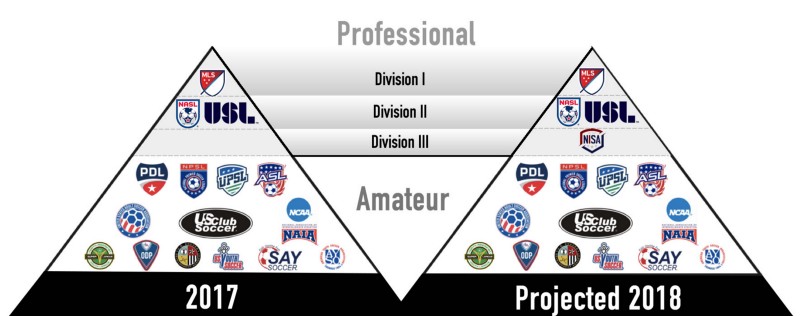
All that said, U.S. Soccer surely could’ve stopped all this. Look back on the Professional League Standards helpfully published by Neil Morris, whose digging on lower-division soccer is invaluable. (Try PDF from Neil’s old site or non-PDF from Kenn Tomasch.) They’re a little overboard. It’s one thing to make sure teams don’t pop up and blow away like dandelion seeds. It’s another to say you can have multiple Division 2 leagues and then make it nearly impossible for two leagues to meet the standards.

To remain in Division 2, the NASL is supposed to have 12 teams. (Someone, probably Neil, pointed out that a Division 1 women’s league has to have at least 10 teams by year four, which means the NWSL currently has no margin for error.) They’re all supposed to have an owner (at least 35% of the club) with an individual net worth of at least $20 million. They have to be in the Eastern, Central and Pacific time zones.

Why? What’s the harm in having a second division that’s 10 teams in the East and Central? Or eight teams in the Pacific? Why one principal owner with at least $20 million to throw around?

Yes, you can get waivers. Expect Kessler to paint those waivers as purely arbitrary. And he may have a point.

In short: This whole mess really could’ve been avoided. Maybe it’s unrealistic to relaunch the NASL and the Cosmos with pretenses of glory. Maybe it’s unrealistic for the Federation to try to solve the problem with implausible standards.

Maybe everyone involved deserves to be involved.


podcast, women's soccer, youth soccer

Podcast, Ep. 9 — Girls’ Development Academy with Travis Clark, plus a soccerpolitical rant

The podcast starts this week with a bit of a political rant. The news on DACA is hard to ignore, and we’ve had some ongoing overheated arguments in the soccer community.

The Travis Clark interview on the Development Academy starts around the 9:25 mark. A few landmarks:

  • Will the NWSL affiliates dominate? (19:45)
  • DA vs. high school (25:00)
  • Can we tame the chaos and still have multiple development pathways? (30:30)
  • A few clubs to watch in the DA (38:45)

podcast, pro soccer

Podcast: Ep 5 — Promotion/relegation with Peter Wilt

For more than a decade, promotion/relegation talk has been the bane of the U.S. soccer community’s existence. It wasn’t going to happen any time soon, and some people reacted to that news by harassing and slandering the people who explained the reasons why.

But now? We have a former Chicago Fire president — Peter Wilt, who has plenty of experience in other soccer leagues and U.S. sports endeavors — writing a manifesto on how we can make it happen, and he’s starting a league with the goal of making it happen.

In other words, the grownups are talking about it now.

Also, I’m doing a survey of lower-division clubs, from Division 2 to Division Not, and I need more replies.

In this week’s podcast, Peter Wilt and I go through history and FIFA statutes (starting around the 5:30 mark), argue the merits of pro/rel (18:15) and talk about what’s changed to make it more likely (31:30).

Quick note: This was recorded before Miami FC and the Kingston Stockade appealed to the Court of Arbitration for Sport to ramp up the pressure on U.S. Soccer to force pro/rel into being, an action I fear will be counterproductive. But perhaps we can talk about that on a future podcast.

Listen away …

https://play.radiopublic.com/ranting-soccer-dad-8QVdvP/ep/s1!ac49849bc440835d7c5c04c6a02f0cfa88678616

podcast, women's soccer

Podcast: Episode 4— Are WoSo players role models? Guest: Jen Cooper

Charles Barkley said he isn’t a role model. Women’s soccer players, though, have typically embraced that role. But does being on a pedestal come with inevitable pitfalls? Jen Cooper, keeper of Keeper Notes and the Mixxed Zone podcast, joins the show to talk about it.

We cover (in rough order; see Podbean for the timestamps): four-letter words, arrests, fan worship, Christie Pearce on divorce and therapy, Abby Wambach’s memoir, collective bargaining propaganda, the fawning mainstream media, 99ers heteronormative “girl next door” marketing, soccer moms, and yes, Hope Solo.

(And here’s the Barkley ad …)

women's soccer

Jill Ellis, the U.S. women and whether a “wrong experiment” exists

Sometime last night, while the U.S. women were losing to Brazil (before the frenetic last 10 minutes yielded an improbable 4–3 win), WoSo Twitter was melting down.

And it wasn’t without reason. I found myself recalling that Tom Sermanni lost his job for far less experimentation than Jill Ellis has been doing in 2017.

But the consensus is that Sermanni was unjustly fired, isn’t it? Wouldn’t we (mostly) agree that it’s a good thing that no block of veteran players is going to grumble every time the lineup changes and force U.S. Soccer to start from scratch?

Some of the concern on Twitter was about this elusive “chemistry” that the team might lose by shifting things around. But we’re still two years from the next World Cup. As it stands now, the players in the best form are Megan Rapinoe and Christen Press. Who’s to say it won’t be Crystal Dunn and Tobin Heath in 2019?

National teams have to experiment at some point. Otherwise, we get situations in which, say, only one goalkeeper and two central defenders have any experience. That’s not good.

Now the question is whether Jill Ellis is choosing the right experiments. She has plenty of time right now, but it’s not unlimited. The team won’t play enough games to try every possible permutation of 40 or so players. The 3–5–2 formation trotted out earlier this year may be best saved for the time the USA would actually use it — trailing late in the game (like last night). We may also wonder why Lindsey Horan is getting a run at forward when we have plenty of evidence that says she’s best as a midfield playmaker, a position the USA has never had in abundance. (Arguably none since Aly Wagner.)

And yes, Becky Sauerbrunn at defensive mid was an odd call. I can see a bit of a case — she hasn’t been flawless in 2017, she could surely do the job, and moving her gives other players an opportunity. But there’s little doubt her best position and the team’s greatest need are in central defense.

Yet the experiments do yield some results. At this point, the clear choice for defensive mid — a position occupied by converted forwards all too often — is Sauerbrunn’s former partner, Julie Ertz. And if you had to pick one forward right now, you’d have to pick Christen Press. We can also conclude that Megan Rapinoe’s run of form in the NWSL is no fluke.

All that said, Ellis may still need to try other people in those positions this year. Players lose form and get hurt. That’s why the U.S. men rarely field a recognizable lineup from one game to the next in friendlies and the Gold Cup group stage.

It’s taken us nearly 20 years to realize a national team needs more than 15 players. Don’t spoil it now!

And let’s be clear — a lot of the failings you saw last night had nothing to do with unfamiliarity. Abby Dahlkemper isn’t sending weak passes back to the keeper because she’s not familiar with her defensive partner. Alex Morgan isn’t failing to spot her passing options because she doesn’t know Press or Dunn. (Maybe playing a bunch of blowouts in Lyon didn’t sharpen Morgan’s form. I’d be tempted to argue that playing in England might have hurt Dunn and Carli Lloyd, but it didn’t hurt the English national team!)

And still — the USA didn’t play that badly last night over the whole 90 minutes. The first Brazilian goal was a shot that Alyssa Naeher saves 99 times out of 100. After consulting with the Laws of the Game and a few refs, I’d say the ref erred in giving an indirect kick for dangerous play instead of a penalty kick when Sauerbrunn took a Holly Holm-style boot to the face — the intent may not have been there, but the Laws do mention “contact,” which obviously was.

Rewind to the 2008 Olympic final. The USA beat Brazil in that game because Hope Solo played out of her mind and Carli Lloyd took a shot that changed her life. The gap between the USA and Brazil has historically not been huge.

If you’d said before last night’s game that the USA would concede a goalkeeping howler, concede a goal on a world-class free kick, be robbed of a penalty kick and see Dunn, Morgan and Mallory Pugh squandering chances, would you have predicted a 4–3 win? Probably not.

So let’s not excuse everything. Maybe spread some of the blame to the players, some of whom are simply not at their best right now for whatever reason.

And we can hope Sauerbrunn stays on the back line from now on. Otherwise, on to the next experiment … (maybe Campbell at keeper? Or Krieger with Sauerbrunn in central defense?)

youth soccer

Youth soccer survey: Happy with your area's leagues?

Parents, coaches, technical directors, administrators, whoever … please let me know what you think. I’ll likely do a story on the results.

(function(t,e,s,c){var n,o,i;t.SMCX=t.SMCX||[],e.getElementById(c)||(n=e.getElementsByTagName(s),o=n[n.length-1],i=e.createElement(s),i.type=”text/javascript”,i.async=!0,i.id=c,i.src=[“https:”===location.protocol?”https://”:”http://”,”widget.surveymonkey.com/collect/website/js/uFF4fQzUbK4fZsqFBqGAy_2BxG70Oc_2F0sddFbNF4hLS8y8cpZ14T8tJgHmpqqLijEw.js”].join(“”),o.parentNode.insertBefore(i,o))})(window,document,”script”,”smcx-sdk”); Create your own user feedback survey

ranting soccer dad, soccer

Youth soccer survey: Happy with your area’s leagues?

Parents, coaches, technical directors, administrators, whoever … please let me know what you think. I’ll likely do a story on the results.

(function(t,e,s,c){var n,o,i;t.SMCX=t.SMCX||[],e.getElementById(c)||(n=e.getElementsByTagName(s),o=n[n.length-1],i=e.createElement(s),i.type=”text/javascript”,i.async=!0,i.id=c,i.src=[“https:”===location.protocol?”https://”:”http://”,”widget.surveymonkey.com/collect/website/js/uFF4fQzUbK4fZsqFBqGAy_2BxG70Oc_2F0sddFbNF4hLS8y8cpZ14T8tJgHmpqqLijEw.js”].join(“”),o.parentNode.insertBefore(i,o))})(window,document,”script”,”smcx-sdk”); Create your own user feedback survey

pro soccer

About this story: How this weekend could shape US Soccer's long-term future

Reminder: I’m off Twitter for a while aside from automated stuff like this. And the next one. And the next one. So if you want to chat with me about this story, why not chat here?

And this one has a bit of a back story, anyway. I’ve been working on this for months. One reason it took so much time is the staggering number of documents I read — financial reports, transcripts from annual general meetings (“Alabama … here … Alaska … here … OK, now the adult associations … Alabama … Alabama … Alaska … here …”) and so on.

Another reason might surprise you: A lot of people weren’t interested in talking. But I didn’t sense that they felt intimidated. They simply didn’t know anything.

I’m grateful that they admitted it. They’re not the Twitter pundits who think they have all the answers on reforming U.S. Soccer but have never even peeked at any of the information the federation puts online. A couple of people had nothing to add to this story but were looking forward to seeing it published.

So there’s a “put up or shut up” element to this story. Sure. If you really want to see some new people in charge, speak up now and over the next four years, because a lot of people may soon be term-limited off the board.

But I also hope it gives people a bit of a peek behind the curtain. Sure, anyone can read the same documents I did and maybe even talk to some of the same people I did, but it takes some time. If you understand U.S. Soccer a little better after reading this, I’ve done my job.

And if you have anything to add now, please do.

It’s an exciting time for soccer. The sport’s profile in this country has completely changed in the past 15 years. So what’s next?

Story: How this weekend could shape US Soccer’s long-term future | Football | The Guardian

soccer

The real controversies of U.S. Soccer in 2016

Eric Wynalda was not the most controversial speaker I saw at the NSCAA Convention this week. That honor goes to AYSO’s Scott Snyder.

Snyder criticized the U.S. Soccer E and D license programs, saying they’re geared toward coaches on a professional track and don’t address the needs of parent coaches, who make up the majority of coaches that work with kids in their formative years under age 12. He pointed fingers at “superclubs” who have tryouts and cut 6-year-olds to fuel big business. He said the Philadelphia Union Academy has hula hoops and other gear to teach kids physical literacy — lessons they should have received around age 5-8 but didn’t because we were too busy coaching them win a bleeping U7 game.

The hammer, which would have echoed through Twitter if Snyder were a Hall of Fame player like Wynalda: Elite players will make it despite our involvement. In other words, players make players. Coaches don’t.

And while we’re trying to make prodigies out of our U7s, we’re driving a lot of them away from the game. Fewer players. And therefore, down the line, fewer elite players.

Add to that the elephant in the Baltimore Convention Center — the change to birth-year age groups. Communication on that topic has been abysmal. U.S. youth leaders simply don’t know what they’re allowed to do. Plenty of clubs’ coaches and technical directors think the change might make sense for the oldest and most competitive levels of youth soccer, but they don’t understand why they have to do it with their U-Littles. (They don’t, but the USSF simply hasn’t broadcast that fact.)

Bottom line: “Elite” coaches have declared war on recreational play. Both sides are guaranteed to lose.

But I covered some of these issues at SoccerWire and will add to that in the next week, and you all want to read more about Wynalda’s session. That’s fine. The point I wanted to make first was that the most pressing issues are not what Wynalda talked about. I’m making you eat your vegetables (youth issues) before getting your dessert (the Wynalda talk).

Before Wynalda started, he and I talked a bit about getting older (we’re close to the same age) and how we care a lot less about what other people think. He also says he’s impatient. He wants to see the USA win a World Cup in his lifetime.

And yet, Wynalda seems more conciliatory and more generous than he came across in the past. He may throw a little bit of red meat to the MLS-bashing fringe on Twitter, but he doesn’t hate the league or those in it. He wants it to be better.

The issue isn’t talent or coaching, he insists. It’s whether players are challenged.

He tells a fun story from his Bundesliga days. After a loss, he made what seemed to be an innocuous joke about his sock. A teammate threw a shoe at him, opening a cut on his face that required stitches. The trainer suggested he go apologize for joking.

So how do we replicate that mentality in MLS? (We’ll assume for sake of argument that we want to — maybe we’d rather see swashbuckling teams that attack all the time and shrug off the occasional 4-3 loss as the season’s going OK.) He says promotion and relegation would help bring that about.

That said, he has a pragmatic streak. He’s not expecting pro/rel to happen tomorrow.

Still, I’d disagree with some of his depictions of pro finances and ambitions in this country. He harped on MLS’s alleged $100 million annual losses (not as frightening as it seems in a 19-team league, and also said in the context of a CBA negotiation, so take it with a grain of salt) and posited that they need to feed the beast with expansion fees. The counterargument: MLS isn’t “losing” money — it’s reinvesting. If they weren’t building facilities, expanding staffs and raising salaries, they’d surely be making money. But they’re doing all those things because they want to keep progressing.

Wynalda also said the lack of promotion crushed the dreams of hundreds of clubs across the country. But most lower-division clubs are there by choice. A couple of clubs have stars in their eyes about how their NPSL membership should grant them the chance to move up the pyramid strictly by merit, ignoring both the difficulties of establishing such a pyramid merely 20 years after top-level pro soccer was dead in this country and the fact that European teams don’t climb to the top without megarich owners in search of a new plaything. (I love the Bournemouth story, too, but does it happen without a Russian petrochemical bigwig? No.)

He has convinced me (and he got the room to applaud my conversion) that MLS should play a fall-to-spring schedule, with the caveat that it should take a long winter break. It could be awkward — the midseason break might end up longer than the break between seasons — but I now think the pros outweigh the cons. Play MLS Cup in June, away from football (which Wynalda, again showing his pragmatic streak, knows will be TV’s big dog for the foreseeable future). Align the transfer windows with Europe.

Now, to be honest, I haven’t really changed. I floated an Apertura/Clausura model with late-spring playoffs back in 2010.

So Wynalda’s session was full of fun discussion threads. I enjoyed it, and I enjoy my Twitter banter with him.

But these are, for the most part, idle discussions. Pro/rel isn’t happening soon.

I do wonder if we can change the culture in MLS to make it more challenging. I don’t think that change has to come from a systemic overhaul. My guess is German teams threw shoes in the locker room generations ago, before the big money rolled in.

And I’m not sure that’s an accurate depiction of MLS locker rooms these days, anyway. When I regularly went to MLS locker rooms in the mid- to late 00s, the losing team’s locker room usually had a dank pall seeping in. Taylor Twellman was not a pleasant person when the Revs lost.

Here’s a story to counter Wynalda’s story: Brian Straus and I were once part of a small group of journalists stuck in the RFK corridor while the Houston Dynamo broke league rules and kept the locker room door shut for about 30 minutes after the game. When we finally got in, Dom Kinnear was pleasantly professional. But a whiteboard behind him had a fresh fist-sized hole in it.

Change comes slowly in MLS, at least after Garber’s first couple of years, when he ditched the shootout, started SUM, etc. The single-entity structure has evolved, but it’s hard to see why it still necessary at all. The last CBA could’ve given players a bit more.

(Incidentally, if you think the NPSL is the answer to your anti-MLS dreams when it comes to league business practices, take a look at this sheet from the NPSL’s booth …)

IMG_1567

So MLS needs watchdogs to prod it along. That’s good. But we have other needs that are more pressing.

Wynalda closed with a comment that drew a rousing ovation, though I’m sure some of the “Klinsmann good, MLS bad” folks on Twitter will be appalled. It’s horrible, he said, to deny kids the opportunity to play high school soccer.

That’s something we can change without asking people to risk even more money than they already have. Maybe we start there?