us soccer

An even deeper dive into U.S. Soccer finances

I went into a rabbit hole and kept digging.

On Dec. 4, The Guardian published my piece on U.S. Soccer and where the money is going. It was essentially a preview of a board meeting that had the potential to shed light on the federation’s five-year plan to spend its assets down to $50m but did not.

I had been working on a spreadsheet rounding up a lot of U.S. Soccer numbers from their public documents — the 990 forms required of nonprofits, Audited Financial Statements, Annual General Meeting reports, etc. I figured I would have it done the day after the piece was published.

I finished it this morning. Dec. 13.

It’s fair to say I have a lot of detail:

  • Revenue and expenses in detail from 2011 forward, with some information from 2001-03 and 2006.
  • Game-by-game estimates for U.S. national team pay dating back to 2010.
  • Attendance and ratings for U.S. national team games

I’ve uploaded all of this to GitHub. If you’d prefer that I make it available some other way, please let me know.

Download away.

podcast, us soccer

Podcast: The introduction to “Why the U.S. Men Will Never Win the World Cup: A Historical and Cultural Reality Check”

The podcast returns after a long absence with a brief autobiography to explain how I became a grumpy old man, I mean, how I arrived at the perspective I have.

Then, 15 minutes into the podcast, I give a dramatic reading of the introductory chapter to the new book.

Buy the book from your favorite booksellers:

us soccer

The Berhalter hire and why I don’t really care

As the press conference announcing Gregg Berhalter as the U.S. men’s soccer head coach started, I was at The Fresh Market pondering ways to introduce farro into my diet. 

After listening to a bit of the press conference on delay on Jason Davis’ show, I went downstairs to play the following songs on drums: 

  • The Weapon – Rush (playing along with live version from Grace Under Pressure tour, complete with the intro from SCTV’s Count Floyd)
  • Green Eyes – Angela Perley and the Howlin’ Moons
  • Texas – Magnapop
  • Falling to Pieces – Faith No More

I played pretty well. Much better than the other day, when I made a complete mess of Love Spreads (Stone Roses) and I Need Some Fine Wine, and You, You Need to Be Nicer (The Cardigans).

OK, OK. I’ll get to soccer. 

The press conference had a few moments of interest. The opaque process of finding a coach was emphatically laid bare, with president Carlos Cordeiro and general manager Earnie Stewart talking about whittling a list of 30 candidates down to three finalists, one of whom opted to go elsewhere. (Tata Martino?) 

Not that it matters. Haters gonna hate. Ambivalents gonna ambivalent. 

The former group is, of course, quite active on Twitter. There’s already a BerhalterOUT Twitter account, followed by the usual disgruntled Twitterati and a disturbing number of MAGA accounts. 

A perfect stocking stuffer from BustedTees.

Prepare for an irony over the Berhalter era, no matter how long it lasts, of a bunch of people who consider themselves experts because they watched a couple of damn Ajax training sessions, all turning up their noses at a guy who actually played many years in the Netherlands and Germany, all starting with the endorsement of Rinus Freaking Michels. If Rinus Freaking Michels recommended you for a career in Europe, please let me know and share all your insights.  

I have no idea whether Berhalter will be a good coach for the national team. His resume is fine. He might be more motivated to turn around the U.S. program than a foreign coach with no ties here — besides, we really shouldn’t be in the mood to repeat the Klinsmann experiment any time soon, and Klinsmann at least had lived here for a while. You could make a good case for Oscar Pareja, and I probably couldn’t argue with you. 

Nor am I particularly aggravated by the presence of Jay Berhalter in U.S. Soccer management. If someone can really connect the dots to undue influence from the federation’s chief marketing officer, please let me know. Sure, perhaps now would be a good time for Jay Berhalter to … I don’t know, replace Kathy Carter at SUM? Work for Nike? Retire, having made more money in U.S. soccer than just about anyone other than David Beckham? The optics could be better, and anything USSF can do to demonstrate a firewall between the Berhalters would be a good idea. 

But perhaps the most notable part of the press conference is that it contained quite a few questions and answers about tactics and style. We’re obsessed with such things, even though Bruce Arena engineered one of the biggest wins in U.S. history by changing things up for the 2002 World Cup game against Mexico, thanks in part to his faith in a defender named … you guessed it … Gregg Berhalter, who is quoted as such in an oral history of the game: “This is a team that had never played that system before.”

In particular, Soccer Twitter seems pleased with this exchange between Alexi Lalas and the new coach: 

For further reading both on the Dutch-style tactics and the Habsburg-esque family entanglements, may I recommend Kim McCauley at SBNation.

After all that, why do I have such a blasé attitude about the Berhalter hire? 

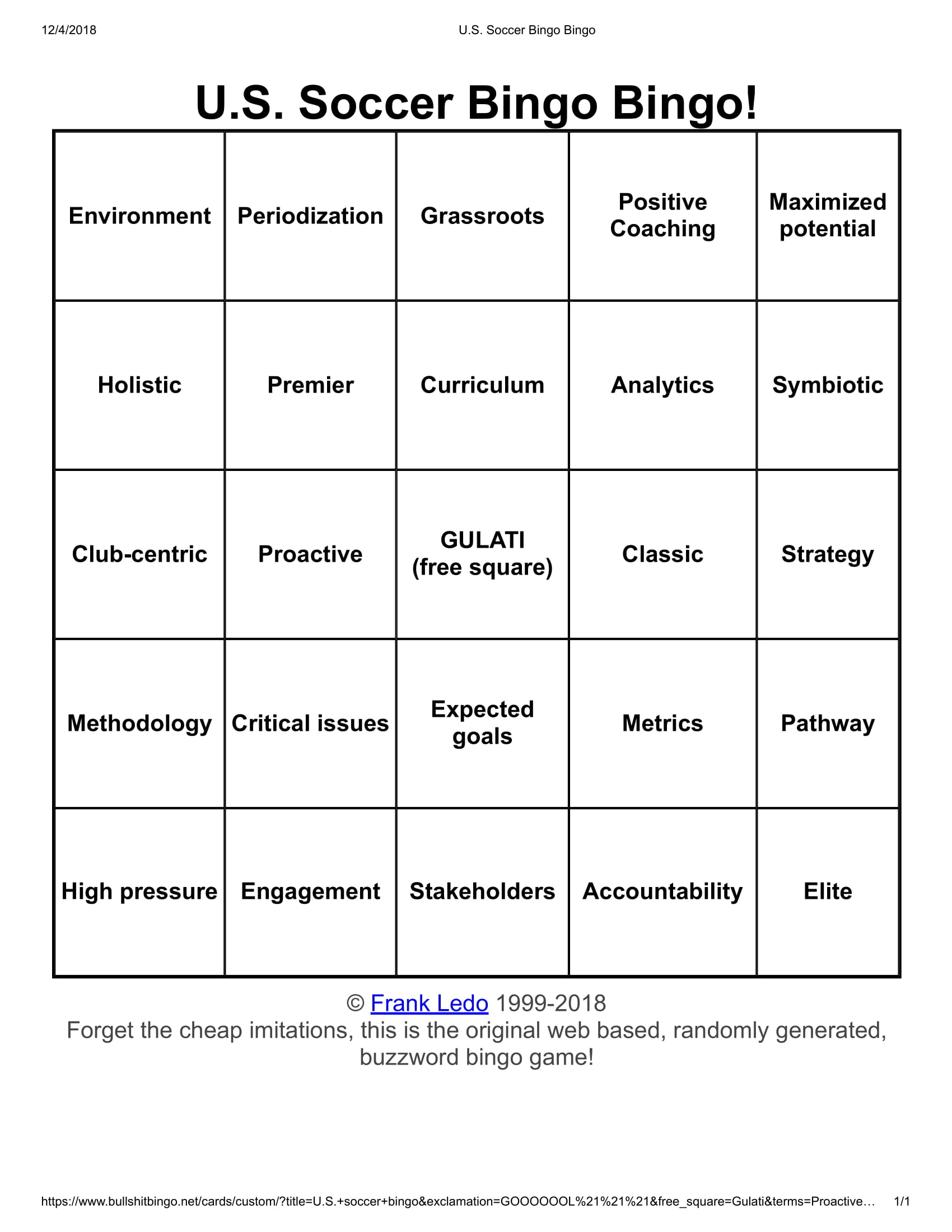
Simple. I’m working on a book now that gets into a lot of the problems in U.S. soccer (lowercase s), some of which can be solved and some of which cannot. Not one of them can be solved by the men’s national team coach. Not Berhalter, not Klinsmann, not Arena, not Pareja, not Martino, not Lopetegui. Not even Klopp.

I kept listening to Jason Davis and company after the Berhalter wrap, and he had an interview with Julie Foudy that illustrated some of those problems. We don’t have a U.S. women’s general manager. We don’t have an NWSL commissioner. (I have a good nominee — just email me.)

And we have a lot of bureaucrats. 

Meanwhile, we have families that can’t afford the money or time needed to play high-level youth soccer. We have coaches who can’t get the education they need. We have leagues and organizations that can’t stop fighting with each other. We have coaches and pundits whose entire identity is based on doing what the majority of people in U.S. soccer are not — if the Federation didn’t jump off a cliff, they would. We have deep currents of distrust — some justified, some not.

Good luck to Gregg Berhalter as he attempts to find the 30-40 best U.S.-eligible players that can get the team to the World Cup (assuming it’s still held in 2022) and make a halfway decent showing. He might actually have an easier job than Carlos Cordeiro, and he’s getting paid for it.

us soccer

Should men’s and women’s national teams start playing “B” games?

Two bits of news, ICYMI:

  • CONCACAF will play along with the global effort to have a “Nations League,” a promotion/relegation competition that basically replaces friendly games.
  • The U.S. men played in Portugal with a bunch of young players, earning a 1-1 draw and stirring up a bit of optimism for the future.

Take the second part first because it applies to a long debate in women’s soccer. The U.S. women have long been accused of having a stale player pool, giving few opportunities for players to gain experience. (This topic was one of my first pieces for The Guardian.)

Things have changed a little bit. The new collective bargaining agreement isn’t public, but it’s apparent that some of the restrictions previous coaches faced in calling in new players have been eased.

Still, it’s hard to imagine a U.S. women’s team like the men’s team we saw in Portugal. Here’s a rough attempt to come up with such a roster. You’ll see the men’s players first, with their ages, clubs and number of caps (thank you, Soccer America), and then I’ll try to come up with their female analogues. Some of them are inexact (I really had to mix up specific midfield roles).

GK: Ethan Horvath (22, Club Brugge/BEL, 2). Jane Campbell (22, Houston, 2)

GK: Bill Hamid (26, FC Midtjylland/DEN, 3). Yes, two goalkeepers in one game. Hamid has just moved from D.C. United, where he came up through the academy.  Adrianna Franch (27, Portland, 0)

RB: DeAndre Yedlin (24, Newcastle United/ENG, 49). This is a tough one. Yedlin is well beyond the “prospect” stage, having already played in a World Cup. He’s not on the way out, like (don’t shoot the messenger) Ali Krieger. Let’s say Kelley O’Hara (29, Sky Blue, 104)

CB: Matt Miazga (22, Vitesse/NED, 4). Emily Sonnett (23, Portland, 12)

CB: John Brooks (24, Wolfsburg/GER, 33). Like Yedlin, he has already played in a World Cup, so this is a tough one. Since we went with an experienced right back, let’s take a less experienced center back who’s closer to Brooks’ age: Abby Dahlkemper (24, N.C. Courage, 13)

CB: Cameron Carter-Vickers (19, Sheffield United/ENG, 1). Tierna Davidson (19, Stanford, 0)

LB: Eric Lichaj (29, Nottingham Forest/ENG, 14). Jaelene Hinkle (24, N.C. Courage, 8)

LB: Jorge Villafana (28, Santos Laguna/MEX, 15). Lauren Barnes (28, Seattle, 0)

RM: Tyler Adams (18, New York Red Bulls, 1). Jaelin Howell (17, Real Colorado, 0)

DM: Danny Williams (28, Huddersfield Town/ENG, 23). Allie Long (30, Portland, 33)

LM: Kellyn Acosta (22, FC Dallas, 17). Lindsey Horan (23, Portland, 43)

LM: Lynden Gooch (21, Sunderland/ENG, 2). Christina Gibbons (22, Kansas … um … Utah?, 0)

AM: Weston McKennie (19, Schalke/GER, 1). Brianna Pinto (17, CASL Elite, 0)

AM: Alejandro Bedoya (30, Philadelphia, 66). Kristie Mewis (26, Houston, 15)

F: Juan Agudelo (24, New England, 27). Crystal Dunn (25, Chelsea/ENG, 57)

F: C.J. Sapong (28, Philadelphia, 3). Jessica McDonald (29, N.C. Courage, 1)

F: Dom Dwyer (27, Orlando, 4). Kealia Ohai (25, Houston, 3)

So that’s a WNT without Naeher, Sauerbrunn, Ertz, Lloyd, Morgan, Rapinoe, Heath, Leroux or Press. (Also, oddly, without Mallory Pugh or Andi Sullivan — I simply didn’t find the proper place for them, though I would fully expect to see them in a “youth movement” lineup.)

Would we like to see that? The U.S. women don’t play many friendlies like that. In fact, none.

But pretty soon, the U.S. men also might not have that chance. The Nations League may wipe out available slots for friendlies. Every game may count for something, so experiment at your own risk.

Incidentally, someone asked about a Nations League for women. Can you imagine the U.S. women going to play on a bumpy, overgrown field in Trinidad or the artificial turf in Saprissa? Those are the stadiums they roll out for men’s World Cup qualifiers — can you imagine where they might put a women’s Nations League game?

So how will the national teams develop players?

Perhaps it’s time to bring back an old idea — the national “B” team. The USA-Portugal game might be a great example, and if you can’t do it in a friendly ….
podcast, youth soccer

How do we raise soft, tattooed millionaires? Alexi Lalas on RSD

Alexi Lalas is a Soccer Hall of Famer. He’s also an entertainer, with interests in music as well as riling people up from a soccer broadcast studio. So when he rips the U.S. men’s national team as “soft, tattooed millionaires,” he’s drawing on both backgrounds.

In our conversation, Lalas explains that “tattooed millionaires” came from a solo release by Iron Maiden lead singer Bruce Dickinson (no, not the “More Cowbell” guy on SNL), and then we talk about whether everything from the now-defunct Bradenton residency program to the Development Academy is giving us a generation of coddled, entitled men’s soccer players.

We also talk about specialization, playing in multiple soccer environments (i.e., not just in the Development Academy), high school/college soccer, the Apollo Theater, diversity of playing styles, Michael Bradley’s understanding of livestock, and Brad Friedel playing basketball.

pro soccer, women's soccer

Attendance check: Club over country?

Attendance at last five Atlanta United home games:

July 4: 44,974
July 29: 45,006
Sept. 10: 45,314 (first game in new stadium)
Sept. 13: 42,511
Sept. 16: 70,425

Attendance at last five Seattle Sounders home games:

July 23: 43,528
Aug. 12: 43,350
Aug. 20: 40,312
Aug. 27: 51,796
Sept. 10: 44,697

Attendance at last five U.S. men’s national team home games:

July 15: 27,934 (Gold Cup; Cleveland)
July 19: 31,615 (Gold Cup quarterfinal; Philadelphia)
July 22: 45,516 (Gold Cup semifinal; Arlington, Texas)
July 26: 63,032 (Gold Cup final; Santa Clara, Calif.)
Sept. 1: 26,500 (World Cup qualifier; Harrison, N.J. — sellout and a loss)

Attendance at last five U.S. men’s national team home friendlies:

Oct. 11: 9,012 (Washington)
Jan. 29: 20,079 (San Diego)
Feb. 3: 17,903 (Chattanooga, Tenn.)
June 3: 17,315 (Sandy, Utah)
July 1: 28,754 (Hartford, Ct.)

Attendance at last five FC Cincinnati (USL) home games:

July 29: 23,548
Aug. 5: 25,308
Aug. 23: 20,058
Sept. 2: 22,643
Sept. 16: 30,417

Attendance at last five U.S. women’s national team home games:

April 9: 11,347 (friendly; Houston)
July 27: 15,748 (Tournament of Nations; Seattle)
July 30: 21,096 (Tournament of Nations; San Diego)
Aug. 3: 23,161 (Tournament of Nations; Carson, Calif.)
Sept. 15: 17,301 (friendly; Commerce City, Colo.)

Attendance at last five Portland Thorns home games:

June 28: 16,199
July 15: 16,804
July 22: 18,478
Aug. 5: 18,243
Aug. 19: 19,672

What’s going on here? Do we officially care more about club soccer than international games? How can the Thorns outdraw the women’s national team? How can Atlanta, Seattle and Cincinnati outdraw men’s friendlies?


soccer

We’ve won over the English

Brilliant read from the Telegraph celebrates Tim Howard, U.S. fandom, Clint Dempsey’s goals, Michael Bradley’s distance covered, and the USA’s knack for making World Cup games interesting …

Setting aside the 1-0 defeat to Germany, they were all belters. Edging out Ghana late on, succumbing to a Portugal equaliser even later on, and a deranged attempt to upset Belgium with only the power of hard work and Gatorade.

via 33 reasons why we love the US men’s soccer team.

And it’s true. Miserable flop or wild ride, the USA does not do boring.

2002: Stunning first-half rout of Portugal, surviving the South Korean tempest, referee robbery against Poland (but advancing anyway), dos a cero, denied by KAHHHHNNN against Germany.

2006: The Italy game alone: McBride’s bloody face, 10v9, a game-winner unluckily (though correctly) waved off. Then the Reyna injury curse striking at the worst possible time against Ghana.

2010: 1-1 vs. England, Coulibalied against Slovenia, ALGERIA!!, extra time against Ghana.

Not a world champion, not always in the knockout stages. Never dull.

soccer

U.S. men’s soccer: Progress report

After a full USA World Cup campaign that exceeded my expectations, I’m still on the fence about Jurgen Klinsmann.

Strange thing to say, I know, especially while the country is still exhaling from a game that could hardly have been more dramatic unless it had actually gone to PKs. The USA bent but didn’t break for 92 minutes. They broke, only to come back with a fire that belied the fact that they had been through the World Cup’s most brutal schedule in terms of miles traveled and teams played.

And someone wanted to question their fitness? Sure, we need to talk the hamstring injuries, but was fitness the question?

I’d argue the other way. Watch the replays and see DaMarcus Beasley still sprinting in vain to catch up on Belgium’s first goal. See how often Michael Bradley raced back to recover.

The issue isn’t the ground they covered. The issue is that they had to cover so much ground. They ran their way into America’s hearts.

So the reason I’m still on the fence is simple: Nearly three years into The Klinsmann Experiment, what we saw in this World Cup was a quintessentially American team.

We’re singing the praises today of the Americans’ heart, resilience and determination. It’s as true of the German contingent as it is of the old guard. Bradley and Jermaine Jones alike left everything on the field.

We didn’t see tactical and technical brilliance, except perhaps in the middle 80 minutes of the Portugal game. We saw a team that was overrun on the wings and in the center of the field.

I don’t think for a minute that the Klinsmann game plan consisted of allowing Belgium nearly 40 shots. I don’t think the U.S. players were technically good enough to stop that from happening, at least not in the formation and lineup they were playing.

They did, at least, limit the damage — among those 39 shots were a lot of hopeful and hopeless blasts from long range, shots right at Tim Howard from impossible angles, or shots that were rushed by persistent defenders. Then when the big shots came, Howard was there.

But when you’re charting the progress of the USA over the 24 years of its modern history (that is, the era of qualifying for World Cups), you have to wonder — would a lineup of Tab Ramos, Thomas Dooley, Mike Sorber and John Harkes have allowed 39 shots against Belgium? Probably not.

And yet I refuse to believe the talent pool has gone backwards. It’s certainly deeper than it was — we’ve gone from “I can’t believe so-and-so is going to the World Cup” to “I can’t believe so-and-so is not going to the World Cup.” The players we doubted — DeAndre Yedlin, Julian Green, John Anthony Brooks — all contributed.

Howard, Omar Gonzalez, Matt Besler and DaMarcus Beasley had legendary defensive performances. Yedlin was more of a Roberto Carlos model defender — fantastic moments going forward, a couple of nice defensive plays in midfield, but then he was caught upfield in extra time.

The midfield was curious. The FourFourTwo/Opta stats engine and WhoScored.com tell me that from a statistical point of view, Geoff Cameron and Alejandro Bedoya had good games. Most observers would argue that Kyle Beckerman and someone other than Bedoya would have been improvements. (The engines offer no such defense of Graham Zusi, who simply wasn’t at his best today, or Jermaine Jones, who had better games in this Cup.)

The USA’s most accomplished field players of the past two years are Michael Bradley and Clint Dempsey. You’d have to say Dempsey had a good tournament, but he was starved for service today — one of Matthew Doyle’s excellent insights is that Dempsey was so busy coming back to help out in midfield that he could hardly pose an offensive threat. Bradley was such a fulcrum that his errors were magnified — he surely had the most giveaways, but he touched the ball more than the rest of the team.

Busy guy

So we have a couple of questions for Klinsmann:

1. Why leave Dempsey out there alone for so much of the game? And when he went to the bench, why Wondolowski rather than someone with more of a playmaking mentality? (Mix Diskerud?)

2. After seeing Bedoya and others demonstrate no capacity for turning around a game, now do you regret leaving Landon Donovan back in L.A.? (Yes, I’ll ask it — it is and should be a question we ask about this tournament.)

But Klinsmann got results — probably the best results anyone would have reasonably expected with the team that he had and the draw that he had. Think back a month ago — if someone had told you this team would beat Ghana 2-1, draw Portugal 2-2, lose 1-0 to Germany and take Belgium to extra time, you probably would have written them off a delusional fanboys. They also took it to Portugal in every sense.

And I’ll disagree, slightly, with those who saw the attack at the end of the Belgium game and wondered where that was all game. No one attacks like that all game — not even Belgium in this game.

The longer-term questions of the Klinsmann era will take longer to assess. He’s supposed to change the culture, and that won’t happen in three years.

That’s actually the part that puzzles me most. Claudio Reyna unveiled a new youth soccer curriculum a couple of months before Klinsmann came on board. The curriculum and Klinsmann both point the USA toward a more sophisticated style of play. You know — Barcelona. Yet the U.S.-bred youngster who had the most impact in this tournament, DeAndre Yedlin, is about as classically English-by-way-of-college as you can get. He’s fast, he gets down the wing, and he whips in crosses. It’s hard to judge the U.S. youth teams because they’ve developed a strange habit of not qualifying for major tournaments. Barcelona still seems as far away as it ever was.

But Klinsmann is and has long been more “American” than most people realize. He certainly cussed out the fourth official like an American when he held up the sign for only one f’ing minute of stoppage time.

And Klinsmann has always appreciated the American spirit. Perhaps after this tournament, he understands it more than ever.

So now, maybe, he knows what he needs to do next.

soccer

USA: An opportunity to cherish

Today’s World Cup knockout game against Belgium is the reward for years of suffering and patience.

FIFA likes to pitch the World Cup as a tournament for every team in the world. The qualifiers aren’t really qualifiers. They’re part of the tournament. The field of 32 is in the World Cup finals.

For a country like American Samoa, as chronicled in the must-see film Next Goal Wins, any game with “World Cup” in the name is a wonderful event. But for the United States, qualifiers are anything but festive. They’re painful experiences that fans watch between the fingers over their eyes. The relationship between fans and the team through the qualifying process is deep and yet fragile. “We love you,” fans will say, “but in the name of Joe Gaetjens and Earnie Stewart, do not lose this game!”

Nor are qualifiers routine. The fretting over England missing the group stage for the first time in eons left out one important historical note — England didn’t qualify for USA 1994 at all. And that was a team that had come within penalty kicks of making the final (the two-team final, not the 24-team final) in 1990.

That’ll happen to the USA one day. It nearly happened to Mexico this time around, and you saw in this tournament the kind of soccer Mexico is capable of playing.

At this moment, we’re well past all that. The roller-coaster of qualifying is forgotten for now. And the USA slogged its way through the Group of Death with one exhibition of resilience and spirit, one truly outstanding performance, and one weary last stand. This team has met every reasonable expectation anyone could have.

And now, this team is ideally placed. No burden of being the favorite. It’s the classic American underdog story with the added incentive of knowing that the upset is there for the taking. The USA may be the No. 2 team in this matchup with Belgium, but they’re No. 2 with a bullet. No one expects the USA to win this game (though I’m sure Michael Bradley would say otherwise), but everyone thinks it’s possible.

In so many U.S. games, both men’s and women’s, we have often feared that the team is playing for the future of the sport. Women’s soccer fans don’t want to think about where the sport would be if Megan Rapinoe hadn’t hit the perfect cross for Abby Wambach’s perfect finish three summers ago in a quarterfinal in Dresden, much less what would have happened without Alex Morgan and Amy Rodriguez’s goals to dispatch Italy in a last-ditch qualifier the year before. The men have had countless qualifying dramas through the years.

This year, soccer’s naysayers could hardly have faced a more emphatic rebuttal. The ratings are astronomical, and they don’t include the big public gatherings. Celebrity fans have emerged from every corner. The trolls are left with the argument that MLS doesn’t bring in all these fans, as if the people who spread out food for the Super Bowl watch every NFL game or the people who watch the World Series spend every weeknight riveted to a Diamondbacks-Marlins matchup. And they forget soccer’s diversity — MLS is part of a grand landscape that includes the Premier League, the Champions League, Mexican soccer, La Liga, the Bundesliga, Serie A, the NWSL and local teams all over the map.

Today, all those fans are gathering to watch and celebrate. They’re going without Belgian food and drink for a day with a little laugh. They’re cheering in public spaces both real and virtual. They’re defiantly chanting their belief, even if their brains tell them Belgium’s the favorite.

No one’s fearing a loss. The country is imagining what happens if the USA wins.

Just imagine …

soccer

Diamonds are the USMNT’s best friend

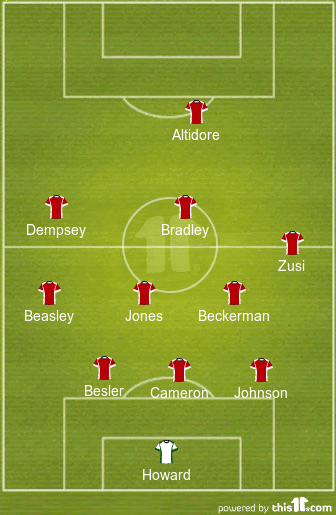
Can anyone make sense of the new diamond midfield that’s really more of a parallelogram? Today, Zonal Marking and MLSSoccer.com’s Central Winger gave it a try.

With the fullbacks spending so much time on offense, maybe it’s the old W-M formation:

football formations

Or not — Jones may be nominally the left mid but is more of a destroyer. Like so.

football formations

That doesn’t seem right, does it? Maybe move Beasley farther up the field and shift the defense to cover that space. Have Beasley link up with Dempsey on the left, like so:

football formations

You could call that a 3-3-1-2-1, but the midfield roles should be fluid. So for sake of simplicity, we’ll call it … uh … we’ll call it …

… oh no …

A 3-6-1! RUN!

(repeat to yourself: tactics don’t matter … tactics don’t matter … tactics don’t matter …)