us soccer, youth soccer

Freddy Adu’s next chapter will be worth reading

Remember when U.S. men’s soccer was so full of hope?

You don’t? Watch this …

That ad is so much better than the ads we see for the U.S. women’s team today. The field-level ad isn’t bad, but so much of it is over-the-top hero worship. If we keep putting the women on pedestals and exalt them as flawless, we can’t be too surprised when critics pounce on any crack in that facade. (And then we prolong the discussion by claiming that the criticism is sexist, even though it’s not the least bit inconsistent with what we see in men’s sports, and it’s painfully ironic that the knowledgeable women who question the narrative are bullied worse than people who speak up about women’s soccer pay. You’ve read this, right?)

(Also, the band that provided the soundtrack for that ad is an indie duo called Joy Zipper, and the NYT writeup of their wedding is cute.)

But this isn’t a rant about advertising. The focus here is the young man who pops up at the 44-second mark to do some stepovers, flip the ball up and smash a volley into the net.

He’s Freddy Adu, one of the most talented young players this country has ever seen.

No, really …

No, really …

No, really.

One of the disappointments in the soccer media of the last 10 years has been that no one ever quite captured the story of how Adu plummeted from such heights to where he stands today, unable to stick with a second-division U.S. team.

Until now. See the ESPN story by Bruce Schoenfeld, who not only landed a rare interview with Adu himself but chatted with people who’ve known him at the beginning and the (almost certain) end of his playing career.

For the latter point, the definitive comment comes from the ever-candid Eric Wynalda, who took over the USL’s Las Vegas Lights team and declined to invite Adu for another season with the team.

The reason that Freddy’s not here now, there are six or seven guys getting their first chance or their second chance. He’s on his fourth or fifth. It’s their turn, not his.

Wynalda and Isidro Sanchez, son of the legendary manager Chelis and temporary coach at Las Vegas last year, also put into words what others have not. Adu’s skill was as good as anyone’s. His work ethic was not. By this point in his career, he simply won’t be able to do the work he didn’t do when he was younger.

One problem is that, despite a couple of ludicrous scouting reports to the contrary, he was never fast. He could create space with a deft touch and beat a defender that way. He was never going to run past a typical professional defender.
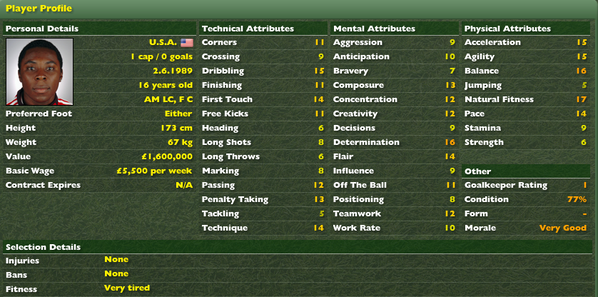
What were the makers of Football Manager looking at?

Adu also suffered from bad advice and a string of bad luck with his club teams. At D.C. United, Peter Nowak was widely considered to be the perfect coach for a prodigy, but his mismanagement peaked in the 2006 playoffs. With United trailing New England 1-0, Adu was the best attacking force United had on the field. Nowak pulled him in the 65th minute in favor of Matias Donnet, who contributed absolutely nothing. A little while later, Christian Gomez cramped up — an accomplishment on a cool fall day — leaving only Ben Olsen to inspire the attack through sheer force of will. (Yes, this is all in my book. The first one.)

On Adu went to Real Salt Lake, which was always going to be a brief stop on his way to Europe. He wound up at storied Portuguese club Benfica, which turned out to be a mess.

Then it was Monaco’s turn to mess up, spurred by Franco-American club president Jerome de Bontin’s proclamation that Adu could represent U.S. soccer in France the way Greg LeMond represented U.S. cycling. That’s a lot of pressure to put on a player the coaches didn’t even seem to want. A whirlwind tour of Europe akin to something Chevy Chase did in the movies followed.

At this point, Adu got a lifeline. He came back to MLS to play for Philadelphia. And he wasn’t bad. Had he embraced the shot to be an above-average MLS starter at this point, he could have spent the rest of his 20s as a productive professional player.

Instead, he embarked on another round of globe-trotting and another return to the USA. The player who was a strong MLS player in his teens was a mediocre USL player in his 20s.

So why is this a story of optimism? Let’s go back to the ESPN story.

Adu believes that several of the players at Next Level have significant potential. He knows now, though, that potential only sets the starting line. “Growing up, I was always the best player,” he said. “Guys who were way below me at the time, you’d say right now had better careers than I did.”

If he’d had a Freddy Adu working with him, an elite-level player there to explain what it meant to succeed, he would have developed a different attitude. “So when I see a kid who’s really talented, clearly above the rest, and he’s just coasting, trying to get away with his talent, I say, ‘No, no, no. That can’t happen! You can’t let that happen! They will surpass you.’ Because I was that kid.”

He’s the perfect coach. He’s charismatic. He has good attacking vision.

And kids can learn so much from people who’ve failed. Many of the best coaches in the world are people who never panned out as players. They faced adversity, and they pass those lessons along to those players.

We’ll never see Freddy Adu representing the U.S. again. Not on the field.

But off the field? We’ll see.

It’s too late to take advantage of the potential he had as a player. Maybe he’ll take advantage of the potential he has now.
us soccer, youth soccer

U.S. coaching education gets better, but …

I had low expectations for the new 11v11 U.S. Soccer grassroots coaching course, and getting up early Sunday morning to drag myself to Springfield didn’t help. Neither did the uninformative “Introduction to Grassroots Coaching” that replaced the helpful online F license after only a few years.

Five hours later, I wished that U.S. Soccer had done this years ago, back when I was first starting. Or I wished I had younger kids.

grassroots

Sure, I miss the old (but not that old) F license videos, which should really come back to replace the new intro. The 4v4 online module also was rather disappointing.

But when I took the 11v11 module this weekend, it clicked. I “got it.” And what I got was a new outlook on coaching.

The basic framework of a practice has changed.

Old way …

  1. A warmup activity related to the topic
  2. A small-sided game, also related to the topic
  3. An “expanded small-sided game,” also related and less comprehensible
  4. A scrimmage, also related … etc.

New way …

  1. Play
  2. Practice
  3. Play

Yes, it all relates to a topic. But we’re no longer dependent on explaining a new set of exercises to kids each week, at least in the 11v11 module.

Let’s look at it from the kids’ point of view …

Old way …

  1. What are we doing? What the heck is this?
  2. What are we doing? What the heck is this?
  3. What are we doing? What the heck is this?
  4. What are we doing? What the heck is this?

New way …

  1. Hey, we’re playing soccer, 4v4 or similar numbers. I get it.
  2. Hey, we’re playing soccer. The coach is freezing us on occasion, but I get it.
  3. Hey, we’re playing soccer again.

So the exercises don’t change that much. It’s soccer, just with different numbers per side and different coaching points to emphasize. If you take a look at these training plans on the Massachusetts Youth Soccer site, you’ll see there’s not much difference between them aside from what the coach says during practice. The U8 training plans vary a bit more, but they’re not too complicated.

That’s great. More playing. Less time explaining the purpose of the 100 cones on the field. And the coach spends less time figuring out different drills for different occasions. Just go to the Digital Coaching Center, pick your topic, get some suggested points of emphasis, add your own (perhaps based on something your team did really badly the week before) and off you go. Brilliant.

And it’s flexible. We can still do some of the old “four-phase” (warmup, small-sided, expanded small-sided, scrimmage) in the “practice” phase. You can introduce something with your favorite warmup activity — a “gates” drill if you want to sharpen their passing and receiving skills before getting into the tactics of attacking, a 3v3 before you get to the 6v5, etc.

I asked specifically about heading, prompted by a few fellow “candidates” in the course who were concerned about it. We’re supposed to limit the time we spend on heading, and I doubt many coaches were spending a whole 90-minute practice on the topic even before concussion awareness ramped up. My instructors’ suggestion — just take a few minutes out of the practice phase and toss around the ball a few different ways.

But this leads to my basic problem with every coaching course I’ve done — new way, old way or older way …

Is this really a course for grassroots/recreational coaches?

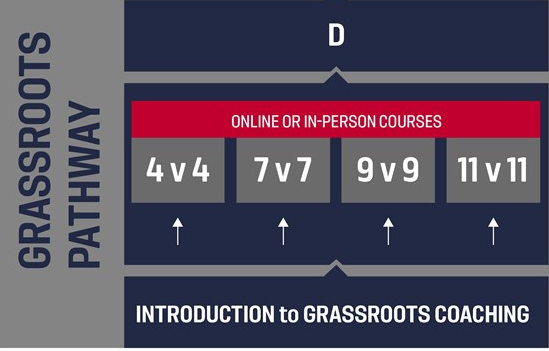
In fairness, a lot of the people in the class had ambitions beyond rec league. To get to the D license and progress up the ladder from there, you have to take three of the eight available grassroots modules, and the in-person 11v11 module must be one of them. (If you’ve played three years in a top-tier pro league, however they choose to define that, you can skip to the C.)

And the parent/professional line seems to be blurring more than I’ve seen in the past. The course’s host, Braddock Road (hey, Vienna — can I be reimbursed?), is moving its parent-coached teams up from the developmental/recreational leagues up to the NCSL. A lot of the parents in the room were anxious to take the D as soon as possible. (Apparently, it’s more accessible for parent coaches than it was in the past when I griped about it.) Maybe some clubs have realized they don’t need to hire pros to be on the sideline for every “travel” game any more.

Also, some parent coaches are really into it. Maybe a bit too much. One coach said he does his practice plans based in part on what he sees in scouting his opponents. At U9. I’ve only seen three distinct styles of play at U9.

  1. Alexandria Soccer: We’re going to complete a couple hundred passes each game, and unlike Spain, we’re also going to score because the typical U9 defense and goalkeeper can’t cope. If we concede goals to a big fast forward, so be it.
  2. Northern Virginia Soccer Club: We’re going to beat the crap out of you. Literally. Not like U9 refs are going to blow the whistle on most of these fouls, much less give us yellow cards. Then by U12, we’ll be ready to identify your top player and kick him out of the game just after halftime, then reduce your team to barely enough players to finish the game.
  3. Kids playing soccer. They’re kids. They’re going to do what kids do, and what the coach says is just a small factor in what they do.

But there are two reasons why this “grassroots” module still doesn’t quite meet the needs of a parent coach, even though it’s dropped some of the insistence on incomprehensible practice planning that the E and old D license had.

plan

1. We’re not learning how to teach technique.

Sure, at U14, it’s less of an issue than it is at U8. But we’re still getting some players with less experience or players who may move on to travel once they fix a couple of holes in their game. We’re still not getting that.

Granted, former elite players will always have an advantage here. My fellow rec coach who played with Julie Foudy at Stanford will know more about technique (and tactics, and probably a lot of things) than I ever will. No coaching class is likely to make up that gap. But I’m still surprised that, in all the resources and reading we’re given, no one emphasizes the best way to strike a ball, receive a ball, etc.

Heading is especially problematic. Maybe U12 rec coaches don’t need to know the finer points of dribbling and passing, given the lack of potential elite players in their ranks. But heading is an actual safety issue. Shouldn’t we learn how to do it and teach it? (Sure, I learned it when I was a youth player, but that was 35 years ago. Times have changed.)

So my constructive criticism for USSF would be simple. Give us a few videos on technique. In the in-person session, maybe spend 15 minutes on it while we’re on the field.

2. A lot of the information still seemed unrealistic for recreational coaches.

One of our instructors noted that it often takes a year for lessons to sink in. Travel coaches and elite coaches may have their teams for that long. Rec coaches usually do not. If they’re in AYSO, the teams are broken apart and reformed each year.

(Maybe that’s more of a criticism of the AYSO “redistribute the teams” model, but that’s another rant.)

Other notes from the session …

  1. We no longer use neutral players — say, a 5v5 with two players available on the wings who’ll pass back to whichever team passed it to them. Not “game-like.”
  2. Also not “game-like” — rondos. We didn’t talk about these at all. (I should point out that the Massachusetts U8 training plans above had a few things that also weren’t really “game-like.” Are rondos or neutral players any less “game-like” than having multiple goals on each side of the field?)
  3. Dynamic stretching is built into the first “play” phase. Basically, let them play for a few minutes, and let that be the primary warmup. (Personally, I plan to tell them not to go too hard at first.) Then pause, do your Frankensteins and barn-door swings, then get back to it. Makes sense. In my running days, I knew plenty of runners who’d jog a bit before stretching. Stretching a cold muscle incurs the old snapping-rubber-band analogy. And yes, you can use the “FIFA 11” warmup, which is coincidentally the only soccer video game in my house.
  4. We now “freeze” the action only in the practice phase. In the first play phase, we coach over the flow of the game and sometimes pull players aside. The last play phase is more like a game — maybe you’d pull a player aside, but you’re more likely to shout things over the flow. (Or not shout, if you’re stick with a tiny practice space like I am.)

So on the whole, this is an improvement. I’ve talked a lot about what parent coaches need, including a full presentation at an NSCAA convention. This gets us partway.

It’s unfortunate in a way that U.S. Soccer needed to do such a drastic revision. It’s difficult to feel the previous lessons weren’t wasted. But the good news is that any changes in the future should just be tweaks rather than a teardown.


us soccer, youth soccer

Why coaching youth soccer is impossible

There’s something funny about listening to a chat between the great soccer coaching gurus John O’Sullivan and Sam Snow while dodging baseballs lobbed over a bunch of Little League All-Stars and the right field fence by a baseball coach might be a little too excited over this coaching gig.

As I retrieved a ball that had sailed over my head, several yards beyond the fence on the park’s walking trail, I heard O’Sullivan and Snow talk about things that make them cringe as they see soccer coaches in action.

I laughed at the first few items. Starting a practice with laps is so 1983, isn’t it?

Then Sam, someone who has been a wonderful resource for me and thousands of others, lamented the warmup drill in which players line up, play the ball forward to a coach, run on to the square pass the coach sends them, and blast it at the goal.

Hey, wait a minute. That’s my gameday warmup.

Sam’s objection — in addition, I presume, to the fact that we coaches are supposed to avoid “lines, laps and lectures” as much as possible — is that it doesn’t mimic the game.

“Well,” I objected in my head as I continued my walk on the uphill section and started breathing a little heavier, “if you have a forward who understands playing his back to goal, you might see a give-and-go combination … OK, Sam, you’re right.”

But what I didn’t hear was what I’m supposed to do instead.

I’m sure some hotshot Self-Appointed Elite coach who only works with top-tier talent will tell me what I’m supposed to do. Maybe it’s some sort of dazzling drill in which the ball is played out to the wing and a defender applies some pressure before it’s played back into the center. Or maybe I’m supposed to do what every NWSL team does — possession drills and some sort of painful-looking exercise involving large rubber bands.

Let me explain a few things to the SAE coach:

  1. I’m not coaching D.C. United’s U-18s. I’m coaching rec league players. If I have 11 players by the time the ref calls us over to check our shin guards, I consider myself lucky. I don’t have a lot of time to explain anything. I need to keep it simple.
  2. Why do we think of finishing as dessert? (I can’t cite the originator of that analogy because it’s quite old.) Do your 5,000 short touches, juggle 3,000 times, run 20 possession drills with no passes longer than five yards, and then we might let you take a shot. And then we wonder why no one can score a danged goal.

So I hear what Sam’s saying. But then how do I learn what I’m supposed to do instead?

Google didn’t help. The first item that came up on my search was a warmup drill that’s basically free kicks with no defense. How realistic is that?

Here’s the next problem: We have so many different philosophies. John didn’t use the word “rondo” but stepped into The Great Rondo Kerfuffle of 2018 by fretting about “directionless” drills. (Granted, after seeing Spain crash out of the World Cup because it ran a 120-minute rondo against Russia and neglected to set up meaningful scoring chances, perhaps the U.S. idea of adding “direction” to possession drills will gain some traction. Or, again, maybe we should work on finishing on occasion?)

But the biggest problem was something John and Sam mentioned as a positive of older-skewing licenses. In the National Youth License, coaches are taught how to teach. They’re taught about the “psychosocial” aspects of coaching.

Those of us who coach at the earliest stages of the game are taught nothing of the sort. And yes, I’ve taken the new “grassroots” modules — at least the ones that are out now. The F license, which was discarded for reasons known only to people in Chicago, taught a bit of it, at least by the example of seeing Shannon MacMillan teach.

The licensing courses have typically focused on practice plans. Is that really the first priority for grassroots coaches? Shouldn’t we be getting our practice plans from those who have really studied them?

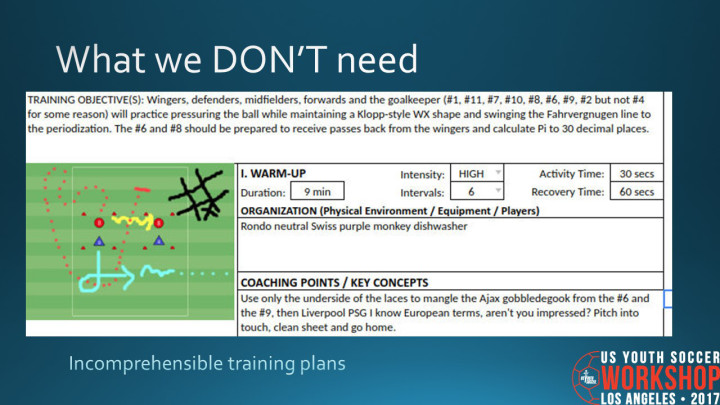
Unfortunately, the practice plans we get generally aren’t helpful. They’re written for other members of the technical staff, full of jargon that Coach A and Coach B might understand but not the befuddled coaches of the C-teams and the recreational kids.

The new “Play-Practice-Play” practice plans, admittedly a good bit simpler than the “Warmup-Small Sided Game-Expanded Small Sided Game Because You’re Supposed to Guess The Difference Between That and the Small-Sided Game-Scrimmage With Caveats” practice plan we were taught a couple of years ago, are interesting. But the first set of plans I saw (I’m not going to name the state association that posted them) had something interesting. I checked out the U14 plans, which had nice names like “attacking from wide areas” and “defending crosses.” Take away the titles, and every practice was almost exactly the same. Get the kids to warmup with some 2v2, 3v3 and dynamic stretching while you talk to them about their day. (The last bit is a nice touch — finally teaching us how to teach.) Then move into the “practice” phase — which is basically a half-field setup in which seven players are trying to score against six. Doesn’t matter what topic it is. It’s an odd-number attack.

Maybe we should simply admit it. “OK, coach of a team from U12 on up. You’re going to do the same thing every practice. You’re going to do small-sided scrimmages, then basically a halfcourt scrimmage. We’re just going to ask you to emphasize different points in each one.”

So instead of a bunch of diagrams that spell out the same thing every practice, you just give us a list. Hey, we can put that on our phones. Nice.

Even then, though, we still won’t have much idea how to teach a lot of valuable skills. How do you teach someone to shoot like Denis Cheryshev? How do you teach someone to drop a 50-yard pass effortlessly into the stride of a teammate? (Granted, those might be beyond the capacity of a rec-leaguer, anyway.)

I’m going into my U16 and U14 seasons with two goals.

  1. Get players a lot of touches on the ball in varying situations. Futsal is nice, but it doesn’t teach you how to switch the point of attack on a full-sized field or deal with a hard-hit ball at chest level.
  2. Learn how to move on a big field.

That’ll be tough, because my practice space is generally one-fourth of a field. But we’ll give it a shot.

I’m open for ideas. Especially a new warmup exercise for unskilled finishers with short attention spans.


women's soccer, youth soccer

More apps (and more women) in the crowded soccer-skills marketplace

From the mailbox today:

English Premier League soccer team Manchester City has launched SkillCity, presented by Nexen, a new interactive app that will help develop the talents of young soccer players across the US. The City squad is currently in the United States for its pre-season tour, visiting Houston, Los Angeles and Nashville.

SkillCity will see young players compete across a series of challenges that have been exclusively developed by the Club’s City Football Schools coaches. The four challenges will allow boys and girls aged 5–14 years old to test their speed of movement, ball mastery, finishing and passing — ranking themselves against their friends and Manchester City players. Manchester City player Kevin De Bruyne and former Manchester City Women’s player, and Tour Ambassador, Carli Lloyd have already tested the app and users can watch these videos to help develop their skills.

U.S. women’s soccer is already well-represented in this app genre. Former WPS Commissioner Tonya Antonucci was on iSoccer’s board of directors. Kristine Lilly’s long association with Coerver carried over to apps.

And last week’s Ranting Soccer Dad podcast guest, Yael Averbuch, teaches skills through her Techne Futbol app.

Check out the podcast.

youth soccer

Maybe coaches DON’T need a new practice plan for every practice

I’ve got a healthy skepticism of coaches who imply they’d be able to develop the next Messi while few other coaches could handle it. This quote puts it best:

But there’s no doubt Brian Kleiban, the subject of RSD podcast guest Mike Woitalla’s latest Q-and-A, has a lot of good things to say about coaching. And here’s one:

In my opinion, less is more. Figure out your core exercises to teach the basic fundamentals and team style of play. Work them over and over and over again. Demand perfection and execution in training. Once it becomes clear on consistent basis that they have mastered it individually and collectively, you can add layers of complexity. Until then, stick to the same things. Most coaches just jump around, all over the place with new content to fool everyone that they can run different sessions each and every day. The players never improve in any facets of their games this way.

Note that this runs directly counter to what we’re all told in the USSF license sequence. We’re supposed to plan out a curriculum, like we’re science teachers or something. Teach a new topic each time, reinforcing it with every step from warmups to scrimmage.

And for most coaches, that’s a royal (and wholly unnecessary) pain. For one thing, coaches end up spending half the practice explaining a bunch of new drills. For another — when was the last time you mastered something in 15 minutes?

Uncategorized

Icing the kicker, or why coaches are sometimes wrong

Journalists (and fans) love to second-guess coaches. Honestly, they’re rarely on solid ground. We don’t see everything in practice and team meetings. Coaching staffs sometimes spend 80 hours a week going over game plans in minute detail, and journalists (and fans) simply can’t match that depth of knowledge.

Asking about a particular decision is one thing. That’s illuminating. We can learn more about the game that way — if the coach’s reasons can be made public. Armchair coaching, on the other hand, is usually ridiculous.

But sometimes, those of us in the pressbox or the stands can see the forest for the trees. Or we can see a blind spot or bias that forces a bad move. One example: In retrospect, D.C. United’s handling of Freddy Adu was far from ideal, particularly when Peter Nowak pulled him out of a playoff game in which he was supplying plenty of creativity that replacement Matias Donnet did not.

And coaches are often playing hunches that just don’t add up. I’m convinced NFL coaches are doing just that when they call time out to “ice” the kicker.

The problems with icing:

A. Without the timeout, kickers may be rushed to get their kicks away. So many things can go wrong with the snap, the hold or the kick. Calling timeout gives everyone a chance to get in place.

B. The timeout sometimes comes so late that the kicker gets a practice kick. Then he has a chance to check the wind, check his footing and make any other correction.

C. That’s one timeout gone. Suppose the kicker puts his team ahead, and you have to come back and drive the length of the field? That timeout would’ve been useful, right?

I’m going to keep an eye out for the rest of the season — I’m sure I’ll find several really bad icing calls. (Yes, I must be overcompensating for the lack of hockey this season.)

Example #1: Giants-Eagles, Sept. 30. New York kicker Lawrence Tynes misses a 54-yard field goal for the win, but Philly coach Andy Reid had called a late timeout. See Problem B above. Tynes corrected the flight of the ball on his second attempt, but he came up a yard short to bail out Reid. Three more feet on that kick, and Reid is being vilified this morning.

olympic sports

Chaos, coaching and sports (or, “things I can’t do with my youth soccer teams”)

The Anson Dorrance biography The Man Watching describes the constant chaos in the North Carolina women’s soccer program. Dorrance has piles of papers on his desk — sometimes, he finds big checks he has yet to deposit. And his team regularly shows up late to the airport, something I couldn’t handle at all.

Ironically, it’s a Duke guy writing this post about the benefits of chaos in coaching:

Before meets, Bowman hid goggles, so that Phelps had to swim without them; he deliberately arranged late pickups, so that Phelps would miss meals and swim with hunger; he cracked goggles, so they would fill up with water and obstruct Phelps’ vision in the pool. We don’t know how Phelps did in those earlier meets, but we know that Bowman created uncertainties for him in lower-risk situations so that when it really mattered he had familiarity with the unexpected and a mental adaptability that gave him the best shot at winning.

So, parents on my soccer team — if I’m late for practice or a drill goes horribly wrong, it’s all part of the plan.

via You Can Only Win in Sports, or Anywhere Else, if Youre Ready for Chaos – Forbes.