us soccer, women's soccer, youth soccer

Yes, it’s possible to understand the U.S. Soccer WoSo and YoSo numbers — maybe

This tweet, with a screenshot from the 2018 U.S. Soccer Annual General Meeting book, created some consternation:

https://twitter.com/duresport/status/951622431663448064

Did I say consternation? I meant confusion. Perhaps they shouldn’t make footnotes bigger than the headlines. (As an aside: Due to the collapse of the newspaper business model, hundreds or maybe thousands of people who worked in editing/page design have been displaced in the past decade and change. So, businesses and nonprofits? Hire them. Communication is good.)

So once you realize that the footnote is actually a footnote, it starts to become a little clearer. Chart 2 (which is the first chart in that screen capture) gives the numbers from all games and compares them in the last column to the same numbers from 2016. Chart 3 (the second chart) omits the numbers for the games outside USSF’s commercialization capabilities and compares those games to the same numbers from 2016.

But to put it in full context, you have to go back to the previous year’s book …

… which doesn’t have the same sort of figures. Oops.

We do have this …

ratings 2016

And that tells us pretty much the same thing — 2016 was an outlier for both the MNT and WNT. The men had the Copa America Centenario. The women had the Olympics.

We can easily explain the women’s ratings here. Chart 2 is comparing the WNT games of 2017 to the WNT games of 2016. The latter would include the Olympics, so of course, the 2016 ratings are going to be considerably higher. Chart 3 would omit the Olympics from that comparison because USSF doesn’t have those rights. In 2017, USSF had the commercial rights to every WNT game, but in 2016, they did not.

So I have a couple of remaining questions:

  1. What’s a “year”? The WNT played 16 games in 2017 — 13 in the USA, one in Canada, two in Europe. Were four not televised? Off the top of my head, I can’t recall that. If it’s a fiscal year, then it’s a partial year, isn’t it?
  2. What’s included in the list of games USSF can’t commercialize? The Olympics, certainly, but that only affects the WNT. How were 10 of 18 MNT games not included? They played 19 games in 2017 (see ratings at World Soccer Talk, though those are English-only) — eight World Cup qualifiers (four home, four away), six Gold Cup, five friendlies. The away qualifiers are tricky, which is why the biggest debacle in U.S. Soccer history was only seen by those of us with beINSports. Does USSF get nothing from Gold Cup even with SUM in the mix?

On another note, I’ve compiled registration-fee numbers from every organization from the last eight years. And they tell us … very little?
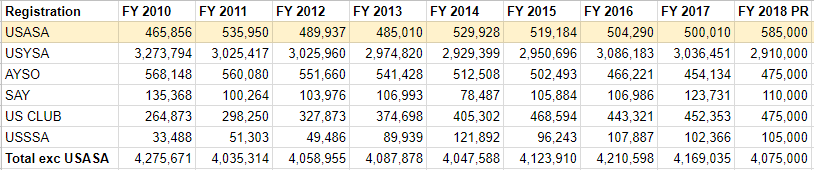
regstat

Quick reminder: USSF charges adults $2 each, so the USASA registration numbers are basically the USASA fees divided by two. (Unless there are some waivers somewhere.) The youth fee is $1 per player.

But we can’t quite equate that last line to the number of youth players registered. Here’s why:

  • U.S. Club, USSSA and maybe AYSO numbers might include some adults.
  • Some youth players may be registered in more than one organization (a point Eric Wynalda is making).

Yet this is an apples-to-apples comparison from year to year, for the most part. And … I can’t really detect a trend. I see fluctuations that could be accounting flukes as much as anything else. The numbers are basically flat.

And yet we keep hearing horror stories (and I keep repeating them — in several presentations and maybe even a book over the past few years) of participation dropping. Take a look at Project Play, which says the percentage of children aged 6 to 12 who participate in outdoor soccer plummeted from 10.9% in 2010 to 7.7% in 2016.

What’s going on here?

  1. Consider the methodology. The Project Play numbers come from an online survey of 24,134 “individuals and households.” Could our changing online habits (less computer, more phone) be skewing the numbers? (I’d turn it over to a data scientist, but after the 2016 election, I’m starting to view “data” as applied to polling with a higher margin of error than the data scientists would care to admit.)
  2. Could it be that there are indeed fewer people playing soccer but that USSF’s organizations are managing to register a higher percentage of those people? Isn’t that the opposite of what we’re hearing from the presidential candidates — that tons of kids (and adults) are playing in unaffiliated leagues?

Hard to say. But the evidence certainly doesn’t point to a sport on the rise. (Please don’t respond by saying the numbers are increasing in high schools. That’s generally a function of having more high schools. The number of soccer players at a high school of significant size equals the number of players they can take, not the number who are interested. My local high school could probably field 10 teams if they had the field space. They have four — boys and girls varsity and JV. A lot of travel soccer players won’t make the cut for either one.)

So whether this is an outright crisis or just a little hiccup, it’s worth addressing.

If you can derive any other conclusions or insights from this, please share.

podcast, us soccer, women's soccer, youth soccer

RSD21: U.S. Soccer presidential candidate Eric Wynalda

Eric Wynalda has played in multiple World Cups, Germany, MLS, etc. He’s been a successful coach and commentator.

Yes, we talk about promotion/relegation. In fact, we did it first just so you single-issue types can listen and then bail out. If you want to hear about EVERY issue facing the next USSF president — well, we got to maybe half of them. There are lot of issues. In rough order, we talk about:

1. What’s different or similar between the concerns of the Twitterati and the concerns of the typical state or national association.

2. Whether people are nervous to speak up about the USSF power structure.

3. Women’s soccer: The new collective bargaining agreement and the NWSL.

4. Youth soccer: Has the federation done too little? Too much?

podcast, pro soccer, women's soccer, youth soccer

RSD18: U.S. Soccer presidential candidate Mike Winograd

He doesn’t have the name recognition of Eric Wynalda, he hasn’t been in the U.S. Soccer inner circle like Carlos Cordeiro, and he hasn’t been campaigning as long as Steve Gans. But Mike Winograd is an interesting candidate for the USSF presidency. He’s a former player, he helped launch a pro club, and he’s a lawyer who works on very big deals.

In our conversation (starting around the 10-minute mark after I ranted a bit about the NASL lawsuit and gave an overview of the presidential election), we talk about Winograd’s background and his plans, which he outlined in a prior interview at GotSoccer. His basic mode of operation: He wants to get everyone on the same page — or, as he puts it, rowing in the same direction.

Key quote: “U.S. Soccer should not be in the business of trying to ram things down people’s throats.”

Particular points of interest: How to get the WNT and MNT equal or equivalent, depending on what each team wants (35:00), and addressing cost barriers in youth soccer (40:00).

soccer, women's soccer, youth soccer

Upcoming coverage/career plans

Mid-major announcement to start with: Ranting Soccer Dad now has its own site. I’m not married to the design yet, but it should stabilize in the next few days. This site and podcast will be my top work priority for some time to come. I’m even planning a related book. Stay tuned.

Ranting Soccer Dad deals primarily with youth soccer, but it ties into everything in the soccer world — U.S. Soccer politics, the national teams, the pro leagues (men and women), etc. Even if you think you’re not interested in youth soccer, check it out. You’ll find some interesting guests.

I’ll still be freelancing on occasion for The Guardian and Four Four Two, and I’m open to other suggestions. You may be a little less likely to get random pitches from me for the foreseeable future.

What about women’s soccer? 

These days, there’s less of a place for me in terms of NWSL and WNT coverage. Part of that is simply where my reporting has carried me (huge stories elsewhere), part of it is the ongoing decline of the news media (it’s nice to get paid every once in a while).

But I’ll still want to have a lot of female guests on the podcast, and we’ll certainly talk about every level of the women’s game. When I see youth soccer leagues in our area, I see a lot more boys than girls, and that concerns me. Farther up the ladder, I frankly was not impressed with the quality of play in the NWSL this year, and I’m not sure whether that’s a coaching preference for a “physical” style of play or a lack of quality coaching in clubs and college. (Probably a bit of both.) We’re going to address that at Ranting Soccer Dad, and I’d love to talk with a lot of people who can diagnose the problem better than I can.

I’m also going to be a bit of an agitator for more and better coverage. Equalizer Soccer is a great resource, and SB Nation’s various blogs are generally great at giving the women their due. Elsewhere, coverage is lacking, and I’m not just talking about the News & Observer‘s inexplicable decision to ignore an NWSL semifinal that took place in its backyard. ESPNW ramped up a bit for the NWSL playoffs, but I wouldn’t say they were a vital WoSo news source throughout the year. Other large sports sites give irregular coverage.

On all the politics around WoSo — I had good advice yesterday to “amplify” good reporting and analysis. I think I can do that. I’m going to avoid rehashing old debates. In the past 18 months or so, I’ve dealt with three primary groups of people — people who’ve made good points and engaged in actual discussion, people who may mean well but come across as condescending know-it-alls who don’t listen, and people who are simply reprehensible. If the last group takes over WoSo fandom without challenge, the sport will suffer.

But I’ve learned a lot from the discussion, and I intend to keep learning without being as active a participant as I have been. This is a starting point:

And yes, learning is a lifelong process. Even if most of us think we know everything at age 21. (Hey, I did too!)

So I’m not quite giving up WoSo. But I can’t really justify taking up a season credential at Spirit games and coming home to write about it without a significant outlet, and I’m not really shopping myself around to find a significant outlet. You’re probably more likely to find me on Spirit Hill next season than in the pressbox.

I’m very happy with what I’ve done in WoSo — everything from covering W-League games in the mid-2000s with maybe 200 people in the stands to the 2008 Olympic final and the 2011 Women’s World Cup opener. I’ve covered labor disputes and the WPS implosion, and I’ve covered a lot of good soccer and good soccer players. I hope someone coming out of college today gets to have all those experiences. (Maybe not the WPS implosion.)

What about MMA? 

I enjoyed writing for Bloody Elbow this year, and I really should finish my Cageside memoir at some point. There’s just too much going on in soccer right now.

What about Olympic sports?

I’ll update the Perpetual Medal Count at some point, and I’ll do one for winter sports as well. And I’ll do the occasional post. Most likely on curling.

What about music?

Once a month at Popdose and occasionally at Mostly Modern Media, where I’ll also periodically skewer political bullshit in all forms. And economists.

What about everything?

Good song to end this:

women's soccer

Women in U.S. Soccer leadership

No, it’s not a blank post.

The Guardian recently posed the question of whether a woman could be elected U.S. Soccer president, focusing on one of the more likely candidates (we think) — Julie Foudy. The response from Foudy? “It’s not realistic.”

But it’s not because a good female candidate couldn’t win.

Foudy also says that most women are unable to even consider running for the position because it is an unpaid role with a high workload.

“How much work does Sunil do for a volunteer position?” Foudy says. “There’s no pay for the president so what woman who needs an income or is raising kids is going to say, ‘Oh yeah, I’ll be able to volunteer 30 or 40 hours a week that take me away from family and my real job’. It’s not realistic. The position itself needs restructuring if you are going to get more women engaged in it.”

That might also explain why we don’t see many women heavily involved on the U.S. Soccer board. Here’s a quick history:

In the mid-2000s, U.S. Soccer followed the lead of other sports federations and reduced the size of its board from 40 to 15 voting members (plus two non-voting — the immediate past president and the CEO/Secretary General, the top paid USSF employee). The bylaw was approved in 2006, the same year Sunil Gulati was elected president for the first time. Let’s look at who has occupied each seat since then:

President, vice president: Sunil Gulati, Carlos Cordeiro. Gulati was unopposed in 2006, 2010 and 2014. Not in 2018. Cordeiro, formerly an independent director (we’ll get to it) won the vice presidency in 2016, ousting incumbent Mike Edwards (who replaced Gulati as VP in 2006). (Yeah, I’ve already written about this.)

In short — no women here as far back as I can trace.

Athlete representatives: Chris Ahrens, Carlos Bocanegra, Angela Hucles. USSF is required to give athletes at least 20 percent of the vote, which means three out of 15 in this case. There’s no official rule saying the reps must be one Paralympian, one MNT veteran and one WNT veteran, but that’s how it’s worked out since Jon McCullough joined the board in 2008. The 2012 Paralympic torch-bearer passed away in 2014, and Ahrens took his place on the board.

Linda Hamilton was on the board after the 2006 re-org. Her seat has since gone to Amanda Cromwell, Danielle Fotopoulos, Danielle Slaton, Cindy Parlow Cone and now Hucles.

Pro Council: Don Garber, Steve Malik. Bylaws say these seats are for the Pro Council chairperson and an elected rep. MLS commissioner Garber has been on the board for the whole century so far. WPS commissioner Tonya Antonucci had the other seat for a year or so. Malik, who runs North Carolina FC (and the NWSL finalist Courage), replaced USL CEO Alec Papadakis, who replaced another MLS/NWSL owner in Merritt Paulson.

So that’s one woman, briefly (bad timing for her departure).

Adult Council: Richard Moeller, John Motta. As on the Pro Council, these seats are for the chairperson and a rep. Motta defeated Gulati in a close race for vice president in 1998, but Gulati won a rematch in 2000. Motta is exploring a bid for the presidency. I can’t find any women who’ve held these seats since the 2006 re-org.

Youth Council: Jesse Harrell, Tim Turney. Also chairperson and a rep. Evelyn Gill was on the board for four years.

At-Large Representative: John Collins. The election process for this spot is insanely complicated. Read Bylaw 413, section 3. In any case, no women, at least since 2006.

Independent Directors: Donna Shalala, Val Ackerman. These positions were added to the board in the 2006 re-org. They’re officially elected, but in practical terms, the board seeks out people with some clout in the worlds of sports business, general business and politics. The board also has used these spots to find people other than white men — Cordeiro, Fabian Núñez, Shalala and Ackerman. Shalala recently made news as the alleged independent director who fell asleep during the presentation of Rocco Commisso on behalf of the NASL’s Division II sanctioning application, which Commisso thinks is an indication of the board’s prejudice but more likely an indication that Shalala might not be young enough to sit through an NASL presentation.

So as it stands now, is the best path for a woman to the USSF presidency might be through the independent director seats? Let’s compare it to the other pathway — through the various constituencies …

Adult Council (basically U.S. Adult Soccer): The one woman out of eight here is Shonna Schroedl, who has run for the Council’s elected spot on the board. (Note to self: Interview Shonna Schroedl.)

Youth Council: This is a little more complicated. Four organizations are represented — U.S. Youth Soccer, U.S. Club Soccer, AYSO and SAY Soccer. How many women are on their boards?

Pro Council: If the NWSL ever names a commissioner, maybe they’ll have some female representation?

Actually, the organization with the most women in leadership is the Organization Formerly Known As NSCAA. That would be United Soccer Coaches, where Amanda Vandervort just wrapped up a one-year term as president and Lynn Berling-Manuel is the CEO. Including the ex officio members such as Berling-Manuel, five of 11 board members are female.

U.S. Soccer also has committees and task forces that have a few women involved. The giant Appeals Committee includes Kate Markgraf (also one of two women on the Rules Committee), Shannon Boxx, Lauren Holiday, Lori Lindsey, Heather O’Reilly, Christie Rampone, Becky Sauerbrunn, Lindsay Tarpley and several more women. Siri Mullinix pops up on the small Credentials Committee. Gill, Schroedl and Lauren Gregg are on the Disability Soccer Committee. Mary Harvey is on the Life Member Task Force. Sandra Hunt is among the women on the Referee Committee. Finally, the Technical Committee is a 50-50 split that includes WNT coach Jill Ellis, April Heinrichs and Carin Gabarra.

(Lydia Wahlke, listed as a staff liaison on several of these committees, is a U.S. Soccer general counsel.)

Here’s the one that aggravates the Ranting Soccer Dad in me: The 12-member Task Force on Youth Issues has ONE woman — Hucles.

So would U.S. Soccer have some viable presidential candidates here? Perhaps.

Would it help to get more women involved on these task forces and then perhaps on the board? Definitely, and not just because that’ll increase the likelihood of having a female president one of these years.

ranting soccer dad, women's soccer

Alex Morgan’s ejection from Epcot: Not a big deal, not not newsworthy

Let’s first get rid of the notion that male athletes or public figures would not make the news if they were tossed from a bar — let alone tossed from Epcot Center, where hundreds of people may have seen the incident — or some similar things:

Ric Flair tossed out of bar (pro wrestler)

Deshaun Watson kicked out of bar (football player)

Something about a hat (also football)

Something about paying with bubble gum (also football)

Noooo! Harry Potter himself tossed from bar! (male actor)

Underage college drinking (football)

Underage college drinking (basketball)

More college drinking (football)

Remember Freddy Adu? (soccer)

Jimmy Buffett tossed from NBA game (laid-back rock)

Politician pees on himself (Kenya)

In fact, see how this story was reported in the UK, which might not know Alex Morgan as well as Americans do and instead focused on “Ex Derby County star Giles Barnes.”

You may note that a couple of the players listed above were arrested. I’d suggest reading the stories and asking if a white woman would be arrested for the same crimes. (Yes, Giles Barnes, who was escorted from Epcot along with Morgan and Donny Toia, is Jamaican/English. Just a hunch, and I do have a relative who works elsewhere in the Disney megaplex, but I think Epcot security might be a little less arrest-happy than a lot of police officers in this country.)

Notice one other thing from this NFL arrest database: Many players arrested on DUI charges were immediately released. Not so in women’s soccer, where we have seen a couple of players arrested and quickly forgiven.

So is Alex Morgan’s ejection from Epcot newsworthy, bearing in mind the precedent in other sports? Yes.

Would a male soccer player of note — say, Michael Bradley or Jozy Altidore — get the same sort of treatment? Probably. The fact that Morgan is also a published children’s author might make her a little more noteworthy than Bradley or Altidore, as might the fact that Morgan has won international championships. Maybe we should be comparing with Neymar or someone, and I think it’s fair to say Neymar would make headlines if he got tossed out of Epcot.

Is Morgan’s offense worthy of suspension? No. Other internal punishment? Meh.

Would I expect Portland fans to bring it up this weekend, just as college sports fans would pounce all over a player who got in a mild bit of trouble? Yes.


women's soccer

Alex Morgan's ejection from Epcot: Not a big deal, not not newsworthy

Let’s first get rid of the notion that male athletes or public figures would not make the news if they were tossed from a bar — let alone tossed from Epcot Center, where hundreds of people may have seen the incident — or some similar things:

http://www.nydailynews.com/sports/more-sports/ric-flair-thrown-bar-acting-moron-article-1.3043398

https://www.sbnation.com/college-football/2017/3/31/15144612/deshaun-watson-kicked-out-tuscaloosa-bar-innisfree

http://www.azcentral.com/story/news/local/scottsdale/2017/04/06/scottsdale-police-cardinals-wide-receiver-arrested-after-dispute-over-missing-hat-marquis-bundy/100133666/

https://sports.yahoo.com/blogs/nfl-shutdown-corner/jaguars-corner-dwayne-gratz-arrested-after-trying-to-pay-with-bubble-gum-201406918.html

(Harry Potter? Nooooooo!)
https://jezebel.com/5968104/two-years-sober-daniel-radcliffe-pounds-jaeger-gets-tossed-from-bar

http://articles.chicagotribune.com/2012-05-17/sports/chi-notre-dame-wr-daniels-cited-for-underage-drinking-20120516_1_underage-drinking-davaris-daniels-underage-party

http://www.indystar.com/story/sports/college/indiana/2015/08/25/two-indiana-basketball-players-cited-illegal-consumption-alcohol/32285469/

http://www.desmoinesregister.com/story/sports/college/iowa-state/football/2015/09/27/isu-football-player-cited-alcohol-violatioon/72925696/

http://www.soccertimes.com/mls/2004/sep21.htm?CMP=LEC-50Y6D3931797

http://articles.latimes.com/2001/feb/05/sports/sp-21464

https://www.sde.co.ke/thenairobian/article/2000173751/one-for-the-road-drunk-senior-kenyan-politician-pees-on-himself-in-broad-daylight

In fact, see how this story was reported in the UK, which might not know Alex Morgan as well as Americans do and instead focused on “Ex Derby County star Giles Barnes.”

You may note that a couple of the players listed above were arrested. I’d suggest reading the stories and asking if a white woman would be arrested for the same crimes. (Yes, Giles Barnes, who was escorted from Epcot along with Morgan and Donny Toia, is Jamaican/English. Just a hunch, and I do have a relative who works elsewhere in the Disney megaplex, but I think Epcot security might be a little less arrest-happy than a lot of police officers in this country.)

Notice one other thing from this NFL arrest database: Many players arrested on DUI charges were immediately released. Not so in women’s soccer, where we have seen a couple of players arrested and quickly forgiven.

So is Alex Morgan’s ejection from Epcot newsworthy, bearing in mind the precedent in other sports? Yes.

Would a male soccer player of note — say, Michael Bradley or Jozy Altidore — get the same sort of treatment? Probably. The fact that Morgan is also a published children’s author might make her a little more noteworthy than Bradley or Altidore, as might the fact that Morgan has won international championships. Maybe we should be comparing with Neymar or someone, and I think it’s fair to say Neymar would make headlines if he got tossed out of Epcot.

Is Morgan’s offense worthy of suspension? No. Other internal punishment? Meh.

Would I expect Portland fans to bring it up this weekend, just as college sports fans would pounce all over a player who got in a mild bit of trouble? Yes.


podcast, women's soccer, youth soccer

Spirit season recap and a post-Vegas anti-cynicism rant

In the wake of the Las Vegas massacre, the Ranting Soccer Dad podcast opens with a few thoughts on why we shouldn’t give up on changing people and society as a whole, either on something relatively trivial like youth soccer or something horrifying like one man’s ability to assemble the weapons to wound 500 people. Maybe we need a little less competition and a little more cooperation to make the changes we need?

Also, a quick recap of the Washington Spirit’s season, in which the team fell from being 30 seconds away from a league championship to last place. Includes postgame comments from Spirit coach Jim Gabarra and the team’s star attacking player, Mallory Pugh.

(Apologies for the drop in volume during the Pugh interview. Also, if you can’t hear Gabarra’s last two words, they’re “No comment.”)

(Featured image from Flickr)

women's soccer

Spirit, Reign play a legitimately entertaining soccer game

Things didn’t bode well Saturday. Traffic heading up the Beltway to Maryland was worse than usual. The SoccerPlex didn’t have its usual Ben & Jerry’s cart — Yom Kippur apparently kept the proprietor away.

And Seattle’s Jess Fishlock, simultaneously one of the most inspirational and infuriating players in women’s soccer, started the game by clattering into Washington’s Mallory Pugh, the type of foul that does nothing other than send an early message.

Then a funny thing happened. An actual soccer game broke out. Free-flowing. Long strings of passes. Good runs.

For Spirit fans, it looked a bit like 2016 all of a sudden, with Pugh replacing Crystal Dunn and Meggie Dougherty Howard replacing everyone else. The two rookies carved up the Seattle defense with incisive passes en route to a 2-0 lead.

But the defense certainly isn’t last year’s defense. The Reign got back into the game as Spirit defenders kept whiffing on clearances. It’s the SoccerPlex — a terrific playing surface on which the Spirit play every home game. They should be used to it.

And credit to the Reign. They were pressing. They didn’t want their season to end on a loss. And coach Laura Harvey told us after the game, incongruously given her giddiness after Seattle’s 3-2 win, that she had reminded players at halftime they were playing for their jobs.

So were the Spirit players. Looking ahead to next season, they’ll build around their two sensational rookies from opposite ends of the hype meter — national teamer Pugh, who skipped out on UCLA to go pro early, and third-round pick Dougherty Howard. Of the other 11 Spirit players to appear in the game, who’s guaranteed to return next year? Probably captain Shelina Zadorsky and original Spirit player Tori Huster, who can surely play for the Spirit as long as she wants. Anyone else?

It’s not that the players are particularly bad. As a whole, even with a viable starting XI on the injury report, Washington had a competitive team this season. It’s strange to say for a last-place team, but they overachieved. If you’d told me before the season they’d have this many injuries but would still win five games (two more than the disastrous 2013 season) and score 30 goals (more than Kansas City, Boston and Houston, and only three less than playoff-bound Chicago), I’d have said that’s impossible.

The defense, though, needs to be addressed. I don’t want to speculate on whether Stephanie Labbe will be back in goal for the Spirit — I simply hope she’s happy and healthy. Zadorsky is generally solid, and Estelle Johnson was having a career year until her injury. Other than that, it’s simply not a reliable group of players for this level.

They’ll surely draft Andi Sullivan, who could slot in at center back alongside Zadorsky. But she can have a bigger impact in midfield.

They can’t just draft a bunch of defenders with their surplus of picks and see who emerges. The Spirit have enough youth. If they want their rebuilding project to be 1-2 years instead of 3-4, they need to make a trade or a sign a big-time free agent.

But there’s time enough to deal with that. Tonight, it seems most NWSL fans got an entertaining sendoff to the regular season, a nice change of pace from what’s been a lackluster season marked by cynical play that the referees refuse to stop.

Whatever you think of the Spirit, let’s hope tonight’s slate of games was a nice harbinger of things to come next year.


home, women's soccer

No one injured in Spirit-Breakers game

Neither the Washington Spirit nor the Boston Breakers tanked Saturday night’s game to get the No. 1 draft pick. For once, my prediction was right.

But it wasn’t pretty. I didn’t notice any Spirit Academy kids in the crowd, and that’s probably for the best. You don’t want them to learn anything from this. Two own goals by the same luckless player, former Breaker Kassey Kallman. No shots for the home team in the first half. Fouls that weren’t particularly malicious but just pointless. Passes that clattered into opponents.

The Breakers played hard, and aside from two maybe-overdue yellow cards, they played fairly. Own goals are often a mix of luck and getting the ball in good spots, and the Breakers got the ball in good spots many times in the first 10 minutes of the second half, turning a 0-0 snoozer into a 3-0 game with a bit of life.

And the Spirit didn’t pack it in. Two terrific strikes were called back due to close but probably correct offside calls. The silver lining (coincidentally, the Rilo Kiley song of the same name is now playing on my Spotify mix) for the Spirit: They put the ball in the net four times! Too bad two counted against them and the other two didn’t count at all.

Late in the game, those of us in the pressbox were wondering why Breakers coach Matt Beard was so animated, chastising his team and gesticulating wildly. After the game, the thoughtful and tactically shrewd coach explained that he was legitimately worried that the Spirit might come back, like Sky Blue has on more than one occasion this season. When you haven’t won a road game in a while, a little paranoia is understandable.

So yes, both teams were trying. It wasn’t just a couple of teams tanking to land Andi Sullivan in the 2018 draft. At this point, the Spirit seem destined to land their hometown hero. And tonight, they looked like they needed her. Some of the players on the field simply were not up to the task.

And it’s not as if the Spirit have many other options. They dressed 14 players for the game. (The Breakers, also limping toward the finish line of the season and missing game-changer Rose Lavelle, only dressed 15.)

Coach Jim Gabarra said quite candidly after the game that his team really didn’t have the training they needed to prepare. Too many games in a short time. Too many injuries.

“So you didn’t think it would be a good idea to run your players through a series of intense practice in 90-degree weather with only three available subs?” I asked (paraphrased).

“Probably not,” Gabarra said.

Spirit fans weren’t about to forget the birthday of their last remaining original player, Tori Huster.

Spare a thought for Spirit fans who’ve attended most of the games this season. They’ve seen a lot of bad soccer, and it’s not all from the home team.

Maybe it’s a strange thing to say about a team in last place, but the Spirit overachieved in many ways this season. Stephanie Labbe and Estelle Johnson were having great seasons until they abruptly ended a couple of weeks ago. Arielle Ship was better than expected. Meggie Dougherty Howard was way better than expected — even people who wish the next hurricane would race up the Potomac and destroy the Maryland SoccerPlex because they so despise Spirit ownership have pegged the late third-round draft pick as a solid pick for Rookie of the Year.

But Spirit fans really haven’t been treated to a lot of quality from their visitors, either. Portland showed little in Mark Parsons’ return to the SoccerPlex. Orlando wasn’t quite the Morgan-and-Marta juggernaut they later became. The Chicago Red Stars looked like they were playing old-school roller derby. The best game of the season, oddly enough, may have been the previous Spirit-Breakers game, when Boston goalkeeper Abby Smith flat-out robbed the Spirit (legally) of a win.

Call it bad luck, compounded by some personnel moves that will leave some lasting bitterness. Frankly, the quality of play in the NWSL has been poor this season. If you want to blame anyone, blame the referees who’d rather carry on conversations with players like Allie Long and McCall Zerboni rather than give them cards for any of the 349 fouls they commit each game. That needs to change.

One thing that’s not going to change — the occasional late-season game between tired, ailing teams at the bottom of the table. And if this game proved one thing, it’s that the women’s game is not ready for promotion and relegation, no matter how many U.S. Soccer presidential candidates try to win points by promising it. These coaches can’t afford a training injury, and there’s absolutely nothing to be gained by tossing Rose Lavelle or Cheyna Williams out on the field at this point just so they can avoid swapping places with WPSL champion Fire And Ice SC. (Granted, if the problem with Lavelle is that she’s flying too much, may I suggest a bus with adequate sleeping space? And no, I have no idea what possessed anyone to name a team “Fire And Ice.” Does Shy Ronnie play for them?)

Even in a no-good, horrible, very bad game such as this, you’ll see moments of quality. Smith didn’t have to pull the mind-boggling saves she made last time to get the shutout this time, but she was terrific when she needed to be. Mallory Pugh adds life to any attack, whether it’s the U.S. national team in full flight or whichever players the Spirit can scrape together around her.

The Spirit will be better-prepared when Seattle visits for the season finale. I’m predicting a 6-5 game with 30 saves. We’re due.