It’s not the central point of Bob Cook’s latest post, but it’s a good point that I have planned to raise in the book: Look, some kids are going to quit, and it’s not the end of the world.
And he gets credit for a terrific analogy:
But the more I read of this discussion — and all the fun-determinants that are a part of it — perhaps some re-thinking is in order. First, that 30 percent of a large cadre of children is sticking with anything is probably a victory, giving my research into the Christmas Gifts that Sat Unused A Few Weeks Later.
Brilliant read from the Telegraph celebrates Tim Howard, U.S. fandom, Clint Dempsey’s goals, Michael Bradley’s distance covered, and the USA’s knack for making World Cup games interesting …
Setting aside the 1-0 defeat to Germany, they were all belters. Edging out Ghana late on, succumbing to a Portugal equaliser even later on, and a deranged attempt to upset Belgium with only the power of hard work and Gatorade.
And it’s true. Miserable flop or wild ride, the USA does not do boring.
2002: Stunning first-half rout of Portugal, surviving the South Korean tempest, referee robbery against Poland (but advancing anyway), dos a cero, denied by KAHHHHNNN against Germany.
2006: The Italy game alone: McBride’s bloody face, 10v9, a game-winner unluckily (though correctly) waved off. Then the Reyna injury curse striking at the worst possible time against Ghana.
2010: 1-1 vs. England, Coulibalied against Slovenia, ALGERIA!!, extra time against Ghana.
Not a world champion, not always in the knockout stages. Never dull.
What really happened at the Maryland SoccerPlex last night?
We know the Washington Spirit got a 3-3 draw with the Boston Breakers in familiar fashion — a Diana Matheson penalty kick in the final minutes.
But even after going through the video and photos like JFK conspiracy theorists (hmmm — the Plex does have a grassy knoll, though it’s tough to hide in the beer garden), we’ve got no shortage of contrasting opinions on these topics:
The first PK (2:20 into the game). Did Boston deserve a penalty kick when Niki Cross fell next to Jazmine Reeves in the box, just 2:20 into the game? The video is unclear, and commentators Michael Minnich and Danielle Malagari (who are not the homers we hear on so many other NWSL broadcasts) were stunned when the teams lined up for the PK.
One photo from the end line catches the key moment. Is Reeves’ foot trapped under Cross? Or is that just scant, incidental contact that shouldn’t make Reeves fall so easily?
One note Boston coach Tom Durkin raised after the game: Isn’t this a red card for denying an obvious goal-scoring opportunity? To me, the fact that Cross wasn’t carded suggests the ref wasn’t fully sold on the call.
The second PK (5:58).This time, Ali Krieger definitely made contact with Nkem Ezurike. Maybe a little harsh, but the contact makes it a reasonable call. (Remember that. We’ll return to this principle in a minute.)
The red card to Maddy Evans (69:16). This call also shocked Minnich and Malagari. Ashlyn Harris, in her postgame comments, wondered if it was some belated attempt by the ref to take control of the game. I have no problem with it. Yes, Evans missed Lori Lindsey’s leg, and we can all be thankful for that. But she came sliding in hard, nowhere near the ball. You don’t have to make contact to get a foul. If I try to punch you on the field, it doesn’t matter if I hit you in the face or miss and break my hand on the goal post. I’m off. Evans deserved the red and needs a stern lecture from her team or the league.
The Harris “shove” (86:42). I’ve watched it scores of times, and I basically see a “get your hands off me” gesture with no force behind it. I can see how others might see it in a more belligerent light. As tightly as this ref was calling this game, it seems fair to say he would have acted if he had felt accosted. The other incidents happened quickly, and it’s tough to gauge how much contact took place. For this one, the ref felt whatever contact Harris made and what force she used. But then it’s the league taking a closer look:
#NWSL spokesman says league submitted for review to PRO 88th minute incident Wed. between Wash. GK Ashlyn Harris & ref Dimitar N. Chavdarov.
The final PK (89:15). You can say Jodie Taylor fell a little easily, and some people have. But that doesn’t mean no foul happened. Former Spirit defender Bianca Sierra had her hands around Taylor. They kept moving, she fell, the ref blew the whistle. If you want to say it’s a soft make-up call, fine. But it’s hardly beyond the pale, and you’d have to say it’s consistent with the standard set earlier in the game.
The rest of the game. Let’s say for sake of argument that referee Dimitar Chavdarov got all five of the major flashpoints correct, or at the very least that he was consistent in his PK calls. The players still wouldn’t have been happy.
Consider these quotes (and read Sarah Gehrke’s piece at The Soccer Desk for more complete transcriptions):
Spirit coach Mark Parsons, cleverly choosing vague words: “There were a couple of moments where our players almost lost their cool because I think the players were put in situations they shouldn’t have been put in.”
Spirit goalkeeper Ashlyn Harris: “It was just one of those games where everyone was kind of just losing control. I think the ref kind of let things get out of hand.” She said the refs let down the Spirit and Boston.
And Durkin, while also questioning whether his team can ever get a fair shot, agreed that both teams struggled to comprehend the officiating.
A few other areas of general agreement:
Traffic surely killed some of the walkup crowd. Took me two and a half hours to get to the SoccerPlex from Northern Virginia, most of that time on the Beltway and I-270. An accident on 270 was cleared just as rush hour started, and traffic didn’t quite catch up. Another accident blocked the GW Parkway, leaving people stranded if they were trying to come up from the district.
The Spirit defense made three horrific blunders. PKs or not, Cross and Krieger had ill-timed slips when dealing with attacks they should’ve been able to handle with ease. These aren’t rookie center backs any more. These are veteran pros. (Better defending up the field would’ve prevented such 1-on-1s, too.) Then Crystal Dunn, already on the wrong side of Reeves, slipped and left Reeves alone with the ball for goal No. 3.
The Spirit missed a few chances. “We can’t miss three sitters,” Harris said.
Harris is an exciting keeper-sweeper: “High risk, high reward. There are some sketchy times. But if I’m not there, it’s just a foot race, and who knows what could happen.”
Also, if no one’s in the box, you can’t give up a PK, right? “As long as I was outside the 18 and everyone else was, we were OK.”
Jazmine Reeves is the real deal. She’s fast, she works hard, and she can shoot. Steal of the draft.
“Our rookie strikers, Nkem and Jazmine Reeves, are getting better and better with every game this season,” Heather O’Reilly said. “Nkem is very strong and holds the ball up well. Jazmine obviously is very quick and made the defense work today.”
The last two are the big takeaways. The Spirit will need to tune up this rebuilt defense. NWSL teams will need to figure out how to contend with Reeves.
A few other takeaways:
Breakers love the long ball, and they should: “Direct” is a dirty word these days. Everyone wants to play like Barcelona. But if you have defenders like Cat Whitehill and speedsters with ball control like Reeves, why would you not go long a few times a game? That’s like telling a boxer not to punch with her right hand because the left hand is so much prettier.
And it’s getting the Breakers what they want. Durkin (and others) disputed the notion that the Breakers gave up more chances than they created, with the Breakers coach going so far as to cast aspersions on home teams’ stat-keeping. You could put 100 stat-keepers in isolated rooms in front of that same game, and they’re all going to tell you the Spirit created more good opportunities than the Breakers. But the Breakers may feel it was even because they created just enough. Get Reeves and company a few chances, and then in Naeher we trust.
Harris: “They have threatening speed up top, and they just look to whack it. A lot of their ball are bending, quality balls behind the back line.”
Emotion got the better of people who should know better: Why were Durkin and Harris arguing after the game? Why did Harris and Krieger, “shove” accusation notwithstanding, react so badly to Reeves just trying to pressure the ball?
Krieger is the Spirit’s captain this season. But while others were staying calm, she was fussing at Reeves after picking up a yellow card. Then after the game, in violation of NWSL rules, she declined interviews. That’s questionable leadership.
We know Durkin has a challenge with the Breakers. A quick peek at the standings will tell you that.
But Parsons has a tall task with the Spirit as well. The midfield and forwards are clicking — Lindsey creates chances, Christine Nairn is a long-range shooting threat, Tori Huster is thriving in her new central midfield role, and Lisa de Vanna and Diana Matheson are a dangerous attacking punch behind proven scorer Jodie Taylor. But the defense is still in transition, with no shortage of talent but questionable poise and a few tactical questions to sort out.
“Portland (a 6-1 loss in the Spirit’s last home game) was crazy,” Parsons said. “I think that’s self-inflicted. Tonight, some very extreme events happened. If it happens for a third time … (pause) … we’ve got a lot of training.”
And while the referee may not have been up to the task last night, everyone else needs to step up and dial back the shenanigans. We used to be able to say women’s soccer players didn’t flop and dive. No more. (At least they don’t writhe around as if shot.) I’m starting to see more reckless or even intentional brutality in this league than I see in most men’s leagues. Team officials don’t need to be leading the heckling from the stands.
Time to respect the game. Then maybe I won’t get 1,300 words into a game report without mentioning de Vanna’s sublime cross to Taylor for the first Spirit goal and other great highlights.
Speaking of which — here’s the game in full. Joanna Lohman has a great block on a Matheson shot at 13:20. The Taylor goal is at 27:30. Reeves’ well-taken goal is around the 44-minute mark. Taylor’s second (a scramble off a close-range free kick) is at 55:45. Taylor bids for the hat trick with an audacious chip at 58:10. The lightning delay is at 64:54. Krieger just misses the equalizer at 82:25.
Harris: “You could (after the two PKs) put your head down and just say it’s not our day. But we continued to fight, we continued to battle. We had chances to win that game.”
After a full USA World Cup campaign that exceeded my expectations, I’m still on the fence about Jurgen Klinsmann.
Strange thing to say, I know, especially while the country is still exhaling from a game that could hardly have been more dramatic unless it had actually gone to PKs. The USA bent but didn’t break for 92 minutes. They broke, only to come back with a fire that belied the fact that they had been through the World Cup’s most brutal schedule in terms of miles traveled and teams played.
And someone wanted to question their fitness? Sure, we need to talk the hamstring injuries, but was fitness the question?
I’d argue the other way. Watch the replays and see DaMarcus Beasley still sprinting in vain to catch up on Belgium’s first goal. See how often Michael Bradley raced back to recover.
The issue isn’t the ground they covered. The issue is that they had to cover so much ground. They ran their way into America’s hearts.
So the reason I’m still on the fence is simple: Nearly three years into The Klinsmann Experiment, what we saw in this World Cup was a quintessentially American team.
We’re singing the praises today of the Americans’ heart, resilience and determination. It’s as true of the German contingent as it is of the old guard. Bradley and Jermaine Jones alike left everything on the field.
We didn’t see tactical and technical brilliance, except perhaps in the middle 80 minutes of the Portugal game. We saw a team that was overrun on the wings and in the center of the field.
I don’t think for a minute that the Klinsmann game plan consisted of allowing Belgium nearly 40 shots. I don’t think the U.S. players were technically good enough to stop that from happening, at least not in the formation and lineup they were playing.
They did, at least, limit the damage — among those 39 shots were a lot of hopeful and hopeless blasts from long range, shots right at Tim Howard from impossible angles, or shots that were rushed by persistent defenders. Then when the big shots came, Howard was there.
But when you’re charting the progress of the USA over the 24 years of its modern history (that is, the era of qualifying for World Cups), you have to wonder — would a lineup of Tab Ramos, Thomas Dooley, Mike Sorber and John Harkes have allowed 39 shots against Belgium? Probably not.
And yet I refuse to believe the talent pool has gone backwards. It’s certainly deeper than it was — we’ve gone from “I can’t believe so-and-so is going to the World Cup” to “I can’t believe so-and-so is not going to the World Cup.” The players we doubted — DeAndre Yedlin, Julian Green, John Anthony Brooks — all contributed.
Howard, Omar Gonzalez, Matt Besler and DaMarcus Beasley had legendary defensive performances. Yedlin was more of a Roberto Carlos model defender — fantastic moments going forward, a couple of nice defensive plays in midfield, but then he was caught upfield in extra time.
The midfield was curious. The FourFourTwo/Opta stats engine and WhoScored.com tell me that from a statistical point of view, Geoff Cameron and Alejandro Bedoya had good games. Most observers would argue that Kyle Beckerman and someone other than Bedoya would have been improvements. (The engines offer no such defense of Graham Zusi, who simply wasn’t at his best today, or Jermaine Jones, who had better games in this Cup.)
The USA’s most accomplished field players of the past two years are Michael Bradley and Clint Dempsey. You’d have to say Dempsey had a good tournament, but he was starved for service today — one of Matthew Doyle’s excellent insights is that Dempsey was so busy coming back to help out in midfield that he could hardly pose an offensive threat. Bradley was such a fulcrum that his errors were magnified — he surely had the most giveaways, but he touched the ball more than the rest of the team.
Busy guy
So we have a couple of questions for Klinsmann:
1. Why leave Dempsey out there alone for so much of the game? And when he went to the bench, why Wondolowski rather than someone with more of a playmaking mentality? (Mix Diskerud?)
2. After seeing Bedoya and others demonstrate no capacity for turning around a game, now do you regret leaving Landon Donovan back in L.A.? (Yes, I’ll ask it — it is and should be a question we ask about this tournament.)
But Klinsmann got results — probably the best results anyone would have reasonably expected with the team that he had and the draw that he had. Think back a month ago — if someone had told you this team would beat Ghana 2-1, draw Portugal 2-2, lose 1-0 to Germany and take Belgium to extra time, you probably would have written them off a delusional fanboys. They also took it to Portugal in every sense.
And I’ll disagree, slightly, with those who saw the attack at the end of the Belgium game and wondered where that was all game. No one attacks like that all game — not even Belgium in this game.
The longer-term questions of the Klinsmann era will take longer to assess. He’s supposed to change the culture, and that won’t happen in three years.
That’s actually the part that puzzles me most. Claudio Reyna unveiled a new youth soccer curriculum a couple of months before Klinsmann came on board. The curriculum and Klinsmann both point the USA toward a more sophisticated style of play. You know — Barcelona. Yet the U.S.-bred youngster who had the most impact in this tournament, DeAndre Yedlin, is about as classically English-by-way-of-college as you can get. He’s fast, he gets down the wing, and he whips in crosses. It’s hard to judge the U.S. youth teams because they’ve developed a strange habit of not qualifying for major tournaments. Barcelona still seems as far away as it ever was.
But Klinsmann is and has long been more “American” than most people realize. He certainly cussed out the fourth official like an American when he held up the sign for only one f’ing minute of stoppage time.
And Klinsmann has always appreciated the American spirit. Perhaps after this tournament, he understands it more than ever.
Today’s World Cup knockout game against Belgium is the reward for years of suffering and patience.
FIFA likes to pitch the World Cup as a tournament for every team in the world. The qualifiers aren’t really qualifiers. They’re part of the tournament. The field of 32 is in the World Cup finals.
For a country like American Samoa, as chronicled in the must-see film Next Goal Wins, any game with “World Cup” in the name is a wonderful event. But for the United States, qualifiers are anything but festive. They’re painful experiences that fans watch between the fingers over their eyes. The relationship between fans and the team through the qualifying process is deep and yet fragile. “We love you,” fans will say, “but in the name of Joe Gaetjens and Earnie Stewart, do not lose this game!”
Nor are qualifiers routine. The fretting over England missing the group stage for the first time in eons left out one important historical note — England didn’t qualify for USA 1994 at all. And that was a team that had come within penalty kicks of making the final (the two-team final, not the 24-team final) in 1990.
That’ll happen to the USA one day. It nearly happened to Mexico this time around, and you saw in this tournament the kind of soccer Mexico is capable of playing.
At this moment, we’re well past all that. The roller-coaster of qualifying is forgotten for now. And the USA slogged its way through the Group of Death with one exhibition of resilience and spirit, one truly outstanding performance, and one weary last stand. This team has met every reasonable expectation anyone could have.
And now, this team is ideally placed. No burden of being the favorite. It’s the classic American underdog story with the added incentive of knowing that the upset is there for the taking. The USA may be the No. 2 team in this matchup with Belgium, but they’re No. 2 with a bullet. No one expects the USA to win this game (though I’m sure Michael Bradley would say otherwise), but everyone thinks it’s possible.
In so many U.S. games, both men’s and women’s, we have often feared that the team is playing for the future of the sport. Women’s soccer fans don’t want to think about where the sport would be if Megan Rapinoe hadn’t hit the perfect cross for Abby Wambach’s perfect finish three summers ago in a quarterfinal in Dresden, much less what would have happened without Alex Morgan and Amy Rodriguez’s goals to dispatch Italy in a last-ditch qualifier the year before. The men have had countless qualifying dramas through the years.
This year, soccer’s naysayers could hardly have faced a more emphatic rebuttal. The ratings are astronomical, and they don’t include the big public gatherings. Celebrity fans have emerged from every corner. The trolls are left with the argument that MLS doesn’t bring in all these fans, as if the people who spread out food for the Super Bowl watch every NFL game or the people who watch the World Series spend every weeknight riveted to a Diamondbacks-Marlins matchup. And they forget soccer’s diversity — MLS is part of a grand landscape that includes the Premier League, the Champions League, Mexican soccer, La Liga, the Bundesliga, Serie A, the NWSL and local teams all over the map.
Today, all those fans are gathering to watch and celebrate. They’re going without Belgian food and drink for a day with a little laugh. They’re cheering in public spaces both real and virtual. They’re defiantly chanting their belief, even if their brains tell them Belgium’s the favorite.
No one’s fearing a loss. The country is imagining what happens if the USA wins.
The USA gets all wrapped up in the World Cup. Everyone asks if it’ll last and whether we’ve finally caught on.
But to see the progress, you have to look farther back than every four-year cycle.
In the pre-Internet days 20 years ago, I was always “The Soccer Guy.” If people had a soccer question, they asked me. By today’s standards, I wasn’t much of an expert. In those days, anyone who could name a few players was the go-to person.
Even in 1999, I was in relative isolation. Frankly, that gave me some opportunities — the Knight Ridder Tribune News Service and then USA TODAY let me write soccer columns because I filled a niche no one else was clamoring to fill. I wrote a column for KRT after the 1999 Women’s World Cup final suggesting that the USA was finally learning what it meant to be a soccer supporter — to fret nervously through a tight game and then exulting in relief and celebration. (Or not, which is painful.)
My timing was wrong. The USA has always had a subcurrent of people who want to be soccer supporters but didn’t have the tools of today’s satellite TV and social media. The mainstream took a bit longer to catch on.
But it did. And just take a look at all the things today we couldn’t have imagined a generation ago:
– Massive public gatherings to watch U.S. games, not just in metropolises like New York but everywhere.
– ESPN’s website brought to its knees by demand. (It’s OK — I didn’t need to watch Portugal-Ghana.)
– Sitting down at Starbucks to watch South Korea play on my phone, only to see the person next to me already has it up on his laptop.
– Going outside to deal with the dogs and hearing loud cheers alerting me to a U.S. goal — from next door. (Their cable is apparently a little faster than ours.)
– The USA leading the world in traveling to Brazil for the Cup.
– Topic A everywhere you go. Twenty-five, even 10 years ago, if you mentioned the World Cup to someone, you might have to explain what it is. No more.
The biggest question, the skeptics always say, is what happens in the years between big events. But notice how the skepticism has shifted.
MLS was once written off because, it was said, Americans couldn’t get into soccer. Now the skeptics say MLS can’t get any better because U.S. fans are spoiled by the Premier League, La Liga, Mexican soccer and the Champions League.
Quite a change, isn’t it?
Perhaps it’s a latent love of the game that was brought out by social media and the realization that others were out there. Perhaps it’s a generational change, with kids growing up with the game as part of the mainstream.
Doesn’t matter in the long run. I said in my 1999 column that the USA was learning to be a soccer nation. But I had no idea what that would mean for all of us over the next 15 years.
For those of us who always argued for this sport and fought for it, it’s a moment to savor. Enjoy.
And then make sure everyone’s watching the women next year.
I fell out of love with baseball in young adulthood. MLB commissioner Bud Selig radiated arrogance. I’d read enough about soccer and American exceptionalism to view the game as cultural imperialism, complete with its mythical origins that hid the game’s roots in foreign sports. My experience with high school baseball coaches and parents from my local newspaper days skewed negative.
Then there’s the D.C. situation, where Selig and company extorted more than $600 million off the Washington government to build Nationals Park. The city will be paying for that one for years to come, while D.C. United is left begging for a land swap just so they can build their own field before RFK Stadium finally turns to dust. (To this day, I refuse to set foot in Nationals Park. I might change my mind when D.C. United finally completes its own place.)
But one of my kids wanted to play Little League with a few of his friends this spring, and I went along with it. I even wound up helping out a bit, coaching at first base and keeping the lineup card on occasion.
And it was fun.
Little League and youth baseball as a whole do a lot of things right — some little, some big.
1. Kids progress at their own pace. New to the game at age 7 or 8? You might be in “Rookie ball” or “Single-A,” mirroring pro baseball’s minor-league system. More advanced? Try out for “Double-A,” where kids take over pitching duties from the coaches and score is kept for the first time. Then “Triple-A” and eventually the “Majors,” where everyone winds up by age 12. (Local leagues have the authority to set the specifics.)
Compare this to soccer, where players are rigidly herded into teams by their birthdates. Advanced players can “play up” on occasion, but it’s rare that a newcomer is allowed to “play down.”
2. Cool uniforms. When the Little League Athletes play the Cardinals, the players all look like miniaturized major leaguers. We don’t seem to do this in soccer. I’ve seen a few organizations that have “Fire” and “Rapids” T-shirts, but they look nothing like the MLS team apparel.
(I think Eric Wynalda, a baseball fan as well as a soccer Hall of Famer, once made a similar point.)
3. Rec trumps travel. The Little League World Series isn’t a competition of travel teams. It’s a collection of All-Star teams from local Little Leagues. And no matter what you think of the wisdom of shining such a bright spotlight on 12-year-old kids, it’s clearly the biggest event in youth sports.
Our town has several scattered baseball fields, but there’s a “home park” with a couple of fields and some walls with plaques bearing the names not of travel teams that won State Cups, but of teams that won the local leagues.
Travel baseball exists. But you don’t hear much about it. I never heard a parent talking about it at our Little League games. It’s not a big topic in our elementary school. Our local message boards aren’t full of anonymous parents trashing each other’s baseball clubs like they do with the soccer clubs.
And the mindset of the baseball parent was set down in this landmark Washington Post opinion piece this year, fighting back on Little League’s behalf against the growth of travel baseball.
But soccer is different, you might argue. Well, yes, it is. For one thing, a “good” soccer player can be dragged down by teammates. Baseball players can come from tiny high schools — a good bat and a 95-mph fastball stand out no matter what kind of competition a player is facing. A good soccer player can only do so much if his or her team never gets the ball. So soccer players have more incentive to play with similarly skilled teammates and face solid competition to prove that their goals aren’t just flukes of playing against bad teams.
This is the age to teach soccer. A gifted soccer player needs to hone skills and test them against good defenders at ages 8-12. Most doctors and baseball experts agree a gifted baseball pitcher shouldn’t even learn how to throw a curveball until his teens.
Yet many aspects of youth baseball can translate. Soccer players can get additional training, as many baseball players do, without segregating themselves from their classmates and friends. MLS would surely benefit from having some brand identity in the youth ranks.
Specifics aside, the big lesson to take from Little League baseball is that it’s fun. It’s creating good associations with the sport.
Travel soccer, on the other hand, simply demands too much and gives too little. I talked recently with one parent of a talented athlete who lamented an upcoming two-hour drive to West Virginia for a one-hour game. In baseball, she never traveled more than 15 minutes for her son to play for two hours. They’re ditching travel soccer in the fall.
Here’s what Steve Rushin recently wrote for Sports Illustrated (I didn’t find it online: it’s p. 96 of the June 9 issue) about seeing his kids in Little League:
Little League is celebrating its 75th anniversary this month and is a powerful gateway drug to Major League Baseball fandom. And so my children, three of whom started playing Little League this spring, have become suddenly hooked on the big league game as well.
Rushin wasn’t excited because his kids might become travel baseball stars, college scholarship material or pro draft picks. He was excited because his kids had learned to love the game.
Is youth soccer “a powerful gateway drug” to soccer? Or is it creating negative associations of overbearing parents, flunked tryouts, and long, lonely car rides?
Question came up today on Twitter: We know Russia and Qatar were controversial choices. Who would be a good World Cup host?
I’d set out these criteria:
Stable, non-authoritarian government
Ability to build venues without creating a class of slave laborers
Demonstrated interest in the sport
Then a “nice to have” rather than a “must have”: Ability to get from venue to venue without getting in an airplane or spending a full day on trains.
Most of the past World Cup hosts have been up to the task. In 1950, Brazil helped the World Cup, which had only been contested three times before World War II, regain a foothold in international sports. Chile, in the pre-Allende and pre-Pinochet days, overcame a devastating earthquake to host in 1962. Mexico (1970, 1986) and the USA (1994) had heat issues but were otherwise pretty good, with the USA smashing attendance records.
The worst World Cup host of my lifetime was surely Argentina in 1978. The horrors of torture and slaughter, coinciding with a suspicious win for the host country, are chronicled in a recent Wright Thompson story for ESPN’s magazine. (Update: Here’s the link. Also, I fixed the year. My brain is mush.)
Most European hosts have been just fine, though my highlights from the 1990 World Cup in Italy showed a lot of empty seats.
The 2002 World Cup had two good hosts in Japan and South Korea who shouldn’t have had to share. The 2010 World Cup was a lot to ask from South Africa.
It’s only now that we’ve hit a rut. Brazil probably could have pulled off a decent World Cup but insisted on some oddities like building a stadium far up the Amazon in Manaus. Far too ambitious.
Russia is … well, it’s Russia. Not too interested in getting along with the rest of the world these days. They plan to build a bunch of new stadiums. The Sochi Olympics didn’t fill anyone with confidence.
Then there’s Qatar, the most ghastly hosting decision by a major sports organization. Exploited workers are dying. FIFA has suddenly realized it’s hot. The bid process was 50 shades of shady.
So what would be better?
Call it Western bias if you like, but most past hosts would be fine. England is surely overdue. The USA would be even better today than it was in 1994, though I’d prefer some geographic consolidation.
The better question would be where the World Cup can go next.
Australia had a solid bid for 2022. It’s the one place that offered a solo bid in the 2018-22 fiasco that hasn’t already hosted.
After that, back to England. Then maybe perennial bidder Morocco?
“So, you getting ready to go to Rio?” asked my dentist.
He loves soccer. We often have conversations like this:
“What about the defense? They have that guy Besler, or am I thinking of Beasley?”
“Arrrghwa rahhbwa baahna.”
“Right — Besler at center back. How is he?”
But no, I’m not getting ready to go to Brazil. Just I didn’t go to South Africa in 2010. Or Germany in 2006, though I was there five years later for the Women’s World Cup and loved it. I wasn’t in Japan or South Korea for 2002, instead going through an intensive sleep-deprivation experiment at home and in the USA TODAY office, nor France in 1998.
When the Cup was in the USA in 1994, I made it to one game — Belgium-Saudi Arabia, which means I was lucky enough to see the goal of the tournament.
Don’t mistake my lack of attendance as apathy. I’ve always followed the World Cup any way I could.
In 1982, I realized that the nearly four weeks I would spend at summer camp coincided with most of the World Cup. I was just old enough to be horrified.
I asked my dear mother if she would clip each day’s scores and standings, if applicable, from the daily paper and mail them to me. Bless her heart, she did it. And in a cabin in the Northeast Georgia foothills, I duly copied them into a bulky notebook in which I followed each group’s standings and traced through the knockout rounds. If anyone at my camp needed a break from being pummeled in the rowdy sports that apparently built character, they could come over and ask me how Argentina had progressed from the group stage through the quarterfinals. (Not that anyone did. Go to that camp today, and you might see a few Messi shirts. There were no Maradona shirts in those days.)
In my USA TODAY days, I went to several Olympics: 2002, 2006, 2008, 2010. No World Cups. It’s pretty simple: USA TODAY sends scores of people to the Olympics. To a World Cup, usually one or two. (I understand it’s more these days.) It wasn’t me in 2002 or 2006 because the “print” staff hadn’t yet realized that the “online” staff had built a presence and that people outside our offices generally saw me as our soccer writer. It wasn’t me in 2010 because I had left.
I would have loved to have gone in 2006. Then again, I had one young son and was about to have another. So the timing wasn’t ideal.
So maybe I missed my window of opportunity. But I don’t really have any regrets. And frankly, I’ve developed a view that may shock most of you:
I’d rather go to the Olympics than the World Cup.
No, really. I got a credential to the 2014 Winter Olympics and only gave it back when I ran the numbers and realized I didn’t have the time to make the trip to Sochi pay off. Brazil this summer? Never even considered it. Rio 2016? I’m a little nervous about the preparation, but I’ll probably try to go. Pyeongchang 2018? Logistics could be tricky, but all things being equal, I’d be happy to be there. Tokyo 2020? Oh, I’m there.
Part of it is simple logistics. It’s the travel. Reporters in Brazil will cover one game, get on a plane, cover another game, get on another plane, repeat. At the Olympics, I could cover two, three, eight events a day.
The Women’s World Cup in Germany was as close to that experience as you’ll get at a major soccer tournament. Thanks to the train passes organizers offered up for a semi-reasonable price (hey, espnW was paying, not me), I could go to nine games in seven cities in 11 days.
I’m hoping to go to the Women’s World Cup again in 2015, but I won’t be able to duplicate that experience in Canada’s far-flung venues. Won’t happen in Russia 2018, either. Sure, the travel will be easy in Qatar 2022, but I’d sooner cover an ice fishing contest in Antarctica than go to that disaster-in-waiting. (If it’s moved to, say, the USA, I’ll at least get tickets, if not credentials.)
But let’s say you could pool all the World Cup games in a cohesive area. Would I want to go? Honestly, unless it’s in England — probably not.
The World Cup is not the Olympics. The World Cup doesn’t have the diversity, the color, the sense of wonder of the Olympics. It’s not the same.
And with a few exceptions, the World Cup features the same players you’ve been watching all year. You don’t get many chances to see Michael Phelps in meaningful competition. Messi and Rooney are on our TVs every week, sometimes twice, for about nine months.
Here’s the sad part: World Cup hosting rights are considered so valuable that the exchanges of goods, services and cold hard cash that surround them are one big beautiful tragedy. The 2022 Olympics? At this point, the IOC is practically begging cities to bid, lest they face an unappealing choice between Almaty (Kazakhstan) and Beijing.
Part of the problem is the “white elephant” label. Athens, Torino and Beijing had some venues that had sketchy post-Games plans. Then there’s Russia — Sochi was such a money pit that it has scared off the normally rational European public. No Winter Olympics should cost that much — you put up bleachers at your ski resorts, maybe build a ski jump hill or sliding track, and off you go. If you already have the ski jump hill and sliding track, you should be in great shape.
But there’s hope. I’ve been to London’s Olympic Park — a nice tourist attraction, training facility and host for various events. Salt Lake City unquestionably did it right — the Olympic Park and the Olympic Oval are humming with athletes in training and regular folks taking advantage of the many activities on offer.
And now, Brazil is doing it wrong for the World Cup. They’ve built a stadium in the middle of nowhere in the most literal sense.
So I’m not sure the World Cup can claim superiority over the Olympics on the “white elephant” syndrome. Not if the Olympics are planned well by a non-authoritarian government.
Sure, the Olympics could be scaled back, particularly the Summer Games. Maybe it’s time to split the Summer Games into a couple of smaller events (future blog post). But they’re still a wonderful event. Being immersed in the Olympic atmosphere is an experience I’ll always treasure.
The World Cup, on the other hand, is losing some of its allure to me. There’s so much soccer all year. I love the weekly Saturday wakeup with the NBC Premier League crew, my trips to the SoccerPlex to see the NWSL, and the steady summer diet of MLS. I’m finding less in common with the people going to Brazil and more in common with the hard-core Spirit fans, the masses in Seattle, and the English supporters banding together with their neighborhood club.
Then there’s FIFA, the organization so ugly that it’s hard to stomach any summary of their deeds that isn’t mitigated by John Oliver’s wit.
Of course I’m still going to watch the World Cup. I’m looking forward to hearing Ian Darke, whom I had the privilege of meeting in Germany, add life to the action. And after seeing Next Goal Wins, I have a new appreciation for the countries that strive just to get a small piece of the competition.
But when it comes to planning international trips over the next decade, I have a few things that will be higher priority than handing any of my money to FIFA.
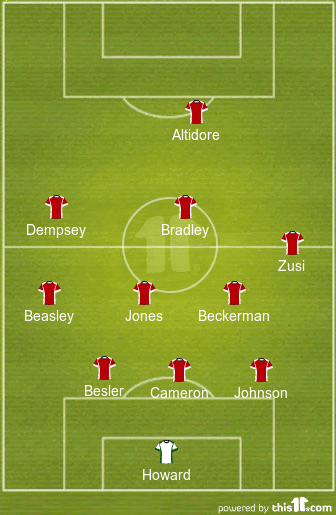
Can anyone make sense of the new diamond midfield that’s really more of a parallelogram? Today, Zonal Marking and MLSSoccer.com’s Central Winger gave it a try.
With the fullbacks spending so much time on offense, maybe it’s the old W-M formation:
Or not — Jones may be nominally the left mid but is more of a destroyer. Like so.
That doesn’t seem right, does it? Maybe move Beasley farther up the field and shift the defense to cover that space. Have Beasley link up with Dempsey on the left, like so:
You could call that a 3-3-1-2-1, but the midfield roles should be fluid. So for sake of simplicity, we’ll call it … uh … we’ll call it …


 Duresport.com