soccer

Is MLS liable for a player’s foul temper and concussion treatment?

A lawsuit filed by former D.C. United goalkeeper Charlie Horton raises a few interesting questions … and some that seem a little less interesting. (Disclaimer: I’m not a lawyer.)

Like many legal documents, this suit has a few aspects that will make anyone with the slightest knowledge of the sport laugh out loud. I’ll never understand why lawyers think they can get away with such nonsense, but they’re not alone in the “post-fact” landscape. Horton’s four caps with the U23s (sharing time with Cody Cropper, Ethan Horvath and Zack Steffen) are distorted into “a starting goalkeeper for the national team.” That may be technically true. The assertion that Horton played in Olympic qualifying games is not. He was on the roster, but Steffen and Horvath played all five games (four wins, one very costly loss).

The allegation is as follows: After United’s players watched video of their recent match against Dallas, Espindola confronted Horton about a practice-field incident “weeks prior.” Horton said he wasn’t interested in talking about it, but then …

(Again, this is the plaintiff’s side of the case — we’ll see how the various defendants dispute what happened.) Espindola is the sole defendant in the first three counts of the complaint: assault, battery, and intentional infliction of emotional distress.

The next day, coach Ben Olsen met with Horton. Here’s how the plaintiffs sum it up:

The notion that a coach, a team and a league may be negligent (Count IV of the complaint is “negligent supervision,” directed at Olsen and United) for hiring a player with “fire in his belly” won’t win Horton and his legal team many sympathizers in the soccer community. And skeptics will question how Horton was able to play for the Richmond Kickers (8 games, 16 saves, 0.88 GAA — good enough to get called back up to United for part of the summer) and return to preseason camp with United, only to announce his retirement after Olsen told him he wouldn’t make the team in 2017.

But here are the interesting aspects:

1. Is MLS, under the single-entity structure, liable for all the actions of all its teams? 

Count V (Negligent Hiring and Retention) is directed at MLS, with this paragraph included:

2. Did D.C. United follow proper concussion procedures?

Curiously, no one on United’s training staff — which surely would’ve been responsible for any decision on whether Horton trained that day — is listed as a defendant. It’s Espindola, Olsen, United and MLS.

The complaint goes on to say Horton’s condition worsened overnight. He then reported the problem to trainer Brian Goodstein, who referred to an unnamed doctor and put him in the Concussion Protocol.

Count VI of the complaint is “Respondeat Superior/Vicarious Liability,” which would surely require a lawyer to untangle.

The complaint doesn’t specify an amount of damages sought. See the full version at Courthouse News.

The law firm is Ashcraft & Gerel, which advertises frequently on D.C.-area television.

For sake of comparison: When Bryan Namoff sought $12 million for his career-ending concussion, he sued Goodstein, then-coach Tom Soehn, D.C. United, then-team physician Christopher Annunziata and Commonwealth Orthopedics. He also had a malpractice suit against United, Goodstein and Commonwealth, plus a separate malpractice suit against Annunziata. In skimming through the docket reports, it seems these cases dragged on forever, with a couple dozen doctors and a few outliers (Langley School? Arlington Soccer Association) also served with subpoenas.

(Disclaimer: I’ve been treated at Commonwealth, as have a couple of relatives. My hand is much better now, thanks.)

As Steven Goff reported, that case did not end well for Namoff.

D.C. Superior Court documents show the sides did not settle. The case, which sought $20 million in total damages, was dismissed.

A judge ruled workers’ compensation laws barred Namoff’s claim against United, Soehn and Goodstein.

Namoff’s claim against Annunziata and Commonwealth Orthopaedics was withdrawn after the defense provided a detailed list of evidence that Namoff was not as sick as he stated.

In an interview Tuesday, attorneys for Annunziata and the medical group said no payment was ever offered or made.

Why wasn’t MLS sued as well? Perhaps it’s simply the different nature of the injury. Horton claims Espindola inflicted his injury, and MLS is negligent for employing him. Namoff wasn’t claiming an assault; he was claiming negligent medical care.

So in addition to the ongoing concern about concussions in sports, the Horton case could be one to watch for those interested in understanding the league’s complex single-entity structure.
olympic sports, soccer

USA Hockey vs. U.S. Soccer: Quick comparison

With the U.S. women’s hockey team (and possibly the men’s team as well) on the verge of striking through the World Championships, this seems like a good time to compare USA Hockey to U.S. Soccer.

Which … isn’t easy. You can compare each organization’s Form 990s, as I’ve done in the chart below, but one line item might not equal another line item. I get a headache just thinking about lawyers arguing the definition of “program service revenue” and so forth.

One key difference: When U.S. Soccer lists its highest-paid employees, you’ll find coaches and players. Not at USA Hockey.

Viewed historically, that makes sense. Before MLS, U.S. Soccer paid its men’s players to be part of the national team. Today, they get substantial World Cup bonuses that can easily put their names in the 990 forms. USA Hockey’s men get paid well in the NHL, and there has been no need to pay them more. The women’s team is arguing now that its players need professional salaries, and they’re not going to get them from pro club play just yet.

So the next question is obvious: Can USA Hockey afford it? Again, I’m not enough of an accountant to say no, but the budget outlined here suggests they’d need some more revenue.

Which raises the next question: Can USA Hockey attract sponsors to pay the players? USA Track and Field, included for sake of another comparison, has plenty of sponsorship money.

And one totally unrelated question: Is USA Hockey spending an absurd amount of money on website hosting? They list one registration contractor (Neural Planet, $212,198), one web host (TST Media/NGIN, $158,440) and one “programming, support and hosting” contractor (The Active Network, $180,250). I didn’t see similar listings for USSF and USA Track and Field, but could they be spending just as much money on in-house employees doing roughly the same thing?

[gview file=”http://www.sportsmyriad.com/wp-content/uploads/2017/03/Fed-form-990s-Share.pdf”%5D

If you prefer to see it as a Google Sheet, click here.

Sources (transcribed, not scraped, so any transcription errors are mine):

olympic sports, soccer

News for soccer and Oly fans (including NWSL) trying to cut the cord

Earlier this month, the A+E networks — including new NWSL home Lifetime — joined the beta test for Hulu’s live TV service.

The big news today is the addition of NBC cable networks, though not NBC itself. The stories don’t specifically mention NBC Sports Network, because a lot of people who write about TV don’t watch sports, which I’ve always found odd. (Seriously — several of the stories make a big deal about Comedy Central, which most of us are watching on YouTube these days, and they don’t go into detail about actual live programming that we might want to watch as it’s happening. Even Awful Announcing talks about missing out on NBC and Comedy Central without mentioning NBC Sports Network, haven for diverse sports such as the Premier League, NASCAR and bidding on cars.)

YouTube already has a few sports networks for its planned launch.

The most comprehensive chart comparing the existing streaming services (Sling, PlayStation Vue, DirecTV Now) is at CNET. Then check Business Insider for some good details focusing on sports and adding Hulu and YouTube.

For the handful of networks that appeal most to soccer and Olympic sports fans, I’ve taken a table-maker for a test drive here:

[attc id=4]


women's soccer

What happened to the Washington Spirit?

I spent several weeks reporting this piece tracing the club’s trajectory from “30 seconds from the title” to “who’s starting for this club?” and “what happened to the youth clubs?”

I did not pick the word “downfall” in the headline, which immediately made me think of Meme Hitler screaming about the Krieger trade.

Source: So close, and yet so far: the curious downfall of the Washington Spirit | Football | The Guardian

women's soccer, work portfolio

U.S. women’s soccer: Always look on the bright side of life

Sure, they lost 3-0. But they learned a lot, and the crowds keep coming out to see them even when they’re not seeing a bunch of celebrities crushing some hapless, unfunded national team just happy to be staying in a nice hotel.

Go ahead and rip me on Twitter. I won’t be responding. At least until Easter, when all bets are off.

My analysis, quotes and words of comfort from what’s probably my last appearance in the RFK pressbox …

Source: USA women suffer worst defeat in a decade as France win SheBelieves Cup | Football | The Guardian

women's soccer

Steffi Jones’ homecoming, anthem update, other notes from RFK

German women’s coach Steffi Jones has every reason to be pleased tonight. Her team took an impressive 1-0 win over England, and she did it in her old home stadium from her Washington Freedom days.

“That was about 14 years ago, but I was still feeling home,” Jones said. “I remember so many great games here, the great fans. I was feeling good coming back. I know it’s going to be a new stadium coming, so me being in here one more time is a good, good feeling, yes.”

She was too polite to mention that the place looks like it’s about to fall down. A few newcomers to the RFK Stadium pressbox have been looking around in disbelief.  And the cookies and brownies in the hospitality room have disappeared.

But a good crowd has filed in here, despite the threat of rain. Sunil Gulati is here. So is Abby Wambach.

This is probably my last trip to the pressbox, so it’s a little sentimental for me, too.  So many memories of incomprehensible PA announcements, nachos and bad weather. And great soccer.

One note from the lineup: Former Spirit players Ashlyn Harris, Ali Krieger and Crystal Dunn are NOT in the starting lineup. You could say Jill Ellis is a spoilsport, or you could say she simply cares more about developing her team than anything else.

And … it’s pouring again. This stadium always makes it interesting.

Thoughts on the game at some point tomorrow and later this week.

UPDATE: I also got a little bit more information about the national anthem policy (NOT BYLAW) and why it was not included in the “book” that’s released before the Annual General Meeting. The quick answer: Not enough time. Items from the February board meeting simply couldn’t be added to the book. (You might argue that they still could’ve sent out an addendum, of course.)

I was also told the when the policy appeared on screen at the AGM, the crowd of state and association reps from all over erupted with a loud cheer. Take that for what it’s worth or whatever you want to make of it.

soccer

A partial clarification on the U.S. Soccer anthem policy (not bylaw)

“Why didn’t we know about this national anthem bylaw before U.S. Soccer voted to approve it yesterday?”

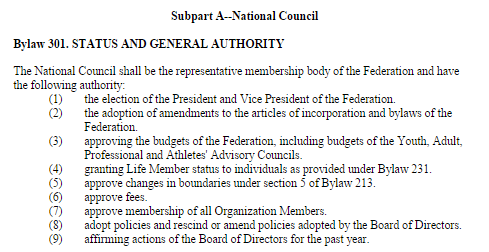
First up: It’s not a bylaw. It’s a policy. One big difference between the two is that bylaws — such as the one approved yesterday setting term limits on the president and vice president — don’t exist until they go before the National Council says yea or nay at the Annual General Meeting. See duties (2), (8) and (9) here, from the bylaws:

national-council

Bylaw discussions have been surprisingly contentious in past years, even if the bylaw is something along the lines of “rename the Audit Committee to the Audit and Compliance Committee.” (That’s not a real one, but if you go back through the transcripts, you’ll find something close. And you can see all those transcripts, along with the bylaws and policies, on the U.S. Soccer site. In fact, let’s look at how picayune these bylaw changes can be, while also taking a look at who’s included in the National Council. It’s not just the bigwigs. This is from this year’s book with the AGM agenda, showing some proposed changes …)

council-members

Policies are set by the Board of Directors (bigwigs) throughout the year, and they’re often things that can’t wait until the next AGM. Last year, it was the new Open Cup policy banning teams whose rosters are controlled by a higher-division team (in other words, USL or NPSL teams that are literal or de facto reserve teams for MLS or NASL clubs can’t play). The National Council, as you see above, can either affirm these policy decisions or reject them.

In the case of the national anthem, the National Council was affirming a policy set at a February board meeting. The minutes for that meeting are not yet posted.

But I was still kicking myself a little when I saw the uproar over the national anthem policy (again — not bylaw). I read the whole AGM book as part of the three months of research that went into this Guardian story. I managed to spot a bylaw amendment (as part of a general overhaul, not a separate vote like the term-limit bylaw) that would remove the Hall of Fame and Society for American Soccer History as U.S. Soccer historian. I alerted the unofficial membership of the Society for American Soccer History, which includes people who worked for the Hall of Fame, and they seemed a bit alarmed. But no one made the case that the vestigial Hall staff or the ad hoc Society (I’m one of two people to attend our last two meetings) had actually been serving as U.S. Soccer historian in recent years. So I still don’t know what it means, and I’m … digressing. Back to the point …

As it turns out, the national anthem policy was not in the AGM book. (Unless I’m reading over it, and unless my PDF reader’s search function is broken.) I still have a vague memory of reading about the anthem policy, but I simply can’t find any such reference now.

The only source we have for this is Stuart Holden’s Twitter account. I’m not supposed to be on Twitter until Easter, but I did check out his timeline to see if he mentioned anything about the discussion or the vote. He did not.

So I guess I’ll have to get in touch with some people who were at the AGM in Hawaii. I’ll start calling and emailing on Monday when they’ve flown back to the mainland.

If you were there or can shed some light on this, please let me know.

Meanwhile, please don’t overlook the fact that Val Ackerman is now on the board. Or that the term limits mean it’s “put up or shut up” time for people who want to steer U.S. Soccer a little differently. Maybe start by glancing at the bylaws and trying to figure out how the federation works, because I’m starting to think Sunil Gulati and a few staffers in Chicago are the only people who know — and that’s our fault, not theirs.

soccer

U.S. Soccer approves term limits, elects Val Ackerman

No surprises today in Hawaii — the U.S. Soccer general membership approved term limits for board members, with the president now limited to three four-year terms.

Also, they’ve added former WNBA president, former USA Basketball president and current Big East commissioner Val Ackerman to the board as an independent director.

That’s a big deal for women’s sports fans. I’m not sure who would have a better combination of general sports and women’s sports experience on her resume.

It’s still a very male board — just three of the 15 voting members are women. Ackerman joins Donna Shalala, a fellow independent director, and Cindy Cone of the Athletes’ Council.

I’ll link to the press release when I see it online (for now, it’s just in my mailbox). And don’t forget to read my story on U.S. Soccer to put all this in context. Basically, if you want change, now’s a very good time to speak up.

soccer, work portfolio

MLS 2017 power rankings: Median, mean and ???

I’ve compiled power rankings / predictions / odds from several sources and presented them below in order of median. I chose to emphasize the median over the mean to diminish the influence of the rogue picker. But you can also see the mean as well as the standard deviation as a measure of how much disagreement the pundits have for each team.

Rankings are from FiftyFiveOne, Matt Doyle (MLSSoccer.com), Nate Scott (Fox), ESPN FC, SI, SBI/USA TODAY and Bovada.


ranting soccer dad, soccer, work portfolio

About this story: How this weekend could shape US Soccer’s long-term future

Reminder: I’m off Twitter for a while aside from automated stuff like this. And the next one. And the next one. So if you want to chat with me about this story, why not chat here?

And this one has a bit of a back story, anyway. I’ve been working on this for months. One reason it took so much time is the staggering number of documents I read — financial reports, transcripts from annual general meetings (“Alabama … here … Alaska … here … OK, now the adult associations … Alabama … Alabama … Alaska … here …”) and so on.

Another reason might surprise you: A lot of people weren’t interested in talking. But I didn’t sense that they felt intimidated. They simply didn’t know anything.

I’m grateful that they admitted it. They’re not the Twitter pundits who think they have all the answers on reforming U.S. Soccer but have never even peeked at any of the information the federation puts online. A couple of people had nothing to add to this story but were looking forward to seeing it published.

So there’s a “put up or shut up” element to this story. Sure. If you really want to see some new people in charge, speak up now and over the next four years, because a lot of people may soon be term-limited off the board.

But I also hope it gives people a bit of a peek behind the curtain. Sure, anyone can read the same documents I did and maybe even talk to some of the same people I did, but it takes some time. If you understand U.S. Soccer a little better after reading this, I’ve done my job.

And if you have anything to add now, please do.

It’s an exciting time for soccer. The sport’s profile in this country has completely changed in the past 15 years. So what’s next?

Story: How this weekend could shape US Soccer’s long-term future | Football | The Guardian