home, ranting soccer dad, soccer

The best post-T&T pro-promotion/relegation argument

Predictably, Soccerocalypse has brought out the usual arguments from the promotion/relegation crowd:

  1. Youth development will be so much better!
  2. Players will be under constant pressure!

If anyone could turn their attention away from Twitter long enough to read something longer than 280 characters at a time, they would have seen this addressed in the pro/rel series — both pros (and alleged pros) and cons.

The short versions:

Youth development: European clubs that have good academies have them so they can sell players (and yes, solidarity payments/training compensation is a legitimate issue with legal potholes I can’t fully comprehend). Chelsea’s inability to develop a first-team player from within is legendary, just one example of a “broken” academy system in the birthplace of soccer.

MLS has actually made progress in youth development because its clubs know they can avoid the boom and bust of pro/rel. They feel confident spending millions to create what wasn’t there before. Then they have a pathway, via their oft-derided relationship with USL, to send promising 17-year-old players to the first team via the USL bridge.

And then MLS teams can play their youngsters because they know they’re not going to be relegated. That’s one reason why MLS has developed so many players who turn around and beat the USA in CONCACAF. (I have heard arguments that MLS needs to impose stricter limits on international players. Then I’ve heard arguments saying MLS needs to spend more on international players to raise the level so that any U.S. players who make that first team will be more appropriately challenged.)

Pressure: Yes, we know. Someone in a German locker room threw a shoe at Eric Wynalda.
shoe

First of all, the idea that you’re “playing for your job” at every training session in Europe but not in MLS is inflated. European clubs aren’t going to cut people mid-contract. You can lose a starting spot, sure, and then you can regain it the next week. That’s not unique. If you want to see job insecurity, watch the NFL, where a kicker can miss once or twice on Sunday and be unemployed on Monday.

Second: Bobby Warshaw tells a different story of playing for a relegation-threatened team. His teammates in Scandinavia all just wanted to wash their hands of it and be gone.

And it’s not as if pressure always makes diamonds. Sometimes, it makes dust. In this clip, Woody Harrelson is Trinidad and Tobago. Wesley Snipes is the USA.

https://www.youtube.com/watch?v=fgJ2CaTfaxU

The USA didn’t lose because the media and supporters are too nice to them. They played tense. Cautious. Trinidad and Tobago did not.

After Prince died, Saturday Night Live ran a tribute. Jimmy Fallon told a story of being at a party where he was on stage wondering if he could get Prince to come up and play. Then he saw the crowd parting and Prince basically floating to the stage. Prince came up to Fallon and gave him a look that said, “Yeah, I got this.”

That’s what the USA needed. Not overconfidence. But that sweet spot between confidence and complacency in which they say, “I got this.” Only Christian Pulisic, who’s too young to have been through the same CONCACAF wars (or relegation battles — see Altidore, Jozy) as his teammates, played with that attitude.

But let’s say there’s a benefit to playing in a league that’s more intense than MLS — though, if you were ever in a locker room with Taylor Twellman or Dom Kinnear after a game, you know things can get pretty intense. Why is Germany more intense than the USA? Why is Germany more intense than Scandinavia?

It’s because Germany has a deeper soccer culture.

Same reason Mexico and the big Euro leagues are more intense than MLS or Scandinavia. For all the progress made in the USA since Paul Caligiuri took a wild shot in Trinidad in 1989, this country is still a good bit behind everyone else. Youth soccer participation plateaued and then started dropping, and while a lot of those kids turn up wearing Messi or Rooney jerseys, a lot more never watch soccer on TV or in person.

So if you want to make a good argument for promotion/relegation, try this:

Pro/rel will help deepen the soccer culture in this country.

And I believe that. Most of what I’m saying here on pro/rel is the same stuff I’ve been saying for 15 years, no matter how much it’s been misrepresented by the PRZ on Twitter. But this is an argument that I can’t remember hearing before. Maybe some people made it, but it was drowned out in all the “PRO/REL WILL OBVIOUSLY MAKE EVERYTHING BETTER BUT MLS/SUM/USSF/STEVE BANNON ARE CONSPIRING TO KEEP THE NFL BIG” nonsense.

This is your argument. This is something you can present to people who have money on the table — not the Monopoly money Silva and company threw at MLS so they could create the narrative that MLS turned down a gazillion bucks to institute pro/rel now.

Is it enough? I don’t know. The other realities still exist. We have a Division I soccer league now where we didn’t in 1992, and it’s because people were enticed to invest in a scheme that reduced the risk from “might as well burn your money” to “there’s a small chance this might work.” If you’d told people in 1992 we’d have a soccer league that consistently drew 40,000 people in Atlanta and Seattle, people would’ve laughed at you. (Especially Atlanta. I grew up in Georgia, and I’m astounded.)

But if the pro/rel crowd is willing to drop the nonsense, along with the conspiracy talk and nonsensical legal actions, maybe there’s a chance to win the argument.

If I were elected USSF president (no, I’m not running — there’s a reason a lot of sane, qualified people from Peter Wilt to Julie Foudy aren’t interested), I’d do the following:

  1. Divisions 2 and 3 go pro/rel next year. I’m torn on whether the USL brand name should stay. The NASL brand name should not. It has a history of incompetence, and even the glory days of the late 70s were built on non-traditional glitzy Americanized soccer. Besides, given the existence of Mexico, the “North American” part of the brand name never rang true. Keep the clubs — to start, put the clubs on the soundest financial foundation in D2 and the others in D3.
  2. Division 4 becomes the top amateur division (semipro clubs are allowed to compete, but it’ll be mostly amateur, as these leagues are now) for the top tiers of the major amateur leagues — PDL, NPSL, UPSL, Cosmopolitan, GCPL, other USASA Elite Amateur Leagues. Clubs that finish in the top three of these leagues can apply for D3 status — for the foreseeable future, only a few clubs will do that. (At this point, I don’t think we can or should relegate clubs from pro D3 to amateur D4. If D3 gets too big, start a pro D4, more or less mimicking what England has recently done with its fifth tier.) Have a D4 national championship if it’s feasible, replacing some of the existing and sort of redundant national amateur cups.

Two reasons to this. First, it’ll make the lower divisions much more interesting.

And it just might demonstrate to the powers- and purseholders-that-be that there’s a benefit to expanding the pyramid and building a soccer culture.

Or, you know, just yell and scream and sue. That’s working so far, right? And competition between uncooperative leagues worked so well that we’re about to celebrate the 100th anniversary of the ASL, right?


home, women's soccer

No one injured in Spirit-Breakers game

Neither the Washington Spirit nor the Boston Breakers tanked Saturday night’s game to get the No. 1 draft pick. For once, my prediction was right.

But it wasn’t pretty. I didn’t notice any Spirit Academy kids in the crowd, and that’s probably for the best. You don’t want them to learn anything from this. Two own goals by the same luckless player, former Breaker Kassey Kallman. No shots for the home team in the first half. Fouls that weren’t particularly malicious but just pointless. Passes that clattered into opponents.

The Breakers played hard, and aside from two maybe-overdue yellow cards, they played fairly. Own goals are often a mix of luck and getting the ball in good spots, and the Breakers got the ball in good spots many times in the first 10 minutes of the second half, turning a 0-0 snoozer into a 3-0 game with a bit of life.

And the Spirit didn’t pack it in. Two terrific strikes were called back due to close but probably correct offside calls. The silver lining (coincidentally, the Rilo Kiley song of the same name is now playing on my Spotify mix) for the Spirit: They put the ball in the net four times! Too bad two counted against them and the other two didn’t count at all.

Late in the game, those of us in the pressbox were wondering why Breakers coach Matt Beard was so animated, chastising his team and gesticulating wildly. After the game, the thoughtful and tactically shrewd coach explained that he was legitimately worried that the Spirit might come back, like Sky Blue has on more than one occasion this season. When you haven’t won a road game in a while, a little paranoia is understandable.

So yes, both teams were trying. It wasn’t just a couple of teams tanking to land Andi Sullivan in the 2018 draft. At this point, the Spirit seem destined to land their hometown hero. And tonight, they looked like they needed her. Some of the players on the field simply were not up to the task.

And it’s not as if the Spirit have many other options. They dressed 14 players for the game. (The Breakers, also limping toward the finish line of the season and missing game-changer Rose Lavelle, only dressed 15.)

Coach Jim Gabarra said quite candidly after the game that his team really didn’t have the training they needed to prepare. Too many games in a short time. Too many injuries.

“So you didn’t think it would be a good idea to run your players through a series of intense practice in 90-degree weather with only three available subs?” I asked (paraphrased).

“Probably not,” Gabarra said.

Spirit fans weren’t about to forget the birthday of their last remaining original player, Tori Huster.

Spare a thought for Spirit fans who’ve attended most of the games this season. They’ve seen a lot of bad soccer, and it’s not all from the home team.

Maybe it’s a strange thing to say about a team in last place, but the Spirit overachieved in many ways this season. Stephanie Labbe and Estelle Johnson were having great seasons until they abruptly ended a couple of weeks ago. Arielle Ship was better than expected. Meggie Dougherty Howard was way better than expected — even people who wish the next hurricane would race up the Potomac and destroy the Maryland SoccerPlex because they so despise Spirit ownership have pegged the late third-round draft pick as a solid pick for Rookie of the Year.

But Spirit fans really haven’t been treated to a lot of quality from their visitors, either. Portland showed little in Mark Parsons’ return to the SoccerPlex. Orlando wasn’t quite the Morgan-and-Marta juggernaut they later became. The Chicago Red Stars looked like they were playing old-school roller derby. The best game of the season, oddly enough, may have been the previous Spirit-Breakers game, when Boston goalkeeper Abby Smith flat-out robbed the Spirit (legally) of a win.

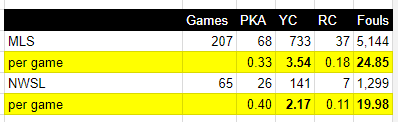
Call it bad luck, compounded by some personnel moves that will leave some lasting bitterness. Frankly, the quality of play in the NWSL has been poor this season. If you want to blame anyone, blame the referees who’d rather carry on conversations with players like Allie Long and McCall Zerboni rather than give them cards for any of the 349 fouls they commit each game. That needs to change.

One thing that’s not going to change — the occasional late-season game between tired, ailing teams at the bottom of the table. And if this game proved one thing, it’s that the women’s game is not ready for promotion and relegation, no matter how many U.S. Soccer presidential candidates try to win points by promising it. These coaches can’t afford a training injury, and there’s absolutely nothing to be gained by tossing Rose Lavelle or Cheyna Williams out on the field at this point just so they can avoid swapping places with WPSL champion Fire And Ice SC. (Granted, if the problem with Lavelle is that she’s flying too much, may I suggest a bus with adequate sleeping space? And no, I have no idea what possessed anyone to name a team “Fire And Ice.” Does Shy Ronnie play for them?)

Even in a no-good, horrible, very bad game such as this, you’ll see moments of quality. Smith didn’t have to pull the mind-boggling saves she made last time to get the shutout this time, but she was terrific when she needed to be. Mallory Pugh adds life to any attack, whether it’s the U.S. national team in full flight or whichever players the Spirit can scrape together around her.

The Spirit will be better-prepared when Seattle visits for the season finale. I’m predicting a 6-5 game with 30 saves. We’re due.


home, medal projections, olympic sports

Presenting the Perpetual Medal Count

How are each country’s Olympic athletes trending in World Championship and other competition? Glad you asked.

As it stands now, U.S. athletes are doing quite well, tracking a good bit ahead of how they finished in Rio 2016. So are Russian, Australian, Chinese and French athletes. British athletes, on the other hand, are falling rapidly.

pmc20170802

What does this mean?

Check out the Perpetual Medal Count, which adds up each country’s performance in Olympic events through all relevant World Championships. Each country starts with its medal count from the Rio Olympics, then gains or loses medals depending on how its athletes do in those events. In the chart above, the Rio medal count is on the left, and the Perpetual Medal Count on the right, with a plus/minus category at far right.

So if there’s been no relevant competition thus far (as in archery, badminton, basketball, boxing, canoeing, mountain bike, road cycling, equestrian, field hockey, golf, gymnastics, women’s handball, judo, modern pentathlon, rowing, rugby sevens, sailing, shooting, tennis, some volleyball, weightlifting, wrestling, and — until next week — track and field), the medals are still in the hands in the countries that won them in 2016.

Here’s how things stack up in some of the events that have been contested so far:

Track cycling: A huge 10-medal loss for Great Britain, which dominated in Rio and barely missed a shutout in worlds. Australia gained four.

Diving: More losses for the USA (-3) and Britain (-2); big gain for Russia (+4).

Swimming: Believe it or not, the USA broke even — 33 medals in 2016, 33 medals in Olympic events (including open water) in 2017. Add the new Olympic events, and the USA gets two more. The other major countries also came close to matching their Rio totals.

And the new events throughout the Games give the USA a huge boost — 15 medals total, though it’s tough to tell whether the skateboarding competition for the Olympics will resemble any other competition.

This will be updated every couple of weeks while we still have a lot of World Championships going on, then more sporadically in 2018, then picking up again in 2019.

Next up: the winter version.

home

Meet the new site, not quite the old site

SportsMyriad had a weird, wonderful seven-year run. The last year was a bit half-hearted, honestly — a hacker attack sapped my energy, and I’ve been retrenching, work-wise.

I’ve migrated my posts and pages over here, essentially combining my two sites. Simplify. Zen. All that Eastern philosophy stuff but with an English-language keyboard.

And I’ll still blog on occasion, but this site will feature work I’m doing here, there and everywhere. That includes a new podcast on youth soccer and related topics (general soccer, parenting, philosophy, migrating to Mars), and I’m quite excited about it.

Follow, tune in, enjoy.

home, soccer

Single-Digit Soccer: NSCAA convention presentation (abridged)

On Saturday, I had the honor of speaking at the NSCAA Convention, presenting what I’d put together toward my Single-Digit Soccer book, sharing ideas, and making bad jokes about my youth team being named Athens Applejacks.

In case you couldn’t make it — or in case you weren’t writing things down — here’s a synopsis. It may even have some things I forgot to mention. U.S. Youth Soccer will also post slides later.

About the book

Single-Digit Soccer is an exploration of issues, a guidebook for parents, a collection of fun stories and so forth — all in the U-Little age groups (U10, U9, etc.).

The book will come out sometime this year, but I’m still seeking input. Please chime in and let me know what you think.

About me (writer)

USA TODAY, Long-Range Goals, Enduring Spirit (if you’re on this blog, you already know I can be found here). My youth soccer work started in earnest when I covered the unveiling of the U.S. Soccer curriculum for ESPN.com.

About me (parent coach/player)

Yes, I was the starting sweeper for the U14 Athens Applejacks 1970. As a player, it’s been all downhill from there, and I recently retired from indoor soccer goalkeeping because my hand didn’t recover from a couple of saves.

As a coach, I’ve been involved with House league, All-Stars and a “crossover” program in which our U7s and U8s sign up for extra training and play against teams from other clubs. I have an “E” license and will get my “D” this year.

The age we’re talking about

I love this video:

Mixed messages

There’s a chasm between what we say and what we do. U.S. Youth Soccer says we shouldn’t have competitive tournaments, tryouts or a split between “recreational” and “competitive” at U10. Then we have U9 State Cups.

Tryouts

We worry about kids not having enough fun, getting too serious too soon, and then quitting. So at U9, we’re telling kids they’re not good enough. You don’t get to train with the great coach. You don’t get the fancy warmups. You can’t play in a tournament.

The kids who make it

Then we tell other 8-year-olds they’re hot stuff. These kids strut around school like they own the place. “Hi, Coach Beau! I’m really good — I made travel!” Then coaches wonder why these kids aren’t devoted to improving themselves. It’s like Nuke Laloosh with the quadraphonic Blaupunkt.

Trickling down

And it trickles down even lower. U8 ID Days. U6-U10 Tryouts. And if your club isn’t doing these hyperserious things, the club next door is. In our “crossover” league, we took 48 kids who just signed up, split them into four teams and took them into games against teams that had tryouts for the top 12 players. It was House players who signed up for additional training vs. a travel team in everything but name.

ISSUES

The idea here is to frame the discussion. Some of these issues don’t have simple solutions. Some are just things to weigh in the balance when making any sort of decision about soccer — how to set up a club, how to coach, what parents should look for, etc.

How much is this going to cost?

Big issue, especially for parents. Travel teams can easily cost $1,000 per season not inclusive of tournament fees, uniforms, postgame stops at McDonald’s, etc. And one elite league in my area has a four-hour, 35-minute drive between clubs. For a league game.

How much time will this take?

Again, see that travel distance. Now all these other commitments. Welcome to the U9 Academy, where you’ll spend three days a week training for your 30-35 games in a 10-month span.

What do parents really want?

Not that simple. Some are chasing college scholarships. Most just want their kids to do something fun and healthy. Some hope their kids can play high school soccer. Some hope their kids get the social experience of playing travel soccer with other kids who love the sport. And some don’t want to drive more than five minutes to practice.

Should we play year-round?

Probably not. That’s what orthopedists and psychiatrists would say. But parents are terrified of their kids being left behind. Or they play indoor soccer in the winter because they get something different from that than they get from their house leagues — they can play with their buddies.

Winning vs. development

The big one. Entire rooms at NSCAA tackle this issue. And we all say development. Are you rotating everyone on defense and in goal? Are you selecting only small numbers of players, like some teams do in our crossover and All-Star tournaments? Are you teaching your players to foul, dive and do other acts of wanton gamesmanship? I saw it at a U9 tournament.

Fun vs. development

Some kids are content playing “Mr. Wolf, What Time is It?” Some want to play actual soccer. And then there’s the whole notion of keeping score. A lot of kids want to do it.

Fun vs. structure

How many of your clubs have time set apart for free play, where kids can come in and play in mixed groups with parents and coaches told to shut the bleep up? We say the game is the best teacher. We warn against joystick coaching. Is that message getting across? A program near me has three training sessions for every game at U8 — the games are every other week, and they just play other kids in the program. I can’t think of a kid I’ve coached, and I’ve coached some very good ones, who would enjoy that.

Fun vs. parity

Kids like to play with their friends. Some groups of friends have greater interest in and aptitude for soccer than others. So the typical house league might bust them up. Fair? Perhaps. Fun for all? Maybe not. Are there other ways this house league could be fair without splitting up all the groups of friends?

Development vs. parity

Are unevenly matched games a good challenge? Or a waste of time?

What kind of development?

Some clubs and curricula think we should teach passing at early ages; some insist that you can’t. When Claudio Reyna unveiled the curriculum, he warned against “overdribbling.” Coaches at the back of the room were puzzled. (I bumped into Reyna soon after the curriculum presentation — he used Barcelona as an example of a team that takes 1-2 touches and then passes, rarely dribbling.)

Tracking/segregating

Do “A” players need to train apart from “B” players? Will it drag down the “A” players to be around other kids? Should we ban them from playing at recess with their buddies? And what’s an “A” player at age 8 anyway? Can we do it differently, perhaps putting everyone in one pool and only pulling them out for voluntary extra training and merit-based tournaments?

Burnout

Are we burning these kids out? Mentally and physically?

RADICAL IDEAS

This part will work best when you can see the slides. I list the issues on one side of each slide, and I highlight the ones that are addressed by each idea.

These are not Commandments. These are discussion-starters. Some of them actually contradict each other. Some may make sense for one club and not another, depending on your geography, your schools, your staffing, etc.

Tailor practices to your team, not vice versa

By all means, try to follow a curriculum, but meet reality at some point. Your curriculum may tell you to do a completely different set of exercises each week, but your kids may not have that kind of attention span. The kids I coach usually don’t, and I can’t spend half of every practice explaining the new exercises.

Put more coaching education online

This is actually happening — through NSCAA, U.S. Soccer, AYSO and others. That’s great. We need to train parent coaches, and they can’t always drive 90 minutes for two weekends a year to get a “D” license. We’re asking them to volunteer as soccer coaches, not join the Army Reserve.

Don’t push specialization

We need to make what we say match what we do. I’m not sure how. Maybe just talk to your parents. The trouble is that if you don’t offer something, they may sign up for a program somewhere else. But we can encourage kids to do other things. Basketball will help teach team tactics. Swimming will keep them fit. Martial arts can teach discipline. Chess, music, acting — everything else will make them well-rounded people. That, moreso than a singular focus on soccer, will help kids at college admissions time.

Teach positions, or at least basic tactics

My first youth sports experience was at the Athens YMCA playing four sports a year, mostly under the guidance of football coaches. In football season, we ran plays. The coach could call “32,” and I knew it meant a running back was going run into the hole between me (the right guard) and the center. Then in the spring, we all played 11v11 soccer, and it wasn’t a total train wreck.

One reason this is important: “Magnetball” can easily drive skilled kids out of soccer. They can’t get the ball, so they can’t use their skills.

Do programs through school

We ask parents to pick up their kids from school, take them home for an hour or three, then drive them back to a soccer field that might be right back at that school. Meanwhile, the local karate school is picking the kids up in a van. Parents who strain to make one soccer practice a week will gladly sign their kids up for five days of karate. It’s not because they’re chasing a karate scholarship.

Don’t travel more than 90 minutes for league games

Some people in the audience objected because their geography demands such travel. That’s understandable. In the metro D.C. area, it seems ridiculous.

Part-time travel

This is what I see in our local baseball, and guess what? We produce a lot of good players without segregating people. The players all play Little League. A few of them also get “elite” play on a travel team that just plays a handful of games.

Group by skill level, not age group

Another idea borrowed from baseball. If you start playing at age 7, you don’t just get tossed in with U8s who have been playing for years. You’ll likely start at Rookie baseball while more experienced 7-year-olds play Single-A. People progress through the ranks at their own pace. By the time they’re 12, they’re all in the same league.

Doesn’t that sound better than splitting into “recreational” and “competitive” at a tryout at age 8, with little opportunity to bridge the gap?

Have a program between “House” and “travel”

Another idea for keeping late bloomers in the game and for rewarding players who are serious about soccer but can’t match the elite players’ athleticism. Ideally, give everyone who wants professional training and evenly matched competition the chance to get it – maybe not every day or every week, but at some point each season.

THE ULTIMATE GOAL: Be inclusive

The one thing of which I’m firmly convinced is that THIS is the ultimate goal for all of us who care about youth soccer. We need to meet the needs of elite players with good competition, at least on occasion. We need to meet the needs of those who are not elite yet but might be. We need TOPSoccer. We need basic rec league for people just starting out. We need to give all players a good time — these are our future soccer fans and our future youth club volunteers.

And I want this project to be inclusive. I want to hear from you. Comments, email, Twitter, skywriting — anything’s fine. (But get a move on — I’d like to get this book done!)