us soccer

National B teams: It’s ‘Bout time

The Total Soccer Show guys raised a good question on their podcast from Feb. 22: Why doesn’t the USA have a “B” team?

This was specifically in the context of the men’s team, but it’s a good question for the women’s program as well. And though we could’ve asked this question any time, it’s especially relevant now.

A couple of reasons:

  1. As the TSS folks point out, the men have this little problem of not qualifying for Olympics. A “B” team would surely be mostly Under-23s with the occasional overage player. The U23s would get more experience playing together, and if they make it, they’ll be used to playing with the occasional overage player as well. (The men’s Olympic tournament really is a strange thing, isn’t it? I’ve covered an Olympic final with Messi involved, and I have virtually no memory of it except that it was like sitting in a convection oven. The Birds Nest really might be better for the Winter Olympics than it was for the Summer Olympics.)
  2. FIFA might be cutting back on its youth tournaments, leaving a big gap between U18 or U19 and the senior team.
  3. The CONCACAF Nations League will leave fewer international dates for friendlies that would usually be a good opportunity to give younger players a shot.

So, yes, having B teams would make a lot of sense, for the USA and for most other countries.

(Which means it’ll never happen.)


us soccer

Shaking off the dust for Ranting Soccer Dad’s return

Just a quick housekeeping note now that the Olympics are done …

  1. The RSD podcast will return this week, probably with a quick test episode to try out a new publishing tool, then with a special guest toward the end of the week. Yes, it’s someone you’ve heard of.
  2. The next big project will be available through Patreon. It’s the Ranting Soccer Dad Guide to Youth Soccer, which I’ll build up gradually, state-by-state. I had thought about doing it as a book, but I think it makes more sense to do it online where it can be constantly updated and enhanced.

And I’ll also have a post about that pesky old Fricker Plan.

Glad to be back. After a quick nap …

olympic sports, winter sports

U.S. men win curling gold — how it happened

If you’re a little tired of curling coverage that tries way too hard to explain the sport without telling you anything that’s actually happening on the ice, this post is for you.

This is what happened. If you don’t know the terminology, figure it out. It’s not that hard. Also, my local curling club has a good glossary.

The teams in order of when they deliver their rocks:

Sweden: Christoffer Sundgren, Rasmus Wranaa, Oskar Eriksson, Niklas Edin.

USA: John Landsteiner, Matt Hamilton, Tyler George, John Shuster.

I’m also going to refer to the shot-by-shot diagrams on the results page, which includes grades for each shot (100%, 75%, 50%, 25%, 0%). Not that they’re accurate. When in doubt, trust NBC analyst Kevin Martin, a Canadian who took silver in 2002 and gold on home ice in 2010.

1st end: Sweden has the hammer. The USA goes straight into the house with its first rocks, setting up a routine string of takeouts. The only tricky shot in such an end is the last one, where Edin needs to hit Shuster’s last rock and roll his own rock out of the house, which means he has to hit it to one side rather than on the nose. Edin does just that, meaning there’s no score and Sweden retains the hammer. Fourteen of the 16 shots are scored at 100%, but it’s all pretty routine. 0-0.

2nd end: USA opts to set up a center guard this time. Sweden sets up another guard. Landsteiner draws around his own guard into the house, and Sundgren counters with a precise shot to bump the USA’s rock to the back of the house.

Hamilton, showing he’s not just a man with a sense of humor and great mustache, follows with a terrific shot to take the Swedish rock out of the house. Then Wranaa tops that with a double takeout, clearing out the U.S. rocks.

So we have a more complicated series of takeouts because everyone has to deal with the two guards in front.

And we finally get an outright miss. After Edin draws his penultimate shot to the top of the four-foot, Shuster tries an ambitious shot that would knock his own guard into the house and take out Edin’s. He hits the guard, but it’s just a little bit off the nose, and his rock sails by Edin’s rock, leaving the top-ranked player in the world an easy draw for two. 2-0 Sweden.

One thing here showing how Shuster has changed. The stereotype of Shuster in the past is the scrunched-up face of anguish. As The Ringer’s Rodger Sherman put it:

Each time, the camera finds Shuster, whose missed stone has turned him stone-faced. His look is not “Crap, I’ve messed up.” It’s “Crap, I’ve messed up again.” He’s probably lamenting the failure, and probably remembering the aftermath of every one of his past failures, and dreading the fact he has to live through it again. Then, the tweets begin to pop up.

This time, Shuster has a wry smile, and he and Hamilton dissect what went wrong. It’s a cool, calm reaction of a man at the height of his game.

3rd end: Sundgren puts Sweden’s first rock in the top of the house. Landsteiner sets up a guard off to the side. Sweden guards its own, and Landsteiner comes around it to bump Sweden’s rock back. Wranaa swiftly removes the U.S. rock in the house to leave Sweden lying two with a guard in place, but Hamilton’s double takeout reduces that to one. Wranaa freezes a Swedish rock to his own, both on one side of the button.

The next shot shows how scoring can be inexact. Was Hamilton trying to draw around his own guard to hit the Swedish rocks? If so, he failed, and it’s 0% — as it was indeed scored. But he managed to bump his own guard out of the way, which will make it easier for George and Shuster to bring the heavy lumber. Also, his shooter has neatly rolled underneath that forgotten corner guard that Landsteiner put in place earlier.

A cool-looking hit-and-roll from Eriksson gives Sweden three clustered rocks near the center of the house. Looks good, right?

3-9

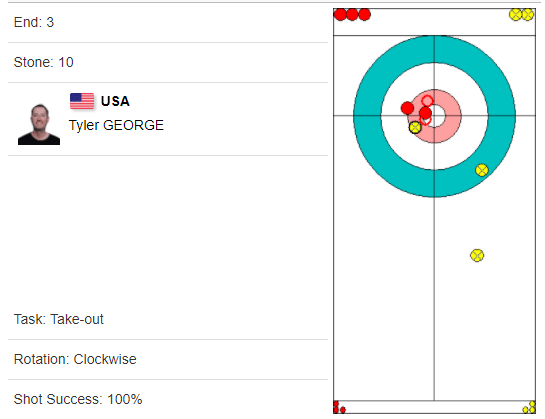
Tyler George changes that. He hits the top rock, which bangs one of the Swedish rocks out of there, and his shooter rolls just ever so slightly so it’s neatly positioned between the two Swedish rocks. Good luck getting that rock out of there, Sweden.

3-10

Again, the scoring is a little odd with the next shot. Eriksson bumps into the cluster of rocks and gets 100%, but the NBC commentators think it’s a slight miss because it leaves George a good double takeout. George responds by getting both red rocks out of there, leaving just one yellow. He gets 100% and applause from Ivanka Trump in the crowd, but he’s grimacing (as he too often does), perhaps because he thinks Edin will make a double takeout of his own. He does.

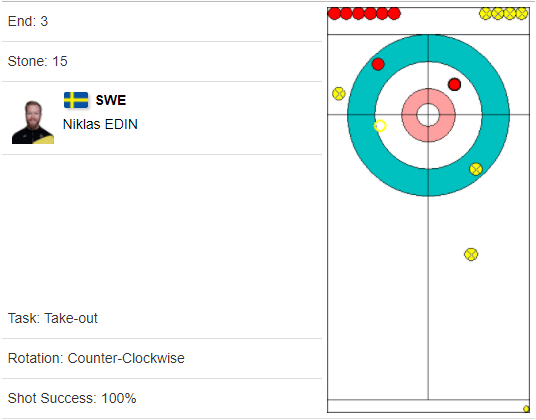
That leaves two red rocks on one side of the house, lined up for a possible double. Shuster can only get one (50%). Edin takes out the rock Shuster just threw and rolls as far as he can across the house. We’re not sure who’s second rock now, which complicates things.

3-15

Shuster can easily take out Sweden’s shot rock and score one, but maybe not two. Does he go for the double takeout to make sure he gets two?

Yes. And he hits it. It’s the best shot of the game so far, and we’re tied. 2-2

4th end: The inverse of the last end at the start. Landsteiner draws to the button. Sundgren sets up a corner guard (remember from the last end — the USA’s corner guard helped them keep a second rock in the house). Landsteiner guards his own, and Sundgren freezes to the rock on the button.

Hamilton’s draw is slightly off (75%). Wranaa also gets 75%, Hamilton gets 50% on his next one, and we have five jumbled rocks in the house. Wranaa makes it six and bumps the yellow U.S. rock off the button — scored at 100%, but the NBC crew thinks it’s heavy, and they’re right.

Shuster and George have a long conversation about the next shot to see how many of these rocks they can get out. And it’s another strange score — 100%, but no one on the U.S. team sounds pleased. Eriksson tries a difficult double takeout and gets one (though he’s also scored at 100% for some reason).

NBC says George wants to bump a Swedish red rock out of the four-foot and roll slightly onto the center line. George bumps a Swedish red rock out of the four-foot and rolls slightly onto the center line. THAT is 100%, and Sweden’s path to score two is more complicated. The chance of scoring three or more is probably out.

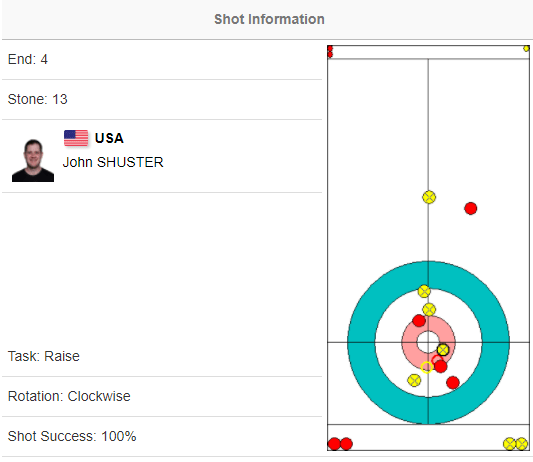
But when Eriksson hits and rolls off his own, everything is coming up Sweden. Shuster says no, threading the needle to bump in for shot rock ahead of the Swedes.

4-13

And Edin finally misses. He tries to get past that yellow at the top of the four-foot (pinkish red circle) but just nicks it, sliding off to the side. Shuster has a half-miss (appropriately scored 50%), hitting to the right of that jumble and knocking a red rock off the four-foot, but he leaves a potential double takeout from which Edin can score two. But he doesn’t. He’s a little off to the right. The various caroms leave that best-placed yellow rock on the edge of the four-foot, and we need a measurement to see who scores one. It’s the USA, and it’s a steal of one. 3-2 USA

5th end: The first four shots are virtually identical to those of the fourth end. Wranaa accidentally gives Sweden a rock to the side of the house, bumping into a guard and rolling off to the side. Hamilton jumbles things up a bit more, and Wranaa has a difficult shot to hit and roll into the center.

Tyler George go bang. All the red rocks are out of the eight-foot. The USA lies four. Eriksson draws into the eight-foot, but it’s wide-open.

Another long chat ensues. Lots of U.S. rocks in the house, but that also means a lot of rocks Edin can hit.

George on one option: “We’ll only be sitting three.”

Shutster: “That’s fine. I like that — only be sitting three.”

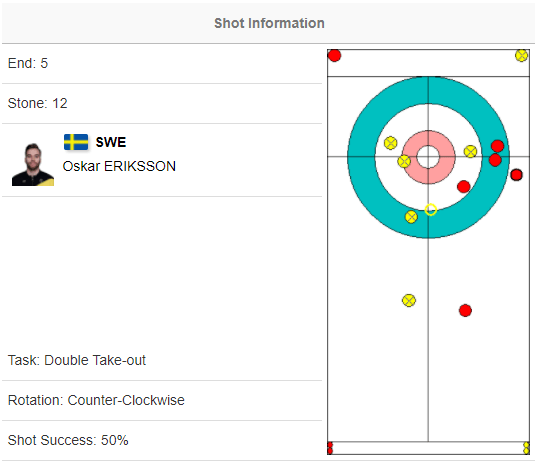
George’s shot is fine. Eriksson’s is not. He should be able to get a couple of yellow rocks out of there, but he only gets one.

5-12

Shuster guards the middle of the house. Edin manages to draw past it but just a bit heavy, going to the back of the button. (Curling 101: Front is better than back. The idea isn’t just to get there but to stay there.)

But Shuster misses badly. His rock sails through the house. Edin draws for two, and we’re roughly even at the halfway point — Sweden up one, USA with the hammer. 4-3 Sweden

6th end: A little less traffic this time. Landsteiner removes one of Sundgren’s rocks. Wranaa tries to take out both Hamilton’s guard and the lone U.S. rock in the house, but he only gets one. Hamilton gets a harsh 0% on his next rock, which leaves a Swedish rock clinging to the house but leaves the USA lying two.

Eriksson plays a perfect hit-and-roll, given Sweden shot rock under a long center guard. George, who’s on fire, makes that one go away. Eriksson, also playing very well, takes out both U.S. rocks in the house and rolls his own shooter out, leaving just the one Swedish rock in the house. George draws around the Swedish guard and sets up shot stone at the top of the house.

Edin tries one of the curling shots that boggles my mind — the long, long runback, banging a guard into the house and trying to use that to take out the rock in the house. Shuster missed this shot earlier in the game. Edin misses, too.

Shuster draws to the side of the house to give the USA two stones and leave Edin a difficult double takeout. Edin opts against that shot and tries a hit-and-roll that would give him shot stone. It rolls too far, and Shuster draws for two. 5-4 USA 

7th end: Landsteiner plays a nice draw to the top four-foot behind his own center guard. Sundgren comes around and bumps it, giving Sweden shot rock early.

Hamilton isn’t happy with his first delivery. He hits the red rock, but it jams into the yellow rock behind the button. Sweden has one at the back of the four-foot, outcounting a U.S. rock off to the side.

But Wranaa’s attempt to freeze to that U.S. rock is off-target, and Hamilton redeems his end with a perfect double takeout. That’s two U.S. rocks in the house and none for Sweden, thanks very much. The Mustache Man is pumped. And Wranaa counters with a draw that comes up very light, not even reaching the house.

George pounces. He puts a draw right on the button, and with a yellow rock immediately behind it, that’ll be difficult to dislodge. Eriksson clears some traffic. George tries to guard the center, but he leaves enough room for Eriksson to put his own red rock on the button.

7-12

Shuster plays a guard in the eight-foot. He’s content to give up one here and take hammer in the eighth in a tie game. Edin tries to pick off Shuster’s rock and misses everything. (Well, he moved the red rock about an inch when his shot glanced by.) Shuster tosses up another guard to further complicate Edin’s chances of getting two, and Edin has to hit a complex chain reaction up the middle just to get one. 5-5

8th end: And now, the deluge …

Landsteiner tries the most difficult shot a lead ever plays, the “wick” shot to bump a guard out of the way without knocking it all the way out, which isn’t allowed while the leads are playing. (The stone would be replaced.) He misses. But he plays a nice draw with his second shot. In the house: 2 U.S. rocks, 0 for Sweden.

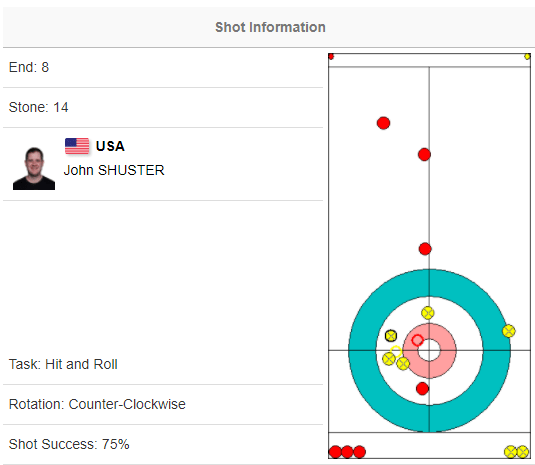
Wranaa draws into the four-foot for shot rock. Hamilton, whose numbers in this game aren’t great, removes a guard. Wranaa replaces it, and Hamilton bumps it out of the way again. The Swedish guard only moves partway out of the way, but Hamilton’s shooter rolls (spins, in fact) to the edge of the house, which will be important later.

Eriksson puts up yet another guard. George tries to pick the red rock out of the house but isn’t really successful (a legit 50%). Eriksson draws to the four-foot but leaves it open for George, who knocks it away.

Edin’s first rock is a draw almost to the same spot as Eriksson’s. But it’s not quite buried behind all the guards.

So we have one of those complicated ends in which a lot of rocks are in play. It could be a big end for the USA or a steal for Sweden, the latter outcome possible if Edin can get a rock in there that Shuster can’t get out.

8-14

Edin calls timeout. Kevin Martin thinks Edin can hold this end to no more than two, which would certainly leave Sweden in contention.

8-15

That 75% is so deceiving. Edin left Shuster a double takeout.

After all that John Shuster has been through — all the disappointment, all the ridicule — he has this shot to virtually clinch a gold medal.

Need you even ask?

10-5 USA

9th end: This is nearly academic now. Edin has to swing for the fences and get a ton of points here just to make the 10th end worth playing.

Landsteiner tosses a shot through the house. No need to leave any traffic. Hamilton takes out a guard. Wranaa replaces it. Hamilton clears it again. Wranaa draws deep into the house, partially buried behind the lone remaining guard, but George takes it out.

Then Eriksson errs. His draw goes all the way through the house. George has a bit of a miss, too, knocking out the lone guard but leaving his own rock in play. Eriksson draws behind that.

Shuster takes out the guard. He’s willing to give up two here. Edin barely gets a draw to the top of the house. Shuster removes it, leaving Edin the whole house to draw for two. 10-7 USA 

10th end: Sweden needs to steal three. Good luck with that.

A mistake from Landsteiner as he tries to hit the “wick” — he knocks the Swedish guard all the way out, so it’s replaced. Sundgren puts up another guard. Landsteiner flings his rock through the house. Again, just trying to avoid a lot of traffic here. Completely different situation than trying to score two.

Wranaa draws behind the two guards. Wait, what two guards? Hamilton bangs them away and leaves nothing in front of the house. Big fist pump time. Sweden’s got very little to play with here.

Wranaa guards again. Only one? Hamilton gets rid of that one, finishing his lonnnnnng Olympics (about 40 hours on the ice between mixed doubles and men’s) on a high.

Eriksson guards. George removes it. Rinse, repeat.


Edin does a spin move on his last shot, then shakes hands. It’s over.


olympic sports

UPDATED — USA in Pyeongchang: How bad is it?

Updates are in italic. Things have taken an upturn.

We’re at the middle Sunday of the 2018 Olympics, and the USA has … 10 medals.

The Netherlands have 13, perhaps an advantage of picking one sport and getting really, really good at it. They only have four athletes at the Olympics who aren’t speedskaters.

Canada has 16 medals in seven different sports, and we haven’t even hit the hockey medal rounds yet.

Germany has 18. They slide, shoot and ski jump quite well.

Norway has 26. Basically, if it involves skis, the Norwegians have medaled. They’ve already equaled their total from Sochi.

The USA had 28 medals in Sochi. It’s no surprise that they do better in North America — 34 in Salt Lake City and 37 in Vancouver, compared with 25 in Torino.

Sure, the numbers were in the 20th century. In those days, 13 was a record. In 1988, Bonnie Blair and Brian Boitano were the only Americans to take gold, and Blair accounted for two of the USA’s six medals. But that was a different era. The Winter Games have grown — 38 events in Lake Placid 1980, 68 in Nagano 1998, 98 in Sochi 2014.

And the USA has gained from the X Games-ification of the Winter Olympics. Freestyle skiing officially debuted with one event (moguls) in 1992, then added aerials, then ski cross in 2010 and halfpipe and slopestyle in 2014. The USA had 21 medals in that sport coming into Pyeongchang, along with 24 in snowboarding.

But it’s not just the newfangled sports that have kept the USA near the top of the medal table. In Sochi, the USA took five medals in Alpine skiing, four in bobsled (including two in women’s, still a new-ish event), one in luge and one in ice dancing. Even with the long-track speedskating shutout, that’s not a bad showing.

The USA is actually competitive in sports that were once far beyond Americans’ grasp. I was there in 2010 to see the USA’s first Nordic combined medals. The long-overmatched bobsled and luge programs have sprung to life. Skeleton’s return to the Olympics was a boon for the USA — apparently, going head-first down a long slide suits us. And the USA took two medals in last year’s biathlon World Championships to go with a steady stream of cross-country skiing medals, two sports in which the USA has a combined total of one all-time Olympic medal.

So what’s going on in Pyeongchang, where snowboarding accounts for half of the USA’s medal haul so far and all but one of the Americans’ golds?

Two categories. First, near misses:

  • An ailing Mikaela Shiffrin, who already has the only non-snowboarding gold for the USA so far, was fourth in her best event (slalom).
  • Jessie Diggins came into South Korea with a terrific shot at winning the USA’s first women’s cross-country medal, and she has finished fifth, fifth, fifth (relay) and sixth.
  • Nathan Chen made a heroic effort to reach the podium in men’s figure skating and posted the top free skate, but he was fifth overall. (Should’ve been fourth.)
  • The luge team relay, led by surprise men’s medalist Chris Mazdzer and track record-breaker Summer Britcher, was fourth.
  • Lindsey Jacobellis and Nick Baumgartner each took fourth in snowboardcross. The USA also nearly had fourth-place finishers in men’s and women’s halfpipe, which you may have not noticed given Shaun White and Chloe Kim’s golds.
  • Brittany Bowe has nearly broken the speedskating hex, placing fourth, fifth and fifth.
  • Maggie Voisin, who was injured in a training run in Sochi and couldn’t compete, finished fourth in slopestyle skiing.
  • Casey Andringa was fifth in men’s moguls.

So the 10-medal haul could easily be 15 or more.

Second, ill-timed down years:

  • Biathlon. Lowell Bailey took gold and Susan Dunklee took silver in last year’s World Championships, but it’s just not happening this year in the World Cup or in South Korea.
  • Men’s Alpine skiing. While the women have two skiers vying for G.O.A.T. status (Shiffrin and Lindsey Vonn), Ted Ligety is the only viable medal contender for the U.S. men. He was fifth in the combined.
  • Long-track speedskating. There’s really no good way to explain how a team with Bowe and Heather Bergsma has gone two Olympics without reaching the podium.
  • And the glory years are long gone for Nordic combined, women’s short-track skating and skeleton.

So what’s the path forward here? Can the USA still get into the mid-20s?

Let’s peek at the remaining medal events:

Sun/Mon, Feb. 18-19 – Day 10. 0 medals. Indeed, none

6:15 a.m.: Bobsled, two-man final two runs. No chance.
6:53 a.m.: Speedskating, men’s 500 meters. Little chance.
7:30 a.m.: Ski jumping, men’s team. No chance.

Mon/Tues, Feb. 19-20 – Day 11. 1-2 medals (running total: 11-12) Got both, bronze in each case. Total of 12.

⭐8 p.m: Figure skating, ice dance free dance. Very good chance. If the Shib Sibs aren’t at their best, two more teams have a shot.
⭐8:30 p.m.: Freestyle skiing, women’s halfpipe. Very good chance. Maddie Bowman is the defending gold medalist.
6:15 a.m.: Biathlon, mixed relay. If Dunklee, Bailey and Tim Burke have awesome legs … well, we can dream.
6:33 a.m.: Short-track speedskating, women’s relay final. Didn’t qualify.
7:45 a.m.: Nordic combined, large hill 10k race. No chance.

Tues/Wed, Feb. 20-21 – Day 12. 1-4 medals (running total: 12-16) OK, I was wrong about the women’s team pursuit. The USA took bronze. That made up for only getting one in women’s bobsled. Vonn got her medal, and yes, so did Diggins (with Kikkan Randall). Still running on the high end of the projections — 16 medals.

⭐9 p.m.: Alpine skiing, women’s downhill. Lindsey Freaking Vonn, folks.
⭐5 a.m.: Cross-country skiing, men’s and women’s team sprint finals. Please, please let Jessie Diggins get her medal here.
⭐6:40 a.m.: Bobsled, women’s final two runs. Certainly one, maybe two.
7:52 a.m.: Speedskating, men’s and women’s team pursuit finals. No chance.

Wed/Thurs, Feb. 21-22 – Day 13. 2-4 medals (running total: 14-20) Not quite a sweep, but two medals in halfpipe and then gold in women’s hockey. So just one off the high end of the projection at 19 medals. Also, the Alpine combined and big air were moved ahead a day, but I’ll leave them with the next day for projection purposes.

⭐9:30 p.m.: Freestyle skiing, men’s halfpipe. Outstanding chance. Might even sweep.
⭐11:10 p.m.: Hockey, women’s gold medal game. All-but-certain gold or silver.
11:45 p.m.: Alpine skiing, men’s slalom. Not likely.
5:20 a.m.: Nordic combined, team relay. Not this year.
6:15 a.m.: Biathlon, women’s 4x6k relay. I wish, but no.
6:18 a.m.: Short-track speedskating, men’s 500-meter final. Slight chance.
6:30 a.m.: Short-track speedskating, women’s 1,000-meter final. Little chance.
7:03 a.m.: Short-track speedskating, men’s relay final. Didn’t qualify for A final, though if a bunch of teams are disqualified …

Thurs/Fri, Feb. 22-23 – Day 14. 1-5 medals (running total: 15-25) Already got two of these a day early thanks to rescheduling. That’s probably going to be all, so they’ll still be at 21. But five medals here was always a stretch.

⭐7:30 a.m.: Snowboarding, women’s big air. Pretty good chance.
⭐8 a.m.: Figure skating, women’s free skate. Less than 50-50, but maybe?
⭐12:30 a.m.: Alpine skiing, women’s combined. Shiffrin and Vonn could contend.
12:35 a.m.: Freestyle skiing, women’s skicross. No U.S. entries.
5 a.m.: Speedskating, men’s 1,000 meters. Only if Shani Davis turns back time.
6:15 a.m.: Biathlon, men’s 4×7.5k relay. No chance.

Fri/Sat, Feb. 23-24 – Day 15. 1-4 medals (running total: 16-29) This will be at least one thanks to the men’s curlers. So the minimum stands at 22. The Torino total of 25 depends the snowboarders and speedskaters.

⭐8 p.m.: Snowboarding, men’s big air. Possible.
9 p.m.: Alpine skiing, team event. Hard to say.
10 p.m.: Snowboarding, parallel giant slalom. Probably not, but you never know.
12 a.m.: Cross-country skiing, men’s 50k mass start. No chance.
⭐1:35 a.m.: Curling, men’s gold medal game. They’re still in it, but this might be a stretch.
⭐7:30 a.m.: Speedskating, men’s mass start. Decent chance. Joey Mantia won the 2017 world title. Maybe they can finally break through.
8 a.m.: Speedskating, women’s mass start

Sat/Sun, Feb. 24-25 – Day 16. 0 medals

7:05 p.m.: Curling, women’s gold medal game. Not likely.
7:30 p.m.: Bobsled, four-man final. Not likely based on two-man runs.
11:10 p.m.: Hockey, men’s gold medal. No Miracle here.
1:15 a.m.: Cross-country skiing, women’s 30k mass start. Not Diggins’ best event.

So the chances of matching Sochi are slim. They’ll struggle to match Torino. But 20 medals wouldn’t be so bad.


Uncategorized

Moving forward and making peace with U.S. Soccer’s “change” wing and the Athletes’ Council

I have an important message for the “Gang of Six” supporters:

You made a difference. Really. Your choice now is whether you want to follow through or just take to Twitter and whine about the election result.

peter-elephantHaving spent 48 wild hours in Orlando, I think people in U.S. Soccer are receptive to change. Maybe not the specific solution you want, maybe not at the pace you want. Maybe not with the fiery rhetoric you want. But they’re open to it.

And yes, that includes the Athletes’ Council. They could’ve done things differently, and I’ll get to that. But you can’t write them off just because they voted for an “establishment” candidate (who has only been VP for two years and was an independent director before that).

I realize this post will seem a little pedantic. While in Orlando, someone with one of the campaigns sent me an angry email saying I act like I know everything. But in that discussion, the only things I needed to know were (A) the hotel layout between the sports bar and the Unicorn meeting room, (B) what Sunil Gulati looks like and (C) what Don Garber looks like. And the things I’ll say here are, frankly, just as obvious as those things. As Edie Brickell sang: I know what I know, if you know what I mean.

I’ll dispsense with the preachy stuff early and then move on to some actual ideas …


1. Drop the nonsense and get educated

This isn’t just directed at Soccer Twitter and the conspiracy theories of doom. Certainly a bunch of bro/rel dudes should spend most of this Lenten season atoning for everything they said about Kathy Carter, Julie Foudy, Chris Ahrens, Carlos Bocanegra, Sunil Gulati, Don Garber, Nipun Chopra, Kyle Martino, Donna Shalala …

Then consider the sheer ignorance of this BigSoccer post on Carlos Cordeiro: “He was the VP under Sunil during the biggest disaster in the history of US Soccer.” You may have 100 legitimate questions and concerns about the new president. Blaming him for the men’s national team World Cup flameout is a flying leap across the giant atrium in the Renaissance hotel.

Some of the campaigns deserve a bit of blame for the cesspool surrounding the election as well. Consider this non-hypothetical: Given the couple of inevitable last-minute changes to state representation, when U.S. Soccer sends out a list with those changes to candidates, do you (A) thank the staffer who had to dig that up and send it out or (B) go on Twitter to put the federation on blast for telling you these things so late in the campaign, as if it’s a conspiracy rather than an additional level of transparency?

And behind a lot of it is the NASL and its legal challenge against U.S. Soccer, a suit for which I didn’t detect a lot of sympathy in Orlando. It’s gone way beyond fussing with Gulati and Garber. They’ve sued most of the board, and by extension, they’ve thumbed their noses at everyone who elected the board. It’s funny, but a bunch of people who’ve spent much of their adult lives volunteering in the sport don’t take too kindly to being sued by someone who bought the New York Cosmos a year ago and now wants to dictate how professional soccer should be run.

The NASL certainly has a big overlap with the more radical (or factually impaired) wing of Soccer Twitter. And what has it gotten them? A bunch of lawsuits and a plan to prop up D2 by bringing up some NPSL teams.

As promised, there’s another way forward …

2. Work with the states

You may not be able to walk into an Eastern New York adult soccer meeting and walk out as Sal Rapaglia’s replacement as president. Other states, best represented in Orlando by West Virginia’s ebullient Dave Laraba, have openly asked for some new blood.

Even if you can’t get onto a state board, try to work with them. Attend their meetings.

You’ll find many of them are receptive. Yes, Carlos Cordeiro and Kathy Carter combined for a little more than 70 percent of the vote. But we know who many of those voters are. The athletes. The Pro Council. U.S. Youth Soccer, which has a handful of organizational votes as well as being the umbrella group for state associations, endorsed Cordeiro.

Take them out, and you have a bunch of state associations who were clearly split all over the place.

And — this may shock some of you — for some of them, Cordeiro is the “change” candidate.

He’s not Sunil Gulati. If you saw the board meeting Friday in Orlando, you saw a president who, for all his accomplishments, didn’t seem too interested in listening. Cordeiro is the opposite. I actually have a hard time picturing him presiding over a National Council meeting, but they’ll figure it out.

(For that matter, Kathy Carter isn’t Sunil Gulati. But the manner in which she entered the election drew a lot of legitimate questions, as did her campaign-killing idea to have  Casey Wasserman oversee an “independent” commission despite his agency’s deep ties to so many players. She is a “soccer person” in every sense of the phrase. This just was not the right election for her.)

The states, and perhaps some national organizations, are where you can gain momentum for this …

3. Suggest bylaws and policies

Toward the end of the big meeting Saturday in Orlando, Cal South president Derek Barraza stepped up to the microphone with a reminder for his fellow National Council members: We’re not just here to vote. We’re here to do our duty and make policy.

That’s not just academic. If you’ve read my recaps of meetings gone by, you’ve seen bylaws and policies suggested by various parties and approved by the memberships. Louisiana Soccer Association. Bylaw/policy machine Richard Groff. A task force on professional player registrations. Eastern New York Youth Association (not the adults). Athletes’ Council chair Jon McCullough. A policy from a Transgender Task Force.

You may think people in power aren’t listening to such things. The voting records suggest otherwise. And even the weekend’s symbolic effort to cut registration fees in half (something no right-minded person was going to do just before electing a new president who may have another mandate to use or reduce those fees) wasn’t just spitting into the wind. In the board meeting, Athletes’ Council chair Chris Ahrens asked several good questions about how to proceed on that matter. You can bet this issue will come up again.

So along these lines, let’s try this:

4. Lobby to change the Professional League Standards

It’s safe to say promotion and relegation in the pro leagues is not an issue that moves the masses among the U.S. Soccer membership. They’re not necessarily opposed to it — Kyle Martino had support among states and was one of three finalists for the Athletes’ Council votes — but it’s not their top priority. Frankly, there’s no reason it should be. (For reference, see everything I’ve written on the topic.)

The way to get that going isn’t to elect Eric Wynalda president. It’s not a lawsuit or a grievance, where any “victory” would have us racing to find the correct spelling of “Pyrrhic.” Peter Wilt has the right idea — start building toward pro/rel within the lower divisions. If it catches fire and makes MLS owners realize they should be part of it, great. If not, at least you’ve reinvigorated the lower divisions and given more people more opportunities.

The muted response to NISA suggests to me that what I’ve seen for the last 22 years hasn’t really changed — owners have found it’s a lot simpler and cheaper to run a summer amateur team than it is to run a full-season pro club. But aside from pesky things like “workers comp” and “salaries,” there’s one legitimate obstacle keeping clubs from organizing new D3 leagues: the Pro League Standards.

Standards exist for a reason, of course. U.S. Soccer has an interest in making sure its pro leagues are credible. A $250,000 performance bond to make sure a team can make it through a season is certainly reasonable, as are some (maybe not all) of the requirements on fields, stadiums and staffing. (Can we please drop the “media guide” requirement? Are those still printed?)

fuddThe big one is the “individual net worth” requirement. Perhaps a legal or economic authority can explain otherwise, but I’ve never understood why a pro club requires one person to have $10 million. If you have people who can put up the performance bond — perhaps even an increased bond — why would it matter whether the group can find an owner who’s in the top 1 percent?

Can the standards be overturned from within? I think so. At the very least, you can force people to vote yay or nay on the record, which is something you can use in future presidential campaigns and might be more useful than a conspiracy theory.

And there’s one group that really should be interested in such things …

5. Reach out to the Athletes’ Council

This group took a lot of unfair abuse over the past week. First, they were accused of being pawns for Kathy Carter. It was fun to see the conspiracy theorists try to adapt when the athletes announced they were going as a bloc for Cordeiro. It was also fun to see Hope Solo lecture them about not reading bylaws when she demonstrated little grasp of the published election procedures and a few other simple bits of public info. (Again — coaching modules aren’t age-appropriate? Where’d she get that?)

But we still don’t have a good grasp of what issues they were considering. In talking about Cordeiro, they mentioned his experience — which is a legitimate qualification — and Carlos Bocanegra said he felt the candidates’ platforms were similar and vague, which was partially true.

It would be reassuring, though, to hear that the athletes are concerned about the grassroots. Perhaps it’d be nice to hear they’re going to work in concert with states.

And changing the Pro League Standards should be something that would appeal to the athletes. It’s more opportunity, isn’t it?

So look, reformists (genuine reformists, not people who’ve staked their identities on pretending they understand pro/rel while ignorant Americans do not), you have opportunities. One well-connected source told me he thinks we’re going to have fewer unopposed elections down the road.

Change is coming. As it stands now, the federation has voted for incremental change. Maybe if people can push for a few more incremental changes, we’ll be able to look back in a couple of years and see if it all added up to something big.

us soccer, youth soccer

Last-minute election plea: Think of the children

We, the media, have failed you.

We’ve been distracted by the drama. The politics. The personalities.

Not that the personalities aren’t important. The next U.S. Soccer president has to build bridges and trust. The right personality to do that is essential.

But we’ve failed to shed enough light where it needs to be:

Youth soccer.

Soccer has grown by leaps and bounds in this country in terms of viewership, sponsorship and just a general sense of “bigness.” Youth soccer has not kept pace.

Where we need more outreach, we’ve gotten more elite programs.

Where we need more kind introductions to organized play, we’ve gotten ham-fisted mandates such as the birth-year age-group switch, which U.S. Soccer is only now beginning to realize was a colossal mistake from idea to execution. There is no elite player-development reason for forcing the other 90% of the pyramid to have less fun playing rec soccer and perhaps — just maybe — advancing into elite soccer.

We’ve forgotten that every elite player starts as a rec player. It may be in organized U5 soccer. It may be playing on a tennis court in an apartment complex where the residents have marked out some makeshift goals.

We’ve focused on the Athletes’ Council — a group of good people getting their names dragged through the mud by tinfoil-hat conspiracy theorists. And frankly, they’re too focused on meeting amongst themselves. Heather O’Reilly didn’t need to fly across the Atlantic to talk with Shannon Boxx and Kate Markgraf. They should be out talking with state youth representatives.

The state youth reps have been forgotten. They’ve been upstaged by the athletes and the adult associations, some of whom have not covered themselves with glory in this process and may have frankly demonstrated that they have too much of the vote. Maybe USSF can bring in colleges and combine them into the Adult Council? Might help.

But it’s our fault. We, the media, have forgotten to talk about all this. All the reasons why youth soccer has been stagnant, both in terms of adding rec players and developing elite players.

So it’s up to you … well, mostly the Athletes’ Council. Leave your meeting room. Go to the bar. Talk to the states. See why they’re frustrated. Then vote accordingly.


us soccer

Scenes from a U.S. Soccer board meeting

While other reporters were out chasing down details of the Gang of Six (or Five or Four), I was at a U.S. Soccer Board of Directors meeting.

And what I can report from that meeting is that USSF board business is …

Boring.

Really, really boring.

If you read Twitter — and yes, the board members made it known that they’re aware of what’s said — you would think the board sits around discussing ways to prevent promotion/relegation from happening. Or ways to make sure Eric Wynalda is never employed. Or perhaps just taking turns swimming in piles of Soccer United Marketing gold.

Here’s what happened in the first, oh 150 minutes (minus a few minutes where I had to run out):

1. Sunil Gulati said he’s looking forward to the election being over. Carlos Cordeiro, sitting next to him, nodded his head slightly.

2. Gulati went over the USA/Canada/Mexico World Cup bid. He’s quite enthusiastic about it.

3. Gulati went over FIFA’s current thinking over changes in international competition. They’re combining youth tournaments — instead of a separate U20 and U17 tournament, we’ll see either U19 or U18. They’re leaning U18 because it’s easier to get players released. That also works for the U.S. because they often run into conflicts with college players now.

4. OK, THIS is interesting. FIFA is working a women’s Nations League, like the UEFA and CONCACAF men’s league. The goal is to keep women’s national teams more active. Gulati gave the example of Ecuador’s women, who made the 2015 World Cup and then went more or less dormant.

There’s a side discussion about SUM and whether it’ll have less stuff under its control as FIFA controls more rights. Gulati points out that other countries are in the same boat, and FIFA is backing off a bit for now.

5. Want to see a long presentation of marketing stuff being planned around the Women’s World Cup? Here you go. No word on what happens if the U.S. women don’t qualify.

6. A player development update turned into a discussion with Dr. Bob Contiguglia, attending his last board meeting as past president, asking about the process the federation went through before announcing the birth-year age-group changes that have blown up real good. Ryan Mooney answers and says nothing substantial for the first three minutes or so but then says it has spun off a longer discussion about better communication with members.

7. A participation study has shown that rec players tend to “lapse” at age 8-10, while travel players tend to leave at 11-15. But there’s a high interest in “unorganized” soccer, and there’s interest in an intermediate level between rec and travel. (Which some states do.)

8. Tax Reform Impacts. This goes on for a while.

Having fun yet?

9. USSF counsel Lydia Wahlke goes through a presentation on athlete safety, especially in the wake of what’s happened with USA Gymnastics. The federation was already doing a lot, including harassment training for every NWSL club last spring. This was a long but absolutely important discussion. I couldn’t follow all of it, and I started wondering how long these meetings would run if Wahlke and Kyle Martino are both involved.

10. Election update: The vendor overseeing the election is Plante Moran. We get the lowdown on who they are. I didn’t need to know that they were named one of the top places to work in Chicago.

A break. Finally.

11. Donna Shalala’s term as independent director is ending, and the Risk and Audit Committee needs another independent director to lead it in the interim. I think Val Ackerman ducked. Lisa Carnoy gets volunteered.

Incidentally, Carnoy also filled in as treasurer for the purposes of validating registration fees so they can properly weight the votes. Cordeiro would normally do that, but he recused himself, sensibly.

12. AN OPEN CUP DISCUSSION! And it got quite interesting. They’re considering an amendment that would eliminate the Cup’s foreign-player restriction, which currently stands at five for pro clubs. The pro clubs don’t want that any more — in fact, NASL interim commissioner Rishi Sehgal was in attendance and spoke up to testify that all the pro leagues agreed on this. (Nice to know they all agreed on something.)

The lines of argument are surprising. It’s basically Gulati and CEO Dan Flynn vs. Shalala, Carlos Bocanegra and Don Garber. Gulati argues that the Cup’s credibility won’t be hurt by limiting the number of foreign stars, especially considering how many of them sit out until the semifinals or final, anyway. And Gulati says he wants to give U.S. players more opportunities. John Motta is on the Open Cup committee but says he didn’t really participate in this discussion because it affects the pro leagues, not the ones in his domain (USASA).

tabledThe amendments wouldn’t take effect until qualifying begins anew in August, so the motion is tabled.

13. Insurance. The USSSA had some concerns with the USASA’s proposal. Tabled to give them time to work it out.

14. Wahlke describes an independent ethics committee proposal. Gulati points out the Risk and Audit Committee has been doing a lot of this work but doesn’t object to it being formed. No one speaks in opposition. So that passes the board — I’m not sure whether the National Council (the big meeting, which will vote on the presidency) has to vote on it tomorrow.

15. Membership fees. They saved the most explosive item for last. Motta wants to cut membership fees in half — from $2 to $1 per player for adults, from $1 to 50 cents for youth. At-large member John Collins, who asks great questions throughout the meeting, points out that the National Council would have to approve this.

It’s safe to say Gulati is not a fan of this idea. Especially the timing of it, one day before a National Council meeting at which they’ll need to approve the budget. (Cordeiro points out it’s also one day before the election.) And Gulati is convinced we’re not losing players over 50 cents.

Gulati unleases his full sarcasm on Motta, with whom he traded the VP slot way back when (Motta beat him for the spot in 1998, Gulati won it 2000): “Want to withdraw it or see it defeated?” Motta wants a vote.

So they vote … sort of. A couple of people raise their hands in favor. Athletes’ Council chair Chris Ahrens is intrigued. He asks Motta for a specific use of the money (which is maybe a couple million dollars, all told) if they get it “back.” Motta doesn’t give a particularly good answer.

It’s safe to say this issue is going to come up again. But the argument to recommend such a change now isn’t persuasive. They take a final vote. Motta and fellow Adult Council member Richard Moeller vote yes, as does Youth Council rep Jesse Harrell — overlooked at first because he doesn’t raise his hand very high. Cordeiro abstains. Everyone else votes no.

And that’s the last order of business. We’re off to the “Good of the Game” segment in which members can talk about what they want. That’ll be part of the National Council meeting — actually, all my local club meetings end with it, too. It’s generally like the minute-long speeches in Congress hailing the accomplishments of a local chess club. But it can get testy, as it did in the National Council meeting a couple of years ago when people went back and forth with contrasting opinions on Chuck Blazer. And if Kathy Carter wins, I think tomorrow’s session will be a doozy.

This one had a lot of positives. Bocanegra praised the work on the SheBelieves Cup and related initiatives. Several board members bid a fond farewell to departing board members Shalala and Contiguglia. Several also summed up their congratulations to Gulati for 12 mostly good years.

But there was some talk of the election animosity. Contiguglia was philosophical — having been through tough times at USSF before, he reminds everyone, “this too shall pass.” Moeller lamented the palpable animosity at the hotel bar last night.

Ahrens was particularly pointed, saying criticisms of the Athletes’ Council were offensive. They’ve put a lot of effort into their duties, he says, only to see their integrity unfairly and inaccurately called into question.

Then Gulati lets fly. “I’d love to say only friendly things, but that wouldn’t be honest.”

He laments that the board (other than Motta and Contiguglia) has been accused in legal documents of being conflicted. (I turned to look at Sehgal, who had a face of stone.) He says the independent directors are truly independent. He didn’t know Shalala until Julie Foudy introduced them. He barely knew Ackerman or Carnoy.

He takes aim at Twitter — particularly, the fact that people who retweet nonsense. “A tweet by someone anonymous gets retweeted, and now it’s Encyclopedia Brittanica.” He jokes that his wife tried to take the tweet that he’s due $30 million-$50 million from the World Cup bid to the bank to see if she could some how use it for cash or credit.

“So much nonsense out there, and you should let people know that.”

And frankly, it was hard not to sympathize. Anyone who sat through that and doesn’t think these people are doing their fiduciary duty is … well, probably looking at it strictly through the lens of self-interest and one decision that didn’t go their way. If you think that’s worth burning down everything the board members and staffers in that room are doing, fine. Sign your name to it and make your case below.

No, that’s not an endorsement for anything in the election. It’s one thing to say the board could use some fresh ideas. So could MLS, for that matter. That’s all that needs to be said. The rest is overkill.

And I found myself wondering who would want to be on this board in the current climate. Who would voluntarily put themselves through this?

So tomorrow, someone is going to win an exhausting and often tedious volunteer position. And they will have skipped all the other exhausting and often tedious volunteer positions that people normally do to pay their dues. So the new president should walk before the board with the greatest humility. Maybe then those fresh ideas will gain some traction.


us soccer, women's soccer

Scenes from an Orlando hotel (or, why Heather O’Reilly is hard core)

After my interview with SiriusXM FC today (thanks, Dunny and Janusz), I headed over to the hotel where all the action is at the U.S. Soccer Annual General Meeting to grab a good meal and see who was hanging around.

I found more than I expected:

Hard-core HAO: I’ve been wrong about a few things in this election. One of them — I assumed that because Arsenal’s women play Sunday, Heather O’Reilly would not be at this meeting. As I walked through the lobby, someone from a table (not the table with Kathy Carter mentioned below) that also included Shannon Boxx and Lori Lindsey waved to me.

My brain: “That’s Heather O’Reilly. But it couldn’t be. She has a game on Sunday.”

Yes, she does. And she’s playing in it. On Saturday, she’ll go straight from the meeting to the airport and fly across the Atlantic for Sunday’s game.

That’s how important this meeting and election is to her. And to a lot of people.

I guess I shouldn’t complain about my flight. (Which was actually pretty good.)

“Hey, Eric! You’re on TV!”: I snagged the table in the hotel sports bar in front of the only TV tuned to beINSport, which was doing its election coverage. I looked up at the screen and saw … Eric Wynalda.

I looked back across the room and saw … Eric Wynalda.

He seemed a little puzzled when I insisted to him that he was on TV at the very moment. Safe to say the interview wasn’t live.

Carter holds court: I stumbled into a room where Kathy Carter had apparently just finished speaking. Quite a few dignitaries (voters) were on hand, including John Motta and Kevin Payne. Don’t read anything into that — I still don’t know who’s voting for whom. Motta is clearly one of the big winners in this election — he gets along with everyone, which is very impressive. When I saw him in Philly, he was at a Wynalda event.

I did get to speak with her and was a little surprised to find she has been reading my work. I hope that doesn’t mean she’s reading Twitter. (Motta is a big winner; a big loser in this election is clearly Soccer Twitter, a web of conspiracies and miscellaneous b.s. Seriously. You’ve heard that the non-Carter and Cordeiro candidates are talking about some sort of solidarity statement, and I can confirm that such conversation is taking place. I wouldn’t be surprised if all eight candidates agreed on a statement blasting selected anonymous jerks on Twitter who keep poisoning the conversation.)

Coincidentally, I had listened to the Total Soccer Show podcast on the plane, which I heartily recommend. (The podcast, not the plane, though American Airlines has more leg room on a flight to Orlando than British Airways has on a flight to London.) They pointed out that she has a lot of good ideas in her platform that haven’t gotten a lot of attention. Maybe we’re too focused on asking, “So, SUM is really evil, right?”

Her campaign has had a few missteps. I can’t argue that she’s the best choice, and I can’t argue against people who say they want more of a change in the Federation. But this whole “evil Wasserman/SUM cabal” talk is, to put it mildly, overblown. If she wins, please put down the torches and pitchforks. Work with her. You might be surprised.

I saw Carter a bit later at a table in the sports bar with a few members of the Athletes’ Council. And Sunil Gulati.

Martino’s army: I wandered down the hall after visiting the Carter room and found the room where Kyle Martino has been talking for … I don’t know how long.

I found a misconception worth correcting here. A lot of us have been viewing Martino as a sort of compromise candidate who may win out as everyone’s “anyone but (Candidate X)” second or third choice. What I found in that room: Many people who passionately support Martino. He’s not their second or third choice. He’s No. 1. They love him, and they’re ready to fight for every vote.

And several state reps in the room said they’re looking for change. No one mentioned promotion and relegation. They said they were glad that the Trinidad debacle has helped shed light on the many issues within U.S. Soccer.


us soccer

A quick Carlos Cordeiro Q-and-A

Remember the questions I posed to the candidates last week? I knew it’d be difficult to get answers when the candidates are all talking to as many voters as possible.

But I just got one set of answers from Carlos Cordeiro. The questions and answers are below, with no editing:

You’ve demonstrated a reluctance to do interviews. How will you adapt to the role of president, when you be required to do many press conferences?

On the contrary—since announcing my candidacy, I’ve conducted numerous in-depth interviews with journalists, including Grant Wahl and Brian Straus (Sports Illustrated), Joe Prince-Wright (NBC Sports), Ian Thomas (Sports Business Journal), Kevin Draper (New York Times), Paul Kennedy (Soccer America), Sam Borden (ESPN FC), Henry Bushnell (Yahoo Sports), Jonathan Tannenwald (Philadelphia Inquirer) and Michelle Kaufman (Miami Herald). These interviews are publicly available on my website.

In addition, I’ve provided detailed written answers to numerous questionnaires, including from the Athlete Council, Adult Soccer, US Youth Soccer, The American Outlaws, the US Open Cup, LGBT.soccer and ESPN. All of these Q&As are also publicly available, in full, on my website. I also participated in the candidate forum hosted by US Youth Soccer in Philadelphia on January 20.

Meanwhile, I’ve been traveling extensively across the country to meet directly with voters and members of our soccer community to listen to their concerns and develop solutions together.

A pillar of my campaign is bringing open, inclusive, transparent governance to USSF. If elected, this will include open and ongoing communication with members across our U.S. Soccer community, and I will continue to be available for interviews with the press. At the same time, it’s my hope that the spotlight will rightly focus where it belongs—on our players, coaches and referees.

Why hasn’t U.S. Soccer released its Form 990 and audited financials for the year ending March 31, 2017?

The USSF Form 990 will be submitted to the IRS prior to the 2/15 deadline, and after it has been reviewed by the USSF Board of Directors.

olympic sports, winter sports

2018 Winter Olympics: A concise viewing guide with stars, medals and flags

Each day during the Olympics, I’ll be telling you what to watch and making a few predictions. You can also find my daily previews at Bleacher Report.

Time difference and schedule/streaming options: The Pyeongchang schedule is …

  • Eight hours ahead of a lot of Europe (Eurosport)
  • Nine hours ahead of Greenwich Mean Time (BBC)
  • 14 hours ahead of Eastern Time (NBCCBC)
  • 17 hours ahead of Pacific Time (NBCCBC)

Here, all times are Eastern. So if it’s Thursday morning in South Korea, it’s Wednesday night here. If it’s Thursday night in South Korea, it’s Thursday morning here. NBC is live-streaming everything, and I’ve noted network coverage where applicable.

And yes, I’m using emoji. Stars for recommended viewing, Xs are for events of interest to X Games fans, medals for medal events, U.S. flags where the USA has a good chance of getting a medal (or a couple of events you simply have to see if you’re interested in U.S. athletes). It’s slightly selective — on busy days, I don’t list every qualifying session or curling matchup.

(Update: Bleacher Report bowed to the “Day 1” naming convention, and so have I. Also, I’ve updated some of the rescheduled events.)

Wed/Thurs, Feb. 7-8 – Day before the day before Day 1

PRIME TIME

7:05 p.m.: Curling, mixed doubles, USA-“Russia.” First event of Games. Note: Each curling session throughout the Games (until tiebreakers and playoffs) will have 3-4 games at once.

OVERNIGHT

Naught (NBCSN will have more curling and some training runs.)

EARLY MORNING

6:05 a.m.: Curling, mixed doubles, USA-Canada (NBCSN)
7:30 a.m.: Ski jumping, men’s normal hill qualification (NBCSN)

Thurs/Fri, Feb. 8-9 – Day 0

PRIME TIME

6:35 p.m.: Curling, mixed doubles, USA-Switzerland
⭐8 p.m.: Figure skating, team event, men’s short program (NBC; Nathan Chen?)
8 p.m.: Freestyle skiing, women’s moguls qualification (NBC; Jaelin Kauf)
9:45 p.m.: Figure skating, team event, pairs short program (NBC)
9:45 p.m.: Freestyle skiing, men’s moguls qualification (NBC)

OVERNIGHT

11:35 p.m.: Curling, mixed doubles, USA-South Korea (NBCSN)

EARLY MORNING 

⭐6:00 a.m.: Opening Ceremony. (Live stream has “natural sound only.”)

Fri/Sat, Feb. 9-10 – Day 1

PRIME TIME

7:05 p.m.: Curling, mixed doubles, USA-China
(8 p.m.: NBC shows fully produced Opening Ceremony on 14-hour delay)
✖8 p.m.: Snowboarding, men’s slopestyle qualifying

OVERNIGHT

🥇🇺🇸2:15 a.m.: Cross-country skiing, women’s 15k skiathlon (NBCSN; Jessie Diggins; chance for U.S. women’s first-ever Nordic medal)
2:40 a.m.: Hockey, women’s, Japan-Sweden

EARLY MORNING 

🇺🇸5 a.m.: Short-track speedskating, heats in multiple events (NBCSN; Maame Biney)
🥇6 a.m.: Speedskating, women’s 3,000 meters
6:05 a.m.: Curling, mixed doubles, USA-Norway
🥇6:15 a.m.: Biathlon, women’s 7.5k sprint (Susan Dunklee)
7 a.m.: Hockey, women’s, Switzerland-South Korea (USA Network)
⭐🥇🇺🇸7:28 a.m.: Short-track speedskating, men’s 1,500-meter final (NBCSN; J.R. Celski)
🥇7:35 a.m.: Ski jumping, men’s normal hill final (NBCSN)

Sat/Sun, Feb. 10-11 – Day 2

PRIME TIME

7:05 p.m.: Curling, mixed doubles, USA-Finland (final round-robin game)
✖🥇8 p.m.: Snowboarding, men’s slopestyle final (NBCSN)
⭐8 p.m.: Figure skating, team event, ice dance short program (NBC; Shib Sibs?)
⭐🥇9 p.m.: Alpine skiing, men’s downhill (NBC)
⭐9:45 p.m.: Figure skating, team event, women’s short program (NBC)
✖11:30 p.m.: Snowboarding, women’s slopestyle qualifying (NBCSN)
11:40 p.m.: Figure skating, team event, pairs free skate (NBC)

OVERNIGHT

🥇1:15 a.m.: Cross-country skiing, men’s 30k skiathlon
🥇2 a.m.: Speedskating, men’s 5,000 meters (Brian Hansen)
2:40 a.m.: Hockey, women’s, USA-Finland (NBCSN)

EARLY MORNING 

🥇6 a.m.: Luge, men’s, final two runs
6:05 a.m.: Curling, mixed doubles, tiebreaker (if necessary)
🥇6:15 a.m.: Biathlon, men’s 10k sprint (NBCSN; Lowell Bailey)
🥇🇺🇸7 a.m.: Freestyle skiing, women’s moguls final (Jaelin Kauf)
7 a.m.: Hockey, women’s, Canada-“Russia” (USA Network)

Sun/Mon, Feb. 11-12 – Day 3

PRIME TIME

7:05 p.m.: Curling, mixed doubles semifinal 1
✖🥇🇺🇸8 p.m.: Snowboarding, women’s slopestyle final (NBCSN; Jamie Anderson)
8 p.m.: Figure skating, team event, men’s free skate (NBC; Nathan Chen)
⭐8:15 p.m.: Alpine skiing, women’s giant slalom, first run (NBC; Mikaela Shiffrin)
9:10 p.m.: Figure skating, team event, women’s free skate (NBC)
⭐🥇🇺🇸10:20 p.m.: Figure skating, team event, free dance (NBC; Shib Sibs)
⭐✖11:30 p.m.: Snowboarding, women’s halfpipe qualifying (Chloe Kim)
⭐🥇🇺🇸11:45 p.m.: Alpine skiing, women’s giant slalom, second run (NBC; Mikaela Shiffrin)

OVERNIGHT

2:40 a.m.: Hockey, women’s, Switzerland-Japan (NBCSN)

EARLY MORNING 

🥇5:10 a.m.: Biathlon, women’s 10k pursuit (NBCSN; Susan Dunklee)
6:05 p.m.: Curling, mixed doubles semifinal 2
🥇7 a.m.: Biathlon, men’s 12.5k pursuit (Lowell Bailey)
🥇7 a.m.: Freestyle skiing, men’s moguls final
⭐🥇🇺🇸🇺🇸7:30 a.m.: Speedskating, women’s 1,500 meters (Heather Bergsma, Brittany Bowe)
🥇7:50 a.m.: Ski jumping, women’s final (Sarah Hendrickson)

Mon/Tues, Feb. 12-13 – Day 4

PRIME TIME

7:05 p.m.: Curling, mixed doubles, bronze medal game
⭐⭐✖🥇🇺🇸🇺🇸🇺🇸8 p.m.: Snowboarding, women’s halfpipe final (NBC; Chloe Kim)
9:30 p.m.: Alpine skiing, men’s combined, downhill (NBC)
✖11 p.m.: Snowboarding, men’s halfpipe qualifying (NBC; Shaun White)

OVERNIGHT

🥇1 a.m.: Alpine skiing, men’s combined, slalom (NBC)
2:40 a.m.: Hockey, women’s, Canada-Finland (NBCSN)
3:30 a.m.: Cross-country skiing, men’s and women’s sprint qualifying (Jessie Diggins, Kikkan Randall)

EARLY MORNING 

5 a.m.: Short-track speedskating, heats in women’s 500 meters, men’s 1,000 meters and men’s relay
🥇🇺🇸5:30 a.m.: Luge, women’s final two runs (Summer Britcher, Erin Hamlin)
6 a.m.: Cross-country skiing, men’s and women’s sprint heats (NBCSN)
⭐🥇🇺🇸6 a.m.: Speedskating, men’s 1,500 meters (Shani Davis)
🥇6:05 a.m.: Curling, mixed doubles gold medal game
🇺🇸7:10 a.m.: Hockey, women’s, USA-“Russia” (NBCSN)
🥇7:11 a.m.: Short-track speedskating, women’s 500-meter final
⭐🥇🇺🇸7:25 a.m.: Cross-country skiing, women’s sprint final (Diggins, Randall)
🥇7:34 a.m.: Cross-country skiing, men’s sprint final

Tues/Wed, Feb. 13-14 – Day 5

PRIME TIME

7:05 p.m.: Curling, men’s, USA-South Korea (first game)
8 p.m.: Figure skating, pairs short program (NBC/NBCSN)
8:15 p.m.: Alpine skiing, women’s slalom, run 1 (NBC; Mikaela Shiffrin)
⭐✖🥇🇺🇸8:30 p.m.: Snowboarding, men’s halfpipe final (NBC; Shaun White)
⭐⭐🥇🇺🇸🇺🇸11:45 p.m.: Alpine skiing, women’s slalom, run 2 (NBC; Mikaela Shiffrin)

OVERNIGHT

🇺🇸12:05 a.m.: Curling, women’s, USA-Japan (first game)
1 a.m.: Nordic combined, normal hill ski jump
2:40 a.m.: Hockey, women’s, Japan-South Korea (USA Network)
🥇3:45 a.m.: Nordic combined, normal hill 10k race (NBCSN)

EARLY MORNING 

⭐🥇🇺🇸🇺🇸5 a.m.: Speedskating, women’s 1,000 meters (NBCSN; Heather Bergsma, Brittany Bowe)
🥇6:05 a.m.: Biathlon, women’s 15k individual (Susan Dunklee)
🥇6:20 a.m.: Luge, doubles
⭐🇺🇸7:10 a.m.: Hockey, men’s, USA-Slovenia (NBCSN; debut for non-NHL team)

Wed/Thurs, Feb. 14-15 – Day 6

PRIME TIME

7:05 p.m.: Curling, women’s, USA-Britain
🥇8:30 p.m.: Figure skating, pairs free skate (NBC/NBCSN)
🥇9 p.m.: Alpine skiing, men’s super-G (NBC; Andrew Weibrecht)
⭐⭐🇺🇸10:10 p.m.: Hockey, women’s, USA-Canada (NBCSN)
✖11:30 p.m.: Snowboarding, men’s snowboardcross, heats

OVERNIGHT

12:05 a.m.: Curling, men’s, USA-Italy
✖🥇12:45 a.m.: Snowboarding, men’s snowboardcross, final (NBC)
🥇🇺🇸1:30 a.m.: Cross-country skiing, women’s 10k individual (Jessie Diggins)
2:40 a.m.: Hockey, one men’s and one women’s game (NBCSN/USA Network)

EARLY MORNING 

🥇6 a.m.: Biathlon, men’s 20k individual (Lowell Bailey)
🥇6 a.m.: Speedskating, men’s 10,000 meters (no USA)
6:05 a.m.: Curling, women’s, USA-Switzerland
7:10 a.m.: Hockey, two men’s games (NBCSN/USA Network)
🥇7:30 a.m.: Luge, team relay

Thurs/Fri, Feb. 15-16 – Day 7

PRIME TIME

7:05 p.m.: Curling, men’s, USA-Sweden
🥇7:30 p.m.: Skeleton, men’s final two runs (NBC; Matt Antoine)
8 p.m.: Figure skating, men’s short program (NBC/NBCSN; Nathan Chen)
10:10 p.m.: Hockey, men’s, USA-Slovakia (CNBC)
✖🥇🇺🇸10:15 p.m.: Snowboarding, women’s snowboardcross, heats and final (NBC; Lindsey Jacobellis)

OVERNIGHT

🥇1 a.m.: Cross-country skiing, men’s 15k individual (NBCSN)
2:40 a.m.: Hockey, men’s, “Russia”-Slovenia (NBCSN)

EARLY MORNING 

✖🥇6 a.m.: Freestyle skiing, women’s aerials
🥇6 a.m.: Speedskating, women’s 5,000 meters
6:05 a.m.: Curling, men’s, USA-Denmark
7:10 a.m.: Hockey, two men’s games (NBCSN/USA Network)

Fri/Sat, Feb. 16-17 – Day 8

PRIME TIME

7:05 p.m.: Curling, women’s, USA-“Russia”
🥇🇺🇸🇺🇸8 p.m.: Figure skating, men’s free skate (NBC/NBCSN; Nathan Chen)
🥇9 p.m.: Alpine skiing, women’s super-G (NBC; Lindsey Freaking Vonn)
10 p.m.: Hockey, women’s, quarterfinal 1 (CNBC)
✖🥇🇺🇸11 p.m.: Freestyle skiing, women’s slopestyle final (NBC; Maggie Voisin)

OVERNIGHT

2:40 a.m.: Hockey, women’s, quarterfinal 2 (USA Network)
2:40 a.m.: Hockey, men’s, South Korea-Switzerland (NBCSN)
🥇4:30 a.m.: Cross-country skiing, women’s 4x5k relay
5 a.m.: Short-track speedskating, women’s 1,500-meter and men’s 1,000-meter heats

EARLY MORNING 

6:05 a.m.: Curling, women’s, USA-Canada
🥇6:15 a.m.: Biathlon, women’s 12k mass start (Susan Dunklee)
🥇6:20 a.m.: Skeleton, women’s final two runs
⭐⭐🇺🇸7:10 a.m.: Hockey, men’s, USA-“Russia” (NBCSN; last group-stage game)
🥇7:11 a.m.: Short-track speedskating, women’s 1,500-meter final
🥇7:26 a.m.: Short-track speedskating, men’s 1,000-meter final
🥇7:30 a.m.: Ski jumping, men’s large hill final

Sat/Sun, Feb. 17-18 – Day 9

PRIME TIME

7:05 p.m.: Curling, men’s, USA-Japan
8 p.m.: Alpine skiing, men’s giant slalom, run 1 (NBC)
✖8 p.m.: Freestyle skiing, men’s slopestyle qualifying (NBCSN)
✖🥇11:15 p.m.: Freestyle skiing, men’s slopestyle final (NBC)

OVERNIGHT

🥇11:45 p.m.: Alpine skiing, men’s giant slalom, run 2 (NBC; Ted Ligety)
🥇1:15 a.m.: Cross-country skiing, men’s 4x10k relay
2:40 a.m.: Hockey, men’s, Czech Republic-Switzerland (NBCSN)

EARLY MORNING 

✖🥇6 a.m.: Freestyle skiing, men’s aerials final
⭐6:05 a.m.: Curling, men’s, USA-Norway (fancy pants)
🥇6:15 a.m.: Biathlon, men’s 15k mass start (Lowell Bailey)
🥇6:56 a.m.: Speedskating, women’s 500 meters (Erin Jackson)
7:10 a.m.: Hockey, two men’s games (NBCSN, USA Network)

Sun/Mon, Feb. 18-19 – Day 10

PRIME TIME

7:05 p.m.: Curling, women’s, USA-Denmark
✖7:30 p.m.: Snowboarding, women’s big air qualifying
8 p.m.: Figure skating, ice dance short program (NBC/NBCSN; Shib Sibs)
✖8 p.m.: Freestyle skiing, women’s halfpipe qualifying (NBC; Maddie Bowman, 2 more contenders)

OVERNIGHT

⭐11:10 p.m.: Hockey, women’s semifinal 1 (NBCSN)
12:05 a.m.: Curling, men’s, USA-Canada

EARLY MORNING 

6:05 a.m.: Curling, women’s, USA-China
🥇6:15 a.m.: Bobsled, two-man final two runs (in memory of Steven Holcomb)
🥇6:53 a.m.: Speedskating, men’s 500 meters
⭐7:10 a.m.: Hockey, women’s semifinal 2 (NBCSN)
🥇7:30 a.m.: Ski jumping, men’s team

Mon/Tues, Feb. 19-20 – Day 11

PRIME TIME

7:05 p.m.: Curling, men’s, four games (no USA)
⭐🥇🇺🇸🇺🇸8 p.m: Figure skating, ice dance free dance (NBC/NBCSN; Shib Sibs)
✖🥇🇺🇸🇺🇸8:30 p.m.: Freestyle skiing, women’s halfpipe final (NBCSN; Maddie Bowman, more)
10:10 p.m.: Hockey, men’s playoff 1 (NBCSN)
✖11 p.m.: Freestyle skiing, men’s halfpipe qualifying (NBC)

OVERNIGHT

12:05 a.m.: Curling, women’s, USA-South Korea
2:40 a.m.: Hockey, men’s playoff 2 (NBCSN)
5 a.m.: Short-track speedskating, men’s 500 meters and women’s 1,000 meters heats
5 a.m.: Nordic combined, large hill ski jump

EARLY MORNING 

6:05 a.m.: Curling: men’s, USA-Switzerland
🥇6:15 a.m.: Biathlon, mixed relay
🥇6:33 a.m.: Short-track speedskating, women’s relay final (no USA)
7:10 a.m.: Hockey, men’s playoff 3 and 4 (NBCSN / USA Network)
🥇7:45 a.m.: Nordic combined, large hill 10k race

Tues/Wed, Feb. 20-21 – Day 12

PRIME TIME

7:05 p.m.: Curling, women’s, four games (no USA)
✖7:30 p.m.: Snowboarding, men’s big air qualifying (NBC)
8 p.m.: Figure skating, women’s short program (NBC/NBCSN; Mirai Nagasu)
⭐⭐🥇🇺🇸🇺🇸9 p.m.: Alpine skiing, women’s downhill (NBC; Lindsey Freaking Vonn)
10 p.m.: Hockey, men’s quarterfinal 1 (CNBC)
✖11:15 p.m.: Freestyle skiing, men’s skicross heats

OVERNIGHT

12:05 a.m.: Curling, men’s, USA-Britain
✖🥇12:35 a.m.: Freestyle skiing, men’s skicross final
2:40 a.m.: Hockey, women’s bronze medal game (USA Network)
2:40 a.m.: Hockey, men’s quarterfinal 2 (NBCSN)
3 a.m.: Cross-country skiing, men’s and women’s team sprint semifinals

EARLY MORNING 

⭐🥇🥇🇺🇸5 a.m.: Cross-country skiing, men’s and women’s team sprint finals (Diggins/Stephen)
6:05 a.m.: Curling, women’s, USA-Sweden
⭐🥇6:40 a.m.: Bobsled, women’s final two runs (Elana Meyers Taylor)
7:10 a.m.: Hockey, men’s quarterfinal 3 and 4 (NBCSN / USA Network)
🥇🥇7:52 a.m.: Speedskating, men’s and women’s team pursuit finals

Wed/Thurs, Feb. 21-22 – Day 13

PRIME TIME

7:05 p.m.: Curling, men’s and women’s tiebreakers
8:15 p.m.: Alpine skiing, men’s slalom run 1 (NBC)
✖🥇9:30 p.m.: Freestyle skiing, men’s halfpipe final (NBC; possible U.S. sweep)
⭐⭐⭐🥇🇺🇸🇺🇸🇺🇸11:10 p.m.: Hockey, women’s gold medal game (NBCSN)

OVERNIGHT

🥇11:45 p.m.: Alpine skiing, men’s slalom run 2 (Marcel Hirscher)
2:30 a.m.: Nordic combined, team ski jump (NBCSN)

EARLY MORNING 

5 a.m.: Short-track speedskating, men’s 500-meter and women’s 1,000-meter heats
🥇5:20 a.m.: Nordic combined, team relay (NBCSN)
6:05 a.m.: Curling, men’s semifinals
🥇6:15 a.m.: Biathlon, women’s 4x6k relay (NBCSN)
🥇6:18 a.m.: Short-track speedskating, men’s 500-meter final
🥇6:30 a.m.: Short-track speedskating, women’s 1,000-meter final
🥇7:03 a.m.: Short-track speedskating, men’s relay final

Thurs/Fri, Feb. 22-23 – Day 14

PRIME TIME

✖🥇7:30 a.m.: Snowboarding, women’s big air final (NBC)
⭐🥇8 a.m.: Figure skating, women’s free skate (NBC/NBCSN; Mirai Nagasu)
9 a.m.: Alpine skiing, women’s combined downhill run (NBC; Mikaela Shiffrin, Lindsey Freaking Vonn)
✖11:15 p.m.: Freestyle skiing, women’s skicross heats

OVERNIGHT

⭐🥇🇺🇸🇺🇸12:30 a.m.: Alpine skiing, women’s combined slalom run (NBC; Mikaela Shiffrin, Lindsey Freaking Vonn)
✖🥇12:35 a.m.: Freestyle skiing, women’s skicross final (NBC)
1:35 a.m.: Curling, men’s bronze medal match
⭐2:40 a.m.: Hockey, men’s semifinal 1 (NBCSN)

EARLY MORNING 

🥇5 a.m.: Speedskating, men’s 1,000 meters (NBCSN; Shani Davis)
6:05 a.m.: Curling, women’s semifinals
🥇6:15 a.m.: Biathlon, men’s 4×7.5k relay
⭐7:10 a.m.: Hockey, men’s semifinal 2 (NBCSN)

Fri/Sat, Feb. 23-24 – Day 15

PRIME TIME

✖🥇8 p.m.: Snowboarding, men’s big air final (NBC)
🥇🇺🇸9 p.m.: Alpine skiing, team event (NBC; Olympic debut)
🥇🥇10 p.m.: Snowboarding, parallel giant slalom heats and final (NBC)

OVERNIGHT

🥇12 a.m.: Cross-country skiing, men’s 50k mass start (NBCSN)
⭐🥇1:35 a.m.: Curling, men’s gold medal game

EARLY MORNING 

6:05 a.m.: Curling, women’s bronze medal game
7:10 a.m.: Hockey, men’s bronze medal game (NBCSN)
🥇7:30 a.m.: Speedskating, men’s mass start
🥇8 a.m.: Speedskating, women’s mass start

Sat/Sun, Feb. 24-25 – Day 16

PRIME TIME

⭐🥇7:05 p.m.: Curling, women’s gold medal game (NBCSN)
7:30 p.m.: Figure skating, exhibition gala (NBC)
⭐🥇7:30 p.m.: Bobsled, four-man final two runs (NBC; in memory of Steven Holcomb)
⭐⭐🥇11:10 p.m.: Hockey, men’s gold medal game (NBCSN)

OVERNIGHT

🥇1:15 a.m.: Cross-country skiing, women’s 30k mass start (NBCSN; joined in progress?)

EARLY MORNING 

6 a.m.: Closing Ceremony (natural sound only)

(NBC will show the Closing Ceremony with full commentary at 8 p.m., wrapping up their coverage.)