Uncategorized

A few changes at SportsMyriad

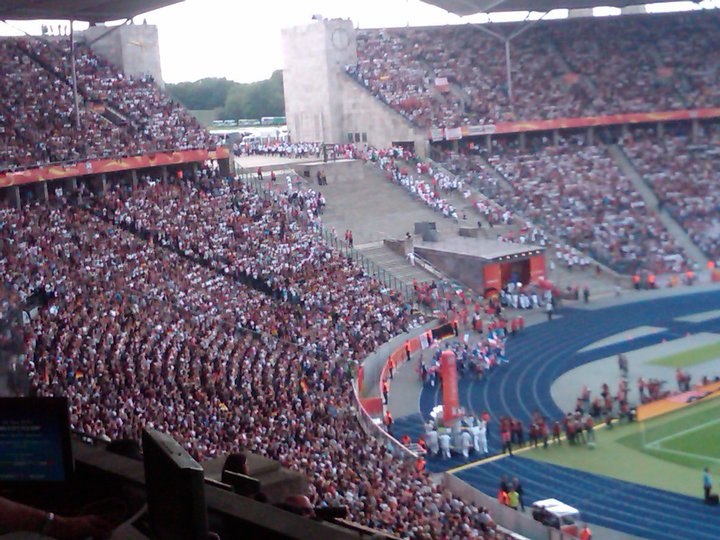
The unprocessed version of the background photo shows kids running up the Marathon Step at the Olimpiastadion after the opening ceremony.

Looks a little different, doesn’t it? What? You’re viewing in an RSS reader? OK, click through the full story …

OK, now are you at the site itself? Great. Looks a little different, doesn’t it?

I have a few shout-outs to make:

1. The logo and other design advice are the work of someone familiar to soccer fans and players — Prairie Rose Clayton, who tweets as @hoover_dam and shows her breathtaking banners (we’re talking real-world, show-at-soccer-games banners, not banner ads) at tifosi.hooverdam.net. She’s so cool that when I met her in Boston, a big-time music person (Ted Leo) came up and recognized her.

2. The new theme is Magazine Basic, which I can’t believe is free. It’s wonderful and incredibly easy.

3. The background photo is from Olimpiastadion in Berlin at the opener of the 2011 Women’s World Cup. I wanted a photo I took, but I also wanted to do some processing so it wouldn’t overwhelm the rest of the site. I used a sepia filter, of course. I hear the kids today call that “Instagram.”

The cosmetic changes will indeed point to more substantive changes. I’m going to keep up a steady presence on the blog, and I’m going to rev it up big time after I finish the MMA book. Almost there.

I’ll be looking not just for advertisers but for writers as well. See the “About” page for details on both.

track and field

Diamond League: Track and field, back already

Miss the Olympics? Good news! Track and field never sleeps. (Not in the summer, anyway.)

Not that everyone was back in action in today’s Diamond League meet in Stockholm. But a few familiar people were back:

– Long jump gold medalist Brittney Reese had a poor performance. You could say she’s erratic, or you could say she shows up for the big events. Bronze medalist Janay Deloach was a bit behind her London mark but still finished third.

– Michael Tinsley beat Olympic gold medalist Felix Sanchez to win the 400 hurdles with ease.

– Do you know who won the gold medal in the men’s triple jump? You should. He’s American. And he won again today.

– Same for Reese Hoffa in the shot put, who threw just a centimeter farther here than he did in London but beat Olympic champion Tomasz Majewski.

– Remember Ryan Bailey? (The sprinter, not the water polo player.) He was the only man under 10 seconds in the 100.

– Olympic pole vault champion Jenn Suhr entered today’s competition at 4.55 meters and promptly exited.

– Two Americans, including Dukie Shannon Rowbury, ran their best times of the season to stay in the top five in the 1,500.

– Newly crowned (as in “post drug test”) women’s shot put champion Valerie Adams (New Zealand) got the joy of winning it on the field of competition this time. She has a funny and mildly profane quote in the New Zealand media.

– Russia’s Yuliya Zaripova dominated the steeplechase with a meet record and the best time in the world this year.

– Dawn Harper and Kellie Wells continued their “Hey, stop looking at Lolo for a second and look at us!” tour with a 1-2 in the women’s 100 hurdles.

– Charonda Williams and Bianca Knight were 1-2 in the 200, with Jeneba Tarmoh fifth.

– And this just in … Sanya Richards-Ross is still the best in the world in the women’s 400.

One person jumped out at me and inspired a possible blog post later that I’ll call “the lonesome pacemaker” — Matt Scherer, who is carving out quite a career not finishing races.

But wait — there’s more! In the four-way DecaNation meet, the USA convincingly beat Russia, Germany and France. Big wins for Justin Gatlin, Alysia Johnson Montano, Bridget Franek, Christina Manning, Calvin Smith, Michelle Carter, Nick Symmonds, Cory Martin, David Oliver and … Shannon Rowbury? She’s everywhere!

Oliver in particular is worth noting — he was dominating the 110 hurdles between Games but was out of form and didn’t make the Olympic team at trials.

(OK, OK … the triple jump winner is Christian Taylor.)


olympic sports, sports culture

Myriad links: The Onion on water polo, dreary Americans, new Olympic sports

A few late-night links that I haven’t had a chance to work into full-fledged posts today:

1. The Onion brought the funny on water polo and other sports (if you consider baseball a sport) in one of their video segments.

2. At Fox Sports, Jen Floyd Engel ponders the difference between American “thou shalt not cheer in the pressbox” journalists and those from elsewhere, who cheer, hug, get kisses from athletes, etc.

Having spent my last Olympics sharing press tables with a corps of Russian journalists that was mostly grumpy old men (the exception was the lone woman, who looked a bit like Tori Amos and might have smiled once), I can tell you it’s not universal. But yes, many other countries are a bit more … expressive. Most of the time, it’s harmless. In soccer pressboxes, though, we’ve all seen a few really annoying situations.

3. Following up on the fun discussion we’re having on golf in the Olympics (the driving range/miniature golf biathlon has potential), I’ve seen some musing on the next wave of sports competing to make the Olympic programme. Around the Rings tells us the IOC is warning sports federations not to spend a lot on their campaigns, because that would be unfair to those who don’t have much to spend. (Imagine American TV advertising if the Republicans and Democrats had to limit themselves to what the Green Party can afford.)

Via Andrew Sullivan’s blog (Andrew’s on vacation), The Atlantic takes a look at all of the contenders. The most sensible inclusion would be karate. It has immense global popularity, and no one needs to build a new venue — just rotate it into the same arena or convention center that’s hosting judo, taekwondo or weightlifting. But no one said these decisions made sense.

soccer

Very Good Things in U.S. soccer

No, the U.S. soccer scene isn’t all petty arguments over turf wars, business plans and what was said in 2007. A lot of Very Good Things have happened in American soccer recently — some well-publicized, some not.

– The U.S. men won for the first time in Mexico’s Azteca Stadium last night, getting a series of increasingly stupefying saves from Tim Howard and a clever goal — a strong run and cross from Brek Shea, a nifty backheel from Terrence Boyd and the finish from Michael Orozco Fiscal. The game was a friendly, not a World Cup qualifier or Gold Cup game, but there’s no downside to smashing a psychological barrier.

– Something I mentioned in my live blog of the women’s final but deserves more attention: Abby Wambach played her guts out as always in the Olympics in pursuit of her first major international championship in eight years. Has anyone done a complete story about what it means to her to come back from the 2007 Women’s World Cup and her 2008 injury to win this gold medal? I can hardly imagine what she’s feeling, but she deserves it.

– This book snuck up on me — Gwendolyn Oxenham, another of those hyperachieving Dukies who makes me wonder why that school ever let me in the door, has released Finding the Game, a book derived from the same travels that brought us the film Pelada. If you want to take a look at soccer beyond the spotlight, look here.

– The Seattle Soundersbusiness numbers are still impressive, well after the honeymoon period should be over.

– The San Antonio Scorpions have been a tremendous success in the NASL, a league that seems to have more life than the skeptics thought. Along with other healthy USL and NASL clubs, there’s life beyond MLS in men’s soccer.

And maybe D.C. United is getting closer to a stadium deal? Maybe?


soccer

Women’s soccer, the new league and Hope Solo: Can’t we all just get along?

We got two fillings for THIS?

There’s three sides to every story — yours and mine and the cold, hard truth Don Henley

There’s blood in my mouth ’cause I’ve been biting my tongue all week Rilo Kiley

Jules: Yolanda, I thought you said you were gonna be cool. Now when you yell at me, it makes me nervous. And when I get nervous, I get scared. And when (bleepers) get scared, that’s when (bleepers) accidentally get shot.
Yolanda: You just know, you touch him, you die.
Jules: Well, that seems to be the situation. But I don’t want that. And you don’t want that. And Ringo here *definitely* doesn’t want that.Pulp Fiction

Maybe I’m reaching with the last one. Perhaps I should’ve skipped to the part where Jules says the Ezekiel verse one last time and says he’s trying real hard to be the shepherd. The U.S. women’s soccer community could use a shepherd.

As you know if you follow me on Twitter, I bought Hope Solo’s memoir, skimmed the personal parts and read the soccer parts. No offense intended to her personal story — I was just in a hurry to learn what she had said.

I mentioned a couple of things that surprised me. One was a quote that I thought could be taken the wrong way. Another was that she reiterated her racism accusations against Boston Breakers fans, accusations that most of us thought had been put to rest.

People were angry with me. A couple of them were people I respect and like, and we talked it out. A couple were people I don’t know as well who slung a few drive-by insults at me and declined to elaborate on what exactly I’d said.

The latter isn’t a surprise. Solo has a legion of fans who will mobilize against any alleged “hater,” even if she doesn’t ask them to do so. Just check out the reviews at Amazon, where the one person to say anything negative is marked with the dreaded “1 in 24 people found the following review helpful.” (To be sure, the review doesn’t say much. But some of the other reviews marked as “helpful” are simply insane.)

If anyone’s reading here wondering if I’m going to be a “hater,” you might be disappointed. I didn’t hate this book. Her story is well-written — co-writer Ann Killion is never one to mince words (ask Don Garber), and the book moves briskly. And though some people come across better than others, this book wasn’t written to settle grudges. It’s her story. She spends much more time talking about the truly important people in her life — family and a few supportive coaches — than she does about her conflicts. Plenty of people will find this book inspiring.

If you read the book, just remember the Don Henley quote here. There are multiple sides to every story.

Continue reading

general sports, olympic sports

Rio 2016: Is there any way to make golf work in the Olympics?

Golf’s inclusion in the 2016 Olympics is one of the most puzzling IOC decisions in recent years. For one thing, that decision forced Rio to build a golf course, which has turned out to be a major problem.

The other problem is that the golf calendar is already super-saturated. Four majors, WGC events, Ryder Cup, Presidents Cup and the tour playoffs — that’s a lot to handle. (Granted, tennis has the same problem but is starting to get a foothold in the Games.)

So if you must have golf in the Games, why not make it interesting? My longtime work buddy Scott Michaux has a modest proposal: Have national teams play. It would still be a stroke-play format with individual gold/silver/bronze, but you’d also take scores and add them up, NCAA-style, to give team medals.

A similar proposal at CBSSports: Same thing, only in match play.

olympic sports

Chaos, coaching and sports (or, “things I can’t do with my youth soccer teams”)

The Anson Dorrance biography The Man Watching describes the constant chaos in the North Carolina women’s soccer program. Dorrance has piles of papers on his desk — sometimes, he finds big checks he has yet to deposit. And his team regularly shows up late to the airport, something I couldn’t handle at all.

Ironically, it’s a Duke guy writing this post about the benefits of chaos in coaching:

Before meets, Bowman hid goggles, so that Phelps had to swim without them; he deliberately arranged late pickups, so that Phelps would miss meals and swim with hunger; he cracked goggles, so they would fill up with water and obstruct Phelps’ vision in the pool. We don’t know how Phelps did in those earlier meets, but we know that Bowman created uncertainties for him in lower-risk situations so that when it really mattered he had familiarity with the unexpected and a mental adaptability that gave him the best shot at winning.

So, parents on my soccer team — if I’m late for practice or a drill goes horribly wrong, it’s all part of the plan.

via You Can Only Win in Sports, or Anywhere Else, if Youre Ready for Chaos – Forbes.

soccer

Greg Ryan responds to Hope Solo’s allegations

In this story on Hope Solo’s book, we read this about her meeting with then-U.S. coach Greg Ryan: “She writes that during a meeting with Ryan, he pushed her back onto a couch as she tried to leave.”

The athletic department at Michigan, where Ryan coaches now, sent this statement from Ryan:

This allegation is completely false. I did not shove or push Hope as I’ve been accused in her book. I would have been terminated immediately by USA Soccer had this allegation been true. I have openly discussed the contents of the meeting and this is the first time that this accusation has been brought to light.

Hope was disappointed that I benched her for the semifinals but it was the right move for the team. It was discussed with team leaders and they stood by my decision.

It’s in the past and I’ve moved on. I’m focused on the upcoming Michigan Soccer season.

So far, I haven’t seen any other reaction from team veterans.

olympic sports

Olympic legacy: White elephants, tourist attractions or training centers?

You may have seen some of the depressing photos of abandoned Olympic venues in recent days — from Beijing, from Athens, from all over.

Is the USA doing any better? A travel-planning site called RoadTrippers sent out a release today highlighting a few thriving venues from Squaw Valley (though it’s labeled as the “only venue in use from ’60 Winter Olympics”), the Lake Placid center that saw Sonja Henie in 1932 and the “Miracle on Ice” in 1980, the still-useful speedskating oval and Olympic Park from Salt Lake City, and the still-dancing fountains at Atlanta’s Centennial Olympic Park.

Winter Olympics are mostly about using a couple of arenas and putting up temporary stands for skiing and snowboarding events. The biggest questions are the sliding track (luge, skeleton, bobsled) and the ski jumps. Sarajevo, as seen above, has a couple of nasty leftovers, but the region had more pressing issues in the 90s. Salt Lake City is happily using its facilities. The bobsled/skeleton federation has events in Cesana (2006) and Whistler (2010) this winter. Getting into the mix in ski jumping is more difficult, with so many facilities in Europe hosting traditional stops. Whistler Olympic Park as a whole gets some use, but the Canadian ski jumpers seem to prefer Calgary, another former Olympic host.

The Summer Games can be trickier. One good reason for that: They’re huge.

The best way to save costs and minimize abandonment, of course, is to use a lot of pre-existing facilities. Atlanta got by with a lot of college gyms and pools. Some specialized facilities, like the Georgia International Horse Park and the beach volleyball venue, segued nicely into other uses. The tennis center’s fate is still in the air. As for the shooting center, Wikipedia states with no source other than common sense that it’s difficult to attract major competition when Fort Benning isn’t that far away.

Sydney 2000 changed the rules. Tons of new venues, mostly concentrated in one big park. But in sports-mad Australia, those facilities were welcomed and mostly still in use. One arena has even hosted multiple UFC cards.

Then, alas, came Athens. Greece simply couldn’t afford the Olympics, much less the upkeep afterwards. It’s no surprise to see abandoned facilities in the pictures above.

Beijing shocks me. And it shocks someone at Deadspin who calls the “ruin porn” pictures “dishonest crap.” Several of those venues were supposed to be temporary. The Bird’s Nest and Water Cube are tourist attractions near the big convention centers that housed us friendly media types and a few competitions during the Games. And I don’t know what they’re supposed to do with the canoe slalom course built in the middle of nowhere.

The picture that makes the least sense to me, though, is the beach volleyball picture. That was supposed to be a temporary facility, and it’s in a busy neighborhood. You’d think it would’ve been torn down between the twin forces of national pride and locals wanting their park back.

London also went with some temporary facilities. Others will go to local club teams — Wimbledon fans will note the irony in a basketball team leaving Milton Keynes to go to London and play in the “Copper Box.” Cycling-mad English folks will probably figure out a use for the velodrome.

You’d think the IOC would have some consideration for the expense of all these venues when it ponders the Olympic program. You’d think. But they added golf to the 2016 Games. And Rio had to start taking bids. Then they get the joy of securing a golf course. Maybe Tiger can pay for it.