us soccer

Scenes from a U.S. Soccer board meeting

While other reporters were out chasing down details of the Gang of Six (or Five or Four), I was at a U.S. Soccer Board of Directors meeting.

And what I can report from that meeting is that USSF board business is …

Boring.

Really, really boring.

If you read Twitter — and yes, the board members made it known that they’re aware of what’s said — you would think the board sits around discussing ways to prevent promotion/relegation from happening. Or ways to make sure Eric Wynalda is never employed. Or perhaps just taking turns swimming in piles of Soccer United Marketing gold.

Here’s what happened in the first, oh 150 minutes (minus a few minutes where I had to run out):

1. Sunil Gulati said he’s looking forward to the election being over. Carlos Cordeiro, sitting next to him, nodded his head slightly.

2. Gulati went over the USA/Canada/Mexico World Cup bid. He’s quite enthusiastic about it.

3. Gulati went over FIFA’s current thinking over changes in international competition. They’re combining youth tournaments — instead of a separate U20 and U17 tournament, we’ll see either U19 or U18. They’re leaning U18 because it’s easier to get players released. That also works for the U.S. because they often run into conflicts with college players now.

4. OK, THIS is interesting. FIFA is working a women’s Nations League, like the UEFA and CONCACAF men’s league. The goal is to keep women’s national teams more active. Gulati gave the example of Ecuador’s women, who made the 2015 World Cup and then went more or less dormant.

There’s a side discussion about SUM and whether it’ll have less stuff under its control as FIFA controls more rights. Gulati points out that other countries are in the same boat, and FIFA is backing off a bit for now.

5. Want to see a long presentation of marketing stuff being planned around the Women’s World Cup? Here you go. No word on what happens if the U.S. women don’t qualify.

6. A player development update turned into a discussion with Dr. Bob Contiguglia, attending his last board meeting as past president, asking about the process the federation went through before announcing the birth-year age-group changes that have blown up real good. Ryan Mooney answers and says nothing substantial for the first three minutes or so but then says it has spun off a longer discussion about better communication with members.

7. A participation study has shown that rec players tend to “lapse” at age 8-10, while travel players tend to leave at 11-15. But there’s a high interest in “unorganized” soccer, and there’s interest in an intermediate level between rec and travel. (Which some states do.)

8. Tax Reform Impacts. This goes on for a while.

Having fun yet?

9. USSF counsel Lydia Wahlke goes through a presentation on athlete safety, especially in the wake of what’s happened with USA Gymnastics. The federation was already doing a lot, including harassment training for every NWSL club last spring. This was a long but absolutely important discussion. I couldn’t follow all of it, and I started wondering how long these meetings would run if Wahlke and Kyle Martino are both involved.

10. Election update: The vendor overseeing the election is Plante Moran. We get the lowdown on who they are. I didn’t need to know that they were named one of the top places to work in Chicago.

A break. Finally.

11. Donna Shalala’s term as independent director is ending, and the Risk and Audit Committee needs another independent director to lead it in the interim. I think Val Ackerman ducked. Lisa Carnoy gets volunteered.

Incidentally, Carnoy also filled in as treasurer for the purposes of validating registration fees so they can properly weight the votes. Cordeiro would normally do that, but he recused himself, sensibly.

12. AN OPEN CUP DISCUSSION! And it got quite interesting. They’re considering an amendment that would eliminate the Cup’s foreign-player restriction, which currently stands at five for pro clubs. The pro clubs don’t want that any more — in fact, NASL interim commissioner Rishi Sehgal was in attendance and spoke up to testify that all the pro leagues agreed on this. (Nice to know they all agreed on something.)

The lines of argument are surprising. It’s basically Gulati and CEO Dan Flynn vs. Shalala, Carlos Bocanegra and Don Garber. Gulati argues that the Cup’s credibility won’t be hurt by limiting the number of foreign stars, especially considering how many of them sit out until the semifinals or final, anyway. And Gulati says he wants to give U.S. players more opportunities. John Motta is on the Open Cup committee but says he didn’t really participate in this discussion because it affects the pro leagues, not the ones in his domain (USASA).

tabledThe amendments wouldn’t take effect until qualifying begins anew in August, so the motion is tabled.

13. Insurance. The USSSA had some concerns with the USASA’s proposal. Tabled to give them time to work it out.

14. Wahlke describes an independent ethics committee proposal. Gulati points out the Risk and Audit Committee has been doing a lot of this work but doesn’t object to it being formed. No one speaks in opposition. So that passes the board — I’m not sure whether the National Council (the big meeting, which will vote on the presidency) has to vote on it tomorrow.

15. Membership fees. They saved the most explosive item for last. Motta wants to cut membership fees in half — from $2 to $1 per player for adults, from $1 to 50 cents for youth. At-large member John Collins, who asks great questions throughout the meeting, points out that the National Council would have to approve this.

It’s safe to say Gulati is not a fan of this idea. Especially the timing of it, one day before a National Council meeting at which they’ll need to approve the budget. (Cordeiro points out it’s also one day before the election.) And Gulati is convinced we’re not losing players over 50 cents.

Gulati unleases his full sarcasm on Motta, with whom he traded the VP slot way back when (Motta beat him for the spot in 1998, Gulati won it 2000): “Want to withdraw it or see it defeated?” Motta wants a vote.

So they vote … sort of. A couple of people raise their hands in favor. Athletes’ Council chair Chris Ahrens is intrigued. He asks Motta for a specific use of the money (which is maybe a couple million dollars, all told) if they get it “back.” Motta doesn’t give a particularly good answer.

It’s safe to say this issue is going to come up again. But the argument to recommend such a change now isn’t persuasive. They take a final vote. Motta and fellow Adult Council member Richard Moeller vote yes, as does Youth Council rep Jesse Harrell — overlooked at first because he doesn’t raise his hand very high. Cordeiro abstains. Everyone else votes no.

And that’s the last order of business. We’re off to the “Good of the Game” segment in which members can talk about what they want. That’ll be part of the National Council meeting — actually, all my local club meetings end with it, too. It’s generally like the minute-long speeches in Congress hailing the accomplishments of a local chess club. But it can get testy, as it did in the National Council meeting a couple of years ago when people went back and forth with contrasting opinions on Chuck Blazer. And if Kathy Carter wins, I think tomorrow’s session will be a doozy.

This one had a lot of positives. Bocanegra praised the work on the SheBelieves Cup and related initiatives. Several board members bid a fond farewell to departing board members Shalala and Contiguglia. Several also summed up their congratulations to Gulati for 12 mostly good years.

But there was some talk of the election animosity. Contiguglia was philosophical — having been through tough times at USSF before, he reminds everyone, “this too shall pass.” Moeller lamented the palpable animosity at the hotel bar last night.

Ahrens was particularly pointed, saying criticisms of the Athletes’ Council were offensive. They’ve put a lot of effort into their duties, he says, only to see their integrity unfairly and inaccurately called into question.

Then Gulati lets fly. “I’d love to say only friendly things, but that wouldn’t be honest.”

He laments that the board (other than Motta and Contiguglia) has been accused in legal documents of being conflicted. (I turned to look at Sehgal, who had a face of stone.) He says the independent directors are truly independent. He didn’t know Shalala until Julie Foudy introduced them. He barely knew Ackerman or Carnoy.

He takes aim at Twitter — particularly, the fact that people who retweet nonsense. “A tweet by someone anonymous gets retweeted, and now it’s Encyclopedia Brittanica.” He jokes that his wife tried to take the tweet that he’s due $30 million-$50 million from the World Cup bid to the bank to see if she could some how use it for cash or credit.

“So much nonsense out there, and you should let people know that.”

And frankly, it was hard not to sympathize. Anyone who sat through that and doesn’t think these people are doing their fiduciary duty is … well, probably looking at it strictly through the lens of self-interest and one decision that didn’t go their way. If you think that’s worth burning down everything the board members and staffers in that room are doing, fine. Sign your name to it and make your case below.

No, that’s not an endorsement for anything in the election. It’s one thing to say the board could use some fresh ideas. So could MLS, for that matter. That’s all that needs to be said. The rest is overkill.

And I found myself wondering who would want to be on this board in the current climate. Who would voluntarily put themselves through this?

So tomorrow, someone is going to win an exhausting and often tedious volunteer position. And they will have skipped all the other exhausting and often tedious volunteer positions that people normally do to pay their dues. So the new president should walk before the board with the greatest humility. Maybe then those fresh ideas will gain some traction.


us soccer, youth soccer

Fact/reality checking the Sunil Gulati speech

I don’t think I’ve ever seen Sunil Gulati take a stage as quickly as he did at the U.S. Youth Soccer gala. It was as if he felt an internal clock ticking as he tried to unleash 20 years of institutional knowledge while a bunch of youth soccer families waited for their dinners.

His hourlong session in Philly was similar. Unfortunately, that’s not posted online. But his speech at the gala is available (see above).

How much of this is the mere venting of someone who’s furious about being attacked on his way out of a long (and, we have to say, accomplished) tenure in office, and how much of it is a reality check on the other candidates and their backers? I’d say roughly 33% of the former and 67% of the latter.

Let’s check out his claims.

The tone of this election: “disappointing and disgusting” (1:15)

You wouldn’t guess that if you saw all the candidate sessions and the U.S. Youth Soccer forum with all eight candidates. (Which, as you know from Twitter, I did.) Everything was civil. The most pointed attack was from Hope Solo, who said Kathy Carter and Carlos Cordeiro have had their opportunity to make change and they have not. Bare-knuckled politics, this is not.

But some of the discussion around the election has been nasty, and Gulati specifically referred to The Truck — somehow left in front of the Pennsylvania Convention Center with neither a demonstration permit nor a special parking permit, according to the helpful city officials I contacted. He says it’s disgraceful. It is, but my understanding is that it’s actually backfiring on some of the more strident candidates, even though they’ve either (A) not claimed credit or (B) actively said “no, I didn’t do that.”

“At the last (Annual General Meeting), things seemed to be pretty good.”

In his hourlong session, Gulati went overboard in talking about how smoothly everything has run for the last 12-20 years. (See my post about it and search “roundup of transcripts.”)

Here, his basic point is half-right. Some issues are bound to have more light shed on them when we have an election. A lot of people are frankly ignorant about USSF in general. But he has a point that some folks who are now suddenly experts on everything USSF should be doing better were awfully quiet a few months ago.

Transparency

Gulati seems shocked that this is suddenly an issue, and he’s happy to compare USSF to any other similar federation. How many have independent directors, he asks? (Not many, but the USSF search committee landed on far too many people who have some sort of tie to Gulati, Columbia, etc. You’d think they could at least get someone from the West Coast.)

wallowingHe’s on slightly firmer ground when he talks about open board meetings (they have them, but they go into executive session far too often). He says they print every word of meetings, which is true for the National Council meeting (the big one, with everyone) at the AGM but not true for the board meetings, which have minutes that don’t really tell us much. He could’ve mentioned the AGM “book” with all the reports, which is usually released to the public at some point, though it’s a little hit-or-miss.
And they publish financial statements, as required by U.S. law but not required in many places elsewhere in the world. Yes, though we’re still waiting on the statements for the year ending March 31, 2017.

I think Gulati has a point here, but I’m willing to admit I’m a little biased because I’ve been frustrated by the sheer volume of people — mostly anonymous folks but also some candidates and their reps — who claim not to know something that’s right there in plain view on the USSF site.

Of course, the biggest transparency question is in regards to ….

Soccer United Marketing

“Everyone is conflicted in one way or another” may not be the best way to open this segment, but he’s absolutely right. By design, the National Council consists of representatives of all the state associations, and the board consists of representatives of the various councils.

He gives the history of SUM that we heard in a few other places in Philly — rewind to 2003, when IMG wanted out as the USSF marketing company, and SUM (formed in 2002 to save MLS) stepped in.

He says the agreement to renew SUM has been approved unanimously by the board three times. I’ve started to look into this. There’s an old trick — so old that I saw it in the very first board meeting (local hospital board) I ever attended as a journalist — in which the board has some debate but agrees to record the vote as unanimous. I have no evidence that USSF has done this, and I also haven’t heard from any disgruntled board members asking about SUM, and to my knowledge, no one else has. (There were reports that some board members wanted answers about how the Klinsmann contract was handled, a completely different issue, so it’s not as if the board is totally closed off to outside communication.)

Promotion/relegation: Changing the rules on people for undetermined benefit

This is at the 5:50 mark. And he’s right. I wish we’d have more discussion on potential ideas to phase into pro/rel, but I’m not sure how to make that happen. Maybe after the election, when we either have an open pro/rel advocate as president or the pro/rel-minded owners realize they’re going to need to work with the new “establishment” to make it happen.

No, the MLS summer schedule isn’t the reason Qatar is hosting the 2022 World Cup

Nor is it why Morocco could win the World Cup rights for 2026. He also points out near the end that whatever FIFA could complain about within U.S. Soccer can’t be fixed in the four months that remain in the World Cup bid campaign.

He’s right.

(I’ll skip the bits about whether to pay the president and what a “soccer person” is. He says little on the former, and he’s justifiably snarky about the latter.)

Now we’re getting to what he calls his fact check, starting at the 8:20 mark.

Gulati disputes claim: No one ever called Jonathan Gonzalez

He says Tab Ramos talked at the convention about how many times they talked, and he says Christian Pulisic called Gonzalez at Gulati’s request. He concedes USSF may not have done enough but blasts the idea that no one ever contacted Gonzalez.

He’s surely right by the letter of that statement, but most reasonable people aren’t saying USSF had no contact with Gonzalez.

Gulati disputes claim: We have “utter chaos in the states”

Gulati says USSF used to have a grievance or appeal every few weeks, and we haven’t had as many lately, which is a credit to the federation as a whole. From the available evidence, he’s right — if we’re defining “chaos” strictly as grievances and appeals. I’d make the case that “the states” are in chaos because youth soccer is in chaos.

Gulati disputes claim: In the Development Academy, we shouldn’t have the same restrictions on substitutions as we have in the rest of the world

This is an odd one in this list because it’s not a “fact.” That’s an opinion. He scoffs at the idea that the Development Academy should have more freedom of substitution than we have in pro-level games. I could frankly see an argument either way. North Carolina’s legendary women’s coach Anson Dorrance has pointed out that he has a lot of players who’ve made a commitment to play for him, and he thinks he should be able to spread out the playing time.

In any case, again — that’s not a “fact.”

Gulati disputes claim: USSF is out of compliance with 13 FIFA statutes

Wynalda actually said “bylaws or statutes.” In any case, Gulati says this is simply false, and in a few cases where we are out of compliance, it’s because we would be out of compliance with U.S. law.

“We’ve made it clear we’re not going to violate American law.”

The example he gives is training compensation and solidarity payments. “We’ve spent a lot of money with a lot of lawyers,” he says, and player reps have made it clear they will sue youth clubs who try to claim compensation.

This is one of those cases in which it’ll surely help to have new people at the table. Gulati’s surely correct on the facts here. But it doesn’t mean there’s no solution available.

Gulati disputes claim: “Heard from a self-confessed TV expert that 50% of our revenues come from TV.”

Easy to check, he says. It’s closer to 15-20%. “That’s only a several-million dollar error in the budget,” he quips.

No, it’s not easy to check, even if USSF’s accountants made every possible best-faith effort to explain it. How do you separate “sponsorship” money? How much sponsorship is predicated on TV appearances?

So I’m not sure I buy the notion that we can put a hard number on it. But I also have a hard time buying the notion that TV is “50%.” The Wynalda campaign is, as always, free to contact me to explain this figure.

Gulati disputes claim: “The board has little actual business acumen”

This one is also somewhat subjective, but I think Gulati makes a very strong point here. The independent directors in particular have plenty of business experience.

Side note: I’ve heard the claim that “business acumen” from Goldman Sachs and so forth is irrelevant because we’re talking about a nonprofit here. OK. But the board also includes, as Gulati points out, a former university president.

In fact, under Donna Shalala’s leadership, the University of Miami was ranked the most fiscally responsible nonprofit in the country, as I just learned. (Google is fun!) I wish I’d known that when someone talked my ear off about this topic.

Gulati disputes claim: “USSF needs a membership services department”

Gulati says one of the most lauded people in U.S. Soccer is Caitlin Carducci … of the membership services department.

You may argue, but I’ve heard from several people within U.S. Soccer who aren’t necessarily Gulati loyalists than up to 90% of what candidates say USSF should be doing are things USSF is already doing.

Maybe that’s exaggerated. But I have little doubt that the next president will be surprised to learn that some of his or her campaign points have already been addressed.

Gulati disputes claim: “We need multiple pathways that we don’t have now”

He claims they’re still sending scouts to ODP. How effective they are is anyone’s guess.

The finish

Gulati finishes by asking people to ask questions of the candidates. Hard questions.

He’s right. And we’ve got a few more days. Send me your questions, and I’ll ask.

us soccer

The big winner in Philly’s U.S. Soccer presidential conversation is guaranteed to lose

Out of all the speakers I saw in Philadelphia, the person who looked best-suited to be U.S. Soccer president is …

OK, I should warn you. Some of you are going to hate this.

But bear with me. I’m not saying this person should be president on Feb. 11. I bring this up to point out the daunting challenges the next president will have not just in reforming the things U.S. Soccer is doing poorly but also in building upon the things U.S. Soccer has done well.

Some of you don’t want to hear that, I know. Again, not saying this is a vote for the status quo. I went into Philadelphia with severe reservations about Kathy Carter and Carlos Cordeiro, and if you read my FourFourTwo recap of the week’s campaign events, you’ll see they were not adequately addressed.

(And thanks to everyone for your kind words about that recap and about my hundreds of live tweets over those three days. I really appreciate it. And please bear it mind when you read this thing you’re going to hate.)

So, again, the big “winner” of the week was …

(Please don’t shoot the messenger.)

… Sunil Gulati.

Again, again — that’s not a voice of regret that his presidency is about to end. It might be a sign that a lame-duck Gulati, freed from the need to appease various voting blocs, is an entertaining interview. He and Alexi Lalas had a candid, searing and occasionally hilarious discussion. I know a youth soccer organization plans to post the candidate sessions, and I hope someone does the same with Gulati’s session.

You may have read the Soccer America and ESPN recaps. Here are a few comments you might not have expected:

https://twitter.com/duresport/status/954066954351992833

https://twitter.com/duresport/status/954058849279008769

He gave the most pointed defense (or perhaps the only pointed defense) of Soccer United Marketing that I’ve heard. It started in 2002 out of necessity, filling a vacuum IMG was leaving. Since then, they’ve renewed it three times. He insisted they’ve looked at alternatives but says there’s an advantage to renewing the deal before it expires, like a player having leverage before a contract expires. And the deal is always voted on by the non-recused (non-SUM-or-MLS-affiliated) members of the Board, and it has been renewed unanimously.

And then we had a few good zingers:

  • “Winning Twitter polls is not getting elected.”
  • In response to Alexi Lalas asking if he considered resigning after the Trinidad loss: “Did you quit after the 1998 World Cup?”
  • Anyone who thinks the Federation can legislate promotion/relegation “is going to end up in front of nine judges.” Lalas: What if FIFA pushes it? Gulati: “Then they’ll end up in front of nine judges.”
  • He says a lot of candidates are promising things they can’t deliver, something he refused to do even when it would help. He said a Central American FIFA voter once asked him for some sort of promise, and he declined. The response: “I like you, Sunil, but you’re a lousy politician.”

Some of it didn’t ring true. He said he’s not supporting a candidate but has recently given two candidates some solicited advice and one candidate some unsolicited advice. He finds a lot of the electoral discourse “depressing and disgusting” and claims all his past NSCAA Conventions and USSF Annual General Meetings have been positive — for a refutation of that, check out 2003 in my roundup of transcripts.

But is there more to this than just an entertaining session? Is it unfair to dump on the Gulati era?

A good take on that:

https://twitter.com/DiCiccoMethod/status/955808177521610753

And how about Soccer United Marketing, which has been intertwined with the Federation throughout Gulati’s tenure as president? Merritt Paulson is an MLS (and NWSL) owner and former Board member, so feel free to consider all that, but he makes a few interesting points:

https://twitter.com/MerrittPaulson/status/955250512948965376

But what about transparency?

https://twitter.com/MerrittPaulson/status/955253543564275712

Want to dismiss Paulson? OK. Let’s look at the numbers from the Form 990s on the USSF site and ProPublica.

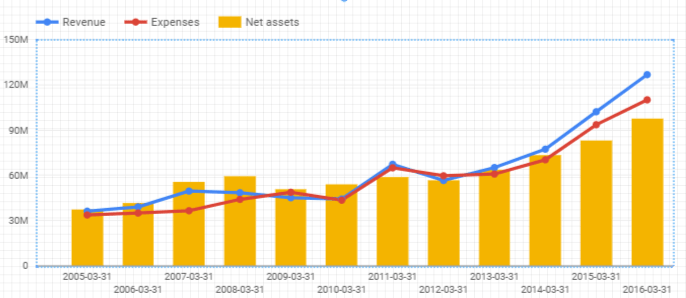
ussf-money

Here’s the funny thing: If I could extend this chart on each side, you’d see an even more dramatic increase. I didn’t include the numbers from the years four years before this because USSF changed its fiscal year from Aug. 31 to March 31, so it’s not a valid comparison. The annual revenue and expenses weren’t sharply different, but the net assets were far lower. The 2001 statement shows net assets of $14,054,712, and it lists the previous year’s assets at $6,683,668.

And though the March 31, 2017 numbers aren’t available yet, we’ve seen information that net assets will be up in the $140-$150 million realm, thanks in large part to the Copa America Centenario.

So it’s no exaggeration to say that, in 18 years, USSF has gone from a seven-figure organization to a nine-figure organization.

And they’re not just accumulating that money. (They did in the early 2000s, which I gather from Board minutes was a business strategy at the time to make sure they didn’t run into serious problems.) I included “expenses” here for a reason. The Federation spends a lot more than it used to.

(Note: Eric Wynalda claims to have $1 billion sitting on the table for the Open Cup, then says we’re leaving $120-$150 million out there through various mismanagements. I’d love to know details.)

So are we being unfair to the Gulati era and to Soccer United Marketing — and, perhaps, to Kathy Carter? Or Carlos Cordeiro, who also has played a role?

No. Because for better or for worse — and in this case, we’re looking at the “worse” — neither Carter nor Cordeiro is Sunil Gulati.

Gulati’s session probably hurt Carter by contrast. Carter comes off as corporate, speaking in vague business terms. Gulati doesn’t. You may hate what he says at times, but you know what he’s saying, which isn’t always true for Carter.

Then there’s Cordeiro. He didn’t do a one-on-one session, and he has done few interviews at all. He did pretty well in his 15-20 minutes on stage at the forum. Then he stepped off the stage and balked at a recorded interview. He did finally chat with the reporter, but he wouldn’t be recorded unless he had questions in advance. Compare that with Gulati, who knows facing the firing line is part of the job.

So does it matter to this election that Gulati knows his stuff and is a strong voice with more openness to change than one might think?

No. It doesn’t. No matter who wins, Gulati will be on the Board as a non-voting immediate past president. No one wants to dump him off the World Cup bid committee. Even supposed nemesis Eric Wynalda led a round of applause for the good he has done, and Wynalda knows the next president will need to work with Gulati in many capacities.

But they can all do it. Gulati can work with his supposed enemies. So he doesn’t need Kathy Carter to take his place. Nor will it matter if Cordeiro is elected, no matter the state of their relationship.

So the takeaway here is that the next president, no matter how ideologically or personally tied to Gulati, has a steep learning curve.

Now that might be a good thing. For 12 years, Gulati has run U.S. Soccer with little opposition — none in the elections, perhaps not enough on the Board or within the membership. The next president, who probably won’t have a majority on the first ballot, will be forced to build bridges that Gulati had no incentive to maintain.

And that’s a good thing. So is the fact that Gulati isn’t completely going away. Maybe we’ll get that one-vs.-eight debate one of these days.


podcast, us soccer

All the USSF president’s men (part 1 of RSD23 podcast)

The nomination deadline has passed, and we still don’t really know how many candidates will officially run for U.S. Soccer president. Current educated guess is eight, but at least three are unconfirmed.

This morning, I chatted with Jason Davis on SiriusXM’s United States of Soccer. The interview is now available on demand on the SiriusXM site. Highlights:

  • 1:30 – How many nominees? We go through individually.
  • 5:00 – Who can nominate, anyway?
  • 6:25 – Conspiracy theories — separating the ludicrous from the rational, especially in terms of Soccer United Marketing and Major League Soccer.
  • 8:33 – The Nominating and Governance Committee: Too much influence for Garber and Gulati?
  • 14:00 – Has SUM lost control of things?
  • 15:30 – The Steven Gans letter

And the election accounts for the first 15 minutes of the Dec. 13 podcast …

  • 4:30 – Why it’s important that the rest of the election is in the hands of the Credentials Committee, not the Nomination and Governance Committee. No, really. It’s about SUM.
  • 6:00 – The positives of SUM (historically), segueing quickly into what looks quite bad right now.
  • 8:10 – The establishment candidate (Kathy Carter)
  • 9:15 – Why the delay in USSF announcing the final field?
  • 10:10 – The adult soccer associations are leaning toward …
  • 12:30 – Yeah, somehow this segued into pro/rel and how we can do it better than Europe
  • 13:10 – Summing up the field and how they all have something to say.

The second part of the podcast is on the Soccer Parenting Summit. See the next post tonight or tomorrow or whenever I thaw out from another trek outside. Listen:


us soccer

U.S. Soccer presidential race: Nomination check

Yesterday, I saw a list of 44 nominations (43 organizations, 1 athlete) who had nominated someone for the U.S. Soccer presidency.

Today, it’s down to 20. I’m going to reproduce here an email I obtained whose veracity I have confirmed with multiple sources:

U.S. Soccer has received confirmation that Sunil Gulati has officially withdrawn from the presidential nomination and election process. The Nominating & Governance Committee has determined that the 24 Organization Members that nominated Mr. Gulati are therefore eligible to nominate another candidate by December 12, 2017.

We want to remind you that the three (3) letters of support/nomination from Organization Members, or the Athlete members of the Board of Directors is due by 11:59 p.m. on December 12, 2017. If you believe that an Organization Member or Athlete member of the Board of Directors has nominated you and they are not on the list below, please contact me as soon as possible by replying to this email.

I’m not going to reproduce the list to protect the innocent. Or the guilty, in some cases. Depends on your point of view.

I’ve broken it down by type of organization, lumping together the various national affiliates (including national youth organizations, disability sports organizations) as “national.” The numbers might be off by 1-2 — I’m unsure whether one state association is adult or joint (combined youth and adult), and there are a couple of unusual national affiliates that I’m not sure can actually nominate anyone (say, the Hall of Fame). With that disclaimer in mind, here’s the breakdown of how many organizations exist and how many had nominated someone as of Nov. 29, Dec. 8 and Dec. 9:

TYPE No. Nov. 29 Dec. 8 Dec. 9
Adult state association 36 13 16 9
Youth state association 37 12 15 6
Joint (adult/youth) state 18 5 5 3
Pro league 4 0 1 1
National affiliates/orgs 13 6 6 0
Athlete Board members 3 0 1 1
TOTAL 111 36 44 20

UPDATE: The “No.” (or “number” since we don’t have to abbreviate here) column has been corrected now that USSF has released a complete list of affiliates. I’m assuming “Orlando” should be “Oregon.” The incorrect figures were 41 adult, 41 youth, 14 joint, 11 national affiliates/organizations.

One announced nomination is not included here because it’s not on the emails I’ve seen. That’s the South Carolina youth association, which has declared for Kyle Martino.

From that, we can deduce the 24 organizations that had endorsed Gulati but are now in play. Here’s a breakdown with names changed to regions (“res” means “rescinded”):

ORGANIZATION TYPE Mid-Nov Nov. 29 Dec. 8 Dec. 9 NOTES
Midwest Adult yes yes yes res Gulati: Confirmed by email
Midwest Adult yes yes yes res Gulati: Deduced from lists
Northeast Adult yes yes yes res Gulati: Deduced from lists
Southeast Adult yes yes yes res Gulati: Deduced from lists
Northeast Adult yes res NEW yes
Northeast Adult NEW yes
West Adult NEW yes
Southeast Adult NEW yes yes
West Adult NEW yes yes
Illinois Adult Adult yes yes yes yes Wynalda: Announced
Midwest Adult yes yes yes yes
West Adult yes yes yes yes
Athlete Athlete NEW yes
Northeast Joint yes yes yes res Gulati: Deduced from lists
Southwest Joint yes yes yes res Gulati: Deduced from lists
Northeast Joint NEW yes yes
New Hampshire Joint yes yes yes yes Wynalda: Announced
Northeast Joint yes yes yes yes
National National yes yes yes res Gulati: Deduced from lists
National National yes res
Major League Soccer Pro NEW yes Carter: Announced
Midwest Youth yes yes yes res Gulati: Deduced from lists
Northeast Youth yes yes yes res Gulati: Deduced from lists
Northwest Youth yes yes yes res Gulati: Deduced from lists
Southeast Youth yes yes yes res Gulati: Deduced from lists
West Youth yes yes yes res Gulati: Deduced from lists
Northeast Youth yes res NEW yes
Northeast Youth NEW yes
West Youth NEW yes
West Youth NEW yes yes
Northeast Youth yes yes yes yes
West Youth yes yes yes yes
South Carolina Youth Youth Martino: Not on list but announced

If you have any corrections or comments (including claiming your nomination if you are one of these organizations), speak up!

us soccer

Shocking allegation starts post-Gulati era

Sunil Gulati will not run for re-election. It’s the right decision, one that frankly should’ve been made before the late November deadline for organizations to rescind their nominations for the presidency.

But let’s take a close look at that story, particularly this quote:

Gulati, born in India, was the subject of some racist commentary on social media, but said that didn’t play a significant factor in his decision.

I must be muting the right people now, because I didn’t see any of that. I switched to the browser I don’t normally use and tried to find something.

It was a while ago, but on Oct. 13 (by far the highest volume of tweets mentioning him — that was day Gulati held a conference call and Bruce Arena resigned), he did indeed get at least three tweets that would qualify as racist. One suggested Trump should deport him (also noted Oct. 10). One used a word that seems to be a regional answer to Mexico’s “p—” chant. Another made reference to curry.

And some of it was simply abusive:

https://twitter.com/dario27soccer/status/937244498211495937

It gets worse. I’m not going to repeat one allegation. Let’s say it had nothing to do with soccer or business or economics. Another one still thinks “gay” is an insult. And there are another couple of invitations to remove himself from the living.

This one might be the strangest:

https://twitter.com/TitanFan98/status/917994413627985920

Or maybe this:

A lot of people simply asked him to resign — hundreds of tweets in the hour after the apocalypse in Trinidad, then another burst when news broke that the Italian federation president was stepping down.

And the usual stuff from people who don’t understand that this isn’t a paid position:

https://twitter.com/mikemce9/status/930282941107855360

https://twitter.com/IVXXd0pe/status/920155909657001984

This one’s especially muddled:

Also, I sometimes wonder if people think we’re living in a fascist country (hey, we’re getting closer) in which the federation and other authorities also dictate the media coverage:

Here’s a palate cleanser from someone who ran against Gulati a couple of times (and won once):

That search as a whole, though, was a reminder that there are a lot of really stupid hate-mongers on Twitter.

And that’s just Twitter. Other platforms may have carried more racist abuse, but when I think racist abuse and sheer hate, I think Twitter.

Here’s a more pertinent quote to dissect:

“Look, the general perception in the soccer community versus the people who vote in elections may be different right now,” Gulati said, referring to the various state soccer associations and administrators who will vote in the presidential election.

“But the loss to Trinidad was painful, regrettable and led to a lot of strong emotions. And to be honest, I think at this point, that’s overshadowed a lot of other things that are important. So fair or not, I accept that and think it’s time for a new person.”

All of this is true. If I were advising Gulati on PR, I’d drop the “fair or not” clause. And I wouldn’t have responded to this point:

Cordeiro’s entry was the most dramatic, given his relationship with Gulati — and it was clear that Cordeiro’s choice affected the relationship between the longtime friends.

“It was an interesting set of discussions with Carlos,” Gulati said in a quiet tone. “That’s all I’m prepared to say about that.”

So it’s not the most graceful exit for Gulati. He still maintains higher ground than his Twitter accusers, but that’s a very low bar. Even the people on Twitter who use their real names rarely have any perspective or understanding of what Gulati has done. It’s not really logical to blame Gulati for undoing all the progress made over the past decade without noticing Gulati was in place while all that progress was made.

And the bulk of the job — er, volunteer position — has little to do with the men’s or women’s national teams. Here’s what he says about the other candidates:

I think several of them would be in for a pretty big shock about what the job is — it’s not just about national teams. It’s about 4 million registered players, referees, medical safety, grass-roots stuff. It feels like that stuff gets ignored sometimes.

It’s definitely more drudgery than the Twitterati realize. Read back through the minutes of USSF Board meetings, and you will be bored. I also wouldn’t want to be the one trying to figure out what to do with the country’s pro leagues — Neil Morris and I basically figured it’s nearly impossible to avoid lawsuits down the road.

But I think Gulati, perhaps in one final comment that shows he hasn’t been listening to the right people, is selling the other candidates short. Steve Gans, who embarked on a listening tour before announcing his candidacy, is talking about a youth summit to try to quell the factionalism at the grass roots. Paul Caligiuri is talking about ODP, id2 and the Development Academy. Eric Wynalda spent the weekend at an adult soccer tournament. Kyle Martino, Mike Winograd and Paul Lapointe have ideas for every aspect of the game. And Carlos Cordeiro certainly understands the scope of the job — he’s vice president, and he has done the heavy lifting on the budget for many years.

We’re seeing a productive exchange of ideas. We need Cordeiro and maybe Kathy Carter to come in and give their views as well.

So can we agree that we’re not going to let Twitter ruin this election?


us soccer, youth soccer

U.S. Club Soccer forum: Caligiuri, Gans punch sacred cows — and who should drop out?

The first U.S. Soccer presidential forum, hosted by GotSoccer, was a bit like a League of Women Voters political gathering, designed to cover a broad range of topics.

The second forum was hosted by and for — and to some extent, about — US Club Soccer. There’s nothing inherently wrong with that. Their votes carry a lot of weight in this election. They certainly have the clout to bring in all these candidates for a discussion, and they provided a valuable public service by putting the audio online. (The photo in that link confirms what we hear around the 51-minute mark — someone opening a can of Coke.) And there’s certainly nothing wrong with a conversation focused on youth soccer, as much as some people want to hear about the national teams, promotion/relegation and so forth.

Five candidates were there. Carlos Cordeiro was not, and we’ll get to him. Paul Lapointe was not, and that’s a bit contentious. There are two sides to this story. Lapointe told his on Twitter. US Club told me by phone. Here’s how it breaks down:

Start with the press release: “Invited were announced candidates that had personally contacted US Club Soccer to initiate a discussion about U.S. Soccer and their respective candidacies.”

Lapointe insists that he did.

The response I received: All Lapointe sent us was a form letter.

I’ve seen what Lapointe sent. It appears to be a form letter addressed to “Dear USA member,” with bio and platform info attached. So how much should he be penalized for not personalizing that introduction?

US Club did issue a late invitation — a few hours before the forum — for Lapointe to join in. He could not do so on such short notice. And frankly, it may not have been worth his while. He’s not going to be getting a nomination letter from US Club, which had nominated someone but then rescinded that nomination under the late addition to the election procedures that allows an organization to rescind its nomination and yes, I’m getting a headache writing this sentence.

(Incidentally, I obtained a list of organizations that have nominated someone earlier this week. I was working toward publishing it today, and then a new list was posted. Multiple organizations did indeed rescind nominations before the deadline. Maybe later this week, I can get that list posted, but it doesn’t say who nominated whom.)

In any case, he has agreed to be on the RSD podcast in the very near future, so if you want to hear him talk about the issues, come back right here next week. As I said earlier today — he might not be the frontrunner, but he deserves to be heard.

In fact, let’s ask …

Beyond the dispute over times and emails is a larger, more pertinent question: What should an organization demand of USSF candidates? I mentioned on Twitter that US Club came across as if they were expecting candidates to “kiss their ring.” Maybe that’s too harsh. A primary purpose of this forum was to determine how US Club will cast its votes. If I’m advising US Club from a PR point of view, I tell them to invite everyone just to avoid coming across as arrogant — a look everyone wants to avoid when the primary issue in this election is whether U.S. Soccer itself is prone to hubris. But I might be more sensitive to such things than most.

So anyway, what happened at the forum?

If you’ve been following this election closely (or if you’ve listened to the RSD podcast interviews with Kyle Martino, Mike Winograd and Steve Gans — more interviews are on the way), you’ve heard most of this before. All of the candidates think U.S. Soccer has been too heavy-handed and too unresponsive to its members. They have their own ways of saying it — Winograd says USSF shouldn’t be dictating things from Chicago, to which Eric Wynalda amiably retorted that it’s actually from an apartment in New York (where incumbent Sunil Gulati lives).

And all the candidates agree coaching education is far too expensive. Martino pointed out the A and B licenses are only offered at a few specific sites, so coaches have to pay for travel as well.

This forum said little specifically about women’s soccer aside from Winograd’s point that using comparative revenues to justify unequal pay for the MNT and WNT is a misreading of U.S. Soccer’s mission, but we need to remember something here — when we’re talking about youth soccer, we are talking about women’s soccer. A lot of the issues — access, diversity, costs, etc. — are the same for boys and girls. Not all of them, of course, and Paul Caligiuri noted the absence of girls from the Development Academy for its first decade.

But is the DA a good thing? This is where Caligiuri stood out, pointing to the U.S. men’s record before and after the formation of the DA. Spoiler alert — it was better before the DA, back when the USA qualified for World Cups and Olympics. Meanwhile, the U.S. women have been doing OK without a DA. He wants to reorganize to bring the DA, ODP and id2 together. ODP is the old-school player ID-and-training system; id2 is US Club’s answer.

So that’s one hot take. Another came from Gans, who lamented the fact that many states (including his — Massachusetts — and mine — Virginia) now have two State Cups. That is, of course, a result of US Club Soccer starting its own. You have to wonder if the US Club members will take kindly to such a statement or whether it’ll be like my interview for a college scholarship, in which I told a room full of stock brokers I thought Selective Service was unconstitutional. (No, I didn’t get the scholarship.)

Meanwhile, Cordeiro’s absence is being played off as no big deal. I’m not sure that’s right. We’ve had two forums, and he has missed both of them. That might be understandable for Gans and Winograd, who have jobs and shouldn’t be expected to pop up at a random site, especially on a weekday. But Cordeiro’s retired. And if he doesn’t have time for these forums, perhaps he doesn’t have time to be president. (He is, like every other candidate, invited to appear on the podcast.)

And there’s one more candidate who should announce, immediately, that he is not running.

He’s Sunil Gulati.

It’s not about Gulati’s record at this point or whether he’s the right man to continue to serve at this pivotal time. He had every right to make the case.

But now it’s simply too late. Delaying his announcement has left many organizations in limbo as they decide what to do with this newfound power to nominate a candidate. (Previous elections took nominations from the floor of the meeting. Everything about this election is new.)

And while he has been absent, the call for change has gained momentum. It’s a polite call for change, with many kind words about what Gulati has done to help turn around U.S. Soccer from a small federation in red ink to a giant organization awash in sponsorships and infrastructure investments. But it’s loud and clear. The time to stop it has long since passed.

So which candidate will lead that change? I don’t know. It’s going to take a lot more discussion to discern the right choice. Then we’ll see if the voters agree.


podcast

RSD 14: The next U.S. Soccer president?

The problems in U.S. Soccer run deeper than the water that flooded Ato Boldon Stadium in Trinidad and Tobago before the U.S. men’s anemic performance and shocking exit from the World Cup on Tuesday night.

There’s an arrogance throughout the federation. There’s chaos in youth soccer, where the costs keep spiraling upward with no tangible results.

My guest on Ranting Soccer Dad: Episode 14 is out to change that. He’s Steven Gans, and he’s challenging Sunil Gulati for the presidency of U.S. Soccer. The election will be at the federation’s Annual General Meeting, Feb. 8-11 in Orlando.

He believes he can get better results from the country’s national teams. But he wants to devote a lot of effort at the bottom — youth soccer and the various volunteers he sees as being neglected and ignored today.

The interview took place Monday, when the U.S. men’s qualification campaign seemed to be in good shape.

pro soccer

About this story: How this weekend could shape US Soccer's long-term future

Reminder: I’m off Twitter for a while aside from automated stuff like this. And the next one. And the next one. So if you want to chat with me about this story, why not chat here?

And this one has a bit of a back story, anyway. I’ve been working on this for months. One reason it took so much time is the staggering number of documents I read — financial reports, transcripts from annual general meetings (“Alabama … here … Alaska … here … OK, now the adult associations … Alabama … Alabama … Alaska … here …”) and so on.

Another reason might surprise you: A lot of people weren’t interested in talking. But I didn’t sense that they felt intimidated. They simply didn’t know anything.

I’m grateful that they admitted it. They’re not the Twitter pundits who think they have all the answers on reforming U.S. Soccer but have never even peeked at any of the information the federation puts online. A couple of people had nothing to add to this story but were looking forward to seeing it published.

So there’s a “put up or shut up” element to this story. Sure. If you really want to see some new people in charge, speak up now and over the next four years, because a lot of people may soon be term-limited off the board.

But I also hope it gives people a bit of a peek behind the curtain. Sure, anyone can read the same documents I did and maybe even talk to some of the same people I did, but it takes some time. If you understand U.S. Soccer a little better after reading this, I’ve done my job.

And if you have anything to add now, please do.

It’s an exciting time for soccer. The sport’s profile in this country has completely changed in the past 15 years. So what’s next?

Story: How this weekend could shape US Soccer’s long-term future | Football | The Guardian

ranting soccer dad, soccer, work portfolio

About this story: How this weekend could shape US Soccer’s long-term future

Reminder: I’m off Twitter for a while aside from automated stuff like this. And the next one. And the next one. So if you want to chat with me about this story, why not chat here?

And this one has a bit of a back story, anyway. I’ve been working on this for months. One reason it took so much time is the staggering number of documents I read — financial reports, transcripts from annual general meetings (“Alabama … here … Alaska … here … OK, now the adult associations … Alabama … Alabama … Alaska … here …”) and so on.

Another reason might surprise you: A lot of people weren’t interested in talking. But I didn’t sense that they felt intimidated. They simply didn’t know anything.

I’m grateful that they admitted it. They’re not the Twitter pundits who think they have all the answers on reforming U.S. Soccer but have never even peeked at any of the information the federation puts online. A couple of people had nothing to add to this story but were looking forward to seeing it published.

So there’s a “put up or shut up” element to this story. Sure. If you really want to see some new people in charge, speak up now and over the next four years, because a lot of people may soon be term-limited off the board.

But I also hope it gives people a bit of a peek behind the curtain. Sure, anyone can read the same documents I did and maybe even talk to some of the same people I did, but it takes some time. If you understand U.S. Soccer a little better after reading this, I’ve done my job.

And if you have anything to add now, please do.

It’s an exciting time for soccer. The sport’s profile in this country has completely changed in the past 15 years. So what’s next?

Story: How this weekend could shape US Soccer’s long-term future | Football | The Guardian