us soccer, youth soccer

Kyle Martino and the next steps for the U.S. Soccer “change” movement

(This week’s podcast has been snowed out.)

A historical reminder here: Four years after Richard Nixon just demolished George McGovern 520-17 in the electoral vote, the USA elected a Democrat named Jimmy Carter.


Granted, the situation had a few unique factors. Nixon threw it all away with Watergate. Carter was a Southern Baptist, making him a little more palatable to conservatives than more modern Democrats. But he had solid progressive credentials and eventually left his denomination for that reason. And the causes of the 60s radicals were certainly not dead.

The point for soccer people? Giving up after the election of Carlos Cordeiro is simply ridiculous.

The Chattanooga summit showed a healthy willingness to innovate, though I still have doubts about the lack of experienced people working with them. Why were so few traditional USASA clubs represented, for one thing?

And now we finally have some extended thoughts — once you battle your way through SI’s obnoxious autoplay video and pop-up ads — from a presidential candidate. Unsurprisingly, it’s Kyle Martino, the “change” candidate who showed more potential than most in bridging the gap between the conservative old guard and the “hey, I just discovered soccer two years ago, and now I know everything — America doesn’t have pro/rel because it’s stupid” contingent.

Martino gives us a behind-the-scenes glimpse at how things went down, including a surprise change of opinion in the youth soccer establishment. But he isn’t griping. He understands why voters broke toward Cordeiro and sees potential in the new president.

And Martino puts the focus back where it really needs to be — youth soccer. He’s jumping into that arena himself, working with Street Soccer USA, where initiatives such as putting futsal goals on basketball courts are a natural fit.

Make no mistake — that’s where the rot lies in U.S. Soccer. It’s astounding to see exponential growth in the amount of soccer on TV and the level of fan interest while the participation level is stagnant or worse. We’re losing recreational players before they can become elite players. And we’re giving elite players a muddled pathway, with the Development Academy and the ECNL playing a giant game of Risk across North America.

U.S. Soccer took a laissez-faire attitude for decades. Then they stepped in with the Development Academy, competing with rather than bolstering programs that had been in place (and developed some damn good players), and a ridiculous birth-year age-group mandate that any veteran of youth soccer could’ve told them was a really bad idea. As Martino points out, these moves alienated and marginalized people who may not have been perfect but had valuable expertise and experience.

Seems like there’s a lesson in all that for the “change” movement as it focuses on the other aspects of change, from promotion/relegation to … promotion/relegation. Yeah, there’s not much else.

Bring the new ideas. Have good honest discussion about them. But don’t marginalize the people who have built things that work. Even the people who’ve built things that didn’t work have experience worth sharing. You learn more from failure than success.

Opportunities are still there. But an “us vs. them” mentality isn’t going to help. Gotta build some bridges if you want to get across the river.


Uncategorized

Moving forward and making peace with U.S. Soccer’s “change” wing and the Athletes’ Council

I have an important message for the “Gang of Six” supporters:

You made a difference. Really. Your choice now is whether you want to follow through or just take to Twitter and whine about the election result.
peter-elephantHaving spent 48 wild hours in Orlando, I think people in U.S. Soccer are receptive to change. Maybe not the specific solution you want, maybe not at the pace you want. Maybe not with the fiery rhetoric you want. But they’re open to it.

And yes, that includes the Athletes’ Council. They could’ve done things differently, and I’ll get to that. But you can’t write them off just because they voted for an “establishment” candidate (who has only been VP for two years and was an independent director before that).

I realize this post will seem a little pedantic. While in Orlando, someone with one of the campaigns sent me an angry email saying I act like I know everything. But in that discussion, the only things I needed to know were (A) the hotel layout between the sports bar and the Unicorn meeting room, (B) what Sunil Gulati looks like and (C) what Don Garber looks like. And the things I’ll say here are, frankly, just as obvious as those things. As Edie Brickell sang: I know what I know, if you know what I mean.

I’ll dispsense with the preachy stuff early and then move on to some actual ideas …


1. Drop the nonsense and get educated

This isn’t just directed at Soccer Twitter and the conspiracy theories of doom. Certainly a bunch of bro/rel dudes should spend most of this Lenten season atoning for everything they said about Kathy Carter, Julie Foudy, Chris Ahrens, Carlos Bocanegra, Sunil Gulati, Don Garber, Nipun Chopra, Kyle Martino, Donna Shalala …

Then consider the sheer ignorance of this BigSoccer post on Carlos Cordeiro: “He was the VP under Sunil during the biggest disaster in the history of US Soccer.” You may have 100 legitimate questions and concerns about the new president. Blaming him for the men’s national team World Cup flameout is a flying leap across the giant atrium in the Renaissance hotel.

Some of the campaigns deserve a bit of blame for the cesspool surrounding the election as well. Consider this non-hypothetical: Given the couple of inevitable last-minute changes to state representation, when U.S. Soccer sends out a list with those changes to candidates, do you (A) thank the staffer who had to dig that up and send it out or (B) go on Twitter to put the federation on blast for telling you these things so late in the campaign, as if it’s a conspiracy rather than an additional level of transparency?

And behind a lot of it is the NASL and its legal challenge against U.S. Soccer, a suit for which I didn’t detect a lot of sympathy in Orlando. It’s gone way beyond fussing with Gulati and Garber. They’ve sued most of the board, and by extension, they’ve thumbed their noses at everyone who elected the board. It’s funny, but a bunch of people who’ve spent much of their adult lives volunteering in the sport don’t take too kindly to being sued by someone who bought the New York Cosmos a year ago and now wants to dictate how professional soccer should be run.

The NASL certainly has a big overlap with the more radical (or factually impaired) wing of Soccer Twitter. And what has it gotten them? A bunch of lawsuits and a plan to prop up D2 by bringing up some NPSL teams.

As promised, there’s another way forward …

2. Work with the states

You may not be able to walk into an Eastern New York adult soccer meeting and walk out as Sal Rapaglia’s replacement as president. Other states, best represented in Orlando by West Virginia’s ebullient Dave Laraba, have openly asked for some new blood.

Even if you can’t get onto a state board, try to work with them. Attend their meetings.

You’ll find many of them are receptive. Yes, Carlos Cordeiro and Kathy Carter combined for a little more than 70 percent of the vote. But we know who many of those voters are. The athletes. The Pro Council. U.S. Youth Soccer, which has a handful of organizational votes as well as being the umbrella group for state associations, endorsed Cordeiro.

Take them out, and you have a bunch of state associations who were clearly split all over the place.

And — this may shock some of you — for some of them, Cordeiro is the “change” candidate.

He’s not Sunil Gulati. If you saw the board meeting Friday in Orlando, you saw a president who, for all his accomplishments, didn’t seem too interested in listening. Cordeiro is the opposite. I actually have a hard time picturing him presiding over a National Council meeting, but they’ll figure it out.

(For that matter, Kathy Carter isn’t Sunil Gulati. But the manner in which she entered the election drew a lot of legitimate questions, as did her campaign-killing idea to have  Casey Wasserman oversee an “independent” commission despite his agency’s deep ties to so many players. She is a “soccer person” in every sense of the phrase. This just was not the right election for her.)

The states, and perhaps some national organizations, are where you can gain momentum for this …

3. Suggest bylaws and policies

Toward the end of the big meeting Saturday in Orlando, Cal South president Derek Barraza stepped up to the microphone with a reminder for his fellow National Council members: We’re not just here to vote. We’re here to do our duty and make policy.

That’s not just academic. If you’ve read my recaps of meetings gone by, you’ve seen bylaws and policies suggested by various parties and approved by the memberships. Louisiana Soccer Association. Bylaw/policy machine Richard Groff. A task force on professional player registrations. Eastern New York Youth Association (not the adults). Athletes’ Council chair Jon McCullough. A policy from a Transgender Task Force.

You may think people in power aren’t listening to such things. The voting records suggest otherwise. And even the weekend’s symbolic effort to cut registration fees in half (something no right-minded person was going to do just before electing a new president who may have another mandate to use or reduce those fees) wasn’t just spitting into the wind. In the board meeting, Athletes’ Council chair Chris Ahrens asked several good questions about how to proceed on that matter. You can bet this issue will come up again.

So along these lines, let’s try this:

4. Lobby to change the Professional League Standards

It’s safe to say promotion and relegation in the pro leagues is not an issue that moves the masses among the U.S. Soccer membership. They’re not necessarily opposed to it — Kyle Martino had support among states and was one of three finalists for the Athletes’ Council votes — but it’s not their top priority. Frankly, there’s no reason it should be. (For reference, see everything I’ve written on the topic.)

The way to get that going isn’t to elect Eric Wynalda president. It’s not a lawsuit or a grievance, where any “victory” would have us racing to find the correct spelling of “Pyrrhic.” Peter Wilt has the right idea — start building toward pro/rel within the lower divisions. If it catches fire and makes MLS owners realize they should be part of it, great. If not, at least you’ve reinvigorated the lower divisions and given more people more opportunities.

The muted response to NISA suggests to me that what I’ve seen for the last 22 years hasn’t really changed — owners have found it’s a lot simpler and cheaper to run a summer amateur team than it is to run a full-season pro club. But aside from pesky things like “workers comp” and “salaries,” there’s one legitimate obstacle keeping clubs from organizing new D3 leagues: the Pro League Standards.

Standards exist for a reason, of course. U.S. Soccer has an interest in making sure its pro leagues are credible. A $250,000 performance bond to make sure a team can make it through a season is certainly reasonable, as are some (maybe not all) of the requirements on fields, stadiums and staffing. (Can we please drop the “media guide” requirement? Are those still printed?)

fuddThe big one is the “individual net worth” requirement. Perhaps a legal or economic authority can explain otherwise, but I’ve never understood why a pro club requires one person to have $10 million. If you have people who can put up the performance bond — perhaps even an increased bond — why would it matter whether the group can find an owner who’s in the top 1 percent?

Can the standards be overturned from within? I think so. At the very least, you can force people to vote yay or nay on the record, which is something you can use in future presidential campaigns and might be more useful than a conspiracy theory.

And there’s one group that really should be interested in such things …

5. Reach out to the Athletes’ Council

This group took a lot of unfair abuse over the past week. First, they were accused of being pawns for Kathy Carter. It was fun to see the conspiracy theorists try to adapt when the athletes announced they were going as a bloc for Cordeiro. It was also fun to see Hope Solo lecture them about not reading bylaws when she demonstrated little grasp of the published election procedures and a few other simple bits of public info. (Again — coaching modules aren’t age-appropriate? Where’d she get that?)

But we still don’t have a good grasp of what issues they were considering. In talking about Cordeiro, they mentioned his experience — which is a legitimate qualification — and Carlos Bocanegra said he felt the candidates’ platforms were similar and vague, which was partially true.

It would be reassuring, though, to hear that the athletes are concerned about the grassroots. Perhaps it’d be nice to hear they’re going to work in concert with states.

And changing the Pro League Standards should be something that would appeal to the athletes. It’s more opportunity, isn’t it?

So look, reformists (genuine reformists, not people who’ve staked their identities on pretending they understand pro/rel while ignorant Americans do not), you have opportunities. One well-connected source told me he thinks we’re going to have fewer unopposed elections down the road.

Change is coming. As it stands now, the federation has voted for incremental change. Maybe if people can push for a few more incremental changes, we’ll be able to look back in a couple of years and see if it all added up to something big.

us soccer, youth soccer

Last-minute election plea: Think of the children

We, the media, have failed you.

We’ve been distracted by the drama. The politics. The personalities.

Not that the personalities aren’t important. The next U.S. Soccer president has to build bridges and trust. The right personality to do that is essential.

But we’ve failed to shed enough light where it needs to be:

Youth soccer.

Soccer has grown by leaps and bounds in this country in terms of viewership, sponsorship and just a general sense of “bigness.” Youth soccer has not kept pace.

Where we need more outreach, we’ve gotten more elite programs.

Where we need more kind introductions to organized play, we’ve gotten ham-fisted mandates such as the birth-year age-group switch, which U.S. Soccer is only now beginning to realize was a colossal mistake from idea to execution. There is no elite player-development reason for forcing the other 90% of the pyramid to have less fun playing rec soccer and perhaps — just maybe — advancing into elite soccer.

We’ve forgotten that every elite player starts as a rec player. It may be in organized U5 soccer. It may be playing on a tennis court in an apartment complex where the residents have marked out some makeshift goals.

We’ve focused on the Athletes’ Council — a group of good people getting their names dragged through the mud by tinfoil-hat conspiracy theorists. And frankly, they’re too focused on meeting amongst themselves. Heather O’Reilly didn’t need to fly across the Atlantic to talk with Shannon Boxx and Kate Markgraf. They should be out talking with state youth representatives.

The state youth reps have been forgotten. They’ve been upstaged by the athletes and the adult associations, some of whom have not covered themselves with glory in this process and may have frankly demonstrated that they have too much of the vote. Maybe USSF can bring in colleges and combine them into the Adult Council? Might help.

But it’s our fault. We, the media, have forgotten to talk about all this. All the reasons why youth soccer has been stagnant, both in terms of adding rec players and developing elite players.

So it’s up to you … well, mostly the Athletes’ Council. Leave your meeting room. Go to the bar. Talk to the states. See why they’re frustrated. Then vote accordingly.


us soccer

Scenes from a U.S. Soccer board meeting

While other reporters were out chasing down details of the Gang of Six (or Five or Four), I was at a U.S. Soccer Board of Directors meeting.

And what I can report from that meeting is that USSF board business is …

Boring.

Really, really boring.

If you read Twitter — and yes, the board members made it known that they’re aware of what’s said — you would think the board sits around discussing ways to prevent promotion/relegation from happening. Or ways to make sure Eric Wynalda is never employed. Or perhaps just taking turns swimming in piles of Soccer United Marketing gold.

Here’s what happened in the first, oh 150 minutes (minus a few minutes where I had to run out):

1. Sunil Gulati said he’s looking forward to the election being over. Carlos Cordeiro, sitting next to him, nodded his head slightly.

2. Gulati went over the USA/Canada/Mexico World Cup bid. He’s quite enthusiastic about it.

3. Gulati went over FIFA’s current thinking over changes in international competition. They’re combining youth tournaments — instead of a separate U20 and U17 tournament, we’ll see either U19 or U18. They’re leaning U18 because it’s easier to get players released. That also works for the U.S. because they often run into conflicts with college players now.

4. OK, THIS is interesting. FIFA is working a women’s Nations League, like the UEFA and CONCACAF men’s league. The goal is to keep women’s national teams more active. Gulati gave the example of Ecuador’s women, who made the 2015 World Cup and then went more or less dormant.

There’s a side discussion about SUM and whether it’ll have less stuff under its control as FIFA controls more rights. Gulati points out that other countries are in the same boat, and FIFA is backing off a bit for now.

5. Want to see a long presentation of marketing stuff being planned around the Women’s World Cup? Here you go. No word on what happens if the U.S. women don’t qualify.

6. A player development update turned into a discussion with Dr. Bob Contiguglia, attending his last board meeting as past president, asking about the process the federation went through before announcing the birth-year age-group changes that have blown up real good. Ryan Mooney answers and says nothing substantial for the first three minutes or so but then says it has spun off a longer discussion about better communication with members.

7. A participation study has shown that rec players tend to “lapse” at age 8-10, while travel players tend to leave at 11-15. But there’s a high interest in “unorganized” soccer, and there’s interest in an intermediate level between rec and travel. (Which some states do.)

8. Tax Reform Impacts. This goes on for a while.

Having fun yet?

9. USSF counsel Lydia Wahlke goes through a presentation on athlete safety, especially in the wake of what’s happened with USA Gymnastics. The federation was already doing a lot, including harassment training for every NWSL club last spring. This was a long but absolutely important discussion. I couldn’t follow all of it, and I started wondering how long these meetings would run if Wahlke and Kyle Martino are both involved.

10. Election update: The vendor overseeing the election is Plante Moran. We get the lowdown on who they are. I didn’t need to know that they were named one of the top places to work in Chicago.

A break. Finally.

11. Donna Shalala’s term as independent director is ending, and the Risk and Audit Committee needs another independent director to lead it in the interim. I think Val Ackerman ducked. Lisa Carnoy gets volunteered.

Incidentally, Carnoy also filled in as treasurer for the purposes of validating registration fees so they can properly weight the votes. Cordeiro would normally do that, but he recused himself, sensibly.

12. AN OPEN CUP DISCUSSION! And it got quite interesting. They’re considering an amendment that would eliminate the Cup’s foreign-player restriction, which currently stands at five for pro clubs. The pro clubs don’t want that any more — in fact, NASL interim commissioner Rishi Sehgal was in attendance and spoke up to testify that all the pro leagues agreed on this. (Nice to know they all agreed on something.)

The lines of argument are surprising. It’s basically Gulati and CEO Dan Flynn vs. Shalala, Carlos Bocanegra and Don Garber. Gulati argues that the Cup’s credibility won’t be hurt by limiting the number of foreign stars, especially considering how many of them sit out until the semifinals or final, anyway. And Gulati says he wants to give U.S. players more opportunities. John Motta is on the Open Cup committee but says he didn’t really participate in this discussion because it affects the pro leagues, not the ones in his domain (USASA).

tabledThe amendments wouldn’t take effect until qualifying begins anew in August, so the motion is tabled.
13. Insurance. The USSSA had some concerns with the USASA’s proposal. Tabled to give them time to work it out.

14. Wahlke describes an independent ethics committee proposal. Gulati points out the Risk and Audit Committee has been doing a lot of this work but doesn’t object to it being formed. No one speaks in opposition. So that passes the board — I’m not sure whether the National Council (the big meeting, which will vote on the presidency) has to vote on it tomorrow.

15. Membership fees. They saved the most explosive item for last. Motta wants to cut membership fees in half — from $2 to $1 per player for adults, from $1 to 50 cents for youth. At-large member John Collins, who asks great questions throughout the meeting, points out that the National Council would have to approve this.

It’s safe to say Gulati is not a fan of this idea. Especially the timing of it, one day before a National Council meeting at which they’ll need to approve the budget. (Cordeiro points out it’s also one day before the election.) And Gulati is convinced we’re not losing players over 50 cents.

Gulati unleases his full sarcasm on Motta, with whom he traded the VP slot way back when (Motta beat him for the spot in 1998, Gulati won it 2000): “Want to withdraw it or see it defeated?” Motta wants a vote.

So they vote … sort of. A couple of people raise their hands in favor. Athletes’ Council chair Chris Ahrens is intrigued. He asks Motta for a specific use of the money (which is maybe a couple million dollars, all told) if they get it “back.” Motta doesn’t give a particularly good answer.

It’s safe to say this issue is going to come up again. But the argument to recommend such a change now isn’t persuasive. They take a final vote. Motta and fellow Adult Council member Richard Moeller vote yes, as does Youth Council rep Jesse Harrell — overlooked at first because he doesn’t raise his hand very high. Cordeiro abstains. Everyone else votes no.

And that’s the last order of business. We’re off to the “Good of the Game” segment in which members can talk about what they want. That’ll be part of the National Council meeting — actually, all my local club meetings end with it, too. It’s generally like the minute-long speeches in Congress hailing the accomplishments of a local chess club. But it can get testy, as it did in the National Council meeting a couple of years ago when people went back and forth with contrasting opinions on Chuck Blazer. And if Kathy Carter wins, I think tomorrow’s session will be a doozy.

This one had a lot of positives. Bocanegra praised the work on the SheBelieves Cup and related initiatives. Several board members bid a fond farewell to departing board members Shalala and Contiguglia. Several also summed up their congratulations to Gulati for 12 mostly good years.

But there was some talk of the election animosity. Contiguglia was philosophical — having been through tough times at USSF before, he reminds everyone, “this too shall pass.” Moeller lamented the palpable animosity at the hotel bar last night.

Ahrens was particularly pointed, saying criticisms of the Athletes’ Council were offensive. They’ve put a lot of effort into their duties, he says, only to see their integrity unfairly and inaccurately called into question.

Then Gulati lets fly. “I’d love to say only friendly things, but that wouldn’t be honest.”

He laments that the board (other than Motta and Contiguglia) has been accused in legal documents of being conflicted. (I turned to look at Sehgal, who had a face of stone.) He says the independent directors are truly independent. He didn’t know Shalala until Julie Foudy introduced them. He barely knew Ackerman or Carnoy.

He takes aim at Twitter — particularly, the fact that people who retweet nonsense. “A tweet by someone anonymous gets retweeted, and now it’s Encyclopedia Brittanica.” He jokes that his wife tried to take the tweet that he’s due $30 million-$50 million from the World Cup bid to the bank to see if she could some how use it for cash or credit.

“So much nonsense out there, and you should let people know that.”

And frankly, it was hard not to sympathize. Anyone who sat through that and doesn’t think these people are doing their fiduciary duty is … well, probably looking at it strictly through the lens of self-interest and one decision that didn’t go their way. If you think that’s worth burning down everything the board members and staffers in that room are doing, fine. Sign your name to it and make your case below.

No, that’s not an endorsement for anything in the election. It’s one thing to say the board could use some fresh ideas. So could MLS, for that matter. That’s all that needs to be said. The rest is overkill.

And I found myself wondering who would want to be on this board in the current climate. Who would voluntarily put themselves through this?

So tomorrow, someone is going to win an exhausting and often tedious volunteer position. And they will have skipped all the other exhausting and often tedious volunteer positions that people normally do to pay their dues. So the new president should walk before the board with the greatest humility. Maybe then those fresh ideas will gain some traction.


us soccer, women's soccer

Scenes from an Orlando hotel (or, why Heather O’Reilly is hard core)

After my interview with SiriusXM FC today (thanks, Dunny and Janusz), I headed over to the hotel where all the action is at the U.S. Soccer Annual General Meeting to grab a good meal and see who was hanging around.

I found more than I expected:

Hard-core HAO: I’ve been wrong about a few things in this election. One of them — I assumed that because Arsenal’s women play Sunday, Heather O’Reilly would not be at this meeting. As I walked through the lobby, someone from a table (not the table with Kathy Carter mentioned below) that also included Shannon Boxx and Lori Lindsey waved to me.

My brain: “That’s Heather O’Reilly. But it couldn’t be. She has a game on Sunday.”

Yes, she does. And she’s playing in it. On Saturday, she’ll go straight from the meeting to the airport and fly across the Atlantic for Sunday’s game.

That’s how important this meeting and election is to her. And to a lot of people.

I guess I shouldn’t complain about my flight. (Which was actually pretty good.)

“Hey, Eric! You’re on TV!”: I snagged the table in the hotel sports bar in front of the only TV tuned to beINSport, which was doing its election coverage. I looked up at the screen and saw … Eric Wynalda.

I looked back across the room and saw … Eric Wynalda.

He seemed a little puzzled when I insisted to him that he was on TV at the very moment. Safe to say the interview wasn’t live.

Carter holds court: I stumbled into a room where Kathy Carter had apparently just finished speaking. Quite a few dignitaries (voters) were on hand, including John Motta and Kevin Payne. Don’t read anything into that — I still don’t know who’s voting for whom. Motta is clearly one of the big winners in this election — he gets along with everyone, which is very impressive. When I saw him in Philly, he was at a Wynalda event.

I did get to speak with her and was a little surprised to find she has been reading my work. I hope that doesn’t mean she’s reading Twitter. (Motta is a big winner; a big loser in this election is clearly Soccer Twitter, a web of conspiracies and miscellaneous b.s. Seriously. You’ve heard that the non-Carter and Cordeiro candidates are talking about some sort of solidarity statement, and I can confirm that such conversation is taking place. I wouldn’t be surprised if all eight candidates agreed on a statement blasting selected anonymous jerks on Twitter who keep poisoning the conversation.)

Coincidentally, I had listened to the Total Soccer Show podcast on the plane, which I heartily recommend. (The podcast, not the plane, though American Airlines has more leg room on a flight to Orlando than British Airways has on a flight to London.) They pointed out that she has a lot of good ideas in her platform that haven’t gotten a lot of attention. Maybe we’re too focused on asking, “So, SUM is really evil, right?”

Her campaign has had a few missteps. I can’t argue that she’s the best choice, and I can’t argue against people who say they want more of a change in the Federation. But this whole “evil Wasserman/SUM cabal” talk is, to put it mildly, overblown. If she wins, please put down the torches and pitchforks. Work with her. You might be surprised.

I saw Carter a bit later at a table in the sports bar with a few members of the Athletes’ Council. And Sunil Gulati.

Martino’s army: I wandered down the hall after visiting the Carter room and found the room where Kyle Martino has been talking for … I don’t know how long.

I found a misconception worth correcting here. A lot of us have been viewing Martino as a sort of compromise candidate who may win out as everyone’s “anyone but (Candidate X)” second or third choice. What I found in that room: Many people who passionately support Martino. He’s not their second or third choice. He’s No. 1. They love him, and they’re ready to fight for every vote.

And several state reps in the room said they’re looking for change. No one mentioned promotion and relegation. They said they were glad that the Trinidad debacle has helped shed light on the many issues within U.S. Soccer.


us soccer

A quick Carlos Cordeiro Q-and-A

Remember the questions I posed to the candidates last week? I knew it’d be difficult to get answers when the candidates are all talking to as many voters as possible.

But I just got one set of answers from Carlos Cordeiro. The questions and answers are below, with no editing:

You’ve demonstrated a reluctance to do interviews. How will you adapt to the role of president, when you be required to do many press conferences?

On the contrary—since announcing my candidacy, I’ve conducted numerous in-depth interviews with journalists, including Grant Wahl and Brian Straus (Sports Illustrated), Joe Prince-Wright (NBC Sports), Ian Thomas (Sports Business Journal), Kevin Draper (New York Times), Paul Kennedy (Soccer America), Sam Borden (ESPN FC), Henry Bushnell (Yahoo Sports), Jonathan Tannenwald (Philadelphia Inquirer) and Michelle Kaufman (Miami Herald). These interviews are publicly available on my website.

In addition, I’ve provided detailed written answers to numerous questionnaires, including from the Athlete Council, Adult Soccer, US Youth Soccer, The American Outlaws, the US Open Cup, LGBT.soccer and ESPN. All of these Q&As are also publicly available, in full, on my website. I also participated in the candidate forum hosted by US Youth Soccer in Philadelphia on January 20.

Meanwhile, I’ve been traveling extensively across the country to meet directly with voters and members of our soccer community to listen to their concerns and develop solutions together.

A pillar of my campaign is bringing open, inclusive, transparent governance to USSF. If elected, this will include open and ongoing communication with members across our U.S. Soccer community, and I will continue to be available for interviews with the press. At the same time, it’s my hope that the spotlight will rightly focus where it belongs—on our players, coaches and referees.

Why hasn’t U.S. Soccer released its Form 990 and audited financials for the year ending March 31, 2017?

The USSF Form 990 will be submitted to the IRS prior to the 2/15 deadline, and after it has been reviewed by the USSF Board of Directors.

us soccer

U.S. Soccer election: On Carter, conspiracies and conflicts of interest

By announcing her plans to start an independent commission chaired by mega-agent Casey Wasserman, did USSF presidential candidate Kathy Carter force a lot of people into a conflict of interest? And can Wasserman’s company force voters to back Carter?

My research tells me the answers are “yes” and “no.” Here’s why …

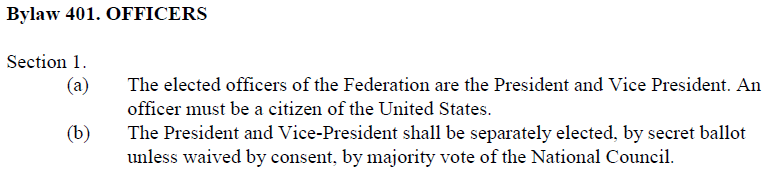
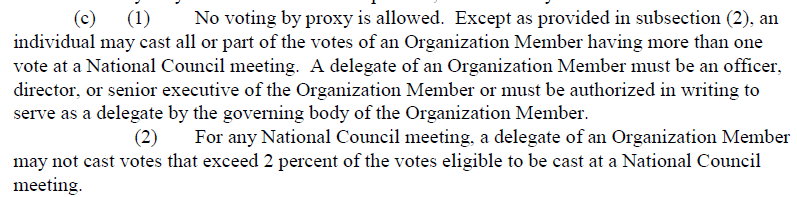
Let’s start with the conspiracy theory first. Could anyone force voters to do their bidding? The USSF bylaws say no.

First of all, it’s a secret ballot.

secret

A good question came up yesterday — could a group such as the Athletes’ Council form a bloc and hand over all its votes to be cast by one person? If so, that would mean an outside actor could twist arms to hand all their voting keypads to the most trusted loyalist on the Council.

But the good news is that, as I’m reading the bylaws and from my understanding of reading all those past AGM transcripts, you can’t do that. This is from the lengthy Bylaw 302: Composition and Voting:

proxy

So unless there’s some quirk in the Bylaws I haven’t found, there’s simply no way to enforce any threats. A voter can say, “Oh, why, yes, I’ll vote for Kathy Carter,” then turn around and vote for Pat Buchanan.

(OK, no, not Pat Buchanan. The candidate has to be on the ballot, having gone through the declaration period and background check. Just thought I’d throw some Election 2000 humor into the mix.)

(UPDATE: See below. The “proxy” bylaw I’ve cited here may not apply to the Athletes’ Council.)

So let’s get back to the first question: Are some voters facing unfortunate conflicts of interest, given Carter’s call for Wasserman to step in and solve everything?

We need a quick disclaimer first. The existence of a conflict of interest does not mean that a person is corrupt. A conflict of interest is simply something that needs to be disclosed. For reasons having nothing to do with sports, I have to file all sorts of things having to do with my investments. In some cases, people involved must recuse themselves — see all votes relating to pro league standards and Soccer United Marketing in which Don Garber, Sunil Gulati and any athlete working in MLS step away.  Conflicts of interests may actually prove useful in some cases — say, if you want to avoid jury duty.

And we should remember that people often vote against their own alleged self-interests. Just look at all the blue-staters who benefit from race and class privilege but have no interest in voting for Mitt Romney, much less Donald Trump. Or consider former MLSNet columnist Eric Wynalda.

Given all that, I think the Twitterati should avoid pro-actively abusing all the Wasserman clients on the Athletes’ Council. I’m mentioning names here only to show my work as I count numbers. (I’m also open to some crowd-sourcing … nah, you all never help me.)

No one here asked to be put into an awkward situation. The person who put them in that situation is Kathy Carter. I’ve reached out to her campaign for comment.

My current count, based on the most recent info I could find, is:

4 Wasserman (Richard Motzkin, Dan Levy) clients: Brian Ching (at some point in the past; not sure about present), Lauren Holiday (as of 2015), John O’Brien, Heather O’Reilly (as of 2015)

6 clients of other agents: Carlos Bocanegra (Lyle Yorks/James Grant Sports Group), Brad Guzan (also Yorks), Will John (JCN Sports Management), Jonathan Spector (SK Soccer Tours), Shannon Boxx (Josh Schwartz/Evolution, as of 2015), Christie Pearce (Carie Goldberg/Gold Standard Sports, verified current)

1 client of nobody: Chris Ahrens (verified current)

9 unknown: Stuart Holden, Angela Hucles, Lori Lindsey, Kate Markgraf, Leslie Osborne, Nick Perera, Gavin Sibayan, Lindsay Tarpley, Aly Wagner

Now bear in mind there are two people who probably won’t be in Orlando for the election. Heather O’Reilly plays for Arsenal and has a home game against Yeovil Town on Sunday. (Yes, I know they played two days ago, and HAO played the full 90, but that was the FA Cup — Sunday’s game is a league game.) Also, Leslie Osborne is a little tied up right now.

(Maybe USSF could consider a bylaw to allow new moms to vote by proxy.)

And it’s probably safe to say that even if Wasserman was truly an evil genius and had figured out a way to force people to do Carter’s bidding, he’s not exactly going to threaten Lauren Holiday’s financial future.

The MLS-affiliated people may be facing some lobbying efforts, of course. That said, it’s not as if Kyle Martino and Eric Wynalda need an introduction to them.

So I’ll say again — any vitriol directed at these people is misguided. They don’t owe a bunch of Twitter tough guys an explanation of how they’re spending their time the week of the election. They’re human beings who have volunteered for a position of responsibility in which they have to weigh different factors and make decisions.

There’s also no evidence to suggest Wasserman and his company are making threats. For one thing, I’m guessing they understand the voting process, so they know any such threats would be empty. For another thing, they’re people who have built up a lot of goodwill in the sport. Wasserman led the bid for Los Angeles to land the Olympics and is in charge of the organizing committee. His top two soccer agents, Richard Motzkin and Dan Levy, were in the business long before they joined up with Wasserman, and their reputations are terrific. (Yes, I’ve corresponded with each of them many times over the years.)

So, once again, we’re left with one person who should be answering questions right now. And that’s Kathy Carter.

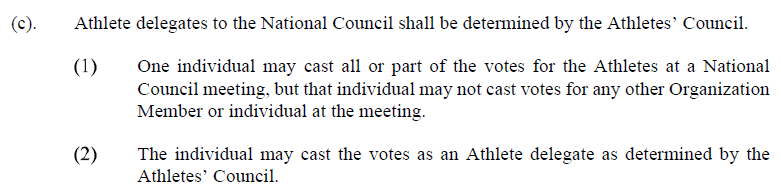
UPDATE: This “abstract” posted recently at U.S. Soccer’s site implies that the Athletes’ Council could in fact hand all its votes to one person:

ac-agm-one

The part that isn’t clear to me: Are they talking about literally handing all the keypads to one person? Or are they talking about the fact that the 20 members of the Athletes’ Council are not required to go to the meeting. Typically, they have single-digit representation, with each vote heavily weighted. This year, we’re expecting 10-15 people to go. (See above to see why it’ll be no more than 18.)

Theoretically, the Athletes’ Council could just have one representative in the room, and that person would cast every Athlete vote by default.

I don’t see any record of that happening in past meetings, where the Credentials Committee report usually mentions how many Athlete reps are present. (In 2017, it was six.)

From a practical point of view, I can tell you this:

  1. There is a push within the Athletes’ Council to have more members attending this year.
  2. There may be people pushing the Council to vote as a bloc, but there are also people who have made it clear they’re not going to pushed around.

And here’s another word on keypads:


us soccer

USSF election: The final questions (cue Europe keyboard riff)

With one week to go in the election, we’re all talking about many things.

who-killedNot many of those things have anything to do with ideas or qualifications or anything like that. It’s mostly screaming that if (Kathy Carter, Eric Wynalda, anyone but Wynalda) is elected, we should all move to Canada or Mexico. Or it’s a bunch of rumors of shady politics.

So my goal in soliciting questions to pose to the candidates in the final week was simple. Let’s take advantage of this opportunity to talk about issues and so forth. We were doing that for a while, and then we just … stopped.

I didn’t get much response. Perhaps I should’ve included a truck portraying Kyle Martino and Hope Solo as Kang and Kodos. But a couple of people did get in touch, and so I’ve added their questions to the list below.

I will contact each campaign to see if they can give some answers. Each candidate’s answers will be a separate blog post.

Don’t hold it against a candidate if he/she doesn’t respond. We’ve got a week to go, and they’re surely on the phone nonstop with actual voters right now. But I’ll make an effort.

Here goes …

ALL CANDIDATES

Paralympics

  1. What will you do to work with the 7-a-side program (for athletes with cerebral palsy or brain injury) while it’s not part of the Paralympic Games program?
  2. Can anything be done to start a 5-a-side program for visually impaired athletes, a sport that is in the Paralympic Games? Have you already had conversations with athletes about doing this?

Futsal

  1. Most conversations about futsal in this campaign have focused on using it as a youth development tool. But we have a men’s national team and a couple of budding pro leagues. What’s the next step for building out the game at the elite level?

NWSL 

  1. Name three things that can be done to improve the women’s league.

Women’s national team

  1. Will you try to negotiate both the MNT and WNT collective bargaining agreements at the same time?
  2. Hypothetical: You’re negotiating with the WNT. They ask for 24 players to be put on full-time salary with restrictions on the number of “floaters” who can come into camp. The coaching staff has warned that they need flexibility to call in players who are impressing in the NWSL and Europe. What’s your next move?
  3. Should (or could?) U.S. Soccer put the women’s national team’s media rights under a different contract than the MNT/SUM contract so we can see exactly how much revenue the WNT is generating?

Youth soccer

  1. Hypothetical: Let’s say the state associations, backed by a national movement of parents and coaches, ask USSF to standardize leagues throughout the country, folding the Development Academy and other elite leagues into a clearly defined pyramid with promotion/relegation and more local play (less travel). U.S. Club Soccer, predictably, gets very upset. What’s your next move?
  2. Will you tell Development Academy clubs to let their players play high school soccer? Do you see any sort of compromise (say, letting kids play their junior and senior years)?

Open Cup 

  1. Hypothetical: You’re trying to sell the Open Cup as a separate TV property. The best bid you have is from an online streaming service that just launched a year ago. They’re offering four times as much as any traditional broadcaster. What’s your next move?
  2. Should the Open Cup run a fall-to-spring schedule that isn’t tied to the summer leagues (NPSL, PDL). If so, would you favor a separate Summer Open Cup for those leagues?

Promotion/relegation 

  1. Would you be open to a modified promotion/relegation system in which clubs can’t be relegated below a specific floor (for “major” clubs, D2; for other fully professional clubs, D3)?
  2. Hypothetical: You get a conglomeration of leagues to agree to set up a pyramid. MLS says it will not participate. The top league in your pyramid applies for D1. The task force recommends approval. MLS lawyers up. What’s your next move?

The team that didn’t qualify for the World Cup, causing Earth’s magnetic poles to reverse

  1. Was hiring Bruce Arena a smart decision?
  2. Did you support the decision at the time?
  3. Do you believe that Bruce Arena should be hired again for some other role by US Soccer?

ERIC WYNALDA

  1. Some lawyers and others with experience in the nonprofit world and with NGBs are skeptical of your idea to turn USSF into a lending bank. How would you respond?
  2. Will you please, please stop saying “international calendar” in reference to the fall-to-spring calendar that isn’t used in half the world? (Sorry, pet peeve of mine.)

HOPE SOLO

  1. Where did you hear the incorrect statement that U.S. Soccer coaching licenses are not age appropriate? (The purpose of this question is to find out where she’s getting misinformation like this and whether she has taken steps to find better sources of info.)
  2. If you win the presidency, you will be in the position of defending the federation against a grievance you filed. What’s your next move?

KYLE MARTINO 

  1. In your Progress Plan, why would any club created after 2024 be “non-league”? What happens if we have major demographic and climate shifts?
  2. Why move all of U.S. Soccer to New York and not just have a satellite office?

CARLOS CORDEIRO

  1. You’ve demonstrated a reluctance to do interviews. How will you adapt to the role of president, when you be required to do many press conferences?
  2. Why hasn’t U.S. Soccer released its Form 990 and audited financials for the year ending March 31, 2017?

KATHY CARTER

  1. Is it a conflict of interest to have the head of SUM, Don Garber, serving on the Board as long as it’s been in its current (15-member) configuration AND serving as the chairperson of the Nominating and Governance Committee? If not, why not?
  2. What happened to SUM’s site? It’s now redirected to a page on the quasi-independent MLSSoccer.com.
  3. Would MLS expansion fees be cheaper if new owners did not get a share of SUM? Is there any way to untangle that relationship?
  4. Would MLS be in good shape, financially (either profitable or running a loss only because it’s investing in future growth), if it were separated from SUM?
  5. Plenty of people who understand how SUM helped save professional soccer in 2002 question whether it’s still necessary in its current form (co-mingled with MLS) today. How would you respond?

MIKE WINOGRAD

  1. The plan to build a physical training center in each state sounds costly. Some state associations already have similar facilities. Would you simply cooperate with the state to share the space? In general, how would you pay for this plan?


pro soccer, us soccer, women's soccer, youth soccer

U.S. Soccer presidential election: Last call for questions

In one week, U.S. Soccer members — from big-shot board members to little-known delegates from far-flung state associations — will descend upon a hotel just outside Disney World and Sea World. They’ll have two days of preliminary meetings and a welcome event at Hollywood Studios. (I have not yet inquired about Fastpasses for Toy Story Mania.)

questions-flipThen on Saturday, it’s the Big Vote. Eight candidates enter. One takes over the presidency from Sunil Gulati.

And we still have so many questions left unanswered. So many ideas that haven’t been fully vetted. So many vague statements.

So let’s come up with a list of questions — some for all candidates, some for specific candidates. Then I’ll see if I can get them answered.

You can leave them as comments here. You can email me. You can hit me up on Twitter.

Here are a few to get us started:

ALL CANDIDATES

Paralympics

  1. What will you do to work with the 7-a-side program (for athletes with cerebral palsy or brain injury) while it’s not part of the Paralympic Games program?
  2. Can anything be done to start a 5-a-side program for visually impaired athletes, a sport that is in the Paralympic Games? Have you already had conversations with athletes about doing this?

Futsal

  1. Most conversations about futsal in this campaign have focused on using it as a youth development tool. But we have a men’s national team and a couple of budding pro leagues. What’s the next step for building out the game at the elite level?

NWSL 

  1. Name three things that can be done to improve the women’s league.

Women’s national team

  1. Will you try to negotiate both the MNT and WNT collective bargaining agreements at the same time?
  2. Hypothetical: You’re negotiating with the WNT. They ask for 24 players to be put on full-time salary with restrictions on the number of “floaters” who can come into camp. The coaching staff has warned that they need flexibility to call in players who are impressing in the NWSL and Europe. What’s your next move?

Youth soccer

  1. Hypothetical: Let’s say the state associations, backed by a national movement of parents and coaches, ask USSF to standardize leagues throughout the country, folding the Development Academy and other elite leagues into a clearly defined pyramid with promotion/relegation and more local play (less travel). U.S. Club Soccer, predictably, gets very upset. What’s your next move?
  2. Will you tell Development Academy clubs to let their players play high school soccer? Do you see any sort of compromise (say, letting kids play their junior and senior years)?

Open Cup 

  1. Hypothetical: You’re trying to sell the Open Cup as a separate TV property. The best bid you have is from an online streaming service that just launched a year ago. They’re offering four times as much as any traditional broadcaster. What’s your next move?
  2. NEW! Should the Open Cup run a fall-to-spring schedule that isn’t tied to the summer leagues (NPSL, PDL). If so, would you favor a separate Summer Open Cup for those leagues?

Promotion/relegation 

  1. Would you be open to a modified promotion/relegation system in which clubs can’t be relegated below a specific floor (for “major” clubs, D2; for other fully professional clubs, D3)?
  2. Hypothetical: You get a conglomeration of leagues to agree to set up a pyramid. MLS says it will not participate. The top league in your pyramid applies for D1. The task force recommends approval. MLS lawyers up. What’s your next move?

ERIC WYNALDA

  1. Some lawyers and others with experience in the nonprofit world and with NGBs are skeptical of your idea to turn USSF into a lending bank. How would you respond?
  2. Will you please, please stop saying “international calendar” in reference to the fall-to-spring calendar that isn’t used in half the world? (Sorry, pet peeve of mine.)

HOPE SOLO

  1. Where did you hear the incorrect statement that U.S. Soccer coaching licenses are not age appropriate? (The purpose of this question is to find out where she’s getting misinformation like this and whether she has taken steps to find better sources of info.)
  2. If you win the presidency, you will be in the position of defending the federation against a grievance you filed. What’s your next move?

KYLE MARTINO 

  1. In your Progress Plan, why would any club created after 2024 be “non-league”? What happens if we have major demographic and climate shifts?
  2. Why move all of U.S. Soccer to New York and not just have a satellite office?

CARLOS CORDEIRO

  1. You’ve demonstrated a reluctance to do interviews. How will you adapt to the role of president, when you be required to do many press conferences?

KATHY CARTER

  1. Is it a conflict of interest to have the head of SUM, Don Garber, serving on the Board as long as it’s been in its current (15-member) configuration AND serving as the chairperson of the Nominating and Governance Committee? If not, why not?
  2. What happened to SUM’s site? It’s now redirected to a page on the quasi-independent MLSSoccer.com.
  3. Would MLS expansion fees be cheaper if new owners did not get a share of SUM? Is there any way to untangle that relationship?
  4. Would MLS be in good shape, financially (either profitable or running a loss only because it’s investing in future growth), if it were separated from SUM?
  5. Plenty of people who understand how SUM helped save professional soccer in 2002 question whether it’s still necessary in its current form (co-mingled with MLS) today. How would you respond?

Anything else?


pro soccer, us soccer, youth soccer

Another man, another plan: Reviewing Eric Wynalda’s long-awaited manifesto

In less than 48 hours between my sprawling recap of the week in Philadelphia and my podcast on the week and the election (with Charles Boehm), one interesting thing has happened …

I’ve received a lot of pushback on the notion that Eric Wynalda is the front runner.

No, it’s not Sunil Gulati and Don Garber calling. These are people who are plugged into soccer politics, in some cases even moreso than I am, even after my obsessive coverage in the past few months.

I’m still not convinced Wynalda isn’t the front-runner. I understand that some people have an “anyone but Wynalda” attitude, just as some have “anyone but Carter” or “anyone but Carter and Cordeiro.” I still think that Carter has a very difficult road to 50%+1, and I think the opposition will eventually join forces behind one candidate, and the most likely candidate fitting that bill is Wynalda. But I could be wrong, and perhaps we’ll see a compromise between the “no Wynalda” and “no Carter” camps that gives us a President Martino or Gans or Winograd or I Have No Idea.

But one thing has become clear: Wynalda’s stock dropped in Philadelphia. The forum in which he promised solutions, truths and the gloves coming off, with none of them happening. Fairly or unfairly, some voters may resent the truck with the nasty protest, even though he disavowed it.  (He did not, of course, disavow the statement implying Kathy Carter and Carlos Cordeiro are not “soccer people,” a message that didn’t sit well with a lot of people and tends to undermine his anti-elitist stance.)

Then consider this from the New York Times piece:

ew-board

“Fine,” you might say. “He’s the insurgent attacking the status quo.”

But consider the voters. Adult Council. Youth Council. Pro Council. Athletes’ Council. All of whom combine for about 95% of the vote. All of whom also elect representatives to that board.

None of this means that Wynalda’s campaign is sunk. I still think he has a better chance of winning than any other candidate. But that chance is probably less than 50%. There are eight candidates, after all, and you can’t really rule many of them out.

So when we heard yesterday, when Wynalda called in to Jason Davis’ show to say he’d finally be releasing a plan of some sort, the stakes were raised. This could put him over the top or not. (And we have to wonder whether it’s too late — all the state reps with whom I spoke in Philly seemed to looking at the convention as the last bits of info they would take home to their boards before making decisions.)

He released the plan today. It’s 14 pages and seems to be a little more digestible than the massive Kyle Martino plan. Let’s take a look.

PAGE 1: Cover sheet.

PAGE 2: Inclusive. Consensus-building. Experience — player, coach, technical director, owner, TV. “Move toward future compliance with FIFA standards” — a point that really needs to be explained, especially when we keep hearing about this inaccurately named “international calendar.”

And this is not the comprehensive plan. Position papers are forthcoming. Clock is ticking. But let’s see what’s here …

PAGE 3: Table of contents

PAGE 4: A picture of a calculator. People still use those?

PAGE 5, PART 1: Registration Rewards Initiative. He wants to return the $1/youth and $2/adult fee back to the youth and adult organizations. He says there will be a $1 “bonus allocation” for meeting certain criteria. These fees, he says, can really help the youth/adult organizations, while USSF is no longer dependent on them. The numbers back him up on this.

PAGE 5/6: >$5 Million in Annual Support, Grants and Scholarships to Membership Groups. He’s really talking about 5% of “unrestricted investable assets,” saying this is in line with how nonprofits use their endowments. “Many candidates talk about funding new programs but have yet (sic) identify definitively how to develop funds for those purposes.” Someone who gets fund-raising and nonprofit finance better than me will have to explain how this works and how it will impress voters more than, say, Carlos Cordeiro saying the federation is already planning to spend its $150 million-ish reserves down to about $50 million. Wynalda’s plan might be more of a long-term cash stream, while Cordeiro may be talking about a set of one-time investments. I don’t know.

PAGE 6: Internal Loans. Wow, I really don’t understand this. Literally. He seems to be saying state organizations and other organizations could get loans from U.S. Soccer. Someone will need to do a study to see if that’s actually an improvement on just funding programs.

PAGE 7: Monetize the U.S. Open Cup. “Multiple media executives have asked why the US Open Cup has not yet been packaged and monetized in a meaningful way and have identified themselves that it is a grossly undervalued asset and represents an untapped source of funds for the USSF itself.”

Let’s get this straight — and this echoes something he said in Philly. Is he saying there are multiple media executives who, instead of contacting the people who actually run the U.S. Open Cup, decided to ask Eric Wynalda? Or are there people at U.S. Soccer who heard a pitch to monetize the U.S. Open Cup and said no? Did they ask the Open Cup Committee, which has actually done some pretty good work to build up the tournament? (Eric, I know you’re reading — please let me know what you mean here.)

PAGE 8: A picture of Soccer House

PAGE 9: Transparency starts here with Apply for a public credit rating with Moody’s or Standard and Poor’s, which would obligate USSF to another annual review on top of what’s required for the 990. Seems like an interesting idea, but again, I’ll need to hear from nonprofit econ experts.

Then …

The USSF should create a non-voting sub-committee of the Board that includes a diverse selection of membership that is expected to attend all USSF Board meetings and that would be encouraged and supported to share their opinions and voices on public matters. The USSF management team would be obligated to host a conference call with this subcommittee no less than two weeks ahead of each scheduled USSF Board meeting to update members, provide information on planned agenda for the Board meeting, and to share public materials that will be discussed at the Board meeting itself.

At the very least, the wording here is poor. A “sub-committee of the Board” would be composed of Board members. If he means some sort of group of non-Board members that would be like a shadow Board, I think he’d want to go back and see why the board (sorry to switch cases here) went from 40 to 15. That was following what the USOC and others were doing at the time.

I get what he’s saying, but I think there’s another way to do this. Why tell a subcommittee what’s on the board agenda and not the whole membership?

PAGE 10: Clearly Defined Competitive Bidding Policy. This will be popular, and probably with good reason.

PAGE 10: Develop Conflict of Interest and Risk Management Policies. The board has done and is doing this, but there’s certainly room to ask whether they’re doing enough.

PAGE 11: Office of Ethics, Integrity, and Inclusion. It’s the sort of idea that sounds good in a vacuum. The question is whether it’s really better than the mechanisms that are in place now. Do you need to replace the mechanisms or replace the people?

Included in this: Restart the Diversity Task Force, and I know no good argument against that.

PAGE 12: Picture of scarves.

PAGE 13: Establish Membership Services Team. Sounds kind of like what Steve Gans has been saying.

PAGE 13-14: Support Network for National Team Players. OK … I guess? The idea of having a group to guide players into a post-playing career sounds good, but why would we limit it to national team players? Why not help players who probably made a lot less money?

PAGE 14: Consulting. In conjunction with the internal bank.

And that’s it. Until the position papers come out.

So … I don’t know what to make of this. Some of the ideas are obvious (and good), some are less obvious and still good (the Registration Rewards Initiative is, at the very least, worthy of future discussion), others just seem arcane and off-the-wall. Do we really want the U.S. Soccer Federation to turn into a USAA for soccer? If someone more knowledgeable about nonprofits can tell me if this works, I’d be happy to hear it.

Then some of it seems surprisingly elitist. A subcommittee that shadows the board but just seems to be an unnecessary bulkhead between the board and the membership? Mysterious media executives who aren’t approaching the Open Cup Committee (Mike Edwards, Todd Durbin, USL’s Jake Edwards, USASA’s John Motta, NASL’s Rishi Sehgal and retired MNT player John O’Brien) with a plan to invest megamillions but are approaching Wynalda?

I don’t get it. Someone feel free to explain it to me.