medal projections, olympic sports

Final tally: USA qualifies for 83.5% of possible Olympic spots

Qualifying for the Olympics is not an easy process. It’s not even easy to read about it. I’m tired, and I didn’t even get on a bike and try to rack up the points I needed to make it in omnium or whatever. (I also don’t live near a velodrome. I’m also old and unathletic.)

But the USA did a pretty good job getting spots in the 2012 Games. Some things are givens — no swimmer is going to make the U.S. team in the pool without beating the Olympic qualifying standard. Others are more difficult.

If you haven’t read the saga of how every single U.S. athlete qualified for the Games, please give it a look.

medal projections, olympic sports

2012 tennis/table tennis: Who’s your Venus?

The big news for 2012 tennis: Mixed doubles is in! But only in tennis, not table tennis. Seems a little unfair, really.

TENNIS

They’ll play on grass at Wimbledon, so we’ll let this summer’s results from that hallowed venue weigh heavily in the projections. That said, we have little idea which players will view the Olympics worthy of their participation.

The tournament will be included in the ATP and WTA points races, so that may sway some people.

Continue reading

medal projections, olympic sports

2012 shooting: Bang, bang, bang on the door, baby

Would you believe one of the most dramatic events I ever covered was an Olympic shooting final? Believe it.

This is another one of those sports in which the Olympic program has changed a bit over the years, but not in this Olympic cycle. That’s good for those of us who like a bit of consistency.

The ISSF (shooting’s federation) has a handy updated guide to help us all navigate through the confusing quota system they use for qualification.

We had full World Championships in 2010, with shotgun-only World Championships to come in September.

Continue reading

medal projections, olympic sports

2012 sailing: Take me away to where I want to be …

A couple of things to know about sailing:

1. The World Championships are held once every four years, and we don’t have one until December in Perth, Australia.

2. The Tornado (two-sailor, mixed) and Yngling (three-woman) classes are out. Enter the Elliot (three-woman) match-racing class.

3. One boat per nation per event. A lot of berths will be earned at Worlds.

Continue reading

medal projections, olympic sports

2012 rowing: More medals for sitting British athletes

If Mitch Hedberg had made observations about rowing rather than NASCAR, I think he would’ve asked this question: Why do all these folks have to go backwards?

The World Championships are annual, even in Olympic years. The 2010 event was in New Zealand last fall; the 2011 event will start Aug. 28 in the ominous-sounding town of Bled, Slovenia.

World Cup competition is starting soon, and the powers that be have put together a handy preview.

MEN

Single sculls: The three medalists from 2008 and Britain’s Alan Campbell must be awfully familiar with each other by now. The 2010 Worlds finished in this order: Synek, Drysdale, Campbell, Tufte. Synek was unbeaten in 2010, while Olympic champion Olaf Tufte aims to peak in the big events.

2008: Olaf Tufte (Norway), Ondrej Synek (Czech Republic), Mahe Drysdale (New Zealand)

Projection: Czech Republic, Britain, Norway

Top Americans: Kenneth Jurkowski made the B final in 2010, finishing 12th overall.

Continue reading

medal projections, olympic sports

2012 pentathlon/triathlon: Modern times

Modern pentathlon and triathlon have a few things in common — running, swimming and the inevitability of being lumped together when people like me are doing sport-by-sport breakdowns.

Aside from that, they aren’t too similar. Triathlon has become the trendy way for people to show how fit they are. If you know anyone who has said, “Hey, I’m raising money for charity by doing a pentathlon,” please let me know.

At the Olympics, modern pentathlon is held in a couple of venues through the day, and they can’t really be choosy. In London, for some reason, they’ll have the fencing in the handball venue. Then it’s across the Olympic Park to the main Aquatics Centre for the swim, then over to the equestrian venue at Greenwich Park for the remaining events. (That wasn’t an option in Beijing, where the equestrian venue was in Hong Kong.)

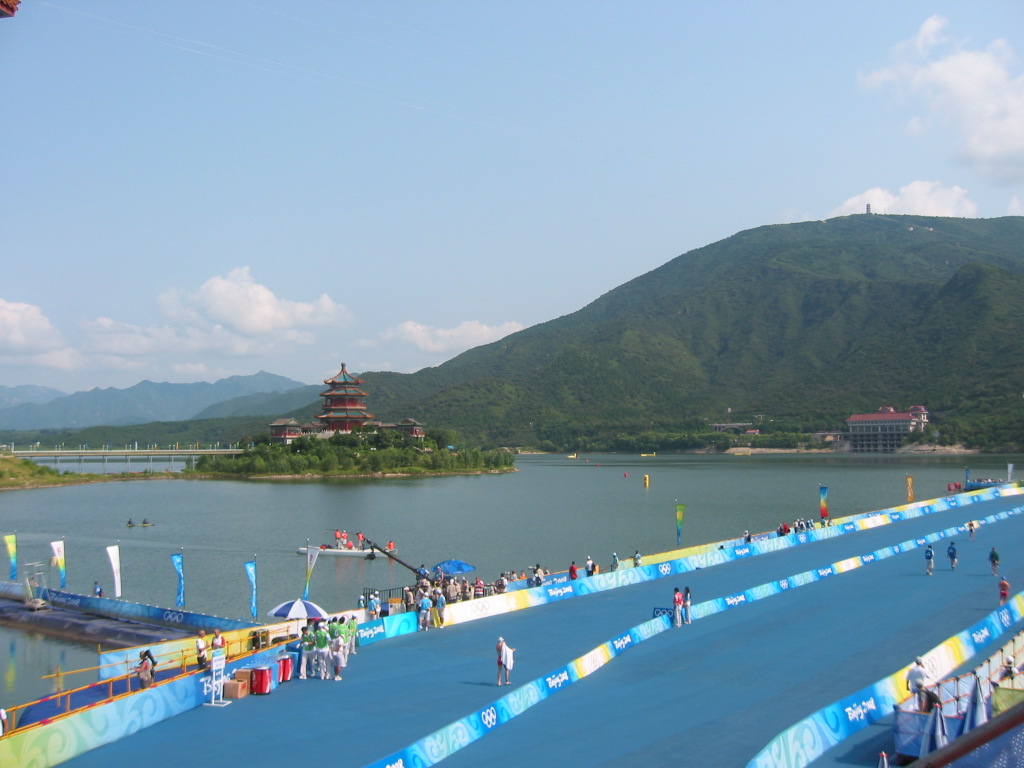
Beijing triathlon venueThe triathlon, meanwhile, is held in a scenic venue like the one in this picture. Beautiful, isn’t it? One of my favorite days in China.

London organizers are opting to hold the triathlon in Hyde Park. Pretty cool.

Triathlon also is much simpler. Swim 1,500 meters. Bike 40k. Run 10k. Cross finish line. Collect medal.

Modern pentathlon has a more complex scoring system, but as they do in Nordic combined (and really should do in the decathlon), they convert points to seconds and start people in the final race in the order in which they currently stand. Build a big lead in the first three events, then try to run alone.

Continue reading

medal projections, olympic sports

2012 diving: Can we just say “China” and move on?

China dominates diving. Period. But we’re going to be thorough in these projections. And if you’re looking for American medals, this is a sport with some potential despite a shutout in Beijing.

In addition to the 2009 World Championships, we have good gauges of form in the 2010 World Cup and World Series.

Men’s springboard: 2008 gold medalist He Chong fought off North American challengers Troy Dumais (USA) and Alexandre Despatie (Canada) to win the 2009 world title.

2008: He Chong (China), Alexandre Despatie (Canada), Qin Kai (China)

Projection: China, Mexico, USA

Top Americans: Dumais just keeps going in search of an elusive Olympic medal, finishing fourth in the 2010 World Series. Chris Colwill has made finals at Olympics and Worlds.

Women’s springboard: 2008 gold medalist Guo Jingjing was so far ahead of the pack at the 2009 Worlds that botching her fourth dive barely made a dent in her lead. Canada’s Emilie Heymans and Italy’s Tania Cagnotto took second and third. But then everything changed in 2010, when Guo retired. Naturally, another Chinese diver emerged to dominate the competition in 2010 — Zi He swept the World Series and World Cup, with Wu Minxia and Mexico’s Paola Espinosa battling for second.

2008: Guo Jingjing (China), Yulia Pakhalina (Russia), Wu Minxia (China)

Projection: China, Mexico, China

Top Americans: Ariel Rittenhouse placed fifth in 2009; Christina Loukas was eighth.

Men’s platform: Somehow, this is one event that eludes the Chinese team. Britain’s Thomas Daley beat China’s Qiu Bo and Zhou Lüxin in the 2009 Worlds, with 2008 gold medalist Matthew Mitcham of Australia a close fourth. Qiu swept the 2010 World Series, but Mitcham beat him in the World Cup.

2008: Matthew Mitcham (Australia), Zhou Lüxin (China), Gleb Galperin (Russia)

Projection: China, Australia, Britain

Top Americans: David Boudia and Thomas Finchem have their moments but are generally better contenders in synchro.

Women’s platform: At last, we have a change-up — a Chinese diver failed to defend an Olympic title at the 2009 Worlds, as Mexico’s Paola Espinosa upset Chen Ruolin and another Chinese diver, Kang Li. Chen and Kang finished 1-2 in the 2010 World Series, and China’s Hu Yadan took the World Cup ahead of Chen and Australia’s Melissa Wu. Espinosa struggled at the World Cup but was third in the World Series.

2008: Chen Ruolin (China), Emilie Heymans (Canada), Wang Xin (China)

Projection: China, China, Mexico

Top Americans: No one stood out in 2010, but someone could surprise out of the solid synchro duo of Haley Ishimatsu and Mary Beth Dunnichay.

Men’s synchronized springboard: A definitive 1-2 at 2008 Worlds — 2008 gold medalist Wang Feng/Qin Kai, followed by Dumais and fellow American Kristian Ipsen. Canada’s Reuben Ross teamed with Despatie for third. Qin went through a couple of different partners in 2010 but kept winning. Dumais/Ipsen beat Ukraine’s 2008 bronze medalists for second in the World Cup.

2008: Wang Feng/Qin Kai (China), Dmitri Sautin/Yuriy Kunakov (Russia), Illya Kvasha/Oleksiy Prygorov (Ukraine)

Projection: China, USA, Canada

Top Americans: Dumais has outlasted several partners in the sport but is still a contender.

Women’s synchronized springboard: Gold medalists Guo Jingjing and Wu Minxia came back a year later at Worlds and posted the top score on all five dives. Italy’s Tania Cagnotto and Francesca Dallape were far ahead of a battle for third contessted by Russia’s 2008 silver medalists, Canada and Australia. With Guo retired, Wu simply teamed up with He Zi to win the overall World Series title and the World Cup. Russia’s Anastasia Pozdniakova and new partner Svetlana Filippova won one World Series event and took second in two other competitions. Canada’s Jennifer Abel went back and forth between Meghan Benfeito and Emilie Heymans, with consistent top-five results.

2008: Guo Jingjing/Wu Minxia (China), Yulia Pakhalina/Anastasia Pozdniakova (Russia), Ditte Kotzian/Heike Fischer (Germany)

Projection: China, Russia, Canada

Top Americans: Kelci Bryant and Ariel Rittenhouse were a solid sixth at 2009 Worlds. They competed with different partners in 2010 as three different U.S. duos took part in the 2010 World Series, each placing third in their respective meets. Kassidy Cook and Cassidy Krug — no, those names aren’t made up — finished fifth in the World Cup.

Men’s synchronized platform: Lin Yue and Huo Liang were in their teens when they won gold in Beijing, and they left everyone else competing for second place in the 2009 Worlds, racking up 10s from a couple of judges not just on their early easy dives but their nasty degree-of-difficulty final dive. Americans David Boudia and Thomas Finchum won a three-way battle for second over a strong Cuban entry and Germany’s 2008 silver medalists. But the Cubans and Germans were the only duos to compete together and post podium finishes in 2010, with China’s new representatives of  Cao Yuan and Zhang Yanquan sweeping everything in sight.

2008: Lin Yue/Huo Liang (China), Patrick Hausding/Sascha Klein (Germany), Gleb Galperin/Dmitriy Dobroskok (Russia)

Projection: China, Germany, Cuba

Top Americans: Boudia, Finchum, Nick McCrory and J.J. Kinzbach competed in different permutations in 2010, with McCrory/Finchem third in a World Series meet and McCrory/Boudia fourth in the World Cup.

Women’s synchronized platform: Tired of reading about Chinese divers defending their gold medals at Worlds? Too bad. Chen and Wang were 22.20 points clear of Australian silver medalists Briony Cole and Melissa Wu after three dives. The only surprise was that Cole and Wu faded to fifth behind duos from the USA, Malaysia and Canada. Naturally, the Chinese team mixed things up slightly in 2010, as Chen teamed with Wang Hao to sweep the World Cup and World Series. Canada’s Roseline Filion and Meaghan Benfeito finished on the podium in all four meets, while Australia’s Melissa Wu had four podium finishes with two different partners. Britain has a couple of contenders, taking fourth in three of the meets with different duos.

2008: Wang Xin/Chen Ruolin (China), Briony Cole/Melissa Wu (Australia), Paola Espinosa/Tatiana Ortiz (Mexico)

Projection: China, Canada, Australia

Top Americans: Mary Beth Dunnichay and Haley Ishimatsu moved up from fourth to second on their final dive at 2009 Worlds, but they dropped to eighth at the 2010 World Cup.
 

medal projections, olympic sports, track and field

2012 medal projections: Old Cold War battles, Jamaica heat up women’s running

Olympic athletes don’t just show up out of nowhere in an Olympic year, except maybe in a few secretive nations. Next year, we’ll have world championships in virtually everything, giving us a good chance to project what might happen in 2012.

We’re not waiting until then. We’re setting up some projections now, then revising as new results come in. It’s FiveThirtyEight with less math and no Rasmussen.

Today, it’s …

ATHLETICS: Women’s running events

We’re not Eurosnobs. Really. But isn’t “athletics” less awkward than “track and field”?

Besides, the marathon uses neither a track (except at the very end) or a field. And the shot put can be held anywhere.

The year’s top performances for each athlete are given in parentheses, but remember that some top athletes (Usain Bolt springs to mind) didn’t put much emphasis on running in a year with no Olympics or World Championships. (Source: IAAF)

We’re going to split this into running events and non-running events, then split it further by gender. We have a lot of ground to cover.

Continue reading

medal projections, olympic sports

2012 medal projections: Archery sweep is South Korea’s aim

You’ve seen the political projections. Now let’s get to the ones that matter.

The Olympics happen every four years. (Think of the Winter Games as the midterms.) The competition is a little more honest than the typical U.S. election, and you don’t have to sit through insulting political ads.

We’re going to go sport-by-sport through the Olympics and project winners in London. We’ll base it on past results. Like FiveThirtyEight.com, we’ll be able to update our projections based on recent data. In our case, though, that’ll be actual competition such as World Cups and World Championships, not polls. Another advantage we’ll have over FiveThirtyEight.com — less math.

Let’s get right to it with an event NBC probably won’t feature in great detail:

ARCHERY

First rule upon checking results: Ignore compound bows. Nothing personal, but they’re not in the Olympics. Seems a shame for the USA, because Americans tend to do pretty well with the high-tech stuff. What we’re dealing with here is the more traditional “recurve” bow.

Women’s individual: South Korean dominance ran into home advantage in Beijing, as China’s Zhang Juanjuan won gold ahead of 2004 champion Park Sung-Hyun. That ended a streak of six straight golds for South Korea, but the 2010 World Cup results give little sign that South Korea is going away. Four of the top six women in the rankings were South Korean, led by Ki Bo Bae in first and World Cup final champion Yun Ok-Hee in fourth. India has an outside shot with two contenders — Deepika Kumari and Dola Banerjee. Poland’s Justyna Mospinek is the best spoiler.

2008: Zhang Juanjuan (China), Park Sung-Hyun (South Korea), Yun Ok-Hee (South Korea).

Projection: South Korea, South Korea, India.

Top Americans: Khatuna Lorig (18th in World Cup), Jennifer Nichols (17th in world ranking)

Women’s team: South Korea could probably enter two teams and win medals here if the IOC allowed it. They’ve won all six women’s team events in modern Olympic history. India gets the edge for silver based on World Cup results. Bronze is wide open — 2008 silver medalist China, bronze medalist France, rankings-round runner-up Great Britain and Italy are among the contenders. We’d go with the hosts if their world ranking were any higher than 16th. Instead, we’ll take second-ranked China.

2008: South Korea, China, France.

Projection: South Korea, India, China.

Men’s individual: The USA has a decent shot, with ageless Vic Wunderle (silver, 2000) still going and Brady Ellison taking the World Cup prize in 2010. South Korea is deep, with three straight team golds. Italy has a good track record in the team event and a couple of top performers in the World Cup. But outsiders are a threat in this event — Mexico’s Juan Rene Serrano won the Beijing ranking round before finishing fourth in the knockout phase, and Ukraine’s Viktor Ruban squeaked through to gold past South Korea’s Park Kyung-Mo.

2008: Viktor Ruban (Ukraine), Park Kyung-Mo (South Korea), Bair Badenov (Russia).

Projection: USA, South Korea, Italy.


Top Americans: Ellison, Wunderle.

Men’s team: In Beijing, China made a stunning run from 12th in the ranking round to take bronze. We’ll chalk that up to home advantage and focus on the South Korea-Italy tandem frequently on top here. Bronze is open, with Ukraine getting the nod on current World Cup rankings and Ruban’s medal experience (2004 team bronze in addition to 2008 individual gold).

2008: South Korea, Italy, China.

Projection: South Korea, Italy, Ukraine.

TOTAL PROJECTION (Gold-silver-bronze, 2008 gold-silver-bronze, total change):
– South Korea: 5 medals (3-2-0, 2-2-1, no change)
– India: 2 medals (0-1-1, 0-0-0, +2)
– Italy: 2 medals (0-1-1, 0-1-0, +1)
– USA: 1 medal (1-0-0, 0-0-0, +1)
– China: 1 medal (0-0-1, 1-1-1, -2)
– Ukraine: 1 medal (0-0-1, 1-0-0, no change)
– Russia: 0 medals (-1)
– France: 0 medals (-1)

BIG EVENTS:
– World championships: July 2-10, Torino