us soccer

United Soccer Coaches convention preview: Tough choices for women’s soccer fans and media

The world’s largest gathering of tracksuits will be in Baltimore this year, starting Jan. 15.

The bad news for casual fans is that there’s no MLS draft to let people shout slogans at each other this year. The other bad news is that United Soccer Coaches still doesn’t have a cool acronym, with “USC” taken by two universities. I’m still pushing “UnSocCo.”

The good news is that I’ll have a book signing. Details to come.

If you don’t have a credential, which can be a budget-buster unless your club is picking up the costs or you’re a respected media member, you should be able to follow along on Twitter to get some insights.

The schedule is out. Here’s a quick list of interesting sessions with the places I’m likely to be (not that you’re planning around me) in bold.

WEDNESDAY

As usual, this is a day of meetings, exhibitor set-up and a few evening coaching sessions for those who plan to get some sort of certification.

5:30 p.m.: “Small-Sided Games to Improve Goal-Scoring,” with the always insightful UnSocCo coaching director Ian Barker.

THURSDAY

Still a lot of meetings, but the coaching courses really pick up here, and we start to see some general-interest sessions.

9:30 a.m.: “The Past, The Present, and The Future of the Latino Coach and Player,” with Julio Serrano, the new chair of UnSocCo’s Latino Coaches Advocacy Group and the director of coaches at Heart of the City, which works to develop soccer programs for underserved communities in Waukegan, Ill.

9:30 a.m.: “Identifying and Developing the Future Female Player,” with U.S. Soccer staff. Please, WoSo media, make sure you have someone there.

9:30 a.m.: The Red Bulls will be talking about their youth-to-pro pathway.

(moved from Friday) 9:30 a.m.: “The Significant Influence Coaches have & the Role they Play When it Comes to Body Image in Their Players,” an especially timely session given the light shed on weight-shaming when runner Mary Cain went public

11 a.m.: “Sports as a Vehicle for Change” sounds kind of buzzword-ish, but the presenter is Haley Carter, who has walked the walk as a coach with Afghanistan’s women’s team and as an advocate for #VetsForGunReform (she’s also a decorated Marine veteran). Seems strange to get this far into a resume without mentioning that she played in the NWSL, but that’s just how impressive she is.

It’d be great to have WoSo people in the crowd, but this unfortunately conflicts with …

11 a.m.: NWSL draft

The early afternoon has a lot of sessions about coaching specifics and club management — valuable for those who have to make budgets work, but not something you’re likely to retweet from home.

2:30 p.m.: “Principles of Coaching In A Non-Traditional Setting” by two staffers from the U.S. Soccer Foundation, another group that walks the walk, even while they’re in a lawsuit with the federation.

(corrected) 2:30 p.m.: Society for American Soccer History Open Meeting. I’ll be presenting my book. And yes, “Open” means “open” — no credential needed. It’ll run two hours, and it’ll be worth it. (It’s not just me, of course. They’ll schedule some cool stuff, and you won’t find a group of more knowledgeable soccer historians.)

4 p.m.: “21st Century Soccer Schedule,” with a heavyweight trio of men’s college coaches — Maryland’s Sasho Cirovski, Stanford’s Jeremy Gunn and North Carolina’s Carlos Somoana — surely set to press the case for a fall-spring NCAA schedule.

4 p.m.: “Reality Check: The Barriers Women in Soccer Still Face, The Leaders Who Overcome Them, and How More Succeed,” again featuring U.S. Soccer staff. Again, I can’t wait to follow tweets from WoSo media here.

Also at 4 p.m.: I’m doing a book signing at Protean Books, not far from the Convention Center

(corrected) 5:15 p.m.: Bo Oshoniyi, one of the great personalities of early MLS, is doing a goalkeeper coaching session.

(corrected) 6 p.m.: Exhibit Hall grand opening. Come see the latest in soccer gadgetry and a bunch of exhibits for leagues, tours and tournaments. Soccer America will be there as well, and if I’m not doing my book signing at this time, I’ll stop by there a couple of times while I’m mingling. You WILL need a credential for this.

FRIDAY

There’s an unfortunate conflict between THREE WoSo sessions:

9:15 a.m.: “Keeping Women in the Youth Game,” with a mix of college and youth coaches

9:15 a.m.: “Journey to the Pros,” NWSLPA Speaker Panel

9:15 a.m.: “Phase 4, We Don’t Care Anymore – Smashing Taboos and Busting Myths with the USWNT,” with English physiologist Georgie Bruinvels.

I hope someone’s lobbying to reschedule one or two of those sessions.

And for us youth soccer nerds:

9:15 a.m.: “Sideline Culture and Why It Matters: The Origins and Solutions to Parent Drama in Youth Soccer

11 a.m.: “Coaching Players with Disabilities,” with UnSocCo’s Kate Ward and U.S. 7-a-side coach Stuart Sharp. I recently did a story on disability soccer.

A few areas in which the sports community at large is trying to make progress pop up after lunch …

1:30 p.m.: “LGBT And Allies Meeting: Conversations and Connections”

1:30 p.m.: “Ending Abuse Within Sport: How the U.S. Center for SafeSport is Championing Athlete Well-Being.” Soccer hasn’t had anything on the scale of gymnastics doctor Larry Nassar or the multitude of abuses reported in swimming, but the SafeSport database isn’t devoid of soccer coaches.

4:30 p.m.: “Repeat: Jill Ellis and the Road to World Cup 2019.” With someone named … hold on, let me check this … Jill Ellis.

SATURDAY

Now we get back into some technical sessions, along with details of club management, but a few general-interest items are on the agenda:

(moved from Friday) 9 a.m.: “Elite Soccer Clubs and High School Soccer Programs: Working together to build Complete Soccer Players.” Maybe we should band together to drag some Development Academy people into the room.

11 a.m.: “Soccer in an Oasis: Rural vs. Urban,” with Dakota Alliance’s Frank Gurnick

11 a.m.: “FIFA Womens World Cup France 2019: Tournament Observations,” with former U.S. coach April Heinrichs and FIFA’s Patricia Gonzalez

11 a.m.: Laura Harvey usually does multiple coaching sessions, but this is the only one scheduled so far. It’s on attacking against a box midfield.

(corrected) 11 a.m.: “Inclusion Without Power: Black Soccer in America,” with 1996 gold medalist Staci Wilson, surely the most accomplished athlete who graduated from Northern Virginia science-and-math magnet school Thomas Jefferson HS. I hope she’s forgiven me for my misgivings about Crystal Dunn’s 1-on-1 defending.

1:30 p.m.: 1-on-1 with Jill Ellis. Not sure how this differs from Friday’s session.

(corrected) 1:30 p.m.: “Beyond Coaching: Understanding How Current Immigration Policy Affects Players Off the Field,” with attorney Mirella Ceja-Orozco

SUNDAY

Nothing but sessions for coaches finishing up diplomas in 4v4 coaching and goalkeeping. The latter features a full morning and early afternoon with Lisa Cole.

I don’t see anything scheduled with Eric Wynalda, who seems to have soured on getting his message across. Another convention favorite, Emma Hayes, will be tied up coaching Chelsea.

us soccer

An even deeper dive into U.S. Soccer finances

I went into a rabbit hole and kept digging.

On Dec. 4, The Guardian published my piece on U.S. Soccer and where the money is going. It was essentially a preview of a board meeting that had the potential to shed light on the federation’s five-year plan to spend its assets down to $50m but did not.

I had been working on a spreadsheet rounding up a lot of U.S. Soccer numbers from their public documents — the 990 forms required of nonprofits, Audited Financial Statements, Annual General Meeting reports, etc. I figured I would have it done the day after the piece was published.

I finished it this morning. Dec. 13.

It’s fair to say I have a lot of detail:

  • Revenue and expenses in detail from 2011 forward, with some information from 2001-03 and 2006.
  • Game-by-game estimates for U.S. national team pay dating back to 2010.
  • Attendance and ratings for U.S. national team games

I’ve uploaded all of this to GitHub. If you’d prefer that I make it available some other way, please let me know.

Download away.

podcast, us soccer

Podcast: The introduction to “Why the U.S. Men Will Never Win the World Cup: A Historical and Cultural Reality Check”

The podcast returns after a long absence with a brief autobiography to explain how I became a grumpy old man, I mean, how I arrived at the perspective I have.

Then, 15 minutes into the podcast, I give a dramatic reading of the introductory chapter to the new book.

Buy the book from your favorite booksellers:

us soccer, women's soccer

Women’s soccer: How about equal spending in general, not just equal pay?

Harvard Business Review had a piece on lessons to learn from the U.S. women’s soccer team’s “equal pay” push, which may be premature given that the lawsuit hasn’t proceeded yet (and, based solely on what’s going to end up presented in court, may not go well for the women).

Here’s how I responded:

I’ve covered women’s soccer for two decades, and I’ve covered the pay issue for several years. This piece makes a few assumptions:

  1. That the USSF data is incorrect and the data associated with the women’s team, such as the dubious “38 percent” claim, is correct.
  2. That the differences between the MLS and NWSL broadcast deals are somehow related to U.S. Soccer even though the federation has heavily subsidized the NWSL. (Yes, you could argue that the overlapping entities of U.S. Soccer, MLS and Soccer United Marketing have amounted to a subsidy for MLS, but that case isn’t made here and hasn’t been fully made elsewhere to my knowledge.)
  3. That the USSF is to blame for a lack of outside investment in the NWSL even though all the pundits and media personalities who jump on the “equal pay” bandwagon have failed to cover or invest in the last two women’s leagues.
  4. That “equal pay” is easily defined. The U.S. women play under a vastly different set of circumstances — no high-stakes trips to hostile venues in Central America and the Caribbean, scant competition for places — in addition to a salary structure that the women declined to go without when they agreed to the last collective bargaining agreement in 2017.
  5. That the women’s aggressive and often misleading stance in 2016, led by Hope Solo’s recommended lawyer Rich Nichols, didn’t hurt their bargaining position when they signed their deal in 2017.
  6. That the Manchin bill would help the U.S. women even though the men’s World Cup will be a money-maker for U.S. Soccer that can only help the women’s program.
  7. That the national teams, not youth programs where the USA is falling behind European countries, are the priority for additional spending.

Simply put, it’s not that simple.

In my work, I try to present the facts as they are, but I have a bias — I want to see women’s soccer succeed at ALL levels, especially because soccer success trickles up from the youth ranks, not down from the national team.

It’s easy to make a case that U.S. Soccer — which, it must be said, started investing in women’s soccer before nearly any other country in the world did — should spend more on development for women (and actually a bit more for the men as well). It’s not just “equal pay” for a handful of players who actually earn more than the men in many scenarios, including the real-world scenarios of the last several years. It’s equal spending.

us soccer

English pay and what it means for U.S. men’s soccer

In yesterday’s Soccer America piece, I tried to give some perspective on the U.S. men’s soccer team’s collective bargaining negotiations (remember: they’re still playing under an expired deal) by taking a look at national team pay in other countries and other sports.

I looked at several examples — English rugby (a considerable amount of money), Indian cricket (also a lot of money), U.S. basketball (little disclosed aside from a new system of paying the women’s players to stay home in the WNBA offseason and go to training camp, though Olympians always have some commercial opportunities if they win).

The one that has drawn some criticism in my inbox is the note that England’s men give their low match fees to charity. The response is that England’s players also receive a substantial percentage of the sponsorship paid to their federation.

The info I received is from a credible source, but details are scarce, and the only mentions of this deal the source passed along are in English tabloids. One of those reports, in The Sun, suggests a split among English players’ unity on the matter. Sky Sports News has a similar report suggesting agents are wary.

I’m surprised I wasn’t pointed to more concrete details. The Times: Players have complained that the money has dropped to “about £150,000 per player.” The Telegraph: “The players’ slice is worth collectively anywhere between £4 million and £6 million annually, paid on a sliding scale according to appearances on behalf of sponsors and their place in the squad.” That’s $5 million to $7.5 million. From my calculations, the U.S. men make a little less than that in a down year of the four-year cycle and more in other years.

If England won the World Cup, The Telegraph reported elsewhere, the players would get a bonus of £5 million. Other countries would get slightly more (Germany), a good bit more (Belgium) or a lot more (Brazil).

So by all available information, if England were to win the World Cup, the bulk of the FIFA prize money of £28 million would go to the federation. But that said, sponsorship money ensures players receive a tidy sum on top of the fortunes they receive from Premier League clubs.

And commercial money makes things interesting. Under their new-ish collective bargaining agreement, the U.S. women have a chance to cash in on licensing rights. (Noteworthy: This all goes through Meghan Klingenberg, who has been out of the national team picture recently.)

Does this mean players have a chance to strike a new deal that isn’t simply about bonuses for friendly wins, draws and losses?

We don’t know. So far, negotiation details are being kept quiet. And the U.S. men are finishing their ninth month with no deal.

Uncategorized

English clubs in danger of collapsing early in the season — why?

I can’t claim to be an expert on the “winding-up” of soccer clubs. In my experience, every time it’s imminent, something magic happens to stop it.

Something feels different this time for two clubs, in part because of the timing. We’re just a couple of weeks into the season. Could we really see League One reduced by two, like WPS in 2010 or some indoor soccer teams back in the 2000s?

That’s not supposed to happen in England, is it?

As it stands now, the clubs in question have a combined -23 points. Not -23 goal difference. They’ve each had 12 points deducted. Bolton managed a draw in one of their four matches. Bury have yet to play at all.

Congratulations to Southend United, who have lost all five matches so far and still have an 11-point gap ahead of the bottom two places. AFC Wimbledon, the poster child for phoenix supporter-started clubs, has 1 point and is out of the relegation places.

Bury’s Twitter feed now has a call for volunteers that radiates English charm:

Bury were in trouble last year but were bailed out by Steve Dale, a businessman whose “business record appeared to consist largely of buying failing companies, selling their assets and seeing them liquidated or dissolved,” The Guardian reports.

The EFL suspended Bury’s fixtures to buy them time. We’ll see what happens this week. The club supposedly faces a Tuesday deadline to conclude a sale.

While Bury haven’t been in the top flight since WWII, Bolton’s history is distinguished, having spent most of their history in the top tier and playing in the UEFA Cup twice in the 2000s. But they’re in the same situation today, facing a Tuesday deadline to sort things out.

I’d offer an explanation, but I don’t have one. Are clubs spending wildly in an effort to climb the ladder? Does the Premier League simply take up all the available bandwidth?

world soccer

Abolish the penalty kick?

Ian Plenderleith raises the question at Soccer America:

In the majority of cases … the punishment doesn’t fit the crime. Minor fouls or unintentional handballs are punished with an almost certain goal opportunity (and even more so now under the dissembling new handball rule ‘clarification’). Replacing the penalty kick with an indirect free-kick would benefit everyone on the field.

The benefits, as Ian sees them:

  • Minor accidental fouls will no longer determine the outcome of a game.
  • Attackers (looking your way, USWNT) will have less of a temptation to take a dive in the penalty area.
  • Referees would have an easier time calling minor fouls, knowing that the call would not lead to an 80% chance of a goal.

As expected, his piece has sparked a nice discussion, and fellow Soccer America columnist Randy Vogt has chimed in with an idea:

If we experiment with this, let’s go with a direct kick instead and I would like to take something from the beach soccer and futsal rules as the attacker shoots on goal from where the foul took place inside the penalty area and all other players besides the GK and shooter must be behind the ball. Hence, no time-wasting with the defense setting up a wall.

That’s not bad, but I disagree about time-wasting. The defense will just argue the call for a minute, argue the ball placement for another minute, and take another minute getting behind the ball.

Here’s my pet idea:

Within the penalty area (or “box,” as you can say when you’re not a referee): Penalty kicks are awarded only for fouls punishable by a yellow or red card.

Within the goal area: Every foul results in a penalty kick.

I had thought about enlarging the goal area for this purpose, but the benefits wouldn’t outweigh the negatives of redrawing lines on every youth field with artificial turf.

So fouls that really do put a wrench in a good scoring chance — deliberate handballs (yes, that Law needs a re-tweaking as well to distinguish between “ball hitting an arm that’s barely outside the natural silhouette because arms move when someone is running” vs. “swatting the ball like a volleyball player”), obvious trips or shoves, fouls at very close range — would still put a player on the spot. But minor incidental contact would not.

us soccer, women's soccer

Equal-pay play: No friendly gap, narrowed Cup bonuses

Now that the national team pay calculator is done (more or less), we can run some scenarios.

Here’s one:

Assumed results:

  • Women win World Cup with 9 points in group stage, take Olympic bronze with 7 points in group stage.
  • Men reach World Cup quarterfinals (7 points in group) one year and take 3 points in group stage in another. 

Friendlies: Bonuses for women are now the men’s bonuses minus their game bonuses, so the pay per game should be equal.

Women’s World Cup qualifiers: Now paid at the same rate as Tier 2 friendlies.
 
Women’s World Cup qualifying bonus: Now roughly equal to what a mid-tier men’s player would make for World Cup qualifying bonus. (The men’s pool bonus is split, not equally, among a much larger group.)

Women’s World Cup bonuses:

  • $10.39 million possible team pay, up from $2.53 million
  • Bonus for the tour formerly known as the Victory Tour bonus is unchanged at $1.4 million after finishing first
  • $11.79 million total (prize + tour), up from $3.93 million
  • Reminder: FIFA prize money was $4 million for first place in 2019 but will rise, maybe not quite double. USSF will lose maybe $4-6 million.

Men’s World Cup bonuses:

  • $26.471 million possible team pay, down from to $20 million, with most of the cuts in later rounds
  • Reminder: FIFA prize money was $38 million for first place in 2018.

Women’s Olympic bonuses:

  • $3.8 million possible team pay, up from $1.8 million
  • Bonus for the tour formerly known as the Victory Tour bonus is unchanged at $1.2 million after finishing first  
  • Reminder: USOC prize money is $35,000 for each gold medalist

New for men: Likeness rights, which are convoluted in the current men’s CBA, are pooled into a $350,000 sum as in the women’s CBA.

Unchanged: Gold Cup, Copa America, SheBelieves Cup and Tournament of Nations bonuses. 

RESULTS

  • Total team compensation over 6 years: women $52,562,676, men $43,925,132
  • Maximum possible per player over 6 years: women $2,454,331, men $1,858,198

Full results

And more detail …

us soccer, women's soccer

Why do I question women’s soccer narratives?

I’m aggravated when people denigrate soccer because it’s my favorite sport — and because such sentiments are often rooted in a form of xenophobia in which generations have been expected to be culturally assimilated through our devotion to American sports like football, basketball and baseball.

I’m aggravated when people denigrate women’s sports because such sentiments are rooted in sexism. As with soccer, no one’s forcing you to play or watch, why put down anyone who makes a different choice?

I’m aggravated when people denigrate women’s soccer for any combination of the reasons above.

In case you don’t know my history covering women’s soccer, here are a few highlights:

So why did I write a piece for The Guardian talking about the U.S. women’s soccer team’s arrogance and their fans’ misguided hero worship?

Why have I written two pieces for Soccer America questioning the prevailing wisdom on equal pay in women’s soccer — not to question whether the women deserve to be paid more but to give people the information they need to make it happen?

Why have I spent a week creating a spreadsheet exploring how much the men’s and women’s national teams have made and would make, given different variables?

Because I’m more aggravated by misinformation.

It could be a bit of OCD, which I think most traditional journalists have. People with OCD are agitated when other people aren’t following the rules. And yes, I’m agitated with the scapegoating of the U.S. men’s team, as if it’s somehow Christian Pulisic’s fault that FIFA’s World Cup bonuses are out of whack.

But mostly, it’s because I think facts matter, and I think people make bad decisions when they aren’t telling the truth or putting it in perspective. (Yes, the current period of American history is hell for me.)

So a few things are difficult to accept …

Distorted equal pay arguments

It’s one thing to say women’s soccer players should be paid better. You can certainly use my spreadsheet above and highlight inequities.

The distortion is the notion that “the women who win the Cup should be paid more than the men who didn’t qualify.” It’s a distortion because they are paid more.

That’s difficult for some people to accept because the narrative is so powerful. We hear “38 cents to the dollar,” and we don’t understand that such comparisons are only one of the myriad scenarios you could create on my spreadsheet.

If the men and women each won the World Cup (I have a book coming out in November saying one of those will never happen), the men would be paid many times more. You can certainly argue that it’s not fair. Then you can argue about whether U.S. Soccer can fix it while FIFA drags its feet on prize money. You can argue about whether the bulk of prize money, men or women, should be going to the next generation of athletes as well as the current one. (Olympic prize money — in fact, the revenue U.S. Soccer gets from the Olympics — is basically nothing, and yet the U.S. women get bonuses.) You can come up with many different ways to rectify the situation, which is why I built the calculator, but there’s no denying the situation exists.

But when the men don’t qualify, they don’t get paid. In my calculations, I see few, if any, men’s players making six figures in 2018. They might make it in 2019, helped by Gold Cup bonuses that are surprisingly low given the attendance for those games.

In other words — the women’s base salary of $100,000, before any bonuses or game fees are paid, is more than what men will make.

So griping that the women should be paid more than men in years such as this is a bit like saying summer in Virginia should be hot. It is.

A “double standard” on behavior

It’s not the first time this has happened in women’s soccer. A women’s soccer player (say, Hope Solo) is criticized for her behavior. We immediately hear men wouldn’t be criticized for such things. That’s simply not true.

These conversations are, of course, far too polarized. On one side, you have people who’ll defend nearly anything the women do.

I’m very suspicious of any such devotion to anyone. Megan Rapinoe. Kanye West. Donald Trump. The Instagram influencers who got people to go to the Fyre Festival.

The good part of all this is that it’s at least an effective counterweight to the other side — the sexist dirtbags who don’t want the women to be paid well. They don’t even want us journalists to be writing about them at all. I actually had a female editor once tell me to quit writing so much about women’s soccer.

Make no mistake — I’d rather see a bunch of people making a statement for women’s rights and gay rights than a team of dumbasses pledging fealty to Brazil’s president or the worst elements of ICE and the Border Patrol. And women have to put up with a lot of things men don’t, from glass ceilings to horrific abuse on Twitter.

But facts and proper context won’t undo any progress fighting against these forces. It’ll just put the movement on a firmer foundation.

So what I’m doing isn’t a “build up and tear down” thing. It’s a “build up” that recognizes complexity and nuance while trying to avoid dead ends.

Because we’ve been through this before. Everyone remembers 1999. Maybe 1996. Less likely, 2004. Few remember the doldrums of the mid-2000s, when we had no professional league and little interest in women’s soccer.

The people who pop up for the majors (World Cup, Olympics) will yell about equal pay without addressing the specifics. They’ll decry the “double standards” of those who raise even the slightest questions about celebrations — an interesting accusation to lob at Hope Solo, and one that fed the fire that made Kaylyn Kyle respond to death threats — before moving on the next story. Maybe Tom Brady will injure Eric Trump while playfully tossing a dinner roll at a White House dinner. Maybe Grayson Allen will pick up a technical foul. Maybe Bryce Harper will take a fastball in the ribs.

You won’t see these people at NWSL games, writing about whether the Portland Thorns/Timbers relationship is a new model for dual-gender professional sports organizations. You won’t see them analyzing the games to see that Julie Ertz had a much bigger impact on the USA’s wins than Megan Rapinoe. (Golden Ball voters really dropped the ball on that one.)

Maybe at some point, we’ll actually cover women’s soccer for what it is. It’s a sport. It has some athletes who’ve made a fortune and some who have second jobs, and in the NWSL, you may see the latter outperforming the former.

Alex Morgan and Marta are on the same team. They’re in eighth place. Out of nine. They missed the playoffs last year, too.

Women’s soccer is interesting. It’s not just a platform for skewed cries of sexism.

Check it out.

us soccer, youth soccer

Freddy Adu’s next chapter will be worth reading

Remember when U.S. men’s soccer was so full of hope?

You don’t? Watch this …

That ad is so much better than the ads we see for the U.S. women’s team today. The field-level ad isn’t bad, but so much of it is over-the-top hero worship. If we keep putting the women on pedestals and exalt them as flawless, we can’t be too surprised when critics pounce on any crack in that facade. (And then we prolong the discussion by claiming that the criticism is sexist, even though it’s not the least bit inconsistent with what we see in men’s sports, and it’s painfully ironic that the knowledgeable women who question the narrative are bullied worse than people who speak up about women’s soccer pay. You’ve read this, right?)

(Also, the band that provided the soundtrack for that ad is an indie duo called Joy Zipper, and the NYT writeup of their wedding is cute.)

But this isn’t a rant about advertising. The focus here is the young man who pops up at the 44-second mark to do some stepovers, flip the ball up and smash a volley into the net.

He’s Freddy Adu, one of the most talented young players this country has ever seen.

No, really …

No, really …

No, really.

One of the disappointments in the soccer media of the last 10 years has been that no one ever quite captured the story of how Adu plummeted from such heights to where he stands today, unable to stick with a second-division U.S. team.

Until now. See the ESPN story by Bruce Schoenfeld, who not only landed a rare interview with Adu himself but chatted with people who’ve known him at the beginning and the (almost certain) end of his playing career.

For the latter point, the definitive comment comes from the ever-candid Eric Wynalda, who took over the USL’s Las Vegas Lights team and declined to invite Adu for another season with the team.

The reason that Freddy’s not here now, there are six or seven guys getting their first chance or their second chance. He’s on his fourth or fifth. It’s their turn, not his.

Wynalda and Isidro Sanchez, son of the legendary manager Chelis and temporary coach at Las Vegas last year, also put into words what others have not. Adu’s skill was as good as anyone’s. His work ethic was not. By this point in his career, he simply won’t be able to do the work he didn’t do when he was younger.

One problem is that, despite a couple of ludicrous scouting reports to the contrary, he was never fast. He could create space with a deft touch and beat a defender that way. He was never going to run past a typical professional defender.

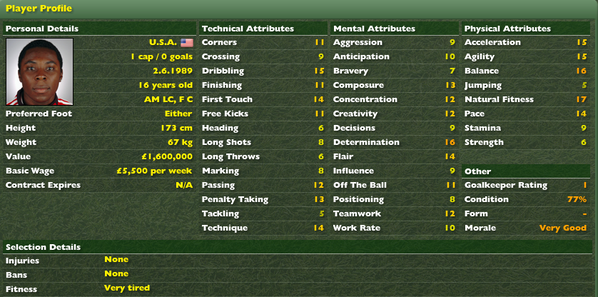
What were the makers of Football Manager looking at?

Adu also suffered from bad advice and a string of bad luck with his club teams. At D.C. United, Peter Nowak was widely considered to be the perfect coach for a prodigy, but his mismanagement peaked in the 2006 playoffs. With United trailing New England 1-0, Adu was the best attacking force United had on the field. Nowak pulled him in the 65th minute in favor of Matias Donnet, who contributed absolutely nothing. A little while later, Christian Gomez cramped up — an accomplishment on a cool fall day — leaving only Ben Olsen to inspire the attack through sheer force of will. (Yes, this is all in my book. The first one.)

On Adu went to Real Salt Lake, which was always going to be a brief stop on his way to Europe. He wound up at storied Portuguese club Benfica, which turned out to be a mess.

Then it was Monaco’s turn to mess up, spurred by Franco-American club president Jerome de Bontin’s proclamation that Adu could represent U.S. soccer in France the way Greg LeMond represented U.S. cycling. That’s a lot of pressure to put on a player the coaches didn’t even seem to want. A whirlwind tour of Europe akin to something Chevy Chase did in the movies followed.

At this point, Adu got a lifeline. He came back to MLS to play for Philadelphia. And he wasn’t bad. Had he embraced the shot to be an above-average MLS starter at this point, he could have spent the rest of his 20s as a productive professional player.

Instead, he embarked on another round of globe-trotting and another return to the USA. The player who was a strong MLS player in his teens was a mediocre USL player in his 20s.

So why is this a story of optimism? Let’s go back to the ESPN story.

Adu believes that several of the players at Next Level have significant potential. He knows now, though, that potential only sets the starting line. “Growing up, I was always the best player,” he said. “Guys who were way below me at the time, you’d say right now had better careers than I did.”

If he’d had a Freddy Adu working with him, an elite-level player there to explain what it meant to succeed, he would have developed a different attitude. “So when I see a kid who’s really talented, clearly above the rest, and he’s just coasting, trying to get away with his talent, I say, ‘No, no, no. That can’t happen! You can’t let that happen! They will surpass you.’ Because I was that kid.”

He’s the perfect coach. He’s charismatic. He has good attacking vision.

And kids can learn so much from people who’ve failed. Many of the best coaches in the world are people who never panned out as players. They faced adversity, and they pass those lessons along to those players.

We’ll never see Freddy Adu representing the U.S. again. Not on the field.

But off the field? We’ll see.

It’s too late to take advantage of the potential he had as a player. Maybe he’ll take advantage of the potential he has now.