The FC Kansas City defender has a lot of playing experience AND is revolutionizing the way we get youth soccer players to improve when they’re not at practice.
The FC Kansas City defender has a lot of playing experience AND is revolutionizing the way we get youth soccer players to improve when they’re not at practice.
The first full-fledged Ranting Soccer Dad podcast features the Soccer America journalist who has been covering, coaching and reffing youth soccer through its rapid changes in the past couple of decades.
The debut / trial run of the Ranting Soccer Dad podcast, explaining what this is all about. (In short: Youth soccer, branching out to related stuff such as soccer, other youth sports, parenting, coaching, stress management, etc.)
Friday, July 21
6:10 a.m.: Water polo, men’s Worlds, USA-Russia, NBC Sports online
11:45 a.m.: Women’s Euro 2017, Sweden-Russia, ESPN3
2 p.m.: Track and field, Diamond League Monaco, NBCSN
2:30 p.m.: Women’s Euro 2017, Germany-Italy, ESPN3
11:30 p.m.: Australian rules football, Essendon-North Melbourne, FS2
Saturday, July 22
7:30 a.m.: Tour de France, time trial, NBCSN
11:45 a.m.: Women’s Euro 2017, Iceland-Switzerland, ESPN3
2:30 p.m.: Women’s Euro 2017, France-Austria, ESPN3
3:30 p.m.: NWSL, Chicago-Orlando, Lifetime
4 p.m.: MLS, Minnesota-NY Red Bulls, ESPN
6 p.m.: UFC Fight Night, Fox
10 p.m.: Gold Cup semifinal, USA-Costa Rica, FS1
Sunday, July 23
Ongoing: Golf, British Open, NBC
9:30 a.m.: Field hockey, Women’s World League semifinal final, USA-Germany, ESPN3
2 p.m.: Swimming, World Championships, NBCSN
2:30 p.m.: Women’s Euro 2017, England-Spain, ESPN3
6:30 p.m.: MLS, Vancouver-Portland, FS1
Monday, July 24
11:30 a.m.: Swimming, World Championships, NBCSN
2:30 p.m.: Women’s Euro 2017, Belgium-Netherlands, ESPN3
Tuesday, July 25
11:30 a.m.: Swimming, World Championships, NBCSN
2:30 p.m.: Women’s Euro 2017, Russia-Germany or maybe Sweden-Italy, ESPN3
Wednesday, July 26
11:30 a.m.: Swimming, World Championships, NBCSN
7:30 p.m.: International Champions Cup, Barcelona-Manchester United, ESPN2
9:30 p.m.: Gold Cup final (might include the USA, might not), FS1
Thursday, July 27
6 a.m.: Cricket, England-South Africa, first day of third Test, ESPN3
11:30 a.m.: Swimming, World Championships, NBCSN
2:30 p.m.: Women’s Euro 2017, no idea which game, ESPN3
10 p.m.: Women’s soccer, USA-Australia, ESPN
Friday, July 28
6 a.m.: Cricket, England-South Africa, second day of third Test, ESPN3
11:30 a.m.: Swimming, World Championships, NBCSN
2 p.m.: Cricket, T20, Sussex-Middlesex, ESPN3
Saturday, July 29
6 a.m.: Cricket, England-South Africa, third day of third Test, ESPN3
11:45 a.m.: Women’s Euro 2017 quarterfinal, ESPN3
2 p.m.: Swimming, World Championships, NBC
2:30 p.m.: Women’s Euro 2017 quarterfinal, ESPN3
10 p.m.: MLS, Los Angeles-Seattle, ESPN
11 p.m.: Darts, Las Vegas Masters, FS1
Sunday, July 30
6 a.m.: Cricket, England-South Africa, fourth day of third Test, ESPN3
8 a.m.: Formula One, Hungarian GP, NBCSN
11:30 a.m.: Swimming, World Championships, NBCSN
11:45 a.m.: Women’s Euro 2017 quarterfinal, ESPN3
2 p.m.: MLS, Toronto-NYCFC, ESPN
2:30 p.m.: Women’s Euro 2017 quarterfinal, ESPN3
5 p.m.: BMX, World Championships, NBC Sports online
8 p.m.: Women’s soccer, USA-Brazil, ESPN2
Monday, July 31
6 a.m.: Cricket, England-South Africa, fifth day of third Test, ESPN3
There’s also cricket and cornhole. Yes, cornhole. And Battle of the Network Stars.
(All times ET. Olympic Channel events are pending a dispute with my cable/Internet company, which rhymes with “horizon.”)
Let’s play Soccer Optometrist.
Better like this?
Or better like this?
That’s the result of my attempt to demonstrate something I’ve been investigating and analyzing for the past two months in a couple of stories — the opus on all Development Academy issues and the five-point plan for reducing the confusion and unnecessary travel in elite soccer — and the first full-fledged Ranting Soccer Dad podcast, in which Mike Woitalla and I pointed to travel itself as the best place to cut costs in travel soccer. The logic is pretty simple — it’s tougher to cut coaching costs and much tougher to cut field costs than it is to cut the bills on hotels and airlines.
So the hypothesis I’m testing with these maps: Elite soccer players don’t need to travel like Odysseus to find competitive games. The Development Academy (adding girls’ teams this year) and the ECNL (adding boys) would be better off if they played each other and top U.S. Youth Soccer teams currently playing in the Eastern Regional League and National League.
I also learned two important lessons:
1. Don’t try to put 332 data points on a map of the Northeast U.S.
2. Most youth soccer clubs have atrocious websites.
But I did compile complete-ish data for most teams playing at a serious or semi-serious level in Region 1 (the East Coast from Virginia to Maine). I put the raw data on Github because I have delusions of becoming a data journalist. (And so people can check numbers at a glance and dive deeper if they wish.)
On the spreadsheet and the maps, all clubs are listed with their 2016-17 leagues EXCEPT the ECNL and DA, which have announced their fall lineups, plus a couple of clubs that have qualified for the National League. I did NOT go through and try to figure new qualifiers for the ERL or calculate promotion/relegation in EDP and local leagues. (But there’s a little bit of pro/rel later.)
The rankings are all from Youth Soccer Rankings. All rankings should be taken with a grain of salt, but this site has the most comprehensive results database. It has the occasional error, mostly because teams often don’t use consistent names (“PREMIER 01 GIRLS FC BULLDOGS” or “PREMIER FC BULLDOGS,” etc.) and because a couple of leagues (looking at you, Virginia Premier League) have sites that simply don’t make it easy to look up results. But it does a remarkable job of compiling and analyzing scores, and I chose the U17 level because that group is old enough for results to be relatively meaningful. I used girls leagues because boys DA teams generally aren’t ranked because they rarely play outside the DA.
I have a plausible reorganization of the “national” leagues in U.S. youth soccer — the Development Academy, the ECNL and the U.S. Youth Soccer regional/national competitions. On these maps, I call that “Division 1.” I’m a little less convinced with what I’m calling “Division 2,” for reasons that will be come apparent.
Here’s how I broke it down:
CRITERIA FOR CURRENT LEAGUES (the “Before” view in the before-and-after of my reorganization; the numbers all refer to rankings)
DIVISION 1: 64 teams
DIVISION 2: (105 teams)
NPL (U.S. Club Soccer) regional leagues
Non-NPL regional leagues
DIVISION 3 (162 teams)
I only mapped this on the rather jumbled 332-team map. I may go back and do some local case studies at some point. But for posterity, here’s how I came up with a third division.
Complete leagues (or divisions of leagues)
In the top 300 or champion in a league with multiple teams over 300
Champions or top U16 teams in these leagues/divisions/states
So how did I do the “reimagined” maps? Like so:
DIVISION 1: Add champions of Division 2 leagues. (EDP-1N champion New York SC Elite NPL is already in DA.)
DIVISION 2
Here’s how it turned out:
BEFORE
AFTER
That’s an improvement, but perhaps less so than Division 1.
The Division 2 issues:
Do we care about high school soccer? Depends on the region. I found most elite teams currently play few to no league games during their high school season. A lot of lower second and third tiers that often play through high school season, depending on the region. In my densely populated area (Northern Virginia), that makes sense — players who aren’t on the top travel teams won’t make their high school teams. That’s surely less common in more rural areas.
High school play is the biggest wedge between the Development Academy and the ECNL. The latter allows players to play in high school. The former doesn’t — sort of. Players can get waivers if their admission or scholarship to private school is contingent on their participation on the soccer team.
If we combine the DA and ECNL, we’d have to let players play in high school. If some teams want to skip high school soccer and play more league games, we can work that out.
Final note: This plan wouldn’t necessarily replace existing leagues. The NPL (U.S. Club Soccer’s network of regional leagues) would get some reorganization, and it could split the second tier with the EDP or share it. (The sprawling EDP already has some NPL divisions in other age groups, so it’s not a stretch to imagine them cooperating.) I do think Club Champions League should reinvent itself as a series of showcase events rather than a “league,” which is another rant.
The rest of the pyramid remains intact, perhaps with the stipulation that teams would need waivers if they’re a certain distance from the league’s geographic center.
There’s no way to prevent all lopsided games. But with this system in place, at least teams wouldn’t travel 300 miles for an uncompetitive game. If they still want to fly to Disney World for a tournament, they’re still free to do so. (Can I join your club?)
A few of us have gotten the impression that referees in NWSL games are awarding tons of penalty kicks but not many yellow cards. Are we right?
Sort of …
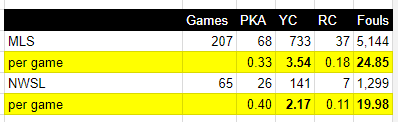
So the PKs, aside from games involving Sky Blue, aren’t that far off. But yellow cards? A rare sight in an NWSL game.
If you’d like to check my work, have at it …
Marta is here. Alex Morgan is back. Mallory Pugh is here. Estefania Banini is back.
But the chemistry isn’t quite there. And neither is the service from midfield.
Yes, the Washington Spirit and Orlando Pride each scored twice in a 2-2 draw before a crowd of 5,200 that filled the seats, the hill and the concession lines Saturday at the Maryland SoccerPlex. And yes, we had a couple of moments like this:
(Incidentally, I have no idea how I’m not in that camera shot. I was sitting on the hill today because I brought the little one with me. So I had a perfect view of that bit of Morganinho skill. And a perfect view of the first penalty awarded. Struck me as a little soft. A bit. When Kate Markgraf calls it “just a little bit of a shoulder challenge,” it’s probably not a great call.)
But neither team produced much to trouble the keepers. Morgan was offside a few times. A late flurry from the Spirit padded the stats.
The strangest thing for the Spirit: Tori Huster, usually a game-changer in midfield but not an offensive force, was shooting from all over. Some of the shots, as coach Jim Gabarra said afterwards, were the result of defenders giving her space and trying to contain Franny Ordega, Mallory Pugh and others.
But then there was this:
And she took a ton of shots in pregame warmups. Even more than Cheyna Williams, who helped the Spirit make a late surge when she came on a substitute.
Williams probably should be starting. So should Kristie Mewis. The Spirit could use some possession, and Ordega’s passing was erratic today.
Today was also the return of Ali Krieger to the SoccerPlex. If you love Krieger, you saw a passionate captain and defensive rock. If you don’t, you saw a lot of griping to the ref and some puzzling passes.
And this:
And a lot of people think Tom Sermanni needs to find a way to move Krieger from center back to right back. Probably, but center backs seem to be in short supply these days.
Sermanni, ever the gentleman, came over for a quick work with the media even though the Pride needed to fly out of town. He wasn’t thrilled with conceding the lead twice. He is thrilled, though, with the prospect of Morgan getting into form alongside Marta.
Pugh is a little younger and Banini is a little less famous than the Pride attackers. But they showed glimmers of quality today, too. Pugh had a marvelous finish and kept her nerve on a last-minute penalty kick.
So both sides will get better. For the Pride, that might mean a late push for the playoffs. For the Spirit, that might mean eighth place.
My new youth soccer podcast, Ranting Soccer Dad, is now available through this site and … well … Podbean. I’ll work on getting it everywhere else.
You can find it on the Podbean site or just check the Ranting Soccer Dad page here.
Future episodes will have interviews. That’s why this one is Episode 0. It’s just me explaining a bit about what I’m planning to do.
The driving distance from Providence Park to the Maryland SoccerPlex is 2,785 miles. Google Maps says I can do it in 41 hours.
But is the relationship between the Portland Thorns and the Washington Spirit a rivalry?
“For me, yeah,” said former Spirit and current Thorns midfielder Hayley Raso with little hesitation. “It’s hard to leave a club the way I did, so coming back here, I feel like I have something to prove.”
Raso is a young soft-spoken Australian who was happy to see Boyd, the SoccerPlex’s field-maintenance dog — “he’s cute,” she said — and doesn’t seem like the sort of person who’d be in the middle of controversy. She had a few fouls tonight and picked up a yellow card (which I missed because I foolishly thought the Thorns might dart through the press area before I got there, so I was heading down to the field) at the final whistle. But this was nothing like the professional agitators so many NWSL teams employ.
And yet, there was an incident immediately after the whistle (again, I missed it) between Washington coach Jim Gabarra and Portland coach Mark Parsons — who was, of course, the man who led the Spirit to consecutive playoff appearances before Portland hired him away. I understand Gabarra didn’t comment (I missed the last part of his comments to catch Raso), but Parsons …
Bear in mind — Parsons didn’t turn up to the postgame interviews with a bright-red face and a hoarse voice from screaming. He thought we didn’t want to talk with him, the result of a miscommunication between some non-PR Spirit staffers and Nadine Angerer, the Thorns’ goalkeeper coach/visiting PR contact. When I suggested to him that perhaps the Thorns could invest some of their gate receipts from their five-figure home crowds in an actual PR contact who isn’t also the goalkeeper coach, he gave me a playful pinch on the arm.
And he was gracious to his former team.
“The Spirit were very good. Packed house (attendance over 4,000) for them tonight, and I know what a packed house does — we have it at home. It pushes you. They caused us some problems, and we struggled to break them down.”
Indeed they did. The Thorns had 62.7% of the possession but generated few chances.
“I don’t think they had any clear possession in our final third,” Gabarra said. “It was all the middle of the park or their half.”
This week may bring a screeching halt to goalkeeper Stephanie Labbe’s weekly nomination(s) for Save of the Week.
“That’s GREAT news!” Labbe laughed. “I guess? I know, they’re killing my saves here, you know? But that was awesome. I can’t even remember having to make a dive at all. Defensively, I thought we played so well and kept everyone in front of us. With so many attacking threats, I think it was almost a good thing for us because we didn’t have to focus on one person, we focused on the whole team.”
Spirit fans are used to seeing Estelle Johnson’s magical recovery power, and they can trust in Shelina Zadorsky’s steady presence at center back. The improvement has been a collective effort, but Zadorsky’s central partner Whitney Church deserves special mention. The thought of putting Church up against Christine Sinclair might’ve seemed frightening in the past. But Church was steady tonight.
Midfielder Tori Huster: “I thought we had really tight lines for the most part. I thought our back four did perfectly. They were dropping when they needed to drop, and I think Whitney had probably 20 headers that we really needed her to have, and they could’ve been a lot more dangerous had she not headed them. I thought she had an outstanding game.”
And yes, that’s Huster, the midfield rock who has been missing with an injury for the last few games. She was so happy to be back on the field that she was still signing autographs 45 minutes after the whistle.
Washington is one of two NWSL teams that doesn’t have a midweek game on Wednesday. Portland has to face perplexing but dangerous Kansas City.
“Individually, we have to look at our performances and examine how we did and go back to work and make sure we’re fixing those things we didn’t do well,” said defender Meghan Klingenberg, who spent much of the game pressed forward on the flank. “And collectively, figure out what we didn’t do well. And fix those things for Wednesday, because it’s a quick turnaround.”
But Klingenberg declined to make any Carli Lloyd-style comments about her teammates. “My teammates are amazing! They work their butts off. I don’t care if we win or lose, I would choose to play with them more than any other team.”
And in any case, the game would’ve been much different if not for this:
Ordega and Cheyna Williams were magnificent up front. Williams forced the best Portland save of the night, and Ordega had a sick nutmeg among other sweet moves.
Ordega was especially inspired:
That goal certainly changed the Thorns’ approach.
Raso: “We went down a goal, so I guess we got a bit anxious out there. From the start, we were chasing the game. We probably could’ve played more simple, but when you’re chasing the game, you’re just trying to do what you can do.”
And the Thorns simply looked tense, making a lot of clumsy turnovers and failing to connect in the final third.
Parsons put it in simple terms: “We were just a little bit off tonight, and when you’re playing a team with a bit of momentum, it’s going to be a rough one.”
Other notes from the game:
Spirit owner Bill Lynch heckled Parsons and a few Thorns during the game. But Parsons didn’t seem to notice anything from the stands this time around.
“Last year, I heard a lot of negative, which was pretty cool and fun. That’s when you know women’s soccer’s growing, when players and coaches come back and get harassed in a good, healthy way.”
But things have changed since last year, when the Spirit had most of the same players from Parsons’ last year.
“It’s been a changeover in players, fans and staff. But it’s great coming back. This is a special place for me that I had some great, unbelievable moments with, and I’ll always hold on to that and know that this gave me an opportunity to get in this beautiful game and work with these great female athletes.”
Tony DiCicco’s passing was observed with a moment of silence and armbands. I missed what Gabarra said about him — check with Caitlin Buckley or Jordan Small. Parsons hailed him as a “person and face and heart of women’s soccer,” and he shared a personal anecdote:
“I remember going to watch his NSCAA Convention sessions when I first got here and wanted to learn. I finally had the opportunity to talk to him when I was trying to sign a Japanese girl here at the Spirit. I reached out to Tony. He didn’t have to help me, and he sat there for an hour on the phone telling me everything I needed to know about this Japanese international and walked me through everything. He didn’t know me, he had no tie to the Washington Spirit, he probably had closer ties to other teams. … Now you read what everybody else is saying about him. I experienced that first-hand. He was all about helping anyone in the women’s game and outside the women’s game. We’ve lost a great there. If we can grab the special qualities that he had consistently every week and keep spreading that love and support for everyone in the game, I’m sure he’d be proud.”
Alternative youth soccer leagues are almost as popular these days as alternative facts.
I’ve spent the last month doing interviews and compiling data for an upcoming story to see how we stand on the fine line between awesome and absurd. That reminds me: Today is the last day to take my survey about leagues in your area and whether they strike the right balance between competition and spending entire weekends in cars and hotels.
The data is now available in map form, showing more than 300 Under-14 boys teams in Region 1 and the leagues in which they play. Here’s the full version:
Here’s the methodology:
The age group: I chose U14 boys because this is the last year before a lot of teams sit out league seasons to allow kids to play high school soccer. They’ll usually play in a few tournaments during that season off, but the point here is to show the leagues. Tournaments are another issue entirely. I chose boys rather than girls because there are more teams (the reasons for that are yet another rant) and because the girls are getting a new Development Academy next year that will throw everything for a loop.
Yes, the boys also have a new league — the boys ECNL, which is represented here.
The rankings: Youth soccer rankings are generally ridiculous. Teams enter every tournament they can in an effort to boost their numbers at GotSoccer so they can brag to their friends and (they think) impress college coaches. They’re also based on results, which can be deceiving (another reason I chose U14 rather than U11 or U12, where kids are still learning the game and one team with a good goalkeeper may beat a far superior team whose goalkeeper is scared of the ball). Some teams I know to be outstanding are poorly ranked or not ranked at all because they’ve either reorganized or simply not played enough games. And you may still have some rogue results because some team’s star player needed math tutoring or was at a cousin’s wedding the weekend of the biggest tournament of the year or whatever.
With that disclaimer out of the way — yes, I used rankings here. I took the ever-controversial GotSoccer as well as a lesser-known site called YouthSoccerRankings, which seems to have more league results as well as a handy tool for soliciting corrections.
The idea behind using two ranking systems was to cast a wide net. Some teams had incomplete records with one service or were missing entirely, but then the other site would have the info. I calculated an overall ranking based on the higher of the two rankings. Then I took the top 300 teams, plus any other teams that play in self-proclaimed elite leagues.
So the numbers are all included, but please take them with a grain of salt. They update quickly — I pulled the YouthSoccerRankings numbers in the middle of last week, and they changed the next day. I’m hoping to get a general idea of where the top teams in Region 1 are playing, and I’ve surely missed a few. I’m not trying to start an argument between overbearing soccer dads in Massachusetts and Virginia because one kid’s team is ranked 45th and another is 58th.
The leagues: “What league are you in?” is not a simple question. Some teams switch leagues between fall and spring, and some play in multiple leagues in the same season. A handful of teams aren’t in a league at all, at least in the spring. I tried to find either the team’s most recent league or the league into which they’re moving this fall (particularly the new ECNL, but also a few other elite leagues replacing ECNL-bound participants).
And in some cases, it’s hard to tell what qualifies as a separate team and what doesn’t. Both of the ranking sites have a lot of duplicates — a team may be “River Otters Premier Black” at one tournament and “River Otters NH North Coast Premier” at another. I did all I could to catch duplicates, and I deleted teams that seem to be one-offs for specific tournaments or otherwise not consistently active.
The leagues are …
The national big dogs
U.S. Soccer Development Academy (DA): Clubs are invited by U.S. Soccer and only play each other. Many are professional clubs (MLS, NASL). No additional tournaments. Players cannot play high school soccer while enrolled in the DA. Launching a girls version in fall 2017.
Elite Clubs National League (ECNL): The girls version has existed for several years. U.S. Club Soccer is launching a counterpart for boys in fall 2017. It competes head-to-head with the Development Academy, offering no MLS affiliations but more flexibility. Teams can compete in outside tournaments but usually not traditional State Cups (U.S. Club Soccer is starting to do its own, which is yet another rant), and players can often play in high school.
U.S. Club Soccer National Premier Leagues
Not to be confused with U.S. Club Soccer Premier Leagues, which also exist.
Elite Development Program (EDP): A hybrid of many things spanning I-95 from New York to Northern Virginia. The top division is considered a U.S. Club NPL and therefore a qualifier for other competitions. Divisions below that are tiered and regionalized. In some areas, it has become the de facto primary league. Farther south, it attracts teams looking for “elite” play — teams often move over their local league’s top division. But it’s not exclusive — the lowest divisions have teams that aren’t ranked anywhere near the top 300. The teams on the map are ranked in the top 300, sometimes reaching down to the league’s sixth tier (Championship 2). For purposes of the map, teams below the NPL division are grouped regionally regardless of division. That’s EDP-North (1N, 2N, PN1-2, CN1-3), EDP-Central/East (1C, 2C, 2E, PC1-2, PE1-2, CC1-4) and EDP-South (1S, 2S, PS1-2, CS1-2). Several clubs are moving their top teams to the ECNL but will likely have other teams remain here. Some teams also play in other leagues and are listed with their base leagues.
New England Premier League (NEP): Also a hybrid of sorts. The Premier League is the top division of the New England Premiership. The NPL division is much larger than the EDP’s NPL division. Teams listed here are any teams in the NPL division (excluding FC Stars and FC Boston Bolts, which are moving to the ECNL) and any other teams in the top 300. Divisions: Premiership (NEP-P), Premiership-1 (NEP-P1), Championship (three regions: NEP-CC, NEP-CN, NEP-CS), League 1 (NEP-L1N, NEP-L1S) and League 2 (NEP-L2).
New York City Soccer League (NYCSL): Another large hybrid league, and this one’s especially confusing. The NPL division is the top division. Then comes Metro (NYCSL-M). Then the Premier League, which has multiple tiers (NYPL-1, NYPL-2, etc.). Though it’s called the NYC Soccer League, it reaches out into suburbs in other states. Next year, East Meadow SC will move its top team to the ECNL.
Virginia Premier League (VPL): A club-centric league. Games are scheduled so that each club’s teams in each age group play its counterparts in another club on the same day. No promotion/relegation. (Disclaimer: I live in Vienna and have had kids in that club’s rec program, and I know quite a few coaches, board members, etc. I also happen to think they should ditch this league. Their top girls teams don’t have enough competition; some of the boys teams have too much.)
Regional elite leagues (not U.S. Club Soccer)
Atlantic Premier League (APL): Teams in New Jersey, Pennsylvania, Delaware, and Maryland. Two divisions in fall, one division in spring. Map accounts for all D1 teams in either season except Penn Fusion SA Elite and Continental FC Barca, which are leaving for the ECNL.
Club Champions League (CCL): Like VPL, scheduling is club-centric, with no promotion and relegation. The league covers Virginia and Maryland and also operates CCL2, which includes CCL clubs’ B teams as well as few other clubs’ A teams. The map accounts for all CCL clubs and the top CCL2 teams except Braddock Road and Maryland United, which are leaving for the ECNL. The site cleverly hides schedules and results, so a lot of the home fields in the map are educated guesses.
Local leagues
National Capital Soccer League (NCSL): A traditional local promotion/relegation league covering the D.C. metro area and sometimes beyond, reaching down to Fredericksburg, up to Baltimore and out to West Virginia. The teams on the map are ranked in the top 300, sometimes reaching down to the league’s fourth tier. It’s included here because it has 15 teams in the top 300, far more than any other local league. (Disclaimer: I have a son who plays in this league. His team is neither U14 nor in the top 300 in the region.)
The other local leagues, in order of number of teams represented:
Thruway League: West and Central New York.
Connecticut Junior Soccer Association (CJSA): Elite and Premier Leagues.
Connecticut Club Soccer League (CCSL): A U.S. Club Soccer league.
Pennsylvania West Classic League (PA West): The top teams also play in the Eastern Regional League, many skipping the spring PA West season.
DELCO: Eastern Pennsylvania.
Eastern New York Premier League (ENYPL): The name says it all.
Vermont State League: Another well-named league.
Virginia Soccer League: Central and Southeast Virginia (Richmond to Hampton Roads).
Westchester Youth Soccer League (WYSL): U.S. Club Soccer league in eastern New York. Top division is called Premier League and is difficult to find on the site.
Cosmopolitan Junior Soccer League (Cosmopolitan): New York City.
Fall Classic League (FCL): Maine. I hope they have lighted fields.
Inter-County Soccer League (ICSL): Pennsylvania East.
Northeast Soccer League (NSL): Mostly Massachusetts, with some from New Hampshire and Rhode Island. Joining U.S. Club Soccer in the fall.
South Jersey Soccer League (SJSL): Again, the name is apt.
The map does not have separate dots for the Eastern Regional League (ERL), a qualification-based U.S. Youth Soccer league. Most ERL teams also play in a local base league, and each ERL team is noted in the descriptions.
x x x
I did a second version of the map as well, limiting this one to the DA plus 100 teams. Again, I’m sure some teams in the 200s can beat some teams in the 80s. I just wanted to get another, slightly cleaner look at it to demonstrate that there are some objectively good teams out there that are near each other and don’t play each other.
Then for those who would rather see static snapshots than play around with a Google Map, let’s take a look at a couple of big areas. Here’s the D.C. metro area in the larger map with 300+ teams in the region:

You can see the inroads EDP (blue circles) has made, especially in Maryland, and you can see the hodge-podge of other leagues dividing my homeland of Northern Virginia.
When we limit the regional map to 100+ teams, it looks like this.

In contrast, New York looks a little more cohesive:
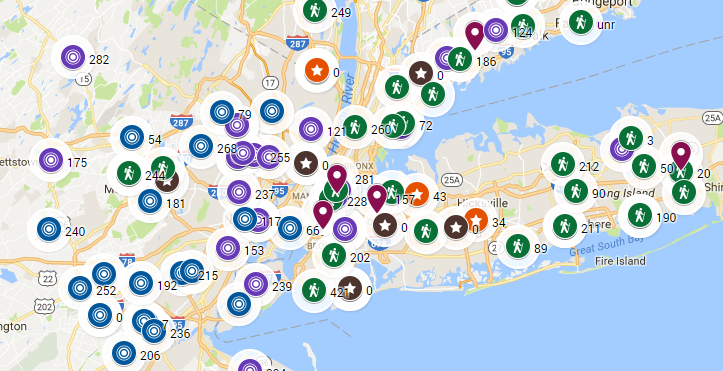
Here it is at 100+:

That’s several DA teams (black circles/white stars), a couple joining ECNL (reddish circles/white stars), a whole lot of EDP North and EDP Central (blue and purple circles), and then a few in the NYCSL (hiking guy in green), particularly on Long Island.
That should be enough to start the conversation. I’m also happy to share my data. I may do it by Google Sheet, or I may go back to trying to figure out Github. Suggestions welcome.
Then be on the lookout later this week for a story about whether this has gotten absurd.
 Duresport.com