Neither the Washington Spirit nor the Boston Breakers tanked Saturday night’s game to get the No. 1 draft pick. For once, my prediction was right.
But it wasn’t pretty. I didn’t notice any Spirit Academy kids in the crowd, and that’s probably for the best. You don’t want them to learn anything from this. Two own goals by the same luckless player, former Breaker Kassey Kallman. No shots for the home team in the first half. Fouls that weren’t particularly malicious but just pointless. Passes that clattered into opponents.
The Breakers played hard, and aside from two maybe-overdue yellow cards, they played fairly. Own goals are often a mix of luck and getting the ball in good spots, and the Breakers got the ball in good spots many times in the first 10 minutes of the second half, turning a 0-0 snoozer into a 3-0 game with a bit of life.
And the Spirit didn’t pack it in. Two terrific strikes were called back due to close but probably correct offside calls. The silver lining (coincidentally, the Rilo Kiley song of the same name is now playing on my Spotify mix) for the Spirit: They put the ball in the net four times! Too bad two counted against them and the other two didn’t count at all.
Late in the game, those of us in the pressbox were wondering why Breakers coach Matt Beard was so animated, chastising his team and gesticulating wildly. After the game, the thoughtful and tactically shrewd coach explained that he was legitimately worried that the Spirit might come back, like Sky Blue has on more than one occasion this season. When you haven’t won a road game in a while, a little paranoia is understandable.
So yes, both teams were trying. It wasn’t just a couple of teams tanking to land Andi Sullivan in the 2018 draft. At this point, the Spirit seem destined to land their hometown hero. And tonight, they looked like they needed her. Some of the players on the field simply were not up to the task.
And it’s not as if the Spirit have many other options. They dressed 14 players for the game. (The Breakers, also limping toward the finish line of the season and missing game-changer Rose Lavelle, only dressed 15.)
Coach Jim Gabarra said quite candidly after the game that his team really didn’t have the training they needed to prepare. Too many games in a short time. Too many injuries.
“So you didn’t think it would be a good idea to run your players through a series of intense practice in 90-degree weather with only three available subs?” I asked (paraphrased).
“Probably not,” Gabarra said.
Spirit fans weren’t about to forget the birthday of their last remaining original player, Tori Huster.
Spare a thought for Spirit fans who’ve attended most of the games this season. They’ve seen a lot of bad soccer, and it’s not all from the home team.
Maybe it’s a strange thing to say about a team in last place, but the Spirit overachieved in many ways this season. Stephanie Labbe and Estelle Johnson were having great seasons until they abruptly ended a couple of weeks ago. Arielle Ship was better than expected. Meggie Dougherty Howard was way better than expected — even people who wish the next hurricane would race up the Potomac and destroy the Maryland SoccerPlex because they so despise Spirit ownership have pegged the late third-round draft pick as a solid pick for Rookie of the Year.
But Spirit fans really haven’t been treated to a lot of quality from their visitors, either. Portland showed little in Mark Parsons’ return to the SoccerPlex. Orlando wasn’t quite the Morgan-and-Marta juggernaut they later became. The Chicago Red Stars looked like they were playing old-school roller derby. The best game of the season, oddly enough, may have been the previous Spirit-Breakers game, when Boston goalkeeper Abby Smith flat-out robbed the Spirit (legally) of a win.
Call it bad luck, compounded by some personnel moves that will leave some lasting bitterness. Frankly, the quality of play in the NWSL has been poor this season. If you want to blame anyone, blame the referees who’d rather carry on conversations with players like Allie Long and McCall Zerboni rather than give them cards for any of the 349 fouls they commit each game. That needs to change.
One thing that’s not going to change — the occasional late-season game between tired, ailing teams at the bottom of the table. And if this game proved one thing, it’s that the women’s game is not ready for promotion and relegation, no matter how many U.S. Soccer presidential candidates try to win points by promising it. These coaches can’t afford a training injury, and there’s absolutely nothing to be gained by tossing Rose Lavelle or Cheyna Williams out on the field at this point just so they can avoid swapping places with WPSL champion Fire And Ice SC. (Granted, if the problem with Lavelle is that she’s flying too much, may I suggest a bus with adequate sleeping space? And no, I have no idea what possessed anyone to name a team “Fire And Ice.” Does Shy Ronnie play for them?)
Even in a no-good, horrible, very bad game such as this, you’ll see moments of quality. Smith didn’t have to pull the mind-boggling saves she made last time to get the shutout this time, but she was terrific when she needed to be. Mallory Pugh adds life to any attack, whether it’s the U.S. national team in full flight or whichever players the Spirit can scrape together around her.
The Spirit will be better-prepared when Seattle visits for the season finale. I’m predicting a 6-5 game with 30 saves. We’re due.
There’s no organization in the world quite like U.S. Soccer.
That’s not a compliment. That’s not an insult. It just … is.
U.S. Soccer is unique among major U.S. sports federations in that its mandate goes beyond organizing national teams and developmental programs. It’s responsible, by FIFA fiat, for regulating professional soccer competitions. (Or, in the case of the U.S. Open Cup, running those competitions outright.)
U.S. Soccer is unique among soccer federations in that the nation it serves is a massive economic power on a giant land mass in which soccer is not the most popular sport. The USA isn’t the only country that has its own indigenous offshoot of “football” that rivals or exceeds soccer in popularity — see Australia and, to a lesser extent, Ireland — but it’s the only one that has multiple team sports that garner more attention. As far as I know, it’s the only soccer federation in a country that has been openly hostile to the sport for generations.
And to my knowledge, it’s the only federation that was charged by FIFA with getting an honest-to-goodness professional league running in the 1990s. Every other major country already had one.
The most important election in U.S. Soccer to date was in the summer of 1990, when Alan Rothenberg unseated Werner Fricker. Rothenberg was under a bit of pressure to run. From 1994, here’s Steve Berkowitz, then of The Washington Postand later a demanding but fair editor who made some of my USA TODAY stories a lot better:
Rothenberg said FIFA officials, familiar with him because of his involvement with the 1984 Olympic soccer competition, initially contacted him about chairing the World Cup organizing committee. When he said he was interested in doing so, he was told that he also would have to become USSF president. He agreed, and lo and behold, Rothenberg unseated Fricker in August 1990.
And so Rothenberg went to work on getting FIFA’s cash cow, the World Cup, up to speed. He also had to fulfill U.S. Soccer’s other promise to FIFA, a pro soccer league. Rothenberg needed a plan, and so he went about hiring people — including economist Sunil Gulati and attorney Mark Abbott, on loan from Rothenberg’s law firm, Latham & Watkins.
Abbott sat with me for an interview when I was writing Long-Range Goals: The Success Story of Major League Soccer (please note: I did not choose that subtitle). Here’s what he said about Rothenberg’s unusually sprawling role:
At that time, there were very stringent procedures that were put in place to ensure that although Alan was the head of the soccer federation and leading the effort to make a presentation with respect to the league, he had been recused from the decision-making system in U.S. Soccer. There was a big meeting in December 1993 where we made our presentations. Alan was not part of the Federation board in making that decision. Also, and I think this gets overlooked, FIFA in awarding the World Cup to the United States did so very expressly for the purpose of using it as a springboard for a professional league. That’s what he was supposed to be doing, using this event to help start the league.
Still, the federation’s board voted to decide which of three bids would be awarded Division I status. In addition to Rothenberg’s group, the existing Division II-ish APSL put in a bid, as did Jim Paglia on behalf of League One America, which would take the old NASL’s Americanization of soccer rules to new extremes. (Jim, I know you’re out there — if you still have the video of the test games, I’d love to see them.)
The vote wasn’t unanimous. The tally was 18 MLS, 5 APSL, 0 League One America.
More from my book (because I can’t find Hersh’s story online):
Veteran national-team defender and U.S. Soccer board member Desmond Armstrong, who cast a ballot for MLS in the Division I vote, said his decision was strictly on merit. “I don’t have any love lost for the federation,” Armstrong told the Chicago Tribune‘s Philip Hersh. … “It wasn’t a matter of playing favorites, but of getting the best proposal out there so we can have jobs. I voted for Alan’s plan because it had all the t’s crossed and i’s dotted.”
The APSL grumbled a bit and for a short time was a legitimate competitor to MLS, signing quite a few players who were clearly good enough for the top tier but balked at the salary structure.
The next year (1994), Rothenberg ran for re-election. It got ugly, but he won.
The election was close in 1998. “Dr. Bob” Contiguglia defeated Larry Monaco 57.6% to 42.4%. Even closer was the race for executive VP, in which John Motta defeated … Sunil Gulati, then serving as MLS deputy commissioner. That was 372 (50.8%) to 361.
Maybe that was a rebuke of MLS officials gaining too much power in U.S. Soccer (though, note, this was before MLS hired Don Garber and well before MLS formed Soccer United Marketing). But such sentiment didn’t last long. U.S. Soccer then started staggering the terms of its top board members, and Gulati came back two years later to win the seat from Motta. And Gulati was able to point out in Fraser v MLS testimony that U.S. Soccer didn’t just rubber-stamp whatever MLS wanted.
Then Gulati succeeded Dr. Bob as U.S. Soccer president, and elections have come and gone with little fanfare or fire since then. The 2016 vice-presidential election was contested in gentlemanly fashion, with longtime independent director (board member) Carlos Cordeiro ousting Mike Edwards. Gulati hasn’t been opposed.
(This is an image of a Google search. Don’t click.)
Wait, wait … you’re saying. What does this have to do with promotion and relegation?
Nothing. Because it wasn’t an issue.
We’re about the have the next biggest presidential election in USSF history. Is pro/rel an issue now? Or is it more about general arrogance and an unwillingness to push Major League Soccer to be more open, whether that means pro/rel or a looser salary cap? Or perhaps the historical view that the close ties between USSF, MLS and Soccer United Marketing that may have been necessary for survival in the mid-2000s are no longer necessary and perhaps harmful?
Gulati has often been painted as ruthless — player testimony in Fraser v MLS certainly made him look like a tough negotiator, to put it nicely. In my experience, he’s a pragmatic idealist. He has devoted thousands of volunteer hours to making the sport succeed, and he has laudable intent (and action) on trying to diversify the typically homogeneous Federation. Whether he has handled every situation in his long tenures in various roles is up to everyone to decide.
Gans is pragmatic as well. He announced his candidacy only after going on a “listening tour” of various constituencies, and he’s concerned about youth soccer dysfunction and the decision-making that led the Fed to renew Jurgen Klinsmann’s contract and then fire him. As mentioned in Part 1 of this series, his take on pro/rel is cautious.
“It’s not the rules of the game that people came in on,” Gulati said. “When you buy into a particular structure, that’s what you expect the rules to be. … But if the leagues or a league wants to engage, we’re happy to be support that.”
Lapointe is more prone to throw stuff at the wall and see what sticks. His approach to Twitter, to which he’s still relatively new, resembles another president in the United States:
Well your $450,000 behind schedule. And that is just one Employee.
NWSL supporters on a lively Facebook group said “let’s get the NWSL in order first” and “technically, we have national Cups for women, but no one enters.” The latter point was emphasized by none other than John Motta, the former USSF VP who is now president of the U.S. Adult Soccer Association.
And Motta is himself considering a run. So is Jerome de Bontin, the former president of French club Monaco and general manager of the New York Red Bulls who is now the chairman of the sprawling Rush Soccer youth organization (sadly, not named after Geddy, Neil and Alex — or Cartman, Stan, Kyle and Kenny, though like Rush Soccer, they hail from Colorado).
So will any of these presidential candidates bring forth promotion and relegation?
It’s complicated.
Like the United States themselves, U.S. Soccer is a representative democracy. Not a dictatorship. The president must contend with the rest of the board, the general membership and perhaps even the U.S. courts.
And even Lapointe sees a need to phase into promotion and relegation, not just throw open the whole pyramid at once. That might not reassure the PRZ (Pro/Rel Zealots), who insist any incremental step suggested by me or Peter Wilt is simply doing the bidding of Evil MLS.
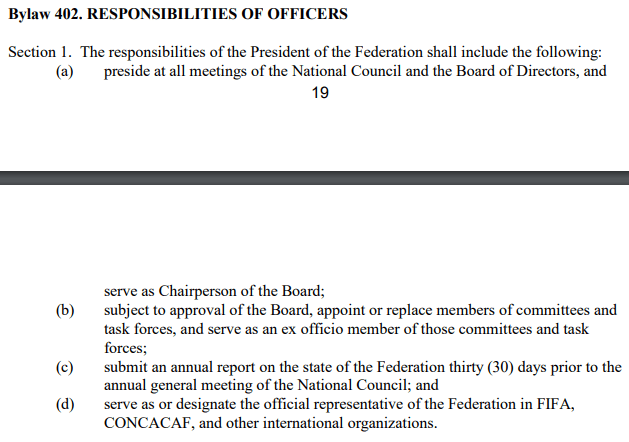
In any case, pro/rel may be the least of the next U.S. Soccer president’s concern. As mentioned many times in the past week or so, the NASL lawsuit calls into question U.S. Soccer’s legal authority to regulate professional soccer, and it’s not the first. But the bylaws clearly state U.S. Soccer’s firm belief that it can’t simply let someone else take over any aspect of the game.
(Except, apparently, indoor soccer. The boarded version of the game is operating outside USSF right now. For a while, it was associated with an organization called the Federation Internacional de Futbol Rapido, whose acronym FIFRA was hilariously close to FIFA. And except, apparently, college and high school soccer, neither of which is governed by U.S. Soccer. But I digress …)
So the Federation, and its president, must walk some difficult political lines. Filip Bondy, a longtime soccer writer now contributing to Forbes, put it best when he described the presidency as “a job opening you might want to pass on.”
Summing up Bondy’s take — the president gets to:
Accept blame for national team downturns
Deal with men’s and women’s national team contract disputes and potential work stoppages
Deal with FIFA and other officials of potentially dubious credentials and ethics (to me, this might be the toughest — how long can you swim in the FIFA cesspool without starting to stink?)
Collect a salary of $0.
Oh, and you have to put up with the NASL and Stefan Szymanski. If you didn’t see my Twitter thread on Szymanski’s declaration in favor of the NASL tweaking U.S. Soccer, check it out. Allow some time.
And it’s not as if U.S. Soccer simply rubber-stamps everything the president wants. (Also in that link: Note that U.S. Soccer changed the way it runs election, asking candidates to declare in advance instead of just presenting themselves on the meeting floor, and it instituted term limits. If Gulati runs and wins re-election in 2018, he’s out in 2022.)
So who votes? Let’s see if we can sum up Bylaw 302:
State association reps, both youth and adult. Their votes are weighted by the number of people they represent. (In other words, New York East is going to have a more heavily weighted vote than Alaska.)
Athlete delegates. There’s usually only a few, but by U.S. law, their votes have to be weighted to count for 20 percent of the final tally.
Board members.
Past presidents.
Life members of U.S. Soccer (weighted so that they have no more than 12 total votes, which isn’t much)
Delegates from pro leagues, national associations, national affiliates, other affiliates, disabled service organizations, etc.
Adult Council and Youth Council administrative commissioners (I have no idea who this is)
Further weighting: The Youth, Adult and Professional Councils will all end up with equal votes.
Here’s how it broke down in 2015:
You know what I don’t see in the bylaws? Is the election “first past the post” (top vote-getter is president, even without a majority) or a runoff system (top two hold a runoff)? In elections for the “at large” representative on the board (which is rarely of interest), the bylaws specify a runoff. I haven’t seen anything about a presidential race with more than two candidates.
And as I’ve been writing this, Eric Wynalda has jumped into the race. Maybe. His platform seems to be simple: Sunil Out. Yet even he suggests promotion/relegation needs to start in the lower divisions before going up to Division I.
So will any of this bring about pro/rel? I don’t know. How’s Trump doing on draining the swamp? Or building the wall? Or ending Obamacare while making sure everyone has access to health insurance?
Overthrowing a dictator is a fairly simple process. Overhauling a democratic organization is much more difficult.
Alexi Lalas is a Soccer Hall of Famer. He’s also an entertainer, with interests in music as well as riling people up from a soccer broadcast studio. So when he rips the U.S. men’s national team as “soft, tattooed millionaires,” he’s drawing on both backgrounds.
In our conversation, Lalas explains that “tattooed millionaires” came from a solo release by Iron Maiden lead singer Bruce Dickinson (no, not the “More Cowbell” guy on SNL), and then we talk about whether everything from the now-defunct Bradenton residency program to the Development Academy is giving us a generation of coddled, entitled men’s soccer players.
We also talk about specialization, playing in multiple soccer environments (i.e., not just in the Development Academy), high school/college soccer, the Apollo Theater, diversity of playing styles, Michael Bradley’s understanding of livestock, and Brad Friedel playing basketball.
You know that scene in Airplane that’s always cut from the TV broadcast? When Ted Striker says something’s going to hit the fan, the camera cuts to the airport office, and said something does indeed hit the fan?
Yeah. That’s my analysis of the ramifications of the NASL’s antitrust suit. But, because this is how we roll, we’re going to dig deeper.
The lawsuit might not be a bad thing. From the youth soccer mandates to the national team ticket prices, the U.S. soccer (lowercase) community has one major complaint against U.S. Soccer (uppercase):
The Federation has become unspeakably arrogant.
So this is a shot across the bow of U.S. Soccer, and perhaps it’s well-deserved. Maybe this will force the Federation to take a good hard look at the state of the lower divisions, listen to the people involved and take more of an enlightened leadership role. It’s certainly an ominous sign that at least three of the four current members (and the two USSF staff liaisons) of the Professional League Standards Task Force are lawyers — one of them an attorney for the Federation from 2001 to 2009.
That said … are the people filing this suit really the people who should be leading the revolution?
The NASL (see Part 2 of my pro/rel series, which will resume this week) has always been an oddball. It revived the brand name of a dead league that still holds unofficial world records for rule changes and Bugs Bunny appearances, then posited itself as the paragon of traditional soccer. Among the many ironies at play here — the old NASL never bothered with the U.S. Open Cup, which the current NASL touts as proof of its competitiveness:
The NASL claims "a highly competitive product of top-tier quality" because its clubs won 42% of Open Cup games by mid-2015: pic.twitter.com/eWXl2o5dWL
I’d like to see a breakdown of that 42%. In any case, the Open Cup semifinals (for that matter, most of the quarterfinals) tend to proceed without NASL involvement.
The last two sentences here are classic Jeffrey Kessler, the lawyer who has been wildly successful in every manner of sports litigation except soccer. (See my entry from when the NASL first floated the antitrust warning two years ago.) They may seem convincing to people who don’t know the U.S. soccer landscape. They’re easily refuted by those who do.
And those who do tend to point out inconvenient facts like this:
And here’s a final concern: Court cases have generally been very, very bad for soccer. The MLS players lawsuit (again, Kessler involved) drained a lot of resources from a developing league that could’ve been used to put the league on firmer ground, and it was hardly the first time …
— Steve Holroyd says "Bring on Soccer War II"! (@soccermavn) September 19, 2017
Steve also made the point that league-vs.-league competition has been good in many U.S. sports. But it hasn’t been so good in U.S. soccer. Indoor soccer never recovered from the alphabet soup of the 1990s — though it’s still hanging in there (and might take off if someone added an ambitious team like, say, the Cosmos?). The “Soccer Wars” of the late 1920s threw a wrench into the progress of the American Soccer League.
All that said, U.S. Soccer surely could’ve stopped all this. Look back on the Professional League Standards helpfully published by Neil Morris, whose digging on lower-division soccer is invaluable. (Try PDF from Neil’s old site or non-PDF from Kenn Tomasch.) They’re a little overboard. It’s one thing to make sure teams don’t pop up and blow away like dandelion seeds. It’s another to say you can have multiple Division 2 leagues and then make it nearly impossible for two leagues to meet the standards.
To remain in Division 2, the NASL is supposed to have 12 teams. (Someone, probably Neil, pointed out that a Division 1 women’s league has to have at least 10 teams by year four, which means the NWSL currently has no margin for error.) They’re all supposed to have an owner (at least 35% of the club) with an individual net worth of at least $20 million. They have to be in the Eastern, Central and Pacific time zones.
Why? What’s the harm in having a second division that’s 10 teams in the East and Central? Or eight teams in the Pacific? Why one principal owner with at least $20 million to throw around?
Yes, you can get waivers. Expect Kessler to paint those waivers as purely arbitrary. And he may have a point.
In short: This whole mess really could’ve been avoided. Maybe it’s unrealistic to relaunch the NASL and the Cosmos with pretenses of glory. Maybe it’s unrealistic for the Federation to try to solve the problem with implausible standards.
Attendance at last five Atlanta United home games:
July 4: 44,974
July 29: 45,006
Sept. 10: 45,314 (first game in new stadium)
Sept. 13: 42,511
Sept. 16: 70,425
Attendance at last five Seattle Sounders home games:
July 23: 43,528
Aug. 12: 43,350
Aug. 20: 40,312
Aug. 27: 51,796
Sept. 10: 44,697
Attendance at last five U.S. men’s national team home games:
July 15: 27,934 (Gold Cup; Cleveland)
July 19: 31,615 (Gold Cup quarterfinal; Philadelphia)
July 22: 45,516 (Gold Cup semifinal; Arlington, Texas)
July 26: 63,032 (Gold Cup final; Santa Clara, Calif.)
Sept. 1: 26,500 (World Cup qualifier; Harrison, N.J. — sellout and a loss)
Attendance at last five U.S. men’s national team home friendlies:
Oct. 11: 9,012 (Washington)
Jan. 29: 20,079 (San Diego)
Feb. 3: 17,903 (Chattanooga, Tenn.)
June 3: 17,315 (Sandy, Utah)
July 1: 28,754 (Hartford, Ct.)
Attendance at last five FC Cincinnati (USL) home games:
July 29: 23,548
Aug. 5: 25,308
Aug. 23: 20,058
Sept. 2: 22,643
Sept. 16: 30,417
Attendance at last five U.S. women’s national team home games:
April 9: 11,347 (friendly; Houston)
July 27: 15,748 (Tournament of Nations; Seattle)
July 30: 21,096 (Tournament of Nations; San Diego)
Aug. 3: 23,161 (Tournament of Nations; Carson, Calif.)
Sept. 15: 17,301 (friendly; Commerce City, Colo.)
Attendance at last five Portland Thorns home games:
June 28: 16,199
July 15: 16,804
July 22: 18,478
Aug. 5: 18,243
Aug. 19: 19,672
What’s going on here? Do we officially care more about club soccer than international games? How can the Thorns outdraw the women’s national team? How can Atlanta, Seattle and Cincinnati outdraw men’s friendlies?
Tennessee Soccer Club’s Ronnie Woodard is a legit women’s soccer pioneer — first scholarship player and goalkeeper at Duke, one of the first wave of women’s soccer players to move into the coaching ranks. She has coached college and elite youth teams, winning 2016 NSCAA Coach of the Year honors, while launching a consulting business for college prospects.
We talk about what’s keeping women out of coaching (10:20 mark) and what’s better or worse in youth soccer today (25:00). Then I rant about my youth soccer weekend (coach ejected!) and some upcoming Ranting Soccer Dad programming.
At the Project Play summit yesterday, we all fretted the state of sports in the USA, as Project Play folks are inclined to do.
The basic problem: “Youth sports” in the USA is less and less about getting out and playing — with all the benefits of being active, being part of a team, etc. — and more and more a means to an end.
Sometimes, the “end” is a pro career or something “shiny,” as Olympic hockey gold medalist Angela Ruggiero put it. She was part of a lively panel that also included NFL punter-turned-entrepreneur Chris Kluwe, who framed the discussion in progressive politics: Maybe if parents felt economically secure and didn’t feel the need to chase scholarships and athletic riches, they’d just let their kids … play.
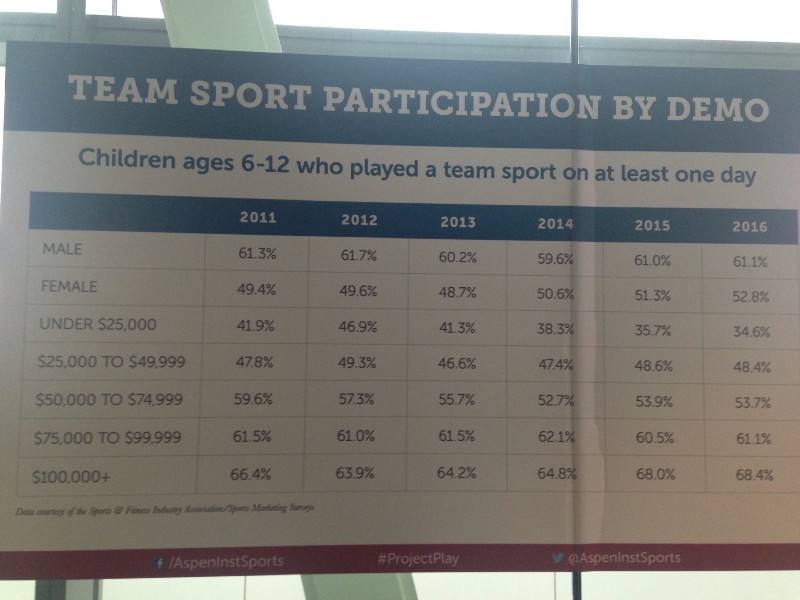
They’re right, and yet there’s something else at play here. See the picture here?
Whose kids are getting out and playing sports? Right. The rich folks.
“Wait a minute,” you might think. “These are the people who can afford college for their kids, and their kids will generally have a sound financial and educational foundation from which they can pursue a multitude of careers. Why would they be caught up in a chase for scholarships?”
Here’s a twist that has stuck into my head since joining the parenting community (otherwise known as “having kids,” which makes you pay more attention to such things): It’s not necessarily about the scholarship. It’s about getting into one’s chosen college in the first place.
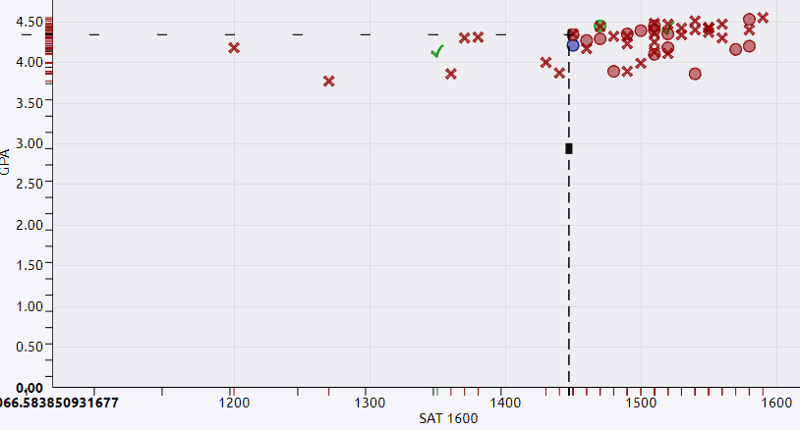
That’s not new. I have a story about puzzling college admissions from my high school, and I’m sure everyone else does, too. But in this technological age, we now get semi-private websites with scattergrams that show us the GPAs and SATs of people who get into School X or School Y. It’s not difficult to spot the athletes.
Division 3 school (no athletic scholarships). Maybe it was a really good essay?
I’ll have to toss in the disclaimer here: I seriously doubt any of my kids will be recruited college athletes. I blame their U-8 soccer coach. Which would be me.
But the point here is this: Sports are seen, with considerable justification, as a way of getting into a good school. Little wonder the Ivy League schools, which don’t offer athletic scholarships, more than hold their own in terms of overall sports performance.
We can argue about whether this emphasis on sports is a good thing for U.S. academic life. The question here: Is it good for sports?
The positives: American colleges promote healthy lifestyles. They build nice facilities for the general student body as well as the student-athletes. It’s the old Greek ideal — classroom in the morning, gymnasium in the afternoon.
The negatives: Youth sports are no longer about the love of the game. They’re about getting ahead and making sure you’re part of the elite. If you’re not, there’s no place for you.
And when you squeeze a sport at the grass roots, it can hurt the elite levels — especially in soccer, where the big problem we all see is a lack of access for lower-income families. No one becomes an elite player if they never have the opportunity to play.
So would we be better off — at the recreational level and the elite level — if youth players could just play without worrying about how their game will affect their chances of getting into Duke, Virginia, Princeton or a good D3 school?
The podcast starts this week with a bit of a political rant. The news on DACA is hard to ignore, and we’ve had some ongoing overheated arguments in the soccer community.
The Travis Clark interview on the Development Academy starts around the 9:25 mark. A few landmarks:
Will the NWSL affiliates dominate? (19:45)
DA vs. high school (25:00)
Can we tame the chaos and still have multiple development pathways? (30:30)
Kris Ward has done a bit of everything in coaching at a relatively young age — high school, Development Academy, ODP, college, traditional clubs and NWSL. We talk about rec soccer, how the U.S. academy approach compares with other countries and what a curriculum really means.
Around the 40:30 mark, get ready for a detailed breakdown of all that isn’t working in U.S. women’s soccer.
There’s just a lot of anger in the world right now.
Our president took a break from Twitter ranting to issue the most controversial presidential pardon since Gerald Ford fell on his sword for Richard Nixon, paving the way for a peanut farmer from Georgia to become president and then a truly outstanding ex-president. North Korea, apparently angry about being pushed off the front page by U.S. domestic shenanigans and a hurricane (and a preposterous fight), flung a few more missiles into the sea, which raises the question of how many North Koreans live in dangerous poverty while Kim Jong Un bombs the whales.
And in the ever-argumentative women’s soccer community, Backline Soccer had to deal with online threats after some woker-than-thou “fantasy” writer discovered an old op-ed about Jaelene Hinkle and deemed the entire staff homophobic, which would come as a great surprise to those who know the staff. (Should someone tell him about Orson Scott Card, who actually does work to deny gay rights and about whom he has said nothing on his site?)
So given all that, perhaps it’s little surprise that the Spirit-Red Stars game, which Chicago desperately needed to halt a skid out of the playoff positions, was a little on the aggressive side. The Red Stars, bringing a talented team against a makeshift Spirit backline, finished the first half with 11 fouls and one shot on goal. (Yes, one. Opta gave Washington keeper DiDi Haracic credit for a save when she pounced on a loose ball in a scramble.)
From the pressbox, it all seemed a little cynical. Time after time, a Chicago player would extend the arms on a shove while the ball was in the air, then turn to the ref in disbelief when the whistle blew.
But most of the physical play was rough but legal. The ref, like nearly every other ref we’ve seen in the NWSL this season, could’ve given out more yellow cards, but give him credit for calling the fouls.
And it worked. The Spirit players were rattled. Tori Huster, the Spirit’s most-fouled player, had a bad giveaway or two after hearing nearby footsteps from Julie Ertz or Kristie Mewis or Danielle Colaprico or anyone else who had knocked her around in the game. (The pressbox consensus seems to be that at least one foul attributed to Mewis actually belonged to Ertz.) Huster participated in a team-high 18 “duels” and only won six of them, a very un-Huster-like performance.
The Red Stars’ goals were the result of good old-fashioned hustle, with Colaprico keeping a ball alive to set up the recently traded Mewis for a goal against her old team and Christen Press finally beating the Spirit’s high line before rounding the keeper. But they were finished well. Things didn’t work for Mewis in Washington for whatever reason, but she can play.
It was a strange night in general. The medical crew carrying injured Spirit forward Arielle Ship off the field took the long way around and was nearly hit by a ball going out of play. (At least Ship was able to go past the Spirit Squadron, which roared for her and got a thumbs-up from the weeping Ship.) The fourth official decided it was cold (a surprise to the announcers who said it was hot and humid) and donned a black long-sleeve top, blending in with the game staff at the middle of the field.
Chicago coach Rory Dames started the postgame inquiries by repeating the first question he was asked.
“Thoughts on the game — it was pretty ugly at times,” Dames said with the expression of a dog that expected a piece of chicken but got tofu. “I would say that with the way they play — they’re very direct out of their end, and they try to get up into your end and press you, and they try to combine with their front players in your end. So there was no reason for us to try to play through their pressure, and nobody the last five games has tried to play through our pressure, so it was always going to be a first-ball, second-ball, ball winning-contest kind of game.”
He didn’t seem too frustrated with the Red Stars’ losing streak heading into the game. Neither did Ertz.
“I don’t think it was necessarily wrought-out frustrations in there,” Ertz said. “We really wanted to win, we really wanted three points. I think everyone does, but especially for us, the points these last few games really do matter for going to the playoffs or not. We wanted to make sure we won our tackles — first ball, second ball, that was a big thing for us — and when that’s your main focus, I think it does become a more aggressive game.”
And yes, the points matter more for Chicago at this point than they do for the Spirit, which was mathematically eliminated from playoff contention but was never really in it this season. In the long run, the Spirit would be better off losing and improving their draft position to make sure they get hometown hero Andi Sullivan, though possible league expansion could throw a wrinkle in that. My guess is that the Spirit will package the pick it received for Mewis with another pick and maybe a player to make sure Sullivan is at the SoccerPlex next season. Let’s be clear — they’re not tanking. They were pushing hard until the last second, spurred by Mallory Pugh, who grew into the game and played some actual soccer amidst the rugby/Aussie rules contest occupying much of the field.
Let’s also be fair to the Red Stars, always a class organization. They figured a choppy game would suit them and they’d be able to go Route 1 to Christen Press at some point. A better team than the Spirit would’ve punished them. A better ref would’ve showed some cards and put a stop to the midfield shenanigans.
Fans got their money’s worth. The weather was nice. The Spirit Squadron was in fine voice. The concession lines seemed to move at a decent speed. And Pugh and Press showed their national-team skills in flashes. They’ll see better games at some point.
The strange, surly night had a perfect capper. Throughout the week, Twitter was been abuzz with the possibility of Stephanie Labbe’s dog, Rio, going out on the field for National Dog Day. I was hoping to meet Rio because I’m a little silly about dogs. One thing I love about my house and my neighborhood is that I can sit in my living room or my bedroom and see dogs walking down the sidewalks. At my elementary school, I earned the nickname “The Dog Whisperer” when I wrangled a dog out of traffic, and all the dogs that turn out at departure time love me.
I met Rio on the way to the postgame interviews. He growled and barked at me. Before you think it’s just me, he did the same to Kevin Parker, one of the nicest guys on the planet.
So, yeah. It was that kind of night. It’s been that kind of week.



 Duresport.com