pro soccer, us soccer, youth soccer

Soccer Parenting Summit: We need joy and collaboration … and maybe pro/rel

One of the earliest Ranting Soccer Dad podcast guests was Skye Eddy Bruce, who played overseas back before pro women’s soccer was widespread and has gone on to coach and, most importantly for all of us, formed the Soccer Parenting Association. (If I were branding it, I might have called it “Polite Soccer Mom,” but her name gets to the point pretty well.)

This weekend, she hosted the Soccer Parenting Summit, which included a staggering 21 guests from diverse backgrounds — current and former pro players, coaches, soccer executives and academics.

It’s a lot to take in. I’ve made it through more than half the sessions, and I plan to go back to listen to a couple more topics.

I say “made it through” not because it’s some sort of ordeal to listen to all of this. These are great discussions. It’s just that it’s a lot to digest, like an all-you-can-eat barbecue buffet. You might need to pace yourself.

At some point, I’ll revisit these sessions. But here are a few takeaways I discussed on Wednesday’s pod:

Where’s the JOY?! (16:30) 

Julie Foudy was the first guest at the Summit, and this was her question as a soccer parent. Bruce brought it up again with many of the guests, and one session was devoted to discussing “fun” with a sports scientist:

(Before you write off this Summit as something stuck in a “rec mentality,” bear in mind there’s a session with Gary Kleiban, the coaching guru who frequently laments such a mindset. We’ll get to it. His session was a good conversation-starter, along with many of the other sessions here. And another session that stressed “fun,” “laughter” and “not shutting out players there for social and recreational reasons” was the session with Johan Cruyff’s son-in-law. Read on.)

“Joy” shouldn’t be controversial, but in the echo chamber of Soccer Twitter, it sometimes is. Soccer is supposed to be a deadly serious pathway for kids to get out of poverty and make something of themselves. I find that more than a little condescending. If we want people to get out of poverty, we need to be investing in STEM programs, not soccer. We have hundreds or thousands of wanna-be soccer pros for every current soccer pro. The supply of U.S. tech talent is debated in the immigration context (in other words: Do we really need to be granting tons of visa to fill open programming jobs?), but the bottom line is that your odds of finding a job as a hard-working dedicated programmer or network specialist are just a bit better than finding a job as a soccer pro. A bit. Say, a few thousandfold.

And in any case — if having a booming economy means we have fewer poor kids who see sports as the only way out, that’s a trade I’m more than willing to make. Besides, the way things are going, the much-derided habit of sitting around playing video games will soon be a better pathway to pro “sports” fame and fortune than soccer is.

So economic incentives aren’t enough. You need to make 6-year-olds fall in love with the game.

John O’Sullivan, of the Changing the Game Project, sees no contradiction between loving the sport and chasing excellence in it. “Find me an elite athlete, and I’ll find you someone who loves what they’re doing,” he said.

Play multiple sports (19:20) 

Oh, you don’t want to take my word for it or O’Sullivan’s word for it or any stack of academic papers you can find? How about Jay DeMerit, who believes his rise from obscurity to the Premier League would not have been possible had he not played basketball. He hadn’t played much defense on a soccer field before college, but he found that the ball-hawking he did on the basketball court helped him adjust to the role that put him on the national team and at the highest levels of the game.

DeMerit has been doing some coaching at the elite youth level, and he’s borrowing techniques from improv. Yes, improv. Comedy. Drew Carey’s influence knows no bounds.

(You could also ask Costa Rican Paulo Wanchope, who scored 50 goals in the EPL. Yes, 50.)

On a more basic level, a lot of learned folks believe we’re so obsessed with sports specialization that we’re failing to teach basic athletic movement. “You’re building an athletic foundation in sand, and eventually, it’s going to crumble,” he said.

I know. This is heresy. The philosophy du jour says soccer is all about skill, like golf or music. We’ll repeat the 10,000-hour myth even after David Epstein’s research blew it up, at least as it applies to most sports. We Americans are the only ones who think it’s athletic. Just look at Xavi or Iniesta!

OK, I’ve looked at Xavi and Iniesta. They’re not Usain Bolt or Kevin Durant. But they’re athletes. On the podcast, I tell a story about Messi’s athleticism playing a vital role in a terrific goal. (Counterargument: Freddy Adu had plenty of skill but not a lot of speed and strength.)

Sure, the USA has typically had more athleticism than skill. “Shot putters,” they said of the 1930 World Cup semifinalists. Anson Dorrance built his North Carolina dynasty and the U.S. women’s program on athleticism and determination, though he has since brought in wonderfully skilled players like Crystal Dunn, Tobin Heath and Summit guest Yael Averbuch.

But are we overcorrecting on the skill/athleticism scale? Probably. I’ve seen plenty of signs of this, particularly a terrific NSCAA session on “Kindersoccer” that showed how counterproductive it was to coach a U6 team like they’re teenagers at Barcelona.

Winning vs. development (or Players First vs. Team First) (26:30) 

US Club Soccer’s Kevin Payne, another RSD podcast guest (I’ve piled up the audio players at the bottom of this post), joined the Summit and talked about his organization’s Players First initiative, which will soon be morphing into a program that certifies clubs. Meet the criteria (and work with US Club to do so), and your club can be a “Players First” club. That includes some criteria dealing with safety, something we don’t often talk about but was mentioned a few times at the Summit.

The basic idea is that the focus needs to be on player development, not winning as a team. I get it, but I have some misgivings. The vast majority of players who play youth soccer will not have a professional career. They’re in it for fun and life lessons — chief among them, playing as a team.

“Winning vs. development” is another area in which I wonder if we’re overcorrecting. Sure, we’ve all seen examples of coaches with misplaced priorities — my least favorite was the guy whose U9 team was still pressing the terrified defenders on goal kicks when his team was up by 15-20 goals, and managing playing time should be a bit different for a U12 team that it would be for a pro team. But the lesson we’re trying to teach, whether a player is going to play professionally or go on to something a little less interesting, is working as a team to overcome adversity.

But Payne and Bruce were careful not to say teams shouldn’t be trying to win. Payne says Barcelona’s academy teams are always trying to win. (I did have a chance to see a Barca academy game on TV while I was in the city last month — they certainly seemed happy to take the lead.) Bruce mentioned that her daughter played with far more intensity for her high school team than she saw in the ECNL.

We’re also sending mixed messages here. US Club can preach “Players First.” Then they set up their own leagues and their own State Cup competitions. Why?

Pay-to-play (31:00) 

One session indirectly talked about pay-to-play, and that’s the Anthony DiCicco session on artificial turf. He has worked in the industry and sees progress being made to get turf — a “necessary evil” for those of us in the youth game who would rather practice on something other than gravelly dirt — a lot better, more shock-absorbent, less prone to heating up like a rubbery frying pan. Maybe even with fewer black pellets in your clothes, car, house, etc. But it’ll cost you. We’re talking about fields that are more expensive to install and maintain, and someone has to pay for that.

For a more typical talk on soccer costs, check the session with Payne. Bruce asked: If we can’t eliminate pay to play, can we at least pay less? Payne sees the issue as the race to get in front of college coaches. There’s an unspoken contract, he says, in which a coach will try to get a player into Duke. (Yes, he said Duke. I’m not sure why he picked my alma mater, though the women’s team just had an awesome season and the men finally made it back to the tournament.) Maybe it’s not Duke, maybe it’s not Division 1, but maybe it’s admission to a good school in Division 3. So parents think that if they go to a lot of tournaments, they’ll get in front of a lot of college coaches.

I posted this thought elsewhere: Way back in 1980, everyone knew the best high school football player was a kid from a tiny Georgia school named Herschel Walker. There was no Internet. No sophisticated recruiting systems. But everyone knew how good this guy was. Then he had what is still widely regarded as the best college football career by any running back. Pretty decent pro, too, aside from Donald Trump’s influence and his unfortunate role in a trade that posited him as Superman.

So why can’t we do that in soccer? Why are we asking players to travel to be seen by scouts and coaches? (One of the more intriguing, if possibly unrealistic, ideas in the USSF presidential race comes from Paul Caligiuri, who posits college and high school coaches as part of a giant network of scouts.)

Regardless, no matter what the next U.S. Soccer president is able to achieve in cutting back youth soccer costs, there’s one thing he or she won’t be able to control:

Parents. Parents who want their kids to go to Duke or some other good school that happens to have a soccer team. Parents who will pay good money for their kid to get the “right” coach or the “right” club or the “right” set of tournaments.

Until Skye Eddy Bruce and I (and a bunch of other people) figure out how to educate parents to make better choices.

Topics I didn’t cover on the podcast …

The USSF election matters

Payne ran for vice president two years ago, when Carlos Cordeiro won it. His buzzword is inclusion. He doesn’t believe in a top-down approach — not even at D.C. United, where he said everyone had a voice and they did a lot of things by consensus. USSF hasn’t been doing that on things like the Player Development Initiatives. (Just ask me or any other parent pissed off about the age-group changes.)

Should USSF pay the president? Payne is torn. Yes, that might encourage more people to run (though, given the NINE candidates this year, perhaps that’s not an issue). But would people run just to get paid? (My thought: Maybe don’t pay them that much?) He has advised candidates not to talk about it during the election, but I think that’s unavoidable. You’re going to have people asking about it. People like me. Sorry. I have to.

DiCicco, who wrote the definitive guide to who votes, did a short Summit session on the election, and he offered a good response to Bruce’s fretting over the existence of independent directors who don’t have soccer backgrounds (something you’re seeing from a lot of other boards as well): The Board have a couple of valuable voices in Val Ackerman (a hyperexperienced sports executive) and Donna Shalala, pointing out especially Shalala’s background with health issues from her time in the Clinton cabinet. DiCicco also hits upon the fact that most of the women on the Board are independent directors — what he doesn’t go on to expound upon is that the Board has used independent director slots to bring aboard Hispanics and women.

And DiCicco sums up Sunil Gulati’s tenure, making a point that especially interesting in the wake of today’s Jeff Carlisle report that the Board is talking about hiring a general manager and thereby limiting the president’s influence: “We’ve benefited from Sunil taking it 24/7, but it doesn’t have to be done that way,” DiCicco said.

Payne also would go along with less of a top-down approach, saying the D.C. United teams that were so successful in his time did a lot of things by consensus, giving everyone a voice.

Along those lines …

Teach your parents well 

Several speakers fretted over a lack of communication between coaches and parents. While Bruce has been working to get parents to talk with coaches at appropriate times, no one’s advocating yelling from the sideline. Learn more, then talk more.

“Silent Saturday” (or Sunday) — a special day many clubs (including mine) use to tell parents to do nothing but the occasional polite cheer or clap — got mixed reviews. United Soccer Coaches staffer Ian Barker thinks it impacts the wrong people. 

Teach your coaches well

Coaching education is a big emphasis for Payne and US Club. They might do it a bit differently than other organizations, just as AYSO has its own curriculum. What Payne wants from U.S. Soccer is a set of guidelines, not something more specific than that.

And US Club, like USSF, is starting to put more information online. Good.

Also one novel idea from Barker: Sure, we should still pay coaches (a point Kleiban also made), but maybe coaches could do 4-8 hours of volunteer work every month to reach players outside the expensive clubs. (I’m sure some already do that, but it’d be interesting to see it become a movement.)

This is also where Bruce brought in some people whose resumes are impeccable. Frank Tschan spent 15 years working with the German federation. Todd Beane is an educator who went to work at Barcelona and married Johan Cruyff’s daughter, so it’s fair to say his family dinner-table soccer discussion was a bit more advanced than most of ours.

One bit of consensus here: A bit of national guidance is good, but you can’t be too overbearing about it. Tschan points out the difference between states — some rural areas can’t really get on the “club-centric” bandwagon because their clubs are too small, and they need other programs.

Finally: Promotion/relegation

I had some trepidation when I saw Gary Kleiban’s name on the list of guests for the Summit, but I decided to listen to his session in the hopes that a conversation with the affable Bruce would be more constructive than the typical Twitter interaction with him. And it was.

But while the conversation was friendlier, the points weren’t any sounder. A few stereotypes of people who refuse to see things his way — a claim that MLS owners came from other sports (some yes, some no, and some of today’s owners also own clubs elsewhere in the world), and a finger pointed at the mainstream media that stands in the way.

I don’t know if I qualify as “mainstream” these days, but I’ve been coming up with pro/rel ideas for years. The reason I’ve been the punching bag for the Twitter fringe is that I think it’s impractical, to put it mildly, to simply throw open the pyramid and let the chips fall where they may. Actually, Kleiban sounded conciliatory on that front as well, suggesting there could be a transitional time so MLS owners can adjust. (I’d add that it would really stink if the Los Angeles Galaxy were relegated after a wayward season in which they were trying to get their once-hyped young players into the mix.)

My thoughts, which I’m now giving the hashtag #ModProRelforUSA, have only been strengthened by speaking with Bobby Warshaw and Brian Dunseth. More importantly for purposes of this Summit, I’m far less worried about the effects relegation would have on MLS/NASL/USL owners and far more concerned about the effects it would have on their academies. 

In short — if the goal is to have a couple hundred pro academies scattered throughout the country, why would you relegate their clubs to a level at which the academy is no longer sustainable? If it happens in England, why wouldn’t it happen here, leaving kids with no academy for hundreds of miles around?

DeMerit also touted the argument that pro/rel ramps up the pressure on players, something I’ve discussed several times recently. But he went on to cite another motivating factor — bonuses. Start, get more money. Win, get more money. Fine. But that has nothing to do with pro/rel. (A salary cap, maybe — that’s an issue for the next CBA.)

In any case, I said more about pro/rel in a reply to Kleiban’s session. With that, I’ll give it a rest. It’s Christmas. And we have an election coming up in which the issues farther up this page are far more important than whether D.C. United gets relegated in 2021.


podcast, us soccer, women's soccer, youth soccer

RSD21: U.S. Soccer presidential candidate Eric Wynalda

Eric Wynalda has played in multiple World Cups, Germany, MLS, etc. He’s been a successful coach and commentator.

Yes, we talk about promotion/relegation. In fact, we did it first just so you single-issue types can listen and then bail out. If you want to hear about EVERY issue facing the next USSF president — well, we got to maybe half of them. There are lot of issues. In rough order, we talk about:

1. What’s different or similar between the concerns of the Twitterati and the concerns of the typical state or national association.

2. Whether people are nervous to speak up about the USSF power structure.

3. Women’s soccer: The new collective bargaining agreement and the NWSL.

4. Youth soccer: Has the federation done too little? Too much?

us soccer, youth soccer

U.S. Club Soccer forum: Caligiuri, Gans punch sacred cows — and who should drop out?

The first U.S. Soccer presidential forum, hosted by GotSoccer, was a bit like a League of Women Voters political gathering, designed to cover a broad range of topics.

The second forum was hosted by and for — and to some extent, about — US Club Soccer. There’s nothing inherently wrong with that. Their votes carry a lot of weight in this election. They certainly have the clout to bring in all these candidates for a discussion, and they provided a valuable public service by putting the audio online. (The photo in that link confirms what we hear around the 51-minute mark — someone opening a can of Coke.) And there’s certainly nothing wrong with a conversation focused on youth soccer, as much as some people want to hear about the national teams, promotion/relegation and so forth.

Five candidates were there. Carlos Cordeiro was not, and we’ll get to him. Paul Lapointe was not, and that’s a bit contentious. There are two sides to this story. Lapointe told his on Twitter. US Club told me by phone. Here’s how it breaks down:

Start with the press release: “Invited were announced candidates that had personally contacted US Club Soccer to initiate a discussion about U.S. Soccer and their respective candidacies.”

Lapointe insists that he did.

The response I received: All Lapointe sent us was a form letter.

I’ve seen what Lapointe sent. It appears to be a form letter addressed to “Dear USA member,” with bio and platform info attached. So how much should he be penalized for not personalizing that introduction?

US Club did issue a late invitation — a few hours before the forum — for Lapointe to join in. He could not do so on such short notice. And frankly, it may not have been worth his while. He’s not going to be getting a nomination letter from US Club, which had nominated someone but then rescinded that nomination under the late addition to the election procedures that allows an organization to rescind its nomination and yes, I’m getting a headache writing this sentence.

(Incidentally, I obtained a list of organizations that have nominated someone earlier this week. I was working toward publishing it today, and then a new list was posted. Multiple organizations did indeed rescind nominations before the deadline. Maybe later this week, I can get that list posted, but it doesn’t say who nominated whom.)

In any case, he has agreed to be on the RSD podcast in the very near future, so if you want to hear him talk about the issues, come back right here next week. As I said earlier today — he might not be the frontrunner, but he deserves to be heard.

In fact, let’s ask …

Beyond the dispute over times and emails is a larger, more pertinent question: What should an organization demand of USSF candidates? I mentioned on Twitter that US Club came across as if they were expecting candidates to “kiss their ring.” Maybe that’s too harsh. A primary purpose of this forum was to determine how US Club will cast its votes. If I’m advising US Club from a PR point of view, I tell them to invite everyone just to avoid coming across as arrogant — a look everyone wants to avoid when the primary issue in this election is whether U.S. Soccer itself is prone to hubris. But I might be more sensitive to such things than most.

So anyway, what happened at the forum?

If you’ve been following this election closely (or if you’ve listened to the RSD podcast interviews with Kyle Martino, Mike Winograd and Steve Gans — more interviews are on the way), you’ve heard most of this before. All of the candidates think U.S. Soccer has been too heavy-handed and too unresponsive to its members. They have their own ways of saying it — Winograd says USSF shouldn’t be dictating things from Chicago, to which Eric Wynalda amiably retorted that it’s actually from an apartment in New York (where incumbent Sunil Gulati lives).

And all the candidates agree coaching education is far too expensive. Martino pointed out the A and B licenses are only offered at a few specific sites, so coaches have to pay for travel as well.

This forum said little specifically about women’s soccer aside from Winograd’s point that using comparative revenues to justify unequal pay for the MNT and WNT is a misreading of U.S. Soccer’s mission, but we need to remember something here — when we’re talking about youth soccer, we are talking about women’s soccer. A lot of the issues — access, diversity, costs, etc. — are the same for boys and girls. Not all of them, of course, and Paul Caligiuri noted the absence of girls from the Development Academy for its first decade.

But is the DA a good thing? This is where Caligiuri stood out, pointing to the U.S. men’s record before and after the formation of the DA. Spoiler alert — it was better before the DA, back when the USA qualified for World Cups and Olympics. Meanwhile, the U.S. women have been doing OK without a DA. He wants to reorganize to bring the DA, ODP and id2 together. ODP is the old-school player ID-and-training system; id2 is US Club’s answer.

So that’s one hot take. Another came from Gans, who lamented the fact that many states (including his — Massachusetts — and mine — Virginia) now have two State Cups. That is, of course, a result of US Club Soccer starting its own. You have to wonder if the US Club members will take kindly to such a statement or whether it’ll be like my interview for a college scholarship, in which I told a room full of stock brokers I thought Selective Service was unconstitutional. (No, I didn’t get the scholarship.)

Meanwhile, Cordeiro’s absence is being played off as no big deal. I’m not sure that’s right. We’ve had two forums, and he has missed both of them. That might be understandable for Gans and Winograd, who have jobs and shouldn’t be expected to pop up at a random site, especially on a weekday. But Cordeiro’s retired. And if he doesn’t have time for these forums, perhaps he doesn’t have time to be president. (He is, like every other candidate, invited to appear on the podcast.)

And there’s one more candidate who should announce, immediately, that he is not running.

He’s Sunil Gulati.

It’s not about Gulati’s record at this point or whether he’s the right man to continue to serve at this pivotal time. He had every right to make the case.

But now it’s simply too late. Delaying his announcement has left many organizations in limbo as they decide what to do with this newfound power to nominate a candidate. (Previous elections took nominations from the floor of the meeting. Everything about this election is new.)

And while he has been absent, the call for change has gained momentum. It’s a polite call for change, with many kind words about what Gulati has done to help turn around U.S. Soccer from a small federation in red ink to a giant organization awash in sponsorships and infrastructure investments. But it’s loud and clear. The time to stop it has long since passed.

So which candidate will lead that change? I don’t know. It’s going to take a lot more discussion to discern the right choice. Then we’ll see if the voters agree.


pro soccer, youth soccer

I have many questions …

… and not enough time to ask them of all the people who need to answer them.

I’ll try to pester people before Thanksgiving. But if anyone wants to go ahead and ask, go ahead.

MLS/COLUMBUS CREW 

  1. If Precourt takes his team or his ownership position or whatever you call it to Austin, then does Columbus immediately jump into the expansion fray as San Jose did when the Earthquakes moved? Columbus already has a stadium, so if they can raise the expansion fee, do they get a “new” Crew?
  2. Is MLS planning to do anything to appease angry fans across the country who are saying they’re less likely to support their local teams because a city can have a solid fan base and a stadium and still move? What assurances will you give them that you’re not just going to let their owners pack up and move somewhere?
  3. Did the Columbus powers-that-be really cut off future conversations, as PSV claimed? If not, why have we not heard a loud denunciation of that claim?
  4. Why should any municipality pledge money, even just for infrastructure, to build a stadium for an MLS club when that’s clearly not enough to guarantee the club’s future?

NWSL OWNERS 

  1. Why don’t you have a commissioner, eight months after Jeff Plush stepped down?

REFEREES

  1. When are you going to start calling more fouls, from the pro level down to Under-9, so that U.S. players will develop skills instead of just beating the crap out of each other?

MEDIA

  1. When are we going to quit exalting players who beat the crap out of each other?

U.S. SOCCER

  1. Are you working on a solution to the training compensation / solidarity payment issue that you think you would survive a court challenge from the MLS Players Union or whomever else, or are you waiting for the Court of Arbitration for Sport to weigh in?
  2. Why did the women’s national team have to play on bad turf in New Orleans?

FIFA 

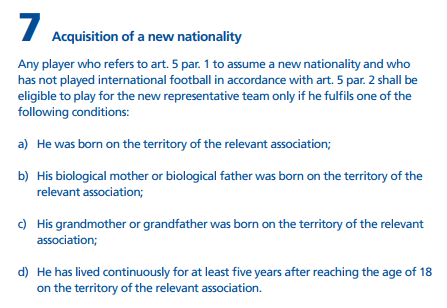
  1. What in the world does “continuously” mean here? Shouldn’t citizenship be part of the criteria? And what’s up with efforts to update this?

fifa-nationality

U.S. SOCCER VOTERS 

  1. Why are you ducking my emails?

I’m sure there’s more, but let’s start with that.

pro soccer, youth soccer

Fact/reality-checking the GotSoccer U.S. Soccer presidential forum

No, I’m not going to fact-check every sentence. I’m relatively sure Paul Caligiuri and Eric Wynalda played in Germany.

I’m also not going to try to transcribe the whole thing, though I did find myself summing up pretty much everything. You can find all that at the bottom of this post. The summary of the summary — basically, the most extraordinary things I noticed — is at the top.

And a quick reminder: While transparency could be improved in many aspects of U.S. Soccer, there is a considerable amount of information on its governance page, including bylaws, the policy manual, and (part) of the election procedures.

So here are the surprising/dubious things, then the whole thing.

Disclaimer up front: While this is a fact/reality check steeped in appropriate journalistic skepticism, these people all seem like the sort of person we’d love to see involved with U.S. Soccer. Only one can be president, but I hope the others find a role.

SURPRISING/DUBIOUS THINGS

Paul Caligiuri tossed out the astounding estimate that more than 500,000 kids in Southern California are not part of U.S. Soccer because of pay-to-play. We know he’s not just talking about travel soccer because he suggests a possible solution of “Friday night soccer” pickup games. Seems staggering to suggest 500,000 kids are being missed by every program, particularly the hundreds of clubs with recreational programs that are cheap and usually offer financial aid.

The ever-popular promotion/relegation discussion drew some reasonable takes and some off-the-wall takes. Caligiuri somehow segued into youth futsal. Paul Lapointe suggested piloting pro/rel in top amateur leagues including his own, the UPSL, but most elite amateur leagues have had pro/rel for generations. (And my indoor league. I didn’t get those two championship T-shirts by winning the Upper Division.)

I have a belated follow-up for Mike Winograd about his plan to have a USSF training center in each state. How does this complement the requirement for each state association to have a director of coaching with an A license?

Several candidates imply U.S. Soccer isn’t doing things it most definitely is — overseeing futsal, hiring independent auditors and governance reviewers, etc.

THE WHOLE THING

Joe Cummings, himself a rather good candidate if he had so chosen, moderates the forum and kicks things off at the 11:15 mark of this video:

I’ll continue to give timestamps throughout, and I’ll give the order in which each candidate answers so you can go through and find specific comments. The format is formal, and candidates answer each question in a different, pre-assigned order. Each candidate gets two minutes for the intro and their answers to specific questions, then four minutes for a closing.

Take a moment to applaud GotSoccer and Cummings here — this is done very well.

My comments are in italic.

INTRO (13:30)

Cummings first explains the absentees: Carlos Cordeiro is at a CONCACAF meeting, Sunil Gulati (not yet announced his bid for re-election) is away on U.S. Soccer business (?!!!), and Kyle Martino had vacation plans before he announced his bid. (We’ll hear from Martino soon enough.)

Frankly, it seems clear that Gulati has no interest in appearing alongside other candidates. That might be why he has delayed announcing his intent to run for a final term under USSF’s new term-limit bylaws. He is appearing at functions as the USSF president, not as a candidate.

Or maybe he’s not running.

The order: Lapointe, Caligiuri, Gans, Wynalda, Winograd.

Noteworthy:

  • Caligiuri went rogue. The intros weren’t supposed to be about the issues, but that’s he discusses. He actually gives more of a personal intro in some of his answers. But he does state here that he was a USSF board member, which I’d forgotten because it wasn’t recent. He served from 2005 to 2007, during which time the board was reduced from 40 to 15. (That may seem sinister to some, but other sports federations have been doing the same thing under guidance/direction from the U.S. Olympic Committee.) 
  • Three candidates — Lapointe, Gans and Winograd — played professional indoor soccer at some point, a bit ironic given that the indoor game isn’t affiliated with USSF right now.


QUESTION 1: Actually two questions — why do you want to be president, and what’s your position on whether the president should be paid? (23:30)

Noteworthy:

  • Winograd, not for the first or last time, says he is not a “burn it all down” guy.
  • Caligiuri makes the first of many references to his DNA.
  • Gans twice says he has “graciously declined” to run for president in the past.
  • Most candidates don’t give direct answers on paying the president. Winograd says he wouldn’t want to be paid but thinks the next president (not him) should be paid to broaden the pool of qualified candidates. Wynalda sees an advantage to paying the president to make that person more accountable. Gans sees an issue with nonprofit law but doesn’t have time to explain it in full.

Fact/reality check:

Lapointe doesn’t care whether president is paid but thinks it should become a full-time position. This is an interesting point that deserves a bit more attention. One criticism of Sunil Gulati has been that he’s too involved with every phase of the game, and that he should let staff and other board members handle their jobs. Lapointe is going the other direction.

QUESTION 2: What are your thoughts on pay-to-play? (33:30)

Noteworthy:

  • There’s some discussion here of applying the USSF surplus, but Gans notes that an upcoming question covers that in more detail.

Fact/reality check, in order:

Caligiuri worries that pay-to-play excludes many players. He says “perhaps millions,” then says by his estimate, more than 500,000 kids in Southern California are not part of U.S. Soccer because of pay-to-play.  That’s an extraordinary claim. It doesn’t seem verifiable, and I wonder what he means by that. Are there really 500,000 kids who aren’t playing for USSF clubs at all, not even on the generally affordable rec level? He further confuses it by suggesting one answer could be “Friday night soccer” — basically, supervised pickup games. Does Southern California really have 500,000 kids who have no access to anything like this?

Wynalda is paying about $3,300 a year for his 8-year-old. He concludes that it’s too much. For his older daughter, farther up the ladder, he has to pay more. By the time it’s done, people pay more on soccer than they could possibly get back in a college scholarship. That’s certainly true. 

Winograd laments the fact that someone finishing up a college career has to spend $1,000 or so to get coaching licenses. Not sure which licenses he means here — the early licenses generally cost less (unless you have to travel), the late licenses generally cost more. Take “$1,000” as a very rough estimate of preliminary costs.

Lapointe says no one’s going to be able to tell independent clubs that they can no longer charge their players. We’ll rate that “true.” He then says he’s the only candidate talking about inner cities and futsal. We’ll rate that “false.” Winograd had just mentioned programs like that. He wants to stop the poaching of players for free, where another club sells a family the Kool-Aid to convince a kid to switch. He wants payments for that.

Gans jokes that all the answers have been made. He agrees with everyone. He says clubs need to be reined in a bit with “Good Housekeeping standards.” We’ve seen some attempts to create club standards, but they’re neither widely known nor universal, so his point is valid.

QUESTION 3: What’s your view on promotion/relegation? (44:30)

Noteworthy:

  • Lapointe works in the UPSL. Caligiuri coaches in it.

Fact/reality check in order:

Lapointe is the big pro/rel champion here. But it’s hard to conclude that he understands the issue. He starts out saying this has been a big issue for months now, which may surprise the people who’ve been talking about it for years. He says it has not been in our culture, which isn’t really true — amateur leagues have done it as long as I know. He works in the UPSL and touts their pro/rel stance as a fresh start — again, I don’t know that it is. He wants to test pro/rel in UPSL, NPSL, PDL and state organizations — again, a lot of leagues already have it. The USASA lists 13 “elite amateur leagues” — including the UPSL — some of them a century old. At least half of them have pro/rel.

Caligiuri talks about his experience in Germany with teams that went up and down. He mentions the excitement it brings fans and the pressure it brings players. I’ve argued many times before, based in part on conversations with Scandinavian soccer veterans like Brian Dunseth and Bobby Warshaw — pressure depends on the soccer culture, not simply pro/rel.

Caligiuri continues with a strange suggestion about futsal for ages 6-12, suggesting that’s a place we could test pro/rel. Traditional youth leagues already have pro/rel, but they don’t do it at younger ages because they want the focus to be on development, and they worry that coaches under relegation pressure will start playing direct at U8. Ontario youth soccer quit keeping scores and standings — a decision I actually argued against on a Canadian radio show a few years ago. Then he talks about doing pro/rel in USASA leagues — which, again, already exists.

Winograd says he’s going to assume we’re talking about the pro ranks. He says it would be exciting, but as a practical matter, “we’re not there yet.” Franchise fees, contracts, etc. He wants to start building it at the lower leagues, and then he touts his alternative plan to have “guest clubs” in the top division in the near-term. I prefer my system, but he’s reality-based on this point, and he goes on to talk about USSF’s power and limitations. USSF shouldn’t be ramming things down people’s throats, he says in conclusion.

Wynalda believes we are ready, and he points to parachute payments and so forth as a way to make sure clubs are better off financially in the long run. Sort of, but when you see English clubs curtailing their academies, you have to wonder if the long-term picture really is better. If I trusted economists, I’d love to see an economic study on that.

Gans says everyone’s watching the last day of the Premier League not to see who wins the league but to see who goes up or down. Is that a feature or a bug? Then he says the passionate promotion/relegation people have made a really good point, which is that players develop more of a cutting edge in pro/rel systems — again, the Warshaw/Dunseth experience and some common sense would say otherwise. Then he offers his own reality check — he remembers the late 80s and early 90s when everything had fallen apart, and given that, he doesn’t think USSF can simply impose it.

QUESTION 4: What do you think of the nomination process, and please explain the election process. (54:45)

Fact/reality check in order:

Gans gets to go first. That might be coincidence, but it’s appropriate. He was the first candidate to declare, so he’s been laying a lot of the groundwork here. If someone other than Gulati or Cordeiro is elected, that candidate owes Gans a debt. He is concerned that he was not given a list of delegates, which he believes should be freely given by a nonprofit. I don’t know enough about applicable law to know whether that’s true, though I can verify that I also asked for that list and was denied. The election procedures call for candidates to receive this list 120 days before the election, then again (because the delegates may change) 60 and 30 days out. He also points out rules have been changing a bit midstream, which is absolutely true.

Winograd sees a lack of clarity and sophistication, and he says his law firm frequently works with companies on their election process. He says he read the bylaws with help from someone at his law firm, a sign that they’re not really clear. He worries about seeing “blocs” form, especially where votes are heavily weighted as on the Athletes Council. (Indeed, I’ve spoken with someone on the Athletes Council who says they do indeed tend to vote as a bloc so their voice isn’t diluted. That said, I have no idea how you change that. USSF can’t change the rules that give athletes 20% of the vote, and I don’t see how you stop them from voting as a bloc.)

Caligiuri says the election rules are against the Roberts Rules of Order. He doesn’t say how. He cites his board experience and says he understands how the councils (Athletes, Pro, Youth, Adult) work. He cites it as a positive that USSF answers to the U.S. Olympic Committee and the Stevens Act, specifically because it mandates athlete representation.

Wynalda says the rules were built as an attempt to represent everybody but that they ended up being built by one man — Sunil Gulati. He’s critical of the process but doesn’t offer much detail.

Lapointe notes he was told two days ago that an association can rescind a nomination — that was indeed recent news. He isn’t happy that he has only three months between his declaration of intent in September and the deadline to present his three (minimum) nominations in December. That’s an odd complaint. Nothing prevented him from declaring his intent as early as Gans did.

All five candidates correctly described the election process itself in varying detail. 

QUESTION 5: What are you going to do with that $100-$150 million surplus? (1:04:45)

Fact/reality check:

Wynalda asks where the money is coming from and gives an astonishingly precise figure — 49% of $94 million is coming from television. Looking at the Form 990 for the year ending March 31, 2015 (not 2016) — there’s a figure of $94.8 million for program service revenue. “Sponsorship and royalties” is $39.7 million of that. In 2016, both numbers increase. I’m not sure where he gets that figure. Then a lot comes from the national teams, and 2018 is going to be an odd year with no major event. He segues into the “registration war” and referees, and I’m not sure I follow. When he visits the podcast, I’ll follow up with him. (You are planning to be on the podcast, right Eric?)

Lapointe says it’s not the Federation’s money — it’s your money (meaning the GotSoccer crowd). “We’re going to give it back to the states and regions,” he says, through coaching education and infrastructure. Then comes a baffling statement: “We don’t have a defined player identification system and a recruiting system thereof.” He wants to allocate those funds to send people out to find players. The USA does have a player identification system — actually, several: the Development Academy, ODP, id2, etc. Does he mean they’re not coordinated?

Gans mentions fields — inner cities, futsal courts, etc. — and pay-to-play. Then opportunities for women — he represented the Boston Breakers at one point.

Winograd says two places: Pay-to-play, not just kids but coaches. Then clearly defining a path to the national team, specifically, training centers in each state — a building with two fields. I should’ve followed up with him on the podcast about this — how does this differ from existing infrastructure? The interesting part is coordination — he wants to have blackout dates for leagues and tournaments, then bring kids into training on those.

Caligiuri wants to keep registration fees with the program that paid them — if you pay $1 to register a youth player, that goes for youth soccer. Same for adult soccer. Then a big proclamation to get all coaches involved: Every high school coach, he says, will be an Olympic Developmental scout. “How many high school players do not participate in your states?” he asks. That surely varies widely by state. In any suburban area, it’s tough to make a high school team if you’re not already on a top travel team. But are we missing some players in rural areas? Frankly, it raises the question of why college coaches aren’t scouting these areas.

QUESTION 6: What would be your plan for the organizational structure of U.S. Soccer? (1:15:15)

Fact/reality check in order:

Gans wonders if the organization is so big that positions need to be split — maybe a general manager of soccer, separate from the CEO. He promises a top-to-bottom review, and as he’s said often, he wants the main office in Chicago to deal more respectfully with the states and other organizations. He’s heard too many stories of disrespect. I’d like to hear some specifics at some point, but does anyone doubt him?

Wynalda cites his dear friend Hank Steinbrecher, the USSF General Secretary through the 1990s, talking about many people arguing for the same thing but opposing each other. He wants to have paid positions to delegate responsibilities (somewhat the opposite of Lapointe).

Caligiuri wants to create a culture. First, fund the Athletes Council and help them understand concerns of other councils. He says this is the only council that isn’t funded. What does this mean? I’m looking into it. And he wants to raise the standards. Second, hire a technical director. Third, look to Silicone Valley. It’s Silicon. (Sorry, pet peeve.) 

Winograd sees serious fracturing — overlapping, competing and unclear structures. He says he couldn’t figure out, as a parent, what team is for what. (On a related note: Watch for the Ranting Soccer Dad Guide to Youth Soccer in 2018.) But there’s no one-size-fits-all solution — same solution in one state may not work in another. We already have reps in each state, he says, which again raises the question of how they would function alongside a USSF center in each state.

Lapointe says he’ll peel back the layers. He’ll want an outside firm to take a look, and he’ll want an outside audit. Both of which have been done, repeatedly, as is evident from board minutes. In fact, an outside review (along with the USOC) is why the board dropped from 40 people to 15. Then, he says, we have to remove conflict of interest, which will peel back the layers. He hints that Dan Flynn’s salary as CEO could be split among a couple of people, but we need to peel back those layers. I don’t mean to harp on this, but I have to say again — it sounds like a lot of the information he’s seeking is readily accessible. In some cases, though, it’s not, and there are some layers to peel back.

Quick check of highest-paid USSF employees for year ending March 31, 2016 (according to the Form 990): 

  • Jurgen Klinsmann, MNT coach: $3,050,813
  • Dan Flynn, CEO: $694,745 
  • Jay Berhalter, CCO: $531,601
  • Andreas Herzog, assistant MNT coach: $398,993
  • Jill Ellis, WNT coach: $306,407
  • Tom King, managing director admin: $300,101
  • Brian Remedi, CAO: $287,329
  • 4 WNT players (Holiday, Klingenberg, Krieger, Heath): $225,450
  • Lisa Levine, legal counsel: $208,095
  • Eric Gleason, CFO: $188,086

QUESTION 7: What would be your process for selecting a men’s national team coach? (1:25:40)

Wynalda says we’re operating under the assumption that the president is the sole selector, which isn’t always true. He says we asked Jurgen Klinsmann to do 3-4 jobs, but the national team coach should do just one — not technical director, not youth development. He thinks we did that with Klinsmann so we could justify his salary. Maybe, but was it also a false belief that Klinsmann would be able to singlehandedly bring Das Reboot to the USA? In any case, he says we need to wait until after the World Cup, then jokes that he skated out of the question.

Gans wants a committee of former players and those involved with the youth game. The latter seems like an awkward reach to the people in the room. Then he talks about the Philadelphia Atoms of the NASL and how their star players took different approaches — some committed, some not. Back to the committee — they would come up with the questions and vetting process, then selection.

Lapointe notes some of the best players in the world aren’t the best coaches or business people. He suggests a director of coaches — “I don’t think there is one in the federation.” The next president, he says, won’t hand-pick the next coach. He wants a coach who leads players into the game rather than just teaching the game. At this level, is a national team coach teaching anything? In the last two World Cup qualifiers, he says, it doesn’t look like the players had leadership and wanted to be there. I’m not going to nit-pick on the second-to-last qualifier, the 4-0 rout over Panama that made us think everything would be OK. The last two qualifiers seared in our memory are the home loss to Costa Rica and … well … the last one.

Caligiuri wonders if it was the national team coach for futsal, beach soccer or the men’s national team, saying we need a coach for all three. Futsal isn’t Keith Tozer any more? He was the coach as of June. And Eddie Soto has been serving as permanent beach soccer coach, though he had to hand the reins to Francis Farberoff for a tournament that conflicted with Soto’s college duties. But, of course, given the World Cup qualifying debacle, he realizes we’re talking about the latter. And that’s about going out and listening to other people’s opinion. Hiring a sporting director or technical director would assist with that, he says. But as president, he would take 100% accountability for that decision. He also points toward looking at coaches at the World Cup, so the next person would likely be interim.

Winograd says this goes to one of the central failings in U.S. Soccer today — decision-making. Whether it’s this or going to birth-year age groups, these are all about the decision-making. We don’t know who made the Klinsmann decisions or how those decisions were made, but we know we need future decisions to be transparent. You have to have a committee with former players, former coaches, business people.

SPECIFIC QUESTIONS FOR EACH CANDIDATE

GotSoccer attendees came up with these.

For Gans: Based on failing to make Olympics and World Cup, what grade would you give the Development Academy and would you continue it? Gans has two kids who’ve been in the DA and sees a lot of positives, but he doesn’t care for the edicts that come down from Chicago, such as the high school prohibition. (“Chicago” has replaced “Washington” as the scapegoat of this political realm, which might not really fit given the dispersed group of people that makes these rules.) He’s seen kids who didn’t even want to play college soccer after playing in the DA because they’ve had the joy sucked out of them and turned into robots. Grade: B-minus.

For Wynalda: What are your expectations for the men’s and women’s national teams? He doesn’t consider finishing 16th in a World Cup to be success, and he doesn’t think we’ve gotten better on the men’s side. We don’t have specialists, he says. He references Gans’ comment on robots and says we need to embrace personality. His expectation is to be a serious contender by 2026, and he thinks we can solve it in eight months rather than eight years. On the women’s side, he says they’ve represented us better than anyone, and staying on top is difficult.

For Winograd: What role should U.S. Soccer play in CONCACAF? What the hell is this question? Winograd gamely gives it a go and says we should take a leading role in getting the respect for CONCACAF that it deserves.

For Lapointe: With so much focus on obtaining college scholarships, how do you intend to influence the college game “in the alignment process”? I don’t understand the last part. Lapointe says the USSF president needs to pick up the phone and call the NCAA because we don’t have a relationship. Not sure what’s he basing that assumption on. Not sure how to prove it one way or the other.

For Caligiuri: What skillsets do you bring that qualify you to lead a national governing body? DNA. Playing experiences. Coaching. Athletes Council and board membership — felt rushed to vote at times and didn’t have complete information. One thing he did on Athletes Council and board — when we have three board members, if it’s a male chair, then it would be a female co-chair. We didn’t have things like that — I learned the Councils can make rules like that on their own.

CLOSING REMARKS

Gans: A recent report gave every candidate a one-word summary, and his was “businessman.” He cringed. He’s a soccer person who became a lawyer.

This is a complex job. It involves someone who has a deep background, leadership, organizational skills, deep business skills, consensus-building, conflict resolution, negotiation. I’m the one candidate that combines all that.

There’s a platform he’ll be disseminating soon. But one of the first things he’ll do (he’s said this on my podcast) is to form a task force to solve the divisiveness in youth soccer. There are two State Cups in Massachusetts. Why? Because sanctioning organizations are fighting. That doesn’t help.

There’s an attrition rate at age 13 that’s higher than other sports. I didn’t find figures to confirm or dispute that statement. On a related note: I’m a little disappointed no one has mentioned Project Play in this forum.

“I have no ties to FIFA. I’m glad to say that.”

Finally, WNT conditions will be evened out right away. Paralympic, futsal and beach will be treated with respect.

Winograd: We have made great strides over the last 20 years, but in a lot of areas, we’ve lagged behind, and there’s an increasing fracture at all levels.

Three key initiatives: First, decision-making must be inclusive, merit-based and transparent.

Second, equality in women’s soccer. He calls this “something we haven’t talked about,” which is mostly true in this forum. He repeats here what he’s said on the podcast — travel and field conditions will be equivalent. If the women want to keep their salary structure, fine, but we’ll still make things equivalent.

Third, reducing cost barriers. Again, not a one size-fits-all solution. Can have competing organizations but there needs to be integration.

Uniquely situated to do this — perseverance, stamina, ability to bring people together and sit and synthesize interests to find a path forward. He’s been doing this throughout his career. You need the business side and the soccer side — I’ve played, I’ve coached.

Caligiuri: Conflict over the years has been promoted in an interesting way. U.S. Club Soccer and U.S. Youth Soccer (not to disregard AYSO and SAY) — those two have Olympic development programs: id2 and ODP. We could reform the Development Academy. Keep those registrations in those national youth organizations rather than channeling them into U.S. Soccer. Waive those fees of $1 per kid. Instead of promoting conflict, we create unity with two organizations that are doing meaningful things and have great volunteers.

We talked about pay-to-play. The Academy has increased it for many. It has narrowed the path for youth soccer players. His plan is broader. Keep your registrations, or everything is going to be run through.

Repeating from opening: “If you don’t want change, then I’m not the right person.”

When he was on board, he asked about girls for Development Academy.

Lapointe: The next president has to have integrity, transparency, honesty and business ethics. I have all five of those. (Yes, I rewound and double-checked. He listed four things, then said he has all five.)

“American soccer is not broken. It needs a reboot. It needs new software.”

“I would rather be knighted or hung on the success of a 3-year-old that puts the ball under their foot for the first time and the parents that go along with that child and the system that they’re going to belong to to make sure it’s proper and to make sure it’s not confusing for them and to make sure they’re on the right path to support the very culture and the very things we’re talking about today.”

He then promises inclusion and equal pay for women. He says he’s also looking at the inclusion of an Open Cup for women. This hasn’t gone over all that well with women’s soccer fans — also there has indeed been an Open Cup in the not-too-distant past, but it suffers from a distinct lack of entries.

He also wants to peel back the layers and remove conflict of interest.

Futsal is near and dear to his heart, and he claims to be the only person to have reached out to AMF and the futsal national team. “We have a national futsal team, and we don’t even sanction the sport in this country.” Multiple problems here — by AMF, does he mean the World Minifootball Federation, the successor to FIFRA (Federacion Internacional de Futbol Rapido)? That’s more small-sided soccer and indoor soccer — now renamed “arena soccer” and under the same general umbrella as the Major Arena Soccer League. It’s not futsal, which is under the governance of U.S. Futsal (USFF) — a USSF affiliate.

OK, let’s try this fact-check again. There IS indeed an AMF — Asociacion Mundial de Futsal — which used to be FIFUSA (the last three letters are NOT United States of America) — that holds its own futsal championships, including the upcoming Women’s World Cup. The rest of the initial check is still correct — there is a WMF (formerly FIFRA) that organizes small-sided and indoor (boards) soccer, and the Major Arena Soccer League (Baltimore Blast, Milwaukee Wave, San Diego Sockers, etc.) is an affiliate. It’s still not quite accurate to say the USSF doesn’t sanction futsal because it includes U.S. Futsal (USFF).

Back to Lapointe’s closing …

I hope I’d be considered to be part of the federation even if I don’t get elected.

Wynalda: A couple of things we don’t have — a clear vision. We’ve been left to our own devices to an extent. We can’t even tell ourselves who we are. It’s not broken. It’s a very unique part of our history that we need to fix it and fix it now. The president’s job is to build a culture that makes sense for all its members, to have an understanding of “who are we? What are we trying to accomplish?”

We’ve been teased. We always say we’re the sport of the future. We can’t rely on an outside sources for Holland or Belgium — YOU know how to do soccer. The federation’s relationship with organizations is the only thing that’s broken. And when we’re fighting with ourselves, how are we supposed to beat the rest of the world.

“They ruled us by fear and then expected us to do great things.”

Commends all these gentlemen (other candidates) on their bravery.

The advantage I have is I understand this game. My job is to help you understand this game.


pro soccer, youth soccer

The myth of promotion/relegation and youth development (continued)


Yes, Twitter has 280 characters now, but that’s still not enough to get to the nuances here. Just be glad I’m not doing the “pro/rel zealots (PRZ) share the same callous attitudes toward athletes as the oligarchs in Rollerball” post.

Before I get into this, I’ll have to sum up once more:

  • No, I’m not “anti” promotion/relegation. I just see practical issues that make it difficult to implement at the top level in the USA at the moment. I see no practical issues limiting our ability to do it at Divisions 2 and 3, and perhaps a well-run league at those levels could attract enough attention that MLS would see the value in making it work.
  • I’ve come up with several plans for a full pro/rel pyramid and other opportunities to give lower-division clubs a chance to shine.
  • We have a bloody history of pro/rel discussion that inhibits rational planning. Even Peter Wilt, who wrote a pro/rel manifesto and is trying to start a league that would kick-start pro/rel in the lower divisions, is seen by the PRZ as a sellout. (Listen to our podcast interview.) And the main players in the discussion aren’t as easily pigeon-holed as we think — the NASL is improbably held up as a pro/rel standard-bearer, but they’re looking less likely to get it done (even if they somehow convince a judge to accept their appeal to be D2 again next season) than the USL.
  • There are pros and cons to pro/rel.

And that brings us to the point here: Promotion/relegation is as likely to be a detriment to youth development as it is to be a positive.

Put another: The evidence that pro/rel — not a deeper soccer culture, not better coaching education — is the driving force behind superior youth development does not outweigh evidence that pro/rel has no effect and may actually limit investment in academies.

Wipe the spit off your laptop, and let’s see why I say that.

Germany: Pro/rel didn’t make Bundesliga clubs form academies. The federation did. Here’s an excerpt from the must-read Das Reboot

The DFB made it compulsory for the eighteen top teams to build performance centres by 2001–02. ‘It was for their own good, but we had to force them to do it, to an extent,’ recalled Rettig. Money was the main obstacle: ‘How much will it cost? Is that really necessary?’, those were the reactions, says Schott. But there was also some resistance at the ideological level against fostering the elite. ‘Werder Bremen doesn’t want to follow the principle of selection,’ the former SVW general manager Willi Lemke, a Social Democrat politician, said in 1998. ‘We have a social responsibility! We are obliged to provide leisure activities for children.’

England: Dagenham and Redbridge was relegated to the fifth tier — out of the Football League and into the National League — in 2016. First order of business: Move its academy to Category 4, which is a technical way of saying they closed it and now only have apprentices/reserves.

Torquay is a yo-yo club between the fourth and fifth tiers. Its academy has come and gone more than once.

Other academies have closed in recent years: Wycombe, Crawley, Yeovil (since re-opened) and Brentford.

Even in the EPL, Huddersfield has announced it will go to Category 4 as well, and the media wonder how soon other EPL clubs will follow suit. The issue is that the big clubs simply snap up all the best players and make money by loaning them out, while clubs like Brentford grab players who fall out of the big academies.

In the meantime, we’re seeing pay-to-play operations pop up — some charging close to $100 a month (still cheaper than the typical U.S. travel club, of course) — to give players an alternate pathway. (We’re also seeing some hybrid school/training operations that are perfectly happy to send young English players to U.S. colleges.)

Quick digression: Solidarity payments / training compensation

Even this has pros and cons. The same NYT story linked in the last paragraph notes that as a club’s potential financial windfall rises, the system is “effectively handcuffing a boy to a club just when he is free to make his own decisions about his career.”

Other issues are at play in the USA. Would solidarity payments violate child labor or antitrust laws? Did Fraser v MLS include secret provisions that would never, ever allow such payments? And do clubs with no senior-level team qualify for such payments? I don’t know, and I’ve been discussing it with Steven Bank:

Perhaps the USA can make solidarity pay work somehow. It would seem fair, and it would make some money trickle down from the pros to the youth clubs.

But the bottom line is that the solidarity / training comp system doesn’t depend on pro/rel. Canada has no pro/rel, and unless everyone speaking on SiriusXM is wrong (apologies for not having another source at the moment), they participate in the system. The FIFA statutes aren’t always clear, but I certainly didn’t see anything that says “a club that cannot be promoted to its country’s top division is ineligible for training compensation.”

If you’re looking for a pro-pro/rel argument to grasp onto at this point, I have good news. I’ve already made it. Pro/rel can help deepen the soccer culture in this country, and a deeper soccer culture — along with some good investments — might mean our kids’ kids will grow up playing much more pickup soccer and futsal on their way to legitimate youth academies that will have popped up all over the country.

I’ve also made the case that the USA can do promotion/relegation better than England, and upon seeing the clubs ditching their academies upon relegation in more recent research, I’m more convinced this plan has merit. England has an artificial barrier to the number of clubs recognized as “fully professional,” even as fifth-tier clubs pay players and have a couple of full-fledged academies. That’s based on a 92-team “league” limit that exists only because of tradition, not because it makes the game better. If you have more clubs that could make the investment if they stay in the Football League, wouldn’t it be better for youth development if the Football League has more clubs? Maybe a fifth division, maybe two regional fourth divisions?

In the USA, spread over a much larger land mass, that argument carries more weight. If a club in a city of 200,000 people has a strong academy, we don’t want to lose that. Why force that team out of the fully professional leagues?

So for you tl;dr people out there — the preceding 1,000 words establish this: Promotion may indeed bring about better youth development. Relegation can hurt.


podcast, pro soccer, women's soccer, youth soccer

RSD18: U.S. Soccer presidential candidate Mike Winograd

He doesn’t have the name recognition of Eric Wynalda, he hasn’t been in the U.S. Soccer inner circle like Carlos Cordeiro, and he hasn’t been campaigning as long as Steve Gans. But Mike Winograd is an interesting candidate for the USSF presidency. He’s a former player, he helped launch a pro club, and he’s a lawyer who works on very big deals.

In our conversation (starting around the 10-minute mark after I ranted a bit about the NASL lawsuit and gave an overview of the presidential election), we talk about Winograd’s background and his plans, which he outlined in a prior interview at GotSoccer. His basic mode of operation: He wants to get everyone on the same page — or, as he puts it, rowing in the same direction.

Key quote: “U.S. Soccer should not be in the business of trying to ram things down people’s throats.”

Particular points of interest: How to get the WNT and MNT equal or equivalent, depending on what each team wants (35:00), and addressing cost barriers in youth soccer (40:00).

case studies, youth soccer

Youth soccer case study: England (yes, they pay, but less)

This is the first in a series of “case studies” examining how a particular club, country or other organization runs youth soccer. It’ll be limited a bit because I, like too many people who’ve come through the American education system, don’t have a lot of foreign language skills.

So, of course, we’ll start with England. Common language. Relatively easy to find information. Somewhat. Actually, I’m happy to crowd-source here. This is based on deep dives online and a couple of conversations, but if you can point me toward other information, I’ll update this post.

I’m trying to get beyond what’s supposedly obvious. We all “know” professional European clubs have academies, and the smaller ones make money selling players to the larger ones. And there’s no “pay to play.” Right?

Well, maybe.

Here we go …

THE EPPP

That’s the Elite Player Performance Plan, which changed everything in 2012. It’s a joint project of the FA, the Premier League, the Football League and the ever-popular “other stakeholders.” The major leagues stem from this plan, as do the three defined “phases”: Foundation (U9-U11), Youth Development (U12-U16) and Professional Development (U17-U23). It also defines the four academy categories — a Category 1 academy needs a full-time “Coach Developer” and sport scientist, while a Category 2 academy can make its Coach Developer part-time, to give just two of many examples.

Want more rules?

Training compensation is also spelled out in vivid detail, and please note the following: “in all the above cases, the Training Club held a valid licence to operate an Academy in accordance with these Rules (or to operate a Football Academy or Centre of Excellence in accordance with the Rules pertaining to youth development which these Rules replaced)” (ENPP 275.6). So if I’m reading this correctly (and my reading matches what I’ve heard elsewhere), clubs only get training compensation if they operate an Academy.

What’s an Academy? From my reading, it’s a club with a license to operate in one of the four categories mentioned below.

Which means, if the same standard applied (however inexactly) to the USA, Crossfire Premier might have trouble getting money on the Yedlin sale.

See the ENPP documents in 100 pages of glory from one of the links here.

THE TOP LEVEL

All pro clubs have academies that compete in special leagues.

Almost.

Start at the very top — England has 24 clubs that meet the Category 1 criteria, and they get two privileges:

  1. Wider recruiting. All clubs are limited to players who live within an hour of the club at U9 through U11, and they’re not limited at all from U17 onward. From U12 to U16, clubs are limited to players who live within 90 minutes — except if they’re Category One. These clubs have no geographic limit on full-time academy players.
  2. These clubs are in “Premier League 2,” a two-tiered (yes, with promotion/relegation) league for mostly U23 players. The Premier League site has a good page on the league format that includes the current two tiers: 15 Premier League clubs and nine Championship clubs. Also, their U18 clubs play in the U18 Premier League, which is divided regionally instead of by pro/rel.

Premier League clubs are also responsible for the education (school, not soccer) of all full-time scholarship players aged 16-19.

Category 2 clubs — most of the rest of the EPL and Championship along with a couple of League One and League Two clubs — play in the U23 Professional Development League and the U18 Professional Development League. One major exception: Huddersfield is moving to Category 4, which means it’s shutting down everything below U17. Also, Bournemouth as of a couple of years ago was the only Category 3 club in the EPL.

Category 3 has most of the rest of the clubs in England’s traditional top-four League tiers, plus a couple of fifth-tier (National League) clubs and even one from the sixth (York). Category 4, as mentioned above, is only U17 up. But both Category 3 and Category 4 play in the Youth Alliance.

I found three League clubs — Wycombe (returning?), Crawley and Brentford — that have closed their academies and, as far as I could tell, not re-opened them. It’s hard to say, though, because some clubs seem to close and re-open academies frequently. See Torquay, currently a fifth-tier club.  Clubs with no full-fledged academy may have “football education academies” for people age 16-19 looking to go to university in the UK or USA. Yeovil, now in League Two, closed its academy for a couple of years.

I only found two Category 4 clubs — Newport County and Dagenham & Redbridge. The latter moved to Category 4 after being relegated from League Two. The country certainly has more than two, but others don’t seem to advertise it — “Hey! We’re Category 4!”

Younger leagues

There’s also a “games programme” for U9 through U11 teams from Category 1 and Category 2 academies, then a separate one for Category 3 academies. Those leagues will not have published league tables, and travel should be (but isn’t always) less than one hour. Futsal is a big deal in winter. (ENPP 123-125)

In this “Foundation” phase, players may still play for school teams.

At the early “Youth Development” phase (U12 through U14), they still don’t produce league tables. Travel time is roughly limited to two hours.

At U15/U16, the games programmes are split into Category 1 and Category 2, and they still don’t produce league tables.

Another note on these age groups: The maximum number of players in each academy drops through the years: 30 in each year from U9 through U14, 20 in U15 or U16, then 15 per year. So a club could cut players and still have a U18 group developed entirely within the club. (Given the scope of recruiting, that probably doesn’t happen often.)

THE NEXT LEVEL

There’s also a National League U19 league for clubs that are non-League — in other words, not in the Football League but rather the National League.

Let’s try that again: There’s a National League U19 competition for clubs in the fifth and sixth tiers. Some clubs have multiple teams; some have none. I also counted 10-15 first- through fourth-tier clubs that entered a team either directly or through an affiliated program (“West Ham United Foundation,” etc.). The competition also has more than 20 teams from seventh-tier clubs (Northern Premier, Isthmian and Southern top tiers), more than 20 from the eighth tier, eight clubs from the ninth tier (Wessex, Hellenic, Spartan South Midlands, etc.), one from some sort of youth academy (FootballCV Reds) and one college team (Manchester Metropolitan University).

The latter shows the goal at this level. A handful of players will get a shot in a pro academy as a young adult. Others are aiming for education, perhaps with a scholarship in the USA.

One sample program here: Dartford FC, currently in the sixth-tier National League South. They’ve partnered with a school that’s literally next door to their home ground, Leigh Academy. They also have a pre-academy that reaches down to U7, with some players still playing for local club teams and others signed exclusively for the pre-academy teams. The site mentions prices — £30-50 per month plus playing kit costs for 1 1/2 to 3 training hours per week.

THE NEXT NEXT LEVEL

The Junior Premier League has an ambitious goal to be a bridge between the grassroots game and the pro game. Its clubs are a mix of pro academy affiliates and independent youth organizations.

REC-PLUS

It’s not quite the Wild West as it is in the USA. Leagues can apply to be recognized as an FA Charter Standard League. One interesting criterion: An FA Charter Standard League must be “linked” to another league — youth-to-adult, mini-to-youth, adult-to-vet, adult-to-adult (promotion/relegation).

To find a place to play, there’s a “Full Time” site with searches for leagues, clubs and teams. Then the clubs can try to find each other for friendlies through a non-FA site.

These clubs are diverse. You have Essex Road Giants, which was founded in 2013 to “get young children into football and off the streets” and planned a four-day trip to see all 20 Premier League stadia. Then Crown and Manor FC sounds a bit like Boys & Girls Clubs — “a safe haven for boys and young men” offering football, table tennis and other activities, where football players are required to go to at least one educational activity per week and parents better behave if they go to games. A more Americanized entry is Soccerscool FC, where you can get a franchise or take a “free taster class” before talking about prices. They use the “play-practice coaching method,” attempting to have the freedom and creativity of street football (soccer?) while developing technical skills.

Can you be in an academy and play in one of these leagues? Camden and Regent’s Park Youth League says if you’re with a Premier League or Football League academy, you can’t play, but if you’re with an academy in Steps 1-6 of the league system (fifth tier on down), you can.

Also note from that league: The age group cutoff is August 31, NOT birth year. That’s also true in the FA Youth Cup (see section 15j). So that argument that U.S. Soccer had to change its age groups to birth year because the “rest of the world” does it that way? Yeah, not so much.

“ORGANIZED PICKUP”

“Just Play!” is a national effort to do what more local U.S. clubs should do — reserve some field space, send out a coach just to organize things (and maybe identify some talented players), and just let players play in a low-stress environment.

The site is a searchable directory of these pickup sessions and local clubs. So it’s marvelously open-ended. I did a couple of different searches and came up with some youth clubs in Highbury and an organized weekly kickabout in Torquay.

COST

A couple of costs are already mentioned above. Here’s a sample of a few others that contribute to what a youth player is paying:

  • Pitch rental: For a “3G” pitch, rental is often anywhere from £50-180 per hour. If you have multiple small-sided games going on, you can split that cost. Those fees — plus league fees and referee fees — are unavoidable.
  • A grassroots team with a parent coach might max out at £15-25 per month, so you could play most of the year without breaking the £200 mark.
  • Some grassroots teams might charge a little more than £25 and/or have a sponsor, enabling them to pay a small amount for a coach.
  • The top end of JPL clubs might charge up to £60 per month.
  • Semipro (National League, not Football League) clubs may have their own ground, saving on one expense. But they may not pay all the coaching costs, so families may still be paying.
  • Independent training centers may charge around £40 per month.

All of this is obviously much lower than the cost of a typical U.S. travel soccer experience. The main mitigating factors appear to be (A) geography and (B) low pay for coaches.

Next case study: How can I do this more efficiently?

podcast, pro soccer, youth soccer

RSD16: Kevin Payne (U.S. Club Soccer) shatters simplistic suggestions

Fix the pay-to-play system! Make U.S. clubs pay and receive solidarity payments and training compensation! Get Sunil Gulati out of U.S. Soccer!

Not so fast.

Today’s guest is Kevin Payne, currently the U.S. Club Soccer CEO and previously an executive with D.C. United, AEG, and Toronto FC. He also has plenty of experience within U.S. Soccer in a variety of roles, including membership on the Board of Directors.

He’s here to tell you the pet solutions we toss around on Twitter are either (A) not so simple or (B) totally missing the boat. The interview starts at the 7:20 mark, after a brief rant on the state of MLS, the NASL, USL, NWSL and maybe even QSL. (Yes, I miss shortwave radio.)

soccer, women's soccer, youth soccer

Upcoming coverage/career plans

Mid-major announcement to start with: Ranting Soccer Dad now has its own site. I’m not married to the design yet, but it should stabilize in the next few days. This site and podcast will be my top work priority for some time to come. I’m even planning a related book. Stay tuned.

Ranting Soccer Dad deals primarily with youth soccer, but it ties into everything in the soccer world — U.S. Soccer politics, the national teams, the pro leagues (men and women), etc. Even if you think you’re not interested in youth soccer, check it out. You’ll find some interesting guests.

I’ll still be freelancing on occasion for The Guardian and Four Four Two, and I’m open to other suggestions. You may be a little less likely to get random pitches from me for the foreseeable future.

What about women’s soccer? 

These days, there’s less of a place for me in terms of NWSL and WNT coverage. Part of that is simply where my reporting has carried me (huge stories elsewhere), part of it is the ongoing decline of the news media (it’s nice to get paid every once in a while).

But I’ll still want to have a lot of female guests on the podcast, and we’ll certainly talk about every level of the women’s game. When I see youth soccer leagues in our area, I see a lot more boys than girls, and that concerns me. Farther up the ladder, I frankly was not impressed with the quality of play in the NWSL this year, and I’m not sure whether that’s a coaching preference for a “physical” style of play or a lack of quality coaching in clubs and college. (Probably a bit of both.) We’re going to address that at Ranting Soccer Dad, and I’d love to talk with a lot of people who can diagnose the problem better than I can.

I’m also going to be a bit of an agitator for more and better coverage. Equalizer Soccer is a great resource, and SB Nation’s various blogs are generally great at giving the women their due. Elsewhere, coverage is lacking, and I’m not just talking about the News & Observer‘s inexplicable decision to ignore an NWSL semifinal that took place in its backyard. ESPNW ramped up a bit for the NWSL playoffs, but I wouldn’t say they were a vital WoSo news source throughout the year. Other large sports sites give irregular coverage.

On all the politics around WoSo — I had good advice yesterday to “amplify” good reporting and analysis. I think I can do that. I’m going to avoid rehashing old debates. In the past 18 months or so, I’ve dealt with three primary groups of people — people who’ve made good points and engaged in actual discussion, people who may mean well but come across as condescending know-it-alls who don’t listen, and people who are simply reprehensible. If the last group takes over WoSo fandom without challenge, the sport will suffer.

But I’ve learned a lot from the discussion, and I intend to keep learning without being as active a participant as I have been. This is a starting point:

And yes, learning is a lifelong process. Even if most of us think we know everything at age 21. (Hey, I did too!)

So I’m not quite giving up WoSo. But I can’t really justify taking up a season credential at Spirit games and coming home to write about it without a significant outlet, and I’m not really shopping myself around to find a significant outlet. You’re probably more likely to find me on Spirit Hill next season than in the pressbox.

I’m very happy with what I’ve done in WoSo — everything from covering W-League games in the mid-2000s with maybe 200 people in the stands to the 2008 Olympic final and the 2011 Women’s World Cup opener. I’ve covered labor disputes and the WPS implosion, and I’ve covered a lot of good soccer and good soccer players. I hope someone coming out of college today gets to have all those experiences. (Maybe not the WPS implosion.)

What about MMA? 

I enjoyed writing for Bloody Elbow this year, and I really should finish my Cageside memoir at some point. There’s just too much going on in soccer right now.

What about Olympic sports?

I’ll update the Perpetual Medal Count at some point, and I’ll do one for winter sports as well. And I’ll do the occasional post. Most likely on curling.

What about music?

Once a month at Popdose and occasionally at Mostly Modern Media, where I’ll also periodically skewer political bullshit in all forms. And economists.

What about everything?

Good song to end this: