Attendance at last five Atlanta United home games:
July 4: 44,974
July 29: 45,006
Sept. 10: 45,314 (first game in new stadium)
Sept. 13: 42,511
Sept. 16: 70,425
Attendance at last five Seattle Sounders home games:
July 23: 43,528
Aug. 12: 43,350
Aug. 20: 40,312
Aug. 27: 51,796
Sept. 10: 44,697
Attendance at last five U.S. men’s national team home games:
July 15: 27,934 (Gold Cup; Cleveland)
July 19: 31,615 (Gold Cup quarterfinal; Philadelphia)
July 22: 45,516 (Gold Cup semifinal; Arlington, Texas)
July 26: 63,032 (Gold Cup final; Santa Clara, Calif.)
Sept. 1: 26,500 (World Cup qualifier; Harrison, N.J. — sellout and a loss)
Attendance at last five U.S. men’s national team home friendlies:
Oct. 11: 9,012 (Washington)
Jan. 29: 20,079 (San Diego)
Feb. 3: 17,903 (Chattanooga, Tenn.)
June 3: 17,315 (Sandy, Utah)
July 1: 28,754 (Hartford, Ct.)
Attendance at last five FC Cincinnati (USL) home games:
July 29: 23,548
Aug. 5: 25,308
Aug. 23: 20,058
Sept. 2: 22,643
Sept. 16: 30,417
Attendance at last five U.S. women’s national team home games:
April 9: 11,347 (friendly; Houston)
July 27: 15,748 (Tournament of Nations; Seattle)
July 30: 21,096 (Tournament of Nations; San Diego)
Aug. 3: 23,161 (Tournament of Nations; Carson, Calif.)
Sept. 15: 17,301 (friendly; Commerce City, Colo.)
Attendance at last five Portland Thorns home games:
June 28: 16,199
July 15: 16,804
July 22: 18,478
Aug. 5: 18,243
Aug. 19: 19,672
What’s going on here? Do we officially care more about club soccer than international games? How can the Thorns outdraw the women’s national team? How can Atlanta, Seattle and Cincinnati outdraw men’s friendlies?
Like the new production of The Tick, the pro/rel debate sometimes muddies the waters between the two “sides.” Is Overkill a trustworthy ally against The Terror? Are we supposed to root for Miss Lint to overthrow Ramses?
And like The Tick himself, a lot of people pop into this saga with no memory of what happened before.
(Look, Amazon Prime gives you more bang for the buck than HBO does, and I don’t think I’d have the stomach for Game of Thrones, anyway. So please pardon my taste in non-soccer entertainment.)
Where, for example, would you categorize Jacksonville Armada owner Robert Palmer?
No, not that guy (RIP), though I’d recommend checking out some of his other solo work and the Power Station, featuring guys from Duran Duran and Chic (RIP Tony Thompson), just in case you only know him from Addicted to Love.
We’re talking about this guy:
This Robert Palmer is either the savior of lower-division soccer or the guy who will crush everyone’s pro/rel dreams. He bought the NASL’s Jacksonville Armada and plans to buy several U.S. Adult Soccer clubs/teams (the exact term is a debate for another day). He’s sincere, charitable and creative. But whether he’s the guy to carry the banner for a U.S. soccer pyramid may depend on how you interpret his informative interview with Neil Morris on the Inverted Triangle podcast, in which Palmer described that “Division 4” investment as a minor-league structure to send players to the Armada. He also said fans generally don’t know what division they’re watching, a blow to those who insist only unsophisticated rubes would watch MLS when there’s a good European game on somewhere, and his soccer interest seems guided by the desire to have an RP Funding logo on screen for 90 minutes.
The Armada business model will be an interesting test case for years to come. But after a decade or so of chastising MLS for bundling its broadcast rights with other soccer properties, how will pro/rel folks react to someone who’s bundling a local club’s broadcasts with his aggressive ad campaigns for his mortgage business?
So it’s not always easy to separate the good guys from the bad guys, no matter how opinionated you are.
And for folks just joining this discussion or those who have misconceptions, which would be all of you, here’s a guide to the parties involved:
Major League Soccer (MLS): An evil entity created by the NFL, which is so afraid that soccer will dominate the U.S. sports landscape that it formed a closed league (no promotion/relegation) with a single-entity structure (it’s complicated) that intentionally plays bad soccer so people will watch gridiron football instead.
Well, that’s the conspiracy theory. Like most conspiracy theories, it falls apart under any sort of examination:
Why would MLS invest in youth academies, stadiums and other facilities if the goal was merely to demonstrate how bad soccer can be?
Why did the NFL owners (Lamar Hunt, Robert Kraft) and the commissioner they recruited from the NFL (Don Garber) go to such great lengths to keep the league from collapsing when the economy crashed after 9/11? (Phil Anschutz was the only other remaining original owner. The originals included investment groups in Los Angeles, New Jersey and Washington, the last of which included popular conspiracy-theory target George Soros.)
In the current MLS boardroom, non-NFL owners could easily outvote the NFL crew.
MLS staved off extinction by creating a new company, Soccer United Marketing (SUM), which has marketing rights for MLS, U.S. Soccer and the Mexican national team. This was either:
A brilliant move to avoid a lot of the in-fighting that has plagued U.S. soccer over the decades.
All part of the NFL conspiracy to limit soccer’s growth.
Mostly the first part but perhaps a little difficult to untangle when some of the same people are involved in varying capacities within MLS, U.S. Soccer and SUM.
MLS does not have promotion and relegation. It is expanding. The next wave of owners to join in will have to pay roughly $150 million each. That’s either:
A Ponzi scheme (a poorly researched Deadspin piece made that accusation, but they’re not the only ones to make such a comment).
Justified compensation for the original capital expenses the previous owners have made to get this thing going.
Or something in between. I’m as surprised as anyone else that someone would pay $150 million to join a soccer league that will always struggle to match the Big Three and a Half sports in the U.S. marketplace and hold its own in the U.S. soccer marketplace against better-established leagues in Europe and elsewhere.
(And before you take this as conclusive proof that pro/rel and traditional soccer structures are the only thing holding back the USA from building England on our green and pleasant lands, consider that the most-watched league in the USA is actually the Mexican league, which has bastardized pro/rel and a convoluted playoff system. Many factors go into soccer supporters’ choices — the German Bundesliga probably offers better soccer than England’s Premier League or Mexico’s Liga MX, but the USA has more expats from England and Mexico than it does from Germany. But that’s another part of the series.)
My publisher would probably want me to tell you that I wrote a book about the history of MLS called Long-Range Goals: The Success Story of Major League Soccer. Honestly, I wasn’t wild about the subtitle, but I made peace with it because, when the book was published in 2010, the fact that MLS had remained in business at all was reasonably considered an achievement given the deep-seeded cultural antipathy toward the sport in this country and the collapse of all previous leagues, including the …
North American Soccer League (NASL): In the late 1970s and early 1980s, the USA had a glitzy soccer league that thrived on legitimate (if aging) global superstars and Americanizations like the “shootout” and a points system that required advanced math to calculate where you really stood in the table. Attendance was all over the place. In 1978, the star-studded Cosmos averaged nearly 48,000 fans, but half the league averaged less than 10,000. The league played a lot of games on old-school AstroTurf and some on baseball fields with the infield dirt simply part of the playing surface.
That league died in 1984, leaving a first-division void that went unfilled until U.S. Soccer, with considerable prodding from FIFA, held a bidding process for a new league in which MLS defeated the existing but somewhat minor APSL and a proposal called League One America, which would have drastically altered soccer’s rules.
Then the NASL was reborn and recast as the anti-MLS. Yes, the league that bent every rule of traditional soccer became the league of choice for traditionalists who disliked the MLS single-entity, non-pro/rel, salary-capped, playoff-having structure.
A lot happened along the way. The league nearly agreed to a partnership with MLS. It was propped up for a while by Traffic Sports, which was ensnared in the CONCACAF scandal. It made a lot of noise about whether divisional status meant anything without promotion/relegation, enticed fans with visions of going pro/rel at some point, and ran screaming when the NPSL (we’ll get to them) suggested they actually set it up.
(It’s been suggested that U.S. Soccer, not the leagues, is responsible for setting up a promotion/relegation system. I’ve asked for precedent along those lines, and I’ve never seen it. As far as I can tell, most sports leagues around the world set their own pro/rel agreements, though it’s not really possible to prove the federation has no input.)
Today, the NASL is fuming because it’s losing Division 2 status. Once upon a time, that wasn’t considered meaningful. The NASL posited itself as a legitimate challenger to MLS, though it never really demonstrated itself superior to the Division 3 USL. (We’ll get to them. Briefly.)
NASL clubs are considering options. Maybe USL. Or maybe …
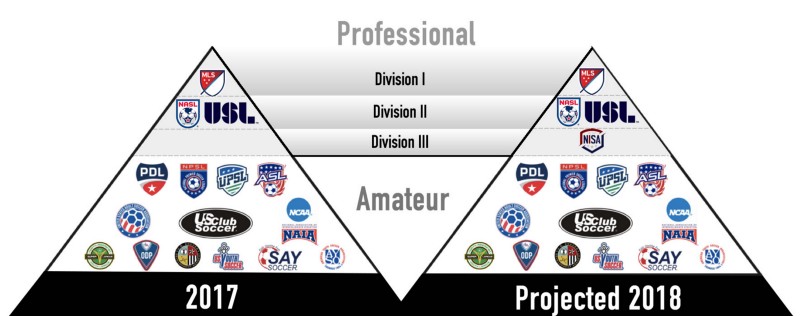
National Independent Soccer Association (NISA): At last. A professional league with a concrete plan to go pro/rel. And it’s backed by Peter Wilt, a well-respected sports executive with experience in MLS and the NASL, along with women’s and indoor leagues. He talked about his plans on the Ranting Soccer Dad podcast.
The plan is to start out at Division 3. Ideally, a Division 4 will materialize (for now, it’s an unofficial term for elite amateur competitions), and they can start promoting teams to a D3 NISA. And NISA will happily promote its teams to D2. Then when all these divisions have a critical mass of clubs that meet the various divisional standards (more on that later), they’ll start going up and down.
To some of us, this makes sense. Demonstrate to U.S. owners that pro/rel can rev up interest in U.S. soccer. Put clubs on a solid foundation before moving up to the big leagues. Maybe they’ll convince MLS to join the fun.
To the zealots (we’re getting to them, too), this plan seems to be part of the Grand MLS/USSF/SUM/NFL conspiracy because it doesn’t explicitly state an intention to fold the top division into the mix.
Meanwhile, clubs have other options:
USL: Oh boy. The history of this league would go on for quite a while. In short: It once had three divisions (two pro, one amateur) and even a little bit of attempted pro/rel. But a lot of clubs chose to drop to the amateur ranks, now called the PDL, and the pro ranks were a little thin. Then the clubs that eventually formed the reborn NASL splintered away, in part because of disagreements over the USL’s centralized ownership (still an obstacle when it comes to making a complete pyramid).
The USL accepted Division 3 status for a while, though it was competitive with the NASL on and off the field. Now they’re Division 2 — and they’re starting a Division 3 league as well.
The USL also has a lot of MLS reserve sides, which is somewhat controversial even though it’s common practice in many nation’s soccer pyramids. It does render the atmosphere a bit uneven — a couple of clubs average five-figure attendance, a couple of MLS reserves average three figures. (See Kenn.com.)
National Premier Soccer League (NPSL): Like the PDL, the NPSL offers summer-league play for college players to get a few competitive games before returning to campus, and a few other amateurs join in. Both leagues also can accommodate semi-pro teams.
Unlike the PDL, the NPSL has some clubs that make a lot of noise about being a bit more than a summer-league amateur activity. And some of these clubs (Detroit City FC, Chattanooga FC) really are building something interesting, testing the waters for a possible move up the ladder. (Which, in our current system, is simply a question of being ready to meet the standards.) But as a whole, we’re talking about a league that generally doesn’t even hand over attendance figures, for all of Kenn’s asking.
I’ve heard the argument that we have to call a lot of NPSL clubs “semipro” instead of amateur because they have professional staff. By that definition, I played “semipro” because the Fairfax Sportsplex pays people to make the schedules, hire the refs and serve the beer.
There’s nothing wrong with what the NPSL does. Not at all. We’re talking about a lot of clubs playing for a lot of different reasons — in many cases, just giving local kids who’ve gone off to college a place to play in the summer. If some clubs are building up toward going pro, great.
It’s more or less the same business model as the PDL, which has a couple of clubs (Des Moines in particular) that could consider going pro and a couple more (Carolina, Long Island) that have been there in the past.
If you’re really looking for semipro ball, consider the New York futsal leagues in which U.S. women’s player Allie Long picks up a few extra bucks. From Gwendolyn Oxenham’s book Under the Lights and In the Dark: Untold Stories of Women’s Soccer (see our podcast interview): “In the 2015 National Women’s Soccer League (NWSL), for the six-month season, the starting salary was $6,842. An NYC men’s league ringer can make more than that in two weeks.”
Your town might have a league like that. Someone should really do a story or a book on it.
U.S. Adult Soccer Association (USASA): The umbrella for nearly every other soccer competition in the United States, including a handful of leagues now designated as “Elite leagues” that send forth the bulk of our annual U.S. Open Cup surprise teams. The American Pyramid Blog is compiling standings for many of these leagues.
Pro/rel zealots (PRZ): Steve Holroyd, I believe, deserves credit for the term “pro-relots.” I like that, but I’m going with PRZ for the remainder of this series.
These people are to legitimate pro/rel discussions what the antifa are to legitimate pro/rel discussions. At some point, you wonder if they care about the underlying cause at all or if they just want to cause as much damage as possible.
I’ve documented these guys a few times. They’re the ones who, when faced with any sort of reality check on their “full, open pyramid” dreams, respond with personal attacks and conspiracy theories such as the MLS stuff above. (I also have a lot of documentation in the NASL/NPSL piece mentioned above, where I note with some sadness that I made a Husker Du reference. Sadness because I learned today that Grant Hart has passed away.)
MLS “shills” like me: I once had a Twitter conversation with someone who claimed not to realize that some journalists who don’t work for the official MLS site actually cover MLS.
“Where are the articles?” he asked. Well … ESPN, Washington Post, Los Angeles Times, Sports Illustrated, etc., etc. Somehow, it didn’t sink in.
I tried to look up the specific tweets, and my computer crashed. I’m taking that as a sign.
So I’m going to repeat something about myself for the record:
I wrote a few fantasy columns for previous MLSNet management more than 10 years ago, and my book was written with MLS’s cooperation but no backing from the league. (I didn’t even let a guy pay for my lunch.) Currently, I have no season credential to cover MLS, and I haven’t been paid to write about the league for years.
Frankly, I’d probably benefit financially if MLS suddenly joined a pro/rel pyramid. The freelance market is dead right now, thanks in large part to the “pivot to video” movement that has seen Fox and Vice lay off writers. Someone would probably take a story pitch if MLS changed course all of a sudden.
I’ve actually come up with a lot of suggestions for getting the pro/rel movement going in this country, mostly because I’m an inveterate tinkerer. Ask me sometime how I’d make the Europa League more interesting.
And I’m not alone in this. The people who get the most vitriol are the people who engage, not those who ignore the topic completely. We’re the ones who see a potential for pro/rel despite all the madmen who’ve pushed the topic for years.
The good news? We’re starting to have other people to talk to. That’s why I’m doing this series.
For nearly 25 years, promotion/relegation has been a blood-soaked battleground in U.S. soccer.
The worst place to be is in the middle of that battleground. Those of us who engaged in pro/rel chat — see Jason Davis, now a host on SiriusXM FC who devotes a considerable amount of air time to pro/rel and lower-division soccer in general — get more flak than people who choose not to engage.
And that’s a pity, especially because we may be gaining some actual traction on pro/rel at this point, but it’s going to take a lot of time to get the people who’ve chosen to keep their heads out of the muck to turn around and take this issue as something other than the ranting of a few Twitter trolls.
Those who are asked about it directly in the political realm give political answers. Here’s U.S. Soccer presidential candidate Steve Gans on the topic:
Certainly there’s a passionate fan base for promotion and relegation out there. It’s a great thing in principle — it’s how the sport works all over the world. It’s dramatic and exciting; we all watch the last week of the Premier League. But you can’t divorce yourself from the fact that the way sports are set up in this country are different. It’s a very complex issue. The passion for it makes sense, but the devil is in the details. You look at over 100 years of tribal loyalty to clubs in these other countries, and it’s just a different sort of structure, history and lineage than how sports work here.
Quite rational, and perhaps it will suffice for the people who actually do constructive work in soccer and will vote on the presidency. For the Twitterati, well …
In the early years, it wasn’t so bad, thanks in part to both the medium and the message. We were all talking on the North American Soccer mailing list, then BigSoccer, where moderators and the community at large would simply remove people who ran out of facts and embarked on a slander campaign. (Hey, it works in modern politics, right?) And with Major League Soccer launching into a massive void with a handful of investors lured by a business model that minimized risk, pro/rel wasn’t Topic A in the 1990s.
And still, we had an early effort at getting things going in the USISL, as Kenn Tomasch describes. But the reality is that more clubs were choosing their own destinies. Some moved up, all the way to MLS. Many others chose to move down. Funny little incentive there — if you don’t pay players, it’s a little easier to break even in soccer.
So has something changed?
I think so. We have several people interested in prodding pro/rel along. Some are new to soccer, like innovative Kingston Stockade owner Dennis Crowley. Some have decades of soccer experience (even in MLS), like NISA founder Peter Wilt, who was kind enough to chat on my podcast about it:
Do we have a critical mass to make this happen? Will it work? Is it even a good idea?
Yeah, this should be a fun series. Stay tuned.
(And no, I’m not talking about this on Twitter. Tired of doing this in 140 characters.)
For more than a decade, promotion/relegation talk has been the bane of the U.S. soccer community’s existence. It wasn’t going to happen any time soon, and some people reacted to that news by harassing and slandering the people who explained the reasons why.
But now? We have a former Chicago Fire president — Peter Wilt, who has plenty of experience in other soccer leagues and U.S. sports endeavors — writing a manifesto on how we can make it happen, and he’s starting a league with the goal of making it happen.
In other words, the grownups are talking about it now.
In this week’s podcast, Peter Wilt and I go through history and FIFA statutes (starting around the 5:30 mark), argue the merits of pro/rel (18:15) and talk about what’s changed to make it more likely (31:30).
Quick note: This was recorded before Miami FC and the Kingston Stockade appealed to the Court of Arbitration for Sport to ramp up the pressure on U.S. Soccer to force pro/rel into being, an action I fear will be counterproductive. But perhaps we can talk about that on a future podcast.
“Wow, it really looks like things might be happening with promotion/relegation in this country! Peter Wilt’s third-division league, intending to link D2 with the top amateur/semipro leagues, seems to be getting a good reception. And most of the responses to my survey are positive. Granted, a lot of those responses are self-selected — the USL, NASL and most of the NPSL clearly deleted the email — and I had a good talk with a PDL manager who reminded me that the vast majority of PDL clubs are in no position to move up, so we’ll still have to be cautious …”)
OK then. Let’s just take the smattering of progress the pro/rel movement is making and lob a grenade at it.
Miami FC (or “The Miami FC,” as they’re billed in the press release) already made waves in the pro/rel scene with a clever PR stunt — owner Riccardo Silva’s “offer” of $4 billion for 10 years of MLS media rights if the league would go pro/rel. Kingston Stockade owner Dennis Crowley is part of a new breed of soccer owner who throws open the books and shows how things are really going. He’s learning the business side, and he wants us all to learn with him. It’s an undeniably cool experiment.
But this filing has several issues. In no particular order (some major points, some picayune):
1. The FIFA statute. This isn’t the first time we’ve heard pro/rel proponents citing page 73 of the current FIFA statutes. Under “Sporting Integrity” in “The Regulations Governing the Application of the Statutes,” Article 9.1 reads: “A club’s entitlement to take part in a domestic league championship shall depend principally on sporting merit. A club shall qualify for a domestic league championship by remaining in a certain division or by being promoted or relegated to another at the end of a season.”
But then Article 9.2 says this: “In addition to qualification on sporting merit, a club’s participation in a domestic league championship may be subject to other criteria within the scope of the licensing procedure, whereby the emphasis is on sporting, infrastructural, administrative, legal and financial considerations. Licensing decisions must be able to be examined by the member association’s body of appeal.”
An analysis by lawyer Terry Brennan suggests 9.2 doesn’t totally overrule 9.1. But he also raises a few interesting contextual issues about why this was put in place — namely, to keep clubs within pro/rel leagues from pulling all sorts of shenanigans to shuffle clubs from place to place and division to division. (He doesn’t mention Mexico but cites an example from Spain that drew a clarification from FIFA that mentions, without objection, “closed leagues” such as those in the USA and Australia.)
Here’s the bottom line: Leagues clearly have leeway to set standards. FC Small Town United can’t grab MLS status with a 5,000-seat stadium. And there’s that word “legal.”
MLS was founded by soccer-loving lawyers, some of whom are still there. You want to bet against their legal team in this argument?
2. Court of Arbitration for Sport. If they were eager to wade into a U.S. legal issue, wouldn’t we have heard something about the issue of solidarity payments — to me and surely others, a more pressing issue — by now? Besides, they still have a global dispute over American football to handle. Seriously.
3. U.S. Soccer. The federation might have the power to end this right away by saying they’re committed to it at the right time. Here’s the precedent from Australia. (Thanks, First Eleven!)
4. Curious bits of the filing. First — there is no official fourth division designation in the United States, so the filing probably shouldn’t say it does on page 7. (Correct me if I’m wrong, but I’ve checked with people in a position to know, and I’ve never come across it in reading years and years of USSF papers.)
Also, I love Wikipedia, but is that really how you want to identify one of the parties in this?
Next — it’s rather curious to appeal to a FIFA statute to impose “sporting merit” as the sole criterion for division status and then complain that lower-division clubs can’t make to the Club World Cup because MLS clubs keep winning the U.S. Open Cup.
5. Tons of countries have firewalls between the amateur and pro ranks. In England, the system was rigged against amateur clubs joining the 92-club Football League for decades. (That’s why I think we can do it better.) Ireland has two pro tiers (barely) and no formal pro/rel between that and the amateur ranks. (Yes, I know I’m citing Wikipedia soon after saying it’s odd to see such a citation in a legal document, but lawyers get paid a lot more than I do, I have no reason to dispute Wikipedia on this, and why are lawyers citing Wikipedia to tell us where CONCACAF exists?) The Netherlands, where soccer reigns supreme and travel costs are nil, only started forcing amateur clubs up the pyramid last year.
Add it all up, and the likelihood of this filing succeeding seems minimal.
Of course, it’s possible that the filers know they’re not going to win, just as Silva surely knew he wasn’t going to walk out of MLS HQ with the league’s future media rights in exchange for a pro/rel pyramid. This smells like a PR stunt.
So here’s the question: What’s the harm? There was no harm in Silva’s media-rights bet. How about this?
If it goes away quietly, no harm done. But there’s a danger in having an ongoing legal battle. MLS’ growth was hindered, quite substantially, by a lawsuit from its players that dragged on far longer than anyone anticipated. If you’re thinking of investing in soccer on any level in this country, would a legal dispute make you hesitate?
And lawsuits have a way of making each side bunker in.
So I have to ask: Given all the progress being made on pro/rel (check out next week’s Ranting Soccer Dad podcast), why was this considered a good idea?
BEAU: Riccardo Silva offered MLS $4 billion for media rights if it would institute promotion/relegation? And people like Jeff Carlisle have already done the heavy lifting in reporting what did and didn’t happen? Great! Time to do a quick opinion piece.
BEAU’S CONSCIENCE: What are we, all clickbait now? You know that offer was just a PR stunt. MLS can’t negotiate its media rights for several years, by which both Silva’s team and David Beckham’s proposed team may literally be underwater thanks to climate change and everyone may be watching sports on AmazonTube.
BEAU: Well aren’t WE Debbie Downer this morning! Come on — we’ve been saying for years that pro/rel talk is just an academic argument until people put their money where their mouths are. Now they are! It’s not just Silva — Peter Wilt is planning a Division 3 league that would evolve into the cornerstone of a pro/rel pyramid. The reasonable voices are winning.
BEAU’S CONSCIENCE: We’ve tried to be reasonable for years. We all know the drill:
Something “new” happens in the world of pro/rel.
You write a blog post dissecting the nonsense arguments — MLS is conspiring to keep soccer smaller than the NFL, a lack of pro/rel is the only thing keeping the USA from dominating world soccer, etc. — and STILL suggest a way to ease into a pro/rel pyramid.
No one pays attention except Twitter trolls whose lives are so pathetic that they try to goad you into pro/rel arguments months after the fact. And then newbies pop up lecturing you about “Economics 101,” as if you haven’t been following sports business since before these dudes were born.
You’re just trying to stir something up so people will notice your new podcast, you sellout.
BEAU: You mean Ranting Soccer Dad? It just so happens we’ve booked a guest on promotion/relegation for Aug. 10.
BEAU’S CONSCIENCE: Is it someone reasonable, at least?
BEAU: It’s a Twitter troll who keeps accusing me of being on the MLS payroll to keep down pro/rel even though it’s been about 15 years since I wrote the MLSNet fantasy column and I keep coming up with plans FOR pro/rel.
(silence)
BEAU: No, I’m kidding. Geez, lighten up! It’ll be a rare chance to have a *substantive discussion* with someone who is actually doing something to make pro/rel a reality.
BEAU’S CONSCIENCE: Fine. Whatever. And I suppose today you’re going to suggest a modification to your latest pro/rel plan that no one will discuss?
BEAU: Glad you asked! Here goes …
I still like my last plan, especially given the number of viable MLS expansion candidates at the moment. The executive summary:
Division 1: 16 teams, single table, no playoffs (see separate Cup competition), bottom three clubs relegated.
Division 2: Initially 14-16 teams in one table but eventually splitting into regions with minimal playoffs. Promotion to D1 but no forced relegation to D3, at least not based on a single season’s results. Clubs can always self-relegate if they can’t compete at D2 — this is an alternative to folding.
Division 3: The top tier of regional pyramids. D3 clubs must meet professional standards. D1/D2 reserve teams are eligible to play (as in Europe, you pseudo-purist know-nothings). No automatic promotion to D2, but clubs can apply to move up based on performance on and off the field.
Division 4: The highest a club can climb while still remaining amateur (which many clubs will opt to do). Some pro (or semi-pro) clubs as well.
Then each league can go lower as it sees fit, just as current amateur leagues have multiple tiers.
I believe I mentioned a Cup competition to replace MLS Cup. This will have 12 teams — eight from Division 1, three from Division 2, and the team from Division 3 that progressed the farthest in the Open Cup.
So why does the clickbait headline say we can do pro/rel better than England? Here’s why:
Until recently, England kept a strict barrier between “League” and “Non-League.” The Non-League clubs could apply to replace the last-place League club (92nd on the four-division English ladder), but they rarely were admitted. Now they’re a bit more fluid, with a fifth tier (formerly called the Conference, now called the National League just to confuse everyone) that’s professional-ish.
We can do it better by being more flexible in Division 3 (and to an extent in Division 2). As more clubs are able to move from amateur to professional, we can add more D3 regional leagues.
For decades, professional soccer in England was a zero-sum game. Add one club, and you had to subtract another.
Leaving Division 3 open-ended gives every club a chance to move into the professional ranks when they demonstrate that they’re ready to do so.
And THAT will help youth soccer, too. More professional clubs. More academies.
So we’ll talk about it in more detail on the Ranting Soccer Dad podcast, assuming my conscience doesn’t take revenge somehow for grabbing the third rail of U.S. soccer once again.
Also: I’m doing a survey. If you are a coach or general manager of a USL, NASL, NPSL, PDL, WPSL, UWS, UPSL or high-level USASA team and have not received a survey by the end of the day, please check with your communications manager (to whom I’m emailing the surveys). If that person didn’t receive one, let me know.
Reminder: I’m off Twitter for a while aside from automated stuff like this. And the next one. And the next one. So if you want to chat with me about this story, why not chat here?
And this one has a bit of a back story, anyway. I’ve been working on this for months. One reason it took so much time is the staggering number of documents I read — financial reports, transcripts from annual general meetings (“Alabama … here … Alaska … here … OK, now the adult associations … Alabama … Alabama … Alaska … here …”) and so on.
Another reason might surprise you: A lot of people weren’t interested in talking. But I didn’t sense that they felt intimidated. They simply didn’t know anything.
I’m grateful that they admitted it. They’re not the Twitter pundits who think they have all the answers on reforming U.S. Soccer but have never even peeked at any of the information the federation puts online. A couple of people had nothing to add to this story but were looking forward to seeing it published.
So there’s a “put up or shut up” element to this story. Sure. If you really want to see some new people in charge, speak up now and over the next four years, because a lot of people may soon be term-limited off the board.
But I also hope it gives people a bit of a peek behind the curtain. Sure, anyone can read the same documents I did and maybe even talk to some of the same people I did, but it takes some time. If you understand U.S. Soccer a little better after reading this, I’ve done my job.
And if you have anything to add now, please do.
It’s an exciting time for soccer. The sport’s profile in this country has completely changed in the past 15 years. So what’s next?



 Duresport.com