Question came up today on Twitter: We know Russia and Qatar were controversial choices. Who would be a good World Cup host?
I’d set out these criteria:
Stable, non-authoritarian government
Ability to build venues without creating a class of slave laborers
Demonstrated interest in the sport
Then a “nice to have” rather than a “must have”: Ability to get from venue to venue without getting in an airplane or spending a full day on trains.
Most of the past World Cup hosts have been up to the task. In 1950, Brazil helped the World Cup, which had only been contested three times before World War II, regain a foothold in international sports. Chile, in the pre-Allende and pre-Pinochet days, overcame a devastating earthquake to host in 1962. Mexico (1970, 1986) and the USA (1994) had heat issues but were otherwise pretty good, with the USA smashing attendance records.
The worst World Cup host of my lifetime was surely Argentina in 1978. The horrors of torture and slaughter, coinciding with a suspicious win for the host country, are chronicled in a recent Wright Thompson story for ESPN’s magazine. (Update: Here’s the link. Also, I fixed the year. My brain is mush.)
Most European hosts have been just fine, though my highlights from the 1990 World Cup in Italy showed a lot of empty seats.
The 2002 World Cup had two good hosts in Japan and South Korea who shouldn’t have had to share. The 2010 World Cup was a lot to ask from South Africa.
It’s only now that we’ve hit a rut. Brazil probably could have pulled off a decent World Cup but insisted on some oddities like building a stadium far up the Amazon in Manaus. Far too ambitious.
Russia is … well, it’s Russia. Not too interested in getting along with the rest of the world these days. They plan to build a bunch of new stadiums. The Sochi Olympics didn’t fill anyone with confidence.
Then there’s Qatar, the most ghastly hosting decision by a major sports organization. Exploited workers are dying. FIFA has suddenly realized it’s hot. The bid process was 50 shades of shady.
So what would be better?
Call it Western bias if you like, but most past hosts would be fine. England is surely overdue. The USA would be even better today than it was in 1994, though I’d prefer some geographic consolidation.
The better question would be where the World Cup can go next.
Australia had a solid bid for 2022. It’s the one place that offered a solo bid in the 2018-22 fiasco that hasn’t already hosted.
After that, back to England. Then maybe perennial bidder Morocco?
“So, you getting ready to go to Rio?” asked my dentist.
He loves soccer. We often have conversations like this:
“What about the defense? They have that guy Besler, or am I thinking of Beasley?”
“Arrrghwa rahhbwa baahna.”
“Right — Besler at center back. How is he?”
But no, I’m not getting ready to go to Brazil. Just I didn’t go to South Africa in 2010. Or Germany in 2006, though I was there five years later for the Women’s World Cup and loved it. I wasn’t in Japan or South Korea for 2002, instead going through an intensive sleep-deprivation experiment at home and in the USA TODAY office, nor France in 1998.
When the Cup was in the USA in 1994, I made it to one game — Belgium-Saudi Arabia, which means I was lucky enough to see the goal of the tournament.
Don’t mistake my lack of attendance as apathy. I’ve always followed the World Cup any way I could.
In 1982, I realized that the nearly four weeks I would spend at summer camp coincided with most of the World Cup. I was just old enough to be horrified.
I asked my dear mother if she would clip each day’s scores and standings, if applicable, from the daily paper and mail them to me. Bless her heart, she did it. And in a cabin in the Northeast Georgia foothills, I duly copied them into a bulky notebook in which I followed each group’s standings and traced through the knockout rounds. If anyone at my camp needed a break from being pummeled in the rowdy sports that apparently built character, they could come over and ask me how Argentina had progressed from the group stage through the quarterfinals. (Not that anyone did. Go to that camp today, and you might see a few Messi shirts. There were no Maradona shirts in those days.)
In my USA TODAY days, I went to several Olympics: 2002, 2006, 2008, 2010. No World Cups. It’s pretty simple: USA TODAY sends scores of people to the Olympics. To a World Cup, usually one or two. (I understand it’s more these days.) It wasn’t me in 2002 or 2006 because the “print” staff hadn’t yet realized that the “online” staff had built a presence and that people outside our offices generally saw me as our soccer writer. It wasn’t me in 2010 because I had left.
I would have loved to have gone in 2006. Then again, I had one young son and was about to have another. So the timing wasn’t ideal.
So maybe I missed my window of opportunity. But I don’t really have any regrets. And frankly, I’ve developed a view that may shock most of you:
I’d rather go to the Olympics than the World Cup.
No, really. I got a credential to the 2014 Winter Olympics and only gave it back when I ran the numbers and realized I didn’t have the time to make the trip to Sochi pay off. Brazil this summer? Never even considered it. Rio 2016? I’m a little nervous about the preparation, but I’ll probably try to go. Pyeongchang 2018? Logistics could be tricky, but all things being equal, I’d be happy to be there. Tokyo 2020? Oh, I’m there.
Part of it is simple logistics. It’s the travel. Reporters in Brazil will cover one game, get on a plane, cover another game, get on another plane, repeat. At the Olympics, I could cover two, three, eight events a day.
The Women’s World Cup in Germany was as close to that experience as you’ll get at a major soccer tournament. Thanks to the train passes organizers offered up for a semi-reasonable price (hey, espnW was paying, not me), I could go to nine games in seven cities in 11 days.
I’m hoping to go to the Women’s World Cup again in 2015, but I won’t be able to duplicate that experience in Canada’s far-flung venues. Won’t happen in Russia 2018, either. Sure, the travel will be easy in Qatar 2022, but I’d sooner cover an ice fishing contest in Antarctica than go to that disaster-in-waiting. (If it’s moved to, say, the USA, I’ll at least get tickets, if not credentials.)
But let’s say you could pool all the World Cup games in a cohesive area. Would I want to go? Honestly, unless it’s in England — probably not.
The World Cup is not the Olympics. The World Cup doesn’t have the diversity, the color, the sense of wonder of the Olympics. It’s not the same.
And with a few exceptions, the World Cup features the same players you’ve been watching all year. You don’t get many chances to see Michael Phelps in meaningful competition. Messi and Rooney are on our TVs every week, sometimes twice, for about nine months.
Here’s the sad part: World Cup hosting rights are considered so valuable that the exchanges of goods, services and cold hard cash that surround them are one big beautiful tragedy. The 2022 Olympics? At this point, the IOC is practically begging cities to bid, lest they face an unappealing choice between Almaty (Kazakhstan) and Beijing.
Part of the problem is the “white elephant” label. Athens, Torino and Beijing had some venues that had sketchy post-Games plans. Then there’s Russia — Sochi was such a money pit that it has scared off the normally rational European public. No Winter Olympics should cost that much — you put up bleachers at your ski resorts, maybe build a ski jump hill or sliding track, and off you go. If you already have the ski jump hill and sliding track, you should be in great shape.
But there’s hope. I’ve been to London’s Olympic Park — a nice tourist attraction, training facility and host for various events. Salt Lake City unquestionably did it right — the Olympic Park and the Olympic Oval are humming with athletes in training and regular folks taking advantage of the many activities on offer.
And now, Brazil is doing it wrong for the World Cup. They’ve built a stadium in the middle of nowhere in the most literal sense.
So I’m not sure the World Cup can claim superiority over the Olympics on the “white elephant” syndrome. Not if the Olympics are planned well by a non-authoritarian government.
Sure, the Olympics could be scaled back, particularly the Summer Games. Maybe it’s time to split the Summer Games into a couple of smaller events (future blog post). But they’re still a wonderful event. Being immersed in the Olympic atmosphere is an experience I’ll always treasure.
The World Cup, on the other hand, is losing some of its allure to me. There’s so much soccer all year. I love the weekly Saturday wakeup with the NBC Premier League crew, my trips to the SoccerPlex to see the NWSL, and the steady summer diet of MLS. I’m finding less in common with the people going to Brazil and more in common with the hard-core Spirit fans, the masses in Seattle, and the English supporters banding together with their neighborhood club.
Then there’s FIFA, the organization so ugly that it’s hard to stomach any summary of their deeds that isn’t mitigated by John Oliver’s wit.
Of course I’m still going to watch the World Cup. I’m looking forward to hearing Ian Darke, whom I had the privilege of meeting in Germany, add life to the action. And after seeing Next Goal Wins, I have a new appreciation for the countries that strive just to get a small piece of the competition.
But when it comes to planning international trips over the next decade, I have a few things that will be higher priority than handing any of my money to FIFA.
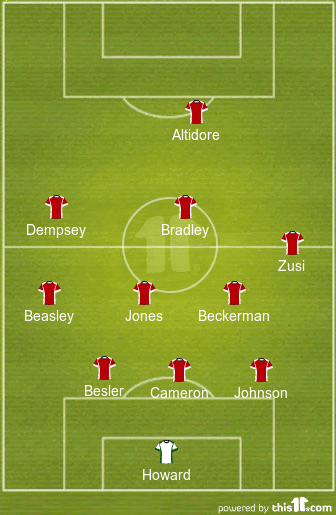
Can anyone make sense of the new diamond midfield that’s really more of a parallelogram? Today, Zonal Marking and MLSSoccer.com’s Central Winger gave it a try.
With the fullbacks spending so much time on offense, maybe it’s the old W-M formation:
Or not — Jones may be nominally the left mid but is more of a destroyer. Like so.
That doesn’t seem right, does it? Maybe move Beasley farther up the field and shift the defense to cover that space. Have Beasley link up with Dempsey on the left, like so:
You could call that a 3-3-1-2-1, but the midfield roles should be fluid. So for sake of simplicity, we’ll call it … uh … we’ll call it …
Heading into the weekend, I cast some doubt on the hype for the modern pentathlon World Cup final, which included the peculiar boast that it was expected to draw a U.S. audience of 25 million on NBC Universal. I couldn’t even find actual broadcast info after checking several sources.
Then I suggested the following:
The more I watch, the more I think modern pentathlon needs to swap the riding phase for something else. Any nominees?
That probably wouldn’t go over well in the host city(ies) of Sarasota/Bradenton, where the local writeup headline is “Equestrian event ignites interest.”
In the morning, less than 30 spectators watched athletes begin their quest for pentathlon glory during the fencing and swimming events at the Selby Aquatic Center.
OK, granted, the fencing is hard to follow. And you can catch half (well, two-thirds, in a sense) of the pentathlon at one venue later in the day.
More than half the number of spectators that filled the grandstands to watch the show jumping portion of the event left by the time the combined running and shooting event started.
You know, if you just want to see show jumping, you can.
I had a lot of fun covering pentathlon in Beijing. Maybe one day it’ll be appreciated for what it is. Though this is a nice first step:
Rolls Royce picked me up for the World Cup Final press conference this morning . Feeling like a princess. #Spoiledpic.twitter.com/qDP68icWSp
Is 3v3 basketball the next beach volleyball? Given the comparative histories of the sports, probably not. But the U.S. women continue to dominate, taking World Championship gold. The men lost in the round of 16 but got a bronze medal in the dunk contest.
BEST AQUATIC EVENT THIS WEEK
The USA Women have arrived in Kunshan, China and start play in the FINA World League Super Final tomorrow. Go USA! pic.twitter.com/v41hLqWmcN
Scotland beat the USA in rugby, four injuries to nil.
BEST ROUNDUPS
– Ollie Williams’ Frontier Sports: More on Team Chris Froome vs. Team Bradley Wiggins, Rio promising clean water for sailing, first steps toward women’s Nordic combined, a triathlon misprint, Rulon Gardner forgetting he’s nearly my age.
– Daily Relay’s Monday Morning Run: The Tori Bowie phenomenon, some youngsters ready to challenge Mary Cain, decathlon champion Ashton Eaton blasting through the 400 hurdles.
– Team USA Sports Scene: More World Cup medals — in shooting this time.
California Chrome, like so many horses before him, did not win the Triple Crown. Unlike many owners before him, Steve Coburn griped that the horses that skipped other Triple Crown races had taken “the coward’s way out.”
Good point, says my former USA TODAY colleague and fellow myriad sports journalist Christine Brennan. Foot in mouth, says my fellow myriad sports journalist Will Graves.
California Chrome heads home with bandaged foot … Owner continues to have foot in mouth http://t.co/hgkdwslJoN
Those of us who remember the 70s remember when Triple Crown winners were commonplace. Or so it seemed. You had Secretariat, a once-in-a-lifetime horse by any standard, in 1973. Then Seattle Slew in 1977 and Affirmed in 1978. Since then, we’ve been waiting for 36 years.
But before then, we were waiting for 25 years. We had plenty of Triple Crown winners in the 30s and 40s, though competition may have been dulled a bit by the Depression and World War II.
So the 70s were really an aberration. And it was close to four in five years — Spectacular Bid and Pleasant Colony fell just short.
For most of the public, a Triple Crown bid is the attention-getter. Last year, with no Triple Crown at stake, the Belmont Stakes drew an overnight rating of 4.6. This year? 12.9.
We’ve had Triple Crown attempts in 1987 (Alysheba), 1989 (Sunday Silence), 1997 (Silver Charm), 1998 (Real Quiet), 1999 (Charismatic), 2002 (War Emblem), 2003 (Funny Cide), 2004 (Smarty Jones), 2008 (Big Brown) and now 2014. (I’ll Have Another won the first two in 2012 but couldn’t run the Belmont.)
What’s that? Oh, you know all those horses? Right. How about Easy Goer, Touch Gold, Victory Gallop, Lemon Drop Kid, Sarava, Empire Maker, Birdstone or Da’Tara? No? They all won the Belmont Stakes. The best of those horses was either Easy Goer, who still has adherents thinking he was a better racer than Sunday Silence, or Victory Gallop, who was second in the Derby and Preakness to Real Quiet and went on to a strong year at age 4. The others aren’t really household names.
Perhaps Coburn has reason to complain. But betting it all on the Belmont usually means a horse may get the Belmont … and nothing else. Everyone roots for the Derby-Preakness winner at the Belmont. Few care about the actual winner.
So does horse racing need a Triple Crown winner? Or does it just need to keep having horses in the running after two races? Maybe horse racing benefits from the Susan Lucci effect — did anyone care about the Daytime Emmys except in the annual fretting over whether this would finally be the year? Quick — who won the Outstanding Lead Actress in a Drama Series last year?
One more valid question about the Triple Crown, from Brennan’s column:
(I)f there are too many concerns about the health of the horses in this current five-week schedule, space out the three legs of the Triple Crown over several more weeks, and again mandate 100 percent attendance for any horse to be in the Belmont field.
That hits home for anyone remembers seeing jockey Chris Antley pull up and save Charismatic’s life in the 1999 Belmont. Or anyone who watched Barbaro struggle with and eventually die from his injury in the 2006 Preakness.
Of course, this isn’t a monolithic sport. The Derby, the Preakness and the Belmont are all individual events with their own traditions. But as everyone keeps trying to breed the next Secretariat and the Triple Crown retains such allure, maybe the quest for the Crown shouldn’t be so risky.
As we concluded in the last post and confirmed from about 95% of the comments here and on Facebook, U9/U10 travel tryouts that segregate “travel” and “recreational” (“House”) players are something no one likes and everyone does anyway. Realistically, we’re not backing away completely from elite-ish soccer at that age.
So what are the alternatives? I’ll toss out a few:
1. Part-time travel. We’re already doing it at U8 in my region — at least, we’re supposed to be, but some clubs treat it as U8 travel in everything but name. Your club’s serious U8 players sign up for a program with extra training sessions under a pro coach’s watchful eye, and they play a couple of friendly games against similar teams from other clubs.
U9 and U10 are the perfect ages to continue a program like that. That’s where we move up from the 4v4 or 5v5 games into full-fledged soccer games of 7v7 or 8v8. Clubs can monitor all their players as they make that transition.
Players and their families would get to keep a foot in each world. Players can face diverse competition, challenging themselves against the elites while gaining confidence to try out what they’re learning in a more relaxed recreational setting.
2. All-Star tournaments. We already have these for House leagues — starting at U8 in our region. One postseason tournament each season. Maybe we could have a couple per season and rotate the “All-Stars.”
3. One season for House, one season for travel. Some players — please sit down so you can digest this — don’t want to spend the whole year playing one sport at age 9. And countless studies suggest it’s a pretty stupid idea to do that, anyway.
So why not offer House in the fall and spring, giving everyone a chance to play one sport per season and still sample different things, and offer travel only in the spring? You’ll have a good House league in the fall, a mix of players that includes your travel-quality players. Spring-only travel will be more affordable. Plenty of advantages.
4. Open travel to everyone. Why segregate into “House” and “travel” at all? If someone wants to get good coaching and a cool jersey at an age well before we know anything about their future athletic careers, why not let him or her do it?
That would be triathlete Gwen Jorgensen. She won again in the World Triathlon Series, this time on the Olympic course in London. And she’s leading the series.
Fellow American Sarah Groff was second.
BEST CHANNELING OF PREFONTAINE
Galen Rupp just keeps getting better. Friday at the Prefontaine Classic, he took down the U.S. record at 10,000 meters. The time: 26:44.36. Oregon fans appreciated it.
BEST RACE
Grenada’s Kirani James ran a world-leading 43.97 in the men’s 400, tied for 10th-best of all time. In second place, LaShawn Merritt … in a world-leading 43.97, tied for 10th-best of all time.
BIGGEST SURPRISE
Tori Bowie transformed from relatively unknown long jumper to the fastest 200-meter runner in the world this year in precisely 22.18 seconds.
ALSO AT THE PREFONTAINE
– Shot put (men): Reese Hoffa won with throw of 21.64 meters, with Joe Kovacs and Christian Cantwell also over 21.
– Triple jump (men): Will Claye needed a meet-record 17.66 to beat Christian Taylor (17.42).
– 2-mile run (women): It’s not run often, but it’s still impressive to see two area records set in a meet by the people who finished third and fourth. The latter, the American record, goes to Shannon Rowbury. (DUKE!)
– 100 meters (men): Justin Gatlin won in 9.76 seconds. The wind will keep it out of the top-10 lists. Michael Rodgers crossed in 9.80 seconds.
– Mile (men): Djibouti’s Ayanleh Souleiman ran the fastest time in the world this year. And in Prefontaine history. And Diamond League history. And Djibouti history. That’s 3:47.32, edging Kenya’s Silas Kiplagat.
Let’s say you’re getting married by the beach, and all of a sudden, Serena Williams walks by. And just think, if she were still playing in France, this would’ve been impossible.
Kerri Walsh Jennings won her 67th AVP event, breaking the record she shared with longtime partner Misty May-Treanor. Earlier this year, she set the record for FIVB wins.
BIGGEST UPSET
Field hockey World Cup: USA 2, England 1. A couple of highlight-reel saves from U.S. goalie Jackie Kintzer in this one:
BEST COUNTRY FOR CYCLING PRODIGIES
Colombian Rigoberto Urán joins Quintana on the podium (2nd). This is only the 2nd Grand Tour in which 2 Colombians finish in top-3 #Giro
– Team USA Sports Scene: Sam Mikulak leads the U.S. gymnastics men, U.S. men beat Brazil in water polo.
– Ollie Williams’ Frontier Sports: 2022 and 2024 bidding update, U.S. engineering archer, plenty of cycling news, good story on once-homeless English soccer player Fara Williams, the other view of the USA’s shocking field hockey win, lots or rowing.
Tomorrow, I’ll coach my U8s for the last time. They’re a wonderful team, most of whom I’ve coached off and on for the past two years (four seasons).
Next year, we move up from concurrent small-sided games of 4-on-4 to the bigger fields with 7-on-7. We’ll have goalkeepers and refs.
What we won’t have will be a couple of our best players. They’re going to travel soccer. A few others have considered it or tried out, and the experience has been simply horrible. I feel like I’ve spent the last two weeks talking parents off ledges. Two years ago, when I saw a ridiculous political situation working against a couple of players I knew well, I spent this time rebuilding confidence so these kids wouldn’t miss out.
I’ve seen plenty of gossip. “Oh, this club isn’t any good because it doesn’t have any teams in the Premier Champions Club League. I’ve heard that’s better than the Champions Elite Premier League or the Academy Premier Champions Academy. Someone on a message board told me Club X only practices twice a week, while Club Y practices eight times.”
You know what? The whole thing is crap.
A lot of parents don’t need me to tell them that. A lot of coaches will disagree. “Oh no,” they’ll say, “these are the peak development years, and we need to get the best players in quality teams with quality coaches.”
Maybe so. And you can still do that without all this mess.
If you still don’t believe me, Mr. Tryout Coach, let me sum it up with words I’ve heard often from parents that should frighten you to your very core:
“Baseball is so much easier to deal with.”
That’s right, Mr. Elite Coach. I’m a baseball parent, too, and they’re right. Our kids aren’t going to Little League practices and dealing with this crap. They just play and learn. Some areas are trying to ramp up with “travel” baseball, and they’re meeting resistance, captured in this wonderful Washington Post piece that has made the rounds among youth sports parents.
Does this sound familiar?
Travel ball, by contrast, is not cheap — participation fees average about $2,000 per player per year. And teams may invite players from anywhere in the region. Since tournaments and games are usually in other towns, players and their parents must spend many hours commuting.
Some travel ballplayers resemble professional athletes: Year by year, they go from one travel team to another, switching teammates and uniforms, with the name splashed across the front of the jersey usually signifying something other than their home town.
For the most part, Little Leaguers play in what we soccer people would call “House” league, maybe making All-Stars at the end, through age 12. Then it’s Babe Ruth or other organizations until high school. And many baseball folks want to keep it that way.
We keep hearing that the mark of a good coach is how many of his or her players return to keep playing. (That’s not true, but we’ll save that for another rant.) So we parent coaches try to do that. And then you undermine us with a system that angers 70% of your parents and kids.
I deal with parents who want to be assigned to whichever team practices at the closest field to their house. You want to take all these kids, pool them together and assign them based on your club’s supposed needs. And if there’s no room in the program with the professional coaches, that’s OK — they can drive over to the next town. You don’t mind driving through the inner suburbs at rush hour, do you?
And I deal with parents who are terrified of their kids facing some kind of stigma from playing “House” or “recreational” soccer. And I deal with kids who walk around their third-grade classes like they’re the bomb because they’re on “travel.” Congratulations, kid — you had an October birthday (or August, but your parents held you back in school), you’re faster and more aggressive than most kids, and so you got a big rep dominating the 3v3 and 4v4 magnetball games in the younger age groups. Truly, you are superior to the kid who just missed the cut.
You’re driving away future players, particularly the late bloomers who don’t shine at the all-important U9 tryout. And you’re driving away future fans, giving people a negative impression of soccer as some cutthroat status-oriented enterprise.
And the funny is this — you all know you shouldn’t be doing this.
Here’s the quote you’ll see in a million PowerPoint presentations from Alfonso Mondelo, MLS director of player development:
The problem in the U.S.A. is they start travel soccer at too early an age. That’s totally detrimental. It becomes more like winning and collecting hardware than about having kids play and learning from playing.
Here’s the U.S. Youth Soccer Player Development Model, February 2012, p. 66-67:
The U-10 age group is when children are often asked to compete before they have learned how to play. This too much too soon syndrome is another symptom of the flux phase. Therefore, US Youth Soccer recommends U-10 players should not:
• Be involved in results oriented tournaments, only play days, jamborees or festivals with a participation award.
• Be exposed to tryouts.
• Be labeled recreational or competitive.
“But soccer isn’t like baseball,” Mr. Elite Coach is blubbering by this point. “We need to make sure good players are challenged and getting good instruction!”
Yes, that’s fine. And here’s how:
A lot of clubs are coming up with transitional “pre-travel” programs at U8. They may play with their regular House/rec teams (some don’t, which is yet another rant), but they also get one session a week with the club’s Serious Professional Technical Staff — which, in all seriousness, is better about teaching skills than most of us parent coaches could be. At the very least, they can demonstrate them a lot better. Then they assemble teams for “crossover” games with other clubs.
This system works pretty well at U8.
And it would work at U9. And U10.
It’s the best of both worlds. The kids get to keep playing with their buddies and with parent coaches who care about them. Those who seek it also get professional training and a chance to represent their clubs.
By U11 or U12, fine — split the travel kids away. Middle school kids are more mature (well, in some ways). You’re almost old enough to specialize in one sport, though it wouldn’t hurt to spend the winter or summer doing something else.
And if you wait until then, that’s another two years for kids to have a positive experience that they’ll remember fondly. They’ll turn into soccer fans — or players. Or both. Their parents won’t scream in horror at the mention of the word “soccer.”
And the sport will be better off.
The bad news: You can’t expect clubs to police themselves. This has to come from on high.
So, U.S. Soccer — it’s up to you.
(If you’ve read this far — first of all, thanks. Secondly, you may have noticed that I’m working on a book called Single-Digit Soccer, and I’d appreciate feedback on this and any other topics. There are some voices of reason emerging from the wilderness — see the Changing the Game project — and I hope my work will encourage others to emerge.)
1. We’ve all had to go into interviews without realizing what happened. At one of the 2008 Olympic biathlon events, one with a staggered start and athletes racing against the clock, I was down in the mixed zone interviewing one American athlete. We finished, and then Jay Hakkinen came right up for his turn. No one had given the handful of reporters any results, and we couldn’t see the course from the mixed zone. The other reporters deferred to me. “So … um … Jay — how’d you do?”
2. That said, if you’re in a press conference room, and you’re pretty sure other people watched the match, you might want to defer to them.
3. When you realize you’ve been given faulty information, apologize … then bow out.
Bottom line: It’s OK to let other people ask questions. Particularly if you have nothing to ask.
One of the neat features of the Maryland SoccerPlex stadium field is the hill behind the south goal, which the Spirit sells as general admission. I’ve seen games from “end zone” seating, but I had never been up close and personal with the goal.
Until tonight.
The kickoff was early enough (4 p.m.) to take one of my kids, and I couldn’t pass up that opportunity. And I figured we’d make it especially interesting.
I wouldn’t want to watch every game from that vantage point. For one thing, you lose any credibility in terms of arguing offside calls. The action at the other end is distorted.
But this game had a lot of action for those of us on the hill. Here’s the video, some highlights and a bit about how it looked from close range:
– 3:56: Dash defensive breakdown, Jodie Taylor presses, ball pops out to Diana Matheson, who chips Erin McLeod for the opening goal. I actually said to my son, “Oh, too bad, it went high.” Then it floated into the net. So, yeah — you’re not going to get a good view of everything from this view. 1-0
– 11:24: This didn’t look the least bit dangerous, and I still have no idea how this ball rolled past Ashlyn Harris. 1-1
– 25:23: Harris’ best moment of the first half, shutting down the near post on Ella Masar.
– 37:10: Even from the other end, we could see Taylor astutely letting the ball bounce in front of her before finishing past McLeod. 2-1
Another first-half highlight: While I didn’t hear a ton of the legendary Harris shouting, I did hear her say something like “OK, no stupid throw-in, right?” before former teammate Stephanie Ochs tossed a long one into the box.
In the second half, most of the action was coming right toward us. It was full of squandered opportunities for the Spirit, who outshot the Dash 11-3 in the half. But every time, the ball just wouldn’t quite sit right. A lot of Spirit attackers were a little off balance when they shot. Lori Lindsey (45:35) couldn’t generate much power on her shot. Matheson (56:25) had a tough angle, and McLeod made a strong save. Tori Huster (61:58) wasn’t really in position to do any more than poke at it.
One distinctive feature of the angle I had — on several occasions, I saw Crystal Dunn cutting into the box, pointed straight at me. It’s scary. She’s not the biggest player, of course, but you just have the sense that she could do anything. But she, too, couldn’t do anything with the shot (63:52) she created.
Then the Dash had its one good spell of the second half. And even from across the field, we could see Osinachi Ohale hanging over the Spirit defense and finishing clinically at the post (76:22). 2-2, and you will never convince me that it’s a good idea to leave a post unguarded on a corner kick. No way Harris could’ve made it over there in time.
We do have to talk about the PK call (80:44). In real time, about 10 yards away,I saw McLeod charging out and figured the call was coming. She wasn’t getting that ball without getting Taylor. And now that I see the replay … I’ll stand by it. Some people on Twitter have said they saw Taylor dragging her feet as if in preparation to dive. Frankly, it doesn’t matter. Contact is contact.
This play — forward going at a diagonal wide of goal, with little opportunity to do much, and a goalkeeper sliding out in a way that makes it too easy for a forward to trip over her — is always controversial. We’ve all seen it so many times. And about two-thirds of the time, the ref gives the PK.
McLeod argued, of course. And she was still mad when Matheson saved a ball on the end line (82:15). “Brutal!” she yelled at the AR. It wasn’t, but her frustration is understandable.
In between those plays, of course, McLeod saved a PK from Matheson. And what you can’t see on the replay is Matheson giggling as she steps up to the spot, as if a little embarrassed to be face-to-face with her Canadian teammate in that situation. It wasn’t Matheson’s best PK effort, but credit McLeod with the save.
And though I don’t think McLeod, in hindsight, could really complain about the call, we can all be glad it didn’t decide the game.
Because what DID decide the game was spectacular. If the Spirit could promise a finish like that in every game, it could charge $200 for hill seating. My thought process as Christine Nairn’s shot (stoppage time, see it on Instagram if you don’t want to work through the video) was airborne: “Holy (bleep), that ball has a — wow, it’s the upper corner.”
You have to feel for the Dash. They didn’t have the better of play, but the defense managed to limit things in the second half. They battled back for the equalizer. And it was all taken away so swiftly.
Houston has some good components. Kealia Ohai came on in the second half and just carved up the Spirit defense. Nina Burger is legit. I was impressed with Rafaelle Souza and surprised she was taken off at halftime. Ella Masar is always dangerous. Ohale and Holly Hein aren’t bad at the back. And McLeod never gets enough recognition.
I’ll be back in the pressbox for the next one, peeking around the obstructions and missing out on the sounds of the game. Memorial Day didn’t draw the Spirit’s biggest crowd of the season, but the Spirit Squadron’s chants and songs are fun.
And at the risk of sounding like a Yelp reviewer, the hill gets five stars.


 Duresport.com