Dan Loney and I have three things in common. First, we’re parents. Second, we have a goofy sense of humor. Third, we’re on the Enemies List of people who push promotion/relegation as The Big Issue That Will Save U.S. Soccer and Make Us A Consistent Global Power.
The funny thing is that Dan, unlike most of us who point out inconvenient facts that make a pro/rel system difficult (but not impossible) in this country, actually hates pro/rel itself. I actually get caught up in the romance of relegation escapes and promotion chases. (I miss you, Coventry City.)
So we spoke for an hour and talked about the Athletes’ Council (in which he and I disagreed on whether Carlos Bocanegra should be on it), the Muppets, Dr. Katz: Professional Therapist, and conspiracy theories — including the accusation that we are the same person.
We did not discussion promotion and relegation in any detail whatsoever.
What was the big curling event of the past weekend?
Was it the third leg of the Curling World Cup? How about the provincial qualifiers for the Scotties and the Brier? Maybe the made-for-TV Skins Game?
If you’re curling in Canada, the Scotties and the Brier take top priority. To explain this to an American audience — this is the equivalent of the U.S. Open Cup or FA Cup in the sense that it’s a national championship in which unheralded entries can beat the big names. Qualification for the national event, which is broadcast on TSN (and therefore to a U.S. audience on ESPN), is a tournament in each of Canada’s provinces. Qualifying for those events tends to be based on subregional qualifiers and the handy Canadian Team Ranking System — basically, the year-to-date Order of Merit.
This looks like one of those shorts Mystery Science Theater 3000 plays before a feature.
It’s really wonderful. Check out the ESPN3 streams starting Feb. 16.
So the Skins Game proceeded this past weekend without any of the teams that were occupied with various qualifiers. Top-ranked Kevin Koe doesn’t have his Alberta qualifier until this week, so he was able to play in the Skins. Brad Jacobs, ranked second, had to take care of Brier business in Northern Ontario. Three top-eight teams were busy in Ontario, so No. 9 Reid Carruthers got the call. The women’s competition had four of the top six in Canada but not top-ranked Rachel Homan.
The World Cup? Canada sent seventh-ranked Matt Dunstone, who beat Sweden’s Niklas Edin to win the men’s event, and eighth-ranked Darcy Robertson, who duly lost all six of her games.
The Curling News is full of suggestions to revamp the calendar as well as the Scotties and the Brier. The jewels of Canadian curling have expanded to 16 teams each, incorporating all three of the sparsely populated northern provinces as well as a “wildcard” entry.
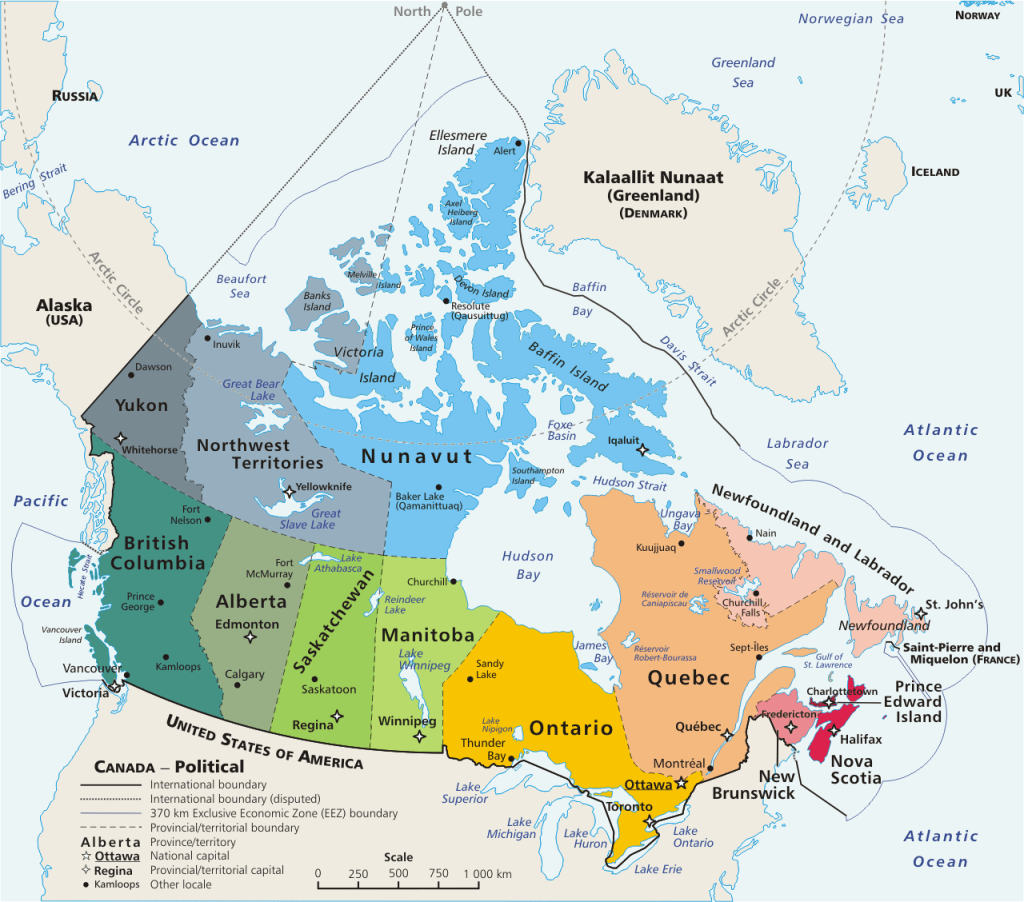
Sure, but after a few more years of climate change, Nunavut might have to build a wall to keep the rest of us out.
It’s a bit controversial because, as vast as those territories are, they’re rather sparsely populated. One survey of the population of Nunavut reports of population density of 0.0 per square kilometer.
The reason is pretty obvious. It’s cold. Really cold. Permanent polar vortex cold. From Nunavut Tourism: “The average temperature in Kugluktuk is the warmest in Nunavut, sometimes rising to 30°C in the summer and ranging from -15°C to -40°C in the winter.” The high end of that winter range is 5 degrees Fahrenheit. The low end, oddly enough, is -40 Fahrenheit. It’s the point at which they converge. It’s not better one province over. The average high temperature in January in Yellowknife, Northwest Territories, is -6 degrees. Yes, Fahrenheit. The average low is -23. Regina, Saskatchewan, is downright tropical by comparison.
So this open national championship, along with its requisite qualifiers, is competing for space on the crowded curling calendar. The Scotties and Brier are part of the “Season of Champions” umbrella along with the “North America vs. the World” Continental Cup and the Canada Cup, for which the teams are determined entirely by rankings.
AND we have the Grand Slam of Curling, which has seven events of its own — one per month from September to January, then a Players’ Championship and Champions Cup right after the World Championships.
AND now we have the World Cup, a complicated four-event series in which teams represent their countries, sort of.
Naturally, I’ll have to add my own pet solution on top of the suggestions The Curling News and the Rocks Across the Pond podcast have made. I promise I’ll get to the power ranking update after that.
WORLD TEAMS
World Cup: Every four years. Obviously not the same year as the Olympics. Make it a Davis Cup/Ryder Cup/World Team Tennis sort of thing — country vs. country matchups in which men, women and mixed doubles teams face off.
Continental Cup: Odd years only. This already has a Ryder Cup vibe to it — North America vs. Europe.
CANADIAN CHAMPIONSHIPS
It’s good to be inclusive, and part of the charm here is seeing teams repping their provinces. It’s less good to spend the first five days watching Rachel Homan, Kevin Koe, Jennifer Jones and company routing Nunavut.
For a couple of years, the Scotties and Brier had a play-in round for the lowest-ranked provinces based on previous years’ results. Bring it back. And cut back the number of teams by doing away with the Ontario/Northern Ontario split and the wildcard team.
(Alternate idea: Have one representative from the northern provinces and two from the Maritimes/Newfoundland and Labrador. Add in the defending champions and the six other provinces, and you’ve got 10 teams.)
THIS YEAR’S EVENTS
The Scotties’ field is powerful. The seven top teams in the rankings are going, though two of them (No. 2 Kerri Einarson and No. 5 Casey Scheidegger) will face off in the wildcard game. The top-ranked teams won in Ontario (Rachel Homan), Alberta (Chelsea Carey), Saskatchewan (Robyn Silvernagle), Northern Ontario (Krista McCarville), Prince Edward Island (Suzanne Birt) and Northwest Territories (Kerry Galusha). Manitoba had a minor upset, with No. 6 Tracy Fleury beating Einarson. The second-ranked team also won in British Columbia (Sarah Wark), New Brunswick (Andrea Crawford) and Newfoundland/Labrador (Kelli Turpin). No one from Nunavut or Yukon is ranked.
The only mild surprises were in Nova Scotia, where Scotties veteran Jill Brothers turned back the clock a few minutes, and Quebec, where Gabrielle Lavois was the best of a low-ranked field.
The men’s qualifiers aren’t done yet, with the brutally competitive Alberta, Manitoba and Saskatchewan provinces playing down this week. Perennial Northern Ontario representative Brad Jacobs is back, but Ontario had a bit of a surprise with Scott McDonald getting past the usually dominant John Epping and Glenn Howard teams. Brier veteran Jim Cotter beat two higher-ranked teams to win in British Columbia. Stuart Thompson edged similarly ranked Jamie Murphy in Nova Scotia. Martin Crete sprang a mild upset in Quebec. In Newfoundland and Labrador, Andrew Symonds won the battle of teams not skipped by Brad Gushue, who has the automatic bid as defending champion.
Power rankings
WOMEN
Rachel Homan (CAN) – won Ontario provincials (up 1)
Anna Hasselborg (SWE) – lost World Cup Jonkoping final to South Korea’s Min Ji Kim. (down 1)
Jennifer Jones (CAN) – won the Skins Game, beating Fleury in the final (up 1)
Chelsea Carey (CAN) – won Alberta provincials (up 3)
Tracy Fleury (CAN) – won Manitoba final and reached Skins Game final (up 5)
Silvana Tirinzoni (SUI) – idle (down 1)
Satsuki Fujisawa (JPN) – idle (down 1)
Kerri Einarson (CAN) – lost to Fleury in Manitoba final and Skins Game semi (down 5)
Casey Scheidegger (CAN) – lost Skins Game semi to Jones (down 1)
Sayaka Yoshimura (JPN) – idle (no change)
Robyn Silvernagle (CAN) – won Saskatchewan provincials (new to top 12)
Darcy Robertson (CAN) – third in Manitoba (down 1)
Dropping out: Anna Sidorova (RUS) – missed final four in Glynhill Ladies Invitational, second in group in World Cup Jonkoping
One U.S. women’s team in action — Cory Christensen was second to Kim in her World Cup group.
MEN
Brad Jacobs (CAN) – won Northern Ontario provincials (no change)
Niklas Edin (SWE) – lost to Matt Dunstone in World Cup Jonkoping final (no change)
Kevin Koe (CAN) – runner-up to Bottcher in the Skins Game (no change)
Brendan Bottcher (CAN) – Skins Game winner (up 3)
Bruce Mouat (SCO) – idle (down 1)
John Epping (CAN) – runner-up to McDonald in Ontario (down 1)
Ross Paterson (SCO) – third behind Dunstone and Edin in Jonkoping (down 1)
Brad Gushue (CAN) – lost to Bottcher in Skins Game semi (no change)
Peter de Cruz (SUI) – idle (no change)
Reid Carruthers (CAN) – won Ed Werenich Golden Wrench Classic in Arizona, lost to Koe in Skins Game semi (up 2)
Matt Dunstone (CAN) – beat Edin to win in Jonkoping (new to top 12)
Scott McDonald (CAN) – won handily in Ontario (new to top 12)
Dropped out: Glenn Howard (CAN) was third in Ontario. John Shuster (USA) has been idle for a while.
A few U.S. teams played in the Werenich Wrench Classic (not sure people call it that, but they should). Rich Ruohonen lost to Carruthers in the semis. Pete Fenson, the 2006 Olympic medalist who doesn’t play much any more, put together a young team — Mark Fenner and two more Fensons — and reached the quarterfinals. Todd Birr was 1-3 in group play. And Jared Allen’s NFL team was 0-4.
Fenner went back to skipping the next week in Jonkoping, finishing fifth.
This week, the big-time Canadian men’s provincials run through the weekend, and the U.S. Championships start Saturday.
This post goes with a short presentation I’m doing at the NSCAA — I mean, United Soccer Coaches (snappy short title to come, but I’m going to say UniSoc here) — convention for the Society for American Soccer History, an organization that has caught fire in the past three years or so.
1941: National Soccer Coaches Association of America (NSCAA) is formed. Coaching education would be a major focus, and the organization would go on to offer its own coaching courses and diplomas, especially ramping up in the mid-1980s. Its conventions aren’t just an attempt to set a world record for the number of tracksuits in one convention center — coaches would flock to them for lectures and demonstrations from pro coaches from the USA and elsewhere. The organization is now known as United Soccer Coaches.
1964: The American Youth Soccer Organization (as with the NSCAA or NASCAR, no one ever uses the full name — it’s “AYSO” to everyone) is formed, offering a different approach than existing youth leagues — it’s open to all, every player plays, and teams are shuffled in the name of parity. Though it remains mostly recreational, with no pretense of being “elite,” it develops some outstanding players (Alex Morgan, Landon Donovan, Carlos Bocanegra, Eric Wynalda among them). It would also develop its own coaching education resources down the road, many of them proprietary. So if you live in an area with no AYSO operations (say, most of my home state of Virginia), you can’t see them.
1970-74: U.S. Soccer Federation coaching begins in earnest with the first course in 1970, which trains several future national team coaches (one of them also a future New York Cosmos coach). The man credited with setting up the curriculum is Dettmar Cramer, who arrived from Germany via Japan and served a brief stint as USMNT coach in 1974.
1980s: Bob Gansler, later the USMNT coach and then director of coaching at U.S. Soccer, helps develop NSCAA coaching education (Source: interview with Ian Barker, United Soccer Coaches director of coaching education).
Source: interview with Ian Barker
1995: U.S. Youth Soccer introduces the National Youth License, a weeklong course that focuses on U12 (and under) and emphasizes psychology and teaching. In 2015, it is renamed the National Youth Coaching Course.
2011: Claudio Reyna unveils the new U.S. Soccer curriculum at the NSCAA convention. Some coaches and journalists are puzzled by the admonition against “overdribbling,” and they’re skeptical that the USA can ever settle on one approach. The curriculum is indeed quite specific — teams are supposed to play a 4-3-3 (slightly revised to 4-2-3-1 or 4-1-2-3 as needed, and possibly 4-4-2 at some older age groups), and coaches are told which skills to emphasize at which ages. Within a few years, it quietly fades into disuse.
“U.S. Soccer, it’s always been kind of ‘What’s the new flavor of the day?’ So if the Dutch were successful, the U.S. would kind of mimic how the Dutch do their systems of play. And then the Germans start winning, you know, I think the U.S. was always looking over in Europe, even South America, for ideas and different ways. And they would bring over a lot of foreign coaches as well to kind of help with some lectures and things like that to give us some ideas about how they do it overseas coaching-wise.”
Mark Pulisic (yes, Christian’s father — also an experienced coach). Source: 2018 interview with PennLive
2011: Dave Chesler hired as U.S. Soccer Director of Coaching Development.
2013: The NSCAA and Ohio University launch a master’s degree program in soccer coaching.
2013: USSF D license (geared toward coaches at U13 and U14) now includes concepts such as periodization, useful for high-level coaches but not really applicable to grassroots coaches. It also requires coaches to take the two weekends of work — “Instructional Phase” and “Performance Review” — with a minimum of 10 weeks in between.
2014, February: Ryan Mooney hired as U.S. Soccer Director of Sport Development.
2015, February: U.S. Soccer slams the door on the alternate coaching pathway that allowed coaches to skip lower-level USSF courses if they had the rough equivalents from NSCAA. (Someone with an NSCAA National Diploma for a year could move into USSF C license course; someone with Advanced or Premier Diploma for a year could move into B license course.) Most controversially, the policy takes effect immediately.
It’s philosophical, because their curriculum approach isn’t aligned with ours. That’s like you’re being taught French, and you’re saying, hey, it’s a Romance language, so it should be equivalent to my Italian course.
Then-USSF Director Chief Soccer Officer Ryan Mooney, speaking with Soccer America in 2018
There is a progression of complexity for tactics that is important. Having coaches come into the pathway at different points is not very functional, so our vision is for a coach to enter our pathway and be in it throughout their entire coaching career.
Then-USSF Director of Coaching Development Dave Chesler, speaking with ussoccer.com in 2015
2015, February: Several soccer organizations not normally on the same page — U.S. Youth Soccer, US Club Soccer, AYSO, Say Soccer, U.S. Futsal, U.S. Specialty Sports Association and MLS (?!) — form a Youth Council Technical Working Group that demands more openness from U.S. Soccer in discussing issues such as the birth-year age-group mandate and coaching licenses.
2015, February: USSF releases new F license (for coaches of U8 and lower) online, effectively taking away the excuse of parent coaches to not take the F license. It features examples of coaching from people such as Shannon MacMillan.
2015, June: Nico Romeijn hired as U.S. Soccer Director of Coaching Education. Chesler remains as U.S. Soccer Director of Coaching Development. Mooney remains as U.S. Soccer Director of Sport Development.
2015, December: First graduates of new USSF Pro License course get their licenses.
2016, January: Chesler leaves Director of Coaching Development post.
2016, September: The NSCAA, anticipating a similar move by U.S. Soccer, overhauls its grassroots coaching curriculum, replacing its Level 1 through Level 6 diplomas with a brief online intro and then several age-appropriate pods.
2018, January: U.S. Soccer unveils its own new grassroots modules, allowing coaches to start with a basic intro and then take age-appropriate modules either online or in-person. The modules are rolled out over eight months. The old F license and E license are gone, but you can still progress to the D license three ways …
First: If you have the E license, you only need to watch the Intro to Grassroots Module online.
Second: If you have the F license, watch the Intro module and take two in-person modules, including the 11v11 module.
Third: If you have neither of those (in other words, you’re starting fresh), watch the Intro and take three modules — one online of your choice, one in-person of your choice, and the in-person 11v11.
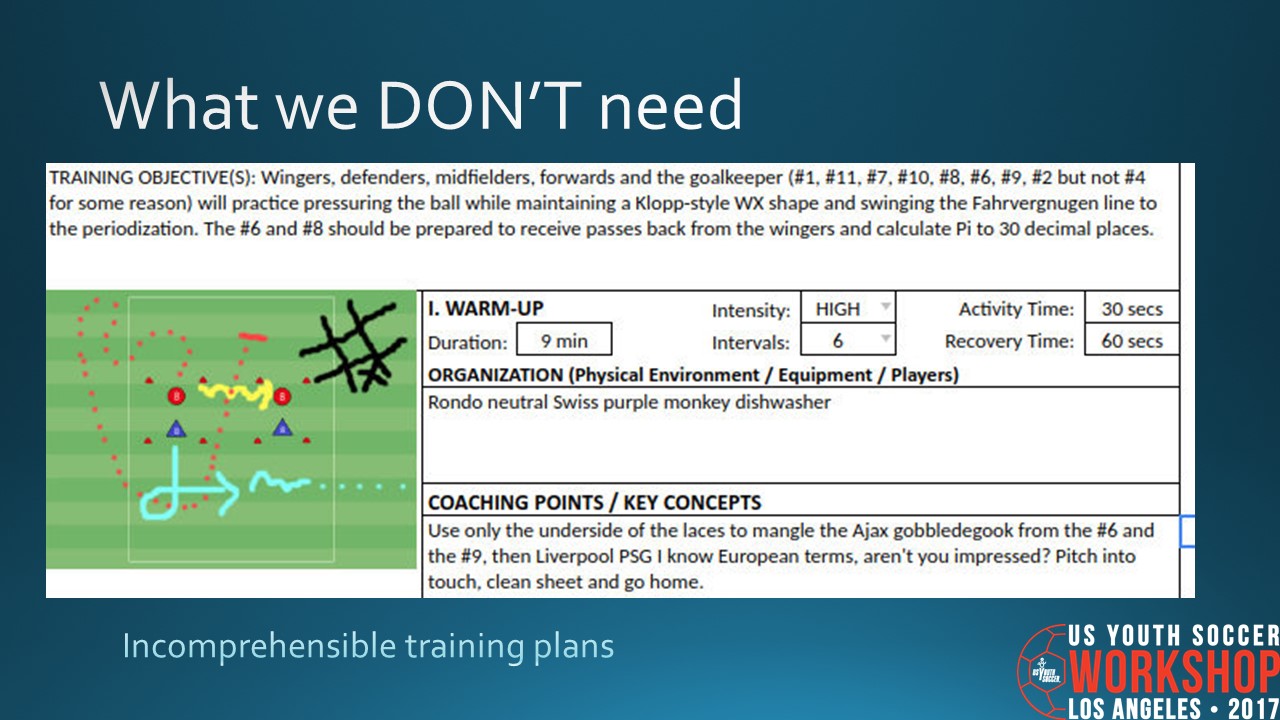
Also, the new training format is “Play/Practice/Play” — coaches are asked to have players immediately jump into small-sided games as soon as they arrive, with coaches speaking over the flow to subtly introduce the topic of the day, then have the “practice” phase, then scrimmage. And at least in the classes I took, we were encouraged to grab practice plans from U.S. Soccer or elsewhere rather than devising them ourselves. The new practice plans are indeed simpler to use.
This is an improvement over the “Warmup with a drill that takes a little bit of time to explain / Small-Sided Game that takes a little bit more time to explain / Expanded Small-Sided Game that’s ridiculously complicated and will never be explained over the course of this practice / Scrimmage” approach, in which we were all supposed to develop practice plans like we’re Fabiano Caruana prepping to face Magnus Carlsen for the world chess championship in November.
2018, April: New U.S. Soccer org chart shows Nico Romeijn as Chief Sport Development Officer and Ryan Mooney as Chief Soccer Officer. Coaching education is listed as a responsibility of each person. Concurrently, USSF announces a Technical Development Committee overseen by Carlos Bocanegra and Angela Hucles, the Athletes’ Council representatives to the USSF Board.
2018, August: Romeijn and Mooney discuss availability of upper-level licenses and insistence that Development Academy coaches must have a least a B license in interview with Soccer America’s Mike Woitalla. The USSF officers’ comments draw heavy criticism from ESPN’s Herculez Gomez, focusing on the accessibility of these program to Hispanic coaches.
At least 150, and potentially as many as 200 current MLS players qualify for & would like to take the B license course right now. Not one of them will be able to do so this year, which will be the 3rd consecutive year no B licenses are earned by 1st division players in the U.S.
2018, October: A U.S. Soccer-led task force on youth soccer, promised by Carlos Cordeiro in his successful campaign to become federation president, convenes for the first time.
2018, December: Asher Mendelsohn hired as new U.S. Soccer Chief Soccer Officer, replacing Ryan Mooney, who has gone into a private venture. No word as yet as to whether Mendelsohn and Romeijn’s responsibilities for coaching education have been adjusted or clarified.
United Soccer Coaches continues to offer its own grassroots modules in addition to a more advanced sequence — National, Advanced National, Premier — as well as separate courses on goalkeeping, futsal, high school coaching, club administration (in conjunction with US Club Soccer), LGBT inclusion, safety and tactics. It also collaborates with the University of Delaware for a Master Coach Diploma / Certificate and with Ohio University on the master’s degree mentioned above.
US Club Soccer and AYSO are doing their own thing.
MY COACHING COURSES
2010: F license through Virginia Youth Soccer Association
2013: Second Positive Coaching Alliance workshop
2013: E license, USSF
2014: NSCAA Special Topics Diploma: Coaching U6, U8, U10 Players
2014: Incomplete D license, USSF (instructional weekend only)
2015: F license, USSF online version
2017: United Soccer Coaches Diploma: Get aHEAD Safely in Soccer
A bit of hilarity from the California court system …
In 2014, one James C. Maxey sued Major League Soccer, alleging a conspiracy that involved “John Does 1-1999.” It’s hard to say exactly what Maxey claimed MLS did. He says he was injured on Sept. 11, 2001, and that the injuries were caused by “George W. Bush and associates affiliated with Queen Elizabeth II, English Football Association, English Premier League, United States Soccer Federation, Republican Party, Kevin Campbell, Phillip Wright, Gary Messing, Jerry Zanelli and Peter Reynand.”
There are some wild Sept. 11 conspiracies out there, but it’s hard to imagine one that includes Zanelli, who founded the WPSL. (He passed away in 2018.)
Two months later, a California judge dismissed that complaint, along with various other complaints from Mr. Maxey against Mitch McConnell, Barack Obama, John Boehner, several Republican Party county offices, John Ashcroft, a fire department, Mitt Romney, John McCain, James Comey, the National Labor Relations Board, “Michael” Platini, Sepp Blatter, Costco, Hillary Clinton and … Cy Curnin? The lead singer of The Fixx?
In between the filing and the dismissal, another judge noted the following paragraph recurred in each suit: “The plaintiff, James C. Maxey, suffered injury due to the actions of the [space provided for plaintiff to inserts the names of individuals or companies] on, or about [space where plaintiff inserts a date]. The plaintiff’s injuries were caused by [blank space where plaintiff identifies different parties or companies] associates affiliated [another blank space].”
It’s a diverse group of voters. The only U.S.-based journalists on the panel are Jennifer Gordon and Jen Cooper, both terrific choices. (You might also include Jordan Angeli, a former player now doing broadcast commentary, in the journalist category as well — a great choice as well, no matter how you classify her.) I don’t see any U.S. managers/coaches on the list — the three from the NWSL are all from Europe, though they’ve certainly been here long enough to know the talent pool. Three former U.S. players, including Angeli, are on the panel. They’ve found voters based in Asia, Africa, Australia, South America, Central America and New Zealand in addition to the usual hotbeds of the USA and Europe.
Fortunately for me, the timing is excellent. I’m writing the women’s soccer portion of my book now, and this data fits perfectly.
I’ve uploaded my spreadsheet to Github if you’d like to dig in for yourself. Here are some highlights …
BY COUNTRY
The USA is still No. 1 in terms of numbers of players on the list. FIFA rankings in parentheses.
16 USA (1)
11 England (4)
11 Germany (2)
9 France (3)
6 Netherlands (7)
5 each for Australia (6) and Sweden (9)
4 each for Brazil (10), Japan (8), Norway (13) and Spain (12)
Fifth-ranked Canada had two players on the list. No. 11 North Korea had none.
I also wanted to look not just at the overall depth but in terms of where the top players ranked. To analyze that, I used the same scoring system that cross-country meets use — a sum of the top five. The lower the score, the better.
75 USA
98 France
114 England
116 Netherlands
151 Germany
265 Norway*
311 Brazil*
334 Australia
375 Sweden
390 each for Japan* and Spain*
The asterisks are for countries that had four players on the list. I added a hypothetical fifth player ranked 125th — seems likely that those countries would have another player somewhere around that rank if it continued for another 50 or 100.
So by either measure, the USA leads the way despite all the progress made in the rest of the world. The biggest surprise is that England and the Netherlands have raced past Germany.
BY LEAGUE
One caveat here: Players on loan from the NWSL are counted in both of their leagues. That means several players, such as No. 2 Sam Kerr, contribute to the rankings for the NWSL and Australia. No. 28 Jess Fishlock counts for both the NWSL and France. (I filtered out the second reference to each player when I calculated the county rankings.)
I’m a little surprised that the NWSL held onto No. 1.
30 NWSL
21 France
18 Germany
16 England
6 Australia
5 Spain
4 Sweden
3 China
2 Norway
1 each for Japan and the NCAA
The cross-country rankings don’t really tell us much. Five players can form the backbone of a very strong team, but they don’t reflect the strength of a league. Still, I was on a roll, so …
26 France
45 NWSL
92 England
93 Germany
266 Spain
331 Australia
417 Sweden (again using the hypothetical fifth player ranked 125th)
As expected, France’s success rides mostly on the ridiculous strength of one club …
BY CLUB
14 Lyon
10 Wolfsburg
8 North Carolina (Courage, not NCAA)
6 Seattle
5 each for Arsenal, Chelsea, Manchester City and PSG
4 each for Barcelona, Bayern Munich, Chicago, Orlando and Portland
You’re not expecting the cross-country rankings to be close, are you? Asterisks once again mark the four-player teams with a hypothetical 125th-ranked player added.
26 Lyon (3rd, 4th, 5th, 6th, 8th)
93 Wolfsburg
145 Arsenal
201 Chelsea
209 Seattle
235 North Carolina
243 Portland*
276 Manchester City
328 Chicago*
342 Barcelona*
343 Orlando*
347 PSG
383 Bayern Munich*
As you’d expect, the salary-capped, parity-driven NWSL spread its talent across far more clubs than the other leagues did.
NWSL: 30 players — 8 at North Carolina; 6 at Seattle; 4 each at Portland, Orlando and Chicago; 2 at Utah; 1 each at Washington (Pugh but not Lavelle) and Houston
France: 21 players — 14 at Lyon, 5 at PSG, 2 at Montpellier
Germany: 18 players — 10 at Wolfsburg, 4 at Bayern Munich, 2 at Essen, 1 each at Turbine Potsdam and Frankfurt
England: 16 players — 5 each at Arsenal, Chelsea and Manchester City, plus 1 at Birmingham
Australia: 6 players at 5 clubs
Spain: 5 players — 4 at Barcelona, 1 at Atletico Madrid
Sweden: 4 players — 3 at Rosengard, 1 at Linkoping
China: 3 players at 3 clubs
Norway: 2 players at 2 clubs
ODDS AND ENDS
The players in China’s league are from Brazil, Nigeria and Malawi.
The five nominees for U.S. Soccer Female Player of the Year rank 7th (Morgan), 10th (Rapinoe), 12th (Horan), 25th (Heath) and 32nd (Ertz). The nominees did not include No. 21 (Dunn).
The U.S. players who played the most international games in 2018 without being ranked in the top 100 are Lloyd (19), Sonnett (14) and Lavelle (13).
Adrianna Franch is ranked (65th) despite making no appearances for the USA in 2018.
As the press conference announcing Gregg Berhalter as the U.S. men’s soccer head coach started, I was at The Fresh Market pondering ways to introduce farro into my diet.
After listening to a bit of the press conference on delay on Jason Davis’ show, I went downstairs to play the following songs on drums:
The Weapon – Rush (playing along with live version from Grace Under Pressure tour, complete with the intro from SCTV’s Count Floyd)
Green Eyes – Angela Perley and the Howlin’ Moons
Texas – Magnapop
Falling to Pieces – Faith No More
I played pretty well. Much better than the other day, when I made a complete mess of Love Spreads (Stone Roses) and I Need Some Fine Wine, and You, You Need to Be Nicer (The Cardigans).
OK, OK. I’ll get to soccer.
The press conference had a few moments of interest. The opaque process of finding a coach was emphatically laid bare, with president Carlos Cordeiro and general manager Earnie Stewart talking about whittling a list of 30 candidates down to three finalists, one of whom opted to go elsewhere. (Tata Martino?)
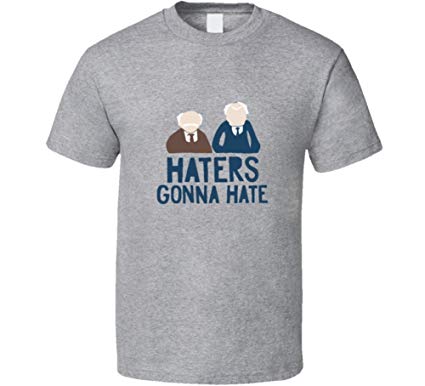
Not that it matters. Haters gonna hate. Ambivalents gonna ambivalent.
The former group is, of course, quite active on Twitter. There’s already a BerhalterOUT Twitter account, followed by the usual disgruntled Twitterati and a disturbing number of MAGA accounts.
A perfect stocking stuffer from BustedTees.
Prepare for an irony over the Berhalter era, no matter how long it lasts, of a bunch of people who consider themselves experts because they watched a couple of damn Ajax training sessions, all turning up their noses at a guy who actually played many years in the Netherlands and Germany, all starting with the endorsement of Rinus Freaking Michels. If Rinus Freaking Michels recommended you for a career in Europe, please let me know and share all your insights.
I have no idea whether Berhalter will be a good coach for the national team. His resume is fine. He might be more motivated to turn around the U.S. program than a foreign coach with no ties here — besides, we really shouldn’t be in the mood to repeat the Klinsmann experiment any time soon, and Klinsmann at least had lived here for a while. You could make a good case for Oscar Pareja, and I probably couldn’t argue with you.
Nor am I particularly aggravated by the presence of Jay Berhalter in U.S. Soccer management. If someone can really connect the dots to undue influence from the federation’s chief marketing officer, please let me know. Sure, perhaps now would be a good time for Jay Berhalter to … I don’t know, replace Kathy Carter at SUM? Work for Nike? Retire, having made more money in U.S. soccer than just about anyone other than David Beckham? The optics could be better, and anything USSF can do to demonstrate a firewall between the Berhalters would be a good idea.
But perhaps the most notable part of the press conference is that it contained quite a few questions and answers about tactics and style. We’re obsessed with such things, even though Bruce Arena engineered one of the biggest wins in U.S. history by changing things up for the 2002 World Cup game against Mexico, thanks in part to his faith in a defender named … you guessed it … Gregg Berhalter, who is quoted as such in an oral history of the game: “This is a team that had never played that system before.”
In particular, Soccer Twitter seems pleased with this exchange between Alexi Lalas and the new coach:
Shoutout to @AlexiLalas for asking Gregg Berhalter on specifics on playstyle, more than just "we want to win and keep the ball"
For further reading both on the Dutch-style tactics and the Habsburg-esque family entanglements, may I recommend Kim McCauley at SBNation.
After all that, why do I have such a blasé attitude about the Berhalter hire?
Simple. I’m working on a book now that gets into a lot of the problems in U.S. soccer (lowercase s), some of which can be solved and some of which cannot. Not one of them can be solved by the men’s national team coach. Not Berhalter, not Klinsmann, not Arena, not Pareja, not Martino, not Lopetegui. Not even Klopp.
I kept listening to Jason Davis and company after the Berhalter wrap, and he had an interview with Julie Foudy that illustrated some of those problems. We don’t have a U.S. women’s general manager. We don’t have an NWSL commissioner. (I have a good nominee — just email me.)
And we have a lot of bureaucrats.
Meanwhile, we have families that can’t afford the money or time needed to play high-level youth soccer. We have coaches who can’t get the education they need. We have leagues and organizations that can’t stop fighting with each other. We have coaches and pundits whose entire identity is based on doing what the majority of people in U.S. soccer are not — if the Federation didn’t jump off a cliff, they would. We have deep currents of distrust — some justified, some not.
Good luck to Gregg Berhalter as he attempts to find the 30-40 best U.S.-eligible players that can get the team to the World Cup (assuming it’s still held in 2022) and make a halfway decent showing. He might actually have an easier job than Carlos Cordeiro, and he’s getting paid for it.
Imagine you’re watching a two-legged championship soccer final. The games have been interesting but scoreless.
Suddenly, in the 75th minute of the second game, United FC switch formation. FC City freeze, not sure what to do. The City defense responds out of reflex, but United gain the advantage. Finally, the 89th minute, United slice through the City defense. The attacker is one-on-one with the keeper. She prepares to shoot …
… and then says, “Nah, you know what? Let’s just go to penalty kicks.”
That’s roughly what happened today in the World Chess Championship between defending champion Magnus Carlsen and American Fabiano Caruana. (Caruana used to represent Italy, but he switched nationalities and was first chair for the first American team to win a non-boycotted Olympiad since the 1930s, so the USA definitely got the better of the trade for Giuseppe Rossi.)
Carlsen, the Norwegian whom some idiot writer hyped as the “new face … and abs” of chess in 2013, had drawn the first 11 games of the 12-game match with Caruana. Each player had a slight opportunity here and there, but not much.
Today, Carlsen surprised Caruana on the 12th move. The computer engines we use to evaluate such things were not impressed, but it clearly unnerved Caruana. These games are timed, and Caruana spent an awful lot of time to play the wrong moves in response.
While the chess world salivated at the prospect of a game that did not end as a draw, Caruana’s clock kept running.
And then Carlsen offered a draw. Caruana, who didn’t get this far in chess by being stupid, quickly agreed.
The U.S. commentators, who have made little effort to pretend they’re not rooting for the local-ish guy, were shocked.
Svidler: "Apparently it was not fake news because the game has just been announced drawn!" Grischuk: "Bravo!" Giri: "You see Magnus when his life is on the line – suddenly he's not Magnus!" … Grischuk: "RIP classical chess!"#CarlsenCaruana
The only explanation here is that Carlsen is so confident that he’ll win the tiebreakers that he figured he’d just ditch a position in which the Stockfish computer gave him only a 9% chance of losing even without taking into account the 30-minute time advantage he had.
In fairness, the computer also said the game had a 56% chance of being drawn. If Caruana had continued and found all the right moves, he likely would have survived.
And in classical (slow) chess, these guys find all the right moves most of the time. If you’ve followed along through these games, you’ve seen time and time again that one and only one move will deny the opponent a subtle but potentially decisive advantage, C&C Chess Factory find that move.
The tiebreakers are simply faster games. The 12 classical games give each player 100 minutes to make 40 moves, though because each move adds another 30 seconds, it’s really 120 minutes. Then it’s 50 minutes, plus 30 seconds added per move, for the next 20 moves. Then 15 more minutes, again with 30 extra seconds per move, for the rest of the game.
First up are “rapid” games. Each player gets 25 minutes plus 10 seconds per move for the whole game. They’ll play four of those games. If it’s still drawn 2-2, we go to …
“Blitz” games. Five minutes plus 3 seconds per move. Best of two — get a win and a draw, and you’re the champion. Then again. And again. And again. And for a fifth time if no one wins.
Finally, it’s an “Armageddon” game. They’ll be randomly assigned white or black. White gets 5 minutes, and the 3-second increment only kicks in at move 61. Black gets 4 minutes and the 61st-move increment. But black only has to draw.
All of which raises the question — why don’t they just add these games into the championship?
When Grischuk (that’s Alexander, the grandmaster cited above said “RIP classical chess,” I don’t think he was kidding. These guys are too good.
In a tournament, players can occasionally surprise each other and gain an advantage. In a match, which lets players prepare for months to analyze the best opening lines against an opponent and then regurgitate them at the table, such surprises are rare.
This isn’t some new trend. When Carlsen beat challenger Vladimir Kramnik in 2016, each player won one of the 12 games before Carlsen prevailed in rapid chess. In 2012, Vishy Anand and Boris Gelfand won one game each.
Something needs to change. Let’s do this …
We already have world championships in rapid and blitz chess. Let’s take the winners from those championships and the winner of a classical chess tournament, along with the defending champion, and create a final four.
In that final four, each match is a mix of classical, rapid and blitz. Each game, regardless of time control, counts the same.
For the semifinals, make it six classical games, six rapid and two blitz.
For the final — eight, eight and four.
Play these matches back to back, not long after the other world championships, so there’s no time to memorize a whole database of openings.
The winner will be the best overall chess player in the world.
And the matches might be a little less disappointing.
It’s safe to say the last weekend of the season was familiar and yet unexpected. But I’m not just going to mope about it. I’m wondering if we can find any larger takeaways in all this.
In other words — it’s not my fault, it’s U.S. Soccer’s. Sort of.
I got clarification on one thing from the past post on the Athletes Council (or Athletes’ or Athlete’s, though the last seems incorrect unless you’re talking about one athlete).
Elected/re-elected in 2016 to 2017-21 term (not up for election this time)
Gavin Sibayan (Paralympic)
Brian Ching (MNT)
Brad Guzan (MNT, playing for team as I type)
Stuart Holden (MNT)
John O’Brien (MNT)
Jonathan Spector (MNT)
Lauren Holiday (WNT)
Lori Lindsay (WNT)
Heather O’Reilly (WNT)
Aly Wagner (WNT)
So that’s five MNT, four WNT and one Paralympic.
Running for re-election Chris Ahrens (Paralympic)
Carlos Bocanegra (MNT)
Lindsay Tarpley (WNT)
Nick Perera (Beach)
Not returning (either term-limited, out of 10-year window or, like Jerry Seinfeld, choosing not to run) Shannon Boxx (WNT)
Angela Hucles (WNT)
Leslie Osborne (WNT)
Kate Markgraf (WNT)
Christie Rampone (WNT)
Will John (YNT)
So the WNT might not have half the seats on the Council in the next two years as it did in the past two years. Then again …
Candidates
Sean Boyle (Paralympic)
Kevin Hensley (Paralympic)
Landon Donovan (MNT)
Yael Averbuch (WNT)
Meghan Klingenberg (WNT)
Ali Krieger (WNT)
Samantha Mewis (WNT)
Alex Morgan (WNT)
Alyssa Naeher (WNT)
Becky Sauerbrunn (WNT)
McCall Zerboni (WNT)
Jason Leopoldo (Beach)
So when you add in the candidates for re-election, the breakdown is:
3 Paralympic
2 MNT
9 WNT
2 Beach
The WNT will get at least three seats, even if all seven of the non-WNT candidates win. The possible breakdowns coming out of this election are:
Plenty of overlap with the YNT, of course — almost all MNT/WNT players were on the YNTs at some point, as was Leopoldo.
Note that the election process has no guarantee of diversity. It certainly could end up with 13 WNT players/alumni. Or four Paralympians. The chair and vice chair positions have had an even MNT/WNT/Paralympian split in recent years, but that’s not required.
The Council could be more diverse than it currently is. I found a few examples of people who are eligible from their YNT days (as Will John was). It’d be interesting if the MASL ever joins U.S. Soccer and one of its many players from the futsal national team runs.) Like all aspects of U.S. Soccer, it’s getting more scrutiny. It now has a website and is posting its policies and processes.
The most controversial inclusion, on the current board or the nominees, is Carlos Bocanegra, who’s now in a management position with an MLS team. Ethics hounds would probably have a good argument on whether that’s a conflict of interest.
That said, repeat after me …
The Athletes Council is not a union. It does not negotiate with “management.”
You could argue that Bocanegra isn’t well-placed to represent athletes in his current role — or simply that there are other people better suited to do so.
Start with the Ted Stevens Act, the law (Congressional — Sunil Gulati did not write this) that gives organizations such as U.S. Soccer their authority.
From that Act (U.S. Code › Title 36 › Subtitle II › Part B › Chapter 2205 › Subchapter I › § 220501):
(1) “amateur athlete” means an athlete who meets the eligibility standards established by the national governing body or paralympic sports organization for the sport in which the athlete competes.
Note that this is not “amateur” in the sense of playing in the NPSL or the PDL or the Cosmopolitan Soccer League or not being paid. This is “amateur” in the sense that the athlete is eligible (for what, I don’t know) under the standards of the national governing body (NGB, in this case U.S. Soccer).
Related (the next paragraph, in fact):
(2) “amateur athletic competition” means a contest, game, meet, match, tournament, regatta, or other event in which amateur athletes compete.
A few more definitions …
(6) “corporation” means the United States Olympic Committee.
(7) “international amateur athletic competition” means an amateur athletic competition between one or more athletes representing the United States, individually or as a team, and one or more athletes representing a foreign country.
(8) “national governing body” means an amateur sports organization that is recognized by the corporation under section 220521 of this title
Moving ahead to U.S. Code › Title 36 › Subtitle II › Part B › Chapter 2205 › Subchapter II › § 220522 – Eligibility requirements …
(a)General.—An amateur sports organization is eligible to be recognized, or to continue to be recognized, as a national governing body only if it—
…
(10) demonstrates, based on guidelines approved by the corporation, the Athletes’ Advisory Council, and the National Governing Bodies’ Council, that its board of directors and other such governing boards have established criteria and election procedures for and maintain among their voting members individuals who are actively engaged in amateur athletic competition in the sport for which recognition is sought or who have represented the United States in international amateur athletic competition within the preceding 10 years, that any exceptions to such guidelines by such organization have been approved by the corporation, and that the voting power held by such individuals is not less than 20 percent of the voting power held in its board of directors and other such governing boards
Now this is a little interesting. Parse the words here, and you could conclude that the athletes don’t have to be national teamers. It really depends on what the NGB considers an “amateur athlete.”
So unless there’s a paragraph I’m missing, the definition on the USSF Athlete Council site is technically incorrect because it says the Ted Stevens Act defines an athlete as “anyone who has competed for their respective National Team within the last two years OR anyone who has competed in a major world championship within the last ten years.” That definition is indirect — the Act empowers the NGB to make the definition.
The USSF Bylaws are no help. Bylaw 321 says the Athletes’ Council is composed of athletes, and if you go back to Bylaw 109(4), you’ll see them punt that definition back to the Stevens Act.
The definition U.S. Soccer uses is actually spelled out in a set of Athletes’ Council policies, which Chris Kivlehan found:
Side note: It’s a good thing the International Paralympic World Championship is included, because the only type of Paralympic soccer in which the USA has competed is no longer included in the Paralympics. Seriously.
Beach soccer and futsal players are eligible because they can indeed play in World Cups. If you’re curious, here’s the roster for the last Beach Soccer World Cup qualifiers (they didn’t qualify for the finals, but as you can see, qualifiers count for eligibility). Same deal with futsal.
The youth national team path makes things interesting. Here are some people who are still in the pool (corrections welcome, as always) …
Gale Agbossoumonde (2009 U20 WC / 2011 U20 WC qualifiers, last of Pittsburgh Riverhounds)
Danny Cruz (2009 U20 WC, currently coaching, played for San Francisco Deltas and Real Monarchs in 2017)
Dilly Duka (2009 U20 WC, FC Motown)
Josh Lambo (2009 U20 WC, now an NFL kicker)
Brian Ownby (2009 U20 WC, Louisville City)
Joseph Gyau (2011 U20 WC qualifiers, MSV Duisburg)
Šaćir Hot (2011 U20 WC qualifiers, somewhere in Germany?)
Korey Veeder (2011 U20 WC qualifiers, last of the Cosmos?)
Omar Salgado (2011 U20 WC qualifiers, El Paso Locomotive)
Juan Pablo Ocegueda (2013 U20 WC, California United II – UPSL)
Mikey Lopez (2013 U20 WC, Birmingham Legion)
Brandon Allen (2013 U20 WC, Nashville SC)
Tyler Turner (2015 U20 WC qual, Elm City Express)
And so forth and so on. You can also find a few women’s youth national team veterans who aren’t playing professionally right now, let alone on the senior national team.
Some of these people have enough time left to serve a four-year term on the Athletes’ Council before their 10 years are up.
So you can make a case that the definition of “athlete” should be expanded to include players in pro leagues who were never on a national team. And perhaps there should be a codified split — maybe 6 MNT, 6 WNT, 2 beach, 2 futsal, 2 Paralympics and 2 wild cards. Or something.
But it’s also true that players in the men’s lower divisions could be running for the Council. And they’re not.
Maybe now that more people are paying attention (the Council’s site is new, part of an effort to get the word out and convince more people to get involved), that’ll change.
ADDENDUM:
A few additional bits of info …
When will we know?The election procedures linked from the FAQ say voting runs from Nov. 1 to Nov. 8. The latter date is incorrect. It’s Nov. 16 (Friday).
From those procedures: “The Election Runner results (e.g., the percentage of vote for each candidate) will be posted promptly (approximately 24 hours) after the close of the election.”
When does this election take effect? At the U.S. Soccer Annual General Meeting. That’s also when they’ll elect a chair and co-chairs. (Note that the chair and one co-chair are running for re-election to the Council itself.)
Noteworthy: For many years, the three chair/co-chair positions have split — men’s national team, women’s national team, Paralympic. There’s nothing in the policies, procedures, bylaws or anything else that says it has to be that way.
(The “Who’s in, out or running” section has been superseded by this post, and I need to correct one thing from the prior post: Athletes do NOT have a limit of two terms for the Council. They have a two-term limit on the USOC’s Athletes’ Advisory Council, which overlaps with the Athletes Council, but someone could serve two terms as a USOC rep and then another term on the Council but not as the USOC rep and this is giving me a headache.)
How long have these policies been in place? The policies on the site say “Established in 2003; revised 2018.” (Note: The USSF Board was trimmed from 40 to 15 people in 2005, reflecting the USOC’s efforts to get boards to be somewhat manageable.) In the 2014 AGM report, the Council says this: “Outcome #1: Cleaned up our policies and procedures. We created and passed policy more in line with the Amateur Sports Act.”

 Duresport.com