general sports

The definitive word on participation trophies …

From a Cracked piece responding to a rant about Millennials:

Simon, let me tell you about my participation trophies. I got them for playing soccer, and they were handed out from a bag at the end of the year with all the ceremony of communist factory workers getting their lunch rations. My response was not “Well, clearly I’m going to be handed a six-figure job as an adult.” It was “Neat, a trophy! Now I’m going to go back to thinking about Pokemon or farts, because I am a child.” Later it was a nice reminder of time spent playing with my friends, and as I got older, eventually only the teams that won were rewarded. This did not shock and sadden us — it was what we expected, and wanted, because we were actually capable of observing adult society, and we noticed that pro sports teams weren’t handed many trophies for constantly losing.

Source: This Millennial Rant Deserves A Trophy For Being Most Wrong

youth soccer

How far would you travel for travel soccer?

Alternative youth soccer leagues are almost as popular these days as alternative facts.

I’ve spent the last month doing interviews and compiling data for an upcoming story to see how we stand on the fine line between awesome and absurd. That reminds me: Today is the last day to take my survey about leagues in your area and whether they strike the right balance between competition and spending entire weekends in cars and hotels.

The data is now available in map form, showing more than 300 Under-14 boys teams in Region 1 and the leagues in which they play. Here’s the full version:

Here’s the methodology:

The age group: I chose U14 boys because this is the last year before a lot of teams sit out league seasons to allow kids to play high school soccer. They’ll usually play in a few tournaments during that season off, but the point here is to show the leagues. Tournaments are another issue entirely. I chose boys rather than girls because there are more teams (the reasons for that are yet another rant) and because the girls are getting a new Development Academy next year that will throw everything for a loop.

Yes, the boys also have a new league — the boys ECNL, which is represented here.

The rankings: Youth soccer rankings are generally ridiculous. Teams enter every tournament they can in an effort to boost their numbers at GotSoccer so they can brag to their friends and (they think) impress college coaches. They’re also based on results, which can be deceiving (another reason I chose U14 rather than U11 or U12, where kids are still learning the game and one team with a good goalkeeper may beat a far superior team whose goalkeeper is scared of the ball). Some teams I know to be outstanding are poorly ranked or not ranked at all because they’ve either reorganized or simply not played enough games. And you may still have some rogue results because some team’s star player needed math tutoring or was at a cousin’s wedding the weekend of the biggest tournament of the year or whatever.

With that disclaimer out of the way — yes, I used rankings here. I took the ever-controversial GotSoccer as well as a lesser-known site called YouthSoccerRankings, which seems to have more league results as well as a handy tool for soliciting corrections.

The idea behind using two ranking systems was to cast a wide net. Some teams had incomplete records with one service or were missing entirely, but then the other site would have the info. I calculated an overall ranking based on the higher of the two rankings. Then I took the top 300 teams, plus any other teams that play in self-proclaimed elite leagues.

So the numbers are all included, but please take them with a grain of salt. They update quickly — I pulled the YouthSoccerRankings numbers in the middle of last week, and they changed the next day. I’m hoping to get a general idea of where the top teams in Region 1 are playing, and I’ve surely missed a few. I’m not trying to start an argument between overbearing soccer dads in Massachusetts and Virginia because one kid’s team is ranked 45th and another is 58th.

The leagues: “What league are you in?” is not a simple question. Some teams switch leagues between fall and spring, and some play in multiple leagues in the same season. A handful of teams aren’t in a league at all, at least in the spring. I tried to find either the team’s most recent league or the league into which they’re moving this fall (particularly the new ECNL, but also a few other elite leagues replacing ECNL-bound participants).

And in some cases, it’s hard to tell what qualifies as a separate team and what doesn’t. Both of the ranking sites have a lot of duplicates — a team may be “River Otters Premier Black” at one tournament and “River Otters NH North Coast Premier” at another. I did all I could to catch duplicates, and I deleted teams that seem to be one-offs for specific tournaments or otherwise not consistently active.

The leagues are …

The national big dogs

U.S. Soccer Development Academy (DA): Clubs are invited by U.S. Soccer and only play each other. Many are professional clubs (MLS, NASL). No additional tournaments. Players cannot play high school soccer while enrolled in the DA. Launching a girls version in fall 2017.

Elite Clubs National League (ECNL): The girls version has existed for several years. U.S. Club Soccer is launching a counterpart for boys in fall 2017. It competes head-to-head with the Development Academy, offering no MLS affiliations but more flexibility. Teams can compete in outside tournaments but usually not traditional State Cups (U.S. Club Soccer is starting to do its own, which is yet another rant), and players can often play in high school.

U.S. Club Soccer National Premier Leagues

Not to be confused with U.S. Club Soccer Premier Leagues, which also exist.

Elite Development Program (EDP): A hybrid of many things spanning I-95 from New York to Northern Virginia. The top division is considered a U.S. Club NPL and therefore a qualifier for other competitions. Divisions below that are tiered and regionalized. In some areas, it has become the de facto primary league. Farther south, it attracts teams looking for “elite” play — teams often move over their local league’s top division. But it’s not exclusive — the lowest divisions have teams that aren’t ranked anywhere near the top 300. The teams on the map are ranked in the top 300, sometimes reaching down to the league’s sixth tier (Championship 2). For purposes of the map, teams below the NPL division are grouped regionally regardless of division. That’s EDP-North (1N, 2N, PN1-2, CN1-3), EDP-Central/East (1C, 2C, 2E, PC1-2, PE1-2, CC1-4) and EDP-South (1S, 2S, PS1-2, CS1-2). Several clubs are moving their top teams to the ECNL but will likely have other teams remain here. Some teams also play in other leagues and are listed with their base leagues.

New England Premier League (NEP): Also a hybrid of sorts. The Premier League is the top division of the New England Premiership. The NPL division is much larger than the EDP’s NPL division. Teams listed here are any teams in the NPL division (excluding FC Stars and FC Boston Bolts, which are moving to the ECNL) and any other teams in the top 300. Divisions: Premiership (NEP-P), Premiership-1 (NEP-P1), Championship (three regions: NEP-CC, NEP-CN, NEP-CS), League 1 (NEP-L1N, NEP-L1S) and League 2 (NEP-L2).

New York City Soccer League (NYCSL): Another large hybrid league, and this one’s especially confusing. The NPL division is the top division. Then comes Metro (NYCSL-M). Then the Premier League, which has multiple tiers (NYPL-1, NYPL-2, etc.). Though it’s called the NYC Soccer League, it reaches out into suburbs in other states. Next year, East Meadow SC will move its top team to the ECNL.

Virginia Premier League (VPL): A club-centric league. Games are scheduled so that each club’s teams in each age group play its counterparts in another club on the same day. No promotion/relegation. (Disclaimer: I live in Vienna and have had kids in that club’s rec program, and I know quite a few coaches, board members, etc. I also happen to think they should ditch this league. Their top girls teams don’t have enough competition; some of the boys teams have too much.)

Regional elite leagues (not U.S. Club Soccer)

Atlantic Premier League (APL): Teams in New Jersey, Pennsylvania, Delaware, and Maryland. Two divisions in fall, one division in spring. Map accounts for all D1 teams in either season except Penn Fusion SA Elite and Continental FC Barca, which are leaving for the ECNL.

Club Champions League (CCL): Like VPL, scheduling is club-centric, with no promotion and relegation. The league covers Virginia and Maryland and also operates CCL2, which includes CCL clubs’ B teams as well as few other clubs’ A teams. The map accounts for all CCL clubs and the top CCL2 teams except Braddock Road and Maryland United, which are leaving for the ECNL. The site cleverly hides schedules and results, so a lot of the home fields in the map are educated guesses.

Local leagues

National Capital Soccer League (NCSL): A traditional local promotion/relegation league covering the D.C. metro area and sometimes beyond, reaching down to Fredericksburg, up to Baltimore and out to West Virginia. The teams on the map are ranked in the top 300, sometimes reaching down to the league’s fourth tier. It’s included here because it has 15 teams in the top 300, far more than any other local league. (Disclaimer: I have a son who plays in this league. His team is neither U14 nor in the top 300 in the region.)

The other local leagues, in order of number of teams represented:

Thruway League: West and Central New York.

Connecticut Junior Soccer Association (CJSA): Elite and Premier Leagues.

Connecticut Club Soccer League (CCSL): A U.S. Club Soccer league.

Pennsylvania West Classic League (PA West): The top teams also play in the Eastern Regional League, many skipping the spring PA West season.

DELCO: Eastern Pennsylvania.

Eastern New York Premier League (ENYPL): The name says it all.

Vermont State League: Another well-named league.

Virginia Soccer League: Central and Southeast Virginia (Richmond to Hampton Roads).

Westchester Youth Soccer League (WYSL): U.S. Club Soccer league in eastern New York. Top division is called Premier League and is difficult to find on the site.

Cosmopolitan Junior Soccer League (Cosmopolitan): New York City.

Fall Classic League (FCL): Maine. I hope they have lighted fields.

Inter-County Soccer League (ICSL): Pennsylvania East.

Northeast Soccer League (NSL): Mostly Massachusetts, with some from New Hampshire and Rhode Island. Joining U.S. Club Soccer in the fall.

South Jersey Soccer League (SJSL): Again, the name is apt.

The map does not have separate dots for the Eastern Regional League (ERL), a qualification-based U.S. Youth Soccer league. Most ERL teams also play in a local base league, and each ERL team is noted in the descriptions.

x x x

I did a second version of the map as well, limiting this one to the DA plus 100 teams. Again, I’m sure some teams in the 200s can beat some teams in the 80s. I just wanted to get another, slightly cleaner look at it to demonstrate that there are some objectively good teams out there that are near each other and don’t play each other.

Then for those who would rather see static snapshots than play around with a Google Map, let’s take a look at a couple of big areas. Here’s the D.C. metro area in the larger map with 300+ teams in the region:

You can see the inroads EDP (blue circles) has made, especially in Maryland, and you can see the hodge-podge of other leagues dividing my homeland of Northern Virginia.

When we limit the regional map to 100+ teams, it looks like this.

In contrast, New York looks a little more cohesive:
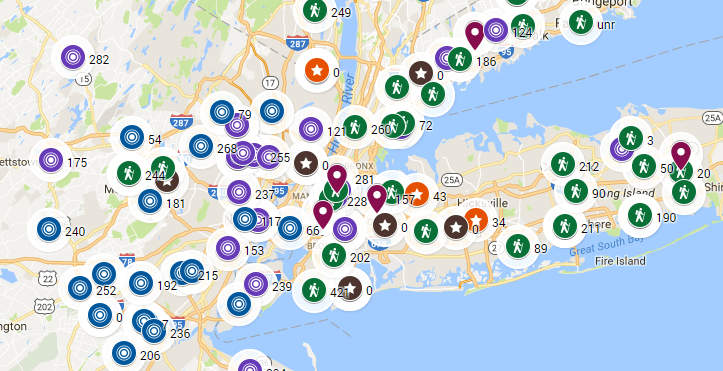
Here it is at 100+:

That’s several DA teams (black circles/white stars), a couple joining ECNL (reddish circles/white stars), a whole lot of EDP North and EDP Central (blue and purple circles), and then a few in the NYCSL (hiking guy in green), particularly on Long Island.

That should be enough to start the conversation. I’m also happy to share my data. I may do it by Google Sheet, or I may go back to trying to figure out Github. Suggestions welcome.

Then be on the lookout later this week for a story about whether this has gotten absurd.

soccer

Washington Spirit 0-1 FC Kansas City: History and repeating

Something new: Mallory Pugh became the first U.S. teenager in the NWSL and, as far as I know, the first U.S. teenager in a pro women’s soccer league.

Something old: The Spirit couldn’t turn their chances into a goal, losing 1-0 for the third time in four home games.

In most respects, though, both teams exceeded my expectations. Maybe I’m just getting old and pessimistic. But the Spirit’s oft-sputtering offense created some chances even without Tori Huster in the midfield to drive them forward. The defense had nowhere to go but up after conceding six in Seattle, but they went beyond “avoiding catastrophe” to “limiting chances.” FCKC’s defense is simply superb, and the offense capitalized on its one good chance.

“We’ve been working all week on getting in the box and finding space,” Newfield said. “I happened to be in the right place at the right time. Syd claims she flicked it over to me on purpose.”

When told Opta had ruled later in the game that Leroux would get an assist on the play, Newfield quipped, “They must have heard her talking at halftime then.”

The Spirit had a few good chances, but two weeks after her offensive explosion against Sky Blue, Francisca Ordega’s touch deserted her. Cheyna Williams got into good spots but shot straight at Nicole Barnhart multiple times. The best chances were from Kristie Mewis — the first after Arielle Ship’s slick move on the left …

… the second on a free kick …

… and another on a free kick.

Unfortunately for Mewis and the Spirit, Becky Sauerbrunn is apparently psychic and had positioned herself right where that ball was going to go.

“When (Nicole Barnhart) was setting the wall, I asked, ‘Do you want me to come back?'” Sauerbrunn said. “She said yeah. Literally, I was trucking back, and Kristie Mewis nailed it off my chest.”

Was that how you drew it up, Vlatko Andonovski?

“I’m gonna say that I was happy with the restarts.”

First time I’ve talked with the FCKC coach after a win. He’s amusing.

And KC needed this. They have playoff potential as usual, but five points in five games won’t cut it.

Andonovski insists that they’re not just going Route 1 to Leroux.

“We were changing it as the game was going on. Sometimes we were a little more possession-oriented and looking for those gaps and opportunities, and sometimes we were direct. We were going to take what they give us. When they put pressure on us and overload numbers in our defensive third, we had to go over the top and find the runners. Then there were times they were sitting a little bit lower, and we started building it from the back.”

Besides, direct play gets a bad rap at times. If someone can whack a 50-yard diagonal ball that sends Leroux into a foot race against a terrified defender, that’s worth trying a few times a game, isn’t it?

Meanwhile, the Spirit’s ambitions are going to be a bit lower this season. Before the rash of injuries, they were a long shot to make the playoffs for a fourth straight year. Now? Nearly impossible.

But tonight’s game gave a few glimpses of potential. Cheyna Williams just seems to be a touch or two away from having that breakout second season that so many NWSL attackers have. When healthy, Mewis and Huster are a powerful midfield engine.

And that new kid out on the left wing in the second half looked pretty good, too. I wonder if Jill Ellis, who was sitting right in front of the pressbox, happened to catch her name.

youth soccer

Survey: How many (too many) youth soccer leagues in your area?

Development Academy! ECNL, for girls AND boys! A different U.S. Club Soccer league! A traditional U.S. Youth Soccer league! Something else your local clubs set up and convinced you that you need to drive 300 miles for a league game!

I’m doing a project on soccer leagues and whether we’re making families travel too much to play travel soccer. I’ve seen it quite clearly here in the D.C. metro area, but I’d like to hear how it is elsewhere. Is this a nationwide problem, or is it just in a few regions?

So if you’re a coach, technical director or other soccer admin-type, won’t you please take a couple of minutes to fill out this survey?

soccer

Washington Spirit 0-1 Houston Dash: Random thoughts

Houston is not that bad.

Yes, the Dash lost 5-1 to Seattle, which lost 3-0 to Boston. It’s an unpredictable league. If you want predictability, watch the Celtic men or Lyon’s women demolish their domestic leagues.

Anyway …

Kealia Ohai was a monster. Her goal, which Washington defender Estelle Johnson simply called “a great play by a great player,” wasn’t even her best play of the game. She was a constant threat down the left wing and put the “track” in “tracking back.” She’s a blur at top speed, even on a hot night in the D.C. exurbs. “It’s a lot of running, but I think that’s my strength,” she said in an early nomination for Understatement of the Week. And she likely would’ve contributed to another goal or two if not for …

– Estelle Johnson, who is having a breakout season at age 28. She managed to get forward and spark the Spirit’s second-half attack even while racing back to deal with the consistent threat of Ohai. She says she’s working on getting forward — “it’s something new that I’m learning” — which is certainly easier when the Spirit abandon the three-back system and go with four. “I’m just constantly a student of the game. I think my mentality from last year to this year is different — more positive and more confident.”

“She’s awesome,” Ohai said.

– Ohai and Rachel Daly were unable to offer any sort of explanation for their goal celebration, in which Daly winds up and tosses an imaginary softball and Ohai hits it out of the park. They simply started doing it out of the blue in preseason, and it stuck. Daly is from England and says she has never played softball. Go figure.

– The Spirit played timidly in the first half. Johnson said it’s something they need to address. (I saw a youth soccer team play timidly and lose 6-0 earlier today on the first part of my Complete Loop Around The Beltway, so it could’ve been worse.)

– Did a ref assessor visit the ref at halftime? The first half featured a contest in which Dash players tried to see who could commit the most obvious foul on Francisca Ordega. In the second half, Ordega drew a soft foul early on, and the ref cracked down on everything.

– Will the Spirit finish last? I was not one of the people who picked them last in preseason. Like most people who’ve watched the team, I figured they’d be somewhere around seventh or eighth.

Now?

You could look at it this way — even without Joanna Lohman, Kristie Mewis, Katie Stengel, Cheyna Williams, Cali Farquharson, Kelsey Wys and Caprice Dydasco, and with only 16 players dressed, the Spirit were still in this game until the final whistle. But they’re not getting Lohman back, and Wys would only displace the in-form Stephanie Labbe.

The attacking players pushed into the positions Mewis, Williams, Stengel and Farquharson have left open simply haven’t been up to the task. Through three games, the Spirit have had seven shots on goal and one goal.

Mewis might be back next week. But the player they really need is Williams, who seemed poised for that second-year breakthrough so many NWSL players have.

– Will Houston be a factor? Too soon to tell. But their ball movement was sharp. They’re fast and strong. And they’re due to end the season with Carli Lloyd, which could either put them into the playoff mix or ruin what appears to be solid team chemistry.

medal projections, winter sports

2018 medal projections: 31 today

NBC’s Nick Zaccardi has taken care of something I had planned to do, rounding up this winter’s World Championship results into a medal projection.

His numbers:

34 Germany
28 USA
27 Norway
26 Canada
22 France

Compare this to the most recent Virtual Medal Table from Gracenote, which compiles all results:

34 Germany
34 Norway
31 USA
29 Canada (only 5 gold)
23 Russia

I haven’t done a full-fledged projection (and I might not), but I’ll take a quick pass through the World Championship results and assign a plus or minus to Nick’s count:

ALPINE SKIING

Medals won: 3

  • Mikaela Shiffrin: gold, slalom
  • Shiffrin: silver, giant slalom
  • Lindsey Vonn: bronze, downhill

Shiffrin won Sochi slalom gold at age 18. Now she’s the overall World Cup champion, dominating in slalom and running quite well in giant slalom. If Vonn’s healthy, she can do it again. The U.S. men can surprise, but if you’re crunching numbers, no one’s near the podium.

Reasonable projection: 3

BIATHLON

Medals won: 2

  • Lowell Bailey: gold, 20k individual
  • Susan Dunklee: silver, 12.5k mass start

Breakthrough! At long last, Bailey and Dunklee put it all together and took major hardware. There’s no reason they can’t do it again, but unless you’re Laura Dahlmeier or Martin Fourcade, biathlon success can be fickle.

Reasonable projection: 1 (-1)

BOBSLED/SKELETON

Medals won: 2

  • Elana Meyers Taylor / Kehri Jones: gold, women’s bobsled
  • Jamie Greubel Poser / Aja Evans: bronze, women’s bobsled

North American women are dominant these days — Canada’s Kaillie Humphries took the middle spot on the podium. The ever-reliable Steven Holcomb was in the World Cup overall top three in both two-man and four-man. The skeleton crew isn’t doing quite as well but still picked up a couple of World Cup podiums.

Reasonable projection: 3 (+1)

CURLING

Medals won: 0 so far; mixed doubles is ongoing

John Shuster made the World Championship bronze-medal game for the second straight year but couldn’t follow through on his breakthrough medal from last year. Nina Roth finished fifth, and breaking that top four will be tough. The wild card: mixed doubles. Joe Polo and Tabitha Peterson took bronze last year, and Becca and Matt Hamilton have gone unbeaten in round-robin play. The Round of 16 and quarterfinals take place today.

Reasonable projection: 1 (+1)

FIGURE SKATING

Medals won: 2

  • Maia Shibutani / Alex Shibutani, bronze, ice dancing
  • Team, bronze (in World Team Trophy)

We can read the World Championship disappointment two ways. Maybe it means the USA just isn’t able to deliver. Or maybe it means phenoms Karen Chen (fourth) and Nathan Chen (sixth) now have the experience they need to blast through the competition next year. Also, two ice dancing medals are a good possibility.

Reasonable projection: 3 (+1)

FREESTYLE SKIING

Medals won: 6 (not including non-Olympic dual moguls)

  • Jonathon Lillis, gold, men’s aerials
  • Ashley Caldwell, gold, women’s aerials
  • Aaron Blunck, gold, men’s halfpipe
  • McRae Williams, gold, men’s slopestyle
  • Gus Kenworthy, silver, men’s slopestyle
  • Devin Logan, bronze, women’s halfpipe

Yeah, the USA is still pretty good in the X Games sports, and they’ve come roaring back in aerials. Two aerials golds and two men’s slopestyle medals may be tough to repeat, but the U.S. team has legitimate challengers across the board.

Reasonable projection: 6

ICE HOCKEY

Medals won: 1 (so far; men yet to play)

  • U.S. women, gold

They settled their labor dispute and won a world title. As always, we’re expecting a USA-Canada final. The men’s competition is completely up in the air — with NHL players apparently not getting time off to go, we might be back to the era of U.S. amateurs playing European pros.

Reasonable projection: 1

LUGE

Medals won: 2 (not including non-Olympic sprint events)

  • Erin Hamlin, silver, women’s
  • Team, silver

In Hamlin we trust. And we should point out the World Championships weren’t in North America this year, so don’t chalk this up to home-ice advantage. Tucker West has a shot in the men’s event and strengthens the team for the relay.

Reasonable projection: 2

NORDIC EVENTS (cross-country skiing, ski jumping, Nordic combined)

Medals won: 3

  • Jessie Diggins, silver, sprint
  • Kikkan Randall, bronze, sprint
  • Diggins / Sadie Bjornsen, bronze, team sprint

Randall came roaring back after maternity leave. Diggins is now a true all-event threat, placing sixth in the World Cup. Still, sprints can be messy, and repeating the 2-3 from Worlds is far from guaranteed.

Reasonable projection: 2 (-1)

SNOWBOARDING

Medals won: 3 (not including several non-Olympic events)

  • Lindsey Jacobellis, gold, women’s snowboard cross
  • Chris Corning, silver, big air
  • Corning, bronze, slopestyle

No halfpipe medals? What in the name of Shaun White is going on here? That won’t happen next year.

Reasonable projection: 5 (+2)

SPEEDSKATING (long-track)

Medals won (World Single Distance): 4

  • Heather Bergsma, gold, women’s 1,000 meters
  • Bergsma, gold, women’s 1,500 meters
  • Bergsma, bronze, women’s mass start
  • Joey Mantia, gold, men’s mass start

It’s easy to lose faith after the flameout in Sochi, but Bergsma was overwhelming on the World Cup circuit (6-for-6 at 1,000 meters, 3-for-5 at 1,500). Brittany Bowe is working her way back. Mantia and Shani Davis had a few podiums as well.

Reasonable projection: 4

SPEEDSKATING (short-track)

Medals won: 0

John-Henry Krueger and J.R. Celski each had one World Cup bronze, and the men’s relay reached the podium once in six tries.

Reasonable projection: 0

TOTAL PROJECTION: 31.

soccer

Why the Washington Spirit should make a deal with Portland

Let’s get a few things out of the way first. The Washington Spirit have problems — some of their own making, some not. (Some of this was covered earlier in my Guardian piece on the club’s issues.)

  • Last year’s national anthem fiasco was, first of all, the wrong decision on the club’s part. (Make no mistake — a lot of people spoke up in support of Bill Lynch, just not within the narrow confines of the women’s soccer community. But you simply can’t make a point about patriotism by stifling peaceful free expression. And I’d challenge the people who said “Oh, I’m a Spirit fan now!” to actually show up at some games this year.)
  • The anthem fiasco was also symptomatic of a persistent issue with the club, which is that it simply does not get public relations. That’s not the fault of the people who’ve done the club’s PR work. It’s higher up.
  • Along those same lines — while it’s not fair to slap a “homophobic” label on Lynch after Joanna Lohman spoke up for him, would it kill the Spirit to have a Pride Night? One potential positive: Maybe players around the league (not just Washington) who have hesitated to go public will do so. It’s sad to think that anyone is living like Barry Manilow did for so many years, unable to talk in public about a partner or spouse who means so much. The decision to speak in public is personal, and some may choose to remain silent, but women’s soccer as a whole should reiterate that this is a community of allies. (Worth noting, though: The notion that the Spirit is the only club not to have a Pride Night is disputed.)
  • A lot of players left, for diverse reasons. Some had issues with coach Jim Gabarra because they felt they deserved a bigger role. (A couple may have had a case; a couple are deluding themselves.) The anthem incident and other management issues surely played a part in some other departures.
  • More troubling from my perspective: The staff turnover. They’ve lost some good people. Players are just packing up and moving to another club. Staff members who leave are generally rooted in the community and are leaving the game entirely.
  • The Development Academy efforts in Virginia are off to a shaky start. Several clubs with proven track records of developing players have removed themselves from Spirit partnerships, replaced by clubs that have some wonderful coaches but are considerably smaller in size and past achievements.

Add it all up, and it’s easy to see how negative narratives can pop up. The Narrative now is simple: “Nobody wants to play for the Spirit. They’re the worst club in the league.”

From 20-something years in journalism, I can say this: The Narrative is usually somewhere between “oversimplified” and “flat-out wrong.” It was wrong over and over again in last year’s election. Journalists deserve most of the blame for that, but the data we get from readers also steer us in that direction. It’s human nature to find a simple way to read a story and stick with it.

In this case, there have been plenty of bad situations around the league. Kansas City fans are hoping new ownership can erase the stains of last year’s messy implosion. Some clubs have horrible playing and training surfaces, though the Spirit simply got lucky there by inheriting space at the Maryland SoccerPlex from past women’s pro teams. (Washington may be the one metro area in the U.S. in which the women’s club has better fields than the men’s club — everything at D.C. United’s lame-duck home of RFK Stadium reeks of neglect.)

And other clubs simply don’t draw the scrutiny that the Spirit, a polarizing team for many reasons, have always drawn. Gabarra’s every move is questioned here. My memory may be fading, but I don’t remember him being on such a hot seat at Sky Blue.

So The Narrative is certainly oversimplified. We can’t say “no one wants to play in Washington.” If we could survey every player in the league, we’d surely find some players — including some good ones — who would be happy to have a change of scenery.

And The Narrative includes a few unsubstantiated or unfair accusations. Some of the chatter yesterday was on the rash of ACL injuries among Spirit players in the last 12 months — if someone has evidence that this is due to overuse or poor physical training, speak up, but it still wouldn’t explain Kelsey Wys being injured in Australia. Also, a lot of critics have piled on with complaints of “unfair treatment” of Canadian goalkeeper Stephanie Labbe, refusing to even consider the possibility that Wys simply played too well last season to lose her spot. (The way Labbe has started this season, Wys might not reclaim the starting spot when she finishes rehab. It’s unfortunate, but there’s simply no scapegoat here.)

All that said … The Narrative needs changing. It’s not just a question of appeasing critics who are eager to pile on for various reasons (some political, some because of allegiances to other teams, some who don’t realize a lot of clubs would’ve lost patience with Ali Krieger a lot sooner than the Spirit did). A lot has gone wrong at the SoccerPlex, and a considerable amount of it is the Spirit’s fault.

And fans are clearly voting with their feet. Some of the Spirit Squadron will show up to cheer for Tori Huster and anyone else who battles for their hometown team no matter what. Some won’t.

The Spirit needs to change something to reverse the trend. And now they have a golden opportunity. Mallory Pugh is ready to go pro. The Spirit would be first in line to bring her to the NWSL, but numerous reports say she’d much rather go to Portland.

We can argue about whether Pugh has the right to hold the league hostage as she is. That’s something soccer fans have argued at least since Freddy Adu maneuvered his way to D.C. United way back when, and sports fans can remember everyone from John Elway to Danny Ferry refusing to go where they were drafted. That’s a complex argument for another day.

And we don’t know what Portland has offered. Merritt Paulson apparently disputes the idea that the Thorns have offered up two federation players (they have several U.S. players in that category, plus Christine Sinclair), but I don’t know what to make of that.

For the record, I did get a comment from Gabarra late last night: “We haven’t even been told yet that Mal is going to be an funded player this year. Therefore, we aren’t going to talk about any deals offered, accepted, or rejected. As we’ve said, we believe Mal is an extraordinary player with tremendous potential. If she is joining the NWSL we would certainly love to have her play in DC. Her talents and skills would be a perfect fit for our style of play and she will continue her growth and development here as a player.”

You can fault Gabarra for saying very little, but it’s not as if the Thorns, one of the most adored clubs in the NWSL, are sending clear signals themselves.

But let’s assume for the moment that no one is misleading all of the reporters, and Pugh is indeed in play. If the Spirit can make a deal with the suddenly valuable No. 1 Allocation Ranking Thing That Apparently Exists, they can accomplish two things:

  1. They’ll earn goodwill among players and many fans for helping Pugh play where she wants.
  2. They’ll show to the fans that they’re not giving up on this season, getting someone good in return for all the puzzling trades they’ve made in the offseason.

Simple narratives are rarely a good thing. But simple solutions are often best.


soccer

Collecting the dripping info of U.S. women’s soccer’s CBA

First, read my piece at The Guardian. If you haven’t been following the saga of the Great Equal Pay Standoff of 2016-17, that’ll help you catch up.

You may notice there’s a lot we don’t know. It’s not as if U.S. Soccer and the union held a press conference and went over the CBA line by line. “It’s a private document,” I’ve been told by someone who wishes to remain anonymous. A BigSoccer poster captured the release of information perfectly:

Exact terms not to be disclosed until you’ve lost interest.

And indeed, the previous CBA and Memorandum of Understanding weren’t released until everyone started suing each other last year, and Jonathan Tannenwald tossed the whole thing up at Philly.com for the world to see because he’s a great guy who works about 80 hours a week.

You may remember those days. Julie Foudy wondered why the U.S. women weren’t enforcing “equal pay” clauses in the existing deal. We all gasped as we realized the U.S. national team’s labor agreement dictated the terms of non-U.S. national team players in the NWSL.

And indeed, the limit on non-WNT pay is one of the few things that has come out about the new deal. You don’t find out by asking people. You find out when Grant Wahl goes on Fox and casually mentions it in passing while reporting on the Marta-to-Orlando deal (which has a lot of unanswered questions of its own, mainly why in the world Rosengard would give up Marta on a “free transfer” as suddenly as Trump changed his mind on Syria).

So here are some of the things we know about the deal, from various sources:

1. The maximum salary for a non-USWNT player in the NWSL is $41,000 (Source: Grant Wahl). (Or maybe $41,700, per Jeff Kassouf. * – see update below) That’s not a ton of money, but a lot of people in their 20s manage to live on that.

And with that said, bear in mind — U.S. Soccer may not have the right to dictate as much to the NWSL as we think.

(Also noteworthy from Jeff’s tweet: The minimum salary is now $15,000, comparable to what MLS “developmental players” earned many years ago. Still not enough to be fully independent of other sources of income, but maybe enough for me to shut up those people on the local youth soccer message board who scoff at the Spirit having “so-called pro players.”)

2. U.S. players have gained some measure of control over their image rights (various sources). We don’t have details. It’s hard to say what this entailed in the past as well. When a player writes a book, does she have to pay U.S. Soccer for a photo of herself? Or just the photographer? .

3. The minimum number of players under U.S. Soccer contract is dropping (Source: Grant Wahl). At first, that may seem like a “win” for the federation and a loss for the players. But maybe not. We’ve all fretted that U.S. coaches haven’t had much flexibility with the player pool in the past. Now, they should have more, and the players on the fringe of the national team also benefit because …

4. “Floater” pay will improve (various sources). We don’t know details, but it’s important to note that this was indeed addressed.

5. Players will “commit” to NWSL in exchange for improved conditions (Grant Wahl, plus my own reporting). One thing I understand from my own reporting: No, Crystal Dunn doesn’t have to immediately pack up and leave England. It’s more complicated than that. There are numbers involved, and the number of players that can be overseas will be higher in a non-tournament year (like this one) than it will be in a World Cup or Olympic year.

6. There’s no outright ban on artificial turf for home friendlies (Andrew Das). The men also played on turf recently in Chattanooga. But does the deal ramp up field inspections to avoid another Aloha Stadium situation?

7. The Victory Tour is … dead? Maybe? (my own reporting). Someone close to the players told me the new bonus structure might make the Victory Tour irrelevant. I hesitate to share something with such shaky sourcing, but I hope this prods people to give us a definitive answer.

8. Travel is better (various sources, including my own reporting). I asked specifically if this means a player based overseas would get a business class flight to come over and play for the USWNT. I was told she would. Other than that, I’m not sure how much else would change. The old deal called for business class or charter for any flight of three hours or more, and even the men’s team might be in economy for something shorter than that. (The men’s team, though, has more international games, so it may come up less often.)

9. The difference in men’s and women’s per diems over the past two years will be paid retroactively (various sources, including my own reporting). This was always a silly issue. Had cooler heads prevailed in 2016, the per diems would’ve been evened up. The cost to U.S. Soccer from a PR point of view is far greater than the financial cost of chipping in a few extra bucks per day per play. But perhaps because of that PR cost, the players used the per diems as a bludgeon against USSF last year.

And that’s just one of the many ways in which the USWNT’s stance from 2016 backfired. It’s not a question of a “hard line.” The players were still taking a hard line — they needed another three months after firing Rich Nichols and easing the more combative players to the back benches to make a deal. They were taking a reasonable line in every sense — a firm stance based on reason.

Add it all together:

Will players get better pay? It certainly appears so.

Did Jill Ellis and any future U.S. coach get more flexibility to bring in new players and have legitimate competition for places on the team? Also appears so.

Will this deal benefit NWSL players? This one’s a little murkier. Non-USWNT players still have an individual salary cap, and we’ll have to see what U.S. Soccer can really do about some aspects of NWSL life. The NWSL’s deal with A&E may bring about more change than anything U.S. Soccer does. But in any case, NWSL players are organizing separately. (Expect news on that sometime in the near future.)

And, again, the NWSL was not a party to these discussions or this agreement. U.S. Soccer does a lot to support the league, but the league is not a dictatorship, even a benevolent one.

How much money will the U.S. women get if they win the next World Cup? And here we’re in the complete unknown.

Something to consider on bonuses: FIFA is (or should be) under pressure to bump up the bonuses it pays out. The 2015 WWC champion (USA) got $2 million. That’s far less than a men’s team gets just for making it to the final 32.

So if you’re negotiating for the WNT, do you ask for your bonus as a percentage of the FIFA bonus rather than a flat fee?

I’ve been told players get nearly all of whatever bonus money FIFA pays. But wouldn’t you rather see that in writing?

In any case, there’s more to fair treatment than what’s written on a piece of paper. From my Guardian piece: “In some areas, what counts more than anything else is what actually happens over the next few years.”

At the very least, we have a fresh start. And that’s progress.

Update: The NWSL has released competition and roster rules. The former aren’t particularly interesting, though it’s always worthwhile to make note of the tiebreaking procedures, and I can’t remember seeing so much detail about who forms what committee on a lightning delay. (The TV producer is included in the conversation, though you’d have to imagine that’s just to keep the broadcasters informed.)

The roster rules are worth browsing, though they raise a few questions. The biggest questions in my mind are on the salary cap, which is $315,000 per team, “spread across a minimum of 18 Players … based on adjustments for Federation players.”

The quick math here: $315,000 divided by 18 equals $17,500. If a team carried the maximum roster of 20, then it’s $15,500. That would make it virtually impossible for any player to make significantly more than the league minimum.

So does that mean the “Federation players” (those allocated by the USA or Canada — Mexico is still listed as a Federation even though it isn’t allocating any players at the moment) are simply exempt from the cap? I’ve asked the league.


soccer

U.S. women’s soccer team: What we know, what we don’t

The U.S. women’s soccer CBA is, quite literally, a Big Deal. And yet we really know so little about it.

We know which players will be allocated in the NWSL, with the only slight surprise being Jaelene Hinkle’s omission.

[gview file=”http://www.sportsmyriad.com/wp-content/uploads/2017/04/NWSL-allocations-by-year-Sheet1.pdf”%5D

We also know, via the NYT’s Andrew Das, that there’s no outright prohibition on artificial turf.

We’ve seen some comparisons between the pay in the old deal and the pay in the new deal. But they’re not apples-to-apples comparisons. Saying players could make $200K-$300K tells us very little. It’s a boost if compared to their old base salaries, sure. It’s less than they made in several years in the past. Just check out the Form 990s posted at U.S. Soccer, which don’t list all player salaries but list the federation’s top-paid employees each year — a handful of administrators, the national team coaches, and a couple of players.

In fiscal year 2012 (ending 3/31/2013), the top-paid players were all female: Alex Morgan ($282,564), Becky Sauerbrunn ($274,871), Christie Rampone ($272,913). The next year, the top-paid player was MNT player DaMarcus Beasley ($187,600). The next year, with a World Cup bonus tossed in for the men, it was Clint Dempsey ($428,002).

I’m still trying to get answers to a few other details. It’s proving to be quite a challenge for reasons I don’t fully understand. Stay tuned.