With FIFA talking about backing away from the truly dreadful concept of three-team groups at the World Cup, I came up with a couple of alternatives — the four-team group under discussion but with a 24-team knockout round rather than 32, and a double-elimination tournament — for a Soccer America article.
The commenters don’t seem enamored of the double-elimination tournament, but that didn’t stop me from running simulations. Take a look at the Google workbook.
I did two types of brackets:
A straight 48-team double-elimination bracket
Double-elimination groups of 6, with the winners advancing to the quarterfinals
Then I simulated each one using different simulators:
A combination of Elo ratings and random numbers for the 6-team groups
If you’d like to play around with the simulations yourself, just make a copy. You could even simulate a different qualifying process — in my suggested systems, most qualifying is done in 6-team groups from which the group winners advance and are eligible for byes, the runners-up advance, and certain third-place teams advance to fill Africa’s ninth spot (based on FIFA’s new quotas) and an intercontinental playoff.
“Why give any money to an organization that has been hostile to so many members and bungled an investigation of its CEO?”
“How does USA Curling membership affect me if I’m never going to play in a national championship?”
Both legitimate questions. And not easy to answer in a quick message on social media.
So I’ll give it a shot here, and I’ll have to start with some basics …
What is a National Governing Body (NGB)?
NGBs are established under federal law to govern each Olympic or Olympic-adjacent sport. That law is the Ted Stevens Act, revised not long ago to add “SafeSport” in as many places as they could while still leaving intact an archaic definition of “amateur.” If you’re eligible to compete in international events, which now includes pretty much everyone, you’re “amateur,” even if you make a lot of money.
An NGB must, according to the Act and from US Olympic and Paralympic Committee bylaws (especially 8.4.1) do the following things, roughly paraphrased and not exhaustive:
Represent the sport internationally (e.g., being a member of the World Curling Federation).
Conduct events (national championships) that lead to world championships.
Have a strategic plan that spans the gamut from grassroots to elites, including such things as marketing, instructor training, performance analysis, talent identification, sports medicine, sports safety, marketing, etc.
Ensure equity for women and run programs for disabled athletes.
Comply with the Center for SafeSport, which investigates several types of abuse claims and puts offenders’ names in an easily accessible database. (See discussion below. This is important.)
Comply with the US Anti-Doping Agency.
Have insurance (whether its members need to get insurance through the NGB itself is the subject of some debate — other NGBs allow clubs to use other insurers, but USAC seems rather insistent that clubs must use USAC’s).
Have elite athletes (the definition is complicated but basically includes people who have played in world championships or could reasonably compete for qualification for those events) comprise 33.3% of the board and all relevant committees.
Submit to periodic audits of its governance, effectiveness, etc. The next one for USAC is due in 2023. Those audits are publicly posted.
Though it’s not explicitly stated, a good NGB strategic plan includes getting eyeballs on the sport and getting money from sponsors. USA Curling spends a considerable amount on broadcasting. Their biggest sponsors are Toyota and Columbia Sportswear; see the bottom of their home page for what I hope is an updated list of their sponsors and partners.
So what does USA Curling do specifically?
A lot. The question is whether it does it well or fairly.
I’ve gone through 990s and Audited Financial Statements to come up with a snapshot of USAC finances (and, while a side-by-side comparison is nonsensical because the organizations have different responsibilities, GNCC finances).
Their big responsibility, over which they were threatened with decertification a few years ago, is the national teams — including youth and Paralympic teams. They get annual grants of around $1.5m from the USOPC, and that’s roughly what they spend on the national teams. (Not all of it can be parsed out easily — the “travel” line item isn’t broken down, and some national team programs may benefit other curlers.)
In 2014, the USOPC shoved some changes upon USAC because national team results weren’t good enough. Fortunately, the USOPC has been willing to back that up with money. So far.
Other big expenses include broadcasting (Amazon Prime and ESPN aren’t in a bidding war to show the national championships), salaries, travel and insurance.
USAC says it spends more than half of the money it receives in membership fees on member services, but that’s a vague definition. They do provide instruction for instructors, on-ice officials, ice techs, etc., and they could stand to spend more on their national championships.
Can we have two NGBs?
No, under federal law (Stevens Act, Subchapter II) and international law — or at least International Olympic Committee law. USOPC Bylaw 8.3.1: “In accordance with the IOC’s Olympic Charter, the corporation will not recognize or certify more than one NGB in each sport.” Also, an NGB may not “delegate decision-making and control of matters central to governance.”
So if you’ve been following this and wondering if the GNCC can become a co-NGB of sorts, something that was asked and not answered at a GNCC board meeting once, the answer is no. I think USAC might also run afoul of its auditors if it simply handed over grassroots curling to another organization.
What options do we have other than leaving or trying to push for reform from within?
Yes. It happened in taekwondo, modern pentathlon and (team) handball.
Does it help?
Do you see a lot of taekwondo, modern pentathlon and (team) handball these days? (Not counting kids’ taekwondo, which usually has as much to do with competitive taekwondo as a Planet Fitness has to do with Olympic marathoning or weightlifting.)
But the threat of decertification produces change. USA Curling itself was threatened when its national teams underperformed (see above), which led to an emphasis on High Performance. USA Track and Field has been threatened because of the composition of its board. USA Gymnastics … that’s an ugly story, though the organization is reforming. USA Badminton had to reform under pressure in 2019.
And just this summer, the USOPC launched decertification proceedings against USA Skateboarding. The accusations are a bit more serious than USA Curling’s current issues: lack of background checks, revocation of tax status by the IRS, no anti-doping procedures, lack of child protection … yeah, it’s not good. (See the USOPC site for cases — Sections 8, 10 and 11 are the relevant cases here.)
Irony: former USAC CEO Jeff Plush, the epicenter of controversy in 2022, was a panel member in a Section 10 complaint against the US Equestrian Federation.
WHAT IS SAFESPORT?
(In allcaps because this is really important.)
A lot of Olympic sports have had horror stories of sexual abuse. Congress responded with some rewrites of the Stevens Act, including the official launch of the US Center for SafeSport and the SafeSport Code in 2017.
Then they left the Center underfunded. (I need to do a follow-up story to my 2019 Guardian piece at some point.)
But while the Center and the legislators who founded it have their critics, there’s no doubt a lot has changed. Some of it seems trivial — a youth soccer player can no longer text a coach to say he’s running late without including a parent or guardian — but is useful when you think of all the coaches who groomed their players for future dating. At curling clubs, we’ve had to pass rules on locker-room usage to make sure a young curler isn’t alone with an unrelated adult.
You can think of SafeSport having three main functions:
Training: If you’re even tangentially involved in sports, you have to take SafeSport training. I was a soccer coach, and I’m still a soccer referee, so I’ve watched this stuff quite a bit.
Investigations: The Center has exclusive jurisdiction (all sexual misconduct, criminal charges of child abuse, various failures to report, etc.) or discretionary jurisdiction (non-sexual child abuse, emotional and physical misconduct, criminal charges not involving sexual misconduct or child abuse, other failures to abide by the Code).
In other words: If it’s a case of sexual misconduct, child abuse or something the Center simply wants to take on itself, the Center does it, NOT the NGB.
That’s not a choice. That’s the law.
And it’s a good thing. Twenty years ago, the overlords all decided to hand over anti-doping work to the US Anti-Doping Agency instead of having NGBs police themselves. Given the abuse problems in so many sports, can anyone doubt it’s a good idea to have another entity take on the bulk of the work?
That said, an NGB needs to have staffers to work on misconduct claims that the Center doesn’t investigate, and it must work to educate members on their rights and responsibilities.
(Which is why the notion that “GNCC can do SafeSport” doesn’t sit well with this reporter who has covered the issues and doubts that a volunteer organization can tackle them.)
WHAT CAN USA CURLING DO MOVING FORWARD?
Some people want the entire board to resign. I think that’s impractical and unnecessary, given the turnover of the top two people (the CEO and the board chair) and the fact that those two were eventually pushed out as a result of some political machinations that will probably never be fully public.
The reasons for leaving USAC would be:
Handling of the Jeff Plush/NWSL situation.
Handling of the GNCC situation.
Inadequate work as an NGB.
The third is worth addressing, but let’s be honest — no one’s talking about leaving USAC because Curling Night in America sucked. Interim CEO Dean Gemmell agrees that it sucked, and he has thrown open the door to hear concerns about what USAC can do better.
Then there’s Plush. I can understand why some board members stuck with Plush for a while, given the investigations that turned up higher-ups in soccer who testified that Plush did what he could given his limited powers as NWSL commissioner. Having covered women’s soccer for a couple of decades, I can attest that his powers were indeed limited. But they weren’t that limited, he has shown a tendency to take appallingly bad advice, and he refused to cooperate with the Yates Report. Therefore, he’s out. I’m not going to fault the board for failing to push him out instantaneously. Firing a CEO isn’t a simple task, especially when a board chair also has to go.
That leaves GNCC, and I’m simply not worked up over that.
What? You’re not worked up over GNCC being kicked out?
Yeah, I’m going to steer clear of that for a bit. I agreed that they should’ve had an extra year to comply with USAC rules, but it has since become clear to me that they simply didn’t accept their position in the org chart.
I would also suggest asking all the regions and clubs who voted against GNCC why they did so.
So what else is on the list?
Regain trust. The Members Assembly at which the GNCC was kicked out was the nadir of an already frayed relationship between USAC and many members, even those who weren’t necessarily on GNCC’s side. (See this essay from Colin Hufman, an athlete rep on the board.)
Clarify bylaws and policies. Governance 3.0 just finished. Next: Governance 4.0, a direct response to the outcry of the past year.
Redefine membership. A flat fee of $34 per person in each USAC club isn’t working for everyone. USA Fencing’s tiered approach has been mentioned by multiple people, including me.
Give the USA Curling Foundation a proper launch. USAC has grant programs and is the guarantor of World Curling Federation loans. The Foundation needs to be a visible focal point for these efforts, and it needs to do effective fund-raising. USAC is set to give it an official launch … soon?
I’M A PHILOSOPHY GEEK. What would famous philosophers suggest regarding USA Curling?
John Rawls would similarly argue that civic unity can and should prevail.
David Hume would say sense data is all that matters, so we should stop using stopwatches when we play.
Plato would say we’re living in a cave, observing only the shadows of Niklas Edin and Tabitha Peterson.
John Stuart Mill of his own free will would order a half pint of shandy from the warm room bar and be particularly ill.
Ayn Rand would let the free market decide, which means we probably wouldn’t have any curling on TV at all.
And Rene Descartes would say curling doesn’t think; therefore, it is not.
I’m fundamentally utilitarian, and I think John Stuart Mill would argue that the curling community should act to spread the greatest amount of joy to the greatest number of curling clubs across the country, which would mean staying in USA Curling as a means of growing the sport as a whole for the benefit of all.
So that’s why, given my club’s decision to depart, I’m getting an individual membership. Not for my own benefits. I believe USA Curling needs reform, but I believe it needs money to do it. I don’t expect everyone to help with that, but I will.
And no matter what, I will continue to struggle with takeouts on the edges of the house, and I will continue to have trouble sliding around to get back to a hack after delivering a stone. But I’m going to have fun.
The accusations of abuse in the NWSL deserved a professional, thorough investigation.
They got that. It’s the Yates Report.
A second report, commissioned by the NWSL and the NWSL Players Association, has some utility. It is, however, flawed in multiple places.
In some cases, dangerously flawed.
As usual, the media reporting on the situation doesn’t help. Everyone from accused sexual predators to coaches who apparently yelled at players are lumped together under the heading “abuse.”
The nuances are important here, and to the investigators’ credit, they ask the powers that be to consider what’s acceptable and what’s unacceptable moving forward. The NWSL doesn’t want any Bobby Knights, nor should it. Players and staff will have to decide if they would abide by a Mike Krzyzewski or even an Anson Dorrance. (“Lost control of her bowels” is a disturbing phrase to describe a fitness test, and “mess with us mentally to pick out who were the weaklings” is a phrase that might have raised a yellow or red flag for the investigators.)
That discussion is all well and good. It’s clear from the report that players have different levels of what they consider “abuse,” and it’s something they should be able to talk through. Absolutely.
Unfortunately, in other areas, the bad guys are predetermined, and the conclusions aren’t always justified.
Consider this bewildering passage concerning Rory Dames. To be sure, there’s no defending his behavior as described here and in the Yates Report unless everyone else involved is lying. But then we get to things like this: “Dames told the investigator that he revoked the media credentials of a player’s boyfriend because he concluded that the boyfriend’s presence was “not positive” based on a conversation with a USWNT coach.”
This point is raised because the NWSL/NWSLPA investigators want to take a US Soccer investigator down a notch for failing to follow up on this “explanation as to the treatment of this player.”
The NWSL/NWSLPA investigators do not, however, take issue with the fact that a player’s boyfriend has a media credential.
Note to journalists: If you start dating a player on a sports team, stop covering that team.
The “guilty until proven innocent — and even then, still guilty” approach isn’t surprising in a sport that holds strict adherence to The Narrative. Players are always right. The lawyers they hired are always right, which is why they get millions of dollars after losing in court. Coaches who cross them — whether they’re perceived as abusive or whether they pull a Tom Sermanni and start tinkering with the lineup — are always wrong. Referees are always wrong. Everyone who has ever worked for the league is wrong. Everyone who was interested in women’s soccer before everyone else got interested in women’s soccer from 2011 onward is wrong.
What’s more disturbing is that the investigators have some fundamental misunderstandings of how to fight abuse. We’ll get to that.
But first, let’s see how someone’s career has been shredded over flimsy, out-of-context conclusions and months waiting in limbo.
James Clarkson
Here are some of the complaints against former Houston Dash coach James Clarkson, who was temporarily suspended for what turned out to be an entire season and will not have his contract renewed.
“(A)nother said she felt under the microscope based on the position she played and feared she would be cut from the team.” Well, yeah. It’s professional sports. Ask NFL players about their job security.
The coach thought some players had been drinking the night before a preseason game and that they were hung over. Players deny it. They didn’t deny being out at dinner with a player from the other team until midnight when they had a 6 a.m. wake-up call, or that one of those players became ill.
A player told a member of the coaching staff but not Clarkson that an injury was bothering her, but she decided to dress because she figured she wouldn’t play. Clarkson, figuring she was fit, put her in the game. She went in and then asked to come out. Clarkson got mad about this, and reports differ on whether he dropped an f-bomb. This is all somehow Clarkson’s fault. (A player who witnessed the incident also said Clarkson later admitted he could’ve handled the situation differently.)
Another note about the last one. On page 71, the report says, “Accounts differ about what happened next.” A player says she doesn’t recall the specific words. On page 104, things are suddenly more certain: “Clarkson denied making this comment, but witnesses corroborated that Clarkson was visibly upset and frustrated at the player, and that the player was upset.”
There’s another passage that paints Clarkson as being a tad racist even though the evidence within that paragraph offers an alternate explanation. Dash player Sarah Gorden, who is Black, said her boyfriend was followed closely by stadium security and told he’d be arrested if he got too close to the team, while white players had freedom to talk with their families. (That’s pretty bad, and we have to hope the team addressed it.) Clarkson asked players to write apologies to stadium security. But upon further investigation, it turns out Clarkson sought those apologies not because Gorden criticized security but because the team had violated COVID-19 protocols.
“But some players and club staff described that Clarkson seemed to defend stadium security, and players and club staff expressed disappointment at Clarkson’s and the club’s failure to attempt to understand the Black players’ perspective. On the other hand, some thought Clarkson handled the situation well and reported that he later expressed his support and apologized if he had appeared insensitive.”
So are the players who reported Clarkson’s support … lying? And the others aren’t? Or, as seems most likely and supported by the evidence, players and staff were disappointed at first but talked through it to clear up any misunderstanding and got assurance of his support?
This incident is lumped together under “Offensive and Insensitive Behavior Related to Race and Ethnicity,” along with accusations that former Washington Spirit coach Richie Burke used the N-word, asked if he should sing the “Black version” or “white version” of Happy Birthday, and compared the team’s poor play to the Holocaust, for which his defense was that he didn’t know there were Jewish players on the team.
Overall, the Joint Investigative Team found that Clarkson committed emotional misconduct.
That’s despite this line: “A majority of players expressed the view that Clarkson’s treatment of players did not rise to the level of abuse or misconduct.”
That’s despite, as the report notes, Clarkson asking for a mental health program to support his players.
That’s despite, as the report notes, Clarkson agreeing that the head coach and general manager should not be the same person.
If you want to fire Clarkson, fire him. Coaches sometimes aren’t that right fit. That’s fine.
But now Clarkson’s name sits alongside that of accused sexual predators and people who don’t seem to care that they use actual racial epithets. His chances of getting another job at this level are surely diminished.
It would’ve been far fairer to Clarkson to have fired him months ago. Instead, he was left to twist in the wind for months, only to have his name smeared by trumped-up claims of abuse.
SafeSport and reporting
At the end of a long report detailing how the NWSL and US Soccer failed to investigate NWSL abuse issues, the investigators come up with several recommendations that the NWSL and US Soccer should continue to investigate NWSL abuse issues.
The investigators urge the league to follow through on its 2022 Anti-Harassment Policy to make sure each club has two people, one of which is neither the Board of Governors representative nor the head coach, whose job is to receive reports of potential violations.
Those people are then responsible for reporting these issues to the NWSL.
Ever work in an office in which someone’s sole job is to sit in a swivel chair and relay things from a lower rung of the org chart to a higher rung?
That part is kind of funny. The next part isn’t.
The investigators charge the NWSL with sufficiently staffing its HR and Legal departments to investigate “all complaints of misconduct.”
This is, at best, a bad idea. At worst, it’s illegal.
The US Center for SafeSport, established by federal law (what, you haven’t memorized the Ted Stevens Act yet?), has a SafeSport Code that lists the allegations for which the Center has exclusive jurisdiction (all sexual misconduct, criminal charges of child abuse, various failures to report, etc.) or discretionary jurisdiction (non-sexual child abuse, emotional and physical misconduct, criminal charges not involving sexual misconduct or child abuse, other failures to abide by the Code).
From that Code: “When the relevant organization has reason to believe that the allegations presented fall within the Center’s exclusive jurisdiction, the organization—while able to impose measures—may not investigate or resolve those allegations.”
Continuing: “When the allegations presented fall within the Center’s discretionary jurisdiction, the organization may investigate and resolve the matter, unless and until such time as the Center expressly exercises jurisdiction over the particular allegations.”
Back to the NWSL/NWSLPA report: There’s a claim that “SafeSport only has jurisdiction over reports concerning NWSL coaches or staff who hold U.S. Soccer coaching licenses.” I wonder if that would hold up under scrutiny.
And in that same paragraph: “Many players who spoke with the Joint Investigative Team were not aware that they could report concerns about misconduct to SafeSport. Some within the NWSL held the misconception that SafeSport deals with misconduct against youth athletes and does not investigate misconduct against professional athletes.”
That sounds like a misconception that should be changed. And it may be difficult to do so when we have a report commissioned by the NWSL and NWSLPA that urges the NWSL and its clubs to take the lead.
The Center has had a wobbly start. But it’s just that — a start. The Center is supposed to be like the US Anti-Doping Agency, taking leagues and NGBs out of the business of policing themselves when it comes to drugs. Between the NWSL cases and the horrors of USA Gymnastics, we’ve surely seen enough to know that we need something similar in the realm of abuse as well.
And at the very least, any allegations like the ones against Paul Riley should go to SafeSport. Not someone on the small staff of a professional women’s soccer club.
Finally, let’s consider a recent test case in which the Joint Investigative Team of this NWSL/NWSLPA report investigated something new:
From the report: “In October 2022, the Joint Investigative Team received a report that then-Thorns Head Coach Rhian Wilkinson had disclosed to the Thorns’s HR director potentially inappropriate interactions with a player with whom she had formed a friendship. The Joint Investigative Team promptly conducted a thorough investigation and, based on the evidence, found that Wilkinson did not engage in wrongdoing or violate the Anti-Harassment Policy. On November 4, 2022, these findings were conveyed to the NWSL, NWSLPA, Thorns, Wilkinson, and the player involved. Out of respect for player privacy, this Report does not provide a detailed account of the evidence or findings in this and other instances where the Joint Investigative Team determined no misconduct occurred.”
A few pages later: “The NWSL’s Non-Fraternization Policy, adopted in 2018, states: “No person in management or a supervisory position with a Team or the League shall have a romantic or dating relationship with a League or team employee whom he or she directly supervises or whose terms or conditions of employment he or she may influence.” The Joint Investigative Team found multiple instances of romantic relationships between players and staff members in violation of this policy.”
In her resignation letter, Wilkinson said she and the player had expressed their feelings to each other but stopped it there and went to HR. But other players on the team took issue with the Joint Investigative Team’s work and expressed some misgivings about the whole chain of command:
At the same time, there are concerns from a number of players on the team as to the thoroughness of the investigation and the process.
Players sent a letter to NWSL commissioner Jessica Berman on Nov. 20 about those concerns.
That letter isn’t mentioned in the report, even though it’s dated November 20, and the report references at least one event from as recently as December 1. Maybe the league didn’t hand it over to the Team?
All of the people involved here are human. NWSL players are human. Lawyers are human. Investigators are human. Coaches are human. We all make mistakes.
What we need is a system that minimizes those mistakes and operates with a clear-headed passion to find the truth while treating everyone — accusers, accused, and those around them — as humans.
Jeff Plush
For my fellow curlers, here’s a quick summary of our former CEO’s appearances in various investigations:
The Yates Report, with which Plush did not cooperate, shows that Plush did a bit to hinder Paul Riley’s future employment within the NWSL after allegations of sexual misconduct were reported. See previous post.
The NWSL/NWSLPA report shows that Plush did a bit more than was reported in the Yates Report, and it says the league failed to act despite Plush’s warnings. However, the NWSL/NWSLPA report relies mostly on one source — Plush, who did cooperate with this one.
Still, the report raises one red flag, and it seems well-substantiated: “Plush told the Joint Investigative Team that the Flash had been considering Riley since October 2015, and Plush warned Lines in October 2015 that the Flash should not hire Riley but should follow up with the Thorns as to why Riley was “no longer coaching there.” Plush wrote that he was “very careful in describing the situation” with Riley because he had been informed by counsel to U.S. Soccer that he could not share the Thorns’s investigative report or its details. However, this position appears inconsistent with the email from the Thorns’s counsel transmitting the Riley report to the League, which Plush received and which did not place any restrictions on the League.”
But the main verdict on Plush is rendered on page 111, and it’s complicated. Plush says he was limited in what he could say about Riley on advice of counsel. The investigators say that’s inconsistent with email from the Thorns counsel and the fact that Plush shared some information with Sky Blue, the New Jersey team that backed away from pursuing Riley. Was it “inconsistent,” or did the advice from counsel come into play after the Thorns email and the Sky Blue conversation?
The bottom line may be how you interpret this final line in his entry on page 111: “By allowing Riley to continue coaching in the NWSL, the League conveyed its continuing implicit approval of him, despite the information Plush received and the concerns that he expressed to others.”
Some people with whom I’ve talked are interpreting “the League” as “Plush.” I don’t think that’s the case, in part because of the “despite” clause and in part because so many other people wielded at least as much power as Plush did. And Riley continued to coach long after Plush was gone.
On the whole, Plush comes across as someone who is too happy to take bad legal advice. That comes up again in the two investigations USA Curling released today. Feel free to ignore the first one, which is only two pages and is essentially a record of the investigator’s inability to get a word with anyone from US Soccer or the NWSL except for one anonymous comment: “Jeff did absolutely nothing wrong in how it was handled.”
The second investigation isn’t much better. It has four interviews — Plush, USA Curling CFO and former USSF/NWSL CFO Eric Gleason, an NWSL team owner, and someone who was a US Soccer official in 2015.
Plush confirms that he didn’t cooperate with the Yates Report on the advice of counsel, and he now recognizes that maybe he should’ve done it anyway. That raises the question of why the Yates Report doesn’t mention him at least saying he had been advised not to cooperate, and it raises the question of why he went along with the NWSL/NWSLPA investigation.
The rest of the USAC investigation casts Plush as a mostly powerless figure, beholden to lawyers and USSF officials, who did what little he could to stop Riley from being hired at an NWSL team. I covered women’s soccer during that time (and many years before and after), and I know there’s a lot of truth in this depiction. But at best, Plush is following various lawyers over a cliff. A good leader should know better.
Other than that, the investigation is flimsy. The only interviews are with Plush and people sympathetic to him.
To recap what’s happened since then: Plush resigned, as did the board chair and two other board members.
And the new management isn’t pleased with these investigations:
“It was important to engage a third-party to do this work, but the quality of these reports does not rise to the level that the Board and the curling community deserved,” noted USA Curling Board Chair Bret Jackson. “As a result, we will conduct an audit of our internal process, and learn how we can be better in the future.”
So what does this mean for USA Curling moving forward?
In social media, a few people want to see the rest of the board resign as well. I’ll disagree for two reasons:
First, the decision to keep Plush (before he resigned) doesn’t appear to be unanimous. Three days after the board announced he was sticking around, the Athletes Advisory Council issued a carefully worded statement that left the door open for further consideration. Plush resigned 12 days later, closely followed by the board chair and independent directors. It’s fair to say they didn’t just find a burning bush that told them to change their ways. Someone gave them a push behind the scenes.
Second, it’s easy to see how board members could have been misled into thinking Plush did nothing wrong. When an investigator hands over interviews with top soccer people defending him, it’s all too tempting to take that as face value. Failing to see beyond the investigator’s report is a mistake, not an act of malice. And in a sense, the investigator and the interviewees were right. He did “nothing wrong.” It’s just that, after a certain point in the timeline, he did nothing at all. It takes a bit more digging to realize his inaction was based on an unwillingness to stand up to people giving him bad advice.
So the top officials at USA Curling are gone. The new board chair and interim CEO have thrown open the discussion to see how USAC could do things better.
A National Governing Body (NGB) is vital to the success of any Olympic sport. In my next post, I’ll explain why that’s the case and why I’ll continue to be a USAC member even though I’m hardly national championship material.
The first time I met Grant Wahl was at an MLS playoff game in Kansas City in 2000. He was there because it was near his family in Kansas. I was there because I had a choice of games to cover and chose that one.
As the game meandered back and forth before a small crowd scattered in Arrowhead Stadium, Grant turned to me and said, “Are you sure you chose the right game?”
Grant got soccer. He understood the rhythms of the game and of its supporters. We’re a bantering bunch, sometimes cantankerous. He could disagree without being disagreeable. He had the acerbic wit we journalists strive to maintain, but he never drifted off into cynicism.
I didn’t always agree with his analysis for one simple reason. We’re soccer journalists. We don’t agree with each other 100% of the time.
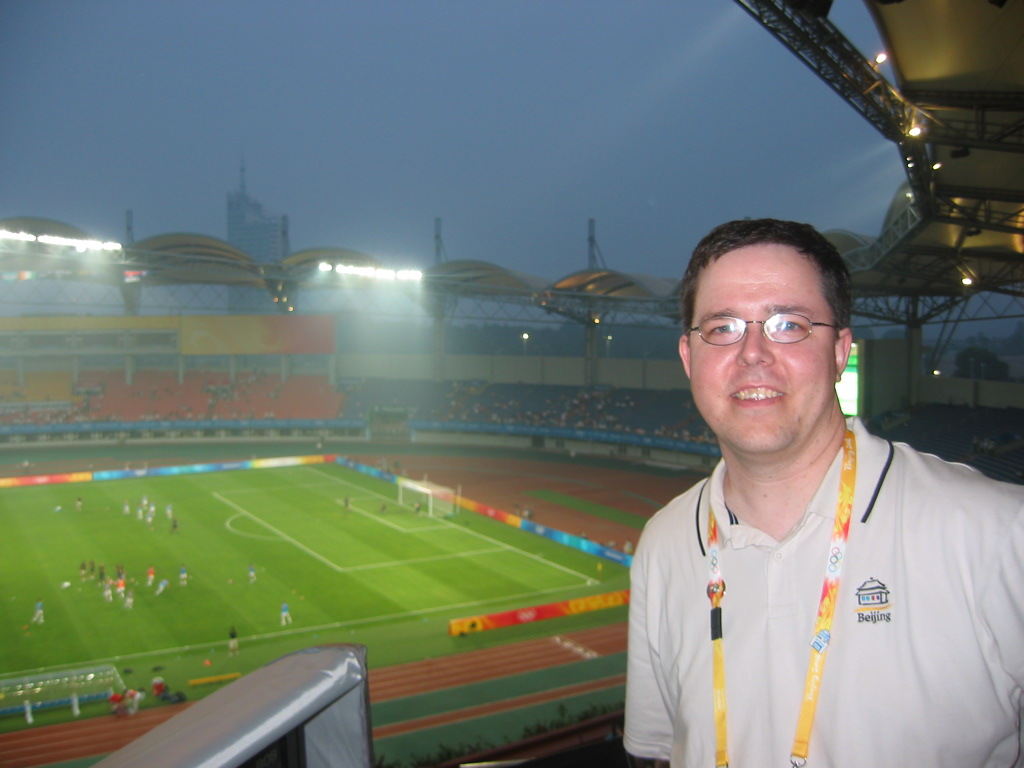
But I enjoyed his company 100% of the time. The memory that has been in my mind today is of traveling at the 2008 Olympics and wandering around a distant stadium a few hours before game time. I have two memorable photos from that day. First, he and I marveled at a bunch of fish in some sort of feeding frenzy.
Second, he took what is, to this day, my favorite photo of myself.
I’m not showing this picture out of vanity. I think he simply composed it perfectly.
After that game, I had the Big Olympics Travel Misadventure that resulted in me taking a standing-room-only overnight train back to Beijing. He, of course, was nestled nicely in a hotel in Qinhuangdao. That was emblematic of the difference between Sports Illustrated and USA TODAY. He also reminded me of the difference in our publications at a media availability later in the Olympics in which he asked me to give him space to do a one-on-one chat with Hope Solo. He was working on a magazine feature-length piece, and USA TODAY was going to give me a tiny space in which to summarize everything.
I would have been mad if not for two things. First, he was right. USA TODAY was still in its milquetoast days, cranking out brief content for hotel-goers nationwide. Second, he was so damn nice. He had gone out of his way to tell me I was one of the people in soccer journalism who knew what I was talking about, praise that I still cherish.
And though his magazine, boasting a formidable 1-2 combo with him and Brian Straus, was more glamorous than USA TODAY, he and I bonded over our status as soccer writers before the “soccer writer” job existed. We had other responsibilities. He was a great basketball writer, too. We had to push for more soccer coverage, not just so we could focus on the sport we loved but because we felt the sport we loved deserved more love.
This may sound like Grumpy Old Man talk here. But this gets to why yesterday’s news is so shocking. Grant wasn’t old. He wasn’t even 50. I’ve written my share of remembrances — my mother (well after the fact, because she didn’t live long enough to see the internet), my father, my dog, my music teacher, Duke’s jazz ensemble director, Duke’s Wind Symphony director (aged 101), etc. I was in tears when I wrote one for my stepmom because she was too young, and I had just attended a memorial service that reminded me what she meant in my hometown.
The only time I’ve written one for someone younger than I am was the one for USA TODAY’s Dave Teeuwen, and that was mostly one anecdote that hopefully captured his spirit a little bit. Dave’s death was tragic but less of a surprise. He had dealt with cancer for several years and had defied his doctors by continuing to live.
The only time I’ve written one for someone whose passing came from out of the blue was for Dan Borislow, whose complexities I attempted to capture. As I said in the opening, I couldn’t make sense of his sudden death, and I still expected him to text me to gripe about the media.
In Grant’s case, I keep thinking that I should send him a message to express my sympathy. I can’t process that the fact that he can’t answer. When my wife came running up to say, “Grant Wahl died,” I heard what she said but couldn’t understand those three words in that order.
I try to make these things positive and uplifting. This one is difficult. I hope I’ve captured a bit of his spirit. As easygoing as he was, he could also be tenacious, as exemplified best in the last days of his life when he stood up to the discrimination and cruelties of Qatar.
As ridiculous as it is to hold a World Cup in Qatar, he couldn’t miss it. But in a just world, he would’ve seen the next one, and the next one and many more after that.
Instead, in all of these World Cups, we’ll be the ones missing out. We’ll be missing him.


 Duresport.com