soccer

Single-Digit Soccer: Dave Barry on the role of the parent

Dave Barry, who married a soccer writer, offers up some classic “it’s funny because it’s true” answers on soccer parenting:

Q. What is my job, as a parent, during a soccer game?

A. Your job is to yell instructions to your child and the other children on your child’s team.

Q. Should I make an effort to educate myself about the rules and tactics of soccer before I start yelling instructions?

A. There is no need for that. As a parent, you have a natural intuitive understanding of the game, which you should share with the entire world by constant yelling.

Too true, too true.


soccer

Single-Digit Soccer: What we don’t talk about

You have a great practice plan. You’ve read three different coaches’ takes on the exercises you’re doing, so you know all the points you’re trying to get across.

Then you spend half of practice trying to get kids to pay even the least bit of attention.

We usually don’t talk about this sort of thing in any coaching clinics or licensing classes. We get the occasional good tip — all I remember of my original F license class a few years ago is that the coach should face the sun so the players aren’t squinting at him.

That’s why I’m happy to report that the new F license class, the one offered online through U.S. Soccer, gives a few ideas on how to keep kids’ attention through keeping them busy and positive reinforcement.

And Soccer America just ran a good piece that draws from people who have to do this sort of thing every day for several hours — teachers.

If kids are still not getting it, redirect them with a non-verbal reminder while you’re still teaching. That is, use a gesture to tell them they need to put their ball down; their eyes need to be on you, etc. Check out how this amazing teacher makes a 10 or more non-verbal interventions in her classroom while she’s still teaching. This keeps the corrections from breaking and slowing down her teaching, which would only result in more off-task kids.

It’s a good conversation for coaches to have. Especially after my practice Monday.

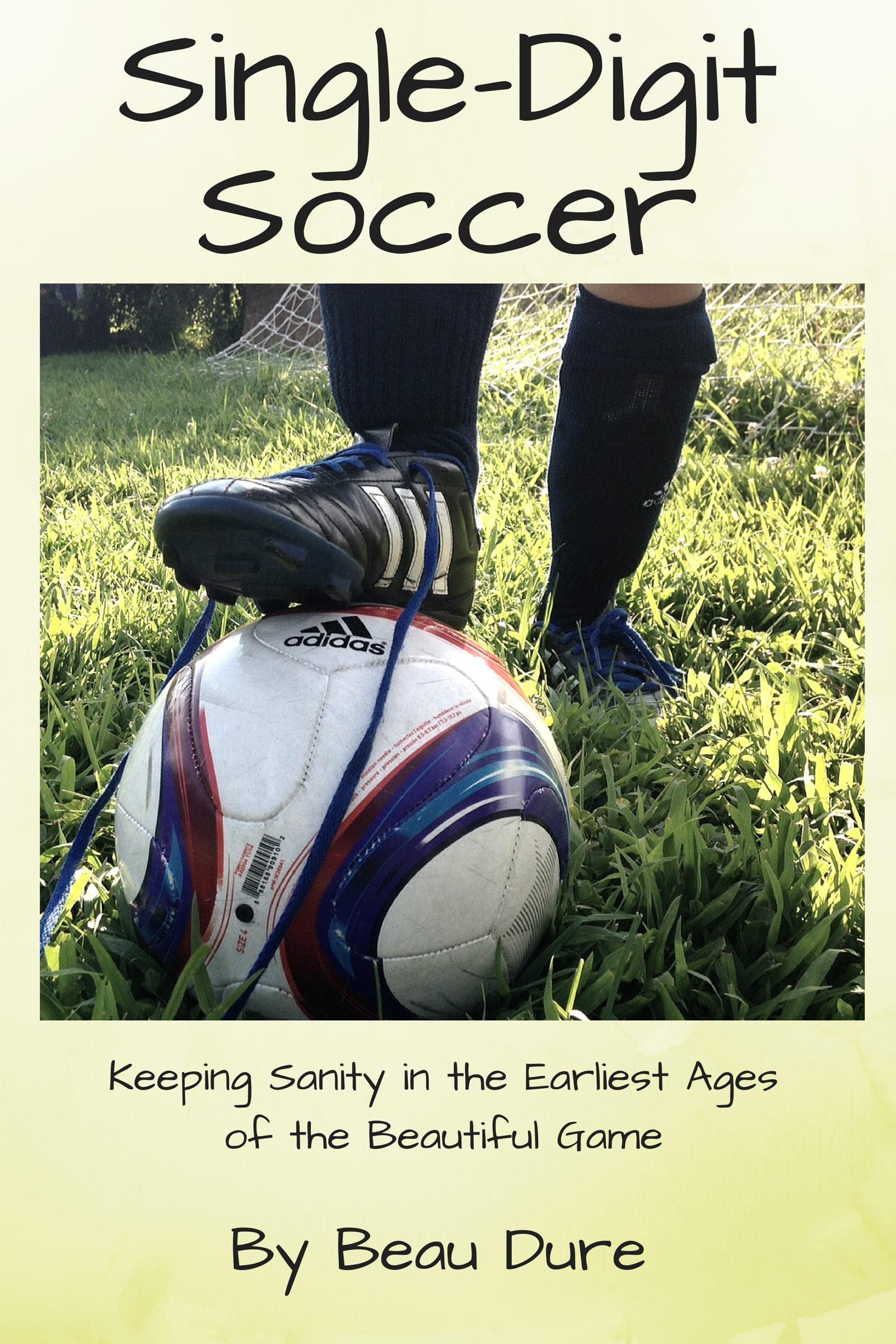
Single-Digit Soccer is now available in paperback as well as in every electronic format I know. Get more info or go straight to Amazon.

soccer

Single-Digit Soccer: These issues matter

sds book coverOn the same day that The Huffington Post ran my piece on Myths Every Soccer Parent Should Know, I saw a cover story in a local magazine (Arlington Magazine, to be specific) in which author Jenny Sokol casts a skeptical eye on the whole business of “elite” or “travel” youth sport.

Problems can arise when youth teams are run with the competitive mentality of a professional sports franchise, says Bowes, who lives in Arlington. That’s when teachable moments tend to get lost. “I always laugh when a coach pulls a player out of a game [as punishment],” he says. “If you’re making a mistake, the only way you can correct it is by getting a chance to correct it. How else do you get better?”

Such scenarios are more common in select leagues, which, unlike rec leagues, are not required to grant players equal playing time. Not only do elite players face stiffer competition on the field; they are also jockeying against their teammates to get off the bench. That dynamic can sour some players’ enthusiasm for the game.

“A lot of times kids will start out loving a sport and enjoying playing it, but if it’s too competitive too soon and the pressure starts to mount, they struggle with anxiety,” cautions Tedesco, the McLean psychologist. “What used to be very enjoyable for them becomes stressful, less fun and more of a job.”

The article goes into note the status element of travel sports. One kid is told by his friends to quit wearing the shirt he wore with his previous team. That’s news to me — I thought kids could wear these things until they outgrew them.

What we really end up doing here is de-valuing rec league. The rec leaguers don’t get the cool shirts. And with so many kids doing travel and not rec (a handful of clubs let you do both at early ages), the rec league competition becomes frustrating for athletes who take soccer semi-seriously but don’t want to commit to (or fall just short of making) the local travel team.

That’s especially frustrating for those who want to follow in the footsteps of most soccer players — and indeed, most big-time athletes — and play multiple sports growing up. Juggling travel soccer and another sport is difficult, as the Arlington story points out. I know a veteran youth soccer coach who longs for multisport clubs that would help kids coordinate schedules, but the political issues there would be monumental. (In fairness, our local Little League also has schedules bordering on the sadistic, asking kids to commit to 4-5 days a week for practices of games once they turn 8 or 9, but most coaches understand if players miss a few of those practices.)

I do see momentum growing against U.S. Soccer’s mandates on grouping kids by birth year, a mandate that terrifies parents of young kids in particular. I’m seeing opportunity in the crisis and may soon unveil a plan that’s more inclusive for everyone while accommodating the truly elite players’ needs. Stay tuned.

Single-Digit Soccer is now available in paperback as well as in every electronic format I know. Get more info or go straight to Amazon.

soccer

Single-Digit Soccer: Is softball different?

It’s official — U10 sports are front-page news.

IMG_1370Granted, the Vienna Connection isn’t The Washington Post. It’s a weekly community paper.

And there they are — the Vienna Stars, national U10 softball champions! They won the Virginia title and moved on to beat teams from Virginia, Maryland, New Jersey, New York, Delaware, Pennsylvania and Illinois.

The team has two players from Great Falls, one from Lansdowne, one from South Riding, one from Leesburg, one from McLean, one from Warrenton, one from Bristow, and one from across the river in Potomac. Oh yes … and one from Vienna.

(For those who don’t know NoVa geography — these towns really aren’t that close to each other.)

Here’s how they did it:

The girls practiced twice a week as soon as Levin selected his team during a tryout period in August of 2014.

During the winter, the 10-year-old girls practiced in a warehouse.

Some players drove more than an hour to get to practices in Vienna.

So if you’ve read Single-Digit Soccer or Tom Farrey’s Game On or John O’Sullivan’s Changing the Game (and you should), you’ve probably spit out your Gatorade by now. This is exactly what we are not supposed to be doing, isn’t it?

Here’s the legendary quote, as reported by Soccer America‘s Mike Woitalla in 2007:

”National youth championships in the USA are the most ludicrous thing I’ve ever heard in my life,” says Horst Bertl, the Dallas Comets longtime director of coaching. ”Whoever thinks these up should be stoned.”

And the turf war Woitalla describes, with multiple national championships, is true in softball as well. The Stars won the U.S. Specialty Sports Association Fast-Pitch National Championship. You can also play in another organization’s fast-pitch “nationals” in four convenient locations! The ASA / USA Softball also has championships down to U10.

In Single-Digit Soccer, U.S. Club Soccer’s Christian Lavers defends the concept of national championship — but not at this age:

At US Club Soccer, we believe that regional competition at U-13 is a good thing, and playing teams from different areas of the country in meaningful games at U-14 is a good thing.

So here’s the question: Are national championships at U10 a bad thing in soccer because of something unique to soccer? Or are they a bad idea, period, even if we don’t want to spoil the fun of the Vienna/South Riding/Leesburg/Potomac Stars?

Part of the answer is easy — “winning” in U10 soccer is a lot easier if you sacrifice development. Put players in set positions, where they’ll learn fewer of the skills down the road. Have the big player blast the ball downfield to the fast player. Find players with the aptitude and love of the game to learn, I mean, find the biggest and fastest players.

Does softball face the same issues? Or is there no harm in having U10s playing a bunch of different tournaments and calling a couple of them national championships?

Single-Digit Soccer is available electronically now and soon in print. Learn more and order here.

soccer

Single-Digit Soccer: Requiem for the Ajax academy?

Perhaps this is a leap of logic — a thin correlation between two items that aren’t quite related. Maybe so. But when you look at Dutch soccer today, it’s easy to spot two things that, related or not, have gone wrong.

First: The Netherlands national team is an utter mess, now looking less likely to make a Euro field that seems to be welcoming everyone else on the continent.

Second: How is the vaunted Ajax academy doing today?

On a message board I frequent (for local parents), someone recently dug up a 5-year-old NYT profile of Ajax as a frightening example of what happens when professional goals go overboard. The whole experience seemed devoid of joy, compassion and all the things you would hope every teenager has a chance to experience — particularly when they’re playing a game that is supposed to be full of joy, not a rote exercise in doing the same bloody thing over and over like you’re in a 1980s Eastern European rhythmic gymnastics barracks.

One comment from the board: “Yeah, my reaction to that article was that I’m fine not having a champion MNT if that’s the way you have to go to get it.”

My memory might be hazy, but was Ajax always that way? I thought it used to be considered intense but also a place of wonder, where creative geniuses met like some sort of Algonquin Roundtable of Total Football.

Maybe Total Football has given way to rigid tactics and player roles? Or have we stopped viewing our kids as kids and started seeing them as people to cast off or sell to keep a corporate operation moving?

Even when kids emerge as the rare few to succeed at a high level from such places, they have regrets. See Steven Gerrard’s poignant comments about wishing he had devoted more effort to his education.  (And bravo, Mr. Gerrard, for speaking up so honestly.)

Then let’s look at the USA for a minute. We’ve gotten more serious over the years, haven’t we? We have Development Academies. We’re telling kids not to play college soccer or even high school soccer. And we’re getting skunked.

In the New Era, we herd our kids into camps and soccer-specific residencies so they can develop away from the public eye. Meanwhile, college soccer continues to offer experiences like this:

Those kids will never forget that moment. And it’ll help some of them develop a sense of joy (or, on the flip side, a sense of mental toughness) you’re not going to develop playing for a bunch of dudes with clipboards.

Surely it’s time to strike a balance, yes? Maybe we’ll figure it out before the Netherlands do and pass them in the FIFA rankings!

soccer

Single-Digit Soccer: The definitive word on Germany

How do they do things in Europe? As we saw with birth-year age groups, perhaps not what we think.

Single-Digit Soccer makes multiple references to a terrific piece from The Guardian (disclaimer: I’m now writing a bit for the excellent UK newspaper) on the way Germany revamped its youth system after falling short at Euro 2000.  Today, The Guardian has an excerpt from a forthcoming book on German soccer called Das Reboot.

The only information I saw in this excerpt that contradicts the previous Guardian piece — the reboot actually started before 2000. Everything else hits and expands upon familiar themes, though the excerpt takes a while to get to the youth programs of interest to Single-Digit Soccer fans.

A few highlights:

– In 1996, the German DFB only worked with the national teams, while regional federations did the bulk of the education. Berti Vogts sought to put a DFB coach “inside each regional federation to conduct additional sessions for gifted kids who weren’t part of the club system.” At the time, it was turned down.

– After World Cup 1998, a modified plan went into effect: 121 regional centers to do weekly two-hour sessions for 4,000 kids in the 13-17 age bracket. Another program would reach 10,000 boys (and yes, we should specify *boys*, though I’ll be curious to see what the book says about the impact on women’s soccer) under 12.

– The goal: Everyone should live within 25 kilometers of a regional center.

Think about that for a second. Twenty-five kilometers. A little more than 15 miles.

Imagine that on the East Coast. You’d have multiple centers in Fairfax County, Va. The Triad area in North Carolina would have at least three — Greensboro, Winston-Salem and High Point. The Triangle would probably have a couple in between the Durham/Chapel Hill and Raleigh metros.

– There was some push and pull between elite and what I guess you’d call recreational.

The DFB made it compulsory for the 18 top teams to build performance centres by 2001–02. Money was the main obstacle: “How much will it cost? Is that really necessary?, were the reactions,” says Schott. But there was also some resistance at the ideological level against fostering the elite. “Werder Bremen doesn’t want to follow the principle of selection,” the former Werder general manager Willi Lemke, a Social Democrat politician, said in 1998. “We have a social responsibility. We are obliged to provide leisure activities for children, promote the motivation to perform, teach them solidarity and team spirit.”

At the same time, the federation was making sure to reach beyond the chosen few in pro academies. Go back to the previous Guardian piece and its comments on a program for ages 8-14 in 366 areas with 1,000 B-licensed part-time coaches:

Some youngsters attending the development programme are already affiliated with professional clubs but others may be only turning out for their local junior side, which means the weekly DFB sessions are also a chance for Bundesliga teams to spot players.

The clubs also have some flexibility to reach out across a wider expanse without herding the “best” youngsters into their academies at an early age:

Across a sizeable area where they face little competition from other Bundesliga clubs, Freiburg work closely with five amateur feeder teams who receive a part-time coach to train children aged 8 to 11 twice a week. The most promising players are invited to attend the academy during school holidays and for occasional tournaments at weekends. “We believe it is not good for a nine-year-old to play [regularly] for a professional football club because it changes the reasons why he plays football,” says Sebastian Neuf, a member of the football school’s management.

National competition starts at U17. It’s regional at U15. That’s typical — check the European Club Academies report.

(Edited to add: What about young women? Through U15, a lot of them are playing on the boys teams!)

soccer

Single-Digit Soccer: What is this about?

Single-Digit Soccer is a book that will make youth soccer parents and coaches laugh, then push for change.

Single-Digit SoccerYouth soccer at this age (9 and below, hence “single-digit”) is fun. And funny. There’s no shortage of fun stories to tell, and I put a couple of them in the excerpt in SoccerWire.

But we also get into more serious topics. U.S. Soccer is trying to step up its game so we’ll have better players emerging from youth soccer. Yet the most obvious solutions aren’t always the best, and in the unique landscape of the United States, they’re often counterproductive.

So that leads us to some of the topics Single-Digit Soccer covers:

1. When do you start travel soccer? In most cases, we’re starting far earlier than development-minded coaches want. U.S. Youth Soccer actually says we should be holding off past the Single-Digit years. We’re obviously not.

2. Help! I’m coaching! What do I do? The book steers you to some good information online and reminds you that you can’t coach 6-year-olds the same way you’d coach 16-year-olds. It also gives you some fun prototypes to consider. Are you The Superfan? The “Fun” Coach? Mr. Passion? Take a look and take your pick!

3. How much do you emphasize winning? None. That’s the short answer. But it’s really hard to drill it in people’s skulls. And, at times, I see a few reasonable exceptions.

4. Are we inclusive? Or are we driving kids away from the sport because it costs too much, is too elitist (especially at too early an age), and stresses vague long-term interests over just making the dadgum game fun for kids to play?

5. Should we be doing more “free play”? Yes, though it’s sometimes a challenge when you don’t just have fields sitting around for the whole neighborhood to race out play pickup games. The book offers some ideas.

6. When should we teach … heading? Team tactics? Diving like Robben? The first two are addressed in the book. Not the third. Shhh. It’s a secret.

7. Why do we have so many different organizations telling us different things we’re supposed to be doing? The follow-up question: What do you do about it?

If you’re still unsure whether to sacrifice that Starbucks latte and buy Single-Digit Soccer instead, check out the excerpt at SoccerWire, my other contributions to SoccerWire, and my Single-Digit Soccer posts here at SportsMyriad. If you want to know more about me, check duresport.com to see much more of my writing and my work history.

You can also get a sense of Single-Digit Soccer from this short video:

The book will be available in paperback sometime in September. Electronically, it’s available now from the store of your choice: Amazon, Barnes and Noble, Apple, Kobo, Scribd, Page Foundry/Inktera and Oyster.

soccer

Single-Digit Soccer: The video (and official release date)

Single-Digit SoccerYou can now read Single-Digit Soccer on the electronic device of your choice.

The paperback edition hit a snag. I’ll keep working through it, and it should be ready in September, hopefully in early September.

If you have not yet read the excerpt posted at SoccerWire, take a look.

To celebrate the release, I’ve posted a video giving people a quick intro to the topic:

Enjoy, and please order on Amazon, Barnes and Noble, Apple or Kobo.

Update: And it’s also available on Scribd, Page Foundry/Inktera and Oyster.

soccer

Single-Digit Soccer: Why elite coaches should care about being inclusive

Should coaches of really good players from U9 to U19 pay attention to Single-Digit Soccer?

Until time freezes and no one ages, yes. U10s have a funny way of growing up to be U16s.

And while Single-Digit Soccer casts a wide net over everything — rec soccer, semi-serious travel soccer, TOPSoccer and extreme travel soccer — there’s plenty to hold the elite coach’s interest.

One major issue for these coaches: soccer’s dropout rate.

Here’s Kevin Payne, who has dealt with elite players as an MLS executive and continues to do so in his role as U.S. Club Soccer CEO, sums it up:

At the ages of 10, 11, 12, kids’ developmental age can vary as much as plus or minus four years from their chronological age. So you could have a 12-year-old kid and they might be developmentally closer to a 16-year-old, or they might be developmentally – especially physically – closer to an 8-year-old. So when the sport is losing 70 percent of its participants by the age of 12, there’s no way that anybody can tell you they’re not worried about that because that 70 percent is a cohort with no chance of becoming elite players.

The fact is, within that 70 percent there undoubtedly are players who could’ve become elite players. They just never got the chance, because they were subjected to such an intense and unpleasant experience, largely shaped by a very outcome-driven culture that they just said, ‘this isn’t fun any more, so I’m leaving.’

Those kids and the people around them never got the chance to figure out whether maybe they could be a serious player. It’s way, way too early to be expecting young players to exhibit the qualities necessary … We think it’s an absolutely critical element of player development in the U.S. to keep a much higher percentage of our soccer population involved in the game longer.

So if you’re focusing on the top 1 percent at U9, you’re not just missing out. You’re cutting down our country’s future player pool.

soccer

Single-Digit Soccer: Book available for pre-order

Single-Digit SoccerIf you can’t wait to read Single-Digit Soccer, here’s good news: You … only have to wait a couple more weeks. But you can be ready to read it the second it’s available if you pre-order now.

The electronic version will be available August 27. I’m hoping to have the print version ready the same day, but I can’t promise that just yet.

If you check today, you may find the book is listed at 27 or 32 pages. It’ll be longer than that — somewhere in the high 100s. That page measurement was taken from a place-holding sample.

I’ll link to each outlet as the pre-ordering availability comes online. Here goes:

1. Amazon (the print edition will also be here at some point)

2. Barnes and Noble (new, August 7)

3. Apple/iTunes

4. Kobo (they’ve actually pulled a small sample from the rough draft)

5. Scribd (not yet as of August 7)

6. PageFoundry (not yet as of August 7)

7. Oyster (not yet as of August 7)

I’ll update this list as I see new links.

This book, like coaching youth soccer, has been difficult but rewarding. I’m so grateful to everyone who has helped out. Here’s a partial list:

People I interviewed (the last four indirectly): Sam Snow (U.S. Youth Soccer), Christian Lavers (U.S. Club Soccer), Rick Wolff, Robin Fraser, Julie Foudy, Tiffany Weimer, Garth Lagerwey, Alexi Lalas, Kofi Sarkodie, Andrew Driver, Mike Chabala and Bobby Boswell.

People who helped me gather interviews: Monique Bowman (NSCAA), Lester Gretsch (Houston Dynamo).

People who’ve kicked around ideas with me: Kate Markgraf, Brandi Chastain, Joanna Lohman, Charles Boehm, Jon Townsend, and tons of anonymous people at BigSoccer.

Editors who’ve put up with my self-indulgent soccer writing: Boehm, Chris Hummer, Deb Barrington, Steve Berkowitz and Gary Kicinski.

Editor who is making this book much cleaner and coherent: Laurel Robinson.

People at my club: Mike Allen, Pete Wacht, Jane Dawber, Eddie Lima, Mike Gurdak, Ryan Phair, Andrew Ritter, Lee Chichester, Jason Steiner, Damon Lee, Michele Sullivan, Chris Hegedus, Rob Lancaster and Mike Lyons.

My workplace: Mary and the crew at Starbucks at Vienna Marketplace.

Every player and parent on my teams, especially my two sons and my remarkably patient wife.