Just to clarify: I’m not off Twitter because of anything directly affecting me. This is my response to their selective enforcement of hate speech and harassment, and the tipping point is the nonsensical decision to allow Alex Jones to keep posting falsehoods designed to do nothing but turn gullible people into dangerous people.
We’ll see what happens. If they relent and ban Jones, I’ll be back as soon as it happens. Until then, all you’re going to get from me is the occasional automated post showing that I’ve published here and a daily tweet explaining why I’m boycotting.
Well I was rolling down the road in a minivan I had a keeper in the back and a guest player at the wheel We going cross-country and we’re skipping school We tired and I’m lost – I wonder why this is cool
Oh I’m bad … I’m nationwide
We know we’re not supposed to do this, right?
At the youth level, we have six national championship-ish events despite legitimate concerns that all we’re doing is rewarding families that can spend a lot of money on travel. And despite the legendary Horst Bertl (Dallas Comets, now FC Dallas) quote: “National youth championships in the USA are the most ludicrous thing I’ve ever heard in my life. Whoever thinks these up should be stoned.”
At the adult level, we fret over the costs a team like Christos FC incurs when it advances in the Open Cup. Then we see teams fall all over themselves to enter national leagues on top of national tournaments.
And the trend is only accelerating. Consider the news from the past week …
U.S. Youth Soccer is revamping the regional pyramid that forms the base of its national league system, which is really a series of national showcases because no one really expects Tennessee Soccer Club to schedule a U15 league game against Greater Seattle Surf.
To some extent, the UPSL is a loose network of regional leagues. It’s much bigger in California than it is elsewhere. But it does have a national playoff and advertises a separate Cup competition called the Admiral Cup, though that doesn’t appear to have been contested recently.
A national playoff of this sort is a little curious. If you’re one of the many people annoyed with the USA for doing things that other countries don’t do, well, this is something other countries don’t do. I don’t see a national Regionalliga championship in Germany — just playoff games to determine the promoted sides, with no overall winner. Nor do I know of any English divisional championships after the fifth tier, which is the last nationwide league. (England does have the FA Trophy, a cup competition for those in tiers 5-8, and the FA Vase for anyone lower than that. But the U.S. counterpart to that would be the U.S. Amateur Cup, which many UPSL teams enter, and that winner can play in the supercup-ish Hank Steinbrecher Cup.) European clubs in regional leagues try to win that league and progress as far as they can in their cups.
But that playoff is, in the words of Douglas Adams, mostly harmless. It’s the summer leagues, PDL and NPSL, that have counterproductive national playoffs. These clubs serve a valuable purpose — giving college players a few more competitive games in the summers. Then they cut their regular seasons short to race through a set of playoffs that no one really cares about. (Seriously — lower-division fans can all remember U.S. Open Cup upsets such as Reading United over the New York Cosmos, Michigan Bucks over everyone, Des Moines Menace over a couple of pro teams, Chattanooga FC over Wilmington, etc. Name the last PDL champion. Or try to remember anything from the NPSL playoffs other than Midland-Odessa scraping together a team to play the final after the bulk of its roster went back to school for the fall.)
That’s the state of adult soccer. What about youth soccer?
Maybe the new U.S. Youth Soccer leagues will be an oasis of sanity. Unlike the Development Academy and the ECNL, they should have enough entries to split into sensible regional divisions. (The DA has a few good clusters at U12 but hits peak absurdity by U15, while ECNL travel budgets are rather excessive even in the long-established girls’ divisions.)
And somewhere in the ashes of the 2018 U.S. Soccer presidential race lies an interesting idea — a national Youth Cup. This exists in England, where the FA Youth Cup draws hundreds of U18 entries (and note that the age range is not by birth year) and Broxbourne Borough of the Spartan South Midlands League Division One (unfortunately, the senior team is facing relegation down to England’s 11th tier) was one game away from the quarterfinals last year.
One national championship. (OK, maybe two — England has a national U18 league with north and south divisions that face off in a national playoff, but that’s about it for national travel, even in a country that requires no airplanes for away fixtures.) That seems sensible. And the top academies might have to face off with a Broxbourne Borough in a meaningful game instead of sitting in a silo.
Basically, if you’re going to have a national championship, maybe it should include everyone in the nation — at least those meeting a certain criteria like “amateur” or “Division 3 or below” or “Division I college teams.” Otherwise, why spend time flying when you could be playing?
So I’m making a good bit of progress on the next Area Guide — Southern California this time. Should be ready in a day or two. Hey, what’s this in the inbox?
But that’s just the journalist’s take. It’s the equivalent of an 89th-minute goal that forces us to tear up the stories our editors are expecting in five minutes. How does everyone else feel about it?
Oh dear. (Disclaimer: Ranting Soccer Dad is an NCSL parent.)
What does this mean?
1. Instead of four regional leagues, we’re about to have a lot of conferences. They’ve named eight so far, but that just covers the East Coast, the Southeast and Texas.
Will this format include more teams? Seems that way, but we’ll wait for clarification. In the current format, the Eastern Regional League has 16 teams in the Elite Division. The lower Premier and Championship divisions can theoretically take more teams but do not. The Midwest Regional League looks a bit bigger, as do the Southern Regional Premier League and the three-pronged Far West Regional League.
Through the current regional leagues, teams can qualify for the National League, which uses the hashtag #EarnYourPlace to establish its intent and perhaps throw some shade on the invitation-only DA and ECNL. And through the National League, teams can earn a place in the regional championships (an alternate path: State Cup) and then the National Championships.
Those pathways will continue. But will they be more crowded?
2. EDP, which currently has its top levels (out of many levels) in U.S. Club Soccer’s National Premier League, has apparently switched over to U.S. Youth Soccer. (I’m asking to have that point clarified.)
3. The press release mentions “newly formed club vs. club brackets may be offered.” That raises two questions. How, given the team-by-team #EarnYourPlace qualification for these leagues? And why, given the objections raised by … OK, maybe just me? See “Club-centric scheduling” on my “About the Area Guides/National Info” page.
4. With these leagues being more localized than the current league system, is the expectation that each team will enter only these leagues? In the current system, some teams play in both the U.S. Youth Soccer regional league and their “home” leagues.
Perhaps it’s unfair to think of these changes mostly in terms of the Turf Wars — U.S. Club Soccer vs. U.S. Youth Soccer in general, then the proxy war of the Development Academy (U.S. Soccer) vs. ECNL (U.S. Club Soccer) vs. traditional league/tournament play (U.S. Youth Soccer) at the elite level. But it’s really impossible to think about it otherwise.
So you may be asking: How does this affect me, especially if I don’t have a kid in the top 1-5% of youth soccer players who might be involved with these programs?
My tentative answer: We may be hitting a tipping point of trickle-down “elite” soccer.
Here’s how …
1. Clubs in your area scramble to get their top teams in the DA, ECNL or U.S. Youth Soccer conferences. (We’re already seeing this for the DA and ECNL; the current U.S. Youth setup is more complimentary.)
2. Clubs that don’t get into these programs (or want their B teams to be in something “elite”) scramble to form “elite” leagues, some of which are pretty good and some of which are demonstrably worse than the old traditional leagues’ top divisions. (Already seeing this, too, in some areas.)
3. Your traditional league needs to recruit more teams to fill the holes in their divisions. Suddenly your big local club has six travel teams in one age group. Suddenly your local “development” league consists of a couple of teams in one place and a couple more 100 miles away.
In short, we can sum it up with one word …
Chaos.
Whether your kids are in the top 5% or the middle 50%, you may find yourself in leagues that are unsettled, with clubs and teams coming and going. Maybe a new team comes in that blows out all its opponents 10-0 or loses all its games 10-0. Maybe a league that used to have all its games within a 45-minute drive now has its games scattered all over your state.
Or not. We just don’t know. So when you sign up your kid for a full year (because heaven forbid a club lets you sign up for one season at a time) of “travel” soccer, you have little idea what you’re getting into.
So it’d be nice if the powers that be would get together and explain to us why this is necessary.
The Ranting Soccer Dad Guide to Youth Soccer is underway. It includes a guide to national programs and, in progress, an area-by-area guide across the USA. Check out the Patreon page for full access and updates.
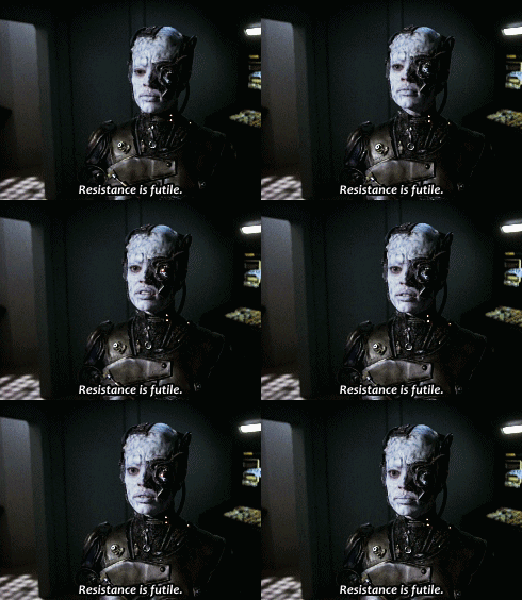 Like the Borg, the UPSL has grown in part through assimilation. The Premier League of America (which, despite the name, covers a relatively compact area around Lake Michigan) simply merged into the UPSL and
 Duresport.com