youth soccer

The devil went down to Georgia … and other youth soccer maneuvers

I guess you didn’t know it, but I’m a soccer admin too …
I’ll bet an Umbro of gold against your soul to think we’re better than you 

This is probably my fault. I did the Area Guide for Georgia a couple of weeks ago. Nice and simple. Big statewide traditional league. Big DA and ECNL clusters in and around Atlanta and a couple of scattered teams in U.S. Club Soccer NPLs, but generally easy to digest. Right?

Couple of quick things about the video for The Devil Went Down to Georgia: 

  1. Playing keyboards with one arm in a sling is impressive dedication. I once did a recital with a finger in a splint, but I’ve got nothing on that guy.
  2. The devil won, right? Does anyone really think Johnny’s tune was better?

I got an inkling a few things were in motion from the friendly and informative GaSoccerForum, as mentioned on the Georgia Area Guide:

“There is some rumbling on GaSoccerForum.com that several clubs are considering a “Champions League.” Those same clubs already have their A teams in the DA or the ECNL or the SAPL.”

So a handful of clubs were going to figure that if their A and B teams were already playing in other leagues, they might as well pull their C teams as well or something like that. (And yes, we need a moratorium on calling something a “Champions League” if it’s not full of actual champions. Europe’s Champions League is bad enough, with a bunch of third- and fourth-place teams contending for the title. It’s worse when it’s a bunch of youth soccer clubs, some of whom aren’t champions of anything and some of whom have the “Champions League” as their second or third priority behind the DA, ECNL or U.S. Youth Soccer National League. But that’s another rant.)

Little did I realize how intense this would get. Check out the Cherokee Impact Facebook page (HT to GaSoccerForum post) …
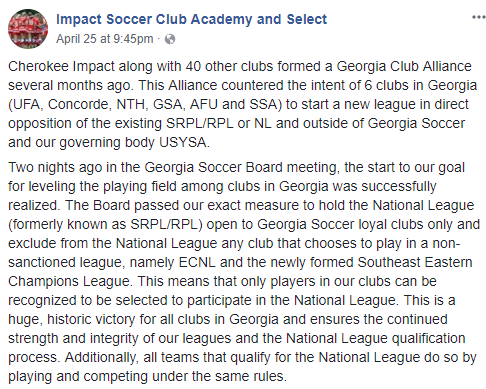
impact

To translate all this …

  1. Those six clubs are United Futbol Academy, Concorde Fire, NTH (the umbrella term for North Atlanta Soccer Association (NASA) and Tophat), Gwinnett Soccer Association, Atlanta Fire United and Southern Soccer Academy. They’re big Atlanta-area clubs, though UFA and SSA have operations elsewhere in the state as well.
  2. “SRPL/RPL” is the soon-to-be-defunct U.S. Youth Soccer regional league, which will be replaced by a new conference, as I’ve already mentioned in a post with an even funkier musical tie-in.

This may or may not be meaningful. If the Big 6 weren’t interested in playing SRPLNLIOU anyway, maybe it doesn’t. Perhaps it’s simply a symbolic gesture — “you can’t quit; you’re fired!”

Here’s the fun part for parents and players — imagine you’re trying out for one of these clubs or just about any club in Georgia with regional potential this spring. At this point, you really have no idea where you’re going to end up playing in the fall.

PARENT: So if my daughter makes this team, will we be playing mostly around Atlanta? Or Alabama, as rumored to flesh out the Champions League? Or Idaho?

COACH: We won’t know until the lawyers sort it out. That’ll be $3,000 and a commitment for the year, please. It’ll be another $2,000 if we make the Mega Premier Elite Champions League. 

Yes, I said “lawyers.” U.S. Soccer has a principle called “interplay,” and those who violate it often end up defending themselves against grievances.

(I did try to contact most of the Big 6 clubs a few weeks ago. You’re still welcome to respond.)

In other “giant game of Risk” news from recent days …

  • Also overlapping with Georgia but taking place in the years before the statewide Athena/Classic league, it’s the Carolinas Premier League! It’s for U9 through U12 only, so “Developmental” seems like a better term than “Premier.”
  • Seven Arkansas clubs are forming the U.S. Club Soccer (but not NPL?) Arkansas Premier Clubs.
  • The Virginia NPL is adding two clubs. (Disclaimer: The VPL or VNPL includes my hometown club, Vienna. At least, that’s the last I’ve heard.)


us soccer, youth soccer

U.S. Club Soccer forum: Caligiuri, Gans punch sacred cows — and who should drop out?

The first U.S. Soccer presidential forum, hosted by GotSoccer, was a bit like a League of Women Voters political gathering, designed to cover a broad range of topics.

The second forum was hosted by and for — and to some extent, about — US Club Soccer. There’s nothing inherently wrong with that. Their votes carry a lot of weight in this election. They certainly have the clout to bring in all these candidates for a discussion, and they provided a valuable public service by putting the audio online. (The photo in that link confirms what we hear around the 51-minute mark — someone opening a can of Coke.) And there’s certainly nothing wrong with a conversation focused on youth soccer, as much as some people want to hear about the national teams, promotion/relegation and so forth.

Five candidates were there. Carlos Cordeiro was not, and we’ll get to him. Paul Lapointe was not, and that’s a bit contentious. There are two sides to this story. Lapointe told his on Twitter. US Club told me by phone. Here’s how it breaks down:

Start with the press release: “Invited were announced candidates that had personally contacted US Club Soccer to initiate a discussion about U.S. Soccer and their respective candidacies.”

Lapointe insists that he did.

The response I received: All Lapointe sent us was a form letter.

I’ve seen what Lapointe sent. It appears to be a form letter addressed to “Dear USA member,” with bio and platform info attached. So how much should he be penalized for not personalizing that introduction?

US Club did issue a late invitation — a few hours before the forum — for Lapointe to join in. He could not do so on such short notice. And frankly, it may not have been worth his while. He’s not going to be getting a nomination letter from US Club, which had nominated someone but then rescinded that nomination under the late addition to the election procedures that allows an organization to rescind its nomination and yes, I’m getting a headache writing this sentence.

(Incidentally, I obtained a list of organizations that have nominated someone earlier this week. I was working toward publishing it today, and then a new list was posted. Multiple organizations did indeed rescind nominations before the deadline. Maybe later this week, I can get that list posted, but it doesn’t say who nominated whom.)

In any case, he has agreed to be on the RSD podcast in the very near future, so if you want to hear him talk about the issues, come back right here next week. As I said earlier today — he might not be the frontrunner, but he deserves to be heard.

In fact, let’s ask …

Beyond the dispute over times and emails is a larger, more pertinent question: What should an organization demand of USSF candidates? I mentioned on Twitter that US Club came across as if they were expecting candidates to “kiss their ring.” Maybe that’s too harsh. A primary purpose of this forum was to determine how US Club will cast its votes. If I’m advising US Club from a PR point of view, I tell them to invite everyone just to avoid coming across as arrogant — a look everyone wants to avoid when the primary issue in this election is whether U.S. Soccer itself is prone to hubris. But I might be more sensitive to such things than most.

So anyway, what happened at the forum?

If you’ve been following this election closely (or if you’ve listened to the RSD podcast interviews with Kyle Martino, Mike Winograd and Steve Gans — more interviews are on the way), you’ve heard most of this before. All of the candidates think U.S. Soccer has been too heavy-handed and too unresponsive to its members. They have their own ways of saying it — Winograd says USSF shouldn’t be dictating things from Chicago, to which Eric Wynalda amiably retorted that it’s actually from an apartment in New York (where incumbent Sunil Gulati lives).

And all the candidates agree coaching education is far too expensive. Martino pointed out the A and B licenses are only offered at a few specific sites, so coaches have to pay for travel as well.

This forum said little specifically about women’s soccer aside from Winograd’s point that using comparative revenues to justify unequal pay for the MNT and WNT is a misreading of U.S. Soccer’s mission, but we need to remember something here — when we’re talking about youth soccer, we are talking about women’s soccer. A lot of the issues — access, diversity, costs, etc. — are the same for boys and girls. Not all of them, of course, and Paul Caligiuri noted the absence of girls from the Development Academy for its first decade.

But is the DA a good thing? This is where Caligiuri stood out, pointing to the U.S. men’s record before and after the formation of the DA. Spoiler alert — it was better before the DA, back when the USA qualified for World Cups and Olympics. Meanwhile, the U.S. women have been doing OK without a DA. He wants to reorganize to bring the DA, ODP and id2 together. ODP is the old-school player ID-and-training system; id2 is US Club’s answer.

So that’s one hot take. Another came from Gans, who lamented the fact that many states (including his — Massachusetts — and mine — Virginia) now have two State Cups. That is, of course, a result of US Club Soccer starting its own. You have to wonder if the US Club members will take kindly to such a statement or whether it’ll be like my interview for a college scholarship, in which I told a room full of stock brokers I thought Selective Service was unconstitutional. (No, I didn’t get the scholarship.)

Meanwhile, Cordeiro’s absence is being played off as no big deal. I’m not sure that’s right. We’ve had two forums, and he has missed both of them. That might be understandable for Gans and Winograd, who have jobs and shouldn’t be expected to pop up at a random site, especially on a weekday. But Cordeiro’s retired. And if he doesn’t have time for these forums, perhaps he doesn’t have time to be president. (He is, like every other candidate, invited to appear on the podcast.)

And there’s one more candidate who should announce, immediately, that he is not running.

He’s Sunil Gulati.

It’s not about Gulati’s record at this point or whether he’s the right man to continue to serve at this pivotal time. He had every right to make the case.

But now it’s simply too late. Delaying his announcement has left many organizations in limbo as they decide what to do with this newfound power to nominate a candidate. (Previous elections took nominations from the floor of the meeting. Everything about this election is new.)

And while he has been absent, the call for change has gained momentum. It’s a polite call for change, with many kind words about what Gulati has done to help turn around U.S. Soccer from a small federation in red ink to a giant organization awash in sponsorships and infrastructure investments. But it’s loud and clear. The time to stop it has long since passed.

So which candidate will lead that change? I don’t know. It’s going to take a lot more discussion to discern the right choice. Then we’ll see if the voters agree.