podcast, us soccer, youth soccer

RSD26: Charles Boehm on the U.S. Soccer election and youth soccer

This week’s guest, Charles Boehm, is a player, coach, referee and writer — check out his intro at the 2:45 mark and learned where he played alongside future non-U.S. national teamers. Like me, he was in Philadelphia for the United Soccer Coaches convention and attended many of the U.S. Soccer presidential candidates’ sessions.

We talk about what makes a soccer person and what makes an elitist (5:30), whether Eric Wynalda is the front-runner (8:00), the “anyone but (so-and-so)” approach to voting (9:45), what the candidates showed us in Philly (13:05), Kathy Carter and Soccer United Marketing (24:10), what’s changing in U.S. Soccer (30:00-ish), then youth soccer and the surprising focus on ODP (38:15).

I didn’t get around to finishing my thought on why I was once the best U12 center back in Athens, Ga. The answer is the same reason why I was once a competent over-30 coed indoor goalkeeper: Reckless disregard for my own safety. It surely had nothing to my skill. It also had a lot to do with the fact that not many kids played soccer and even fewer wanted to play defense.

us soccer

The big winner in Philly’s U.S. Soccer presidential conversation is guaranteed to lose

Out of all the speakers I saw in Philadelphia, the person who looked best-suited to be U.S. Soccer president is …

OK, I should warn you. Some of you are going to hate this.

But bear with me. I’m not saying this person should be president on Feb. 11. I bring this up to point out the daunting challenges the next president will have not just in reforming the things U.S. Soccer is doing poorly but also in building upon the things U.S. Soccer has done well.

Some of you don’t want to hear that, I know. Again, not saying this is a vote for the status quo. I went into Philadelphia with severe reservations about Kathy Carter and Carlos Cordeiro, and if you read my FourFourTwo recap of the week’s campaign events, you’ll see they were not adequately addressed.

(And thanks to everyone for your kind words about that recap and about my hundreds of live tweets over those three days. I really appreciate it. And please bear it mind when you read this thing you’re going to hate.)

So, again, the big “winner” of the week was …

(Please don’t shoot the messenger.)

… Sunil Gulati.

Again, again — that’s not a voice of regret that his presidency is about to end. It might be a sign that a lame-duck Gulati, freed from the need to appease various voting blocs, is an entertaining interview. He and Alexi Lalas had a candid, searing and occasionally hilarious discussion. I know a youth soccer organization plans to post the candidate sessions, and I hope someone does the same with Gulati’s session.

You may have read the Soccer America and ESPN recaps. Here are a few comments you might not have expected:

https://twitter.com/duresport/status/954066954351992833

https://twitter.com/duresport/status/954058849279008769

He gave the most pointed defense (or perhaps the only pointed defense) of Soccer United Marketing that I’ve heard. It started in 2002 out of necessity, filling a vacuum IMG was leaving. Since then, they’ve renewed it three times. He insisted they’ve looked at alternatives but says there’s an advantage to renewing the deal before it expires, like a player having leverage before a contract expires. And the deal is always voted on by the non-recused (non-SUM-or-MLS-affiliated) members of the Board, and it has been renewed unanimously.

And then we had a few good zingers:

  • “Winning Twitter polls is not getting elected.”
  • In response to Alexi Lalas asking if he considered resigning after the Trinidad loss: “Did you quit after the 1998 World Cup?”
  • Anyone who thinks the Federation can legislate promotion/relegation “is going to end up in front of nine judges.” Lalas: What if FIFA pushes it? Gulati: “Then they’ll end up in front of nine judges.”
  • He says a lot of candidates are promising things they can’t deliver, something he refused to do even when it would help. He said a Central American FIFA voter once asked him for some sort of promise, and he declined. The response: “I like you, Sunil, but you’re a lousy politician.”

Some of it didn’t ring true. He said he’s not supporting a candidate but has recently given two candidates some solicited advice and one candidate some unsolicited advice. He finds a lot of the electoral discourse “depressing and disgusting” and claims all his past NSCAA Conventions and USSF Annual General Meetings have been positive — for a refutation of that, check out 2003 in my roundup of transcripts.

But is there more to this than just an entertaining session? Is it unfair to dump on the Gulati era?

A good take on that:

https://twitter.com/DiCiccoMethod/status/955808177521610753

And how about Soccer United Marketing, which has been intertwined with the Federation throughout Gulati’s tenure as president? Merritt Paulson is an MLS (and NWSL) owner and former Board member, so feel free to consider all that, but he makes a few interesting points:

https://twitter.com/MerrittPaulson/status/955250512948965376

But what about transparency?

https://twitter.com/MerrittPaulson/status/955253543564275712

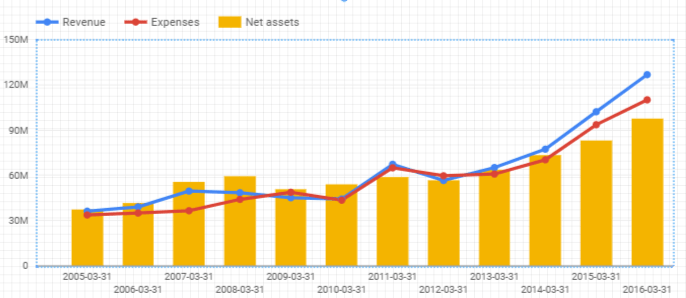
Want to dismiss Paulson? OK. Let’s look at the numbers from the Form 990s on the USSF site and ProPublica.

ussf-money

Here’s the funny thing: If I could extend this chart on each side, you’d see an even more dramatic increase. I didn’t include the numbers from the years four years before this because USSF changed its fiscal year from Aug. 31 to March 31, so it’s not a valid comparison. The annual revenue and expenses weren’t sharply different, but the net assets were far lower. The 2001 statement shows net assets of $14,054,712, and it lists the previous year’s assets at $6,683,668.

And though the March 31, 2017 numbers aren’t available yet, we’ve seen information that net assets will be up in the $140-$150 million realm, thanks in large part to the Copa America Centenario.

So it’s no exaggeration to say that, in 18 years, USSF has gone from a seven-figure organization to a nine-figure organization.

And they’re not just accumulating that money. (They did in the early 2000s, which I gather from Board minutes was a business strategy at the time to make sure they didn’t run into serious problems.) I included “expenses” here for a reason. The Federation spends a lot more than it used to.

(Note: Eric Wynalda claims to have $1 billion sitting on the table for the Open Cup, then says we’re leaving $120-$150 million out there through various mismanagements. I’d love to know details.)

So are we being unfair to the Gulati era and to Soccer United Marketing — and, perhaps, to Kathy Carter? Or Carlos Cordeiro, who also has played a role?

No. Because for better or for worse — and in this case, we’re looking at the “worse” — neither Carter nor Cordeiro is Sunil Gulati.

Gulati’s session probably hurt Carter by contrast. Carter comes off as corporate, speaking in vague business terms. Gulati doesn’t. You may hate what he says at times, but you know what he’s saying, which isn’t always true for Carter.

Then there’s Cordeiro. He didn’t do a one-on-one session, and he has done few interviews at all. He did pretty well in his 15-20 minutes on stage at the forum. Then he stepped off the stage and balked at a recorded interview. He did finally chat with the reporter, but he wouldn’t be recorded unless he had questions in advance. Compare that with Gulati, who knows facing the firing line is part of the job.

So does it matter to this election that Gulati knows his stuff and is a strong voice with more openness to change than one might think?

No. It doesn’t. No matter who wins, Gulati will be on the Board as a non-voting immediate past president. No one wants to dump him off the World Cup bid committee. Even supposed nemesis Eric Wynalda led a round of applause for the good he has done, and Wynalda knows the next president will need to work with Gulati in many capacities.

But they can all do it. Gulati can work with his supposed enemies. So he doesn’t need Kathy Carter to take his place. Nor will it matter if Cordeiro is elected, no matter the state of their relationship.

So the takeaway here is that the next president, no matter how ideologically or personally tied to Gulati, has a steep learning curve.

Now that might be a good thing. For 12 years, Gulati has run U.S. Soccer with little opposition — none in the elections, perhaps not enough on the Board or within the membership. The next president, who probably won’t have a majority on the first ballot, will be forced to build bridges that Gulati had no incentive to maintain.

And that’s a good thing. So is the fact that Gulati isn’t completely going away. Maybe we’ll get that one-vs.-eight debate one of these days.


podcast, pro soccer, us soccer, youth soccer

RSD25: Phillypalooza election preview, the disappointing USSF coaching education overhaul, and being nice

Point 1: Why this weekend will be huge for the U.S. Soccer presidential election. (2:02)

Included in that: Why I’m skeptical of current election projections (including a NewsRadio reference), what the Number 1 issue in this election should be (8:10), a few surprising things on Paralympic soccer (8:30), a question of what we’re really saying about futsal — the next beach volleyball? (9:30), SUM and pro/rel (11:30), and finally back to the Number 1 issue and how it overlaps with other major issues (18:00).

Point 2: The new U.S. Soccer coaching curriculum, grassroots level (22:15)

Included in that: Welcome to Disney (25:55), introducing tactics at 4v4? (26:20), the painful irony of the chosen video clip (27:15), U6 parent coaches developing their own coaching philosophy? (28:00), the nice tone (32:25).

Point 3: Soccer discourse, Twitter (33:40)

Include in that: What we all have to offer (34:15), why dealing with crap for 15 years makes these discussions difficult (35:45), different types of people (36:45), the ideal outcome of the Kathy Carter candidacy (39:30).

Next up for Ranting Soccer Dad (40:00). Basically, I’ll get back to interviews at some point and quit soloing like this. (And yes, I finally bring it full circle.)

us soccer

Man with a plan: A quick review of Martino’s Progress Plan

How specific is too specific?

U.S. Soccer presidential candidate Kyle Martino convened a group of people to come up with some ideas for moving the Federation forward, and he has summarized all of these ideas in a lengthy “Progress Plan.” Doing so is a risk, as he acknowledges:

“I also realize that many of these proposals are significantly more detailed than any yet offered by other candidates and that, in getting more specific, I’m opening myself to criticism. That’s the point. Anyone who can’t handle such an open dialogue isn’t, in my view, qualified for the job.”

And indeed — we can’t view anyone’s proposals as a list of campaign promises. The next USSF president isn’t going to have that kind of power. Such proposals only provide insight into a candidate’s priorities and state of mind. Some of our complaints about candidates being vague are overstated — after 12 years of Sunil Gulati, there’s a significant movement to have U.S. Soccer be a little less top-down. A lot, actually.

So, bearing all that in mind, here’s a quick evaluation of the Martino plan:

TRANSPARENCY

Another audit! Martino mentions the fed’s 2016 McKinsey study and points out that he hasn’t been released to the general membership. But he calls for another independent audit. Maybe the fed should release the McKinsey study and have a general discussion of it before investing more time and money in another study?

Pay the president. He’s not the only candidate (or non-candidate) to say so. The idea is to attract candidates who don’t need a day job (or a supportive spouse) and to increase accountability.

New hires. Technical Director, Grassroot Director, Chief Diversity Officer. Not sure why these are under “transparency.” The diversity officer is an idea he has in common with other candidates (which, as with many common ideas among the candidates, is far from a bad thing). He also wants to revive the Diversity Task Force that quietly disappeared in the last year or two.

Domestic Resolution Committee (DRC). Not sure how this would differ from the existing Appeals Committee, though he specifically mentions solidarity/training compensation fees here. And the DRC will come up later.

Much more financial disclosure. Several specific ideas, including an anti-gift policy and records continually posted online. Not sure the latter is practical, and it seems redundant with other items that would disclosed, such as all salaries over $75,000, which would involve significantly more people than the 990 form requires. And if I’m reading this correctly, all Board members would post their tax returns?

EQUALITY

50/50 Board/executive staff by 2022. Not sure this is really possible — on the executive side, it would entail firing a bunch of people, and the Board membership is determined mostly be various Councils (Youth, Adult, Pro, Athletes). But this will definitely ramp up the pressure on those constituents to quit sending two men to the Board, over and over and over.

Renegotiate MNT/WNT CBAs. Nothing too specific here, in part because he acknowledges (which some candidates do not) that each negotiation has “unique aspects.” (To give two examples — the men play many more qualifiers while the women play more friendlies, and the women get salaries while the men do not.) The principles are fairness and equality.

Latino outreach. Marketing firm, 10% of budget earmarked toward Latino initiatives such as fields and adult league insurance (how would we determine which fields and leagues are “Latino” enough?), social media. The latter exists but could surely be beefed up.

Equal access to facilities. I’m bringing this one up because of the odd combination of overseers — the DRC (see above) and three independent directors from minority organizations. What is the DRC’s role?

Devote 25% of the USSF budget to bottom of the pyramid — low-income areas and recreation. Like the Latino earmarking proposal, I’m not sure how to distinguish what helps low-income areas and what doesn’t. He touts the “Over/Under” initiative to add futsal goals to basketball courts, but is that something the Federation should be funding directly instead of working with the Foundation and sponsors to do it? Would the goals have to be in underserved areas only?

2026 Fund. Take $1 from every USSF, MLS, USL, NWSL and NASL ticket sold to offset the cost of play in underprivileged communities. That seems quite harsh on the NWSL in particular, but I don’t think people would object to U.S. national team ticket sales being used for this.

PROGRESS

Join the Youth Technical Group meetings. These are the meetings between U.S. Youth Soccer, U.S. Club Soccer, AYSO and SAY — a coalition that sprang up in response to the Federation’s heavy-handed youth mandates. The Progress Plan would require the Technical Director to attend every meeting (by phone if needed), and at least once a year, the president and CEO must be there as well. This is a promising idea. I know this group exists, but I have no idea if anyone from the Federation is actually listening.

Hire a Recreation Director within U.S. Soccer. I hear proposals like this from time to time, but I’m not sure what it entails. I did hear someone was working on a coaching curriculum for parent coaches who aren’t going into the pro-coaching pipeline, but I haven’t seen it come to pass.

Eliminate birth chart at U13 Recreation and below. This surely refers to the birth-year age group chart, which a lot of rec leagues are frankly ignoring, anyway. With good reason.

Youth leagues? I don’t quite get where he’s going here. He says he wants to reduce travel costs and have an agreed-upon hierarchy (democratically enforced by the DRC), but his chart includes the same muddled mix of elite leagues we already have.

Support the USASA’s three-tier adult league proposal. The DRC, again, would step in to determine this structure.

Create youth/adult leagues. Not a bad idea to make things a bit more holistic.

NWSL. A couple of points here are unclear, but the gist seems to be that new MLS clubs should either have an NWSL team or participate in a profit-sharing plan that benefits the women’s league.

Professional Paralympics. He says eight of the 10 top nations pay their players. I honestly had no idea. He also wants a national championship to build a “pro pathway.”

Futsal. Get everyone to the table to clear up market confusion. This is a terrific idea. I honestly can’t keep track of the different organizations.

Expand beach soccer calendar. More games.

Promotion/relegation by 2030 (full six-tier system by 2038). He has an extensive timeline that includes steps such as dismantling the single-entity MLS structure by 2024. It’ll be a bit too slow for some tastes, but the steps involved are logical. Except this one — any club created after 2024 will be “non-league” and can’t be promoted into the pro pyramid, which seems odd. What happens when climate change makes North Dakota the country’s top relocation destination? No pro soccer in Fargo?

Succession plan for CEO Dan Flynn. Hard to argue with that.

Open bidding. For all branding/licensing deals and partnerships. This surely seems aimed at SUM.

Build two national “home stadiums.” I can’t stand this idea, frankly. It’s a big country. Spread out the games.

Discuss moving USSF HQ to New York. The rationale is that it’s easier to make business deals there. Perhaps, though I could see the membership balking. Maybe compromise by having a satellite office?

So on the whole — some of these ideas aren’t fully developed, and some may be non-starters. But it’s a strong effort at moving the conversation into specifics beyond the vague platitudes everyone says — reduce costs, focus on coaching education, etc. That’s what this election should be.

Just ditch the stadium idea.


us soccer

What I learned reading tons of USSF minutes and transcripts, Part 2 (2010-2017) …


(Part 1 covered 1998-2009)

Repeating our links of documents:

(In Part 1, there’s also an external 2004 report on governance. I also had a quick side note comparing the USSF structure to what I’ve found elsewhere, but it’s not much so far.)

I’ve read, at one time or another, pretty much all of this information. That doesn’t mean I understood it. That doesn’t mean the records are complete — the Board seems to go into executive session over piddly details, while other boards with which I’ve dealt tend to do so only for personnel matters. But I’ve read it.

The other big-picture item: The organization is turning over much, much more money than it used to.

2006 2016
Sponsorship $14,720,385 $49,498,623
Program revenue $28,365,806 $122,655,465
Gross receipts $39,102,876 $126,747,525
Total expenses $35,047,107 $110,011,376

I certainly have some questions left. Many. I hope to get some of them answered in 2018, preferably before the election.

One clarification here: I’ve been sloppy in my usage of “AGM” (Annual General Meeting). The AGM has meetings of all the Councils (Youth, Adult, Athletes, Pro) as well as the Board, then has the big show — the National Council, in which everyone is represented and all the big, binding votes are held. We get transcripts for the National Council, not the other meetings.

So with that in mind, here’s a full history (abridged) as constructed from the minutes, transcripts and the occasional other document, picking up where I left off in Part 1 …

2010 

A year of big decisions that passed quietly:

  • Sunil Gulati is re-elected without opposition.
  • Claudio Reyna is hired as technical director (a few months after the election).
  • Some sort of resolution between U.S. Youth Soccer and U.S. Club Soccer, but I don’t have details.

Also, this bizarre democratic twist from the Board minutes:
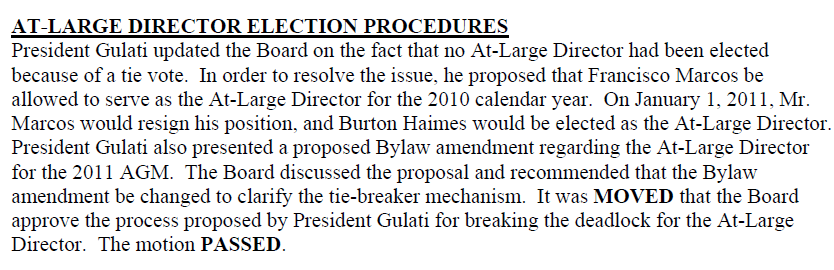
at-large

More typical Board business from May:
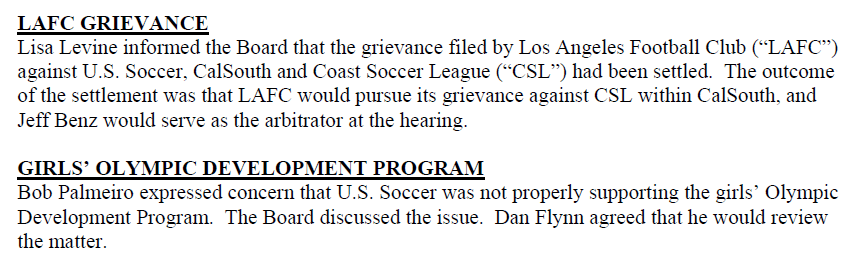
lafc

(That is, of course, not the LAFC entering MLS this year.)

The biggest news for the future — U.S. Soccer stepped into the mess that was lower-division soccer, where teams were breaking away from the USL but neither faction had the critical mass to play D2, and agreed to run a temporary second-division league with teams from both factions included. Also that year, a new task force came up with Pro League Standards. I remember thinking at the time that the D2 standards were ridiculous, but the leadership of the group that would become the NASL (none of whom are still involved with the league) signed on.

This from the President’s Report: “In 2010, U.S. Soccer successfully oversaw the Division 2 Professional League. Twelve teams went through a highly competitive 30‐game season, with the Puerto Rico Islanders claiming the championship after defeating the Carolina RailHawks 3‐1 in aggregate in a two‐game series. For 2011, the NASL has provided a plan that we are hopeful will provide a long‐term solution for Division 2 soccer, while the USL Pro League will also contribute to create a strong base of men’s professional soccer in the U.S.”

And back at the National Council, they were still doing manual roll calls, leading to this from the youth ranks:
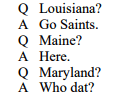
roll-saints

2011 

A few odds and ends:

  • April Heinrichs and Jill Ellis hired for women’s technical roles. At the AGM, Heinrichs gave a speech that went on for 11 1/2 pages of the transcript.
  • In case you forgot, FIFA didn’t give the USA a World Cup to host. Russia and Qatar seem like great choices though, don’t they?

And some interesting business on leagues, first from the National Council, where it seems everyone was combing the bylaws to make sure it was OK to give the NASL provisional membership for 2011:
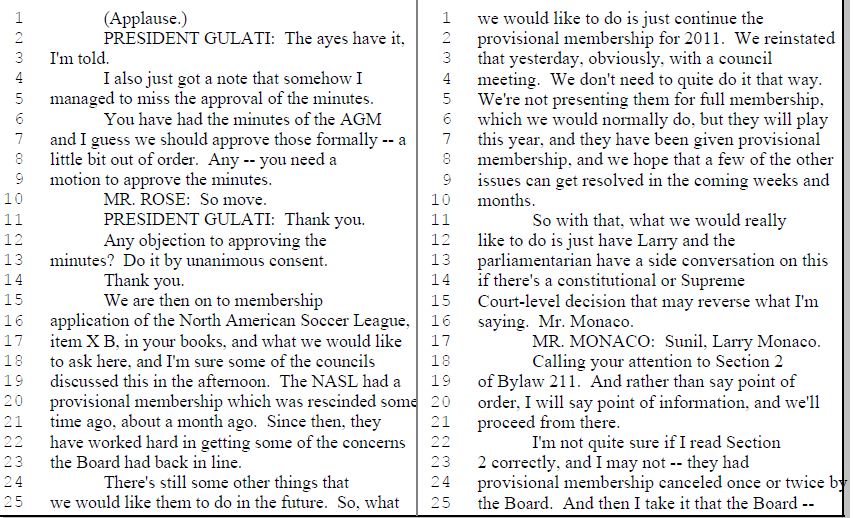
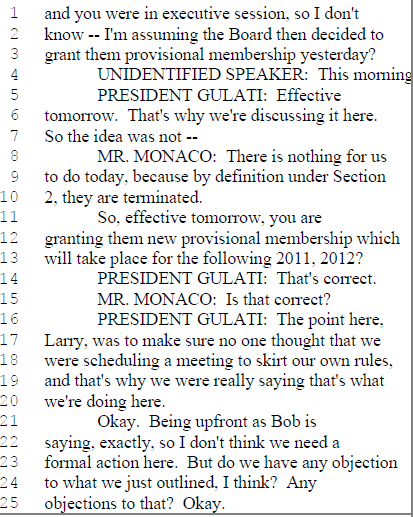
nasl-2011-1

nasl-2011-2

Then from a May Board meeting:

pro-am

Also — this is the earliest AGM “book” currently available online. There, you can see all the committee reports, bylaw changes, policy changes, etc., along with the transcript of the previous National Council (which is also available under AGM transcripts on the site). So your homework now is to tell me which committee(s) John Harkes and Amanda Cromwell served on that year.

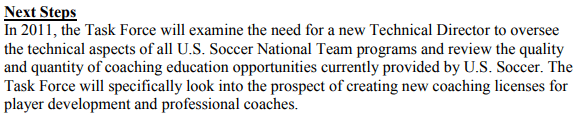
That’s also where we learn things like this:
techdir

That task force had 16 people, including chairman Kevin Payne, Bob Bradley, former USSF president Dr. Bob Contiguglia, Dan Flynn, Sunil Gulati, Tab Ramos, Thomas Rongen, Claudio Reyna and Jerome de Bontin.

And note this from, of all places, the budget report:
core

WoSo folks might be interested in seeing the game-by-game budget summary for the WNT in the fiscal year.

The book also has the NASL’s application for full membership, which notes the average monthly salary would be approximately $2,700.

And it’s bylaws, bylaws, bylaws! The proposals this year …

Amendment to Bylaw 213 by Board member Jim Hamilton (Adult Council): Speeds up the response time when someone bids to replace a state association. PASSED

Amendment to Bylaw 302 by Board member Richard Groff (Adult Council): “This proposed amendment is meant to formalize the customary practice of the Adult Council’s National Association to delegate votes in the National Council to subsidiary affiliates that register adult players directly through the National Association and not through a State Association.” PASSED

Amendment to Bylaw 412 by the Board as a whole: Intended to prevent having another tie for the At-Large spot. PASSED

Amendment to Bylaw 801 by Louisiana Soccer Association: Gives Life Members (and, as amended from the AGM floor, past presidents) the right to propose amendments to bylaws, policies and the articles of incorporation. PASSED

Then policies (some of which the Board enacts, but then the National Council must ratify):

ratified

Amendment to Policy 102(3)-1 by Sunil Gulati: It’s about coaching education, and it seems to be little more than some punctuation changes. PASSED

Amendment to Policy 214-2 by U.S. Youth Soccer: Membership fees! Cutting them in half. Literally. Every category — associate member from $1,000 to $500, adult player from $2 to $1, youth player from $1 to 50 cents, etc.  WITHDRAWN without a vote.

Amendment to Policy 214-2 by Richard Groff: Adds a U20 player category and charges them the youth ($1) rate rather than the adult ($2) rate. Saves some bookkeeping for U20 teams that have both youths and adults. PASSED

2012 

A moment of silence for the full-fledged roll call. They automated it this year.

The National Council votes the NASL into full membership. Commissioner David Downs is present to give a brief word of thanks.

Also welcomed as a member: North Dakota Soccer Association. The transcript has one of my favorite typos ever:

dakota

VP: Mike Edwards is elected to a second full term over Juergen Sommer.

But it wasn’t all bad news for Jurgens. Hello, Coach Klinsmann. He spoke at the National Council meeting for a long time.

The not-yet-recovered economy took a toll on the budget, with a projected deficit of $6.1 million.

The AGM book has a substantial presentation by the NASL. The “youth development” page shows a wide range of approaches — Edmonton has an actual academy, Carolina has an affiliation with giant club CASL, Tampa Bay has invested $65,000 in Maine (?!), and other clubs have players out coaching somewhere. Among the interested expansion markets — Austin, Las Vegas, New York, Sacramento.

Colorado’s state adult association shuts down. The youth association is provisionally accepted as a joint association.

Not as much activity on the bylaw front except for a couple of bylaws about bylaws:

Amendment to Bylaw 802(3) by Life Member Stephen Flamhaft: Suggests requiring that bylaw amendments must be distributed 60 days (not 30) before the AGM. The Rules Committee notes that another bylaw says 30, so the CEO would have to distribute them twice. FAILED (got 58 percent but needed two-thirds).

Amendment to Bylaw 802(4) by Flamhaft: The Rules Committee MUST make a recommendation of whether or not to recommend a bylaw (and may include a minority dissent if applicable). The Rules Committee responds by saying that could be problematic because it might politicize the committee, but hey, if you really want us to do that, go for it. WITHDRAWN without a vote.

Policies:

Amendments to Policies 241-2, 601-2, 601-8 by the Professional Player Registration Task Force (remember that from last year?): Basically, $50 per professional player in a non-pro league, but $10 of that goes back to the organization member and another $10 to the state association up to a very odd total of $1,333 per team in a calendar year.

Amendment to Policy 411-1 by Sunil Gulati: Just gives the CEO a bit more freedom to sign financial agreements.

New Policy 531-1 by USSF Referee Committee: Something about a point of contact.

Amendment to Policy 601-6 by Dan Flynn: International clearance for youth players, to bring USSF into compliance with FIFA requirements.

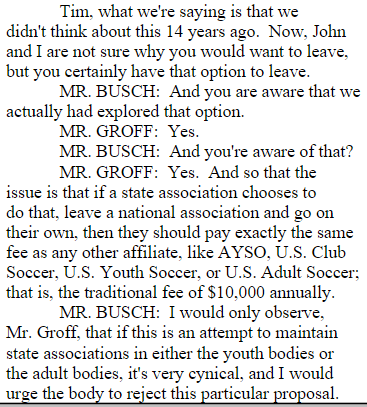
Then there’s a fifth one the Board approved too late for inclusion on the book. It’s from Richard Groff on Policy 214-1, and Washington State Adult Soccer’s Tim Busch has some pointed questions:

BUSCH: So what we’re talking about in Section 10 is if a state association chooses to leave one or the other youth or adult parent bodies and chooses to affiliate directly with the Federation, there’s a $10,000 one-time fee or a $10,000 annual fee.

PRESIDENT GULATI: Annual.

BUSCH:  Let me understand this. The Federation needs $10,000 to be able to accept our player fees? I mean, I understand a reasonable administrative fee. But $10,000?

Groff joins the conversation here:
washington

It still PASSED, though they had to go to the keypads rather than a simple voice vote.

2013 

Big year for the Federation: It launched the NWSL. Initially, the Fed staff was the league staff, but the league slowly grew its own office from an initial group of three into something that could stand on its own. Also, USSF subsidized the league, most directly by paying salaries for U.S. national team players.

Also, it’s the Centennial. 1913-2013.

The Athletes Council formed three internal divisions: Governance, Visibility and Outreach. Angela Hucles took the lead on Visibility; Cindy Parlow Cone took the lead on Outreach.

The Open Cup Committee report hails the increase in prize money — champion will get $250,000, up from $100,000 — and the Cal FC run:

cal-fc

The AGM book includes a report from the Diversity Task Force, opening with its mission statement: “We believe that the under-served soccer community deserves opportunities to succeed. We will identify the challenges, create the road map to success, forge partnerships with corporations, non-profit organizations and individuals who will help us develop the programs and services that allow the under-served soccer players from all backgrounds to reach their full potential in soccer, education, work, health and life.”

A few members of the 20-strong Diversity Task Force: Tiffany Roberts-Sahaydak, Chris Armas, Lynn Berling-Manuel, Luis Montoya, Dante Washington, David Testo. How’d that turn out?

American Amputee Soccer Association was welcomed as a member. U.S. Futsal returned “after a brief absence,” according to the letter from President/CEO Alex Para.

One unusually frank item in the AGM book: Some background, including minutes of a testy meeting and one angry email, of the dispute in Wisconsin.

The AGM itself, held in June, was relatively uneventful. Since-departed CONCACAF president Jeffrey Webb addressed the crowd. So did Dr. Reinhard Rauball of the German federation, who has a gift for U.S. Soccer. Gulati jokes that the plaque’s inscriptions accepts that it was a handball during the 2002 World Cup, then talks about seeing the men’s and women’s Champions League finals. The latter was won by Wolfsburg despite Megan Rapinoe’s presence for Lyon.

Let’s hit the bylaws:

Amendments to Bylaws 202, 232, 241 and 543 by Dan Flynn: All designed to remove the Individual Sustaining Member designation. Once upon a time, individuals could pay some fee and become a member, earning the right to attend any game. But, Flynn says, they hadn’t used this option in years, so it was time to delete it. The Rules Committee agreed, calling these bylaws “vestigial.” The change on 543 was WITHDRAWN for some reason, but everything else PASSED by voice vote.

(Remember the preceding paragraph.)

Amendment to Bylaw 213 by Richard Groff: Adds a mediation process to disputes between an existing State Association and a would-be replacement. It’s referreed to on the floor as “the Wisconsin bylaw amendment.” PASSED with applause.

Amendment to Bylaw 322 by Jon McCullough (Athletes Council chair who sadly passed away the next year): Changes the way the Athletes name reps to the Board and the USOC, going to staggered four-year terms. PASSED

Amendment to Bylaw 412 by Richard Groff: Simple update on Adult Council’s representation on the Board — the Adult Council chairperson would automatically get one of the two slots. PASSED

Amendment to Bylaw 603 by Eastern New York Youth (no, NOT Sal Rapaglia’s organization): Adding a section on how youth tournament organizers must advertise tournaments, taking into account all the different youth organizations and how their insurances differ and good grief, why do we have so many youth organizations? Rules Committee suggested tweaking and did in fact convince ENY to take on an amendment. They used the keypads for the vote, but it PASSED.

New Bylaw 805 by Dan Flynn: Can we please send notices to the National Council electronically? PASSED with slight amendment from the ever-vigilant Larry Monaco.

Phew! How about policies (reminder: Board usually enacts, but National Council must ratify):

Amendment to Policy 102(4)-1 by Open Cup Committee: Sets field standards starting with the first round, not third.

Amendment to Policy 214-2 by Disability Committee: Changes membership fee for Disabled Service Organizations. No longer $1,000. Now a minimum of $500, stepping up $1 per player if the group has more than 500, then a maximum of $1,000. If you have 300 players, $500. If you have 501 players, $501. If you have 999, $999. If you have 1,003 players, $1,000. If you have 10,000 players, good for you — and it’s still $1,000.

Amendment to Policy 601-5 by Transgender Task Force: Adds a new section saying amateur players “may register with the gender team with which the player identifies.” Not applicable to national teams or pros, pending FIFA action.

All three passed in one vote, as did the re-election of independent directors Carlos Cordeiro and Fabian Nunez.

By December, the budgetary news was steeped in black ink — revised projection on FY2015 was a surplus of $7M.

2014 

Back to a winter AGM — Feb. 28-March 2 in New York. The 2013 meeting had been in June.

In February, the Board said its sponsorship deal with Nike had been renewed. Still working on renewing the deal with Soccer United Marketing.

Also in February, revised pro league standards were approved.

Diversity Task Force reports that it’s going to launch a leadership program at a May event with the U.S. Soccer Foundation and the Urban Soccer Collaborative Symposium.

Winning the Gold Cup and holding a qualifier in a large stadium (Seattle) boosted the budget to a projected FY 14 surplus of $3.17M. (Indeed, the National Team revenue line item was $8,223,350 better than budgeted.)

Not much on the bylaw front:

Amendments to Bylaws 231, 301, 302 and 303 by Mike Edwards: These refer to Life Members, which have heretofore been nominated (in excruciating detail — a lot of the 2014 AGM book consists of every sort of supplementary evidence you can imagine in support of one nomination) to the National Council and then voted in. Edwards (still the VP at this point) wants to shift that from the National Council to the Board. Would that give too much power to the Board to stack the National Council? No problem — Edwards’ amendments would also cap the voting strength of Life Members on the Board. After a few tweaks from Larry Monaco, including (seriously) changing some periods to semicolons, all of this PASSED sans opposition.

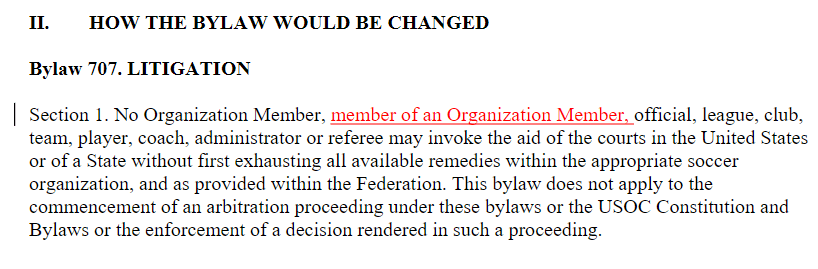
Amendment to Bylaw 707 by Mike Edwards: Oh boy. They’re trying to make it more difficult to sue the Fed.
arbitrate

And the Bylaw would have a few other tweaks as well, all trying to define the path by which anyone can challenge the Fed (or a Fed member).

To which the Rules Committee says, “Good luck with that.”

sue-rules

This was WITHDRAWN.

The only Policy up for a vote has not been approved by the Board and is predicated on the Life Member amendments passing. It just updates the Policies to match the Bylaws. PASSED.

Oh, and Sunil Gulati was re-elected to a third term without opposition. And Donna Shalala was re-elected.

Longtime Board members Richard Groff and Kevin Payne wrap up their terms. Groff was stepping down as USASA chairperson.

Later in the year, the Board considered the application of the US-AFL, agreeing to hold off until the group addressed some concerns from the Rules Committee.

And as mentioned above, sad news — Jon McCullough, a Paralympian and longtime Athletes Council rep to the USSF Board, passed away at age 48.

2015 

The 2015 AGM Book isn’t available online right now, which is a pity because I need some details about this first policy discussion.

In any case, there were no bylaw proposals this year. The policies …

Amendment to Policy 102(3)-1 by Mike Edwards: Something about a national coaching policy. Without the book, I don’t know what it said.

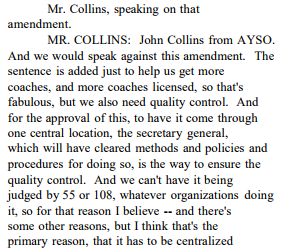
But the transcript tells us we had a battle between the state associations and the big national organizations — U.S. Club Soccer (Kevin Payne speaking) and AYSO (John Collins). It wasn’t about Edwards’ change per se; instead, it was about an amendment offered from the floor that would shift approval of something from the “state secretary general” (I suspect this is a typo or a misstatement, and they actually mean the national secretary general — Dan Flynn, in other words) to the state associations. Here’s Collins:
collins

So that’s why I think they didn’t mean state secretary general. Collins seems to be arguing that this should be centrally run. Whatever this is.

Several states stood up in favor of the amendment — a New Jersey rep actually said the current national F license is not valid in New Jersey for some reason. USSSA’s Craig Scriven had the last word, siding with Payne and Collins.

Payne, Collins and Scriven won. The amendment (to the amendment) failed. Then Edwards’ original amendment PASSED.

Amendment to Policy 213, something about mandatory liability insurance by prolific amendment-writer Richard Groff, PASSED without objection.

Amendments to Policy 531, proposed by the Referee Committee, PASSED without objection.

Carlos Cordeiro and Fabian Nunez were rubber-stamped for another term as independent director.

The National Council meeting ended with the “Good of the Game” free-form section as always, and it included an eloquent letter Jon McCullough sent before his death.

The whole meeting wrapped up in a tidy 83 minutes. That won’t happen in 2018.

At the Board meetings: It’s independent governance review time! McKinsey’s report was due in January 2016.

2016 

The 2016 AGM Book is up, so we get all the reports hailing a big year in 2015 — the WNT winning the World Cup (VP Mike Edwards went to eight of the 10 Victory Tour games), the MNT beating the Netherlands in Amsterdam (pity CONCACAF qualifying couldn’t be held there), MLS’s growth, the NASL contributing a player to the MNT and having its final on ESPN3, etc.

The U.S. Open Cup Committee was pleased that 63 games were live-streamed and available via the USSF site. They were also pretty pumped with the Cosmos’ comeback win over NYCFC. They’re also expanding USSF’s management of the Open Cup’s qualifying rounds — if you follow TheCup.us, you may notice that the qualifying rounds have a bit more pizzazz than they used to. Mike Edwards is the chairman of that committee and the Referee Committee.

The Rules Committee has gone all-male for some reason. It wasn’t like that in years past (Heather Mitts just finished her tenure).

Two bylaw proposals were withdrawn — USASA wanted to amend Bylaw 213 to make it a little more difficult to challenge a State Association so the states wouldn’t face costly, frivolous legal action, and the ever-present Steve Framhaft wanted to amend Bylaw 802 to make the Rules Committee send out its recommendations 60 days before the National Council meeting, not 30.

The proposed policy amendments passed with little fuss. That’s 601-6, a further tweak to youth players and international clearances (undoubtedly FIFA-driven), and 102(4)-1 from the U.S. Open Cup Committee, changing the “Adult Council division” to “Open Division.”

FY2016 was projected to have a six-figure surplus. It ballooned to $18.1M. Winning a World Cup and having a Victory Tour helps. The next fiscal year is projected to be huge because of the Copa America Centenario.

But we have a contested election! Incumbent VP Mike Edwards faces two challengers — longtime Board member Kevin Payne and longtime Board independent director Carlos Cordeiro. All three give speeches, all hailing each other as great people. And the winner is … Cordeiro.

This was also the AGM in which Flamhaft (see policy above, see presidency discussion in Part 1) rose in the Good of the Game section to denounce Chuck Blazer. Anger ensued. (First tweet of a thread below.)

https://twitter.com/duresport/status/944365333456019456

Also, the Board discussed a policy on standing for the national anthem, devoting an entire (though brief) teleconference to the matter in October.

At the December meeting, the last two items in the “Good of the Game” segment are noteworthy, but I’d be especially interested in some further explanation of the first:

alignment

2017 

In February, the Board approved the national anthem policy (604-1).

Also, Gulati gave an update on filling the vacant independent director position, with Heidrick & Struggles becoming more involved in the search for candidates. (So, no, Gulati doesn’t just wander around Columbia looking for people. I looked up that firm to see who they are, and I discovered that they just announced layoffs.)

At the March meeting, Big East commissioner and former WNBA president Val Ackerman attended and was nominated to fill Cordeiro’s spot as an independent director. That was confirmed the next day at the National Council meeting.

There was also some discussion of conflict of interest:

coiI’m sure people who remember that Alan Rothenberg and Mark Abbott, the latter of whom has been with MLS since the beginning, were both from Latham & Watkins, will find some irony in that.

At the National Council meeting …

The long speech this year went to Canadian federation president Victor Montagliani.

Applause for the NWSL’s deal with A&E Networks.

The online F license has been taken by 120,000 people already. Not bad. (I’ve taken it. It’s quite good.)

McKinsey’s consulting has led the Board to institute a few “committees of the Board,” so if you see that on the site and think it’s an odd power grab, just remember that an outside firm recommended it. They’re also evaluating the staff to see who might replace Dan Flynn one day.

How much money did USSF make from the Copa America Centenario? About $46 million, which is why the projected budget surplus is $44 million.

One year after being (politely) ousted as VP, Mike Edwards isn’t present, but he is approved as a Life Member.

U.S. Deaf Soccer is approved as a member.

The national anthem policy passes to applause. Two other policy amendments also pass, but I have no idea what those are because the 2017 AGM book isn’t online. Argh.

Then a major bylaws overhaul, led by Paul Burke of the Rules Committee:

  • Bylaw 213: Replaces the process for replacing State Associations. Voice vote, PASSED
  • Bylaw 232: Reinstates Individual Sustaining Members, just a few years after they were deemed “vestigial.” Fan organizations would be able to get a total of six votes. Voice vote, PASSED.
  • Bylaw 401: Requires candidates for president and VP to declare in advance. (Yes, we’re talking very recent history here.) Voice vote, PASSED
  • Bylaw 413: Term limits, background checks. Voice vote, PASSED

The details are complicated. Fortunately, I’ve written about this.

Also, changes to Bylaws 531 and 532 FAILED by electronic vote. Something about referees? Put the damn book online!

Are we done? Well, we’ve got minutes from three more Board meetings here …

In June, some spending:

  • A $100,000 grant ($50,000 subject to finding sponsors) for the Power Soccer World Cup.
  • $8 million for development of a centralized data integration platform.
  • $3.3 million for further work with soccer consultants Double PASS.
  • An additional $3 million (on top of the existing $1 million) for development of the Hall of Fame.

In July, Chris Ahrens (Athletes Council) inquired about the status of the pro league standards review. There was an update. And Lisa Carnoy was named the next independent director. (Theoretically, could someone else run for that spot at the AGM? It’s never been contested before, but these days, it seems like all bets are off.)

In September, Carnoy was added to the Risk, Audit and Compliance Committee.

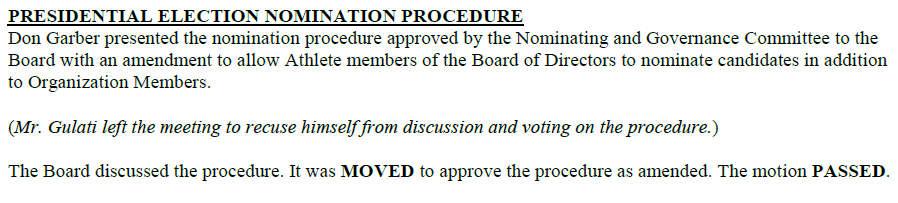
And finally, from the September meeting, make of this what you will.
nomcom

And that’s all we have. For now. At some point, I might go back through the financial documents AGAIN so I can find all the disclosures involving Garber and SUM, or maybe some of you can put down Twitter long enough to do it your own damn selves.

(Sorry, getting punchy. This is 4,145 words. Labor of love or something.)
 

us soccer

What I learned reading tons of USSF minutes and transcripts, Part 1 (1998-2009) …

For all the fuss, sometimes justified, over U.S. Soccer Federation transparency, the fed’s site has a treasure trove of information online. That includes:

(Quick note: If you want to skip ahead to 2010, see Part 2)

Not on the site (I think) is an external 2004 report on structure, governance and ethics by the Consensus Management Group. In the wake of this report, USSF followed the lead of other sports organizations and slashed the size of its board from an awkward 40 people to the current size of 15 voting members and two non-voting (the CEO/Secretary General and the immediate past president).

I’ve read, at one time or another, pretty much all of this information. That doesn’t mean I understood it. That doesn’t mean the records are complete — the Board seems to go into executive session over piddly details, while other boards with which I’ve dealt tend to do so only for personnel matters. But I’ve read it.

Quick side note: At one time, I started to compare the USSF structure to similar organizations, both international football feds and other sports federations in the USA. It’s difficult to get apples-to-apples information. The most similar U.S. organization is probably USA Basketball — it’s a substantial participatory sport with a major pro league. USA Basketball is descended from an amateur-only organization that added the NBA when pro players were cleared to play in international competition, and the NBA now appoints three of the 11 voting board members. In England, the Football Association’s board has representatives from the Premier League and Football League, and very few of the board members’ bios mention any significant playing experience. (Also, the CEO came to the FA from United Biscuits, which is so wonderfully English it makes me want to watch some Monty Python videos.)

The other big-picture item: The organization is turning over much, much more money than it used to.

2006 2016
Sponsorship $14,720,385 $49,498,623
Program revenue $28,365,806 $122,655,465
Gross receipts $39,102,876 $126,747,525
Total expenses $35,047,107 $110,011,376

I certainly have some questions left. Many. I hope to get some of them answered in 2018, preferably before the election.

So with that in mind, here’s a full history (abridged) as constructed from the minutes, transcripts and the occasional other document …

1998

Close elections (reported by Soccer America):

  • President: Dr. Bob Contiguglia 57.6%, Larry Monaco 42.4%
  • Vice president: John Motta 50.8% (372 votes), Sunil Gulati 49.2% (361)

Gulati was MLS deputy commissioner at the time. He was pushed out in early 1999 and became managing director of Kraft Soccer (owners of the New England Revolution and briefly the San Jose Earthquakes) later that year.

Also, new bylaws went into effect in September.

2000

A bylaw change put the VP election in Summer Olympic years and left the presidential election in Winter Olympic years. That set the stage for a Motta-Gulati rematch, and Gulati won. Motta would return to the Board in 2013 via the Adult Council; he’s the current president of U.S. Adult Soccer and is a must-follow on Twitter.

Secretary General/CEO Hank Steinbrecher retires and is replaced by Dan Flynn, who still has the job.

The fed begins a five-year sequence of business plans.

2001

Flynn’s first order of business is to freeze 34 open positions and cut travel to turn a projected $2.2 million deficit to a $300,000 surplus.

Other issues at the AGM sound familiar to a 2017 audience: 75% of players drop out by the time they’re 13, grassroots coaches and players will be a priority.

2002 

President: Dr. Bob re-elected to second term without opposition.

2003

All hell breaks loose.

The AGM has 38 proposed bylaw changes. Several people rise from the floor to complain that the pro leagues and athletes are voting as a bloc and outweighing the votes of the state associations, whose combined votes are just short of a majority. Alabama delegate Dan Mikos, also a member of the important Credentials Committee, compares the situation to the American Revolution and predicts “anarchy and revolution” down the road if changes aren’t made.

New York West Youth Soccer had a pointed opinion of the proceedings on its site a year ago, but alas, the link is dead. Some highlights from my notes:

  • The state youth associations, representing roughly 80% of the membership, have only 20% of the vote. (I think it’s closer to 25% today, but it’s hard to put a precise percentage on this group because some are also represented (somewhat) by other organizations such as U.S. Club Soccer.)
  • Among the bylaws that didn’t pass: an audit committee, a new appeals process, a requirement to give 30 days notice of any new policy being put in place.
  • Many state youth association delegates boycotted the President’s Dinner, and U.S. Youth Soccer passed a grievance to go to the U.S. Olympic Committee.

2004

The big governance report mentioned above is commissioned, researched and released. Among the observations:

  • A lot is going well: Finances, staff, etc. Especially finances, with the Fed moving from a $2.5 million deficit to a $28 million surplus in less than six years.
  • “While politics is always a factor in decision-making bodies, the level of vitriol in
    USSF politics is extreme. The amount of talent and energy consumed in
    internecine strife and finger pointing is destructive. There is little tolerance or
    respect for differing points of view, and few venues for addressing differences
    without rancor. Organizational sectors are increasingly isolated from each other.”

    • The Youth Council barely meets to discuss common issues.
    • The Adult Council is just USASA chatting with itself.
    • Some think MLS shouldn’t vote. (Well, the EPL does in England.) Some think the adults should just shut up. Some think the athletes should just go away, though that would violate federal law.
    • The 40-person Board doesn’t work, in part because people think decisions are just in advance. There’s also an executive committee (not any more) that’s poorly defined.
  • “In 1986, 43.14% of Federation revenue came from dues. By 2000, that percentage went down to 9.05%. Because of the recent dues increase, it is estimated that in 2005, 12% of revenues will come from dues. For some constituents, this dues increase, coupled with a real or perceived decrease in Federation services while it enjoys a 70% fund balance (based on a $40 million budget) is an irritant that migrates into the USSF political arena.”
  • There’s also a suggestion for how to find and nominate candidates for officer positions. That has not been implemented.
  • Bloc voting, bloc voting, bloc voting!

cmg

All that said, no bylaws passed because Larry Monaco (remember him from 1998) says they weren’t disseminated on time. Part of the issue is whether they’ve been distributed in writing as opposed to on a disk. This really happened.

monaco

(Bear in mind, this meeting was in March. Previous years’ meetings were in the summer, so they had a shorter turnaround.)

Also, perhaps in response to the bloc-voting accusation of the past year, Peter Vermes gave an impassioned speech on behalf of the Athletes Council, saying all the athletes wanted to be approachable and they all started out as rec players. He was greeted with applause.

Then Steve Flamhaft (remember that name) rose to castigate Monaco for being such a stickler for the rules.

VP: Gulati re-elected to second term without opposition.

2005

A less eventful year, with some governance tweaking in the wake of all that happened in 2003-04:

  • Dr. Bob mentions that, in addition to the governance report USSF commissioned, they’re expecting a report from the U.S. Olympic Committee recommending a smaller board, greater transparency and a few ethics guidelines. Task forces are assigned to working on the governance of the Board and the Youth Council.
  • Failed: A bylaw change (not sure of number) requiring a Soccer Summit to be held every four years.
  • Failed: A term limits bylaw change limiting officers to two terms. Also something having to do with Bylaw 401.
  • Passed: Something having to do with grievances (I really wish the full “book” from these AGMs was available online). Also changes to Bylaws 212 and 213 and some sort of change on referees.

What’s the president’s role? Flamhaft (whose father, Jack, was president from 1959 to 1961) rises to oppose a change to Bylaws 402 (Responsibilities of Officers) and 501 (Appointment of Secretary General) that he says would “dilute and emasculate” the office of the president. Then a curious argument — former VP Walter Giesler died during an AGM (in Flamhaft’s words; a couple of online sources say he collapsed while the 1950 MNT was being inducted into the Hall of Fame, which may well have taken place concurrently in 1976) and Flamhaft’s father was once carried on a stretcher from a FIFA meeting in Zurich, so we need to remember their sacrifices.

Dr. Bob passes the chair to VP Gulati so he can respond, saying it’s simply a reality of the modern world. Other soccer and other sports organizations are relying on CEOs who aren’t subject to election.

Also this from Dr. Bob: “the authority of the organization is not the president. The authority of the organization is the Board of Directors. And so we’re trying to legalize that and make it the way everyone else is doing it in the world.”

It passed.

Most Board policies were quietly affirmed. The exception was a policy on referee assignments and unaffiliated games (such as high school games) that sparked a discussion that went on for pages and pages. Something was finally passed.

Also, the AGM took place during a USWNT Algarve Cup game vs. Denmark, so they periodically got updates. Kristine Lilly had a monster game, as usual, and the WNT advanced to the final, where they would beat Germany 1-0 on a Christie Welsh goal.

Later in the year, the Board:

  • Approved a grant (later matched by the U.S. Soccer Foundation) for the Hall of Fame.
  • Approved Toronto for membership in MLS. (Cross-border applications have to be approved by the Board; in other years, similar applications are heard in various lower-division men’s and women’s leagues.)

2006 

The Sunil Gulati era begins. He’s elected without opposition.

Dr. Bob does not preside over the election itself.

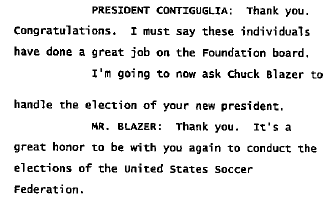
blazer

(Much later in the meeting, Blazer announces that Mike Edwards will be the next vice president, replacing Gulati. Standing ovation.)

Don Garber nominates Gulati. No one opposes him. Then Gulati thanks scores of people, including Sal Rapaglia (12 years before he stepped into a major controversy), Kevin Payne, Soccer America‘s Paul Gardner (!?) and former U.S. coach Bora Milutinovic.

Gulati also talks about how to get better, alluding to what Germany is doing (which would become “Das Reboot”).

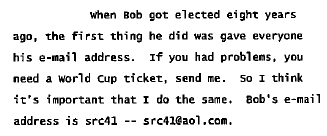
He closes with a joke:

bob

And another big change: The Board is trimmed from 40 people to 15. Much self-congratulation ensues — as Gulati points out, people are basically voting to get themselves less power, and the U.S. Olympic Committee only did it “because Sen. McCain was calling fairly regularly.”

They managed to do all that even after lengthy discussions on whether a particular amendment would promote “interplay” between youth leagues and whether USSF should be allowed to file an amicus brief in an arbitration. They even had a few “Wait, what are we voting on?” moments.

Also, Bob Abbott from Louisiana thanks the rest of the Federation for its support after Katrina.

The streamlined Board doesn’t have too much to deal with, though Bob Bradley is named interim MNT coach, and U.S. Futsal runs into trouble and is eventually removed from membership. (A U.S. Futsal group is an affiliate today; I don’t know how much restructuring they did before getting back into the Fed.)

2007

The first independent director — Carlos Cordeiro — is recruited by the Board and officially elected at the AGM.

The other interesting item at the AGM — in the “Good of the Game” segment (just speeches, no votes), there’s a discussion about compensating the president so they can attract a bigger pool of candidates. Sounds familiar, doesn’t it?

The Board is busy with the launch of the Development Academy and the delayed launch of WPS. A motion to establish a USSF nominating committee fails. Meanwhile, Gulati asks AYSO’s Burton Haimes to start a task force on pro league standards.

(Quick side note: Paul Caligiuri was on the Board this year.)

2008 

Unopposed elections: Mike Edwards (first full term as VP), independent director Fabian Nunez.

The Board votes, at Gulati’s urging, to recommend rejection of a proposed bylaw amendment to pay the president.

WPS gets provisional membership.

CalSouth Adult Soccer goes under criminal investigation. CalSouth Youth Soccer applies to take over adult soccer in the state, and the Board approves a task force to investigate. CalSouth is indeed a joint association today.

Other membership issues: MISL dissolves, Missouri Youth Soccer faces a lawsuit, XSL and NISL get provisional membership. Also: WPS requires some waivers to the new pro league standards.

And promotion/relegation is mentioned in the Board minutes! In the president’s report: “There were also discussions at a recent FIFA Congress regarding promotion/relegation and limiting the number of foreign players starting on domestic professional teams.”

2009

Unopposed election: New independent director Donna Shalala, at least filling the third slot, and re-elections for Nunez and Cordeiro.

More foreshadowing: The Pro Council had been unable to agree on how to split votes due to a disagreement between MLS and USL. The final word: 62.5% MLS, 25% WPS, 12.5% USL.

The AGM is pretty quiet, though there’s some conversation about youth soccer mandates, including the age-old question: “So are you just going to stop kids from playing un-mandated soccer?”

The budget had a surplus of $218,000. International games helped pull it out of a projected deficit.

More conflicts: Dueling associations in Wisconsin (this would go on for a while), U.S. Youth Soccer vs. U.S. Club Soccer.

The Pro League Task Force appears. MLS is sanctioned. WPS and the new MISL are approved with some waivers.

We’ll pick up from there in Part 2.

podcast, us soccer

All the USSF president’s men (part 1 of RSD23 podcast)

The nomination deadline has passed, and we still don’t really know how many candidates will officially run for U.S. Soccer president. Current educated guess is eight, but at least three are unconfirmed.

This morning, I chatted with Jason Davis on SiriusXM’s United States of Soccer. The interview is now available on demand on the SiriusXM site. Highlights:

  • 1:30 – How many nominees? We go through individually.
  • 5:00 – Who can nominate, anyway?
  • 6:25 – Conspiracy theories — separating the ludicrous from the rational, especially in terms of Soccer United Marketing and Major League Soccer.
  • 8:33 – The Nominating and Governance Committee: Too much influence for Garber and Gulati?
  • 14:00 – Has SUM lost control of things?
  • 15:30 – The Steven Gans letter

And the election accounts for the first 15 minutes of the Dec. 13 podcast …

  • 4:30 – Why it’s important that the rest of the election is in the hands of the Credentials Committee, not the Nomination and Governance Committee. No, really. It’s about SUM.
  • 6:00 – The positives of SUM (historically), segueing quickly into what looks quite bad right now.
  • 8:10 – The establishment candidate (Kathy Carter)
  • 9:15 – Why the delay in USSF announcing the final field?
  • 10:10 – The adult soccer associations are leaning toward …
  • 12:30 – Yeah, somehow this segued into pro/rel and how we can do it better than Europe
  • 13:10 – Summing up the field and how they all have something to say.

The second part of the podcast is on the Soccer Parenting Summit. See the next post tonight or tomorrow or whenever I thaw out from another trek outside. Listen:


us soccer

Gans calls USSF election process unfair — any truth to it?

Go ahead, close all your browser windows, adjust your autoplay settings or whatever you need to do to keep SI’s atrociously designed site from crashing your computer, because this story is worth it: Candidate Steve Gans calls on U.S. Soccer to bring in independent management for the rest of the election.

Let’s recap: The deadline for securing three nominations for the presidency is just a few hours away. Gans himself, Eric Wynalda and Kyle Martino say they’ve cleared the three-nomination bar. Carlos Cordeiro, not a big name among fans but the runaway winner of a three-way race for VP just two years ago, shouldn’t have too much trouble getting his three. Kathy Carter surely has hers, given this:

https://twitter.com/duresport/status/940586615096922112

And Paul Caligiuri, the quietest candidate in this race, issued this cryptic tweet today:

https://twitter.com/PaulCaligiuri20/status/940396893586075650

So … he has all three?

No word from Mike Winograd. UPDATE: It appears Winograd got his nominations.

Plenty of words from Paul Lapointe, most of them bitter and suggestive of someone who’s not going to make it. The status of Hope Solo’s late entry is up in the air — I can confirm Julie Foudy’s report from a couple of days ago that she did not have all three, but she’s not giving up until the clock sounds midnight Central time.

In other words, we’re going to have a lot of candidates.

Now, let’s go over the letter from Gans representative Robert Bertsche and the response from U.S. Soccer general counsel Lydia Wahlke …

On the face of it, the Bertsche letter is a little flimsy. Wahlke takes note:

wahlke-1

So this is apparently not the first such communication.

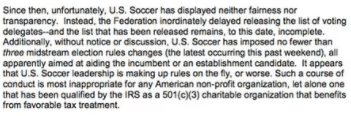
The meat of the Gans allegations is in the third paragraph:

gans-1

Allegation 1: Delaying the release of the delegate lists. Let’s check back to the election procedures to see what this means:

ncm-delegates

“NCM” is National Council Meeting, where everyone gathers in Orlando and conducts business including but not limited to electing the next president.

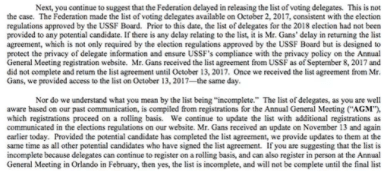
Here’s the Wahlke response:

wahlke-delegates

And yes, the list of delegates is going to keep changing. We know each state association will be there, but life happens — maybe Delegate X has a family thing come up and Delegate Y goes instead.

As far as the timeline goes, bear in mind that Gans has been in this race for months. He had already been in the race for months when I interviewed him for the podcast two months ago. The letter doesn’t state when Gans started asking.

In any case, not a big deal in the long run. The next part, though, puts USSF on shakier ground. Here’s Wahlke …

wahlke-procedures

In fairness to Wahlke, the Gans letter doesn’t specify what has been changed. The SI story mentions three things:

  1. The first change was on Sept. 1, requiring candidates to obtain three official letters of support. That was the initial election procedure, which has never been in place before because we’ve never had an election like this before. The bylaws changed last year, and it seemed uncontroversial at the time.
  2. The decision on Nov. 8 to let nominators withdraw their nominations by Nov. 27 so they could nominate someone else.
  3. Last week’s Sunil-nominator-palooza, when USSF abruptly said all 24 (24??!!!) organizations that had nominated him were free to nominate someone else.

No. 3 really contradicts No. 2. Perhaps USSF should’ve just told nominators they should’ve withdrawn their Gulati nominations before the Nov. 27 deadline, when Gulati was still playing Hamlet staring at a skull and trying to decide what to do before Laertes comes storming back.

So we can consider that a legitimate complaint. Moot point now, but it does establish that the Nominating and Governance Committee has been playing a bit of Calvinball. But they’re not in charge of the vote itself. As far as I know, their role is hereby done.

One more complaint from the Gans team:

gans-pop

Wahlke’s response:

wahlke-pop

Seems reasonable. If Illinois’ adult association wants to praise Eric Wynalda to the high heavens on Twitter, how is that U.S. Soccer’s fault?

That said, at least Wahlke is on the record saying the nomination letters won’t be shared publicly. So if anyone needed assurance that we’re not going to see a press release from USSF saying Kathy Carter has 90 nominations or whatever, we’ve got it. (Now, a press release from SUM, on the other hand, would still be legal. And would probably go over like a lead zeppelin, to paraphrase Keith Moon or possibly John Entwistle giving Jimmy Page the idea for a band name. Then again, Carter’s not getting 90 nominations. Maybe not even nine, despite Gulati hanging on to 24 of them like he’s trying to get on Hoarders.)

And for the record, organizations are by no means obligated to vote for the candidate they nominated.

Two other things that have come out of the exchange:

  • Wahlke mentions “108 Organization Members.” By my count, it’s 110 — 41 state youth associations, 40 state adult associations, 14 joint state associations, 4 pro leagues and 11 national affiliates. I’m not completely sure of the count on state associations because some state associations don’t have websites, as if it’s 1992 or something, and I just found out this evening that Maine has only a youth association, not adult (and not joint). The national affiliates are tricky. A page on the USSF site lists nine, but that doesn’t include a couple of national youth soccer organizations have nominated someone at one point in this process. I’ve asked for clarification, and I’ve been directed to the site. Make of that what you will. Moot point now, but next time, could USSF just print a dadgum list?
  • The SI piece names one of the nominators — Angela Hucles. I’ve had the last few lists of nominators and have decided not to name any of them beyond the identifiers in my previous posts. I’m still wrestling with it from an ethical and practical level. This information probably should be made public, but should I be revealing nominations that a bunch of state associations — many of them small operations run by people who aren’t used to dealing with the media — made with a semi-reasonable expectation of privacy? (Or am I just cowed by the guy who responded to my off-the-record queries about the election with “I DON’T SEE HOW IT ANY OF YOUR BUSINESS”?)

But here’s the kicker, and I apologize for burying the lead …

Gans’ letter is asking for independent oversight. Wahlke responds …

wahlke-indy

That’s certainly not the last word here. We’ll need to know who’s been hired. Maybe some enterprising people will even vet that outside firm.

The Credentials Committee’s membership is listed online. Before the election, I’ll check to see if it’s changed at all.

For now, though, Gans seems pleased.

I can’t remember from past general meetings whether this is new. In any case, perhaps we’ll see a few new bylaws clarifying such practices from now on.


us soccer

U.S. Soccer presidential race: Nomination check

Yesterday, I saw a list of 44 nominations (43 organizations, 1 athlete) who had nominated someone for the U.S. Soccer presidency.

Today, it’s down to 20. I’m going to reproduce here an email I obtained whose veracity I have confirmed with multiple sources:

U.S. Soccer has received confirmation that Sunil Gulati has officially withdrawn from the presidential nomination and election process. The Nominating & Governance Committee has determined that the 24 Organization Members that nominated Mr. Gulati are therefore eligible to nominate another candidate by December 12, 2017.

We want to remind you that the three (3) letters of support/nomination from Organization Members, or the Athlete members of the Board of Directors is due by 11:59 p.m. on December 12, 2017. If you believe that an Organization Member or Athlete member of the Board of Directors has nominated you and they are not on the list below, please contact me as soon as possible by replying to this email.

I’m not going to reproduce the list to protect the innocent. Or the guilty, in some cases. Depends on your point of view.

I’ve broken it down by type of organization, lumping together the various national affiliates (including national youth organizations, disability sports organizations) as “national.” The numbers might be off by 1-2 — I’m unsure whether one state association is adult or joint (combined youth and adult), and there are a couple of unusual national affiliates that I’m not sure can actually nominate anyone (say, the Hall of Fame). With that disclaimer in mind, here’s the breakdown of how many organizations exist and how many had nominated someone as of Nov. 29, Dec. 8 and Dec. 9:

TYPE No. Nov. 29 Dec. 8 Dec. 9
Adult state association 36 13 16 9
Youth state association 37 12 15 6
Joint (adult/youth) state 18 5 5 3
Pro league 4 0 1 1
National affiliates/orgs 13 6 6 0
Athlete Board members 3 0 1 1
TOTAL 111 36 44 20

UPDATE: The “No.” (or “number” since we don’t have to abbreviate here) column has been corrected now that USSF has released a complete list of affiliates. I’m assuming “Orlando” should be “Oregon.” The incorrect figures were 41 adult, 41 youth, 14 joint, 11 national affiliates/organizations.

One announced nomination is not included here because it’s not on the emails I’ve seen. That’s the South Carolina youth association, which has declared for Kyle Martino.

From that, we can deduce the 24 organizations that had endorsed Gulati but are now in play. Here’s a breakdown with names changed to regions (“res” means “rescinded”):

ORGANIZATION TYPE Mid-Nov Nov. 29 Dec. 8 Dec. 9 NOTES
Midwest Adult yes yes yes res Gulati: Confirmed by email
Midwest Adult yes yes yes res Gulati: Deduced from lists
Northeast Adult yes yes yes res Gulati: Deduced from lists
Southeast Adult yes yes yes res Gulati: Deduced from lists
Northeast Adult yes res NEW yes
Northeast Adult NEW yes
West Adult NEW yes
Southeast Adult NEW yes yes
West Adult NEW yes yes
Illinois Adult Adult yes yes yes yes Wynalda: Announced
Midwest Adult yes yes yes yes
West Adult yes yes yes yes
Athlete Athlete NEW yes
Northeast Joint yes yes yes res Gulati: Deduced from lists
Southwest Joint yes yes yes res Gulati: Deduced from lists
Northeast Joint NEW yes yes
New Hampshire Joint yes yes yes yes Wynalda: Announced
Northeast Joint yes yes yes yes
National National yes yes yes res Gulati: Deduced from lists
National National yes res
Major League Soccer Pro NEW yes Carter: Announced
Midwest Youth yes yes yes res Gulati: Deduced from lists
Northeast Youth yes yes yes res Gulati: Deduced from lists
Northwest Youth yes yes yes res Gulati: Deduced from lists
Southeast Youth yes yes yes res Gulati: Deduced from lists
West Youth yes yes yes res Gulati: Deduced from lists
Northeast Youth yes res NEW yes
Northeast Youth NEW yes
West Youth NEW yes
West Youth NEW yes yes
Northeast Youth yes yes yes yes
West Youth yes yes yes yes
South Carolina Youth Youth Martino: Not on list but announced

If you have any corrections or comments (including claiming your nomination if you are one of these organizations), speak up!

us soccer

Shocking allegation starts post-Gulati era

Sunil Gulati will not run for re-election. It’s the right decision, one that frankly should’ve been made before the late November deadline for organizations to rescind their nominations for the presidency.

But let’s take a close look at that story, particularly this quote:

Gulati, born in India, was the subject of some racist commentary on social media, but said that didn’t play a significant factor in his decision.

I must be muting the right people now, because I didn’t see any of that. I switched to the browser I don’t normally use and tried to find something.

It was a while ago, but on Oct. 13 (by far the highest volume of tweets mentioning him — that was day Gulati held a conference call and Bruce Arena resigned), he did indeed get at least three tweets that would qualify as racist. One suggested Trump should deport him (also noted Oct. 10). One used a word that seems to be a regional answer to Mexico’s “p—” chant. Another made reference to curry.

And some of it was simply abusive:

https://twitter.com/dario27soccer/status/937244498211495937

It gets worse. I’m not going to repeat one allegation. Let’s say it had nothing to do with soccer or business or economics. Another one still thinks “gay” is an insult. And there are another couple of invitations to remove himself from the living.

This one might be the strangest:

https://twitter.com/TitanFan98/status/917994413627985920

Or maybe this:

A lot of people simply asked him to resign — hundreds of tweets in the hour after the apocalypse in Trinidad, then another burst when news broke that the Italian federation president was stepping down.

And the usual stuff from people who don’t understand that this isn’t a paid position:

https://twitter.com/mikemce9/status/930282941107855360

https://twitter.com/IVXXd0pe/status/920155909657001984

This one’s especially muddled:

Also, I sometimes wonder if people think we’re living in a fascist country (hey, we’re getting closer) in which the federation and other authorities also dictate the media coverage:

Here’s a palate cleanser from someone who ran against Gulati a couple of times (and won once):

That search as a whole, though, was a reminder that there are a lot of really stupid hate-mongers on Twitter.

And that’s just Twitter. Other platforms may have carried more racist abuse, but when I think racist abuse and sheer hate, I think Twitter.

Here’s a more pertinent quote to dissect:

“Look, the general perception in the soccer community versus the people who vote in elections may be different right now,” Gulati said, referring to the various state soccer associations and administrators who will vote in the presidential election.

“But the loss to Trinidad was painful, regrettable and led to a lot of strong emotions. And to be honest, I think at this point, that’s overshadowed a lot of other things that are important. So fair or not, I accept that and think it’s time for a new person.”

All of this is true. If I were advising Gulati on PR, I’d drop the “fair or not” clause. And I wouldn’t have responded to this point:

Cordeiro’s entry was the most dramatic, given his relationship with Gulati — and it was clear that Cordeiro’s choice affected the relationship between the longtime friends.

“It was an interesting set of discussions with Carlos,” Gulati said in a quiet tone. “That’s all I’m prepared to say about that.”

So it’s not the most graceful exit for Gulati. He still maintains higher ground than his Twitter accusers, but that’s a very low bar. Even the people on Twitter who use their real names rarely have any perspective or understanding of what Gulati has done. It’s not really logical to blame Gulati for undoing all the progress made over the past decade without noticing Gulati was in place while all that progress was made.

And the bulk of the job — er, volunteer position — has little to do with the men’s or women’s national teams. Here’s what he says about the other candidates:

I think several of them would be in for a pretty big shock about what the job is — it’s not just about national teams. It’s about 4 million registered players, referees, medical safety, grass-roots stuff. It feels like that stuff gets ignored sometimes.

It’s definitely more drudgery than the Twitterati realize. Read back through the minutes of USSF Board meetings, and you will be bored. I also wouldn’t want to be the one trying to figure out what to do with the country’s pro leagues — Neil Morris and I basically figured it’s nearly impossible to avoid lawsuits down the road.

But I think Gulati, perhaps in one final comment that shows he hasn’t been listening to the right people, is selling the other candidates short. Steve Gans, who embarked on a listening tour before announcing his candidacy, is talking about a youth summit to try to quell the factionalism at the grass roots. Paul Caligiuri is talking about ODP, id2 and the Development Academy. Eric Wynalda spent the weekend at an adult soccer tournament. Kyle Martino, Mike Winograd and Paul Lapointe have ideas for every aspect of the game. And Carlos Cordeiro certainly understands the scope of the job — he’s vice president, and he has done the heavy lifting on the budget for many years.

We’re seeing a productive exchange of ideas. We need Cordeiro and maybe Kathy Carter to come in and give their views as well.

So can we agree that we’re not going to let Twitter ruin this election?