pro soccer, us soccer, youth soccer

“Shoeless Soccer” and why the U.S. men will never win the World Cup

Today at The Guardian, I have a provocative piece suggesting the U.S. men simply aren’t going to win the World Cup.

At all. Ever.

Coincidentally, I recently read a book (and will be talking with one of the authors) that unintentionally demonstrates why.

The basic idea of Shoeless Soccer: Fixing the System and Winning the World Cup is intriguing — we need less formal travel soccer and training, and we need to build up informal play on harder surfaces, preferably without shoes and shin guards. The authors are a couple of Bowling Green faculty members — one of whom (Nathan Richardson) has spent a lot of time coaching and running soccer clubs, one of whom (Carlo Celli) has spent a lot of time in Italy. It’s not just a facile comparison between Italy and the USA — the authors correctly diagnose many problems in U.S. soccer and offer interesting solutions to some of them.

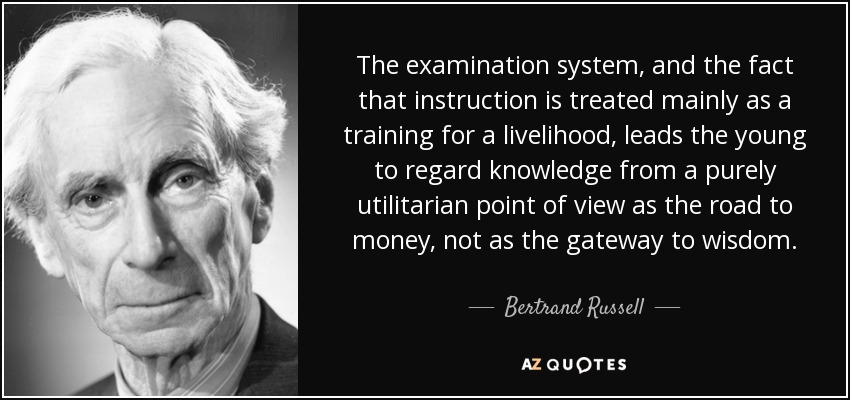
Given the academic background, the number of careless, sloppy errors in the book is startling. First, there’s a logical/philosophical issue — the authors condemn a method of training by associating it with one Friedrich Frobel, saying he was “a disciple of Johann Heinrich Pestalozzi, who in turn was a follower of Jean Jacques Rousseau,” and Bertrand Russell later claimed Rousseau influenced totalitarianism. I believe my logic professor would call that “guilt by association” — and a faint association at that.

Perhaps the Rousseau-bashing is to be expected, though, because the book is as much of an entry in the long-running “mommy wars” as it is a soccer polemic. It was featured prominently on a blog called Let Grow, which is firmly in the “free-range” parenting camp as opposed to the “helicopter” method. That’s a legitimate point of view — we parents certainly should fight our instincts to stifle our kids’ development by shielding them from failure — but it sometimes leads to messy politics and just a bit of tedious dogmatism.
russell

And some of this book reads like your neighborhood populist’s screed against pointy-headed intellectualism, eschewing research and even history. They say the USA hasn’t won a war since Eisenhower was president, which I’m sure will surprise veterans of the first Gulf War in 1991. (I did mention “messy politics.”) The aforementioned Bertrand Russell was a utilitarian at first and then evolved to the next level of trying to attain as much knowledge as possible, so it’s hard to imagine he’d scoff at the latest centrally planned training methods from Germany.

(Thus ends my longest philosophical digression since college, though I did cite Plato and the film Real Genius in my take on Jesus Christ Superstar. Yes, I majored in philosophy (and music), but we mostly read Plato, Descartes and Hume. Ask me about the cave sometime.)

Then we have the basic errors. The “Herman” Trophy. “Demarcus” Beasley — who, incidentally, is going along with the book’s underlying ideals by building futsal courts in his hometown. Author Lewis Carroll is spelled two different incorrect ways — “Carrol” and “Carol.”

And some of the soccer takes are simply incorrect. The authors say MLS tried to introduce the shootout, forgetting the old NASL. (We’ve all seen Once in a Lifetime — some of the Cosmos’ foreign stars actually liked lining up from 35 yards out for a one-on-one tiebreaker!)

(Hello, Mr. Eskandarian! And the upside-down clock is a nice touch.)

They say the 2002 World Cup team had a “nucleus” of players from Bruce Arena’s Virginia and D.C. United teams, which is a bit of a stretch — Carlos Llamosa and Tony Meola were barely involved, and Claudio Reyna was nearly a decade removed from his college days. U.S. Club Soccer becomes “the US Soccer Club Association,” which has “courageously imported coaching expertise from La Liga.” (Wasn’t every NSCAA session a couple of years ago some variant of learning to play like Barcelona?) They say the USA has produced only “second-tier stars in second-tier leagues,” which will come as a surprise to Reyna, BeasleyBrian McBride, Brad Friedel, Steve Cherundolo, John Harkes, Alexi Lalas, Clint Dempsey, Geoff Cameron, Stuart Holden, Tim Howard, Eric Wynalda, Christian Pulisic and Kasey Keller, let alone Mia Hamm, Abby Wambach, Alex Morgan, Becky Sauerbrunn

Then the interesting ideas are often taken to the point of absurdity and beyond. They start with the notion that playing without shoes can teach players proper technique because it hurts a bit to kick the ball the wrong way. Then they proceed to suggest players lose their shin guards because they’ll steer clear of shin-to-shin contact. Unfortunately, that does little good when it comes to foot-to-shin contact — I’m still wincing from the moment I stepped in to demonstrate something in practice a few weeks ago and got whacked.

They end up almost like the footballing Amish, shunning anything that can’t be hand-crafted on a farm. The words “shiny” and “new” are tossed out as frequent insults (isn’t everything shiny and new at some point in its life cycle?), and one of the notes I scribbled on my Kindle is, “What do these guys have against water bottles?” (Or “smart boards” in school classrooms, another of the unwelcome sociopolitical digressions here. Smart boards rock.)

But the book rewards the patient reader. They aren’t the first writers to use the derogatory term “soccer-industrial complex” — I used it last year, and a search for the term turned up many references in the past decade — but they do well to expound upon its ills. We’re spending a lot of time and money on travel and gizmos (check out the obscene prices on soccer goals sometime) that could be going to actual soccer.

They clearly see a lot of the problems, some of which aren’t obvious to all youth coaches. Our participation rates are down. Coaching education is expensive and incoherent (as I write this, I’m still trying to figure out why U.S. Soccer changed its license courses again this spring). High schools and colleges have the infrastructure, and instead of trying to work with schools to reform their soccer programming, we’re turning away from it. A lot of kids turn up for rec soccer because their parents just want an hour of baby-sitting with exercise, a challenge for all of us who’ve coached U6 soccer. Then kids get to travel soccer, where their parents complain if the kids who torched the Pugg goals at U7 have to play a few minutes on defense. And the more “elite” you get, the more likely you are to be traveling to another state for a game of dubious quality when you could just as easily have a good game across town.

They even give credit where it’s due — sometimes. They see clubs starting pickup soccer sessions. They see U.S. Soccer coaching gurus encouraging individual ball skills at early ages, and the fed is admirably moving to a good mix of online and in-person coaching education.

Their own ideas aren’t bad. Having an older kid join a younger group’s practice to teach by doing sounds great — that mix of age and experience is actually one of the things I love about School of Rock as a children’s activity that we don’t get in youth soccer.

And if the “shoeless soccer” motif seems a little too off-kilter or unrealistic, consider the “street soccer” ideas they present. They’re not the only people pushing street soccer, of course — look back at Kyle Martino’s emphasis on hybrid basketball/futsal courts during the presidential campaign and Martino’s subsequent role with Street Soccer USA — but they build a strong case for some of the lessons that can be learned from playing on a small, hard surface. If you’ve coached young kids who are determined to play magnetball and clump around the ball no matter what, you might be a little skeptical that a fast surface will work wonders as opposed to your local grass (dirt) field, but it’s worth a try.

Nor are they the only advocates of free play. Apparently, in their local schools, kids aren’t playing soccer at recess, which is unfortunate. When I volunteered for the day at my local elementary school, I found myself in an entertaining 10v10 game in an enclosed space. It wasn’t perfect, but they were playing.

Playing shoeless or on pavement probably isn’t for everyone. I can’t imagine many of my old U6 rec players taking to the idea or learning anything from it. The highly motivated player, though, might love it and develop more quickly than he or she would in weekly rec soccer activities alone.

But for all these good ideas, which could indeed push U.S. soccer forward, the book demonstrates so many American traits that will hold us back:

  1. The obsession with the “quick fix” instead of an honest assessment of the generations of American exceptionalism (which doesn’t make us “exceptional” — it just makes us the “exception” to the rule) that have led us to fall behind in soccer.
  2. Sloppiness in developing those quick fixes (see the errors above).
  3. Offhand dismissal of relevant objections. The authors smirk at the injuries that can be sustained if we let our kids play rough on any surface they can find, an odd assertion given the injury (read: ACL) concerns we’re seeing these days, particularly in women’s soccer. They note an Italian club that has no mechanism for informing players of cancellations because they never cancel, which perhaps struck me at the wrong time because, just this week, I was in a basement riding out a tornado warning after informing my team that we would not spend the evening on an open turf field volunteering for a reenactment of The Wizard of Oz.
  4. Straw men that give the appearance that the speaker alone is wiser than the mob. They seem to think no one else in the USA has noticed the emergence of Iceland or its coaching education. “We fret about the wrong things in US soccer,” they say at one stage. “And our players suffer.” No, we fret about everything in U.S. soccer. Not all of it is wrong. Mathematically speaking, that would be impossible.
  5. Everything is someone else’s fault. When one of the good professors fails to reserve space on an indoor turf field, and the international soccer club must yield to the local Quidditch team, he blames Quidditch rather than his own organizational skills.

Near the end of Shoeless Soccer, we find a passage that says it all. The authors say “the grassroots proposals in this book require nothing more than a bit of humility.”

We’re Americans. We don’t do humility. We do things our own way, and if that doesn’t work out, we take our ball and go home.

But we can always use ideas, and this book has several worth discussing. Look for a podcast down the road.
 

youth soccer

The first Youth Soccer Guide pages are up

And these are free.

PAGE 1: About the Area Guides — this will tell you about all the national organizations you’ll need to know to make sense of the area guides.

PAGE 2: Area Guide: D.C. metro — of course I started on my home turf.

So here’s what’s next …

Help me write the area guides …

Sound off about your area. Let me know what I should know and can’t discern easily from my own research. Contact me.

Get access to read the rest when they’re done …

Support me at Patreon, where for as little as $1/month, you’ll get access to everything I’m writing.

Made a video about it. Want to see it? Here it goes …


podcast, youth soccer

RSD29: A random but interesting coach/parent, Mike Davitt

Do you know Mike Davitt? Until a few weeks ago, I didn’t, either. He’s a longtime soccer coach who, like many longtime soccer coaches do, also became a soccer parent. He’s originally from Kearny, N.J., hallowed ground for U.S. soccer.

After listening to a few of my rants, he emailed me and said he didn’t think youth soccer was doomed. It might even be a good thing.

I’ve been hoping to find people like that for the podcast, and so we chatted. Our conversation (starting around the 15:00 mark) ends up with an interesting idea on educating coaches, which is an issue that popped up in the big election. We talk about the positives of having an alphabet soup of leagues and organizations, how to help parents make educated decisions (23:00, including a suggestion that we should stop using the word “academy” unless you’re in the DA), how to watch out for players’ self-esteem (32:40), and how to keep score.

But first, I ranted. A little. I talked a bit about the big Chattanooga summit (4:25 mark) that may be the first big step toward a new pro league.

podcast, us soccer, women's soccer, youth soccer

RSD27: Julie Foudy finds reasons to be optimistic about youth soccer

If you came here from my Soccer America piece, skip ahead to the 25-minute mark. Or maybe go back to the beginning of this conversation around the 18-minute mark to hear Foudy talk about pay-to-play and the chase for results. Or back to 13:20 to hear the entire youth soccer discussion.

Today’s guest has an impossible task: Make me feel better about youth soccer, and soccer in general, and youth sports in general … maybe just life in general. But she’s faced tougher tasks. She’s Julie Foudy, Hall of Fame soccer player and ESPN journalist.

After I make an announcement and then rant about curling commentary, the interview starts around the 13:20 mark with a discussion of what’s good about youth soccer, whether soccer can have the same supportive atmosphere of extreme sports (20:30), the lack of women in coaching (26:20), her experiences as a soccer parent (31:20) and then U.S. Soccer politics, including the role of the Athletes’ Council (40:10). She also talks a bit about the U.S. women’s team heading into the SheBelieves Cup (51:10).

pro soccer, us soccer, youth soccer

Soccer Parenting Summit: We need joy and collaboration … and maybe pro/rel

One of the earliest Ranting Soccer Dad podcast guests was Skye Eddy Bruce, who played overseas back before pro women’s soccer was widespread and has gone on to coach and, most importantly for all of us, formed the Soccer Parenting Association. (If I were branding it, I might have called it “Polite Soccer Mom,” but her name gets to the point pretty well.)

This weekend, she hosted the Soccer Parenting Summit, which included a staggering 21 guests from diverse backgrounds — current and former pro players, coaches, soccer executives and academics.

It’s a lot to take in. I’ve made it through more than half the sessions, and I plan to go back to listen to a couple more topics.

I say “made it through” not because it’s some sort of ordeal to listen to all of this. These are great discussions. It’s just that it’s a lot to digest, like an all-you-can-eat barbecue buffet. You might need to pace yourself.

At some point, I’ll revisit these sessions. But here are a few takeaways I discussed on Wednesday’s pod:

Where’s the JOY?! (16:30) 

Julie Foudy was the first guest at the Summit, and this was her question as a soccer parent. Bruce brought it up again with many of the guests, and one session was devoted to discussing “fun” with a sports scientist:

(Before you write off this Summit as something stuck in a “rec mentality,” bear in mind there’s a session with Gary Kleiban, the coaching guru who frequently laments such a mindset. We’ll get to it. His session was a good conversation-starter, along with many of the other sessions here. And another session that stressed “fun,” “laughter” and “not shutting out players there for social and recreational reasons” was the session with Johan Cruyff’s son-in-law. Read on.)

“Joy” shouldn’t be controversial, but in the echo chamber of Soccer Twitter, it sometimes is. Soccer is supposed to be a deadly serious pathway for kids to get out of poverty and make something of themselves. I find that more than a little condescending. If we want people to get out of poverty, we need to be investing in STEM programs, not soccer. We have hundreds or thousands of wanna-be soccer pros for every current soccer pro. The supply of U.S. tech talent is debated in the immigration context (in other words: Do we really need to be granting tons of visa to fill open programming jobs?), but the bottom line is that your odds of finding a job as a hard-working dedicated programmer or network specialist are just a bit better than finding a job as a soccer pro. A bit. Say, a few thousandfold.

And in any case — if having a booming economy means we have fewer poor kids who see sports as the only way out, that’s a trade I’m more than willing to make. Besides, the way things are going, the much-derided habit of sitting around playing video games will soon be a better pathway to pro “sports” fame and fortune than soccer is.

So economic incentives aren’t enough. You need to make 6-year-olds fall in love with the game.

John O’Sullivan, of the Changing the Game Project, sees no contradiction between loving the sport and chasing excellence in it. “Find me an elite athlete, and I’ll find you someone who loves what they’re doing,” he said.

Play multiple sports (19:20) 

Oh, you don’t want to take my word for it or O’Sullivan’s word for it or any stack of academic papers you can find? How about Jay DeMerit, who believes his rise from obscurity to the Premier League would not have been possible had he not played basketball. He hadn’t played much defense on a soccer field before college, but he found that the ball-hawking he did on the basketball court helped him adjust to the role that put him on the national team and at the highest levels of the game.

DeMerit has been doing some coaching at the elite youth level, and he’s borrowing techniques from improv. Yes, improv. Comedy. Drew Carey’s influence knows no bounds.

(You could also ask Costa Rican Paulo Wanchope, who scored 50 goals in the EPL. Yes, 50.)

On a more basic level, a lot of learned folks believe we’re so obsessed with sports specialization that we’re failing to teach basic athletic movement. “You’re building an athletic foundation in sand, and eventually, it’s going to crumble,” he said.

I know. This is heresy. The philosophy du jour says soccer is all about skill, like golf or music. We’ll repeat the 10,000-hour myth even after David Epstein’s research blew it up, at least as it applies to most sports. We Americans are the only ones who think it’s athletic. Just look at Xavi or Iniesta!

OK, I’ve looked at Xavi and Iniesta. They’re not Usain Bolt or Kevin Durant. But they’re athletes. On the podcast, I tell a story about Messi’s athleticism playing a vital role in a terrific goal. (Counterargument: Freddy Adu had plenty of skill but not a lot of speed and strength.)

Sure, the USA has typically had more athleticism than skill. “Shot putters,” they said of the 1930 World Cup semifinalists. Anson Dorrance built his North Carolina dynasty and the U.S. women’s program on athleticism and determination, though he has since brought in wonderfully skilled players like Crystal Dunn, Tobin Heath and Summit guest Yael Averbuch.

But are we overcorrecting on the skill/athleticism scale? Probably. I’ve seen plenty of signs of this, particularly a terrific NSCAA session on “Kindersoccer” that showed how counterproductive it was to coach a U6 team like they’re teenagers at Barcelona.

Winning vs. development (or Players First vs. Team First) (26:30) 

US Club Soccer’s Kevin Payne, another RSD podcast guest (I’ve piled up the audio players at the bottom of this post), joined the Summit and talked about his organization’s Players First initiative, which will soon be morphing into a program that certifies clubs. Meet the criteria (and work with US Club to do so), and your club can be a “Players First” club. That includes some criteria dealing with safety, something we don’t often talk about but was mentioned a few times at the Summit.

The basic idea is that the focus needs to be on player development, not winning as a team. I get it, but I have some misgivings. The vast majority of players who play youth soccer will not have a professional career. They’re in it for fun and life lessons — chief among them, playing as a team.

“Winning vs. development” is another area in which I wonder if we’re overcorrecting. Sure, we’ve all seen examples of coaches with misplaced priorities — my least favorite was the guy whose U9 team was still pressing the terrified defenders on goal kicks when his team was up by 15-20 goals, and managing playing time should be a bit different for a U12 team that it would be for a pro team. But the lesson we’re trying to teach, whether a player is going to play professionally or go on to something a little less interesting, is working as a team to overcome adversity.

But Payne and Bruce were careful not to say teams shouldn’t be trying to win. Payne says Barcelona’s academy teams are always trying to win. (I did have a chance to see a Barca academy game on TV while I was in the city last month — they certainly seemed happy to take the lead.) Bruce mentioned that her daughter played with far more intensity for her high school team than she saw in the ECNL.

We’re also sending mixed messages here. US Club can preach “Players First.” Then they set up their own leagues and their own State Cup competitions. Why?

Pay-to-play (31:00) 

One session indirectly talked about pay-to-play, and that’s the Anthony DiCicco session on artificial turf. He has worked in the industry and sees progress being made to get turf — a “necessary evil” for those of us in the youth game who would rather practice on something other than gravelly dirt — a lot better, more shock-absorbent, less prone to heating up like a rubbery frying pan. Maybe even with fewer black pellets in your clothes, car, house, etc. But it’ll cost you. We’re talking about fields that are more expensive to install and maintain, and someone has to pay for that.

For a more typical talk on soccer costs, check the session with Payne. Bruce asked: If we can’t eliminate pay to play, can we at least pay less? Payne sees the issue as the race to get in front of college coaches. There’s an unspoken contract, he says, in which a coach will try to get a player into Duke. (Yes, he said Duke. I’m not sure why he picked my alma mater, though the women’s team just had an awesome season and the men finally made it back to the tournament.) Maybe it’s not Duke, maybe it’s not Division 1, but maybe it’s admission to a good school in Division 3. So parents think that if they go to a lot of tournaments, they’ll get in front of a lot of college coaches.

I posted this thought elsewhere: Way back in 1980, everyone knew the best high school football player was a kid from a tiny Georgia school named Herschel Walker. There was no Internet. No sophisticated recruiting systems. But everyone knew how good this guy was. Then he had what is still widely regarded as the best college football career by any running back. Pretty decent pro, too, aside from Donald Trump’s influence and his unfortunate role in a trade that posited him as Superman.

So why can’t we do that in soccer? Why are we asking players to travel to be seen by scouts and coaches? (One of the more intriguing, if possibly unrealistic, ideas in the USSF presidential race comes from Paul Caligiuri, who posits college and high school coaches as part of a giant network of scouts.)

Regardless, no matter what the next U.S. Soccer president is able to achieve in cutting back youth soccer costs, there’s one thing he or she won’t be able to control:

Parents. Parents who want their kids to go to Duke or some other good school that happens to have a soccer team. Parents who will pay good money for their kid to get the “right” coach or the “right” club or the “right” set of tournaments.

Until Skye Eddy Bruce and I (and a bunch of other people) figure out how to educate parents to make better choices.

Topics I didn’t cover on the podcast …

The USSF election matters

Payne ran for vice president two years ago, when Carlos Cordeiro won it. His buzzword is inclusion. He doesn’t believe in a top-down approach — not even at D.C. United, where he said everyone had a voice and they did a lot of things by consensus. USSF hasn’t been doing that on things like the Player Development Initiatives. (Just ask me or any other parent pissed off about the age-group changes.)

Should USSF pay the president? Payne is torn. Yes, that might encourage more people to run (though, given the NINE candidates this year, perhaps that’s not an issue). But would people run just to get paid? (My thought: Maybe don’t pay them that much?) He has advised candidates not to talk about it during the election, but I think that’s unavoidable. You’re going to have people asking about it. People like me. Sorry. I have to.

DiCicco, who wrote the definitive guide to who votes, did a short Summit session on the election, and he offered a good response to Bruce’s fretting over the existence of independent directors who don’t have soccer backgrounds (something you’re seeing from a lot of other boards as well): The Board have a couple of valuable voices in Val Ackerman (a hyperexperienced sports executive) and Donna Shalala, pointing out especially Shalala’s background with health issues from her time in the Clinton cabinet. DiCicco also hits upon the fact that most of the women on the Board are independent directors — what he doesn’t go on to expound upon is that the Board has used independent director slots to bring aboard Hispanics and women.

And DiCicco sums up Sunil Gulati’s tenure, making a point that especially interesting in the wake of today’s Jeff Carlisle report that the Board is talking about hiring a general manager and thereby limiting the president’s influence: “We’ve benefited from Sunil taking it 24/7, but it doesn’t have to be done that way,” DiCicco said.

Payne also would go along with less of a top-down approach, saying the D.C. United teams that were so successful in his time did a lot of things by consensus, giving everyone a voice.

Along those lines …

Teach your parents well 

Several speakers fretted over a lack of communication between coaches and parents. While Bruce has been working to get parents to talk with coaches at appropriate times, no one’s advocating yelling from the sideline. Learn more, then talk more.

“Silent Saturday” (or Sunday) — a special day many clubs (including mine) use to tell parents to do nothing but the occasional polite cheer or clap — got mixed reviews. United Soccer Coaches staffer Ian Barker thinks it impacts the wrong people. 

Teach your coaches well

Coaching education is a big emphasis for Payne and US Club. They might do it a bit differently than other organizations, just as AYSO has its own curriculum. What Payne wants from U.S. Soccer is a set of guidelines, not something more specific than that.

And US Club, like USSF, is starting to put more information online. Good.

Also one novel idea from Barker: Sure, we should still pay coaches (a point Kleiban also made), but maybe coaches could do 4-8 hours of volunteer work every month to reach players outside the expensive clubs. (I’m sure some already do that, but it’d be interesting to see it become a movement.)

This is also where Bruce brought in some people whose resumes are impeccable. Frank Tschan spent 15 years working with the German federation. Todd Beane is an educator who went to work at Barcelona and married Johan Cruyff’s daughter, so it’s fair to say his family dinner-table soccer discussion was a bit more advanced than most of ours.

One bit of consensus here: A bit of national guidance is good, but you can’t be too overbearing about it. Tschan points out the difference between states — some rural areas can’t really get on the “club-centric” bandwagon because their clubs are too small, and they need other programs.

Finally: Promotion/relegation

I had some trepidation when I saw Gary Kleiban’s name on the list of guests for the Summit, but I decided to listen to his session in the hopes that a conversation with the affable Bruce would be more constructive than the typical Twitter interaction with him. And it was.

But while the conversation was friendlier, the points weren’t any sounder. A few stereotypes of people who refuse to see things his way — a claim that MLS owners came from other sports (some yes, some no, and some of today’s owners also own clubs elsewhere in the world), and a finger pointed at the mainstream media that stands in the way.

I don’t know if I qualify as “mainstream” these days, but I’ve been coming up with pro/rel ideas for years. The reason I’ve been the punching bag for the Twitter fringe is that I think it’s impractical, to put it mildly, to simply throw open the pyramid and let the chips fall where they may. Actually, Kleiban sounded conciliatory on that front as well, suggesting there could be a transitional time so MLS owners can adjust. (I’d add that it would really stink if the Los Angeles Galaxy were relegated after a wayward season in which they were trying to get their once-hyped young players into the mix.)

My thoughts, which I’m now giving the hashtag #ModProRelforUSA, have only been strengthened by speaking with Bobby Warshaw and Brian Dunseth. More importantly for purposes of this Summit, I’m far less worried about the effects relegation would have on MLS/NASL/USL owners and far more concerned about the effects it would have on their academies. 

In short — if the goal is to have a couple hundred pro academies scattered throughout the country, why would you relegate their clubs to a level at which the academy is no longer sustainable? If it happens in England, why wouldn’t it happen here, leaving kids with no academy for hundreds of miles around?

DeMerit also touted the argument that pro/rel ramps up the pressure on players, something I’ve discussed several times recently. But he went on to cite another motivating factor — bonuses. Start, get more money. Win, get more money. Fine. But that has nothing to do with pro/rel. (A salary cap, maybe — that’s an issue for the next CBA.)

In any case, I said more about pro/rel in a reply to Kleiban’s session. With that, I’ll give it a rest. It’s Christmas. And we have an election coming up in which the issues farther up this page are far more important than whether D.C. United gets relegated in 2021.


podcast, pro soccer, youth soccer

RSD15: The clogged youth-to-pro pipeline, with Brian Dunseth and Chris Keem

Was Nik Besagno a warning sign?

The top pick in the 2005 MLS Draft — ahead of Brad Guzan, Michael Parkhurst, Will John, Chris Rolfe, Bobby Boswell, Chris Wondolowski and Jeff Larentowicz — had a very short MLS career. Perhaps not coincidentally, that’s when people started to wonder if the U17 residency in Bradenton was producing soft, coddled players.

Yes, the youth-to-pro pipeline is at the core of our national wailing and gnashing of teeth after the U.S. men failed to qualify for the World Cup. It’s a topic so big, we need two guests.

First up, player-turned-commentator Brian Dunseth talks about what happened in Trinidad (3:30), Olympic soccer and how much it hurt the men to miss out (5:00), losing players from youth soccer (9:40), the parental perspective when clubs start demanding your money (11:20), the importance of failure (17:00), whether players are too soft or coddled (20:15), MLS (27:15 and 33:10), coaching education (28:15), relegation from a player’s perspective (35:45), the Development Academy (39:45), and an easy solution to all of this (40:10). Then concussions (44:30).

Then it’s Chris Keem, a veteran youth soccer coach and administrator with experience in college and the NPSL as well, joins us around the 50-minute mark. We start out talking about turf wars and how they drive up prices in youth soccer, then move into dealing with the Development Academy when you’re running another youth club (53:45), addressing “pay to play” and how it works in other countries (58:00), getting a club’s coaches on the same page and poaching vs. development (1:04:30), what the NPSL was and what it wants to be (1:06:00), and why youth players may opt for other sports (1:17:30).


youth soccer

What if … colleges de-emphasized sports?

At the Project Play summit yesterday, we all fretted the state of sports in the USA, as Project Play folks are inclined to do.

The basic problem: “Youth sports” in the USA is less and less about getting out and playing — with all the benefits of being active, being part of a team, etc. — and more and more a means to an end.

Sometimes, the “end” is a pro career or something “shiny,” as Olympic hockey gold medalist Angela Ruggiero put it. She was part of a lively panel that also included NFL punter-turned-entrepreneur Chris Kluwe, who framed the discussion in progressive politics: Maybe if parents felt economically secure and didn’t feel the need to chase scholarships and athletic riches, they’d just let their kids … play.

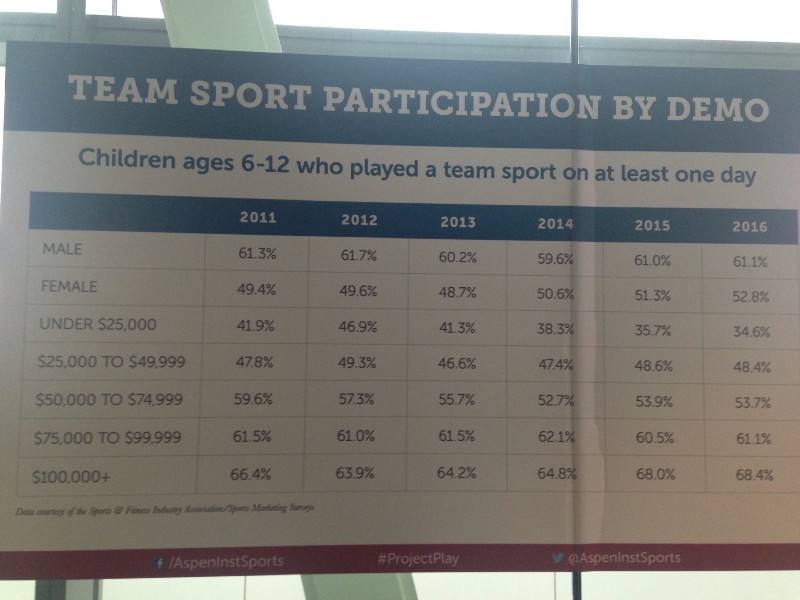
They’re right, and yet there’s something else at play here. See the picture here?

Whose kids are getting out and playing sports? Right. The rich folks.

“Wait a minute,” you might think. “These are the people who can afford college for their kids, and their kids will generally have a sound financial and educational foundation from which they can pursue a multitude of careers. Why would they be caught up in a chase for scholarships?”

Here’s a twist that has stuck into my head since joining the parenting community (otherwise known as “having kids,” which makes you pay more attention to such things): It’s not necessarily about the scholarship. It’s about getting into one’s chosen college in the first place.

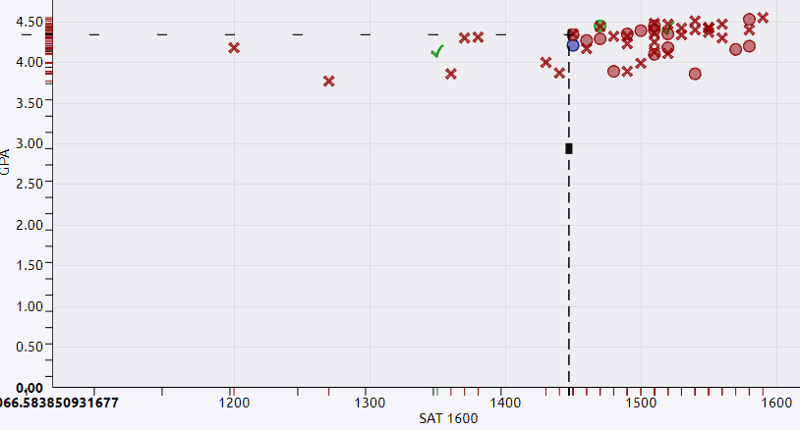
That’s not new. I have a story about puzzling college admissions from my high school, and I’m sure everyone else does, too. But in this technological age, we now get semi-private websites with scattergrams that show us the GPAs and SATs of people who get into School X or School Y. It’s not difficult to spot the athletes.

Division 3 school (no athletic scholarships). Maybe it was a really good essay?

I’ll have to toss in the disclaimer here: I seriously doubt any of my kids will be recruited college athletes. I blame their U-8 soccer coach. Which would be me.

But the point here is this: Sports are seen, with considerable justification, as a way of getting into a good school. Little wonder the Ivy League schools, which don’t offer athletic scholarships, more than hold their own in terms of overall sports performance.

We can argue about whether this emphasis on sports is a good thing for U.S. academic life. The question here: Is it good for sports?

The positives: American colleges promote healthy lifestyles. They build nice facilities for the general student body as well as the student-athletes. It’s the old Greek ideal — classroom in the morning, gymnasium in the afternoon.

The negatives: Youth sports are no longer about the love of the game. They’re about getting ahead and making sure you’re part of the elite. If you’re not, there’s no place for you.

And when you squeeze a sport at the grass roots, it can hurt the elite levels — especially in soccer, where the big problem we all see is a lack of access for lower-income families. No one becomes an elite player if they never have the opportunity to play.

So would we be better off — at the recreational level and the elite level — if youth players could just play without worrying about how their game will affect their chances of getting into Duke, Virginia, Princeton or a good D3 school?

podcast, youth soccer

Podcast, Ep. 7 — Smarter soccer parents with Skye Eddy Bruce

With all due respect to DJ Jazzy Jeff and the Fresh Prince (now known as Will Smith), sometimes parents DO understand.

Skye Eddy Bruce, an experienced player and coach, is now working to help parents understand youth soccer and then advocate for their kids. Throughout this interview, she and I talk about empowering parents. (And educating them — the idea isn’t to have ignorant parents berating coaches all over the country.) We don’t need to let coaches push winning over development, and we don’t need to sign up for the league that travels all over creation.

A few highlights:

2:15 About the Soccer Parenting Association — seeking to elevate the game with a focus on educating, engaging, supporting and advocating for youth soccer parents. And Bruce’s bio — including playing in Italy!

5:15 The stereotype of ignorant parents and how it’s changing. Includes a reference to this video:

12:55 Bringing up Bobby Warshaw’s concern about balancing “being a good person” with “being a good player.”

15:55 Putting too much of an emphasis on winning can drive kids away.

19:45 The true purpose of youth soccer

20:35 The proliferation of “elite leagues.”

28:20 The need to standardize our language — what does “elite” mean? Or “classic” or anything else?

33:35 Down with specialization! (At least, parents should be able to say that.)


podcast, youth soccer

Podcast: Ep. 6 — The Big Questions with Bobby Warshaw

“If you let your kid play sports, she’ll grow up to be a productive member of society! If you don’t, what’s wrong with you?”

That’s the subtext of a lot of sports marketing ads for everything from the NCAA to shoe companies. And we sports journalists buy in whole hog.

But wait a minute. Aren’t some of the traits that make someone a good athlete — aggression, attitude, a winner-takes-all mentality — actually bad traits to have in life?

Bobby Warshaw played at Stanford and went on to the pros in MLS and Scandinavia. His book, When the Dream Became Reality: The journey of a professional soccer player, and the push for meaning, purpose, and contentment, wrestles with the duality of being a good athlete and a good person.

Along the way, we talk about the now-dissolved Bradenton academy (“There’s no human being that came out of that Bradenton academy that was a regular person after that”), promotion/relegation, parenting, character-building and whether the Scandinavians know something we don’t about how to live.

https://play.radiopublic.com/ranting-soccer-dad-8QVdvP/ep/s1!cb4ed3246cb58d45aa918b437869f3b63f6ae7f2