soccer

The Timbers/Polo saga—what did we learn?

On June 3, 2021, a woman who wasn’t sure whether to pursue misdemeanor harassment charges against her husband sat in her home with two people pledging to help, along with a good friend who was serving as translator.

In an audio recording of the session, the two visitors come across as kind and compassionate, trying their best to solve her interconnected problems. She’s dependent on her husband financially and otherwise. She needs to get her kids to school. She wants to go to school herself and get a job. All of these things are difficult, and the visitors offer solutions.

Here’s the problem … 

The husband is Andy Polo, then a player for the Portland Timbers. The two visitors are Jim McCausland, a retired Portland police detective now serving as the Timbers’ director of security, and Christine Mascal, a lawyer retained by the Timbers to represent Polo. McCausland and Timbers executive Gabriel Jaimes also raced to Polo’s home May 23 while police were still on the scene gathering evidence, having been called to investigate a report of a man hitting a woman. 

Anyone who has listened to the June 3 recording would agree that the friend and translator is a saint. But she is not a lawyer. And she is not a social worker sitting there on behalf of a government agency.

So the advice Génessis Alarcón received for dealing with this dire predicament came from two people who, well-intended or not, were representing parties Alarcón would later sue — Polo and the Timbers.

The Timbers are free from that suit, thanks to an undisclosed settlement in late March. Polo, not the Timbers, is the primary target for Alarcón and her lawyers in the United States and Peru, where Polo returned after his dismissal from Portland in February. 

The club also won’t face any further punishment from MLS, which turned to Proskauer Rose to investigate the Timbers’ actions. The law firm, which counts MLS as a frequent client, said the team didn’t induce Alarcón to forgo pursuing charges. MLS fined the Timbers a pittance of $25,000 for not realizing they were supposed to report the Polo incident to the league under the MLS Constitution, as improbable as that seems for a club that employs a general counsel as well as an HR staff. 

But this isn’t going away so easily. 

Start with Madison Shanley, who has frequently sung the national anthem before Timbers for more than a decade and for their wildly popular NWSL team, the Portland Thorns, since the women’s league launched in 2013. On April 3, she sang while wearing a T-shirt with the message “YOU KNEW,” directed at the organization over its handling of the Polo incident and of the case of Paul Riley, the former Thorns coach who was allowed to leave the club and sign elsewhere without anyone revealing that he had been accused of abuse and inappropriate behavior. Last fall, two players came forward to accuse Riley of sexual coercion. 

Shanley has since said she won’t sing the anthem again until she’s satisfied the club has made solid institutional changes. At the Timbers’ April 22 home game, supporters made it clear that they support Shanley and not team management. 

The club did indeed release a list of changes, including community initiatives and anonymous reporting lines. Those changes, though, don’t address the circumstances that put the Timbers in such a terrible situation in the first place. 

Nor do we see any reason to believe the Timbers or any MLS club — for that matter, any employer anywhere — learned a lesson about when and when not to intervene when police show up at a player or employee’s home while a spouse or partner is pleading for help. And to understand why, we have to ask a few questions about the Proskauer Rose report, which reads more like a list of excuses than the result of an exhaustive investigation. 

The Proskauer Rose report had no contact information, and a media spokesperson for the firm did not return an email. The Timbers declined to comment beyond what is publicly available.

To be sure, the Timbers did a few things right. The club had been helping Alarcón adjust to life in a new country well before the May 23 incident. When McCausland and Mascal visited June 3, they urged Alarcón to seek more help from the Department of Human Services and/or Catholic Charities.

But the Proskauer Rose report takes these actions as proof that the Timbers didn’t offer a quid pro quo for help. That might be literally true, but anyone looking at the situation from Alarcón’s perspective might have felt underlying pressure to back off. Mascal points out in the June 3 meeting that Polo could face a year in prison. She may not have meant that as an implied threat. But would anyone blame Alarcón for hearing “one year in prison” and thinking that if she pursues charges, she’ll lose her financial lifeline?

That’s one of several head-scratchers in the Proskauer Rose report: 

“Ms. Mascal explained to the investigators that she had not been provided with a copy of the police report from the May 23, 2021 incident, and therefore wanted to talk to Ms. Alarcon to better understand what had happened from Ms. Alarcon’s perspective.”

Reporters have a copy of the police report. Mascal couldn’t get it? 

Also, Proskauer Rose said its investigators spoke with six Timbers employees (including the CEO), Mascal, Polo and Alarcón while also checking out Alarcón’s audio recordings and “text messages, emails, and other relevant documents provided by the Timbers.” The report says nothing about speaking with the police or the DA. 

(Worth noting: Mascal resigned from the board of the Oregon Crime Victims Law Center in 2019 for what was seen as a “victim-blaming” approach to representing sexual abuse defendants. One sample question she asked in court: “You don’t bring up threesomes with someone you just met, or is that who you are?”) 

“Mr. McCausland and Ms. Mascal each provided credible reasons for being present at the [June 3] meeting.”

Fine, but again, what was the “credible reason” for proceeding with no one representing Alarcón but a good friend who was translating?

The Proskauer Rose investigation was limited to (a) whether the Timbers tried to induce Alarcón not to pursue charges and (b) the Timbers’ failure to report the incident, so it didn’t cover the reason for Alarcón’s since-settled complaint against the club. That document shows another thing from which the Timbers and anyone similarly situated simply have to learn a lesson.

Polo didn’t go to jail May 23. He was given a citation and a June 23 court date. Police were satisfied that Alarcón’s friend and the Timbers staff could keep the couple safe. And that meant, Alarcón’s lawyer argued, that the team assumed responsibility for the situation. 

“Mr. Polo was permitted to be released to his household in part because of the safety plan that was promised by the Portland Timbers,” the complaint read. “Ms. Alarcon and law enforcement relied on the promises above made by the Portland Timbers management. The Portland Timbers failed to honor their responsibilities and duties outlined above, and further abuse and incidents and domestic disturbances occurred within the household after May 23, 2021, causing Ms. Alarcon continued pain and discomfort and significant emotional harm.”

In another action with unfortunate optics, MLS, under pressure from the MLS Players Association, paid his contract in full even though he was terminated and set free to return to Universitario de Deportes, his first pro club in Peru. You’d think that would mean Polo has plenty of money to hand over to Alarcón, but even though Universitario originally said he had to sort things out with her before making his debut, reports from Peru say he turned down one deal and hasn’t settled anything

“We have more than a decade of outstanding work in the community and off the pitch of which we are extremely proud,” read a Timbers press release when the investigation report was made public. “However, we are not perfect and will make mistakes occasionally. When that happens, corrections will be made, and we will learn from them.”

Those corrections can only be made if the mistakes are fully understood. From all available evidence, that is not yet the case. 

When it comes to legal liability, the Polo case may be closed. But it’s not going away.

MLS, the Timbers and all soccer clubs need a serious rethink of what they can and can’t do to assist players’ families, particularly when their relationships turn abusive. If they don’t learn from the past, they’ll be condemned to repeat it.

And then we’ll see more supporters groups holding “YOU KNEW” banners.

Cross-posting to beaudure.medium.com

pro soccer, youth soccer

Who goes from Academy to USL?

Three coincidental bits of reading today (for two of them, thanks to Jason Davis for mentioning them on today’s show):

  1. At The Athletic, Will Parchman ranks all 23 MLS-affiliated academies.
  2. At SoccerWire, Charles Boehm has news of a new D.C. United partnership and a nice pyramid graphic showing players progressing from these partner clubs to the new USL side in exurban Loudoun County to the Chris Durkin-esque heights of the senior side. (A few stray thoughts on this later.)
  3. On a local message board, one anonymous parent reacted to this news by asking which Academy kids get to play for the USL side.

My first reaction: What do you mean — who gets to play for the USL side? It’s pro soccer. Who gets to play pro soccer? Really good players!

Second reaction: Wait a minute. Who does get to play for the USL side?

So I figured I’d do a case study on Will’s No. 1 academy — New York Red Bulls. Who’s playing for NYRB II?

The results:

Former Academy players – 8 

  • Amando Moreno (signed directly from Academy; years ago)
  • Ben Mines (signed directly from Academy)
  • John Murphy (signed directly from Academy)
  • Evan Louro (homegrown contract after college)
  • Kevin Politz (homegrown contract after college)
  • Steven Echevarria (homegrown contract after college)
  • Andrew Lombard (free agent after college)
  • Chris Lema (free agent after college)

Played for PDL Under-23 team – 3, all from 2018 draft

  • Brian White
  • Jared Stroud
  • Jose Aguinaga
  • (also: Lema, Louro, Politz, Echevarria, Murphy)

Lived in NY/NJ, then drafted – 3 

  • Ryan Meara
  • Ethan Kutler
  • Jordan Scarlett

Developed in OTHER MLS academies – 2

  • Jean-Christophe Koffi (D.C. United)
  • Tommy Redding (Orlando)

Then two other draftees, four free agents who just finished college, and six from foreign clubs.

I used a loose definition of an NYRB II player. A couple of these guys have recently been called up to the MLS side, and they’re not the only players to move up in the last few years. (Think Tyler Adams.)

So that’s eight Academy alumni out of a pool of 28 players. The ages of those players: 23, 22, 22, 22, 22, 21, 18, 18.

Sources:

Check my work here.

Back to the Boehm piece (January 2018 podcast guest): D.C. United’s partner clubs here are:

  • Arlington: Current DA through U15
  • Loudoun: Current DA through U15
  • PPA: No current DA
  • Pipeline: No current DA
  • Virginia Development Academy (itself a partnership that includes my hometown club, Vienna): Current DA through U19

So what does this mean for VDA’s older age groups?

(Side note here: VDA’s girls moved from the DA to the ECNL, but they didn’t rename themselves “VECNL,” which sounds like a horrible health insurance company. I didn’t include girls’ DA teams in the breakdown above because United’s program here is boys-only. We’ll talk about the Spirit some other time.)


pro soccer

The ESPN+ deal with the UFC and what it means for MLS (and other sports properties)

The literal big deal in sports media yesterday: In January, ESPN will start paying the UFC $150 million a year for a package including:

  1. 15 live events on ESPN+, the new $49.99/year subscription service
  2. Other shows, including Dana White’s Contenders series and some new untitled program, on ESPN+
  3. Weigh-ins, preview shows and press conferences on ESPN+ (yes, MMA fans watch that)
  4. Archives, archives, archives! (Again, yes, MMA fans watch this. Every once in a while, someone thinks, “Hey, I really need to check out the first St. Pierre-Serra fight” and checks out Fight Pass (see below), even though FS1 and FS2 currently show hours and hours of repackaged UFC replays each week.
  5. On ESPN’s cable networks, as opposed to ESPN+, a 30-minute preview show and the aforementioned UFC “library programming” (replays).

IMG-20110603-00019For MMA fans (and former MMA writers like me), this seems too good to be true. The UFC currently offers something called Fight Pass for twice as much ($9.99/month), and it sounds like ESPN+ will have most of that content. But we’re not sure. As Ben Fowlkes points out at MMAJunkie (the blog of USA TODAY Sports, where I was the first MMA beat writer), we don’t yet know what happens to some oddball programming such as the Eddie Bravo Invitational (grappling), overseas MMA promotions and Invicta FC, which is not a soccer organization but actually a compelling all-female MMA promotion. We know Fight Pass and pay-per-view events will be available through ESPN+, but you have to pay a bit more.

So what does this mean for MLS, which has also shut down its in-house subscription service to put games on ESPN+?

https://twitter.com/ErikStoverNYC/status/993852938945785856

(To clarify/expand — as you’ll see above, it’s much more than just those events.)

Consider this: The UFC currently has a deal with Fox networks for $120 million per year, starting in 2012. WME/IMG bought the UFC itself in 2016 for a ludicrous $4 billion, hoping for bigger deals down the road.

And that seemed to be a dumb investment. As industry insider Dave Meltzer points out at MMA Fighting, the UFC is down by so many metrics — pay-per-view buys, TV ratings, box office, etc. My lukewarm take: MMA has peaked. It’s not going away, but neither is it likely to grow. As Deadspin asked in a very-un-Deadspin deep analysis of the UFC’s rights: “Who Cares About The UFC in 2018?”

In fairness to the UFC, the promotion has had some rotten luck recently. Ronda Rousey lost, then lost worse and raced over to pro wrestling. Jon Jones has shown a catastrophic inability to get his life together, and Conor McGregor has outright flipped out. Those are the biggest stars. The people who actually hold UFC belts are sometimes anonymous, thanks to the convoluted manner in which they win the championships. Consider Robert Whittaker, who won the interim middleweight title in July, watched as UFC legend Georges St. Pierre returned to the cage to win the non-interim belt from Michael Bisping, was promoted to full champion when St. Pierre fell ill, and hasn’t fought since. It’s a rare fight card these days in which the top fights proceed as planned, thanks to injuries, illnesses or botched weight cuts.

But this downturn shows the UFC’s base level when it doesn’t have A-list stars like Rousey, McGregor or Chuck Liddell on fight cards. As with golf or tennis, a big crossover star might give it a temporary boost, but it’s unrealistic to think it’s going to be bigger on any long-lasting level.

And yet, the UFC is getting a raise as its Fox deal runs out at the end of the year. The ESPN deal doesn’t cover everything. Someone’s still going to pay good money for the rest of the UFC’s events (excluding pay-per-views) each year.

That bodes well for everything else in sports. Bloomberg’s headline: “UFC-ESPN Deal Suggests Endless Appetite, Money for Sports Rights.”

So if the declining UFC can command a raise, what will happen to the stagnant Major League Soccer when its deals expire?

As you’ll recall from the Riccardo Silva unvitation to buy the rights for $4 billion, MLS renegotiation is a few years off. To be precise: 2022. Combined pay between ESPN, Fox and Univision: $90 million.

(That’s solely in the USA. I haven’t seen the rights fees for Canadian deals with TSN and TVA, which run through 2021. Overseas, as noted in the post on the NASL’s unvitations to MLS, the league seems to have improved its distribution since switching from Silva, who’s mentioned above, to IMG, which is also mentioned above because apparently only three companies control everything in sports.)

Perhaps that’s unfortunate. The current climate — prodded by new ventures from ESPN, YouTubeTV, Amazon, Twitter, Facebook, etc. — might not last four years.

But maybe it will. And maybe MLS, no matter what comes of this year’s lawsuits, will emerge with a much better deal than it has now. (And perhaps these shadowy TV execs — not media-bundling companies — who claim they’ll offer eleventy billion dollars for rights fees if MLS goes pro/rel will emerge from the woodwork in 2021.)

pro soccer, women's soccer

Time for U.S. pro leagues to treat their cornerstones a bit better

With its callous attitude toward Columbus, MLS has already staked out a “thanks for getting us off the ground, now go away” attitude that Don Garber must fix before he either leaves office or renews his contract.

Are we seeing the same thing in pro women’s soccer? It’s complicated. We might not know a complete answer until we know the lineup of teams for 2019.

But it’s not looking good.

We might be able to absolve the NWSL of blame for the fact that 2018 will be the first season of pro women’s soccer in the USA without a team called the Boston Breakers. They weren’t the strongest club in WPS — see general manager Andy Crossley’s dissections of his handiwork for more details on that and yet another reason to add Curt Schilling to your list of the worst human beings in sports. And they never really found a good home ground in the NWSL — Dilboy Stadium was about as “track-and-field-specific” a venue as anyone could find, and Harvard’s Jordan Field was OK but tiny.

So when word spread that the owners were trying to sell, no one could really blame them. We may never know what happened with the new owners who, as of a few days ago, seemed set to buy the club and continue into the new season. Was the league completely blindsided? Or should they have done more to wrap up the deal or reject it in time to let others have a chance? Would the league have a more potent voice if it made up its mind as to whether Amanda Duffy is the interim or permanent commissioner, executive director, CEO or whatever they want to call their leader?

As we know now, others did indeed leap into the fray to try to save the team. I spoke with representatives of three different camps, some of whom are opposed to each other on other issues. They were confident that they had investors with enough money to keep the Breakers running. They were less confident that they had time for everyone to get through due diligence. After missteps of the past — Jeff Cooper’s mysterious money men bailing on St. Louis, Dan Borislow taking the Washington Freedom to Florida and butting heads with authority for a year until the league finally collapsed — “due diligence” is not something that can be skipped.

Whatever happened has happened. The question now: Is there any chance of reviving the Breakers in 2019?

What I’m hearing isn’t positive. Nor is the fact that the NWSL has not responded to my inquiries over the weekend about the Breakers situation, first to get comment on the last-ditch effort to save the team and then to get comment on what happens next.

The answer affects more than just Boston. Like the Crew in Columbus, the Breakers name means something to soccer fans. It’s an original.

And for all the bluster of MLS-affiliated women’s teams being better situated that everyone else, look who had the most extensive youth and reserves operations — the Boston Breakers, along with fellow independent Washington Spirit. (At least the Breakers Academy will continue. FC Kansas City also still has Academy games scheduled, resuming Feb. 10.)

Something dies every time a team folds or moves. MLS has lucked out so far that things have turned out well in the long run, but that streak could end very quickly if the Crew move. And if the NWSL can’t act on the obvious interest to restore the Breakers next year, the league’s credibility will suffer.


pro soccer, us soccer

An older plan: Soccer United Marketing from a few years ago

Found something interesting while cleaning out the basement. Pictures below.

Coincidentally, Grant Wahl has a crucial interview with MLS commissioner and SUM CEO Don Garber.

Garber says that from the time the first agreement was done (2002?) to 2022, SUM will have paid the Federation $300 million. That’s a cool $15 million per year.

But Garber cites those numbers in response to USSF VP and presidential candidate Carlos Cordeiro calling for a “commercial committee” headed by an independent director to oversee such deals. He also cites the USSF board minutes that show Garber and anyone else affiliated with SUM (say, an Athletes’ Council member currently employed with an MLS club somehow) recuses himself from any vote on SUM. (Even so, Sunil Gulati said the SUM deal has been approved and renewed by a unanimous vote of the non-recused members of the Board.)

That probably doesn’t completely absolve SUM and others of all conflict-of-interest questions. What additional steps need to be taken are in the eye of the beholder. Should Garber simply remove himself from the Board after roughly 18 years? Do we need an accounting of what SUM has done for the women’s national team? Do we simply need to give non-MLS clubs a shot at Division 1 somehow, whether they get a piece of SUM or not?

In any case, the book below is obviously taken from early in SUM’s life. Superliga will never die …


podcast, us soccer

All the USSF president’s men (part 1 of RSD23 podcast)

The nomination deadline has passed, and we still don’t really know how many candidates will officially run for U.S. Soccer president. Current educated guess is eight, but at least three are unconfirmed.

This morning, I chatted with Jason Davis on SiriusXM’s United States of Soccer. The interview is now available on demand on the SiriusXM site. Highlights:

  • 1:30 – How many nominees? We go through individually.
  • 5:00 – Who can nominate, anyway?
  • 6:25 – Conspiracy theories — separating the ludicrous from the rational, especially in terms of Soccer United Marketing and Major League Soccer.
  • 8:33 – The Nominating and Governance Committee: Too much influence for Garber and Gulati?
  • 14:00 – Has SUM lost control of things?
  • 15:30 – The Steven Gans letter

And the election accounts for the first 15 minutes of the Dec. 13 podcast …

  • 4:30 – Why it’s important that the rest of the election is in the hands of the Credentials Committee, not the Nomination and Governance Committee. No, really. It’s about SUM.
  • 6:00 – The positives of SUM (historically), segueing quickly into what looks quite bad right now.
  • 8:10 – The establishment candidate (Kathy Carter)
  • 9:15 – Why the delay in USSF announcing the final field?
  • 10:10 – The adult soccer associations are leaning toward …
  • 12:30 – Yeah, somehow this segued into pro/rel and how we can do it better than Europe
  • 13:10 – Summing up the field and how they all have something to say.

The second part of the podcast is on the Soccer Parenting Summit. See the next post tonight or tomorrow or whenever I thaw out from another trek outside. Listen:


pro soccer, youth soccer

I have many questions …

… and not enough time to ask them of all the people who need to answer them.

I’ll try to pester people before Thanksgiving. But if anyone wants to go ahead and ask, go ahead.

MLS/COLUMBUS CREW 

  1. If Precourt takes his team or his ownership position or whatever you call it to Austin, then does Columbus immediately jump into the expansion fray as San Jose did when the Earthquakes moved? Columbus already has a stadium, so if they can raise the expansion fee, do they get a “new” Crew?
  2. Is MLS planning to do anything to appease angry fans across the country who are saying they’re less likely to support their local teams because a city can have a solid fan base and a stadium and still move? What assurances will you give them that you’re not just going to let their owners pack up and move somewhere?
  3. Did the Columbus powers-that-be really cut off future conversations, as PSV claimed? If not, why have we not heard a loud denunciation of that claim?
  4. Why should any municipality pledge money, even just for infrastructure, to build a stadium for an MLS club when that’s clearly not enough to guarantee the club’s future?

NWSL OWNERS 

  1. Why don’t you have a commissioner, eight months after Jeff Plush stepped down?

REFEREES

  1. When are you going to start calling more fouls, from the pro level down to Under-9, so that U.S. players will develop skills instead of just beating the crap out of each other?

MEDIA

  1. When are we going to quit exalting players who beat the crap out of each other?

U.S. SOCCER

  1. Are you working on a solution to the training compensation / solidarity payment issue that you think you would survive a court challenge from the MLS Players Union or whomever else, or are you waiting for the Court of Arbitration for Sport to weigh in?
  2. Why did the women’s national team have to play on bad turf in New Orleans?

FIFA 

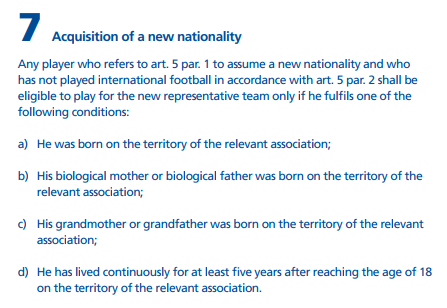
  1. What in the world does “continuously” mean here? Shouldn’t citizenship be part of the criteria? And what’s up with efforts to update this?

fifa-nationality

U.S. SOCCER VOTERS 

  1. Why are you ducking my emails?

I’m sure there’s more, but let’s start with that.

pro soccer

Dissecting the TFC-NYRB halftime kerfuffle

The video we have from the Toronto tunnel doesn’t tell us much. But let’s see what we can figure out:

0:17 — Is this a tent? It looks like footage from a wedding gone horribly wrong.

0:20 – Sacha Kljestan (NY No. 16) meanders into the frame along with phenom Tyler Adams (NY No. 4) and someone wearing No. 67, who is not identified on the Red Bulls roster. Is Adams old enough to be involved in this?

0:23 – Jozy Altidore (TFC) somehow is pushed back from the scene.

0:27 – A loud “Woooo!” Perhaps cross-promotion for the upcoming 30 For 30 on Ric Flair? (And yes, I’m embarrassed to recognize that sound.)

0:42 – How many people are in this tunnel? Bradley Wright-Phillips (NY) passes through like he’s just looking for the bathroom.

0:45 – Michael Bradley (TFC captain) is attempting to be the voice of reason with Jesse Marsch (NY coach) but is distracted by something behind him. Meanwhile, Toronto keeper Alex Bono wanders through as if to remind people not to mess with him because only goalkeepers can use their hands.

0:48 – Security guides Wright-Phillips away. Perhaps, as CCR once sang, there’s a bathroom on the right.

0:55 – Cameo appearances for NY’s Gonzalo Veron (No. 30) and Daniel Royer (No. 77).

0:56 – As Soccer America reported, Bradley appears to be yelling at Marsch, “Why are you here?” The rest of it appears to be directions to the visiting locker room. It’s been a while since I’ve been to BMO — are the tunnels that confusing?

1:00-1:45 – Some stereotypically polite Canadians have taken control and are trying to point the Red Bulls toward their locker room. Someone else is yelling the occasional f-bomb as if to deflate the notion of stereotypically polite Canadians.

1:45 – A kid who sounds like he’s about 7 years old yells, “This is OUR house!”

1:58 – A finger.

I still don’t know what Marsch was doing there.


pro soccer

Not Another Soccer Lawsuit: NASL-USSF, Halloween hearing edition

I’m not going to try to write something coherent out of all the accounts of today’s NASLpalooza in a New York courtroom.

First, I’m going to send my hopes for speedy recoveries for those injured and comfort for those who mourn after today’s senseless attack in Manhattan. I’m going to suggest we look into simple ways to make public spaces safer — bollards would help in this case — without resorting to outrageous racial and religious scapegoating or some sick fantasy that “good guys with guns” can stop this sort of thing from happening.

Then, I’m going to direct you to some first-hand accounts:

  • Michael Lewis, who has covered all leagues called NASL, has a summary.
  • Chris Kivlehan, writing for Midfield Press, has what you might call a play-by-play.

And you’ll want to follow Miki Turner, who has an advantage over most of us in that he’s an attorney. Another advantage: He has the transcript.

So what I’m really doing here is leaving a few breadcrumbs to find our way back through the Labyrinth. Or something like that. In simpler terms, I want to capture a few thoughts before the day is done.

1. The “USSF has no right to regulate squat” apocalyptic vision is probably moot.

And that’s good because I think USSF lawyers may have missed an opportunity to point out that there’s a difference between “amateur” as defined in most of the world (someone who is not paid to play) and “amateur” as clumsily redefined in the USA’s Stevens Act when someone realized a lot of Olympians are now raking in the dough.

Another thought on that topic (“they” here refers to NASL legal team):

So legal nerds hoping for The Ultimate Answer to Life, the Universe and Whether the Stevens Act Covers Professional Leagues might have to wait until the inevitable suit against some other National Governing Body. (If I were making odds, I’d say it’ll happen in rugby. Or volleyball.)

If you want a bit more on this, here’s Midfield Press: “Judge Brodie asks for clarification on whether Sauer (USSF lawyer) is taking the position that Congress has given USSF the authority to regulate professional soccer.  Sauer clarifies that the Stevens Act does not limit their authority.  Sauer traces the USSF’s authority from the Olympic charter, from which FIFA draws its authority.  USSF is recognized by FIFA.  “Bottom line” is that USSF believes it has the authority to govern pro soccer and the Stevens Act does not limit it.”

And finally …

2. I’ll never understand why Jeffrey Kessler gets into soccer lawsuits and tosses out things that are easily refuted by anyone with a shred of outside knowledge (such an opposing counsel).

In Fraser v MLS, we actually had people arguing about whether the Premier League and The Division Now Known As The Championship are equal or whether the bottom three teams in the Premier League are sent down. (See pages 318-321 here, then pages 421-425 here. It actually reached a point of absurdity — page 2190 onward — at which Kessler was forced to backtrack from an assault on the credibility of one Sunil Gulati, who is once again involved in this case and seems to be Kessler’s white whale.)

Today, he brought up the sad story of a family upset over the prospect of losing the San Francisco Deltas. It didn’t take USSF lawyers long to point out that the Deltas’ survival ain’t at stake in this courtroom.

3. Judge Margo K. Brodie has done a remarkable job getting up to speed on soccer.

From the Midfield Press account: “(Kessler) suggests that no other FIFA affiliated federation in the world has standards like USSF’s PLS.  Judge Brodie suggests that is because soccer in those other countries is the number one sport, which is not the case here in the United States.”

Do you hear that, Soccer Twitter?

And she seems like one of those stereotypical New York judges from Law & Order who makes the lawyers behave.

4. I still don’t have a good handle on when this case will discuss whether the NASL can reasonably have D2 status.

We know from earlier filings — and from the reporting by Midfield Press and Nipun Chopra — that the NASL is grabbing some NPSL teams and flinging them up the pyramid to bolster their numbers. Follow-up info on that front is redacted, but it was discussed in court today:

Coincidentally, the Ranting Soccer Dad podcast posting tomorrow morning is an interview with NPSL Managing Director Jef Thiffault. We refer to the clubs considering an NASL move, but given the pending legal action, don’t expect a ton of detail.

5. I have no idea who’s going to win.

Or at what stage. Would the judge grant an injunction, giving the NASL a stay of execution, only to grant the USSF’s Motion to Dismiss, which is following a separate schedule and will take a few more weeks to discuss? I’ve heard convincing arguments either way, and I can’t pretend to be a lawyer.

I can tell you from a journalist/historian’s point of view, the NASL side has piled on more arguments that set off my b.s. detectors. They have eight teams — no, wait, make that 14, even though it’s well-established that a couple of these teams aren’t likely to return, and several others are currently playing before crowds of hundreds (when reported) in the NPSL with amateur players. They made bold claims about competing with MLS well before they were ready to do so, and now that they’ve declined, they’re blaming the system. They could’ve differentiated themselves from MLS by creating the promotion/relegation system they claimed to support, and not long ago, NPSL was interested in doing that. NASL pushed them away, only to latch onto a few NPSL clubs now.

If I were an NASL fan — and if I lived in Indianapolis or Puerto Rico right now, I would be — I’d be embarrassed by this insistence on propping up a brand name instead of joining up with NISA or regrouping some other way in Division III and working back up.

But that doesn’t mean they’re wrong, legally. It doesn’t mean they can’t convince a judge who appears to be quite reasonable that they should be given, like Delta House after the Faber parade, just one more chance.

pro soccer

No, HERE’S how you re-organize the MLS playoffs

Here are the problems with the MLS playoffs, in no particular order:

  1. Too much randomness, making the “league champion” whoever’s hottest for a few games rather than the whole season.
  2. Not enough advantage for the higher seed.
  3. The first leg of a two-leg series is often excruciating.

I’ve seen suggestions for a single-elimination tournament, but that just steps up the randomness. I’ve seen suggestions to bring back the “first-to-five” series, which means each series could be two or three games. And Brian Straus has preserved the group-stage idea he first floated at AOL in 2010.

My proposal remains: Use the Page Playoff system that works so well in curling, Australian football and a few other competitions.

In each conference:

FIRST ROUND:

  • 1 vs. 2 — winner to final, loser to semifinal
  • 3 vs. 4 — winner to semifinal, loser out

CONFERENCE SEMIFINAL: 1-2 loser vs. 3-4 winner

CONFERENCE FINAL: 1-2 winner vs. semifinal winner

Then you can have MLS Cup. Maybe it’s a single game, or maybe it’s the two-leg series I floated at The Guardian last year with one game at the higher seed’s home ground and one at a neutral site. (I’m a little less wedded to that idea in a 28-team MLS in which the schedules will be even less balanced than they are now.)

If you want to get fancy, you could mix the conferences for the conference finals — the East 1-2 winner plays the West semifinal winner and vice versa. That avoids a repeat matchup.

So you get:

  • Serious incentive for every place in the top four.
    • First place gets home field in the 1-2 game and gets a second chance if it loses round.
    • Second place gets a second chance if it loses in the first round, and it will host either the semifinal or the final.
    • Third place hosts the 3-4 game.
    • Fourth place just makes the playoffs.
  • A little less randomness than a straight single-elimination tournament.
  • No games like the game we won’t mention from last night.
  • It all goes relatively quickly. If it’s a one-leg MLS Cup, it’s four gamedays — first round, conference semis, conference finals, MLS Cup. If it’s two legs, just add one game.

So that’s solved. Next, we’ll figure out fun ways to keep the middle of the table engaged …