us soccer

Coaching education through the years

This post goes with a short presentation I’m doing at the NSCAA — I mean, United Soccer Coaches (snappy short title to come, but I’m going to say UniSoc here) — convention for the Society for American Soccer History, an organization that has caught fire in the past three years or so.
1941: National Soccer Coaches Association of America (NSCAA) is formed. Coaching education would be a major focus, and the organization would go on to offer its own coaching courses and diplomas, especially ramping up in the mid-1980s. Its conventions aren’t just an attempt to set a world record for the number of tracksuits in one convention center — coaches would flock to them for lectures and demonstrations from pro coaches from the USA and elsewhere. The organization is now known as United Soccer Coaches.
1964: The American Youth Soccer Organization (as with the NSCAA or NASCAR, no one ever uses the full name — it’s “AYSO” to everyone) is formed, offering a different approach than existing youth leagues — it’s open to all, every player plays, and teams are shuffled in the name of parity. Though it remains mostly recreational, with no pretense of being “elite,” it develops some outstanding players (Alex Morgan, Landon Donovan, Carlos Bocanegra, Eric Wynalda among them). It would also develop its own coaching education resources down the road, many of them proprietary. So if you live in an area with no AYSO operations (say, most of my home state of Virginia), you can’t see them.

1970-74: U.S. Soccer Federation coaching begins in earnest with the first course in 1970, which trains several future national team coaches (one of them also a future New York Cosmos coach). The man credited with setting up the curriculum is Dettmar Cramer, who arrived from Germany via Japan and served a brief stint as USMNT coach in 1974.

Sources: Cramer obituary in Soccer America, interview with Ian Barker (United Soccer Coaches director of coaching education)

1980s: Bob Gansler, later the USMNT coach and then director of coaching at U.S. Soccer, helps develop NSCAA coaching education (Source: interview with Ian Barker, United Soccer Coaches director of coaching education).

Source: interview with Ian Barker

1995: U.S. Youth Soccer introduces the National Youth License, a weeklong course that focuses on U12 (and under) and emphasizes psychology and teaching. In 2015, it is renamed the National Youth Coaching Course.

2011: Claudio Reyna unveils the new U.S. Soccer curriculum at the NSCAA convention. Some coaches and journalists are puzzled by the admonition against “overdribbling,” and they’re skeptical that the USA can ever settle on one approach. The curriculum is indeed quite specific — teams are supposed to play a 4-3-3 (slightly revised to 4-2-3-1 or 4-1-2-3 as needed, and possibly 4-4-2 at some older age groups), and coaches are told which skills to emphasize at which ages. Within a few years, it quietly fades into disuse.

Sources: U.S. Soccer curriculum, My report for ESPN

“U.S. Soccer, it’s always been kind of ‘What’s the new flavor of the day?’ So if the Dutch were successful, the U.S. would kind of mimic how the Dutch do their systems of play. And then the Germans start winning, you know, I think the U.S. was always looking over in Europe, even South America, for ideas and different ways. And they would bring over a lot of foreign coaches as well to kind of help with some lectures and things like that to give us some ideas about how they do it overseas coaching-wise.”

Mark Pulisic (yes, Christian’s father — also an experienced coach). Source: 2018 interview with PennLive

2011: Dave Chesler hired as U.S. Soccer Director of Coaching Development.

2013: The NSCAA and Ohio University launch a master’s degree program in soccer coaching.

Source: Ohio University program information

2013: USSF D license (geared toward coaches at U13 and U14) now includes concepts such as periodization, useful for high-level coaches but not really applicable to grassroots coaches. It also requires coaches to take the two weekends of work — “Instructional Phase” and “Performance Review” — with a minimum of 10 weeks in between.

Sources: 2013 USSF release via SoccerWire, 2014 U.S. Soccer Q&A with then-Director of Coaching Development Dave Chesler

2014, February: Ryan Mooney hired as U.S. Soccer Director of Sport Development.

2015, February: U.S. Soccer slams the door on the alternate coaching pathway that allowed coaches to skip lower-level USSF courses if they had the rough equivalents from NSCAA. (Someone with an NSCAA National Diploma for a year could move into USSF C license course; someone with Advanced or Premier Diploma for a year could move into B license course.) Most controversially, the policy takes effect immediately.

Sources: Multiple, including 2018 Soccer America Q&A with Ian Barker. Can compare USSF policies from 2012-13 and 2017-18, copied and stored at Box.com

It’s philosophical, because their curriculum approach isn’t aligned with ours. That’s like you’re being taught French, and you’re saying, hey, it’s a Romance language, so it should be equivalent to my Italian course.

Then-USSF Director Chief Soccer Officer Ryan Mooney, speaking with Soccer America in 2018

There is a progression of complexity for tactics that is important. Having coaches come into the pathway at different points is not very functional, so our vision is for a coach to enter our pathway and be in it throughout their entire coaching career.

Then-USSF Director of Coaching Development Dave Chesler, speaking with ussoccer.com in 2015

2015, February: Several soccer organizations not normally on the same page — U.S. Youth Soccer, US Club Soccer, AYSO, Say Soccer, U.S. Futsal, U.S. Specialty Sports Association and MLS (?!) — form a Youth Council Technical Working Group that demands more openness from U.S. Soccer in discussing issues such as the birth-year age-group mandate and coaching licenses.

2015, February: USSF releases new F license (for coaches of U8 and lower) online, effectively taking away the excuse of parent coaches to not take the F license. It features examples of coaching from people such as Shannon MacMillan.

Sources: My SoccerWire story, group statement

2015, June: Nico Romeijn hired as U.S. Soccer Director of Coaching Education. Chesler remains as U.S. Soccer Director of Coaching Development. Mooney remains as U.S. Soccer Director of Sport Development.

2015, December: First graduates of new USSF Pro License course get their licenses.

2016, January: Chesler leaves Director of Coaching Development post.

2016, September: The NSCAA, anticipating a similar move by U.S. Soccer, overhauls its grassroots coaching curriculum, replacing its Level 1 through Level 6 diplomas with a brief online intro and then several age-appropriate pods.

Sources: United Soccer Coaches (formerly NSCAA) coaching courses (click “Development” to see the grassroots modules)

Sources: U.S. Soccer release, Soccer America

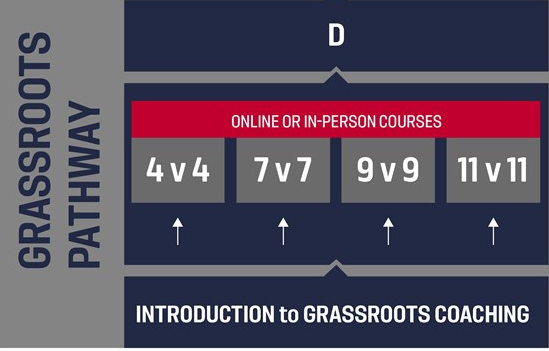
2018, January: U.S. Soccer unveils its own new grassroots modules, allowing coaches to start with a basic intro and then take age-appropriate modules either online or in-person. The modules are rolled out over eight months. The old F license and E license are gone, but you can still progress to the D license three ways …

First: If you have the E license, you only need to watch the Intro to Grassroots Module online.

Second: If you have the F license, watch the Intro module and take two in-person modules, including the 11v11 module.

Third: If you have neither of those (in other words, you’re starting fresh), watch the Intro and take three modules — one online of your choice, one in-person of your choice, and the in-person 11v11.

Also, the new training format is “Play/Practice/Play” — coaches are asked to have players immediately jump into small-sided games as soon as they arrive, with coaches speaking over the flow to subtly introduce the topic of the day, then have the “practice” phase, then scrimmage. And at least in the classes I took, we were encouraged to grab practice plans from U.S. Soccer or elsewhere rather than devising them ourselves. The new practice plans are indeed simpler to use.

Sources: Maryland Youth Soccer Association (thanks for posting, guys), Soccer America
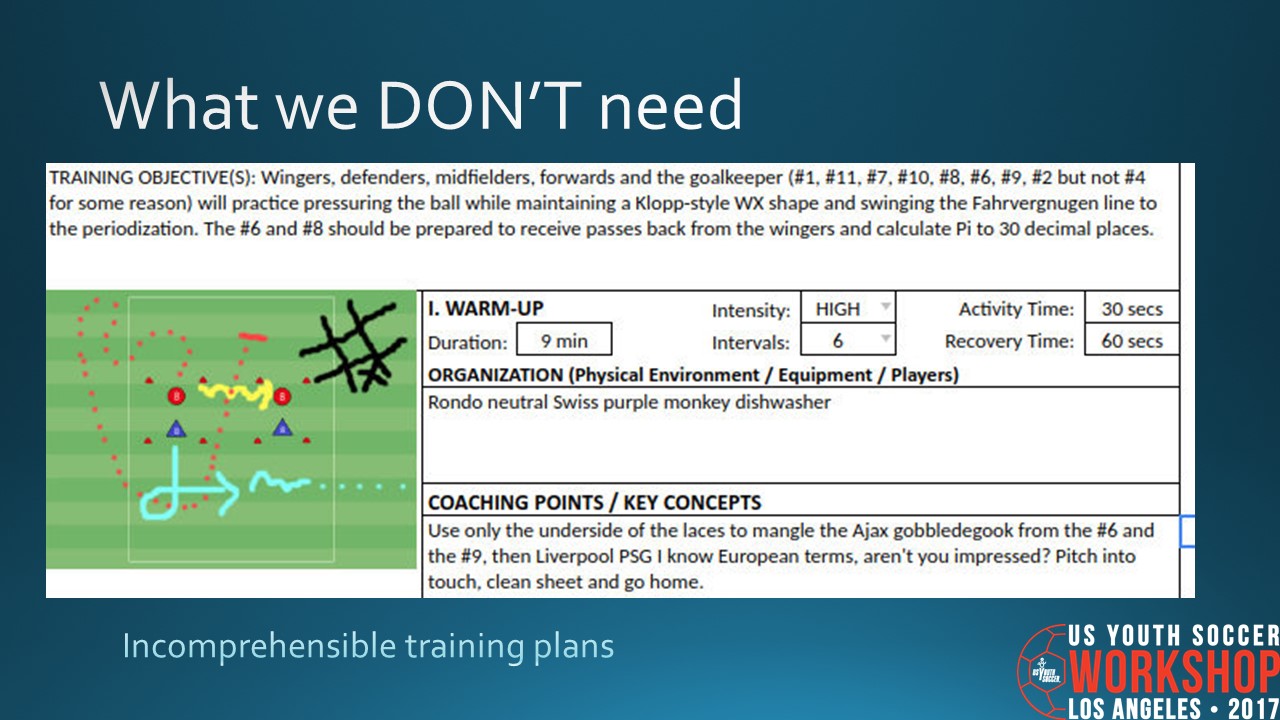
From my 2017 NSCAA presentation on parent coaches’ needs

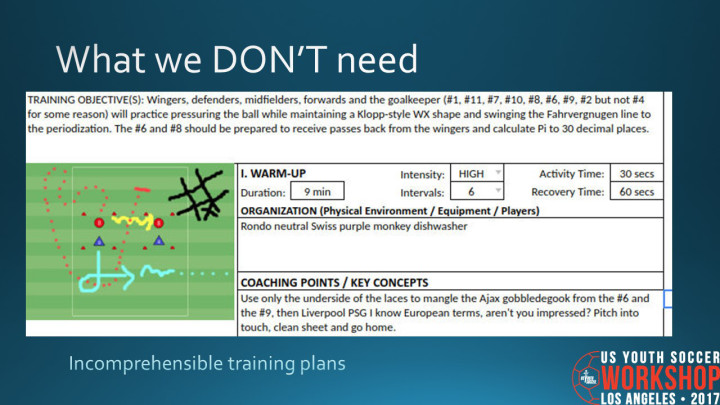
This is an improvement over the “Warmup with a drill that takes a little bit of time to explain / Small-Sided Game that takes a little bit more time to explain / Expanded Small-Sided Game that’s ridiculously complicated and will never be explained over the course of this practice / Scrimmage” approach, in which we were all supposed to develop practice plans like we’re Fabiano Caruana prepping to face Magnus Carlsen for the world chess championship in November.

Source: My review at Ranting Soccer Dad. By the way, Caruana nearly won.

2018, April: New U.S. Soccer org chart shows Nico Romeijn as Chief Sport Development Officer and Ryan Mooney as Chief Soccer Officer. Coaching education is listed as a responsibility of each person. Concurrently, USSF announces a Technical Development Committee overseen by Carlos Bocanegra and Angela Hucles, the Athletes’ Council representatives to the USSF Board.

2018, August: Romeijn and Mooney discuss availability of upper-level licenses and insistence that Development Academy coaches must have a least a B license in interview with Soccer America’s Mike Woitalla. The USSF officers’ comments draw heavy criticism from ESPN’s Herculez Gomez, focusing on the accessibility of these program to Hispanic coaches.

Source: Soccer America Q&A, Ranting Soccer Dad account of Gomez criticism and other issues

2018, October: A U.S. Soccer-led task force on youth soccer, promised by Carlos Cordeiro in his successful campaign to become federation president, convenes for the first time.

2018, December: Asher Mendelsohn hired as new U.S. Soccer Chief Soccer Officer, replacing Ryan Mooney, who has gone into a private venture. No word as yet as to whether Mendelsohn and Romeijn’s responsibilities for coaching education have been adjusted or clarified.

Source: Soccer America report

TODAY …

United Soccer Coaches continues to offer its own grassroots modules in addition to a more advanced sequence — National, Advanced National, Premier — as well as separate courses on goalkeeping, futsal, high school coaching, club administration (in conjunction with US Club Soccer), LGBT inclusion, safety and tactics. It also collaborates with the University of Delaware for a Master Coach Diploma / Certificate and with Ohio University on the master’s degree mentioned above.

US Club Soccer and AYSO are doing their own thing.

MY COACHING COURSES 

  • 2010: F license through Virginia Youth Soccer Association
  • 2013: Second Positive Coaching Alliance workshop
  • 2013: E license, USSF
  • 2014: NSCAA Special Topics Diploma: Coaching U6, U8, U10 Players
  • 2014: Incomplete D license, USSF (instructional weekend only)
  • 2015: F license, USSF online version
  • 2017: United Soccer Coaches Diploma: Get aHEAD Safely in Soccer
  • 2018: USSF Introduction to Grassroots Coaching
  • 2018: USSF 11v11 online module
  • 2018: USSF 11v11 in-person module
podcast, us soccer, youth soccer

RSD short: Funny stories from youth soccer, then less funny news on USSF and NASL

A few texts for today’s podcast:

us soccer, youth soccer

U.S. coaching education gets better, but …

I had low expectations for the new 11v11 U.S. Soccer grassroots coaching course, and getting up early Sunday morning to drag myself to Springfield didn’t help. Neither did the uninformative “Introduction to Grassroots Coaching” that replaced the helpful online F license after only a few years.

Five hours later, I wished that U.S. Soccer had done this years ago, back when I was first starting. Or I wished I had younger kids.

grassroots

Sure, I miss the old (but not that old) F license videos, which should really come back to replace the new intro. The 4v4 online module also was rather disappointing.

But when I took the 11v11 module this weekend, it clicked. I “got it.” And what I got was a new outlook on coaching.

The basic framework of a practice has changed.

Old way …

  1. A warmup activity related to the topic
  2. A small-sided game, also related to the topic
  3. An “expanded small-sided game,” also related and less comprehensible
  4. A scrimmage, also related … etc.

New way …

  1. Play
  2. Practice
  3. Play

Yes, it all relates to a topic. But we’re no longer dependent on explaining a new set of exercises to kids each week, at least in the 11v11 module.

Let’s look at it from the kids’ point of view …

Old way …

  1. What are we doing? What the heck is this?
  2. What are we doing? What the heck is this?
  3. What are we doing? What the heck is this?
  4. What are we doing? What the heck is this?

New way …

  1. Hey, we’re playing soccer, 4v4 or similar numbers. I get it.
  2. Hey, we’re playing soccer. The coach is freezing us on occasion, but I get it.
  3. Hey, we’re playing soccer again.

So the exercises don’t change that much. It’s soccer, just with different numbers per side and different coaching points to emphasize. If you take a look at these training plans on the Massachusetts Youth Soccer site, you’ll see there’s not much difference between them aside from what the coach says during practice. The U8 training plans vary a bit more, but they’re not too complicated.

That’s great. More playing. Less time explaining the purpose of the 100 cones on the field. And the coach spends less time figuring out different drills for different occasions. Just go to the Digital Coaching Center, pick your topic, get some suggested points of emphasis, add your own (perhaps based on something your team did really badly the week before) and off you go. Brilliant.

And it’s flexible. We can still do some of the old “four-phase” (warmup, small-sided, expanded small-sided, scrimmage) in the “practice” phase. You can introduce something with your favorite warmup activity — a “gates” drill if you want to sharpen their passing and receiving skills before getting into the tactics of attacking, a 3v3 before you get to the 6v5, etc.

I asked specifically about heading, prompted by a few fellow “candidates” in the course who were concerned about it. We’re supposed to limit the time we spend on heading, and I doubt many coaches were spending a whole 90-minute practice on the topic even before concussion awareness ramped up. My instructors’ suggestion — just take a few minutes out of the practice phase and toss around the ball a few different ways.

But this leads to my basic problem with every coaching course I’ve done — new way, old way or older way …

Is this really a course for grassroots/recreational coaches?

In fairness, a lot of the people in the class had ambitions beyond rec league. To get to the D license and progress up the ladder from there, you have to take three of the eight available grassroots modules, and the in-person 11v11 module must be one of them. (If you’ve played three years in a top-tier pro league, however they choose to define that, you can skip to the C.)

And the parent/professional line seems to be blurring more than I’ve seen in the past. The course’s host, Braddock Road (hey, Vienna — can I be reimbursed?), is moving its parent-coached teams up from the developmental/recreational leagues up to the NCSL. A lot of the parents in the room were anxious to take the D as soon as possible. (Apparently, it’s more accessible for parent coaches than it was in the past when I griped about it.) Maybe some clubs have realized they don’t need to hire pros to be on the sideline for every “travel” game any more.

Also, some parent coaches are really into it. Maybe a bit too much. One coach said he does his practice plans based in part on what he sees in scouting his opponents. At U9. I’ve only seen three distinct styles of play at U9.

  1. Alexandria Soccer: We’re going to complete a couple hundred passes each game, and unlike Spain, we’re also going to score because the typical U9 defense and goalkeeper can’t cope. If we concede goals to a big fast forward, so be it.
  2. Northern Virginia Soccer Club: We’re going to beat the crap out of you. Literally. Not like U9 refs are going to blow the whistle on most of these fouls, much less give us yellow cards. Then by U12, we’ll be ready to identify your top player and kick him out of the game just after halftime, then reduce your team to barely enough players to finish the game.
  3. Kids playing soccer. They’re kids. They’re going to do what kids do, and what the coach says is just a small factor in what they do.

But there are two reasons why this “grassroots” module still doesn’t quite meet the needs of a parent coach, even though it’s dropped some of the insistence on incomprehensible practice planning that the E and old D license had.

plan

1. We’re not learning how to teach technique.

Sure, at U14, it’s less of an issue than it is at U8. But we’re still getting some players with less experience or players who may move on to travel once they fix a couple of holes in their game. We’re still not getting that.

Granted, former elite players will always have an advantage here. My fellow rec coach who played with Julie Foudy at Stanford will know more about technique (and tactics, and probably a lot of things) than I ever will. No coaching class is likely to make up that gap. But I’m still surprised that, in all the resources and reading we’re given, no one emphasizes the best way to strike a ball, receive a ball, etc.

Heading is especially problematic. Maybe U12 rec coaches don’t need to know the finer points of dribbling and passing, given the lack of potential elite players in their ranks. But heading is an actual safety issue. Shouldn’t we learn how to do it and teach it? (Sure, I learned it when I was a youth player, but that was 35 years ago. Times have changed.)

So my constructive criticism for USSF would be simple. Give us a few videos on technique. In the in-person session, maybe spend 15 minutes on it while we’re on the field.

2. A lot of the information still seemed unrealistic for recreational coaches.

One of our instructors noted that it often takes a year for lessons to sink in. Travel coaches and elite coaches may have their teams for that long. Rec coaches usually do not. If they’re in AYSO, the teams are broken apart and reformed each year.

(Maybe that’s more of a criticism of the AYSO “redistribute the teams” model, but that’s another rant.)

Other notes from the session …

  1. We no longer use neutral players — say, a 5v5 with two players available on the wings who’ll pass back to whichever team passed it to them. Not “game-like.”
  2. Also not “game-like” — rondos. We didn’t talk about these at all. (I should point out that the Massachusetts U8 training plans above had a few things that also weren’t really “game-like.” Are rondos or neutral players any less “game-like” than having multiple goals on each side of the field?)
  3. Dynamic stretching is built into the first “play” phase. Basically, let them play for a few minutes, and let that be the primary warmup. (Personally, I plan to tell them not to go too hard at first.) Then pause, do your Frankensteins and barn-door swings, then get back to it. Makes sense. In my running days, I knew plenty of runners who’d jog a bit before stretching. Stretching a cold muscle incurs the old snapping-rubber-band analogy. And yes, you can use the “FIFA 11” warmup, which is coincidentally the only soccer video game in my house.
  4. We now “freeze” the action only in the practice phase. In the first play phase, we coach over the flow of the game and sometimes pull players aside. The last play phase is more like a game — maybe you’d pull a player aside, but you’re more likely to shout things over the flow. (Or not shout, if you’re stick with a tiny practice space like I am.)

So on the whole, this is an improvement. I’ve talked a lot about what parent coaches need, including a full presentation at an NSCAA convention. This gets us partway.

It’s unfortunate in a way that U.S. Soccer needed to do such a drastic revision. It’s difficult to feel the previous lessons weren’t wasted. But the good news is that any changes in the future should just be tweaks rather than a teardown.


youth soccer

Stubborn arrogance, bureaucracy and youth soccer in the USA and England

Two vital reads today …

At SoccerWire, RSD podcast guest Charles Boehm chats with U.S. Soccer Director of Coaching Education Programs Frank Tschan and Manager of Coaching Education Dan Russell about coaching education and rondos.

One comment from Russell about the former, specifically whether the Federation can reach everyone:

It’s not just U.S. Soccer, it’s not just those within these walls, it’s coaching education reaching out to our state associations, reaching out to US Club, US Youth, United Soccer Coaches, to be a part of this program, this movement as we like to refer to it, to offer more grassroots education opportunities, get more people into the pathway and offer them opportunities to progress within the pathway.

The answer here seems obvious. If U.S. Soccer can’t reach everyone, then maybe it needs to give more respect to training programs from United Soccer Coaches and AYSO.

On the “war on rondos,” something Charlie has already addressed, Tschan gives an answer that’s far too long to quote. I’ll attempt to summarize and translate:

Holistic grassroots environment directional purpose

But he did not say “leverage our core competencies” or “monetize our assets,” at least.

To try a bit more seriously, it appears Tschan is saying pro coaches could maybe use things that grassroots coaches shouldn’t. And grassroots coaches need to listen up and do “reality-based” exercises that include going in a direction.

Objections:

  1. At the littlest level, we’re trying to get players to touch the ball. Period. For years, we’ve been taught games that just encourage kids to dribble — ideally with different surfaces of the feet, with changes of direction and with their heads up. That’s fine, at least to a point. And no one told us they all had to be dribbling in one direction.
  2. We did, though, stick with “one player, one ball” a bit too long, thinking little kids can never pass the ball. Then we’re surprised when we see a bunch of U12s who have no first touch and can’t receive the ball to save their lives. (How was your Memorial Day tournament?)
  3. Playing the ball backwards to an open teammate is “reality-based.” I doubt a lot of people watching U10 soccer in the USA think, “Gee, these kids really need to spend more effort passing the ball forward.”

It’s one thing to point out that you might not want to do rondos to the exclusion of everything else. You really don’t want to do anything to the exclusion of everything else. The U12s who can’t receive a pass also can’t shoot or play a long pass to switch the point of attack. If you spend the first six years of player development dribbling and juggling, you’ll have a bunch of kids who can dribble and juggle, but they can’t play soccer.

With that rant over, let’s switch to another problem that isn’t directly related but also demonstrates what can happen when youth soccer is in the hands of stubborn bureaucrats — the sobering overemphasis on academy recruitment in England. From When Saturday Comes:

The academy of a current Premier League club – renowned for bringing young “local” boys through their system – used [a loophole] to bring in players from distances of 120 miles away. This meant two-hour round trips just for training on school nights, four-hour round journeys for children for “home” matches and longer for away games.

Aside from the travelling involved, many young hopefuls don’t realise that academies only really pinpoint one or two players from each cohort that are likely to make the grade but they need a team of other players around them. As such, the attrition rate for academy players is eye-watering, with less than one per cent becoming professional players. …

[T]here are more serious consequences – a research study carried out by Teesside University in 2015 found that over half of the players released were suffering “psychological distress”. There have been stories of players committing suicide and others turning to drug dealing after being dropped from academies.

As with the rondos, perhaps letting kids see there’s more one direction to go isn’t a bad thing.