pro soccer, us soccer, youth soccer

Another man, another plan: Reviewing Eric Wynalda’s long-awaited manifesto

In less than 48 hours between my sprawling recap of the week in Philadelphia and my podcast on the week and the election (with Charles Boehm), one interesting thing has happened …

I’ve received a lot of pushback on the notion that Eric Wynalda is the front runner.

No, it’s not Sunil Gulati and Don Garber calling. These are people who are plugged into soccer politics, in some cases even moreso than I am, even after my obsessive coverage in the past few months.

I’m still not convinced Wynalda isn’t the front-runner. I understand that some people have an “anyone but Wynalda” attitude, just as some have “anyone but Carter” or “anyone but Carter and Cordeiro.” I still think that Carter has a very difficult road to 50%+1, and I think the opposition will eventually join forces behind one candidate, and the most likely candidate fitting that bill is Wynalda. But I could be wrong, and perhaps we’ll see a compromise between the “no Wynalda” and “no Carter” camps that gives us a President Martino or Gans or Winograd or I Have No Idea.

But one thing has become clear: Wynalda’s stock dropped in Philadelphia. The forum in which he promised solutions, truths and the gloves coming off, with none of them happening. Fairly or unfairly, some voters may resent the truck with the nasty protest, even though he disavowed it.  (He did not, of course, disavow the statement implying Kathy Carter and Carlos Cordeiro are not “soccer people,” a message that didn’t sit well with a lot of people and tends to undermine his anti-elitist stance.)

Then consider this from the New York Times piece:

ew-board

“Fine,” you might say. “He’s the insurgent attacking the status quo.”

But consider the voters. Adult Council. Youth Council. Pro Council. Athletes’ Council. All of whom combine for about 95% of the vote. All of whom also elect representatives to that board.

None of this means that Wynalda’s campaign is sunk. I still think he has a better chance of winning than any other candidate. But that chance is probably less than 50%. There are eight candidates, after all, and you can’t really rule many of them out.

So when we heard yesterday, when Wynalda called in to Jason Davis’ show to say he’d finally be releasing a plan of some sort, the stakes were raised. This could put him over the top or not. (And we have to wonder whether it’s too late — all the state reps with whom I spoke in Philly seemed to looking at the convention as the last bits of info they would take home to their boards before making decisions.)

He released the plan today. It’s 14 pages and seems to be a little more digestible than the massive Kyle Martino plan. Let’s take a look.

PAGE 1: Cover sheet.

PAGE 2: Inclusive. Consensus-building. Experience — player, coach, technical director, owner, TV. “Move toward future compliance with FIFA standards” — a point that really needs to be explained, especially when we keep hearing about this inaccurately named “international calendar.”

And this is not the comprehensive plan. Position papers are forthcoming. Clock is ticking. But let’s see what’s here …

PAGE 3: Table of contents

PAGE 4: A picture of a calculator. People still use those?

PAGE 5, PART 1: Registration Rewards Initiative. He wants to return the $1/youth and $2/adult fee back to the youth and adult organizations. He says there will be a $1 “bonus allocation” for meeting certain criteria. These fees, he says, can really help the youth/adult organizations, while USSF is no longer dependent on them. The numbers back him up on this.

PAGE 5/6: >$5 Million in Annual Support, Grants and Scholarships to Membership Groups. He’s really talking about 5% of “unrestricted investable assets,” saying this is in line with how nonprofits use their endowments. “Many candidates talk about funding new programs but have yet (sic) identify definitively how to develop funds for those purposes.” Someone who gets fund-raising and nonprofit finance better than me will have to explain how this works and how it will impress voters more than, say, Carlos Cordeiro saying the federation is already planning to spend its $150 million-ish reserves down to about $50 million. Wynalda’s plan might be more of a long-term cash stream, while Cordeiro may be talking about a set of one-time investments. I don’t know.

PAGE 6: Internal Loans. Wow, I really don’t understand this. Literally. He seems to be saying state organizations and other organizations could get loans from U.S. Soccer. Someone will need to do a study to see if that’s actually an improvement on just funding programs.

PAGE 7: Monetize the U.S. Open Cup. “Multiple media executives have asked why the US Open Cup has not yet been packaged and monetized in a meaningful way and have identified themselves that it is a grossly undervalued asset and represents an untapped source of funds for the USSF itself.”

Let’s get this straight — and this echoes something he said in Philly. Is he saying there are multiple media executives who, instead of contacting the people who actually run the U.S. Open Cup, decided to ask Eric Wynalda? Or are there people at U.S. Soccer who heard a pitch to monetize the U.S. Open Cup and said no? Did they ask the Open Cup Committee, which has actually done some pretty good work to build up the tournament? (Eric, I know you’re reading — please let me know what you mean here.)

PAGE 8: A picture of Soccer House

PAGE 9: Transparency starts here with Apply for a public credit rating with Moody’s or Standard and Poor’s, which would obligate USSF to another annual review on top of what’s required for the 990. Seems like an interesting idea, but again, I’ll need to hear from nonprofit econ experts.

Then …

The USSF should create a non-voting sub-committee of the Board that includes a diverse selection of membership that is expected to attend all USSF Board meetings and that would be encouraged and supported to share their opinions and voices on public matters. The USSF management team would be obligated to host a conference call with this subcommittee no less than two weeks ahead of each scheduled USSF Board meeting to update members, provide information on planned agenda for the Board meeting, and to share public materials that will be discussed at the Board meeting itself.

At the very least, the wording here is poor. A “sub-committee of the Board” would be composed of Board members. If he means some sort of group of non-Board members that would be like a shadow Board, I think he’d want to go back and see why the board (sorry to switch cases here) went from 40 to 15. That was following what the USOC and others were doing at the time.

I get what he’s saying, but I think there’s another way to do this. Why tell a subcommittee what’s on the board agenda and not the whole membership?

PAGE 10: Clearly Defined Competitive Bidding Policy. This will be popular, and probably with good reason.

PAGE 10: Develop Conflict of Interest and Risk Management Policies. The board has done and is doing this, but there’s certainly room to ask whether they’re doing enough.

PAGE 11: Office of Ethics, Integrity, and Inclusion. It’s the sort of idea that sounds good in a vacuum. The question is whether it’s really better than the mechanisms that are in place now. Do you need to replace the mechanisms or replace the people?

Included in this: Restart the Diversity Task Force, and I know no good argument against that.

PAGE 12: Picture of scarves.

PAGE 13: Establish Membership Services Team. Sounds kind of like what Steve Gans has been saying.

PAGE 13-14: Support Network for National Team Players. OK … I guess? The idea of having a group to guide players into a post-playing career sounds good, but why would we limit it to national team players? Why not help players who probably made a lot less money?

PAGE 14: Consulting. In conjunction with the internal bank.

And that’s it. Until the position papers come out.

So … I don’t know what to make of this. Some of the ideas are obvious (and good), some are less obvious and still good (the Registration Rewards Initiative is, at the very least, worthy of future discussion), others just seem arcane and off-the-wall. Do we really want the U.S. Soccer Federation to turn into a USAA for soccer? If someone more knowledgeable about nonprofits can tell me if this works, I’d be happy to hear it.

Then some of it seems surprisingly elitist. A subcommittee that shadows the board but just seems to be an unnecessary bulkhead between the board and the membership? Mysterious media executives who aren’t approaching the Open Cup Committee (Mike Edwards, Todd Durbin, USL’s Jake Edwards, USASA’s John Motta, NASL’s Rishi Sehgal and retired MNT player John O’Brien) with a plan to invest megamillions but are approaching Wynalda?

I don’t get it. Someone feel free to explain it to me.


podcast, us soccer, youth soccer

RSD26: Charles Boehm on the U.S. Soccer election and youth soccer

This week’s guest, Charles Boehm, is a player, coach, referee and writer — check out his intro at the 2:45 mark and learned where he played alongside future non-U.S. national teamers. Like me, he was in Philadelphia for the United Soccer Coaches convention and attended many of the U.S. Soccer presidential candidates’ sessions.

We talk about what makes a soccer person and what makes an elitist (5:30), whether Eric Wynalda is the front-runner (8:00), the “anyone but (so-and-so)” approach to voting (9:45), what the candidates showed us in Philly (13:05), Kathy Carter and Soccer United Marketing (24:10), what’s changing in U.S. Soccer (30:00-ish), then youth soccer and the surprising focus on ODP (38:15).

I didn’t get around to finishing my thought on why I was once the best U12 center back in Athens, Ga. The answer is the same reason why I was once a competent over-30 coed indoor goalkeeper: Reckless disregard for my own safety. It surely had nothing to my skill. It also had a lot to do with the fact that not many kids played soccer and even fewer wanted to play defense.

us soccer

The big winner in Philly’s U.S. Soccer presidential conversation is guaranteed to lose

Out of all the speakers I saw in Philadelphia, the person who looked best-suited to be U.S. Soccer president is …

OK, I should warn you. Some of you are going to hate this.

But bear with me. I’m not saying this person should be president on Feb. 11. I bring this up to point out the daunting challenges the next president will have not just in reforming the things U.S. Soccer is doing poorly but also in building upon the things U.S. Soccer has done well.

Some of you don’t want to hear that, I know. Again, not saying this is a vote for the status quo. I went into Philadelphia with severe reservations about Kathy Carter and Carlos Cordeiro, and if you read my FourFourTwo recap of the week’s campaign events, you’ll see they were not adequately addressed.

(And thanks to everyone for your kind words about that recap and about my hundreds of live tweets over those three days. I really appreciate it. And please bear it mind when you read this thing you’re going to hate.)

So, again, the big “winner” of the week was …

(Please don’t shoot the messenger.)

… Sunil Gulati.

Again, again — that’s not a voice of regret that his presidency is about to end. It might be a sign that a lame-duck Gulati, freed from the need to appease various voting blocs, is an entertaining interview. He and Alexi Lalas had a candid, searing and occasionally hilarious discussion. I know a youth soccer organization plans to post the candidate sessions, and I hope someone does the same with Gulati’s session.

You may have read the Soccer America and ESPN recaps. Here are a few comments you might not have expected:

https://twitter.com/duresport/status/954066954351992833

https://twitter.com/duresport/status/954058849279008769

He gave the most pointed defense (or perhaps the only pointed defense) of Soccer United Marketing that I’ve heard. It started in 2002 out of necessity, filling a vacuum IMG was leaving. Since then, they’ve renewed it three times. He insisted they’ve looked at alternatives but says there’s an advantage to renewing the deal before it expires, like a player having leverage before a contract expires. And the deal is always voted on by the non-recused (non-SUM-or-MLS-affiliated) members of the Board, and it has been renewed unanimously.

And then we had a few good zingers:

  • “Winning Twitter polls is not getting elected.”
  • In response to Alexi Lalas asking if he considered resigning after the Trinidad loss: “Did you quit after the 1998 World Cup?”
  • Anyone who thinks the Federation can legislate promotion/relegation “is going to end up in front of nine judges.” Lalas: What if FIFA pushes it? Gulati: “Then they’ll end up in front of nine judges.”
  • He says a lot of candidates are promising things they can’t deliver, something he refused to do even when it would help. He said a Central American FIFA voter once asked him for some sort of promise, and he declined. The response: “I like you, Sunil, but you’re a lousy politician.”

Some of it didn’t ring true. He said he’s not supporting a candidate but has recently given two candidates some solicited advice and one candidate some unsolicited advice. He finds a lot of the electoral discourse “depressing and disgusting” and claims all his past NSCAA Conventions and USSF Annual General Meetings have been positive — for a refutation of that, check out 2003 in my roundup of transcripts.

But is there more to this than just an entertaining session? Is it unfair to dump on the Gulati era?

A good take on that:

https://twitter.com/DiCiccoMethod/status/955808177521610753

And how about Soccer United Marketing, which has been intertwined with the Federation throughout Gulati’s tenure as president? Merritt Paulson is an MLS (and NWSL) owner and former Board member, so feel free to consider all that, but he makes a few interesting points:

https://twitter.com/MerrittPaulson/status/955250512948965376

But what about transparency?

https://twitter.com/MerrittPaulson/status/955253543564275712

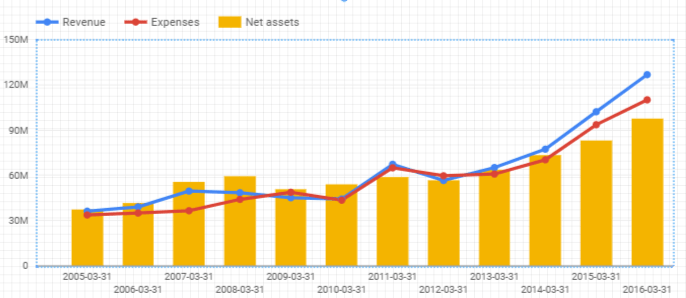
Want to dismiss Paulson? OK. Let’s look at the numbers from the Form 990s on the USSF site and ProPublica.

ussf-money

Here’s the funny thing: If I could extend this chart on each side, you’d see an even more dramatic increase. I didn’t include the numbers from the years four years before this because USSF changed its fiscal year from Aug. 31 to March 31, so it’s not a valid comparison. The annual revenue and expenses weren’t sharply different, but the net assets were far lower. The 2001 statement shows net assets of $14,054,712, and it lists the previous year’s assets at $6,683,668.

And though the March 31, 2017 numbers aren’t available yet, we’ve seen information that net assets will be up in the $140-$150 million realm, thanks in large part to the Copa America Centenario.

So it’s no exaggeration to say that, in 18 years, USSF has gone from a seven-figure organization to a nine-figure organization.

And they’re not just accumulating that money. (They did in the early 2000s, which I gather from Board minutes was a business strategy at the time to make sure they didn’t run into serious problems.) I included “expenses” here for a reason. The Federation spends a lot more than it used to.

(Note: Eric Wynalda claims to have $1 billion sitting on the table for the Open Cup, then says we’re leaving $120-$150 million out there through various mismanagements. I’d love to know details.)

So are we being unfair to the Gulati era and to Soccer United Marketing — and, perhaps, to Kathy Carter? Or Carlos Cordeiro, who also has played a role?

No. Because for better or for worse — and in this case, we’re looking at the “worse” — neither Carter nor Cordeiro is Sunil Gulati.

Gulati’s session probably hurt Carter by contrast. Carter comes off as corporate, speaking in vague business terms. Gulati doesn’t. You may hate what he says at times, but you know what he’s saying, which isn’t always true for Carter.

Then there’s Cordeiro. He didn’t do a one-on-one session, and he has done few interviews at all. He did pretty well in his 15-20 minutes on stage at the forum. Then he stepped off the stage and balked at a recorded interview. He did finally chat with the reporter, but he wouldn’t be recorded unless he had questions in advance. Compare that with Gulati, who knows facing the firing line is part of the job.

So does it matter to this election that Gulati knows his stuff and is a strong voice with more openness to change than one might think?

No. It doesn’t. No matter who wins, Gulati will be on the Board as a non-voting immediate past president. No one wants to dump him off the World Cup bid committee. Even supposed nemesis Eric Wynalda led a round of applause for the good he has done, and Wynalda knows the next president will need to work with Gulati in many capacities.

But they can all do it. Gulati can work with his supposed enemies. So he doesn’t need Kathy Carter to take his place. Nor will it matter if Cordeiro is elected, no matter the state of their relationship.

So the takeaway here is that the next president, no matter how ideologically or personally tied to Gulati, has a steep learning curve.

Now that might be a good thing. For 12 years, Gulati has run U.S. Soccer with little opposition — none in the elections, perhaps not enough on the Board or within the membership. The next president, who probably won’t have a majority on the first ballot, will be forced to build bridges that Gulati had no incentive to maintain.

And that’s a good thing. So is the fact that Gulati isn’t completely going away. Maybe we’ll get that one-vs.-eight debate one of these days.


us soccer

Futsal: The next beach volleyball?

“What about Paralympic, futsal and beach soccer?”

That’s a popular question in the presidential race, where every topic is being thrown onto the table. And we get passionate but vague answers — mostly because no one really knows what to do differently other than “be responsive,” “fill vacancies more quickly” and “make sure we’re paying athletes’ expenses.”

It’s especially difficult with Paralympic soccer. The 7-a-side competition for those who’ve had a stroke, traumatic brain injury or cerebral palsy has been dropped from the Paralympic program. The USA has never qualified for the 5-a-side competition for blind athletes.

Beach soccer actually overlaps with futsal a bit, drawing some players from professional indoor soccer. (Fortunately, FIFA doesn’t seem to mind that the USA’s indoor league, the MASL, isn’t sanctioned through U.S. Soccer.)

So what about futsal?

Everyone speaks passionately about it — as a training tool. It’s something kids should be playing.

But how does that translate to a national team? And what’s the ceiling for a pro futsal league in this country? (Major League Futsal exists under the auspices of the non-FIFA Asociacion Mundial de Futsal and North American Futsal Federation; the Professional Futsal League has the backing of Mark Cuban and others from the NBA but hasn’t done anything since 2016.)

When I was in Barcelona recently, the only live soccer I could watch on the cable package in our apartment was Barcelona academy soccer and some of the UEFA Futsal Cup. The latter had some nice skill and a handful of fans.

Clearly, you’re not going to convince Messi and anyone else worth $100 million-plus in the outdoor game to come in and play pro futsal. At least not year-round.

So is futsal — not for kids, but for pros — condemned to be a game for people who don’t make it outdoors? Or could it possibly be like beach volleyball, a sport that attracts as much attention and talent as the outdoor game?


podcast, pro soccer, us soccer, youth soccer

RSD25: Phillypalooza election preview, the disappointing USSF coaching education overhaul, and being nice

Point 1: Why this weekend will be huge for the U.S. Soccer presidential election. (2:02)

Included in that: Why I’m skeptical of current election projections (including a NewsRadio reference), what the Number 1 issue in this election should be (8:10), a few surprising things on Paralympic soccer (8:30), a question of what we’re really saying about futsal — the next beach volleyball? (9:30), SUM and pro/rel (11:30), and finally back to the Number 1 issue and how it overlaps with other major issues (18:00).

Point 2: The new U.S. Soccer coaching curriculum, grassroots level (22:15)

Included in that: Welcome to Disney (25:55), introducing tactics at 4v4? (26:20), the painful irony of the chosen video clip (27:15), U6 parent coaches developing their own coaching philosophy? (28:00), the nice tone (32:25).

Point 3: Soccer discourse, Twitter (33:40)

Include in that: What we all have to offer (34:15), why dealing with crap for 15 years makes these discussions difficult (35:45), different types of people (36:45), the ideal outcome of the Kathy Carter candidacy (39:30).

Next up for Ranting Soccer Dad (40:00). Basically, I’ll get back to interviews at some point and quit soloing like this. (And yes, I finally bring it full circle.)

us soccer

Man with a plan: A quick review of Martino’s Progress Plan

How specific is too specific?

U.S. Soccer presidential candidate Kyle Martino convened a group of people to come up with some ideas for moving the Federation forward, and he has summarized all of these ideas in a lengthy “Progress Plan.” Doing so is a risk, as he acknowledges:

“I also realize that many of these proposals are significantly more detailed than any yet offered by other candidates and that, in getting more specific, I’m opening myself to criticism. That’s the point. Anyone who can’t handle such an open dialogue isn’t, in my view, qualified for the job.”

And indeed — we can’t view anyone’s proposals as a list of campaign promises. The next USSF president isn’t going to have that kind of power. Such proposals only provide insight into a candidate’s priorities and state of mind. Some of our complaints about candidates being vague are overstated — after 12 years of Sunil Gulati, there’s a significant movement to have U.S. Soccer be a little less top-down. A lot, actually.

So, bearing all that in mind, here’s a quick evaluation of the Martino plan:

TRANSPARENCY

Another audit! Martino mentions the fed’s 2016 McKinsey study and points out that he hasn’t been released to the general membership. But he calls for another independent audit. Maybe the fed should release the McKinsey study and have a general discussion of it before investing more time and money in another study?

Pay the president. He’s not the only candidate (or non-candidate) to say so. The idea is to attract candidates who don’t need a day job (or a supportive spouse) and to increase accountability.

New hires. Technical Director, Grassroot Director, Chief Diversity Officer. Not sure why these are under “transparency.” The diversity officer is an idea he has in common with other candidates (which, as with many common ideas among the candidates, is far from a bad thing). He also wants to revive the Diversity Task Force that quietly disappeared in the last year or two.

Domestic Resolution Committee (DRC). Not sure how this would differ from the existing Appeals Committee, though he specifically mentions solidarity/training compensation fees here. And the DRC will come up later.

Much more financial disclosure. Several specific ideas, including an anti-gift policy and records continually posted online. Not sure the latter is practical, and it seems redundant with other items that would disclosed, such as all salaries over $75,000, which would involve significantly more people than the 990 form requires. And if I’m reading this correctly, all Board members would post their tax returns?

EQUALITY

50/50 Board/executive staff by 2022. Not sure this is really possible — on the executive side, it would entail firing a bunch of people, and the Board membership is determined mostly be various Councils (Youth, Adult, Pro, Athletes). But this will definitely ramp up the pressure on those constituents to quit sending two men to the Board, over and over and over.

Renegotiate MNT/WNT CBAs. Nothing too specific here, in part because he acknowledges (which some candidates do not) that each negotiation has “unique aspects.” (To give two examples — the men play many more qualifiers while the women play more friendlies, and the women get salaries while the men do not.) The principles are fairness and equality.

Latino outreach. Marketing firm, 10% of budget earmarked toward Latino initiatives such as fields and adult league insurance (how would we determine which fields and leagues are “Latino” enough?), social media. The latter exists but could surely be beefed up.

Equal access to facilities. I’m bringing this one up because of the odd combination of overseers — the DRC (see above) and three independent directors from minority organizations. What is the DRC’s role?

Devote 25% of the USSF budget to bottom of the pyramid — low-income areas and recreation. Like the Latino earmarking proposal, I’m not sure how to distinguish what helps low-income areas and what doesn’t. He touts the “Over/Under” initiative to add futsal goals to basketball courts, but is that something the Federation should be funding directly instead of working with the Foundation and sponsors to do it? Would the goals have to be in underserved areas only?

2026 Fund. Take $1 from every USSF, MLS, USL, NWSL and NASL ticket sold to offset the cost of play in underprivileged communities. That seems quite harsh on the NWSL in particular, but I don’t think people would object to U.S. national team ticket sales being used for this.

PROGRESS

Join the Youth Technical Group meetings. These are the meetings between U.S. Youth Soccer, U.S. Club Soccer, AYSO and SAY — a coalition that sprang up in response to the Federation’s heavy-handed youth mandates. The Progress Plan would require the Technical Director to attend every meeting (by phone if needed), and at least once a year, the president and CEO must be there as well. This is a promising idea. I know this group exists, but I have no idea if anyone from the Federation is actually listening.

Hire a Recreation Director within U.S. Soccer. I hear proposals like this from time to time, but I’m not sure what it entails. I did hear someone was working on a coaching curriculum for parent coaches who aren’t going into the pro-coaching pipeline, but I haven’t seen it come to pass.

Eliminate birth chart at U13 Recreation and below. This surely refers to the birth-year age group chart, which a lot of rec leagues are frankly ignoring, anyway. With good reason.

Youth leagues? I don’t quite get where he’s going here. He says he wants to reduce travel costs and have an agreed-upon hierarchy (democratically enforced by the DRC), but his chart includes the same muddled mix of elite leagues we already have.

Support the USASA’s three-tier adult league proposal. The DRC, again, would step in to determine this structure.

Create youth/adult leagues. Not a bad idea to make things a bit more holistic.

NWSL. A couple of points here are unclear, but the gist seems to be that new MLS clubs should either have an NWSL team or participate in a profit-sharing plan that benefits the women’s league.

Professional Paralympics. He says eight of the 10 top nations pay their players. I honestly had no idea. He also wants a national championship to build a “pro pathway.”

Futsal. Get everyone to the table to clear up market confusion. This is a terrific idea. I honestly can’t keep track of the different organizations.

Expand beach soccer calendar. More games.

Promotion/relegation by 2030 (full six-tier system by 2038). He has an extensive timeline that includes steps such as dismantling the single-entity MLS structure by 2024. It’ll be a bit too slow for some tastes, but the steps involved are logical. Except this one — any club created after 2024 will be “non-league” and can’t be promoted into the pro pyramid, which seems odd. What happens when climate change makes North Dakota the country’s top relocation destination? No pro soccer in Fargo?

Succession plan for CEO Dan Flynn. Hard to argue with that.

Open bidding. For all branding/licensing deals and partnerships. This surely seems aimed at SUM.

Build two national “home stadiums.” I can’t stand this idea, frankly. It’s a big country. Spread out the games.

Discuss moving USSF HQ to New York. The rationale is that it’s easier to make business deals there. Perhaps, though I could see the membership balking. Maybe compromise by having a satellite office?

So on the whole — some of these ideas aren’t fully developed, and some may be non-starters. But it’s a strong effort at moving the conversation into specifics beyond the vague platitudes everyone says — reduce costs, focus on coaching education, etc. That’s what this election should be.

Just ditch the stadium idea.


us soccer, women's soccer, youth soccer

Yes, it’s possible to understand the U.S. Soccer WoSo and YoSo numbers — maybe

This tweet, with a screenshot from the 2018 U.S. Soccer Annual General Meeting book, created some consternation:

https://twitter.com/duresport/status/951622431663448064

Did I say consternation? I meant confusion. Perhaps they shouldn’t make footnotes bigger than the headlines. (As an aside: Due to the collapse of the newspaper business model, hundreds or maybe thousands of people who worked in editing/page design have been displaced in the past decade and change. So, businesses and nonprofits? Hire them. Communication is good.)

So once you realize that the footnote is actually a footnote, it starts to become a little clearer. Chart 2 (which is the first chart in that screen capture) gives the numbers from all games and compares them in the last column to the same numbers from 2016. Chart 3 (the second chart) omits the numbers for the games outside USSF’s commercialization capabilities and compares those games to the same numbers from 2016.

But to put it in full context, you have to go back to the previous year’s book …

… which doesn’t have the same sort of figures. Oops.

We do have this …

ratings 2016

And that tells us pretty much the same thing — 2016 was an outlier for both the MNT and WNT. The men had the Copa America Centenario. The women had the Olympics.

We can easily explain the women’s ratings here. Chart 2 is comparing the WNT games of 2017 to the WNT games of 2016. The latter would include the Olympics, so of course, the 2016 ratings are going to be considerably higher. Chart 3 would omit the Olympics from that comparison because USSF doesn’t have those rights. In 2017, USSF had the commercial rights to every WNT game, but in 2016, they did not.

So I have a couple of remaining questions:

  1. What’s a “year”? The WNT played 16 games in 2017 — 13 in the USA, one in Canada, two in Europe. Were four not televised? Off the top of my head, I can’t recall that. If it’s a fiscal year, then it’s a partial year, isn’t it?
  2. What’s included in the list of games USSF can’t commercialize? The Olympics, certainly, but that only affects the WNT. How were 10 of 18 MNT games not included? They played 19 games in 2017 (see ratings at World Soccer Talk, though those are English-only) — eight World Cup qualifiers (four home, four away), six Gold Cup, five friendlies. The away qualifiers are tricky, which is why the biggest debacle in U.S. Soccer history was only seen by those of us with beINSports. Does USSF get nothing from Gold Cup even with SUM in the mix?

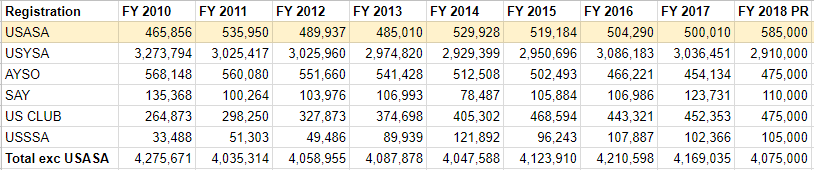
On another note, I’ve compiled registration-fee numbers from every organization from the last eight years. And they tell us … very little?

regstat

Quick reminder: USSF charges adults $2 each, so the USASA registration numbers are basically the USASA fees divided by two. (Unless there are some waivers somewhere.) The youth fee is $1 per player.

But we can’t quite equate that last line to the number of youth players registered. Here’s why:

  • U.S. Club, USSSA and maybe AYSO numbers might include some adults.
  • Some youth players may be registered in more than one organization (a point Eric Wynalda is making).

Yet this is an apples-to-apples comparison from year to year, for the most part. And … I can’t really detect a trend. I see fluctuations that could be accounting flukes as much as anything else. The numbers are basically flat.

And yet we keep hearing horror stories (and I keep repeating them — in several presentations and maybe even a book over the past few years) of participation dropping. Take a look at Project Play, which says the percentage of children aged 6 to 12 who participate in outdoor soccer plummeted from 10.9% in 2010 to 7.7% in 2016.

What’s going on here?

  1. Consider the methodology. The Project Play numbers come from an online survey of 24,134 “individuals and households.” Could our changing online habits (less computer, more phone) be skewing the numbers? (I’d turn it over to a data scientist, but after the 2016 election, I’m starting to view “data” as applied to polling with a higher margin of error than the data scientists would care to admit.)
  2. Could it be that there are indeed fewer people playing soccer but that USSF’s organizations are managing to register a higher percentage of those people? Isn’t that the opposite of what we’re hearing from the presidential candidates — that tons of kids (and adults) are playing in unaffiliated leagues?

Hard to say. But the evidence certainly doesn’t point to a sport on the rise. (Please don’t respond by saying the numbers are increasing in high schools. That’s generally a function of having more high schools. The number of soccer players at a high school of significant size equals the number of players they can take, not the number who are interested. My local high school could probably field 10 teams if they had the field space. They have four — boys and girls varsity and JV. A lot of travel soccer players won’t make the cut for either one.)

So whether this is an outright crisis or just a little hiccup, it’s worth addressing.

If you can derive any other conclusions or insights from this, please share.

us soccer

USSF projecting eight-figure loss for next fiscal year and other AGM notes …

The “book” is out. Let’s take a look:

DISCLAIMER: This is my very quick look at highlights that I think will interest readers. Please do not assume a report didn’t address your pet topic if I don’t mention it here. Eventually, the whole damn book will be online, and you can read it for yourself. I’m just giving a glimpse here. I especially wanted to see the budget — we still don’t have FY 2017 statements online.

Agenda: 

  • No bylaw proposals this year
  • Policies to ratify include more restrictions on MLS reserves participating in the Open Cup and some numbering changes. That should be a quick voice vote.
  • The presidential election is the last item on the list before the traditional “Good of the Game” (open comment) segment. That’s probably for the best. Hard to imagine doing much business after that.

President’s Report

  • Second graf is hand-wringing.

agm-1

  • Then more positive fare about the World Cup bid and enhanced programs, including $1.2 million in subsidizing B, A, Pro and Academy Director licenses, plus this note on scholarships and development.

agm-2

  • Roundup of pro leagues includes NWSL and, more surprisingly, the NASL final. That is the only mention of the NASL in the AGM book.

Vice President’s Report (Carlos Cordeiro, presidential candidate – short report)

  • Budget extends those enhanced programs, including the Innovate to Grow Fun.
  • Governance improvement, including the Risk Management, Audit and Compliance (RAC) Committee

CEO/Secretary General’s report (Dan Flynn, the appointed executive)

  • Federation employees up from 147 full-timers to 172
  • 43% of new hires are women; 26% of those women are from underrepresented minority
  • Sponsorships, sponsorships, sponsorships
  • Full paragraph on NWSL, hailing Amanda Duffy as Managing Director, sponsors, Lifetime deal, total attendance increase
  • New High Performance Department headed by former EPL man James Bunch
  • National Development Center in Kansas City (also mentioned in other reports)
  • Hall of Fame is back!

Committee Reports (I’m not going in much detail here) 

  • Athletes’ Council: New site
  • Budget and Finance Committee (Cordeiro, John Collins, Chris Ahrens, Steve Malik, Val Ackerman):
    • FY 18 budget (year ends in March 2018): Projected for net operating deficit of $2.3 million and net “non-operating” surplus of $27 million, mostly from 2016 Copa Centenario and donor funds, for overall surplus of $24.6 million.
    • FY 19 budget: Net operating deficit of $13.9 million, net non-operating surplus $714,000, overall deficit of $13.2 million.
    • Innovate to Grow Fund gets $1.5 million.
  • Open Cup Committee (former VP Mike Edwards, MLS’ Todd Durbin, NASL’s Rishi Sehgal, USL’s Jake Edwards, USASA’s John Motta, athlete rep John O’Brien): Modern-era record 99 teams, 78 streamed live and accessible through ussoccer.com.
  • Nominating and Governance Committee (chair Don Garber): Mostly worked on 2018 election and search for new independent directors, but it’s also charged with monitoring Board conflicts of interest in association with Risk, Audit, Compliance (RAC) committee.
  • RAC committee (All three independent directors — Donna Shalala chair, Val Ackerman, Lisa Carnoy — plus athlete rep Chris Ahrens and youth rep Jesse Harrell): Will focus in 2018 on an internal risk assessment and an RFP (Request For Proposal) for the Federation’s financial audit services.
  • Sports Medicine Committee: A busy group of doctors (plus John O’Brien) working on the Recognize to Recover (R2R) program and many other medical initiatives.

Budget details

agm-3

  • Preparing for down year: Men’s national team off because of World Cup qualification failure, but also, women’s national team off slightly after Olympics.
  • That said, in 2017, WNT average attendance was up 10% (average 17,731), MNT average attendance up 14% (32,545, though only 21,596 for “U.S. Soccer-controlled matches”)
  • Strategic technical decisions on where we play our World Cup Qualifying matches on the Men’s side limits our U.S. Soccer controlled match attendance.
  • NWSL investment — NOT including USWNT salaries, which are in separate line item — slight decrease from $992,765 to $868,300. My guess would be that this reflects sponsors (and Lifetime) putting more money into the league.
    • Under National Team expenses: NWSL is projected at $868,300 in FY 2019, down from FY 2018 and WAY down from FY 2017 ($2,390,703). I need to investigate this. Is it salaries only? (Hard to tell, given the Open Cup line item under National Team expenses — what does the Cup have to do with any National Team?) Further investigation required.
  • Coaching education: FY 2019 projected expenses $7.63 million, revenue $3.43 million, deficit $4.2 million. That’s more than double the projected loss (investment) from FY 2018.
  • Player development (youth national teams): In FY 2016, the men’s budget was about 2.5 times the women’s ($9.380 million to $3.662 million). By FY 2018, this had swung to where the women got more ($5.064 million to $4.841 million — both far over the original budget). In FY 2019, men get slightly more ($5.545 million to $5 million).

Some figures of note:

agm-4

agm-5

agm-6

The budget also includes a breakdown of registration fees, which gives us a snapshot of how many players are registered. Youth fees are $1/player; adult fees are $2/player; pro fees are higher. As Eric Wynalda has been pointed out, youth may sometimes be registered in multiple organizations (USYSA and U.S. Club). Also, U.S. Club might include some adult registrations — I’d have to ask about that.

In any case, we’re seeing some red numbers and declines here, so if you’ve been scoffing at the Project Play numbers, well …

agm-7

So that’s a very quick read. I’ll do some follow-up reporting — let me know if there’s something that jumps out to you as well. (I know you will!)


pro soccer, us soccer

A U.S. Open Cup proposal (with some NPSL/PDL ramifications)

Let’s address a couple of issues:

  1. The U.S. Open Cup could use a boost.
  2. Teams could use some meaningful games in February, but it’s too cold to play in many parts of the country.

So let’s do this:

The Cup is already playing a lot of qualifying games in the preceding fall. See the 2018 qualifiers that took place from September through November. Switching the tournament to a fall-to-spring schedule wouldn’t take much more.

As in England’s FA Cup (as I type, American Eric Lichaj’s two goals have Nottingham Forest — once affiliated with the Carolina Dynamo — ahead of Arsenal), let’s have the top two divisions (or whatever gives us between 30 and 40 teams) enter the competition in the round of 64.

Then let’s play the first three rounds at neutral-site warm-weather (or indoor) venues in February.

Here are the advantages:

  1. At least one meaningful game in February even if a home ground is covered in snow.
  2. A month in which the Open Cup is the only thing going on in U.S. outdoor soccer, giving it a promotional push.
  3. A good warmup for the Division 1 season (and the CONCACAF Champions League).

The disadvantages:

  1. You lose a bit of the romance of making a Division 1 club play at some tiny lower-division club’s home ground, such as yesterday’s Fleetwood-Leicester matchup. But this is mitigated by having your pick of suitable venues.
  2. Tough to get a “home” crowd. You’d need to put something together to get hard-core supporters to travel. Maybe some creative scheduling could help avoid having teams travel too far. Perhaps some East Coast teams go to Atlanta, Rocky Mountain teams go to Texas or Arizona, Great Lakes teams go to domes (Minneapolis, Indianapolis, Detroit, Syracuse, Milwaukee, Fargo and maybe the warehouse-esque Ultimate Soccer Arenas in Michigan).

Then play the quarterfinals and semifinals during the spring season, with the final itself being the last game before the summer break for the World Cup, Euros, Copa America, Gold Cup, etc.

A couple of questions this format would raise:

If we’re playing a fall-to-spring schedule, what about the MLS playoffs? 

These have always been too long, anyway. In last night’s forum in Illinois, Eric Wynalda pointed out the problem of players getting rusty when their teams don’t make deep runs in the playoffs. That’s a bit of a problem in the current schedule, when a player might sit out from late October to early March, and it would be a problem in a fall-to-spring system — you certainly don’t want players sitting out several weeks before a World Cup or a Copa.

Maybe you’d still have a single-game MLS Cup or a four-team tournament, but that’s it. Hopefully, the Open Cup will fill our need for knockout play. (And maybe some promotion/relegation playoffs, but that’s another rant.)

What about the NPSL and PDL teams that currently play in the Open Cup? 

They shouldn’t be in the Open Cup. At least, the teams that rely on college players (pretty much all PDL teams and most NPSL teams) shouldn’t be in it. If you have a club with enough non-college amateurs to play a fall-spring schedule, fine.

The current NPSL/PDL schedule is absurd. Players only have a couple of months to participate, and yet each league is run as a national competition with national playoffs at the end. Just as Wynalda lamented the fact that many pro players are left idle because their teams don’t make the playoffs, these college players who need more games don’t get to play a couple of weeks in the summer.

And then the players go back to their college teams, sometimes before the league final. Last year, Midland-Odessa had to scramble to find enough players to play the NPSL final. In the current format, there’s no way a college-dependent team could play the Open Cup semis or final if it advanced that far.

These leagues should focus on guaranteed games. Try to play 14 regular-season games over 10-11 weeks. If you want to play a Summer Open Cup of sorts on additional weekdays, fine, and there’s always the option to play in the fall-to-spring Open Cup if the players are available.

Let the summer leagues be summer leagues. Nothing wrong with that. For everyone else, have a Cup that has a larger spotlight.

(And yes — USSF needs to pay the travel costs for any team, particularly amateurs, going to the round of 64 and beyond.)


us soccer

What I learned reading tons of USSF minutes and transcripts, Part 2 (2010-2017) …


(Part 1 covered 1998-2009)

Repeating our links of documents:

(In Part 1, there’s also an external 2004 report on governance. I also had a quick side note comparing the USSF structure to what I’ve found elsewhere, but it’s not much so far.)

I’ve read, at one time or another, pretty much all of this information. That doesn’t mean I understood it. That doesn’t mean the records are complete — the Board seems to go into executive session over piddly details, while other boards with which I’ve dealt tend to do so only for personnel matters. But I’ve read it.

The other big-picture item: The organization is turning over much, much more money than it used to.

2006 2016
Sponsorship $14,720,385 $49,498,623
Program revenue $28,365,806 $122,655,465
Gross receipts $39,102,876 $126,747,525
Total expenses $35,047,107 $110,011,376

I certainly have some questions left. Many. I hope to get some of them answered in 2018, preferably before the election.

One clarification here: I’ve been sloppy in my usage of “AGM” (Annual General Meeting). The AGM has meetings of all the Councils (Youth, Adult, Athletes, Pro) as well as the Board, then has the big show — the National Council, in which everyone is represented and all the big, binding votes are held. We get transcripts for the National Council, not the other meetings.

So with that in mind, here’s a full history (abridged) as constructed from the minutes, transcripts and the occasional other document, picking up where I left off in Part 1 …

2010 

A year of big decisions that passed quietly:

  • Sunil Gulati is re-elected without opposition.
  • Claudio Reyna is hired as technical director (a few months after the election).
  • Some sort of resolution between U.S. Youth Soccer and U.S. Club Soccer, but I don’t have details.

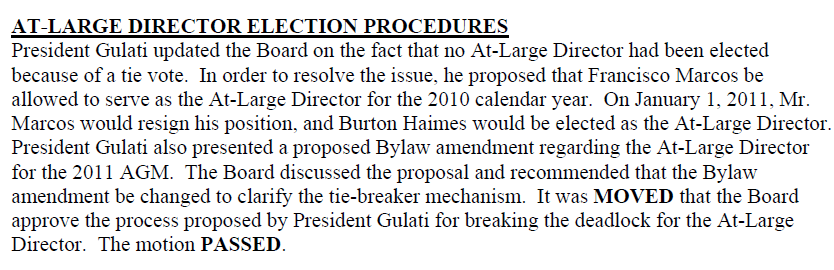
Also, this bizarre democratic twist from the Board minutes:
at-large

More typical Board business from May:
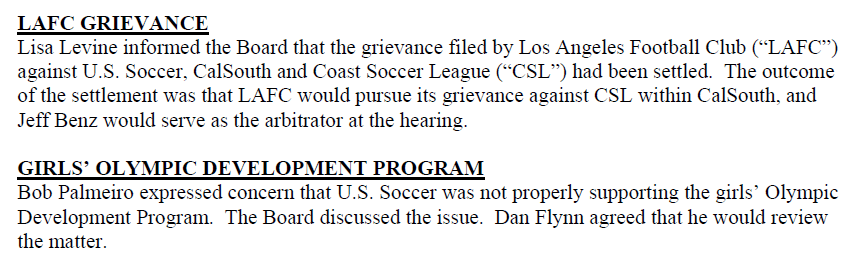
lafc

(That is, of course, not the LAFC entering MLS this year.)

The biggest news for the future — U.S. Soccer stepped into the mess that was lower-division soccer, where teams were breaking away from the USL but neither faction had the critical mass to play D2, and agreed to run a temporary second-division league with teams from both factions included. Also that year, a new task force came up with Pro League Standards. I remember thinking at the time that the D2 standards were ridiculous, but the leadership of the group that would become the NASL (none of whom are still involved with the league) signed on.

This from the President’s Report: “In 2010, U.S. Soccer successfully oversaw the Division 2 Professional League. Twelve teams went through a highly competitive 30‐game season, with the Puerto Rico Islanders claiming the championship after defeating the Carolina RailHawks 3‐1 in aggregate in a two‐game series. For 2011, the NASL has provided a plan that we are hopeful will provide a long‐term solution for Division 2 soccer, while the USL Pro League will also contribute to create a strong base of men’s professional soccer in the U.S.”

And back at the National Council, they were still doing manual roll calls, leading to this from the youth ranks:
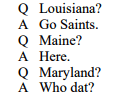
roll-saints

2011 

A few odds and ends:

  • April Heinrichs and Jill Ellis hired for women’s technical roles. At the AGM, Heinrichs gave a speech that went on for 11 1/2 pages of the transcript.
  • In case you forgot, FIFA didn’t give the USA a World Cup to host. Russia and Qatar seem like great choices though, don’t they?

And some interesting business on leagues, first from the National Council, where it seems everyone was combing the bylaws to make sure it was OK to give the NASL provisional membership for 2011:
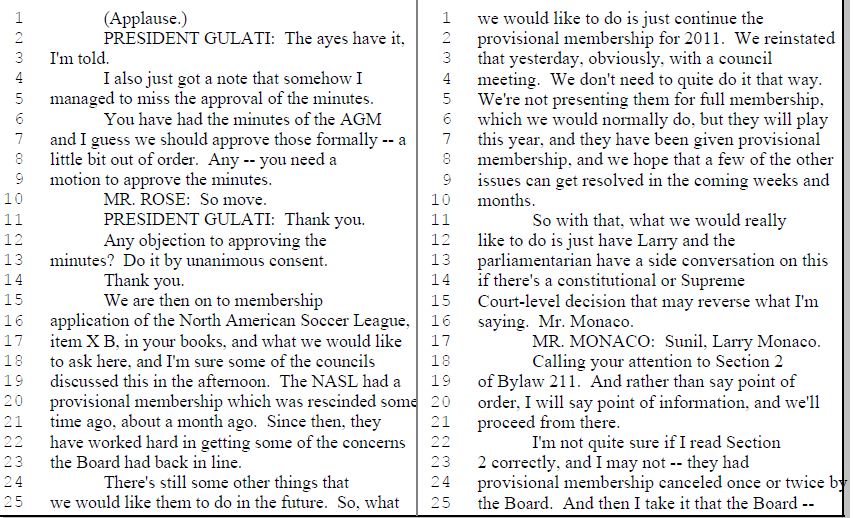
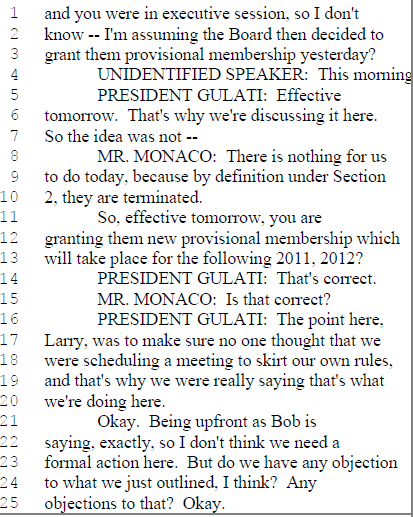
nasl-2011-1

nasl-2011-2

Then from a May Board meeting:

pro-am

Also — this is the earliest AGM “book” currently available online. There, you can see all the committee reports, bylaw changes, policy changes, etc., along with the transcript of the previous National Council (which is also available under AGM transcripts on the site). So your homework now is to tell me which committee(s) John Harkes and Amanda Cromwell served on that year.

That’s also where we learn things like this:
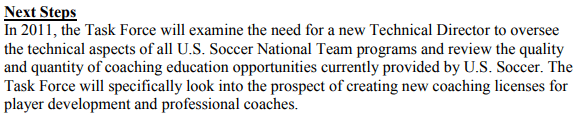
techdir

That task force had 16 people, including chairman Kevin Payne, Bob Bradley, former USSF president Dr. Bob Contiguglia, Dan Flynn, Sunil Gulati, Tab Ramos, Thomas Rongen, Claudio Reyna and Jerome de Bontin.

And note this from, of all places, the budget report:
core

WoSo folks might be interested in seeing the game-by-game budget summary for the WNT in the fiscal year.

The book also has the NASL’s application for full membership, which notes the average monthly salary would be approximately $2,700.

And it’s bylaws, bylaws, bylaws! The proposals this year …

Amendment to Bylaw 213 by Board member Jim Hamilton (Adult Council): Speeds up the response time when someone bids to replace a state association. PASSED

Amendment to Bylaw 302 by Board member Richard Groff (Adult Council): “This proposed amendment is meant to formalize the customary practice of the Adult Council’s National Association to delegate votes in the National Council to subsidiary affiliates that register adult players directly through the National Association and not through a State Association.” PASSED

Amendment to Bylaw 412 by the Board as a whole: Intended to prevent having another tie for the At-Large spot. PASSED

Amendment to Bylaw 801 by Louisiana Soccer Association: Gives Life Members (and, as amended from the AGM floor, past presidents) the right to propose amendments to bylaws, policies and the articles of incorporation. PASSED

Then policies (some of which the Board enacts, but then the National Council must ratify):

ratified

Amendment to Policy 102(3)-1 by Sunil Gulati: It’s about coaching education, and it seems to be little more than some punctuation changes. PASSED

Amendment to Policy 214-2 by U.S. Youth Soccer: Membership fees! Cutting them in half. Literally. Every category — associate member from $1,000 to $500, adult player from $2 to $1, youth player from $1 to 50 cents, etc.  WITHDRAWN without a vote.

Amendment to Policy 214-2 by Richard Groff: Adds a U20 player category and charges them the youth ($1) rate rather than the adult ($2) rate. Saves some bookkeeping for U20 teams that have both youths and adults. PASSED

2012 

A moment of silence for the full-fledged roll call. They automated it this year.

The National Council votes the NASL into full membership. Commissioner David Downs is present to give a brief word of thanks.

Also welcomed as a member: North Dakota Soccer Association. The transcript has one of my favorite typos ever:

dakota

VP: Mike Edwards is elected to a second full term over Juergen Sommer.

But it wasn’t all bad news for Jurgens. Hello, Coach Klinsmann. He spoke at the National Council meeting for a long time.

The not-yet-recovered economy took a toll on the budget, with a projected deficit of $6.1 million.

The AGM book has a substantial presentation by the NASL. The “youth development” page shows a wide range of approaches — Edmonton has an actual academy, Carolina has an affiliation with giant club CASL, Tampa Bay has invested $65,000 in Maine (?!), and other clubs have players out coaching somewhere. Among the interested expansion markets — Austin, Las Vegas, New York, Sacramento.

Colorado’s state adult association shuts down. The youth association is provisionally accepted as a joint association.

Not as much activity on the bylaw front except for a couple of bylaws about bylaws:

Amendment to Bylaw 802(3) by Life Member Stephen Flamhaft: Suggests requiring that bylaw amendments must be distributed 60 days (not 30) before the AGM. The Rules Committee notes that another bylaw says 30, so the CEO would have to distribute them twice. FAILED (got 58 percent but needed two-thirds).

Amendment to Bylaw 802(4) by Flamhaft: The Rules Committee MUST make a recommendation of whether or not to recommend a bylaw (and may include a minority dissent if applicable). The Rules Committee responds by saying that could be problematic because it might politicize the committee, but hey, if you really want us to do that, go for it. WITHDRAWN without a vote.

Policies:

Amendments to Policies 241-2, 601-2, 601-8 by the Professional Player Registration Task Force (remember that from last year?): Basically, $50 per professional player in a non-pro league, but $10 of that goes back to the organization member and another $10 to the state association up to a very odd total of $1,333 per team in a calendar year.

Amendment to Policy 411-1 by Sunil Gulati: Just gives the CEO a bit more freedom to sign financial agreements.

New Policy 531-1 by USSF Referee Committee: Something about a point of contact.

Amendment to Policy 601-6 by Dan Flynn: International clearance for youth players, to bring USSF into compliance with FIFA requirements.

Then there’s a fifth one the Board approved too late for inclusion on the book. It’s from Richard Groff on Policy 214-1, and Washington State Adult Soccer’s Tim Busch has some pointed questions:

BUSCH: So what we’re talking about in Section 10 is if a state association chooses to leave one or the other youth or adult parent bodies and chooses to affiliate directly with the Federation, there’s a $10,000 one-time fee or a $10,000 annual fee.

PRESIDENT GULATI: Annual.

BUSCH:  Let me understand this. The Federation needs $10,000 to be able to accept our player fees? I mean, I understand a reasonable administrative fee. But $10,000?

Groff joins the conversation here:
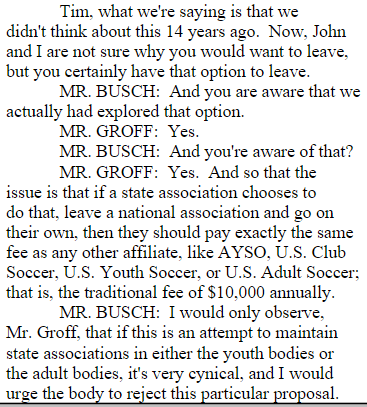
washington

It still PASSED, though they had to go to the keypads rather than a simple voice vote.

2013 

Big year for the Federation: It launched the NWSL. Initially, the Fed staff was the league staff, but the league slowly grew its own office from an initial group of three into something that could stand on its own. Also, USSF subsidized the league, most directly by paying salaries for U.S. national team players.

Also, it’s the Centennial. 1913-2013.

The Athletes Council formed three internal divisions: Governance, Visibility and Outreach. Angela Hucles took the lead on Visibility; Cindy Parlow Cone took the lead on Outreach.

The Open Cup Committee report hails the increase in prize money — champion will get $250,000, up from $100,000 — and the Cal FC run:

cal-fc

The AGM book includes a report from the Diversity Task Force, opening with its mission statement: “We believe that the under-served soccer community deserves opportunities to succeed. We will identify the challenges, create the road map to success, forge partnerships with corporations, non-profit organizations and individuals who will help us develop the programs and services that allow the under-served soccer players from all backgrounds to reach their full potential in soccer, education, work, health and life.”

A few members of the 20-strong Diversity Task Force: Tiffany Roberts-Sahaydak, Chris Armas, Lynn Berling-Manuel, Luis Montoya, Dante Washington, David Testo. How’d that turn out?

American Amputee Soccer Association was welcomed as a member. U.S. Futsal returned “after a brief absence,” according to the letter from President/CEO Alex Para.

One unusually frank item in the AGM book: Some background, including minutes of a testy meeting and one angry email, of the dispute in Wisconsin.

The AGM itself, held in June, was relatively uneventful. Since-departed CONCACAF president Jeffrey Webb addressed the crowd. So did Dr. Reinhard Rauball of the German federation, who has a gift for U.S. Soccer. Gulati jokes that the plaque’s inscriptions accepts that it was a handball during the 2002 World Cup, then talks about seeing the men’s and women’s Champions League finals. The latter was won by Wolfsburg despite Megan Rapinoe’s presence for Lyon.

Let’s hit the bylaws:

Amendments to Bylaws 202, 232, 241 and 543 by Dan Flynn: All designed to remove the Individual Sustaining Member designation. Once upon a time, individuals could pay some fee and become a member, earning the right to attend any game. But, Flynn says, they hadn’t used this option in years, so it was time to delete it. The Rules Committee agreed, calling these bylaws “vestigial.” The change on 543 was WITHDRAWN for some reason, but everything else PASSED by voice vote.

(Remember the preceding paragraph.)

Amendment to Bylaw 213 by Richard Groff: Adds a mediation process to disputes between an existing State Association and a would-be replacement. It’s referreed to on the floor as “the Wisconsin bylaw amendment.” PASSED with applause.

Amendment to Bylaw 322 by Jon McCullough (Athletes Council chair who sadly passed away the next year): Changes the way the Athletes name reps to the Board and the USOC, going to staggered four-year terms. PASSED

Amendment to Bylaw 412 by Richard Groff: Simple update on Adult Council’s representation on the Board — the Adult Council chairperson would automatically get one of the two slots. PASSED

Amendment to Bylaw 603 by Eastern New York Youth (no, NOT Sal Rapaglia’s organization): Adding a section on how youth tournament organizers must advertise tournaments, taking into account all the different youth organizations and how their insurances differ and good grief, why do we have so many youth organizations? Rules Committee suggested tweaking and did in fact convince ENY to take on an amendment. They used the keypads for the vote, but it PASSED.

New Bylaw 805 by Dan Flynn: Can we please send notices to the National Council electronically? PASSED with slight amendment from the ever-vigilant Larry Monaco.

Phew! How about policies (reminder: Board usually enacts, but National Council must ratify):

Amendment to Policy 102(4)-1 by Open Cup Committee: Sets field standards starting with the first round, not third.

Amendment to Policy 214-2 by Disability Committee: Changes membership fee for Disabled Service Organizations. No longer $1,000. Now a minimum of $500, stepping up $1 per player if the group has more than 500, then a maximum of $1,000. If you have 300 players, $500. If you have 501 players, $501. If you have 999, $999. If you have 1,003 players, $1,000. If you have 10,000 players, good for you — and it’s still $1,000.

Amendment to Policy 601-5 by Transgender Task Force: Adds a new section saying amateur players “may register with the gender team with which the player identifies.” Not applicable to national teams or pros, pending FIFA action.

All three passed in one vote, as did the re-election of independent directors Carlos Cordeiro and Fabian Nunez.

By December, the budgetary news was steeped in black ink — revised projection on FY2015 was a surplus of $7M.

2014 

Back to a winter AGM — Feb. 28-March 2 in New York. The 2013 meeting had been in June.

In February, the Board said its sponsorship deal with Nike had been renewed. Still working on renewing the deal with Soccer United Marketing.

Also in February, revised pro league standards were approved.

Diversity Task Force reports that it’s going to launch a leadership program at a May event with the U.S. Soccer Foundation and the Urban Soccer Collaborative Symposium.

Winning the Gold Cup and holding a qualifier in a large stadium (Seattle) boosted the budget to a projected FY 14 surplus of $3.17M. (Indeed, the National Team revenue line item was $8,223,350 better than budgeted.)

Not much on the bylaw front:

Amendments to Bylaws 231, 301, 302 and 303 by Mike Edwards: These refer to Life Members, which have heretofore been nominated (in excruciating detail — a lot of the 2014 AGM book consists of every sort of supplementary evidence you can imagine in support of one nomination) to the National Council and then voted in. Edwards (still the VP at this point) wants to shift that from the National Council to the Board. Would that give too much power to the Board to stack the National Council? No problem — Edwards’ amendments would also cap the voting strength of Life Members on the Board. After a few tweaks from Larry Monaco, including (seriously) changing some periods to semicolons, all of this PASSED sans opposition.

Amendment to Bylaw 707 by Mike Edwards: Oh boy. They’re trying to make it more difficult to sue the Fed.
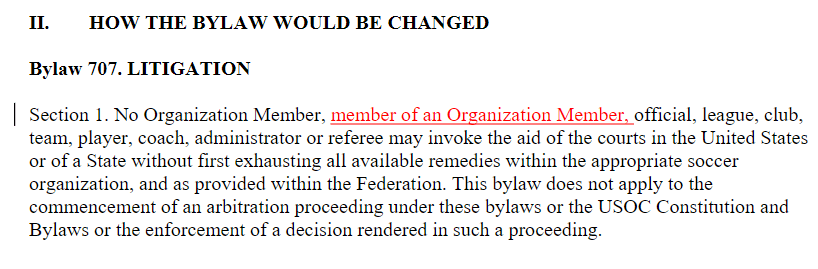
arbitrate

And the Bylaw would have a few other tweaks as well, all trying to define the path by which anyone can challenge the Fed (or a Fed member).

To which the Rules Committee says, “Good luck with that.”

sue-rules

This was WITHDRAWN.

The only Policy up for a vote has not been approved by the Board and is predicated on the Life Member amendments passing. It just updates the Policies to match the Bylaws. PASSED.

Oh, and Sunil Gulati was re-elected to a third term without opposition. And Donna Shalala was re-elected.

Longtime Board members Richard Groff and Kevin Payne wrap up their terms. Groff was stepping down as USASA chairperson.

Later in the year, the Board considered the application of the US-AFL, agreeing to hold off until the group addressed some concerns from the Rules Committee.

And as mentioned above, sad news — Jon McCullough, a Paralympian and longtime Athletes Council rep to the USSF Board, passed away at age 48.

2015 

The 2015 AGM Book isn’t available online right now, which is a pity because I need some details about this first policy discussion.

In any case, there were no bylaw proposals this year. The policies …

Amendment to Policy 102(3)-1 by Mike Edwards: Something about a national coaching policy. Without the book, I don’t know what it said.

But the transcript tells us we had a battle between the state associations and the big national organizations — U.S. Club Soccer (Kevin Payne speaking) and AYSO (John Collins). It wasn’t about Edwards’ change per se; instead, it was about an amendment offered from the floor that would shift approval of something from the “state secretary general” (I suspect this is a typo or a misstatement, and they actually mean the national secretary general — Dan Flynn, in other words) to the state associations. Here’s Collins:
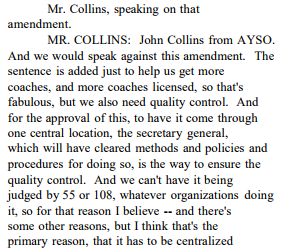
collins

So that’s why I think they didn’t mean state secretary general. Collins seems to be arguing that this should be centrally run. Whatever this is.

Several states stood up in favor of the amendment — a New Jersey rep actually said the current national F license is not valid in New Jersey for some reason. USSSA’s Craig Scriven had the last word, siding with Payne and Collins.

Payne, Collins and Scriven won. The amendment (to the amendment) failed. Then Edwards’ original amendment PASSED.

Amendment to Policy 213, something about mandatory liability insurance by prolific amendment-writer Richard Groff, PASSED without objection.

Amendments to Policy 531, proposed by the Referee Committee, PASSED without objection.

Carlos Cordeiro and Fabian Nunez were rubber-stamped for another term as independent director.

The National Council meeting ended with the “Good of the Game” free-form section as always, and it included an eloquent letter Jon McCullough sent before his death.

The whole meeting wrapped up in a tidy 83 minutes. That won’t happen in 2018.

At the Board meetings: It’s independent governance review time! McKinsey’s report was due in January 2016.

2016 

The 2016 AGM Book is up, so we get all the reports hailing a big year in 2015 — the WNT winning the World Cup (VP Mike Edwards went to eight of the 10 Victory Tour games), the MNT beating the Netherlands in Amsterdam (pity CONCACAF qualifying couldn’t be held there), MLS’s growth, the NASL contributing a player to the MNT and having its final on ESPN3, etc.

The U.S. Open Cup Committee was pleased that 63 games were live-streamed and available via the USSF site. They were also pretty pumped with the Cosmos’ comeback win over NYCFC. They’re also expanding USSF’s management of the Open Cup’s qualifying rounds — if you follow TheCup.us, you may notice that the qualifying rounds have a bit more pizzazz than they used to. Mike Edwards is the chairman of that committee and the Referee Committee.

The Rules Committee has gone all-male for some reason. It wasn’t like that in years past (Heather Mitts just finished her tenure).

Two bylaw proposals were withdrawn — USASA wanted to amend Bylaw 213 to make it a little more difficult to challenge a State Association so the states wouldn’t face costly, frivolous legal action, and the ever-present Steve Framhaft wanted to amend Bylaw 802 to make the Rules Committee send out its recommendations 60 days before the National Council meeting, not 30.

The proposed policy amendments passed with little fuss. That’s 601-6, a further tweak to youth players and international clearances (undoubtedly FIFA-driven), and 102(4)-1 from the U.S. Open Cup Committee, changing the “Adult Council division” to “Open Division.”

FY2016 was projected to have a six-figure surplus. It ballooned to $18.1M. Winning a World Cup and having a Victory Tour helps. The next fiscal year is projected to be huge because of the Copa America Centenario.

But we have a contested election! Incumbent VP Mike Edwards faces two challengers — longtime Board member Kevin Payne and longtime Board independent director Carlos Cordeiro. All three give speeches, all hailing each other as great people. And the winner is … Cordeiro.

This was also the AGM in which Flamhaft (see policy above, see presidency discussion in Part 1) rose in the Good of the Game section to denounce Chuck Blazer. Anger ensued. (First tweet of a thread below.)

https://twitter.com/duresport/status/944365333456019456

Also, the Board discussed a policy on standing for the national anthem, devoting an entire (though brief) teleconference to the matter in October.

At the December meeting, the last two items in the “Good of the Game” segment are noteworthy, but I’d be especially interested in some further explanation of the first:

alignment

2017 

In February, the Board approved the national anthem policy (604-1).

Also, Gulati gave an update on filling the vacant independent director position, with Heidrick & Struggles becoming more involved in the search for candidates. (So, no, Gulati doesn’t just wander around Columbia looking for people. I looked up that firm to see who they are, and I discovered that they just announced layoffs.)

At the March meeting, Big East commissioner and former WNBA president Val Ackerman attended and was nominated to fill Cordeiro’s spot as an independent director. That was confirmed the next day at the National Council meeting.

There was also some discussion of conflict of interest:

coiI’m sure people who remember that Alan Rothenberg and Mark Abbott, the latter of whom has been with MLS since the beginning, were both from Latham & Watkins, will find some irony in that.

At the National Council meeting …

The long speech this year went to Canadian federation president Victor Montagliani.

Applause for the NWSL’s deal with A&E Networks.

The online F license has been taken by 120,000 people already. Not bad. (I’ve taken it. It’s quite good.)

McKinsey’s consulting has led the Board to institute a few “committees of the Board,” so if you see that on the site and think it’s an odd power grab, just remember that an outside firm recommended it. They’re also evaluating the staff to see who might replace Dan Flynn one day.

How much money did USSF make from the Copa America Centenario? About $46 million, which is why the projected budget surplus is $44 million.

One year after being (politely) ousted as VP, Mike Edwards isn’t present, but he is approved as a Life Member.

U.S. Deaf Soccer is approved as a member.

The national anthem policy passes to applause. Two other policy amendments also pass, but I have no idea what those are because the 2017 AGM book isn’t online. Argh.

Then a major bylaws overhaul, led by Paul Burke of the Rules Committee:

  • Bylaw 213: Replaces the process for replacing State Associations. Voice vote, PASSED
  • Bylaw 232: Reinstates Individual Sustaining Members, just a few years after they were deemed “vestigial.” Fan organizations would be able to get a total of six votes. Voice vote, PASSED.
  • Bylaw 401: Requires candidates for president and VP to declare in advance. (Yes, we’re talking very recent history here.) Voice vote, PASSED
  • Bylaw 413: Term limits, background checks. Voice vote, PASSED

The details are complicated. Fortunately, I’ve written about this.

Also, changes to Bylaws 531 and 532 FAILED by electronic vote. Something about referees? Put the damn book online!

Are we done? Well, we’ve got minutes from three more Board meetings here …

In June, some spending:

  • A $100,000 grant ($50,000 subject to finding sponsors) for the Power Soccer World Cup.
  • $8 million for development of a centralized data integration platform.
  • $3.3 million for further work with soccer consultants Double PASS.
  • An additional $3 million (on top of the existing $1 million) for development of the Hall of Fame.

In July, Chris Ahrens (Athletes Council) inquired about the status of the pro league standards review. There was an update. And Lisa Carnoy was named the next independent director. (Theoretically, could someone else run for that spot at the AGM? It’s never been contested before, but these days, it seems like all bets are off.)

In September, Carnoy was added to the Risk, Audit and Compliance Committee.

And finally, from the September meeting, make of this what you will.
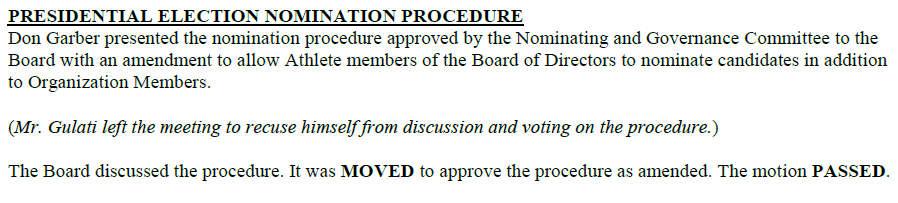
nomcom

And that’s all we have. For now. At some point, I might go back through the financial documents AGAIN so I can find all the disclosures involving Garber and SUM, or maybe some of you can put down Twitter long enough to do it your own damn selves.

(Sorry, getting punchy. This is 4,145 words. Labor of love or something.)