pro soccer, us soccer

That time MLS (and many others) was sued for $50 million

A bit of hilarity from the California court system …

In 2014, one James C. Maxey sued Major League Soccer, alleging a conspiracy that involved “John Does 1-1999.” It’s hard to say exactly what Maxey claimed MLS did. He says he was injured on Sept. 11, 2001, and that the injuries were caused by “George W. Bush and associates affiliated with Queen Elizabeth II, English Football Association, English Premier League, United States Soccer Federation, Republican Party, Kevin Campbell, Phillip Wright, Gary Messing, Jerry Zanelli and Peter Reynand.”

There are some wild Sept. 11 conspiracies out there, but it’s hard to imagine one that includes Zanelli, who founded the WPSL. (He passed away in 2018.)

Two months later, a California judge dismissed that complaint, along with various other complaints from Mr. Maxey against Mitch McConnell, Barack Obama, John Boehner, several Republican Party county offices, John Ashcroft, a fire department, Mitt Romney, John McCain, James Comey, the National Labor Relations Board, “Michael” Platini, Sepp Blatter, Costco, Hillary Clinton and … Cy Curnin? The lead singer of The Fixx?

In between the filing and the dismissal, another judge noted the following paragraph recurred in each suit: “The plaintiff, James C. Maxey, suffered injury due to the actions of the [space provided for plaintiff to inserts the names of individuals or companies] on, or about [space where plaintiff inserts a date]. The plaintiff’s injuries were caused by [blank space where plaintiff identifies different parties or companies] associates affiliated [another blank space].”

Here’s the complaint in its entirety:

https://www.scribd.com/document/396870455/Funny-Mls-Suit

us soccer

The Berhalter hire and why I don’t really care

As the press conference announcing Gregg Berhalter as the U.S. men’s soccer head coach started, I was at The Fresh Market pondering ways to introduce farro into my diet. 

After listening to a bit of the press conference on delay on Jason Davis’ show, I went downstairs to play the following songs on drums: 

  • The Weapon – Rush (playing along with live version from Grace Under Pressure tour, complete with the intro from SCTV’s Count Floyd)
  • Green Eyes – Angela Perley and the Howlin’ Moons
  • Texas – Magnapop
  • Falling to Pieces – Faith No More

I played pretty well. Much better than the other day, when I made a complete mess of Love Spreads (Stone Roses) and I Need Some Fine Wine, and You, You Need to Be Nicer (The Cardigans).

OK, OK. I’ll get to soccer. 

The press conference had a few moments of interest. The opaque process of finding a coach was emphatically laid bare, with president Carlos Cordeiro and general manager Earnie Stewart talking about whittling a list of 30 candidates down to three finalists, one of whom opted to go elsewhere. (Tata Martino?) 

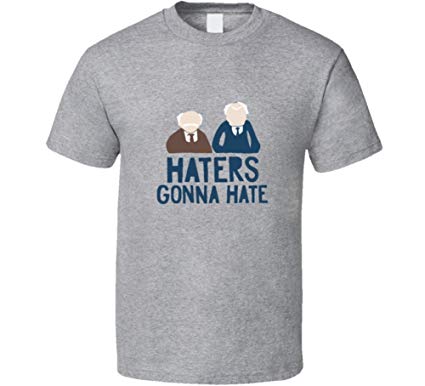
Not that it matters. Haters gonna hate. Ambivalents gonna ambivalent. 

The former group is, of course, quite active on Twitter. There’s already a BerhalterOUT Twitter account, followed by the usual disgruntled Twitterati and a disturbing number of MAGA accounts. 

A perfect stocking stuffer from BustedTees.

Prepare for an irony over the Berhalter era, no matter how long it lasts, of a bunch of people who consider themselves experts because they watched a couple of damn Ajax training sessions, all turning up their noses at a guy who actually played many years in the Netherlands and Germany, all starting with the endorsement of Rinus Freaking Michels. If Rinus Freaking Michels recommended you for a career in Europe, please let me know and share all your insights.  

I have no idea whether Berhalter will be a good coach for the national team. His resume is fine. He might be more motivated to turn around the U.S. program than a foreign coach with no ties here — besides, we really shouldn’t be in the mood to repeat the Klinsmann experiment any time soon, and Klinsmann at least had lived here for a while. You could make a good case for Oscar Pareja, and I probably couldn’t argue with you. 

Nor am I particularly aggravated by the presence of Jay Berhalter in U.S. Soccer management. If someone can really connect the dots to undue influence from the federation’s chief marketing officer, please let me know. Sure, perhaps now would be a good time for Jay Berhalter to … I don’t know, replace Kathy Carter at SUM? Work for Nike? Retire, having made more money in U.S. soccer than just about anyone other than David Beckham? The optics could be better, and anything USSF can do to demonstrate a firewall between the Berhalters would be a good idea. 

But perhaps the most notable part of the press conference is that it contained quite a few questions and answers about tactics and style. We’re obsessed with such things, even though Bruce Arena engineered one of the biggest wins in U.S. history by changing things up for the 2002 World Cup game against Mexico, thanks in part to his faith in a defender named … you guessed it … Gregg Berhalter, who is quoted as such in an oral history of the game: “This is a team that had never played that system before.”

In particular, Soccer Twitter seems pleased with this exchange between Alexi Lalas and the new coach: 

For further reading both on the Dutch-style tactics and the Habsburg-esque family entanglements, may I recommend Kim McCauley at SBNation.

After all that, why do I have such a blasé attitude about the Berhalter hire? 

Simple. I’m working on a book now that gets into a lot of the problems in U.S. soccer (lowercase s), some of which can be solved and some of which cannot. Not one of them can be solved by the men’s national team coach. Not Berhalter, not Klinsmann, not Arena, not Pareja, not Martino, not Lopetegui. Not even Klopp.

I kept listening to Jason Davis and company after the Berhalter wrap, and he had an interview with Julie Foudy that illustrated some of those problems. We don’t have a U.S. women’s general manager. We don’t have an NWSL commissioner. (I have a good nominee — just email me.)

And we have a lot of bureaucrats. 

Meanwhile, we have families that can’t afford the money or time needed to play high-level youth soccer. We have coaches who can’t get the education they need. We have leagues and organizations that can’t stop fighting with each other. We have coaches and pundits whose entire identity is based on doing what the majority of people in U.S. soccer are not — if the Federation didn’t jump off a cliff, they would. We have deep currents of distrust — some justified, some not.

Good luck to Gregg Berhalter as he attempts to find the 30-40 best U.S.-eligible players that can get the team to the World Cup (assuming it’s still held in 2022) and make a halfway decent showing. He might actually have an easier job than Carlos Cordeiro, and he’s getting paid for it.

us soccer

Should the Athletes(‘) Council include non-national teamers?

Start with the Ted Stevens Act, the law (Congressional — Sunil Gulati did not write this) that gives organizations such as U.S. Soccer their authority.

From that Act (U.S. Code › Title 36 › Subtitle II › Part B › Chapter 2205 › Subchapter I › § 220501):

(1) “amateur athlete” means an athlete who meets the eligibility standards established by the national governing body or paralympic sports organization for the sport in which the athlete competes.

Note that this is not “amateur” in the sense of playing in the NPSL or the PDL or the Cosmopolitan Soccer League or not being paid. This is “amateur” in the sense that the athlete is eligible (for what, I don’t know) under the standards of the national governing body (NGB, in this case U.S. Soccer).

Related (the next paragraph, in fact):

(2) “amateur athletic competition” means a contest, game, meet, match, tournament, regatta, or other event in which amateur athletes compete.

A few more definitions …

(6) “corporation” means the United States Olympic Committee.

(7) “international amateur athletic competition” means an amateur athletic competition between one or more athletes representing the United States, individually or as a team, and one or more athletes representing a foreign country.

(8) “national governing body” means an amateur sports organization that is recognized by the corporation under section 220521 of this title

Moving ahead to U.S. Code › Title 36 › Subtitle II › Part B › Chapter 2205 › Subchapter II › § 220522 – Eligibility requirements

(a)General.—An amateur sports organization is eligible to be recognized, or to continue to be recognized, as a national governing body only if it—

(10) demonstrates, based on guidelines approved by the corporation, the Athletes’ Advisory Council, and the National Governing Bodies’ Council, that its board of directors and other such governing boards have established criteria and election procedures for and maintain among their voting members individuals who are actively engaged in amateur athletic competition in the sport for which recognition is sought or who have represented the United States in international amateur athletic competition within the preceding 10 years, that any exceptions to such guidelines by such organization have been approved by the corporation, and that the voting power held by such individuals is not less than 20 percent of the voting power held in its board of directors and other such governing boards

Now this is a little interesting. Parse the words here, and you could conclude that the athletes don’t have to be national teamers. It really depends on what the NGB considers an “amateur athlete.”

So unless there’s a paragraph I’m missing, the definition on the USSF Athlete Council site is technically incorrect because it says the Ted Stevens Act defines an athlete as “anyone who has competed for their respective National Team within the last two years OR anyone who has competed in a major world championship within the last ten years.” That definition is indirect — the Act empowers the NGB to make the definition.

The USSF Bylaws are no help. Bylaw 321 says the Athletes’ Council is composed of athletes, and if you go back to Bylaw 109(4), you’ll see them punt that definition back to the Stevens Act.

The definition U.S. Soccer uses is actually spelled out in a set of Athletes’ Council policies, which Chris Kivlehan found:

Side note: It’s a good thing the International Paralympic World Championship is included, because the only type of Paralympic soccer in which the USA has competed is no longer included in the Paralympics. Seriously.

Beach soccer and futsal players are eligible because they can indeed play in World Cups. If you’re curious, here’s the roster for the last Beach Soccer World Cup qualifiers (they didn’t qualify for the finals, but as you can see, qualifiers count for eligibility). Same deal with futsal.

The youth national team path makes things interesting. Here are some people who are still in the pool (corrections welcome, as always) …

  • Gale Agbossoumonde (2009 U20 WC / 2011 U20 WC qualifiers, last of Pittsburgh Riverhounds)
  • Danny Cruz (2009 U20 WC, currently coaching, played for San Francisco Deltas and Real Monarchs in 2017)
  • Dilly Duka (2009 U20 WC, FC Motown)
  • Josh Lambo (2009 U20 WC, now an NFL kicker)
  • Brian Ownby (2009 U20 WC, Louisville City)
  • Joseph Gyau (2011 U20 WC qualifiers, MSV Duisburg)
  • Šaćir Hot (2011 U20 WC qualifiers, somewhere in Germany?)
  • Korey Veeder (2011 U20 WC qualifiers, last of the Cosmos?)
  • Omar Salgado (2011 U20 WC qualifiers, El Paso Locomotive)
  • Juan Pablo Ocegueda (2013 U20 WC, California United II – UPSL)
  • Mikey Lopez (2013 U20 WC, Birmingham Legion)
  • Brandon Allen (2013 U20 WC, Nashville SC)
  • Tyler Turner (2015 U20 WC qual, Elm City Express)

And so forth and so on. You can also find a few women’s youth national team veterans who aren’t playing professionally right now, let alone on the senior national team.

Some of these people have enough time left to serve a four-year term on the Athletes’ Council before their 10 years are up.

But they’re not running.

So you can make a case that the definition of “athlete” should be expanded to include players in pro leagues who were never on a national team. And perhaps there should be a codified split — maybe 6 MNT, 6 WNT, 2 beach, 2 futsal, 2 Paralympics and 2 wild cards. Or something.

But it’s also true that players in the men’s lower divisions could be running for the Council. And they’re not.

Maybe now that more people are paying attention (the Council’s site is new, part of an effort to get the word out and convince more people to get involved), that’ll change.

ADDENDUM: 

A few additional bits of info …

When will we know? The election procedures linked from the FAQ say voting runs from Nov. 1 to Nov. 8. The latter date is incorrect. It’s Nov. 16 (Friday).

From those procedures: “The Election Runner results (e.g., the percentage of vote for each candidate) will be posted promptly (approximately 24 hours) after the close of the election.”

When does this election take effect? At the U.S. Soccer Annual General Meeting. That’s also when they’ll elect a chair and co-chairs. (Note that the chair and one co-chair are running for re-election to the Council itself.)

Noteworthy: For many years, the three chair/co-chair positions have split — men’s national team, women’s national team, Paralympic. There’s nothing in the policies, procedures, bylaws or anything else that says it has to be that way.

(The “Who’s in, out or running” section has been superseded by this post, and I need to correct one thing from the prior post: Athletes do NOT have a limit of two terms for the Council. They have a two-term limit on the USOC’s Athletes’ Advisory Council, which overlaps with the Athletes Council, but someone could serve two terms as a USOC rep and then another term on the Council but not as the USOC rep and this is giving me a headache.) 

How long have these policies been in place? The policies on the site say “Established in 2003; revised 2018.” (Note: The USSF Board was trimmed from 40 to 15 people in 2005, reflecting the USOC’s efforts to get boards to be somewhat manageable.) In the 2014 AGM report, the Council says this: “Outcome #1: Cleaned up our policies and procedures. We created and passed policy more in line with the Amateur Sports Act.”

pro soccer, us soccer, youth soccer

NPSL turnover and why we need youth clubs to build up, not vice versa

Stop what you’re doing and read the excellent SocTakes analysis of turnover in the NPSL.

Are you back? OK.

centaurs
I want this shirt.

If you’ve followed lower division soccer over the years, you know this isn’t a recent phenomenon. Go back and look up the names in the old A-League on Wikipedia, where some kind soul listed each team’s dates of birth and death. For many of the teams, that doesn’t tell the whole story — the Carolina Dynamo existed and thrived for several years before the A-League and USISL merged, and they retrenched as a successful PDL team. But if gives you an idea.

If you wanted to do a spreadsheet akin to the one SocTakes did of NPSL teams, you’d run into a lot of complications along those lines. Teams rebrand, change leagues, go on hiatus, etc. I thought about it and then realized I had other things I really had to do. (I’m doing live curling commentary on Friday. Check it out.)

OK, fine, I did one.

This should cover every team that played in the nominally professional USISL/USL leagues (which launched in 1995) and the NASL. It does not include long-standing teams that have only played amateur soccer in the PDL or elsewhere (apologies, Des Moines Menace). Nor does it include APSL teams (apologies, San Francisco Bay Blackhawks) that didn’t stick around to play past the USISL/A-League merger.

I cross-checked Dave Litterer’s archive, Wikipedia and official team sites until I was blue in the face. If you see any corrections, please let me know. Going back to, say, 1990 or even 1985 would be the next logical step.

I’ve also ignored MLS reserve teams, including MLS Project 40, which existed.

The next step was the toughest. I tried to figure out how many of these teams have or had youth programs. I’d be happy for any crowdsourcing help here. As it stands, it’s not all that easy to figure out if a club named, say, “Dragons” is (A) a youth program that existed when the Jersey Dragons played in the USISL in 1994-95, (B) a youth program named after the Dragons, or (C) just coincidentally using the same name.

Then try to figure out whether the youth program preceded the senior team. I’m not even completely sure whether that’s true for the Richmond Kickers, a gargantuan youth program with a senior team attached. Both have existed since the mid-90s. Which came first?

So I’ll keep plugging my way through it. I’m pretty sure I have all the relevant teams and their histories, though perhaps some of them are still plugging away in amateur leagues. I’ll happily take help on that and youth programs.

But what I’d conclude so far:

Having multiple options is a good thing. Self-relegate if needed — note all the teams that dropped out of the pro ranks and started playing PDL or other amateur leagues.

My hypothesis: Teams are better off if they’re organic outgrowths of a existing club.

Or maybe the whole club is formed at once.

That’s the idea. Input welcome.

us soccer

U.S. Open Cup qualifiers: Which leagues fared the best?

The U.S. adult (not pro, but maybe not amateur) league system is in flux, with tons of teams joining the suddenly sprawling UPSL and other leagues taking steps toward greater recognition.

So with that in mind, it was interesting to see U.S. Soccer release the list of teams contesting the Open Cup in 2018-19 broken down by league.

Unfortunately, the results we’ve seen have the traditional state-by-state breakdown, so we can’t see which leagues progressed.

Let’s take the two documents together and see what we find. Each league is sanctioned through U.S. Adult Soccer unless otherwise specified. I’m going roughly west-to-east except for breaking out the national UPSL. A lot of games were intraleague; interleague matchups are in italic.

UPSL (4-7)

  • Cal FC; Thousand Oaks, Calif.: W 2-1 San Nicolas
  • California United FC II; Irvine, Calif.: L 2-6 CaliGators
  • JASA RWC; Redwood City, Calif.: W 7-0 San Ramon
  • Lionside FC; Redondo Beach, Calif.: W 2-0 SC Trojans
  • L.A. Wolves FC; Bell Gardens, Calif.: L 0-4 Santa Ana
  • Napa Sporting SC; Napa, Calif.: bye
  • Oakland Stompers; Oakland, Calif.: W 1-0 Leopards
  • Real San Jose; San Jose, Calif.: bye
  • San Nicolás FC; Los Angeles, Calif.: L 1-3 Cal FC
  • San Ramon Dynamos FC; San Ramon, Calif.: L 0-7 JASA
  • Santa Ana Winds FC; Lake Forest, Calif.: W 4-0 LA Wolves
  • Valley United SC; North Hills, Calif.: L 0-4 Buena Park
  • Nevada Coyotes FC; Carson City, Nev.: bye
  • Sporting AZ FC; Scottsdale, Ariz.: bye
  • Boise FC Cutthroats; Boise, Idaho: bye
  • San Juan FC; Draper, Utah: bye
  • Colorado Rush; Highlands Ranch, Colo.: L 1-2 Harpos FC 
  • Gam United FC; Aurora, Colo.: W 2-1 Northern Colorado
  • Indios Denver FC; Englewood, Colo.: L 0-1 FC Denver
  • Aurora Borealis Soccer Club; North Aurora, Ill.: bye
  • FC Maritsa; St. Louis, Mo.: bye
  • Bay Area Oiler FC; Houston, Texas: postponed
  • Dallas Elite FC; Plano, Texas: L 4-4 (PKs) Rayados
  • San Antonio Runners; San Antonio, Texas: postponed
  • Southwest FC; El Paso, Texas: bye
  • Juve-Pro Soccer; Stoughton, Mass.: L 0-1 Boston City
  • Mass United FC; Sommerville, Mass.: L 1-3 Safira
  • Safira FC; Sommerville, Mass.: W 3-1 Mass United
  • FC Cardinals; Winston-Salem, N.C.: L 1-5 Soda City
  • ASC America Soccer Club; Jacksonville, Fla.: W 1-0 Orlando FC
  • Deportivo Lake Mary; Kissimmee, Fla.: L 1-2 Sporting Orlando
  • Florida Soccer Soldiers; Hialeah, Fla.: W 2-1 Miami Sun
  • Hurricane FC; Delray Beach, Fla.: bye
  • Miami Sun FC; Miami, Fla.: L 1-2 Florida Soccer Soldiers
  • Sporting Orlando SC; Orlando, Fla.: W 2-1 Lake Mary

Oregon Premier Soccer League

  • International Portland Select (IPS)/Marathon Taverna; Portland, Ore.: bye

LIGA NorCal (US Club Soccer)

  • Academica Soccer Club; Turlock, Calif.: W 4-1 Davis
  • Contra Costa FC; Walnut Creek, Calif.: bye
  • Davis Legacy; Davis, Calif.: L 1-4 Academica

San Francisco Soccer Football League (0-1)

  • Oakland FC Leopards; Lafayette, Calif.: L 0-1 Stompers

SoCal Premier League (2-1)

  • Buena Park FC; La Palma, Calif.: W 4-0 Valley United
  • CaliGators FC; Lake Forest, Calif.: W 6-2 Cal United
  • Chula Vista FC; Spring Valley, Calif.: bye
  • L.A. South Bay Monsters FC; San Pedro, Calif.: 1-2 Outbreak
  • Outbreak FC; Long Beach, Calif.: W 2-1 South Bay
  • Quickening; Lancaster, Calif.: L 0-4 Royals
  • Real Sociedad Royals; Bellflower, Calif.: W 4-0 Quickening
  • SC Trojans FC; Los Angeles, Calif.: L 0-2 Lionside

Colorado Premier League (U.S. Specialty Sports Assn.; 2-1)

  • Club El Azul; Broomfield, Colo.: L 0-1 Colorado Rovers
  • Colorado Rovers; Broomfield, Colo.: W 1-0 Club El Azul
  • FC Denver; Aurora, Colo.: W 1-0 Indios
  • Harpo’s FC; Commerce City, Colo.: W 2-1 Colorado Rush
  • Northern Colorado FC; Fort Collins, Colo.: L 1-2 Gam United

Ann Arbor Premier Development League (0-1)

  • Ann Arbor FC; Ann Arbor, Mich.: L 3-4 Livonia

Michigan Premier Soccer League (1-0)

  • Livonia City FC; Livonia, Mich.: W 4-3 Ann Arbor

Minnesota Amateur Soccer League

  • FC Minnesota; Blaine, Minn.: bye

Austin Men’s Soccer Association (U.S. Specialty Sports Assn.)

  • Celtic Cowboys Premier; Austin, Texas: postponed

North Texas Premier Soccer Association (1-0)

  • Leon FC; Dallas, Texas: postponed
  • NTX Rayados; Dallas, Texas: W 4-4 (PKs) Dallas Elite

Bay State Soccer League (1-0)

  • Boston City FC II; Malden, Mass.: W 1-0 Juve-Pro
  • Boston Siege FC; Revere, Mass.: L 2-2 (PKs) Kendall Wanderers
  • GPS Omens; Boston, Mass.: W 2-1 Southie FC
  • Kendall Wanderers; Cambridge, Mass.: W 2-2 (PKs) Boston Siege
  • Southie FC; Roxbury, Mass.: L 1-2 GPS Omens

Connecticut Soccer League (0-1)

  • Newtown Pride FC; Newtown, Conn.: L 0-1 Jackson Lions

Rochester District Soccer League

  • Rochester River Dogz; Spencerport, N.Y.: bye

Cosmopolitan Soccer League

  • Lansdowne Bhoys FC; Yonkers, N.Y.: L 0-4 Pancyprian Freedoms
  • New York Pancyprian Freedoms; Jamaica, N.Y.: W 4-0 Lansdowne Bhoys

Garden State Soccer League (1-0)

  • Jackson Lions FC; Jackson, N.J.: W 1-0 Newtown Pride

Greater Pittsburgh Soccer League

  • Tartan Devils Oak Avalon; Pittsburgh, Pa.: bye

United Soccer League of Pennsylvania

  • Ukrainian Nationals; North Wales, Pa.: W 2-0 UGH
  • United German Hungarians; Oakford, Pa.: L 0-2 Ukrainian Nationals
  • Vereinigung Erzgebirge; Warminster, Pa.: L 1-2 West Chester
  • West Chester United; West Chester, Pa.: W 2-1 Vereinigung

Maryland Major Soccer League (1-1)

  • Christos FC; Elkridge, Md.: W 4-1 Rockville
  • Izee Auto FC; Columbia, Md.: L 2-4 World Class
  • Rockville Soccer Club; Rockville, Md.: L 1-4 Christos
  • Steel Pulse FC; Windsor Mill, Md.: L 1-2 Aegean Hawks
  • Super Delegates Football Club; Laurel, Md.: W 4-1 DC Cheddar
  • World Class Premier Elite FC; Boyds, Md.: W 4-2 Izee

Washington Premier League (1-0)

  • Aegean Hawks FC; Boyds, Md.: W 2-1 Steel Pulse

District Sports Premier League (0-1)

  • DC Cheddar; Washington, D.C.: L 1-4 Super Delegates

Woodbridge Soccer League

  • Centro America FC; Woodbridge, Va.: L 1-2 Virginia United
  • Virginia United; Woodbridge, Va.: W 2-1 Centro America

Soccer Organization of the Charlottesville Area

  • Cville Alliance FC Reserves; Charlottesville, Va.: W 3-1 Tigres
  • Tigres FC; Crozet, Va.: L 1-3 Cville Alliance

Central League (1-0)

  • Soda City FC Sorinex; Lexington, S.C.: W 5-1 FC Cardinals

Atlanta District Amateur Soccer League

  • Shahin Atlanta FC; Marietta, Ga.: bye

Gulf Coast Premier League 

  • Motagua New Orleans; New Orleans, La.: W 5-2 Port City
  • Port City FC; Gulfport, Miss.: L 2-5 Motagua

American Premier Soccer League

  • FC Kendall; Miami, Fla.: L 1-2 Red Force
  • Red Force FC; Miami, Fla.: W 2-1 FC Kendall

Central Florida Soccer League (0-1) 

  • Central Florida FC Spartans; St. Cloud, Fla.: Bye
  • Orlando FC Wolves; Altamonte Springs, Fla.: L 0-1 America SC

Sun Cup (U.S. Specialty Sports Assn.)

So that told us … very little.

podcast, us soccer, youth soccer

RSD short: Funny stories from youth soccer, then less funny news on USSF and NASL

A few texts for today’s podcast:

us soccer, world soccer

Want to make soccer a “top sport” in the USA, Mr. Infantino? Here’s your checklist

Let’s say this first about the White House visit by FIFA president Gianni Infantino and U.S. Soccer president Carlos Cordeiro: The “red card to the media” stunt was disgraceful. Maybe Infantino is unaware that the current occupant of the White House has incited hatred toward the media — not just the usual complaints about unfair stories but a deliberate outright undermining of the work they do, leading to death threats and quite possibly playing a role in the murder of five people at the Capital Gazette in Annapolis — but Cordeiro sure as hell knows, and he ought to be apologizing.

Now, let’s move on to the interesting stuff Infantino said. Basically, he wants the USA to contribute more money to … I mean … become a greater power in world football.

We certainly have a lot of work to do along those lines. Cordeiro needs to get busy putting out the fires in youth, pro and adult soccer (in that order, if he needs to prioritize, though delegating people to solve all three is fine). We’ll never be a top-down country like Germany, but we need to get people on the same page. For more on that, read … every other post in this blog, pretty much.

But before you leave, Mr. Infantino, may I please draw your attention to the following?

1. The 2022 World Cup is a human rights disaster. At this point, I’m frankly not sure I have the stomach to watch it.

2. The 2022 World Cup will be held when fewer Americans will be watching it. You can try to go head-to-head with college football and the NFL, but I don’t think it’s going to turn out well, particularly given No. 1 on this list.

3. FIFA still doesn’t get it when it comes to women’s soccer. Progress on some fronts, perhaps. Plenty of countries give their women’s national team no support. Some are still banning or abusing lesbians. It’s time to hold these federations accountable rather than sitting back because you need their votes.

4. Clean your own house. That means, for example, letting the people who are trying to fix FIFA’s many issues do their jobs.

We can’t hold FIFA accountable for everything — the diving epidemic is an issue for referees and leagues. But you can’t simply expect the USA to make soccer bigger here because you say so. U.S. Soccer can only do so much, even if they’re doing everything right. (Again, they’re not, and we’re aware of that and trying to change.)

Some of this falls on you and your colleagues in Zurich.

Best of luck.

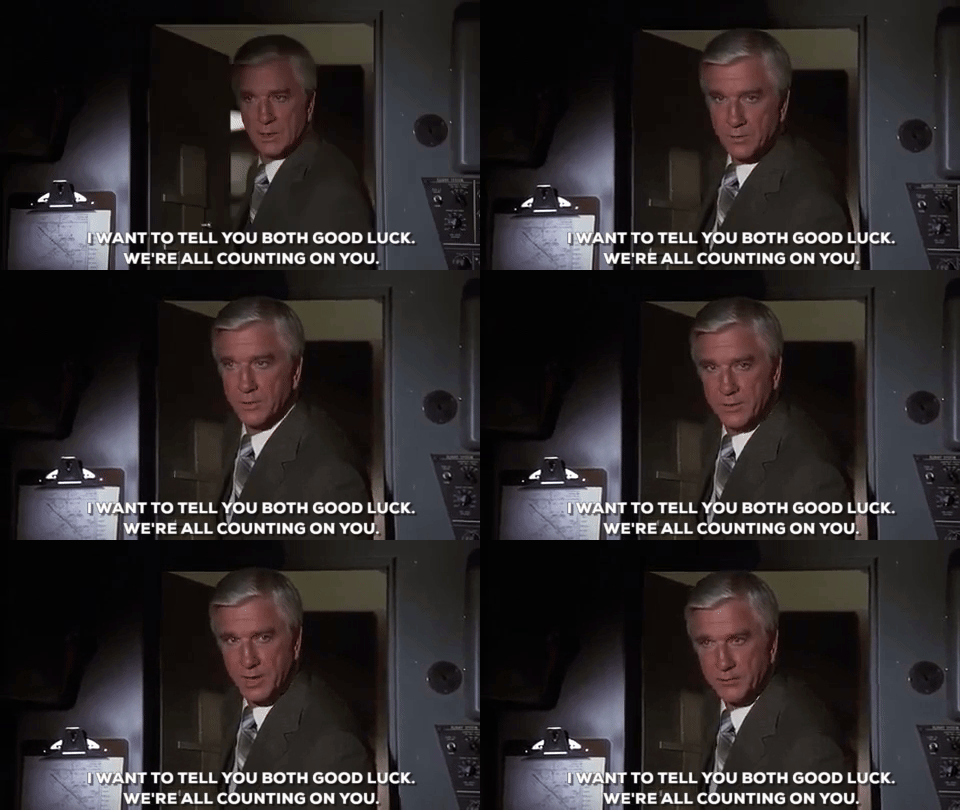
good-luck.gif


pro soccer, us soccer, youth soccer

U.S. Soccer coaching education: One foot forward, one foot firmly stuck in the mud

U.S. Soccer just unveiled its new grassroots coaching modules for 7v7, 9v9 and 11v11, making it much easier for parent coaches to learn what they need to know for working with players who will go on to become elite players, travel players, adult rec players, youth coaches and fans. It’s an important —

… What? Something else happened?

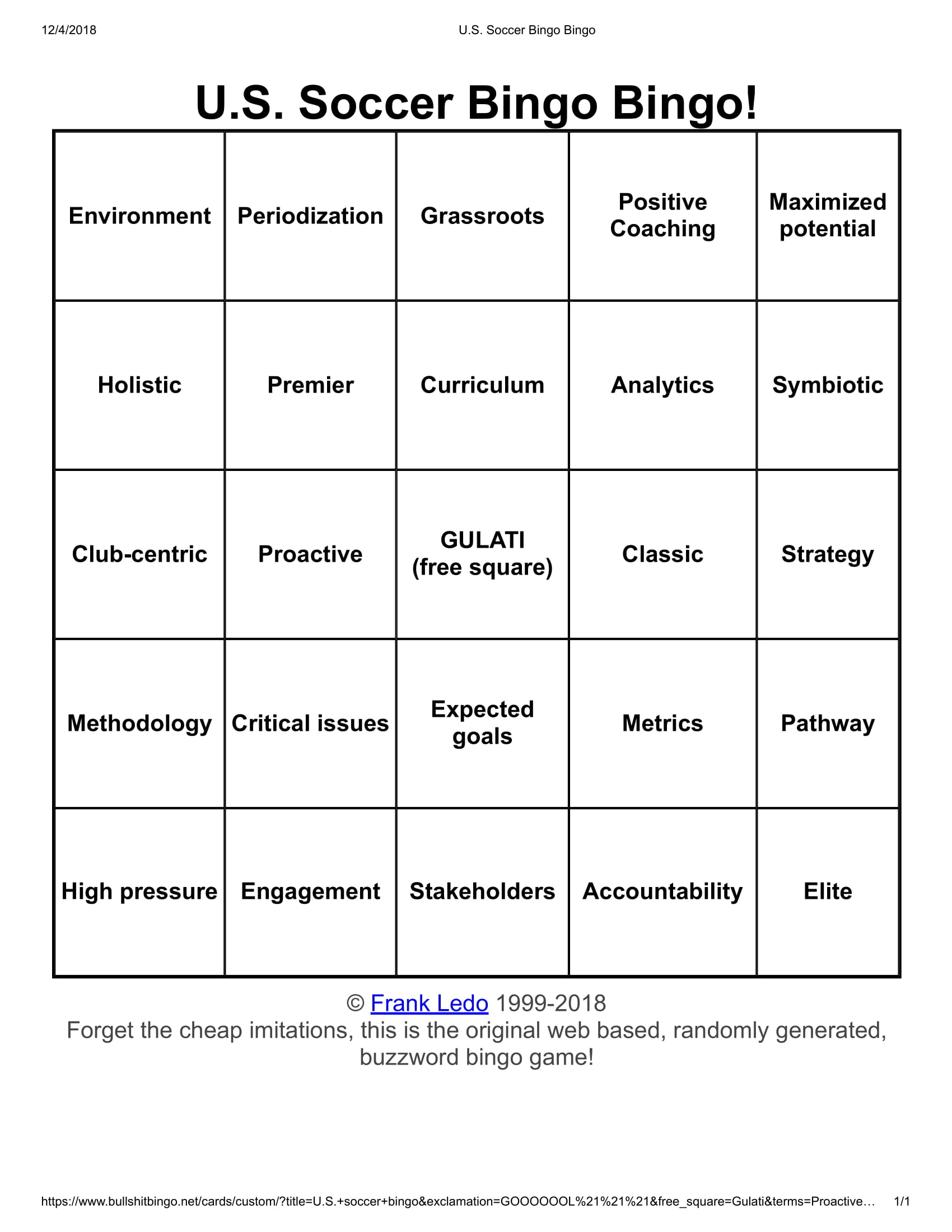
OK, let’s get back to those coaching modules. They’re worth discussing. But what you may have heard about was the first of two Soccer America interviews with U.S. Soccer technical people about coaching education and youth development. The interview didn’t have any specific quote saying, “Hey, Latinos aren’t interested in doing coaching education,” but the USSF’s bureaucratic language certainly came across as a little dismissive. Something along the lines of “mission vision proactive hey they’re just not signing up assets leverage activation.”

Herculez Gomez, the retired MLS/Liga MX player now doing commentary (including an excellent podcast with Max Bretos) for ESPN, pounced on Twitter.

One of the many great things Gomez is doing these days is following up on his initial reaction. U.S. Soccer offered up conversations with the people in this interview, Nico Romeijn and Ryan Mooney, and Gomez reported on the conversation on the Aug. 20 Max and Herc podcast.

Romeijn and Mooney clarified and apologized, and Gomez seemed to be satisfied that they didn’t intend to slight any persons of color. That’s not to say USSF’s outreach is as good as it could or should be, and diversity efforts will always require watchdogs.

In any case, the conversation shed light on several other issues, many of them at least indirectly related to diversity.

First: Cost. Excluding travel, which is going to be a significant cost in itself, someone moving up the coaching ranks will pay (according to Gomez — I’ve contacted USSF to confirm, and they did):

  • C license: $2,000
  • B license: $3,000
  • A license: $4,000
  • Pro license: $10,000.

Yikes.

Now, in fairness, if you’re working for a half-decent professional club or the federation itself, your club will pick up the check. We’d hope. But if you’re trying to break through to those ranks, well …

Second: Difficulty getting pros involved. Here’s where the MLS union got involved …

MLS Players Union executive director Bob Foose will be talking about that with Glenn Crooks on SiriusXM’s The Coaching Academy on Wednesday.

The good news: The NWSL has taken steps to get its players a good headstart on this path. Details are confidential, and any dissatisfied players should certainly feel free to contact me, but it seems promising.

The Max and Herc discussion took a couple of wrong turns. Gomez was surprised U.S. Soccer didn’t have data on the number of minority coaches taking their classes, saying all employers should have that data. But people don’t take coaching courses to be employed by the federation (excluding Development Academy jobs). They take them to be hired by youth clubs. In some cases, up through the D and maybe even C licenses, they take them to be volunteers. That sounds extreme, but in other countries, you’ll find B-license volunteers. All that said, perhaps U.S. Soccer will consider gathering such info in the future, not because of employment law but because it’s simply a good metric to see how their outreach efforts are faring.

Also, Max and Herc seemed surprised that the federation hired Belgian consulting firm Double PASS. That’s definitely not breaking news.

But the discussion did indeed get a much-needed push forward. And it’s clear from the Soccer America interviews — first with Romeijn and Mooney, then with Jared Micklos of the Development Academy — that we’re still not getting much by way of illuminating conversation from people in Chicago. They’ll tout their new training center’s central location in Kansas City, which is indeed a vital asset if all their prospective coaches are traveling by horseback.

And yet, somehow, progress is being made.

The new “grassroots” modules will never get the attention that the Gomez/MLSPA tweetstorm got. That’s understandable. But they’re giving coaches a good way to get started, and they’re giving parent coaches — usually the first coaches a player will encounter — much firmer footing than in the past.

Sure, I still miss the old F license video series. The new grassroots series, though, is better than the old E and D license.

In the old path, the older the kids you were coaching, the higher the license. So, in theory, you needed a D license just to coach rec soccer from U13 on up. Now we can take the corresponding grassroots class, which is (A) less of a time imposition, (B) can be taken online and (C) presents a new practice approach that is already making my life easier.

The approach is “Play / Practice / Play.” As kids show up to practice, you get them playing small-sided games. (Pause to have them do some dynamic stretching once they’ve warmed up a bit.) Then do a half-field activity — 7v7, 8v6, etc. Then a scrimmage. The biggest difference from practice to practice isn’t so much the “drill” you’re attempting as it is the coaching points you make during each practice.

This is an improvement over the “Warmup with a drill that takes a little bit of time to explain / Small-Sided Game that takes a little bit more time to explain / Expanded Small-Sided Game that’s ridiculously complicated and will never be explained over the course of this practice / Scrimmage” approach, in which we were all supposed to develop practice plans like we’re Fabiano Caruana prepping to face Magnus Carlsen for the world chess championship in November.

It’s certainly not perfect. For one thing, United Soccer Coaches’ Soccer Journal seems like a relic now — it’s full of all the triangles, circles and squiggly lines that take us 10 minutes to understand and half of a practice to explain to our kids. (I did like the “secret goals” exercise in the preseason issue, where each side has to do something before scoring — possibly a cross, possibly a certain number of passes — but the other team doesn’t know what the opponent’s restriction is.)

The bigger issue for many (see “Rondos, The War On”) is the insistence that everything has to “game-like.” And it’s a slippery definition. Having the defense try to clear the ball to any one of three “counter goals” is game-like. Having a neutral player is not.

And the jargon is mind-numbing. We have four “moments” of a game — attack, lose the ball, defend, win the ball. So can you come up with a practice that prepares you for … losing the ball? (Don’t even get me started on the “six tasks of a coach,” which include “Leading the player,” “Leading the team” and the redundant “Leadership.”)

But if you can cut through that, you’ll find something quite useful. The video examples in the 11v11 online course are terrific.

So maybe we could sneak an editor into Soccer House to translate bureaucratic talk to plain English?


podcast, us soccer, women's soccer

New podcast, new T-shirt

The feedback I’ve received on the T-shirts is that everyone loves the “three minivans” badge.

minivans-shirtSo the new T-shirt emphasizes that badge. The RSD banner is moved, and the “TRAVEL SUCKER” logo becomes a small badge.

Take a look and get your shirt now.

Also new …

I’m going to do fewer hourlong podcast interviews. Instead, I’m going to do two different sorts of podcasts:

The big ones: Multipart, multivoice series on a particular topic, akin to the great “American Fiasco” series.

The small ones: Short podcasts covering a couple of topics.

This week, it’s the latter. Give it a listen.

The three topics this week are:

  1. We have a new U.S. Youth Soccer chairman. What does that mean for U.S. Soccer?
  2. On women’s soccer broadcasts, could we show a variety of aspirational archetypes, not just soccer players?
  3. What’s new at Ranting Soccer Dad.


pro soccer, us soccer

USL spending and a new D2 idea

At SocTakes, Nipun Chopra has done a deep dive into USL spending, which has really ramped up over the last decade.

You could say that’s a strong rebuttal to the notion that people are unwilling to spend money on lower-division clubs that have no pathway to the upper divisions unless they have a spare couple hundred million to spend. But it’s not that simple, and Nipun suggests we could be looking at another USL bubble as we had in the late 90s. (He actually uses the analogy of a Shepard tone, which is brilliant.)

The figure that stands out: Player salaries per team are somewhere in the $250,000-$500,000 range. That’s maybe $10,000-$20,000 per player. More likely — a few players are making a living range while a lot of others are filler.

In the grand scheme of things, I’ll always argue that I’m more concerned about women’s national team pool players barely making $10,000 in the NWSL, and I’d love to know why all these owners are more willing to spend this kind of money on the 21st through 40th best men’s teams in the United States instead of the top 10 women’s teams. Doesn’t make a lot of sense to me.

But let’s see if we can make things a bit better for the men. If the NASL had one legitimate point, it was the idea that the Cosmos and a couple of other teams (look, if you’re going to say MLS operations with sprawling youth programs aren’t “clubs,” then I’m not going to call Miami FC a “club,” either) were able to pay a bit more. I’m not going to say “what they deserve” because, for the umpteenth time, I’m not going to weep for Danny Szetela wrapping up his professional career after 15 years and 100 chances while Tori Huster and other potential *World Cup players* have to play the offseason in Australia and risk overuse injuries just to keep playing into their mid-20s.

Sorry … sorry … you can tell this sort of nonsense is difficult to swallow. But anyway …

Paradoxically, I think we can create more high-paying jobs for non-MLS players if we have fewer Division 2 teams. Here’s how:

  • Let D2 teams be freed from whatever central management the USL is imposing. You may need a salary cap (I actually prefer the luxury-tax model) to keep at least a little bit of parity, but put it really high — say, $1.5 million for a luxury tax or $2 million for a cap. That might actually convince NASL holdouts to come over and play. (If Commisso and Silva don’t like it, fine. Sell the teams.)
  • Everyone else drops to D3, which would retain a stronger central league management.

What we’re headed toward now doesn’t make a lot of sense. Thirty-some D2 teams and barely eight D3 teams? Let’s leave the inverted pyramid to journalists, shall we?

So we might have, say, 16 teams playing D2. Top of my head, drawing heavily from an attendance chart and some belief in markets that deserve better (St. Louis, for instance) — Cosmos, Miami FC, Jacksonville, North Carolina, Sacramento, Indy, Louisville, Las Vegas, San Antonio, Las Vegas, Phoenix, Tampa Bay, St. Louis, Oklahoma City.

That’s 14. I’m not sure USL stalwarts Richmond, Charleston and Pittsburgh would want to spend that much.

Yes, you in the back? You have a question? Let me guess — what about promotion/relegation?

I think it’s feasible here. Start D2 with the 14 clubs (and yes, some of them are clubs — look at the Richmond Kickers and tell me otherwise) and two others.

You’d need some caveats. If the Kickers, who have opted on multiple occasions not to go big-time, don’t want to go up, don’t force them. But if the top two teams in D3 think they’re ready to try D2, go for it. Perhaps those teams would include an MLS reserve side — the USA certainly wouldn’t be the only country with reserve sides on these tiers of a functional pyramid.

And you might need some bolsters for relegated teams. If they have academies, perhaps they should have a specially designated parachute payment to keep those academies running. (I still can’t believe someone related to the Cosmos once mocked such a suggestion with a Helen Lovejoy-esque “Think of the children!” motif. If we’re not trying to develop young players, what the hell are we doing? Let’s just shut it all down and watch the EPL on TV.)

Perhaps then we could see the following steps:

  • NPSL-Pro and NISA join up with this model to give us even more D3 fun.
  • A top-tier amateur division, which could officially D4, has promotion opportunities to D3. (I don’t think relegation from D3 to D4 is necessary or advisable unless we have hundreds of clubs at D3 — at this stage in the USA’s development, it makes no sense whatsoever to bump a pro club with an academy of any sort down to an amateur league.)
  • Then, yes, perhaps pro/rel between D1 and D2.

The latter would have some criteria involved. Not just the usual “pile of money to ensure club doesn’t fold midseason” but also stringent academy criteria such as the ones Germany imposed.

And a women’s pro team. So many we can finally start paying Tori Huster what she deserves as a nice side benefit to giving a few hundred more guys a chance to earn a living in this game.