podcast, pro soccer, youth soccer

RSD15: The clogged youth-to-pro pipeline, with Brian Dunseth and Chris Keem

Was Nik Besagno a warning sign?

The top pick in the 2005 MLS Draft — ahead of Brad Guzan, Michael Parkhurst, Will John, Chris Rolfe, Bobby Boswell, Chris Wondolowski and Jeff Larentowicz — had a very short MLS career. Perhaps not coincidentally, that’s when people started to wonder if the U17 residency in Bradenton was producing soft, coddled players.

Yes, the youth-to-pro pipeline is at the core of our national wailing and gnashing of teeth after the U.S. men failed to qualify for the World Cup. It’s a topic so big, we need two guests.

First up, player-turned-commentator Brian Dunseth talks about what happened in Trinidad (3:30), Olympic soccer and how much it hurt the men to miss out (5:00), losing players from youth soccer (9:40), the parental perspective when clubs start demanding your money (11:20), the importance of failure (17:00), whether players are too soft or coddled (20:15), MLS (27:15 and 33:10), coaching education (28:15), relegation from a player’s perspective (35:45), the Development Academy (39:45), and an easy solution to all of this (40:10). Then concussions (44:30).

Then it’s Chris Keem, a veteran youth soccer coach and administrator with experience in college and the NPSL as well, joins us around the 50-minute mark. We start out talking about turf wars and how they drive up prices in youth soccer, then move into dealing with the Development Academy when you’re running another youth club (53:45), addressing “pay to play” and how it works in other countries (58:00), getting a club’s coaches on the same page and poaching vs. development (1:04:30), what the NPSL was and what it wants to be (1:06:00), and why youth players may opt for other sports (1:17:30).


pro soccer, youth soccer

Here’s what WON’T help U.S. Soccer

snake-oil“That’s right, folks! Step right up and get your miracle elixir! Cures everything from chronic flatulence to an inability to qualify for the World Cup or Olympics from CONCACAF!”

Doesn’t work that way. The problems have deeper roots. A dash of snake oil isn’t going to make the U.S. men’s team (or women’s, which has some similar issues and some very different) magically better.

Among the pet programs that won’t make the USA follow France’s path from qualifying failure to World Cup champion in four years:

Ramping up “pressure”: Consider how Trinidad and Tobago played in their cozy, bumpy stadium with the soothing hum of generators or pumps or whatever created what little “atmosphere” existed last night. They were loose. They were having fun. Only Christian Pulisic, who’s too young to have been through the battles of his teammates, played with any flair to match what the home side brought to the marshland of Ato Boldon Stadium.

If anything, the U.S. players seemed too tightly wound. Michael Bradley, the captain, was raised in a family that lives for competitive pressure. Jozy Altidore has dealt with the wrath of the global soccer media in the midst of a relegation fight, and yet he was probably a lot better before all that, back in the 2009 Confederations Cup and World Cup qualifying that year.

Which brings us to this …

Promotion/relegation: I dealt with this in the pro/rel series. Pro/rel doesn’t magically turn every club into Barcelona. It doesn’t make clubs run awesome academies — in fact, you might end up with some major gaps as major cities’ clubs lose Division 1 status and have to cut funding.

And can we cut the nonsense that players in MLS clubs aren’t playing for their jobs? North America is littered with MLS washouts. (Some of whom turn around and score against the USA in CONCACAF play.)

Dismantling MLS: The league needs improvement, sure. But it’s worth noting that the goals that eliminated the USA — from Panama and Honduras — came from guys with plenty of MLS experience.

Costa Rica is going back to the World Cup. MLS players scored 11 of their 14 goals in the Hexagonal.

And the oft-derided MLS-USL partnership has created an alternate pathway to the oft-derided college game. Go to an MLS academy. If you’re ready to go pro at age 17 or 18 but not quite ready for the first team, play for the reserves in USL. Then up to MLS.

Clubs have made these investments because they’re financially secure. They feel confident that they’ll be in the top division for the foreseeable future. Any change to that structure needs to be made very carefully.

Let’s put it this way: If you dismantle MLS, you’re also dismantling most of the free academies that exist in this country. How is that supposed to help?

Having the “passion” to hurl rotten fruit at players when they return: Sure, let’s make the notion of being a professional and international soccer player less attractive in a country that has a ton of sports options. That’ll work.

Along those lines …

Telling people how to live their lives: Remember when everyone was telling Landon Donovan to abandon his family and move to Europe for our own satisfaction?

Two issues with that:

  1. That’s not going to inspire future athletes to devote themselves to soccer and international play.
  2. Couldn’t the U.S. men have used a Landon Donovan last night, no matter how many years he spent in MLS instead of the Bundesliga?

Hiring a savior: One guy isn’t going to turn around the men’s national team, let alone change the entire culture in this country. Jurgen Klinsmann had no idea how to change youth soccer other than the vague imposition of things he knew as a child in Germany.

The people working to change the culture are working at the U.S. Soccer Foundation (different from the federation) and other organizations trying to make the sport more accessible.

Turning the sport into a job for which only the elites may apply: Eastern Europe in the Cold War had a bunch of sports machines that culled the top sports talent at an early age and herded them into camps. Brazil and other countries thrive on street soccer. Which group has had more success?

Reading too much into one World Cup, either 2002 or 2018: Was Bruce Arena a genius in 2002? Somewhat, but it helped that Portugal collapsed and the ref didn’t notice John O’Brien’s handball against Mexico. Was he suddenly an idiot in 2018? Somewhat, but it helped that Panama scored a phantom goal and Honduras (and T&T) got a couple of flukes.

Wins amplify good decisions. Losses amplify bad ones.

* * * *

Here’s what WILL help:

“Incremental changes at multiple levels”:

Reducing the “travel” in travel soccer: Even if you have tons of scholarship money, explain to me how a kid with two working parents who don’t control their own schedule are going to get that kid to every practice and game all over a five-state region?

Related to that …

Ending the turf wars: We have an arms race. Club A is in the Development Academy, so Club B has to be in the ECNL. Then Club C has to travel to multiple showcases everywhere from Disney World to that massive soccerplex in Indiana that’s hosting everything these days.

Remembering that we’re still competing for players and fans: Quit telling 9-year-olds that the stuff they’re doing now will pay off when they’re 16-year-old pros. Quit pretending we can drive people out of the sport as children and expect them to be paying customers when they grow up.

If soccer was so deeply ingrained in the USA that we would put up with all this, fine. The truth is that we’re still fighting attitudes like this:

And that is a Democratic Congressman. His voters surely include a lot of immigrants and a lot of soccer fans. And yet he feels secure in bashing soccer. In 2017.

Education: I’ve had the chance to see more than 100 paid coaches at the U9-U12 level. Maybe 20 of them are people I’d be happy to have coaching my kids. Another 20 or so seemed OK. The rest are screamers, joystick coaches and assorted cretins.

I’ve also worked with about 100 parent coaches. Some of them are trying to learn what they can and apply what they’ve learned. Some can’t be bothered to do the two-hour online F license.

Listen: Everyone’s talking and no one’s listening. Not just on Twitter. Also in Chicago, where the most basic questions about the Development Academy or anything else get brushed off and ridiculed.

The USA has a lot of smart people. Not just one, not just a small group. And as Steve Gans found on his “listening tour” before declaring his candidacy for the U.S. Soccer presidency, they’re not being heard.

Maybe we should all do a listening tour.

And then keep some perspective. No one died here. That’s happening in Puerto Rico, Las Vegas and California. We’re talking about a sport, one in which the better team doesn’t always win. The USA probably wasn’t one of the top eight teams in 2002, and they probably aren’t outside the top 32 right now.

Let’s not set up an East German-style sports machine. Let’s not take the fun out of this sport and assume good athletes are going to want to play anyway.

Embrace diversity — in all senses. Embrace accessibility. Calm down and think.

And then we can do the same thing next year when the women don’t qualify for France 2019.
podcast, women's soccer, youth soccer

Spirit season recap and a post-Vegas anti-cynicism rant

In the wake of the Las Vegas massacre, the Ranting Soccer Dad podcast opens with a few thoughts on why we shouldn’t give up on changing people and society as a whole, either on something relatively trivial like youth soccer or something horrifying like one man’s ability to assemble the weapons to wound 500 people. Maybe we need a little less competition and a little more cooperation to make the changes we need?

Also, a quick recap of the Washington Spirit’s season, in which the team fell from being 30 seconds away from a league championship to last place. Includes postgame comments from Spirit coach Jim Gabarra and the team’s star attacking player, Mallory Pugh.

(Apologies for the drop in volume during the Pugh interview. Also, if you can’t hear Gabarra’s last two words, they’re “No comment.”)

(Featured image from Flickr)

podcast, youth soccer

Is youth soccer doomed to suck?

Flying solo on Ranting Soccer Dad this week and wondering whether there’s any way youth soccer can be a positive experience. Making an inherently zero-sum game (winners and losers) a good experience is a challenge, and from what I’ve seen, U.S. Soccer and today’s youth coaches aren’t up to it.

Convince me otherwise.

podcast, youth soccer

How do we raise soft, tattooed millionaires? Alexi Lalas on RSD

Alexi Lalas is a Soccer Hall of Famer. He’s also an entertainer, with interests in music as well as riling people up from a soccer broadcast studio. So when he rips the U.S. men’s national team as “soft, tattooed millionaires,” he’s drawing on both backgrounds.

In our conversation, Lalas explains that “tattooed millionaires” came from a solo release by Iron Maiden lead singer Bruce Dickinson (no, not the “More Cowbell” guy on SNL), and then we talk about whether everything from the now-defunct Bradenton residency program to the Development Academy is giving us a generation of coddled, entitled men’s soccer players.

We also talk about specialization, playing in multiple soccer environments (i.e., not just in the Development Academy), high school/college soccer, the Apollo Theater, diversity of playing styles, Michael Bradley’s understanding of livestock, and Brad Friedel playing basketball.

podcast, women's soccer, youth soccer

Podcast, Ep. 10 – Ronnie Woodard on women in coaching, youth soccer madness


Tennessee Soccer Club’s Ronnie Woodard is a legit women’s soccer pioneer — first scholarship player and goalkeeper at Duke, one of the first wave of women’s soccer players to move into the coaching ranks. She has coached college and elite youth teams, winning 2016 NSCAA Coach of the Year honors, while launching a consulting business for college prospects.

We talk about what’s keeping women out of coaching (10:20 mark) and what’s better or worse in youth soccer today (25:00). Then I rant about my youth soccer weekend (coach ejected!) and some upcoming Ranting Soccer Dad programming.


youth soccer

What if … colleges de-emphasized sports?

At the Project Play summit yesterday, we all fretted the state of sports in the USA, as Project Play folks are inclined to do.

The basic problem: “Youth sports” in the USA is less and less about getting out and playing — with all the benefits of being active, being part of a team, etc. — and more and more a means to an end.

Sometimes, the “end” is a pro career or something “shiny,” as Olympic hockey gold medalist Angela Ruggiero put it. She was part of a lively panel that also included NFL punter-turned-entrepreneur Chris Kluwe, who framed the discussion in progressive politics: Maybe if parents felt economically secure and didn’t feel the need to chase scholarships and athletic riches, they’d just let their kids … play.

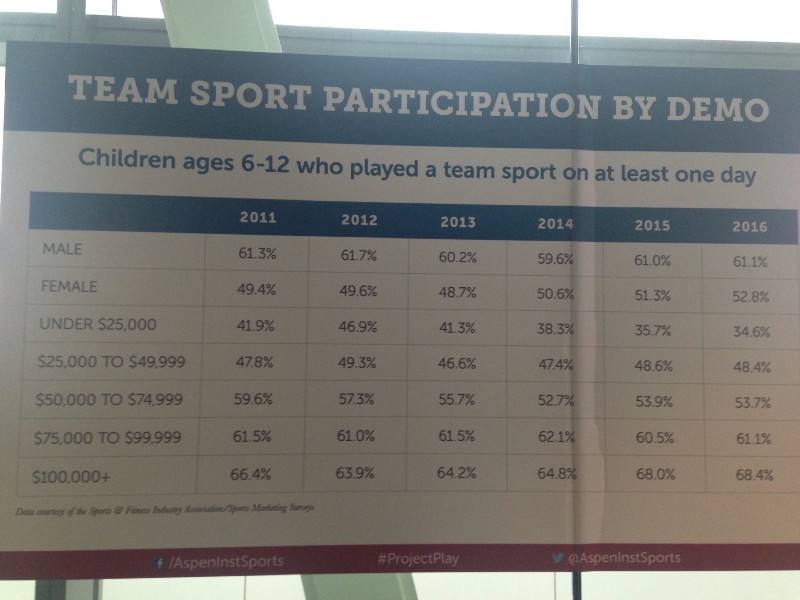
They’re right, and yet there’s something else at play here. See the picture here?

Whose kids are getting out and playing sports? Right. The rich folks.

“Wait a minute,” you might think. “These are the people who can afford college for their kids, and their kids will generally have a sound financial and educational foundation from which they can pursue a multitude of careers. Why would they be caught up in a chase for scholarships?”

Here’s a twist that has stuck into my head since joining the parenting community (otherwise known as “having kids,” which makes you pay more attention to such things): It’s not necessarily about the scholarship. It’s about getting into one’s chosen college in the first place.

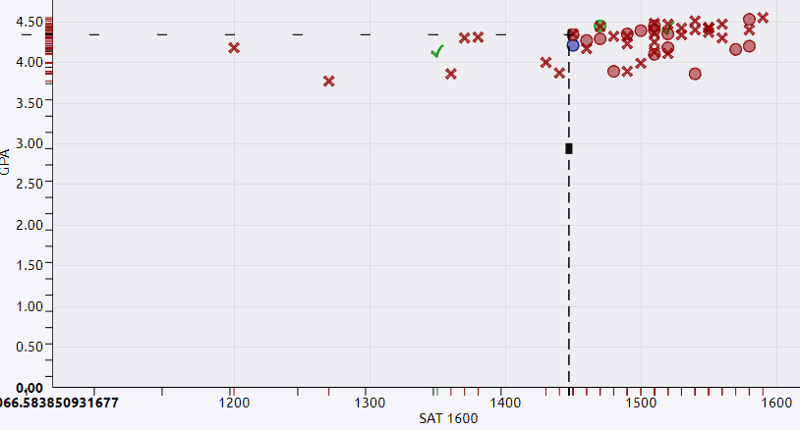
That’s not new. I have a story about puzzling college admissions from my high school, and I’m sure everyone else does, too. But in this technological age, we now get semi-private websites with scattergrams that show us the GPAs and SATs of people who get into School X or School Y. It’s not difficult to spot the athletes.

Division 3 school (no athletic scholarships). Maybe it was a really good essay?

I’ll have to toss in the disclaimer here: I seriously doubt any of my kids will be recruited college athletes. I blame their U-8 soccer coach. Which would be me.

But the point here is this: Sports are seen, with considerable justification, as a way of getting into a good school. Little wonder the Ivy League schools, which don’t offer athletic scholarships, more than hold their own in terms of overall sports performance.

We can argue about whether this emphasis on sports is a good thing for U.S. academic life. The question here: Is it good for sports?

The positives: American colleges promote healthy lifestyles. They build nice facilities for the general student body as well as the student-athletes. It’s the old Greek ideal — classroom in the morning, gymnasium in the afternoon.

The negatives: Youth sports are no longer about the love of the game. They’re about getting ahead and making sure you’re part of the elite. If you’re not, there’s no place for you.

And when you squeeze a sport at the grass roots, it can hurt the elite levels — especially in soccer, where the big problem we all see is a lack of access for lower-income families. No one becomes an elite player if they never have the opportunity to play.

So would we be better off — at the recreational level and the elite level — if youth players could just play without worrying about how their game will affect their chances of getting into Duke, Virginia, Princeton or a good D3 school?

podcast, women's soccer, youth soccer

Podcast, Ep. 9 — Girls’ Development Academy with Travis Clark, plus a soccerpolitical rant

The podcast starts this week with a bit of a political rant. The news on DACA is hard to ignore, and we’ve had some ongoing overheated arguments in the soccer community.

The Travis Clark interview on the Development Academy starts around the 9:25 mark. A few landmarks:

  • Will the NWSL affiliates dominate? (19:45)
  • DA vs. high school (25:00)
  • Can we tame the chaos and still have multiple development pathways? (30:30)
  • A few clubs to watch in the DA (38:45)

podcast, women's soccer, youth soccer

Podcast, Ep. 8 — Youth development and women’s soccer with Kris Ward

Kris Ward has done a bit of everything in coaching at a relatively young age — high school, Development Academy, ODP, college, traditional clubs and NWSL. We talk about rec soccer, how the U.S. academy approach compares with other countries and what a curriculum really means.

Around the 40:30 mark, get ready for a detailed breakdown of all that isn’t working in U.S. women’s soccer.

podcast, youth soccer

Podcast, Ep. 7 — Smarter soccer parents with Skye Eddy Bruce

With all due respect to DJ Jazzy Jeff and the Fresh Prince (now known as Will Smith), sometimes parents DO understand.

Skye Eddy Bruce, an experienced player and coach, is now working to help parents understand youth soccer and then advocate for their kids. Throughout this interview, she and I talk about empowering parents. (And educating them — the idea isn’t to have ignorant parents berating coaches all over the country.) We don’t need to let coaches push winning over development, and we don’t need to sign up for the league that travels all over creation.

A few highlights:

2:15 About the Soccer Parenting Association — seeking to elevate the game with a focus on educating, engaging, supporting and advocating for youth soccer parents. And Bruce’s bio — including playing in Italy!

5:15 The stereotype of ignorant parents and how it’s changing. Includes a reference to this video:

12:55 Bringing up Bobby Warshaw’s concern about balancing “being a good person” with “being a good player.”

15:55 Putting too much of an emphasis on winning can drive kids away.

19:45 The true purpose of youth soccer

20:35 The proliferation of “elite leagues.”

28:20 The need to standardize our language — what does “elite” mean? Or “classic” or anything else?

33:35 Down with specialization! (At least, parents should be able to say that.)