youth soccer

A U.S. youth soccer reform update (FourFourTwo piece and beyond)

My FourFourTwo piece from yesterday gave a multi-part plan for rescuing youth soccer from the pit of despair or some other dreary place of your choosing, and it features input from Kyle Martino, Kevin Payne and two U.S. Soccer officials.

The intro:

“Promote a more unified Youth Soccer landscape where our members—rather than fighting each other for players—work together to bring more young people into our ranks as registered players and where we focus on Youth Soccer less as a business and more as a way to develop talent on the field and nurture our next generation of young adults.”

So read the platform of Carlos Cordeiro in his successful campaign for the U.S. Soccer presidency.

Cordeiro has spent the first four months of his presidency traveling the world on behalf of the ultimately successful USA/Canada/Mexico World Cup bid. In the meantime, youth soccer has progressed from a moderate level of chaos to a full-fledged tropical storm mixed with a Nor’easter mixed with Memorial Day beach traffic.

This piece had a long gestation period, but the timing is good. The World Cup bid effort is finished. Now it’s time for Cordeiro to look at the rest of his agenda. His platform has plenty of ideas that look good on paper — I didn’t recall any other candidates arguing against diversity, stronger adult leagues, etc. — but will require some effort to translate into reality.

But with all due respect to the other issues on that platform, youth soccer needs to be his first priority. (The transparency/diversity issues should be addressed concurrently, and other issues certainly shouldn’t be forgotten. Hopefully we can drop the nonsensical idea that Cordeiro’s next priority needs to be rescuing the NASL. We have a functioning Division 1 league and a functioning Division 2 league. If Cordeiro is going to devote a second of his time to any pro league in the next two years, it should be the NWSL. Period.)

One of my goals here is to keep asking questions and providing analysis. The outlets through which I can do so are dwindling. This sort of thing is a little too esoteric for The Athletic — and besides, I need to reach parents.

So I’m going to be working hard over the next few months to build Ranting Soccer Dad into a substantial brand. You can help on Patreon if you like (I’m going to make magnets and T-shirts!), but anything you can do to share my work would be appreciated. Especially if you can share it with parents. Maybe not parents who sit and watch every World Cup game like you do, but any parents looking for a good youth soccer experience.

At some point soon, I need to write about the next contested election. U.S. Youth Soccer holds its Annual General Meeting on July 28, and I know of at least one challenger to incumbent chairman (and USSF Board member) Jesse Harrell.


podcast, women's soccer, youth soccer

RSD36: Player pathways, college and elite leagues, with Lesle Gallimore

Lesle Gallimore has been head women’s soccer coach at the University of Washington since 1994, and she’s the current president of United Soccer Coaches.

In this conversation, we talk about how college coaches adapt their recruiting to the new “elite league turf war” environment. And we talk about how players adapt and whether they *can* adapt.

For example: Could Gallimore’s most famous player, Hope Solo, work her way through the system today and be discovered?

Coincidentally, Solo made a lot of news this week, and I discuss that before the interview (which was recorded before all that news happened). The Gallimore interview starts around the 10-minute mark.

pro soccer, us soccer, youth soccer

When will the soccer “change” movement get serious?

This will start out on a personal level, but bear with me — it’ll get to big-picture stuff. And we’ll talk about the desperate need to change a few things in U.S. soccer and at U.S. Soccer.

I think the state of the soccer “change” movement can be summed up (pardon the SUM pun) in three conversations I had this weekend and another one in which I did not participate.

One: Someone on Twitter was surprised to learn I am not paid by MLS or SUM.

This person apologized.

I asked why he made the assumption in the first place.

“Likely because I’ve seen folks attribute that to you on Twitter.”

Not the first time I’ve had a conversation that follows this path:

  • Person attacks me, thinking I’m a paid MLS/SUM shill who hates open systems or any criticism of MLS.
  • Person learns I am none of those things and that I’ve actually put forth several plans to work toward promotion/relegation (or, failing that, a wide-open “Division 1”), few of which have gained any traction because everyone’s so firmly entrenched these days. (Some on Twitter insist pro/rel is all or nothing, which will come as a great surprise to people in the Netherlands, where they can’t seem to open a full gateway between the second and third tiers. Maybe that’s why they didn’t make the World Cup, either.)
  • Decent conversation ensues.

For those of you who are new, here’s my restatement of facts (skip to the next bold type if you know all this):

  • The only time I was ever paid by an MLS/SUM affiliate was when I wrote fantasy soccer columns for MLSNet, the forerunner of MLSSoccer.com that was run by a different company. They also hired Eric Wynalda, who suffers no accusations of being an MLS shill today though he wrote far more than I did. (And used to play for the league. Him, not me. Obviously. I played U14 and beer league.)
  • Yes, I wrote a book called Long-Range Goals: The Success Story of Major League Soccer. I was iffy on that subtitle at first but agreed to it because the standard at that time was survival. I would agree that it’s fair to set a higher standard for “success” today. MLS gave me access but paid me nothing. The book is old now and barely sells, so whatever MLS does next isn’t likely to affect my bottom line. (Maybe I’d write a sequel if something substantial changes, which means my self-interest would be in change, not the status quo.)
  • I am not personally against promotion/relegation. As a fan, I’ve enjoyed pro/rel drama since I was an elementary schooler watching Soccer Made In Germany. As a journalist, I’ve simply found occasion to explain why it hasn’t happened so far. I believe it’ll happen when the marketplace is ready for it, and I believe calamity will ensue if any entity tries to force it to happen in a way that harms MLS while its teams are investing in facilities and academies.
  • Summing up (again, sorry for the pun): I have absolutely no interest, financial or otherwise, in the status quo.
  • The fact that people claim otherwise about me should make you very suspicious of those people’s motives.

newsletter

Two: Respected people in soccer continue to associate with and even amplify anonymous Twitter accounts that regularly slander people. 

I’ve actually learned who runs one such account. Not a well-known name, but it’s hilarious that it’s someone who has played and coached for “Christian” schools. I guess they’re soft on that whole “bearing false witness” thing, though the school’s site does say good people of the Bible should not engage in “profanity” and “lying.” They list those two right before “homosexual behavior.”

When I spoke with a particular supporter of such accounts, someone I certainly respect, I got a deflection to a conspiracy theory involving Kyle Martino.

Which was far from the strangest thing I heard along those line this weekend …

Three: Someone in a position of responsibility in U.S. soccer (not the Federation) lumped together most of the presidential candidates and a few other folks into a conspiracy theory.

This theory — again, offered by someone in a position of power whose actions certainly affect others — included the following people:

  • Sunil Gulati (no surprise)
  • Don Garber (also)
  • Kathy Carter (yeah, OK)
  • Kyle Martino (again, not the first to say that)
  • Merritt Paulson (MLS/NWSL owner, OK)
  • Grant Wahl (SI writer — stretching here)
  • Steve Gans (wait … what?)
  • Hope Solo (whoa … seriously?)
  • Eric Wynalda (OK, hold on here …)

I asked for proof. I was told this person had been advised not to offer proof at this time.

But this person, apparently in an effort to demonstrate insider knowledge, pointed out to me that he/she said back in December how everything was a setup.

For Kathy Carter.

Who didn’t win.

Four: The conversation in which I didn’t participate involved the consternation that Rocco Commisso was unable to get an audience with U.S. Soccer for his “proposal.”

Hey, it’s tough to get an audience with U.S. Soccer. Much tougher than it should be. Believe me, I feel your pain. I won’t go into details here, but I’m starting to think it’d be easier to get an interview with Prince that it would be to get some specific information I’m seeking now. And yes, I’m aware that Prince has passed away. (Dammit.)

But when NY Cosmos owner Rocco Commisso told U.S. Soccer he wanted a meeting to discuss a possible $250 million investment (expandable to $500 million when others join in) if they let him have 10 years to build up the NASL, the response should’ve been the following …

Dear Mr. Commisso,

Thank you for your letter. Unfortunately, we are not able to discuss anything involving the NASL or the Pro League Standards while we are engaged in legal action, some of which you initiated, on each of those entities.

If you would like to make a significant investment in an existing league (NPSL, USL, UPSL) or a newly proposed league (NISA), you are welcome to discuss the matter with those leagues.

Unfortunately, U.S. Soccer dragged this along, letting Commisso and his apologists dictate the narrative.

Which brings us to an important point …

federation

The Federation needs change. 

When the U.S. Soccer delegates who had just elected Carlos Cordeiro left the room in Orlando a few months ago, the path forward for changing the federation seemed clear.

Voters had rejected the anointed MLS/SUM candidate, Kathy Carter, in favor of someone who masterfully claimed the “outsider, but with experience and willingness to delegate to experts” ground. A few delegates spoke from the floor, urging the “change” candidates to stay involved. The soccer community was plugged into all the issues on all levels — youth, adult, pro, even a few words about the oft-neglected Paralympic, futsal and beach soccer sectors.

Stodgy old U.S. Soccer had gotten a wakeup call. Fans demanded change after missing the men’s World Cup. Parental ire over misguided youth soccer mandates had finally reached the Board of Directors. Every issue was in play:

  • Accessibility for all to play youth soccer at a level determined not by their money but by their ability level.
  • Clearer pathways to identify and develop all talent.
  • Getting the NWSL to fill its long-vacant commissioner position and build up the league’s standards and wages.
  • Making coaching education affordable and available (and good)
  • Easing the tension in pro soccer and helping lower divisions grow.
  • Hey, don’t we have national teams that need general managers and/or coaches?

I’d add one issue that has popped up since the election: Figuring out the role of state associations when youth and adult leagues are crossing state lines and ODP is being devalued.

And then … it all stopped. Mostly.

We have a few exceptions. The Chattanooga summit failed to unite NPSL, NISA and UPSL, let alone all the other factions in U.S. soccer, but at least it brought a few good issues to the fore with some rational discussions. “Change” candidate Kyle Martino jumped to the board of Street Soccer USA to do some of the grassroots work he had hoped to do as president. Surely hundreds of youth coaches and administrators have been energized to do more work at the local level.

But the national discourse is firmly in the hands of a different group of people. I’m not just talking about the usual toxic stew on Twitter. That’s been around longer than Twitter itself, and it hasn’t done a bit of good. (If anything, it’s hardened attitudes against promotion/relegation from people who otherwise would’ve been ambivalent or receptive.) I’m talking about the people who actually have influence.

And what we’ve seen from a lot of camps are purely symbolic gestures. Yes, that includes Commisso’s proposal, which I’ve often called, in Seinfeld-speak, an “unvitation.” He had to know there was no way USSF would or could meet those demands, and now he gets to claim (as Silva did before him) that the Federation has turned down easy money out of sheer stubbornness. A similarly PR-related proposal came up at the Annual General Meeting — more precisely, at the USSF Board meeting the day before the National Council meeting in Orlando. John Motta proposed cutting registration fees, currently $2 per adult and $1 per youth player, in half. That wasn’t going to fly, given that many presidential candidates had their own plans in mind (evening out the fees between adults and youth players may come up again). Sure, Sunil Gulati was unnecessarily condescending in his response, but the result was never going to change.

Is there a chance that soccer’s would-be reformers are self-sabotaging? In some cases, maybe. Much of the public discourse is designed more for status (as superior thinker or as victim) than for solutions.

Perhaps that’s not a surprise. For generations, being a soccer fan in the United States has meant rebelling against the norm. We are the “other” — by choice. A lot of soccer fans are like those tedious people we 40-somethings knew in college who used to be into R.E.M. but thought they sold out with Automatic for the People.

myspace-stewie

So as soccer has grown more popular, that hipster “outsider” status is harder to achieve. And we all love victim status as well, which means we need an oppressor. Generations of soccer neglect are harder to personalize than That Guy Who Said Something You Don’t Like on Twitter. Or That Guy Who Had More Impact in the USSF Presidential Election Than You’d Like.

I can’t tell other people how to move forward. I’ve tried, perhaps too hard and too harshly. All I can tell you is how I plan to proceed:

  1. Muting more conversations on Twitter. I still plan to block only the incorrigible few.
  2. Getting back to work on youth soccer issues in particular.

If I had any pull at SiriusXM, I’d lobby to get Eric Wynalda back on the air. If I had any pull at other media outlets, I’d suggest more investigations on where the “change” agenda stands now. And if I had any pull at U.S. Soccer … where do I begin?

If you want change, pick a spot and get to work.
youth soccer

Stubborn arrogance, bureaucracy and youth soccer in the USA and England

Two vital reads today …

At SoccerWire, RSD podcast guest Charles Boehm chats with U.S. Soccer Director of Coaching Education Programs Frank Tschan and Manager of Coaching Education Dan Russell about coaching education and rondos.

One comment from Russell about the former, specifically whether the Federation can reach everyone:

It’s not just U.S. Soccer, it’s not just those within these walls, it’s coaching education reaching out to our state associations, reaching out to US Club, US Youth, United Soccer Coaches, to be a part of this program, this movement as we like to refer to it, to offer more grassroots education opportunities, get more people into the pathway and offer them opportunities to progress within the pathway.

The answer here seems obvious. If U.S. Soccer can’t reach everyone, then maybe it needs to give more respect to training programs from United Soccer Coaches and AYSO.

On the “war on rondos,” something Charlie has already addressed, Tschan gives an answer that’s far too long to quote. I’ll attempt to summarize and translate:

Holistic grassroots environment directional purpose

But he did not say “leverage our core competencies” or “monetize our assets,” at least.

To try a bit more seriously, it appears Tschan is saying pro coaches could maybe use things that grassroots coaches shouldn’t. And grassroots coaches need to listen up and do “reality-based” exercises that include going in a direction.

Objections:

  1. At the littlest level, we’re trying to get players to touch the ball. Period. For years, we’ve been taught games that just encourage kids to dribble — ideally with different surfaces of the feet, with changes of direction and with their heads up. That’s fine, at least to a point. And no one told us they all had to be dribbling in one direction.
  2. We did, though, stick with “one player, one ball” a bit too long, thinking little kids can never pass the ball. Then we’re surprised when we see a bunch of U12s who have no first touch and can’t receive the ball to save their lives. (How was your Memorial Day tournament?)
  3. Playing the ball backwards to an open teammate is “reality-based.” I doubt a lot of people watching U10 soccer in the USA think, “Gee, these kids really need to spend more effort passing the ball forward.”

It’s one thing to point out that you might not want to do rondos to the exclusion of everything else. You really don’t want to do anything to the exclusion of everything else. The U12s who can’t receive a pass also can’t shoot or play a long pass to switch the point of attack. If you spend the first six years of player development dribbling and juggling, you’ll have a bunch of kids who can dribble and juggle, but they can’t play soccer.

With that rant over, let’s switch to another problem that isn’t directly related but also demonstrates what can happen when youth soccer is in the hands of stubborn bureaucrats — the sobering overemphasis on academy recruitment in England. From When Saturday Comes:

The academy of a current Premier League club – renowned for bringing young “local” boys through their system – used [a loophole] to bring in players from distances of 120 miles away. This meant two-hour round trips just for training on school nights, four-hour round journeys for children for “home” matches and longer for away games.

Aside from the travelling involved, many young hopefuls don’t realise that academies only really pinpoint one or two players from each cohort that are likely to make the grade but they need a team of other players around them. As such, the attrition rate for academy players is eye-watering, with less than one per cent becoming professional players. …

[T]here are more serious consequences – a research study carried out by Teesside University in 2015 found that over half of the players released were suffering “psychological distress”. There have been stories of players committing suicide and others turning to drug dealing after being dropped from academies.

As with the rondos, perhaps letting kids see there’s more one direction to go isn’t a bad thing.

youth soccer

Diversify U-Little soccer programs with futsal

While Shoeless Soccer (see previous post) touts hard surfaces as a great teaching tool for younger players, especially as an alternative to thick grass, it’s unlikely that all of the families in your local club are going to sign up their kids to play on pavement instead of the local elementary school field.

But would it be an interesting option for some players? And would everyone benefit if hard-surface soccer (we’re going to skip the “shoeless” and “shin guard-less” recommendations, which clubs aren’t going to sanction in a modern litigious environment) as a year-round option, not just in winter futsal?

I’m still a little skeptical that a typical random assortment of 6-year-olds will stop playing magnetball and magically start spreading out and controlling the ball just because they’re on a faster surface than grass. But a self-selected group of 6-year-olds with a bit more aptitude for the game just might.

I once coached a player from Argentina. He turned up at our first practice in a Messi shirt and impressed everyone at practice with his footskills. Then he was a non-factor in games because he could never get the ball out of the mob that chased it around the field. I didn’t see him again after that season.

Another player on my U-Little teams had a knack for running into open space, where he would wait for a pass that would set him up for an easy goal. That pass never came. He plays baseball now.

Maybe if the club offered an alternative soccer experience, it would attract like-minded players who could grasp the concept of using all the available space, not just the space around the ball.

So here’s an idea for your local club: Offer futsal not just in the winter but in other seasons as well. Kids could sign up for this instead of or in addition to the traditional outdoor league.

And you can make the financial argument that you’ll have more “field” space! One reason so many kids play on bad grass fields is because clubs are desperate. If some kids are playing in gyms, which are mostly vacant when it’s not basketball season, fewer kids need outdoor fields.

Surely some clubs are already doing this. How’s it working?

pro soccer, us soccer, youth soccer

“Shoeless Soccer” and why the U.S. men will never win the World Cup

Today at The Guardian, I have a provocative piece suggesting the U.S. men simply aren’t going to win the World Cup.

At all. Ever.

Coincidentally, I recently read a book (and will be talking with one of the authors) that unintentionally demonstrates why.

The basic idea of Shoeless Soccer: Fixing the System and Winning the World Cup is intriguing — we need less formal travel soccer and training, and we need to build up informal play on harder surfaces, preferably without shoes and shin guards. The authors are a couple of Bowling Green faculty members — one of whom (Nathan Richardson) has spent a lot of time coaching and running soccer clubs, one of whom (Carlo Celli) has spent a lot of time in Italy. It’s not just a facile comparison between Italy and the USA — the authors correctly diagnose many problems in U.S. soccer and offer interesting solutions to some of them.

Given the academic background, the number of careless, sloppy errors in the book is startling. First, there’s a logical/philosophical issue — the authors condemn a method of training by associating it with one Friedrich Frobel, saying he was “a disciple of Johann Heinrich Pestalozzi, who in turn was a follower of Jean Jacques Rousseau,” and Bertrand Russell later claimed Rousseau influenced totalitarianism. I believe my logic professor would call that “guilt by association” — and a faint association at that.

Perhaps the Rousseau-bashing is to be expected, though, because the book is as much of an entry in the long-running “mommy wars” as it is a soccer polemic. It was featured prominently on a blog called Let Grow, which is firmly in the “free-range” parenting camp as opposed to the “helicopter” method. That’s a legitimate point of view — we parents certainly should fight our instincts to stifle our kids’ development by shielding them from failure — but it sometimes leads to messy politics and just a bit of tedious dogmatism.

russell

And some of this book reads like your neighborhood populist’s screed against pointy-headed intellectualism, eschewing research and even history. They say the USA hasn’t won a war since Eisenhower was president, which I’m sure will surprise veterans of the first Gulf War in 1991. (I did mention “messy politics.”) The aforementioned Bertrand Russell was a utilitarian at first and then evolved to the next level of trying to attain as much knowledge as possible, so it’s hard to imagine he’d scoff at the latest centrally planned training methods from Germany.

(Thus ends my longest philosophical digression since college, though I did cite Plato and the film Real Genius in my take on Jesus Christ Superstar. Yes, I majored in philosophy (and music), but we mostly read Plato, Descartes and Hume. Ask me about the cave sometime.)

Then we have the basic errors. The “Herman” Trophy. “Demarcus” Beasley — who, incidentally, is going along with the book’s underlying ideals by building futsal courts in his hometown. Author Lewis Carroll is spelled two different incorrect ways — “Carrol” and “Carol.”

And some of the soccer takes are simply incorrect. The authors say MLS tried to introduce the shootout, forgetting the old NASL. (We’ve all seen Once in a Lifetime — some of the Cosmos’ foreign stars actually liked lining up from 35 yards out for a one-on-one tiebreaker!)

(Hello, Mr. Eskandarian! And the upside-down clock is a nice touch.)

They say the 2002 World Cup team had a “nucleus” of players from Bruce Arena’s Virginia and D.C. United teams, which is a bit of a stretch — Carlos Llamosa and Tony Meola were barely involved, and Claudio Reyna was nearly a decade removed from his college days. U.S. Club Soccer becomes “the US Soccer Club Association,” which has “courageously imported coaching expertise from La Liga.” (Wasn’t every NSCAA session a couple of years ago some variant of learning to play like Barcelona?) They say the USA has produced only “second-tier stars in second-tier leagues,” which will come as a surprise to Reyna, BeasleyBrian McBride, Brad Friedel, Steve Cherundolo, John Harkes, Alexi Lalas, Clint Dempsey, Geoff Cameron, Stuart Holden, Tim Howard, Eric Wynalda, Christian Pulisic and Kasey Keller, let alone Mia Hamm, Abby Wambach, Alex Morgan, Becky Sauerbrunn

Then the interesting ideas are often taken to the point of absurdity and beyond. They start with the notion that playing without shoes can teach players proper technique because it hurts a bit to kick the ball the wrong way. Then they proceed to suggest players lose their shin guards because they’ll steer clear of shin-to-shin contact. Unfortunately, that does little good when it comes to foot-to-shin contact — I’m still wincing from the moment I stepped in to demonstrate something in practice a few weeks ago and got whacked.

They end up almost like the footballing Amish, shunning anything that can’t be hand-crafted on a farm. The words “shiny” and “new” are tossed out as frequent insults (isn’t everything shiny and new at some point in its life cycle?), and one of the notes I scribbled on my Kindle is, “What do these guys have against water bottles?” (Or “smart boards” in school classrooms, another of the unwelcome sociopolitical digressions here. Smart boards rock.)

But the book rewards the patient reader. They aren’t the first writers to use the derogatory term “soccer-industrial complex” — I used it last year, and a search for the term turned up many references in the past decade — but they do well to expound upon its ills. We’re spending a lot of time and money on travel and gizmos (check out the obscene prices on soccer goals sometime) that could be going to actual soccer.

They clearly see a lot of the problems, some of which aren’t obvious to all youth coaches. Our participation rates are down. Coaching education is expensive and incoherent (as I write this, I’m still trying to figure out why U.S. Soccer changed its license courses again this spring). High schools and colleges have the infrastructure, and instead of trying to work with schools to reform their soccer programming, we’re turning away from it. A lot of kids turn up for rec soccer because their parents just want an hour of baby-sitting with exercise, a challenge for all of us who’ve coached U6 soccer. Then kids get to travel soccer, where their parents complain if the kids who torched the Pugg goals at U7 have to play a few minutes on defense. And the more “elite” you get, the more likely you are to be traveling to another state for a game of dubious quality when you could just as easily have a good game across town.

They even give credit where it’s due — sometimes. They see clubs starting pickup soccer sessions. They see U.S. Soccer coaching gurus encouraging individual ball skills at early ages, and the fed is admirably moving to a good mix of online and in-person coaching education.

Their own ideas aren’t bad. Having an older kid join a younger group’s practice to teach by doing sounds great — that mix of age and experience is actually one of the things I love about School of Rock as a children’s activity that we don’t get in youth soccer.

And if the “shoeless soccer” motif seems a little too off-kilter or unrealistic, consider the “street soccer” ideas they present. They’re not the only people pushing street soccer, of course — look back at Kyle Martino’s emphasis on hybrid basketball/futsal courts during the presidential campaign and Martino’s subsequent role with Street Soccer USA — but they build a strong case for some of the lessons that can be learned from playing on a small, hard surface. If you’ve coached young kids who are determined to play magnetball and clump around the ball no matter what, you might be a little skeptical that a fast surface will work wonders as opposed to your local grass (dirt) field, but it’s worth a try.

Nor are they the only advocates of free play. Apparently, in their local schools, kids aren’t playing soccer at recess, which is unfortunate. When I volunteered for the day at my local elementary school, I found myself in an entertaining 10v10 game in an enclosed space. It wasn’t perfect, but they were playing.

Playing shoeless or on pavement probably isn’t for everyone. I can’t imagine many of my old U6 rec players taking to the idea or learning anything from it. The highly motivated player, though, might love it and develop more quickly than he or she would in weekly rec soccer activities alone.

But for all these good ideas, which could indeed push U.S. soccer forward, the book demonstrates so many American traits that will hold us back:

  1. The obsession with the “quick fix” instead of an honest assessment of the generations of American exceptionalism (which doesn’t make us “exceptional” — it just makes us the “exception” to the rule) that have led us to fall behind in soccer.
  2. Sloppiness in developing those quick fixes (see the errors above).
  3. Offhand dismissal of relevant objections. The authors smirk at the injuries that can be sustained if we let our kids play rough on any surface they can find, an odd assertion given the injury (read: ACL) concerns we’re seeing these days, particularly in women’s soccer. They note an Italian club that has no mechanism for informing players of cancellations because they never cancel, which perhaps struck me at the wrong time because, just this week, I was in a basement riding out a tornado warning after informing my team that we would not spend the evening on an open turf field volunteering for a reenactment of The Wizard of Oz.
  4. Straw men that give the appearance that the speaker alone is wiser than the mob. They seem to think no one else in the USA has noticed the emergence of Iceland or its coaching education. “We fret about the wrong things in US soccer,” they say at one stage. “And our players suffer.” No, we fret about everything in U.S. soccer. Not all of it is wrong. Mathematically speaking, that would be impossible.
  5. Everything is someone else’s fault. When one of the good professors fails to reserve space on an indoor turf field, and the international soccer club must yield to the local Quidditch team, he blames Quidditch rather than his own organizational skills.

Near the end of Shoeless Soccer, we find a passage that says it all. The authors say “the grassroots proposals in this book require nothing more than a bit of humility.”

We’re Americans. We don’t do humility. We do things our own way, and if that doesn’t work out, we take our ball and go home.

But we can always use ideas, and this book has several worth discussing. Look for a podcast down the road.


youth soccer

The devil went down to Georgia … and other youth soccer maneuvers

I guess you didn’t know it, but I’m a soccer admin too …
I’ll bet an Umbro of gold against your soul to think we’re better than you 

This is probably my fault. I did the Area Guide for Georgia a couple of weeks ago. Nice and simple. Big statewide traditional league. Big DA and ECNL clusters in and around Atlanta and a couple of scattered teams in U.S. Club Soccer NPLs, but generally easy to digest. Right?

Couple of quick things about the video for The Devil Went Down to Georgia: 

  1. Playing keyboards with one arm in a sling is impressive dedication. I once did a recital with a finger in a splint, but I’ve got nothing on that guy.
  2. The devil won, right? Does anyone really think Johnny’s tune was better?

I got an inkling a few things were in motion from the friendly and informative GaSoccerForum, as mentioned on the Georgia Area Guide:

“There is some rumbling on GaSoccerForum.com that several clubs are considering a “Champions League.” Those same clubs already have their A teams in the DA or the ECNL or the SAPL.”

So a handful of clubs were going to figure that if their A and B teams were already playing in other leagues, they might as well pull their C teams as well or something like that. (And yes, we need a moratorium on calling something a “Champions League” if it’s not full of actual champions. Europe’s Champions League is bad enough, with a bunch of third- and fourth-place teams contending for the title. It’s worse when it’s a bunch of youth soccer clubs, some of whom aren’t champions of anything and some of whom have the “Champions League” as their second or third priority behind the DA, ECNL or U.S. Youth Soccer National League. But that’s another rant.)

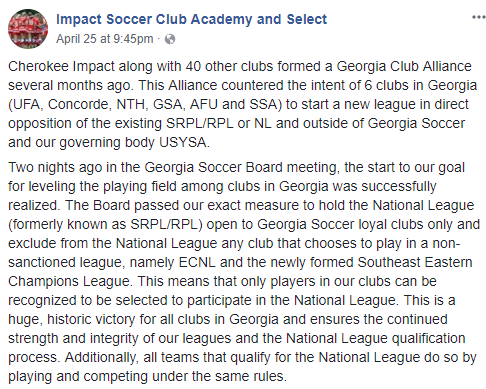
Little did I realize how intense this would get. Check out the Cherokee Impact Facebook page (HT to GaSoccerForum post) …

impact

To translate all this …

  1. Those six clubs are United Futbol Academy, Concorde Fire, NTH (the umbrella term for North Atlanta Soccer Association (NASA) and Tophat), Gwinnett Soccer Association, Atlanta Fire United and Southern Soccer Academy. They’re big Atlanta-area clubs, though UFA and SSA have operations elsewhere in the state as well.
  2. “SRPL/RPL” is the soon-to-be-defunct U.S. Youth Soccer regional league, which will be replaced by a new conference, as I’ve already mentioned in a post with an even funkier musical tie-in.

This may or may not be meaningful. If the Big 6 weren’t interested in playing SRPLNLIOU anyway, maybe it doesn’t. Perhaps it’s simply a symbolic gesture — “you can’t quit; you’re fired!”

Here’s the fun part for parents and players — imagine you’re trying out for one of these clubs or just about any club in Georgia with regional potential this spring. At this point, you really have no idea where you’re going to end up playing in the fall.

PARENT: So if my daughter makes this team, will we be playing mostly around Atlanta? Or Alabama, as rumored to flesh out the Champions League? Or Idaho?

COACH: We won’t know until the lawyers sort it out. That’ll be $3,000 and a commitment for the year, please. It’ll be another $2,000 if we make the Mega Premier Elite Champions League. 

Yes, I said “lawyers.” U.S. Soccer has a principle called “interplay,” and those who violate it often end up defending themselves against grievances.

(I did try to contact most of the Big 6 clubs a few weeks ago. You’re still welcome to respond.)

In other “giant game of Risk” news from recent days …

  • Also overlapping with Georgia but taking place in the years before the statewide Athena/Classic league, it’s the Carolinas Premier League! It’s for U9 through U12 only, so “Developmental” seems like a better term than “Premier.”
  • Seven Arkansas clubs are forming the U.S. Club Soccer (but not NPL?) Arkansas Premier Clubs.
  • The Virginia NPL is adding two clubs. (Disclaimer: The VPL or VNPL includes my hometown club, Vienna. At least, that’s the last I’ve heard.)


youth soccer

How hard is it to make your local high school team? Take the survey

Your soccer club’s site is so upbeat, talking up the programs it offers to help kids play in college. Maybe even beyond!

So you spend a couple thousand a year for your child to play travel soccer, starting in third grade. You congratulate and console your child through all the wins, losses and long trips as you watch him or her grow.

Before you know it, your child is in high school. And if you’re not in the Development Academy, your child tries out for the high school team.

And might not make it.

Not talking here about the Michael Jordan mythology in which he was “cut” from his high school basketball team his sophomore year. He was on the JV. (He also grew quite a bit after that.) We’re talking about not making any team — varsity, JV, anything.

In some cases, maybe parents already knew the deal. In others, maybe not.

The point of Ranting Soccer Dad is to help parents get information. Ideally, we won’t see any families paying thousands of dollars in the expectation of college soccer careers, only to see their kids not even play in high school.

That’s why I’m rolling out two surveys — one for parents, one for coaches. Share your experiences. Can every travel player make a team at your high school? Would a rec player stand a chance?

Parents survey …

Coaches survey …

pro soccer, us soccer, youth soccer

Why are soccer clubs obsessed with going nationwide?

Well I was rolling down the road in a minivan
I had a keeper in the back and a guest player at the wheel
We going cross-country and we’re skipping school
We tired and I’m lost – I wonder why this is cool

Oh I’m bad … I’m nationwide

We know we’re not supposed to do this, right?

At the youth level, we have six national championship-ish events despite legitimate concerns that all we’re doing is rewarding families that can spend a lot of money on travel. And despite the legendary Horst Bertl (Dallas Comets, now FC Dallas) quote: “National youth championships in the USA are the most ludicrous thing I’ve ever heard in my life. Whoever thinks these up should be stoned.”

At the adult level, we fret over the costs a team like Christos FC incurs when it advances in the Open Cup. Then we see teams fall all over themselves to enter national leagues on top of national tournaments.

And the trend is only accelerating. Consider the news from the past week …

    1. U.S. Youth Soccer is revamping the regional pyramid that forms the base of its national league system, which is really a series of national showcases because no one really expects Tennessee Soccer Club to schedule a U15 league game against Greater Seattle Surf.
    2. The UPSL, the first league to institute promotion/relegation besides all the other adult (and youth) leagues that have had it for generations, is rapidly expanding — Columbia, S.C.; Silver Spring, Md.; Alton, N.H.; Hollywood, Fla.; Perris, Calif.; Aurora, Colo.; Dallas; Wake Forest, N.C.; etc. I count just north of 170 teams in the league now.


borgLike the Borg, the UPSL has grown in part through assimilation. The Premier League of America (which, despite the name, covers a relatively compact area around Lake Michigan) simply merged into the UPSL and became the Midwest Conference. A few other teams have moved over from existing amateur leagues such as the Colorado Premier League (a U.S. Specialty Sports Association affiliate), Texas Premier Soccer League (U.S. Club Soccer), the nominally professional American Soccer League, the apparently defunct American Champions League, the apparently defunct Champions Soccer League USA, the People’s Front of Judea (OK, that one’s fictional), and elsewhere. They also have a partnership with the traditionally strong Maryland Major Soccer League (home of the aforementioned Christos FC), one of the USASA’s Elite Amateur Leagues.

To some extent, the UPSL is a loose network of regional leagues. It’s much bigger in California than it is elsewhere. But it does have a national playoff and advertises a separate Cup competition called the Admiral Cup, though that doesn’t appear to have been contested recently.

A national playoff of this sort is a little curious. If you’re one of the many people annoyed with the USA for doing things that other countries don’t do, well, this is something other countries don’t do. I don’t see a national Regionalliga championship in Germany — just playoff games to determine the promoted sides, with no overall winner. Nor do I know of any English divisional championships after the fifth tier, which is the last nationwide league. (England does have the FA Trophy, a cup competition for those in tiers 5-8, and the FA Vase for anyone lower than that. But the U.S. counterpart to that would be the U.S. Amateur Cup, which many UPSL teams enter, and that winner can play in the supercup-ish Hank Steinbrecher Cup.) European clubs in regional leagues try to win that league and progress as far as they can in their cups.

But that playoff is, in the words of Douglas Adams, mostly harmless. It’s the summer leagues, PDL and NPSL, that have counterproductive national playoffs. These clubs serve a valuable purpose — giving college players a few more competitive games in the summers. Then they cut their regular seasons short to race through a set of playoffs that no one really cares about. (Seriously — lower-division fans can all remember U.S. Open Cup upsets such as Reading United over the New York Cosmos, Michigan Bucks over everyone, Des Moines Menace over a couple of pro teams, Chattanooga FC over Wilmington, etc. Name the last PDL champion. Or try to remember anything from the NPSL playoffs other than Midland-Odessa scraping together a team to play the final after the bulk of its roster went back to school for the fall.)

That’s the state of adult soccer. What about youth soccer?

Maybe the new U.S. Youth Soccer leagues will be an oasis of sanity. Unlike the Development Academy and the ECNL, they should have enough entries to split into sensible regional divisions. (The DA has a few good clusters at U12 but hits peak absurdity by U15, while ECNL travel budgets are rather excessive even in the long-established girls’ divisions.)

And somewhere in the ashes of the 2018 U.S. Soccer presidential race lies an interesting idea — a national Youth Cup. This exists in England, where the FA Youth Cup draws hundreds of U18 entries (and note that the age range is not by birth year) and Broxbourne Borough of the Spartan South Midlands League Division One (unfortunately, the senior team is facing relegation down to England’s 11th tier) was one game away from the quarterfinals last year.

One national championship. (OK, maybe two — England has a national U18 league with north and south divisions that face off in a national playoff, but that’s about it for national travel, even in a country that requires no airplanes for away fixtures.) That seems sensible. And the top academies might have to face off with a Broxbourne Borough in a meaningful game instead of sitting in a silo.

Basically, if you’re going to have a national championship, maybe it should include everyone in the nation — at least those meeting a certain criteria like “amateur” or “Division 3 or below” or “Division I college teams.” Otherwise, why spend time flying when you could be playing?