Category: youth soccer
Freddy Adu’s next chapter will be worth reading
Remember when U.S. men’s soccer was so full of hope?
You don’t? Watch this …
That ad is so much better than the ads we see for the U.S. women’s team today. The field-level ad isn’t bad, but so much of it is over-the-top hero worship. If we keep putting the women on pedestals and exalt them as flawless, we can’t be too surprised when critics pounce on any crack in that facade. (And then we prolong the discussion by claiming that the criticism is sexist, even though it’s not the least bit inconsistent with what we see in men’s sports, and it’s painfully ironic that the knowledgeable women who question the narrative are bullied worse than people who speak up about women’s soccer pay. You’ve read this, right?)
(Also, the band that provided the soundtrack for that ad is an indie duo called Joy Zipper, and the NYT writeup of their wedding is cute.)
But this isn’t a rant about advertising. The focus here is the young man who pops up at the 44-second mark to do some stepovers, flip the ball up and smash a volley into the net.
He’s Freddy Adu, one of the most talented young players this country has ever seen.
No, really …
No, really …
One of the disappointments in the soccer media of the last 10 years has been that no one ever quite captured the story of how Adu plummeted from such heights to where he stands today, unable to stick with a second-division U.S. team.
Until now. See the ESPN story by Bruce Schoenfeld, who not only landed a rare interview with Adu himself but chatted with people who’ve known him at the beginning and the (almost certain) end of his playing career.
For the latter point, the definitive comment comes from the ever-candid Eric Wynalda, who took over the USL’s Las Vegas Lights team and declined to invite Adu for another season with the team.
The reason that Freddy’s not here now, there are six or seven guys getting their first chance or their second chance. He’s on his fourth or fifth. It’s their turn, not his.
Wynalda and Isidro Sanchez, son of the legendary manager Chelis and temporary coach at Las Vegas last year, also put into words what others have not. Adu’s skill was as good as anyone’s. His work ethic was not. By this point in his career, he simply won’t be able to do the work he didn’t do when he was younger.
One problem is that, despite a couple of ludicrous scouting reports to the contrary, he was never fast. He could create space with a deft touch and beat a defender that way. He was never going to run past a typical professional defender.
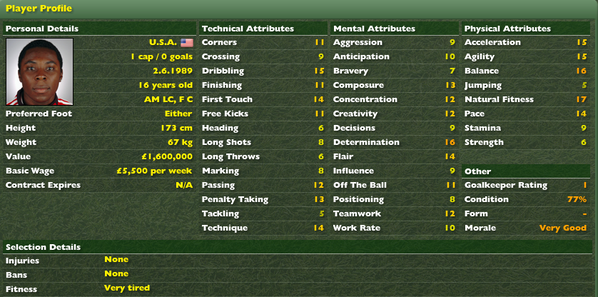
Adu also suffered from bad advice and a string of bad luck with his club teams. At D.C. United, Peter Nowak was widely considered to be the perfect coach for a prodigy, but his mismanagement peaked in the 2006 playoffs. With United trailing New England 1-0, Adu was the best attacking force United had on the field. Nowak pulled him in the 65th minute in favor of Matias Donnet, who contributed absolutely nothing. A little while later, Christian Gomez cramped up — an accomplishment on a cool fall day — leaving only Ben Olsen to inspire the attack through sheer force of will. (Yes, this is all in my book. The first one.)
On Adu went to Real Salt Lake, which was always going to be a brief stop on his way to Europe. He wound up at storied Portuguese club Benfica, which turned out to be a mess.
Then it was Monaco’s turn to mess up, spurred by Franco-American club president Jerome de Bontin’s proclamation that Adu could represent U.S. soccer in France the way Greg LeMond represented U.S. cycling. That’s a lot of pressure to put on a player the coaches didn’t even seem to want. A whirlwind tour of Europe akin to something Chevy Chase did in the movies followed.
At this point, Adu got a lifeline. He came back to MLS to play for Philadelphia. And he wasn’t bad. Had he embraced the shot to be an above-average MLS starter at this point, he could have spent the rest of his 20s as a productive professional player.
Instead, he embarked on another round of globe-trotting and another return to the USA. The player who was a strong MLS player in his teens was a mediocre USL player in his 20s.
So why is this a story of optimism? Let’s go back to the ESPN story.
Adu believes that several of the players at Next Level have significant potential. He knows now, though, that potential only sets the starting line. “Growing up, I was always the best player,” he said. “Guys who were way below me at the time, you’d say right now had better careers than I did.”
If he’d had a Freddy Adu working with him, an elite-level player there to explain what it meant to succeed, he would have developed a different attitude. “So when I see a kid who’s really talented, clearly above the rest, and he’s just coasting, trying to get away with his talent, I say, ‘No, no, no. That can’t happen! You can’t let that happen! They will surpass you.’ Because I was that kid.”
He’s the perfect coach. He’s charismatic. He has good attacking vision.
And kids can learn so much from people who’ve failed. Many of the best coaches in the world are people who never panned out as players. They faced adversity, and they pass those lessons along to those players.
We’ll never see Freddy Adu representing the U.S. again. Not on the field.
But off the field? We’ll see.
It’s too late to take advantage of the potential he had as a player. Maybe he’ll take advantage of the potential he has now.
Bribery scandal’s lesson: Athletes get free passes (also, MIT is a jock school?)
Being a parent opens your eyes to a few things. You realize how far the USA lags behind other countries in family leave and child care, which is a grossly unfair burden in particular on moms who want to work. You see that youth sports are fun up through, say, age 8, and the whole thing turns into a cesspool that forces you to do a bit of work just to find something that isn’t dehumanizing.
And you get a look at college admissions. It’s not pretty.
In a sense, it’s a good problem to have. For all the anti-intellectualism running through America these days, tons of kids want to go to good schools, and many of them are qualified. We really need to start looking at colleges the same way we’re looking at women’s soccer these days — the “elite” is growing in number. Schools that used to attract kids with 1100 SATs and no AP classes are now picking up exceptional students who would’ve gone to top-10 schools 20-30 years ago.
But being a parent helped me discover something I didn’t expect. The stereotype of youth sports parents is that they’re foolishly spending a ton of money without realizing college soccer scholarships are rare. Wrong. They’ve done the math. They know most men’s soccer scholarships are partials, and it’s worse in other sports.
They’re spending tons of money on sports to get their kids in the door.
We’re not talking about basketball players or football players who are just being fast-tracked to the pros. There’s a reason why a big part of the bribery scandal that broke this week is about sports.
Pardon me for sending you to SI’s browser-crashing site, but they have a pretty good roundup of the details. The allegations here are that kids are designated as rowers, tennis players or lacrosse players when they are not. That’s enough of an edge to get someone into a good school.
And yes, we’re talking Ivy League schools, even as they tout their “no athletic scholarships” purity. Here’s former Yale admissions officer Ed Boland, speaking to the Associated Press:
There are what we called ‘hooked’ students and ‘unhooked’ students. Hooked students have some kind of advantage, either from an underrepresented geographic area, a recruited athlete, son or daughter of an alumnus or alumna or an underrepresented ethnic group. Athletes certainly enjoy preferential treatment in the admissions process.
(“Underrepresented geographic area,” incidentally, is what kills, say, those of us who live in Northern Virginia. My town’s high school, with an average SAT more than 150 points above the national average, reports no one going to Harvard, Yale, Princeton and Dartmouth in recent years. The data isn’t complete, but we’re talking about kids with a 4.36-4.55 GPA and a 1590-1600 SAT. Anecdotally, what I’ve seen is that the elite schools love the science and technology magnet and look at everyone else as if there’s something wrong with them. If we moved somewhere, our kids would have a better chance of getting into an elite school or a state flagship. The “scattergram” showing the scores of those accepted or rejected from our school to the University of North Carolina is depressing. A 4.25 GPA and 1500 SAT is borderline at best. Even in-state at the University of Virginia, you likely need a 4.0 and, say, a 1400, according to the scattergrams that I sincerely hope are skewed by some sort of selection bias.)
The Harvard Crimson took a candid look at athletes’ admissions in their own school, based on a couple of studies on the topic. What they found:
- Harvard assigns applicants an academic ranking from 1 (highest) to 6.
- Among candidates assigned a 1 or 2, 16% of non-athletes were accepted. Athletes? 83%.
- Among candidates assigned a 4, non-athletes’ rate was a minuscule 0.076%. Athletes? 70.46%.
Obviously, this can’t be limited to football and basketball players. (No, I don’t think the top three basketball recruits in the country last year, all of whom are currently enrolled at my alma mater, all just happened to have 1400s and 4.0s.) To an extent, we’re talking about all sports.
To be fair, the typical rowing recruit probably doesn’t have a 700 SAT and a 2.0 GPA. If you’re assigned a “2” in Harvard’s academic ranking, a special skill surely helps you get in.
And that special skill might not be sports. I took a music composition class at Duke that had two people, and the other kid was basically recruited for music. That was humbling. Nice guy, though. Some kids also have some unusual trait that makes them outstanding — a first-generation American who didn’t know English at age 10 but scrambled to a 1400 SAT, someone who started a tech company or published an academic paper, etc.
That said, check out this school’s applicants from my town’s school:
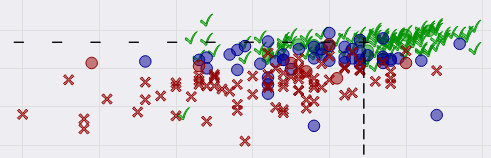
The big cluster is around 4.35 and 1440. And yet there’s one green mark for a 3.41 and 1210. That might be a stretch for a legacy unless that kid’s family has a building named after it or was an Emmy nominee. (See Claire Danes’ Saturday Night Live monologue.)
Surely, the schools that play Division III schools are exempt from all this, right? No athletic scholarships there, and probably no preferential admission, right?
Here’s something that makes me skeptical. This is the Directors Cup (overall athletic excellence) chart for Division III last year.

Williams always wins this thing. Emory is in the top four for the first time.
This is the best result for MIT. But it’s not exactly a fluke. They were 11th the previous year. The year before, sixth. In 2014-15, third behind Williams and Johns Hopkins, which is D3 in everything except lacrosse.
I can’t tell whether these schools are getting ahead because of recruiting and preferential admissions. No one from my local school’s scattergram got into MIT, either. (Seriously? Have you met the kids from this school? Take a closer look, admissions people.) Hopkins took a 4.16 / 1350 student, which isn’t exactly horrible.
What does MIT say about it? The site isn’t really clear. They say athletes are subject to the same “rigorous, academically-focused admissions process” as everyone else, but they also are “always looking for students-athletes.”
Yes, “students”-athletes. Insert joke about engineers’ writing skills.
But coaches can indeed advocate for athletes who might “contribute to MIT’s varsity athletics.” So, again, athletes have an edge. MIT isn’t going to take a kid with a 500 math SAT, but if you have a 700, maybe getting that 8k cross-country time under 26 minutes will help.
This isn’t new. The valedictorian from the class ahead of me in my small college-town private school didn’t get into Yale despite astronomical numbers. A guy who wasn’t near the top of the class got into Princeton, where he nearly made the varsity basketball team that nearly became the first 16th seed to knock off a No. 1 seed in 1989. (I still think Alonzo Mourning fouled that guy on the final shot.)
So … is this fair?
I don’t know. My kids aren’t going to play high school sports, so I might have a bias. Then again, I write about sports, so maybe I’m biased the other way. When I see Duke and Virginia play women’s soccer, I might forget that some of the players’ SAT scores are 100 points or so below the incoming class average.
But I can tell you this — the race to get kids to shore up their academic resumes really doesn’t help make youth sports a pleasant experience. Parents are a little more cut-throat when a place at Harvard or Virginia might be at stake.
Sports, we often hear, are a way out of poverty for many people. Let’s not kid ourselves. The kids getting into these schools as gymnasts, swimmers, golfers and, yes, soccer players (often) have parents who shell out plenty of cash on travel programs and private coaches.
So the rich are getting richer. And they’re turning youth sports into bloodsport.
And that stinks.
RSD short: A meditation on losing and coaching
It’s safe to say the last weekend of the season was familiar and yet unexpected. But I’m not just going to mope about it. I’m wondering if we can find any larger takeaways in all this.
In other words — it’s not my fault, it’s U.S. Soccer’s. Sort of.
(Really, it’s mostly luck.)
Re-organizing Northern Virginia leagues
First, a quick announcement — because I’m writing for Soccer America now and have a book in the works, I won’t have many posts and podcasts over the winter.
But I wanted to take care of something I’ve been trying to do for a while, and it’s a case study of what can be done with a dose of sanity.
The basic idea: There’s no need for artificial divisions between levels of play, and kids/teams should be able to find their levels on their own.
Another basic idea: Quit traveling MORE to play LESS competitive games.
Which leads to this: Like most countries, we’re going to put league play under one umbrella.
You can do club-vs.-club league play IF all or most of your teams are in the same tier as your opponent. No more dragging your U13s 150 miles to lose 8-0.
And this reorganization doesn’t affect tournaments at all. If you have some exclusive league, you can reset it as a couple of tournaments/showcases. (The one caveat: Can we please have ONE State Cup? If you don’t want to enter it, and you want to have a special tournament of your own, fine, but don’t call it a “State Cup.”)
You might think this is just some OCD thing or the narcissism of a lone youth coach who’s sick of seeing lopsided soccer games in which one team has a bunch of kids who are near-elite level and the other has kids who simply can’t keep up physically. But let’s look at a larger issue from that Atlantic article everyone has been reading (“American Meritocracy Is Killing Youth Sports“):
Expensive travel leagues siphon off talented young athletes from well-off families, leaving behind desiccated local leagues with fewer players, fewer involved parents, and fewer resources.
Here’s the cycle I see here:
- Big clubs hold cattle-call tryouts at U9, usually taking the more athletic players. (I’m constantly amazed by the coaching gurus who think they can cast players aside at age 8 or 9 when they’re in their growth-spurt clumsiness. It’s almost as if they haven’t spent any time with children other than their selected few. Sure, you can spot someone who’s light years ahead of the rest in terms of understanding the game, but sifting through the other 99.9% is a fool’s errand.)
- The players who don’t make it are often discouraged and sometimes quit.
- The players who do make it aren’t necessarily those who are really devoted to soccer. They burn out, and they quit, and then the travel teams are left scrambling to grab kids from what’s left of the rec league.
- Some players may really like soccer, but when they hit middle school and high school, they have other interests that keep them from making the year-round commitment to travel (related issue: year-round commitments to mid- and lower-level travel teams are ridiculous), so they drop back into those “desiccated local leagues.”
- The clubs all band together to form a larger “rec” league that’s basically “travel lite.”
A few years ago, I suggested a way to bring players through the U-Little ranks up through Under-10 soccer, inspired by my local Little League baseball program that brings everyone to the “Majors” at their own pace. Basically, if you’re advanced, you play up. You can also arrange scrimmages with other clubs — putting your top players against theirs, your second-best against their second-best, etc. — and make those distinctions fluid. You don’t need “full-time” travel. You need your advanced players to be challenged, and you need your less advanced players to have the same access to good coaching because they might be great players when they grow into their bodies.
Move up to the older ranks: Middle school has a way of reshaping children’s priorities. If they’re truly elite soccer players and want to pursue it, they’ll be in an ECNL Academy program. (Yeah, we’re merging those two — we’ll get to it.) If they’re pretty good “travel” players but also good basketball players, tuba players, drummers or Eagle Scouts-to-be, they might want to drop their commitment level.
Does that mean these players have to quit playing with their similarly inclined friends? Does it mean they have to play at the lowest level of soccer along with new players or those who haven’t figured it out (or don’t have the physical tools to play particularly well)?
I don’t think so. And what I’ve found by high school age is that the difference between the top half of “rec” players and the bottom half of “travel” players no longer exists. The only difference is that the “travel” players are spending more money on professional coaches and … travel.
Let’s change that. As a model, we’ll use Under-14 boys in Northern Virginia. Our data and the abbreviations we’ll use:
- YSR: Youth Soccer Rankings for Virginia (no ranking is perfect, in part because teams don’t always play for the result, but this is the most comprehensive)
- EDP-1, EDP-2, etc.: EDP standings
- CCL-1, CCL-2: Club Champions League Premiership and CCL Championship standings (which aren’t included in Youth Soccer Rankings — note this is not a promotion/relegation league)
- VPL: Virginia Premier League standings
- NCSL-1, NCSL-2, etc.: NCSL standings (this IS a pro/rel league)
- ODSL: ODSL standings
- SFL-1, SFL-2: Suburban Friendship League (rec) standings
- Cup: Spring 2018 U13 State Cup (Play-in is PI, Round of 16 is R16, quarterfinal is QF, etc.)
- Club Cup: Spring 2018 U.S. Club Soccer State Cup
- GotSoccer rankings, but more importantly, tournament results. I didn’t want to reward teams for chasing GS points, but I used their event rankings to judge tournament results. Between that and YSR, I should have a good sense.
The result is admittedly subjective, but I hope I’ve accounted for idiosyncrasies in the rankings in which teams are dragged down (or up) by the strength of their leagues.
ECNL DEVELOPMENT ACADEMY (yes, get over it and merge — and yes, YSR’s rankings are muddled here because of a lack of data points comparing these teams to others)
- Arlington (DA)
- D.C. United (DA)
- Loudoun Soccer (DA)
- McLean (ECNL)
- Virginia Development Academy (DA)
At this level, traveling a bit farther makes sense. The rest of the current Mid-Atlantic DA (Baltimore Armour, Bethesda, Lehigh Valley United, PA Classics) and other nearby ECNL programs (Baltimore Celtic, Maryland United) can be reached with an easy day trip.
We won’t have traditional promotion/relegation here because this league will have different standards than others, and each club will have its teams evaluated by a combined U.S. Soccer/ECNL staff. But any team that is clearly overmatched at this level, it’ll be asked to drop down at that particular age group, even if other teams in that club (in other age groups) remain in the ECNLDA. I’ve done this here with Braddock Road, whose results in and out of ECNL do not indicate a competitive team.
We’ll have one more level with medium-range travel.
EDP D.C. METRO REGIONAL
- Doradus Barca Elite (#2 YSR, #4 EDP, #4 NCSL-1, State Cup R16)
- Alexandria Red (#3 YSR, #2 CCL-P, State Cup QF)
- Lee Mount Vernon Patriots Red (#4 YSR, #6 CCL-P, State Cup QF)
- DC Stoddert Blue Metros (#6 YSR, #8 CCL-P)
- Arlington Red (#12 YSR, #4 CCL-P, State Cup QF)
- Loudoun Red (#9 YSR, #10 CCL-P, State Cup QF)
- Stafford Soccer Revolution Blue (#15 YSR, #3 VPL)
- Annandale United/Villarreal Academy (#10 YSR, #2 VPL, Club Cup champion)
Those eight teams will combine with similar teams in Maryland, with yearlong standings. At least, at U14 — above that, you run into the problem of Virginia playing its public school soccer season in the spring while Maryland and most others play in the fall.
The champion is the non-ECNLDA D.C. metro area champion. (Maybe they could even play some games with ECNLDA teams in the spring season.)
No club can have more than one team in this division or the one beneath it. We want to encourage clubs to use club passes, and it pretty much defeats the purpose if you have multiple teams in the upper tiers.
The bottom Virginia team from this league is relegated to …
NORTHERN VIRGINIA PREMIER LEAGUE
- Herndon Ciclones Black (#16 YSR, #16 CCL-P, State Cup R16)
- Fredericksburg FC Black (#20 YSR, #12 CCL-P, State Cup R16)
- SYA Cardinals Red (#25 YSR, #14 CCL-P, State Cup R16)
- Capital FC Red, formerly Diplomats (#19 YSR, #1 EDP-4)
- FCSC United Black (#29 YSR, #4 CCL-C)
- McLean Green (#26 YSR, #3 CCL-C, State Cup runner-up but may have sent many players to ECNL – Jaime Moreno is the coach!)
- Great Falls Reston Elite NPL (#30 YSR, #5 VPL, Club Cup PI)
- NVSC CCL (#36 YSR, #11 CCL-P, State Cup R16)
The distances here aren’t too bad, though we have some 70-mile drives and might need to think about moving Culpeper, Fredericksburg and FCSC (Fauquier County) to other regions, perhaps with the opportunity to move into EDP. Below this level, as we draw the leagues more locally, teams from this clubs won’t be in the NoVa league.
These top tiers will only have eight teams playing seven games per season. That should give them plenty of time to play tournaments and showcases.
NORTHERN VIRGINIA LEAGUE ONE
- Lee Mount Vernon White (#43 YSR, #2 CCL-C)
- Arlington White (#38 YSR, #1 CCL-C)
- Vienna Red (#31 YSR, #6 VPL)
- Virginia SA NPL (#32, #9 VPL)
- Barca Academy NoVa Blue (#28 YSR, #9 EDP-1)
- Loudoun Black (#42 YSR, #6 CCL-C)
- DC Stoddert Red Metros (#35 YSR, #7 CCL-C)
- Doradus Barca Premier (#36 YSR, #4 NCSL-4)
The Barca team is tough to judge because it has been routed in its league games, and it has also chosen too high of a level in tournament play so far. Its ranking reflects the strength of opposition. I’m giving it the benefit of the doubt in placing it here.
The Doradus team is one of those that plays low-level league play but does quite well in tournaments.
NORTHERN VIRGINIA LEAGUE TWO
- Cougars Youth Club Olympiakos (#53 YSR, #1 ODSL)
- Chantilly YA Purple (#44 YSR, #8 VPL)
- FC Virginia United Elite (#48 YSR, #10 VPL)
- Team America Academy (#49 YSR, #9 NCSL-1, State Cup R16)
- FPYC Blue (#51 YSR, #7 NCSL-1)
- FC Dulles Gold (#53 YSR, #5 NCSL-4)
- McLean White (#58 YSR, #1 NCSL-3)
- Burke Fusion Blue (#64 YSR, #3 NCSL-3)
The FC Dulles team is another tournament overachiever.
I happen to have reffed a game with Olympiakos. They’re one of those teams playing in (and dominating) ODSL because the club isn’t in a higher league, and they’re doing well with an ambitious tournament schedule.
One more eight-team division …
NORTHERN VIRGINIA LEAGUE THREE
- DC Stoddert White Metros (#73 YSR, #10 NCSL-1)
- Annandale Villarreal Yellow (#61 YSR, #1 NCSL-4)
- NVSC CCL II (#63 YSR, #5 CCL-C)
- SYC Lions Blue (#55 YSR, #12 VPL)
- PWSI Pre Academy NPL (#59 YSR, #11 VPL)
- Real World FC Scorpions (#65 YSR, #8 NCSL-4)
- Premier AC Navy (#86 YSR, #3 NCSL-2)
- Leesburg Infinity (#79 YSR, #4 NCSL-2)
As mentioned above, I’ve started skipping teams from farther out — in this case, Fredericksburg SC Vasquez Academy and Winchester Orange.
We’ve now accounted for all of the CCL Premiership and VPL teams. The remaining CCL-Championship teams, EDP team and ECNL team might disagree, but we’re getting to the point at which most of these teams have smaller ambitions, so we’re going to have more league games on the assumption that these teams will not go to as many tournaments. This should create a cheaper price point.
I’m going now by league affiliation rather than rankings, which are splitting hairs at this point, and I can attest there’s still a gap between the typical NCSL Division 2 team and NCSL Division 5.
NORTHERN VIRGINIA LEAGUE FOUR
- Braddock Road ECNL
- Barca Academy NoVa Yellow (EDP-4)
- Herndon Ciclones White (CCL-2)
- SYA Cardinals White (CCL-2)
- Alexandria White (NCSL-2)
- VSA Select Red (NCSL-2)
- Arlington Blue (NCSL-2)
- Chantilly Gold (NCSL-2)
- SYC Lions Orange (NCSL-3)
- Great Falls Reston Napoli (NCSL-3)
- Vienna White (NCSL-3)
NORTHERN VIRGINIA LEAGUE FIVE
- Loudoun White (NCSL-4)
- Sterling Black Lions (NCSL-4)
- Lee Mount Vernon Patriots Blue (NCSL-5)
- SYC Lions Blue (NCSL-5)
- Alexandria Blue (NCSL-5)
- Chantilly Black (NCSL-5)
- Vienna White (NCSL-5)
- FPYC Gold (NCSL-5)
- Premier AC White (NCSL-5)
- Braddock Road United (ODSL)
- PWSI Challenge (ODSL)
Now we’re going to get regional and “recreational,” though we’ll still have promotion and relegation opportunities. We’ll start adding in the SFL (recreational) teams here as well as teams from the two non-SFL clubs — Arlington (15 teams) and Vienna (five — they have 10 in a combined U13/U14 league, so divide in half).
SFL has two divisions, with the top one smaller than the second.
NORTHERN VIRGINIA DEVELOPMENTAL 1-WEST
- Loudoun Gray (ODSL)
- Virginia Revolution WLFC United (ODSL)
- PWSI Classic (NCSL-6)
- Loudoun Silver (NCSL-6)
- Great Falls Reston 1 (SFL-1)
- Herndon 4 (SFL-1)
- FPYC 2 (SFL-1)
- NVSC 6 (SFL-1)
- NVSC 5 (SFL-1)
- Sterling 1 (SFL-1)
- PWSI 3 (SFL-1)
- Herndon 1 (SFL-1)
NORTHERN VIRGINIA DEVELOPMENTAL 1-EAST
- Alexandria Black (ODSL)
- Capital FC White (NCSL-6)
- Annandale 1 (SFL-1)
- Springfield 1 (SFL-1)
- Annandale 2 (SFL-1)
- Gunston 1 (SFL-1)
- Top four from Arlington
- Top two from Vienna
Beyond that, we have:
- 11 more from Arlington
- 3 more from Vienna
- 10 more from SFL-1
- 32 from SFL-2
So that’s probably two more tiers of three regional divisions each.
Over time, some of the SFL teams would probably work their way up into League Five. Other teams would be relegated — and this might keep them together. It’s frustrating to be the bottom team in a travel league with nowhere to go but splitsville.
The teams at the top divisions will always have an eye out for good players. Clubs will promote from within — perhaps a player on the FPYC Developmental 1 team will move up to League Five or even League Two.
Beyond that, kids can play with their friends and find their level. All without breaking the bank.
(Now all we need is field space.)
Exciting news and a meditation on the mercy rule
I’ve been lucky in recent years to write for a publication I’ve long loved, The Guardian.
Now I’m lucky again to write for a second publication that sustained the small U.S. soccer community in the pre-Internet era and continues to be a vital source of news and perspective … Soccer America.
My debut piece is about the mercy rule in youth soccer. It’s often essential but also often misapplied.
RSD podcast: How the ref shortage makes things a little amusing
If I sound out of breath, it’s because I reffed six games this weekend.
NPSL turnover and why we need youth clubs to build up, not vice versa
Stop what you’re doing and read the excellent SocTakes analysis of turnover in the NPSL.
…
Are you back? OK.

If you’ve followed lower division soccer over the years, you know this isn’t a recent phenomenon. Go back and look up the names in the old A-League on Wikipedia, where some kind soul listed each team’s dates of birth and death. For many of the teams, that doesn’t tell the whole story — the Carolina Dynamo existed and thrived for several years before the A-League and USISL merged, and they retrenched as a successful PDL team. But if gives you an idea.
If you wanted to do a spreadsheet akin to the one SocTakes did of NPSL teams, you’d run into a lot of complications along those lines. Teams rebrand, change leagues, go on hiatus, etc. I thought about it and then realized I had other things I really had to do. (I’m doing live curling commentary on Friday. Check it out.)
…
OK, fine, I did one.
This should cover every team that played in the nominally professional USISL/USL leagues (which launched in 1995) and the NASL. It does not include long-standing teams that have only played amateur soccer in the PDL or elsewhere (apologies, Des Moines Menace). Nor does it include APSL teams (apologies, San Francisco Bay Blackhawks) that didn’t stick around to play past the USISL/A-League merger.
I cross-checked Dave Litterer’s archive, Wikipedia and official team sites until I was blue in the face. If you see any corrections, please let me know. Going back to, say, 1990 or even 1985 would be the next logical step.
I’ve also ignored MLS reserve teams, including MLS Project 40, which existed.
The next step was the toughest. I tried to figure out how many of these teams have or had youth programs. I’d be happy for any crowdsourcing help here. As it stands, it’s not all that easy to figure out if a club named, say, “Dragons” is (A) a youth program that existed when the Jersey Dragons played in the USISL in 1994-95, (B) a youth program named after the Dragons, or (C) just coincidentally using the same name.
Then try to figure out whether the youth program preceded the senior team. I’m not even completely sure whether that’s true for the Richmond Kickers, a gargantuan youth program with a senior team attached. Both have existed since the mid-90s. Which came first?
So I’ll keep plugging my way through it. I’m pretty sure I have all the relevant teams and their histories, though perhaps some of them are still plugging away in amateur leagues. I’ll happily take help on that and youth programs.
But what I’d conclude so far:
Having multiple options is a good thing. Self-relegate if needed — note all the teams that dropped out of the pro ranks and started playing PDL or other amateur leagues.
My hypothesis: Teams are better off if they’re organic outgrowths of a existing club.
Or maybe the whole club is formed at once.
That’s the idea. Input welcome.
A Recreational/Most Travel Soccer Manifesto (updated)
A couple of years ago, I wrote a Recreational Soccer Manifesto for SoccerWire. At the time, I was focused more on the younger age groups, having just written Single-Digit Soccer, and I was pushing the idea of having no full-time travel soccer (just All-Star tournaments and other interclub matchups) for kids under age 12.
But I did have a few ideas for older age groups, even though I had not yet coached there. Now I’m in my third year of coaching at the U14 (middle school) level, and I’m now coaching at the U16/U19 level (don’t ask — it’s a long story).
And I’ve found that I was right. Somewhat. I’ve learned a few things that have made me want to revise and expand the Manifesto.
One thing I’ve learned that I had not taken into account: You’re simply not going to be able to keep everyone. I have some ideas for giving all high schoolers an opportunity to play without being totally overwhelmed by all the players dropping back to rec soccer after several years of travel, but even then, high school kids tend to explore new activities and/or shift their focus to the activities at which they’re really good. The kids playing multiple sports may choose one. They may choose to run cross-country and march in the band instead. We have to be OK with that.
(Losing kids before age 12 is a different story. When that happens, it usually means the soccer community messed up.)
I’m also seeing in even more vivid detail just how counterproductive it is to have all these different leagues stuck in silos rather than a pyramid. In my area, kids from U11 on up have these choices:
- The Development Academy, which is taking more and more kids at the younger age groups.
- ECNL, which is fighting back against the DA. We can talk about that some other time.
- EDP, which has taken over U.S. Soccer’s regional leagues in the region and offers a lot of tiers for teams to find a competitive level.
- Club Champions League, a self-appointed elite league with club vs. club scheduling that seems less relevant now that we have three leagues at a higher level.
- Virginia Premier League, a U.S. Club Soccer league that also does club vs. club scheduling and is at a lower level (with even less parity) than CCL.
- NCSL, the traditional local promotion/relegation league that still has a handful of good teams and reaches downward to include teams that are demonstrably worse than a lot of “rec” teams.
- ODSL, which some clubs consider “travel” and some consider “rec.” It’s supposedly a lower level, but after reffing a fantastic U13 game punctuated by a legit bicycle-kick goal, I’m not sure I’d agree.
- Suburban Friendship League, the interclub “rec” league that has a few teams that would clobber the “travel” teams.
- Local clubs’ rec leagues.
With so many artificial divisions, is it any wonder these leagues and clubs fail to offer the wide range of programs and competitive levels players and parents want? Several of these leagues try to have multiple tiers, but they don’t have teams to do it.
And these leagues end up imbalanced. Your local rec league may have some juggernauts, with players who’ve stuck together for a few seasons while doing all sorts of extra work. Can we let these friends stay together while giving them a challenge other than destroying the less serious rec teams? Why can’t they play the low-level travel teams who aren’t any better?
So the basic points of my previous manifesto still seem OK to me. But I think I can distill things down to a couple of simple points:
DA/ECNL: With some hesitation, I’ll exempt the DA and ECNL from what I’m suggesting below. They should merge, of course, with a simple compromise — the ECNL accepts the DA’s limits on the number of games each team plays in a weekend or a week, while the DA gets over itself and lets kids play in high school if they choose. That should give them enough teams for two tiers, and at the pivotal age of U16, they could have a truly national league. (After U16, players that are ready to go pro move into the USL or straight to MLS, while everyone else travels less so they can hit the books and get ready for college.)
As for everyone else …
One pyramid in each region: One. The top level would play throughout the region, though we’ll still try to keep travel reasonable — usually 1-2 states, or half a state in California’s case. The farther down the pyramid you go, the wider the base. (In other words, an actual pyramid. Not a ladder.) Professionally coached teams with committed players who practice 2-3 times a week and don’t mind a bit of driving will end up in the upper tiers. Teams we would now call “recreational” will be at the bottom — if they prove to be a bit better than their peers, they can move up a tier or two. Any team can decline a promotion to a level that would require too much travel. (Within reason — if a team is beating everyone 10-0 in Division 9, they should move up to Division 8 or disperse their players.)
Guest players/available subs: In my adult league, we had a roster of full-time players that was big enough to field a team if everyone showed up. They all paid full freight, and so they had first right of refusal for each game. If a few players were absent, we could call on a list of players who hadn’t committed to the team but would be willing to play on occasion. (I’ll draw once again on the curling example — a curling team usually has four players but can go with three or possibly five — so my local club lets teams call in subs who pay a small fee for each game they play.)
Free play, free play, free play: Some kids simply aren’t going to be able to commit to any team, no matter how low the commitment might be. You can still keep them playing on occasion and give your full-time players a fun break from their league schedules by having free-play days.
You could also offer a change of pace for everyone with small-sided tournaments (tiered) open to all.
Speaking of tournaments:
Set up any tournament you like: In the example above, CCL and VPL could reinvent themselves as organizations that offer club-vs.-club tournaments.
The bottom line is this: Offer a wide variety of clearly labeled programs. Parents have no patience for this alphabet soup. What I’ve outlined above is far simpler and friendlier than the dystopian mess of leagues I listed above that.
Clubs may argue that they’re moving from the “team-centric” model to the “player-centric” or “club-centric” model. You’re not fooling anyone. You might move the occasional player up to fill in on the top team, and the DA has provisions for part-time players who can be called up (and there’s no reason to discontinue that practice). But for the most part, you’re handing parents a schedule at the beginning of the season, and they’re scheduling everything else around those games. You’re not going back and saying, “Hey, let’s bump Maddie down to the C team this week. Game time is 8 a.m. Sunday in Farsburg. See you there.”
In any case, we’ll let clubs continue what little internal movement they have with the “guest player” provisions. Your Division 3 team can call up a Division 6 player if needed. But players and parents at most levels of soccer identify with a particular set of teammates. You can’t change that, nor should you.
So we’ll accomplish the following:
- We’ll make this more fun for everyone.
- We’ll make this less confusing.
- We’ll encourage more players to stay in the game.
And we’ll even provide that elusive “pathway” for all. Maybe a kid comes out to one of your free play sessions, decides to join your Division 10 team and catches on to the game. In a couple of years, that kid is in Division 3 helping you win a State Cup and going on to play in college. Stranger things have happened.
For the other 99 percent, youth soccer will be something other than a major annoyance. And that’ll be progress.
RSD short: Funny stories from youth soccer, then less funny news on USSF and NASL
A few texts for today’s podcast:
- About the “Play/Practice/Play” model of coaching
- About buildout lines
- Mike Woitalla interview with UnSocCo’s Ian Barker
- Compass Football (Jason Davis, Nipun Chopra) summing up NASL response to previous episode
- Brian Quarstad on 2010 Pro League Standards
- Quarstad again on 2011 struggling to get D2 sanction
- Quarstad yet again on 2011 NASL getting D2 sanction
 Duresport.com