women's soccer

Promotion/relegation propaganda/reality, Part 3: U.S. Soccer

There’s no organization in the world quite like U.S. Soccer.

That’s not a compliment. That’s not an insult. It just … is.

U.S. Soccer is unique among major U.S. sports federations in that its mandate goes beyond organizing national teams and developmental programs. It’s responsible, by FIFA fiat, for regulating professional soccer competitions. (Or, in the case of the U.S. Open Cup, running those competitions outright.)

ussf-purpose

U.S. Soccer is unique among soccer federations in that the nation it serves is a massive economic power on a giant land mass in which soccer is not the most popular sport. The USA isn’t the only country that has its own indigenous offshoot of “football” that rivals or exceeds soccer in popularity — see Australia and, to a lesser extent, Ireland — but it’s the only one that has multiple team sports that garner more attention. As far as I know, it’s the only soccer federation in a country that has been openly hostile to the sport for generations.

And to my knowledge, it’s the only federation that was charged by FIFA with getting an honest-to-goodness professional league running in the 1990s. Every other major country already had one.

The most important election in U.S. Soccer to date was in the summer of 1990, when Alan Rothenberg unseated Werner Fricker. Rothenberg was under a bit of pressure to run. From 1994, here’s Steve Berkowitz, then of The Washington Post and later a demanding but fair editor who made some of my USA TODAY stories a lot better:

Rothenberg said FIFA officials, familiar with him because of his involvement with the 1984 Olympic soccer competition, initially contacted him about chairing the World Cup organizing committee. When he said he was interested in doing so, he was told that he also would have to become USSF president. He agreed, and lo and behold, Rothenberg unseated Fricker in August 1990.

And so Rothenberg went to work on getting FIFA’s cash cow, the World Cup, up to speed. He also had to fulfill U.S. Soccer’s other promise to FIFA, a pro soccer league. Rothenberg needed a plan, and so he went about hiring people — including economist Sunil Gulati and attorney Mark Abbott, on loan from Rothenberg’s law firm, Latham & Watkins.

Abbott sat with me for an interview when I was writing Long-Range Goals: The Success Story of Major League Soccer (please note: I did not choose that subtitle). Here’s what he said about Rothenberg’s unusually sprawling role:

At that time, there were very stringent procedures that were put in place to ensure that although Alan was the head of the soccer federation and leading the effort to make a presentation with respect to the league, he had been recused from the decision-making system in U.S. Soccer. There was a big meeting in December 1993 where we made our presentations. Alan was not part of the Federation board in making that decision. Also, and I think this gets overlooked, FIFA in awarding the World Cup to the United States did so very expressly for the purpose of using it as a springboard for a professional league. That’s what he was supposed to be doing, using this event to help start the league.

Still, the federation’s board voted to decide which of three bids would be awarded Division I status. In addition to Rothenberg’s group, the existing Division II-ish APSL put in a bid, as did Jim Paglia on behalf of League One America, which would take the old NASL’s Americanization of soccer rules to new extremes. (Jim, I know you’re out there — if you still have the video of the test games, I’d love to see them.)

The vote wasn’t unanimous. The tally was 18 MLS, 5 APSL, 0 League One America.

More from my book (because I can’t find Hersh’s story online):

Veteran national-team defender and U.S. Soccer board member Desmond Armstrong, who cast a ballot for MLS in the Division I vote, said his decision was strictly on merit. “I don’t have any love lost for the federation,” Armstrong told the Chicago Tribune‘s Philip Hersh. … “It wasn’t a matter of playing favorites, but of getting the best proposal out there so we can have jobs. I voted for Alan’s plan because it had all the t’s crossed and i’s dotted.”

The APSL grumbled a bit and for a short time was a legitimate competitor to MLS, signing quite a few players who were clearly good enough for the top tier but balked at the salary structure.

The next year (1994), Rothenberg ran for re-election. It got ugly, but he won.

The election was close in 1998. “Dr. Bob” Contiguglia defeated Larry Monaco 57.6% to 42.4%. Even closer was the race for executive VP, in which John Motta defeated … Sunil Gulati, then serving as MLS deputy commissioner. That was 372 (50.8%) to 361.

Maybe that was a rebuke of MLS officials gaining too much power in U.S. Soccer (though, note, this was before MLS hired Don Garber and well before MLS formed Soccer United Marketing). But such sentiment didn’t last long. U.S. Soccer then started staggering the terms of its top board members, and Gulati came back two years later to win the seat from Motta. And Gulati was able to point out in Fraser v MLS testimony that U.S. Soccer didn’t just rubber-stamp whatever MLS wanted.

Then Gulati succeeded Dr. Bob as U.S. Soccer president, and elections have come and gone with little fanfare or fire since then. The 2016 vice-presidential election was contested in gentlemanly fashion, with longtime independent director (board member) Carlos Cordeiro ousting Mike Edwards. Gulati hasn’t been opposed.

(This is an image of a Google search. Don’t click.)

gulati-votes

Wait, wait … you’re saying. What does this have to do with promotion and relegation?

Nothing. Because it wasn’t an issue.

We’re about the have the next biggest presidential election in USSF history. Is pro/rel an issue now? Or is it more about general arrogance and an unwillingness to push Major League Soccer to be more open, whether that means pro/rel or a looser salary cap? Or perhaps the historical view that the close ties between USSF, MLS and Soccer United Marketing that may have been necessary for survival in the mid-2000s are no longer necessary and perhaps harmful?

https://www.instagram.com/p/BZKR67THaA0/?taken-by=prorelfc

Gulati has often been painted as ruthless — player testimony in Fraser v MLS certainly made him look like a tough negotiator, to put it nicely. In my experience, he’s a pragmatic idealist. He has devoted thousands of volunteer hours to making the sport succeed, and he has laudable intent (and action) on trying to diversify the typically homogeneous Federation. Whether he has handled every situation in his long tenures in various roles is up to everyone to decide.

Gans is pragmatic as well. He announced his candidacy only after going on a “listening tour” of various constituencies, and he’s concerned about youth soccer dysfunction and the decision-making that led the Fed to renew Jurgen Klinsmann’s contract and then fire him. As mentioned in Part 1 of this series, his take on pro/rel is cautious.

That’s not far from what Gulati said on pro/rel earlier this year:

“It’s not the rules of the game that people came in on,” Gulati said. “When you buy into a particular structure, that’s what you expect the rules to be. … But if the leagues or a league wants to engage, we’re happy to be support that.”

Lapointe is more prone to throw stuff at the wall and see what sticks. His approach to Twitter, to which he’s still relatively new, resembles another president in the United States:

He recently proposed promotion/relegation in women’s soccer and a U.S. Women’s Open Cup. The Twitter reaction was skeptical, to say the least:

NWSL supporters on a lively Facebook group said “let’s get the NWSL in order first” and “technically, we have national Cups for women, but no one enters.” The latter point was emphasized by none other than John Motta, the former USSF VP who is now president of the U.S. Adult Soccer Association.

And Motta is himself considering a run. So is Jerome de Bontin, the former president of French club Monaco and general manager of the New York Red Bulls who is now the chairman of the sprawling Rush Soccer youth organization (sadly, not named after Geddy, Neil and Alex — or Cartman, Stan, Kyle and Kenny, though like Rush Soccer, they hail from Colorado).

So will any of these presidential candidates bring forth promotion and relegation?

It’s complicated.

Like the United States themselves, U.S. Soccer is a representative democracy. Not a dictatorship. The president must contend with the rest of the board, the general membership and perhaps even the U.S. courts.

And even Lapointe sees a need to phase into promotion and relegation, not just throw open the whole pyramid at once. That might not reassure the PRZ (Pro/Rel Zealots), who insist any incremental step suggested by me or Peter Wilt is simply doing the bidding of Evil MLS.

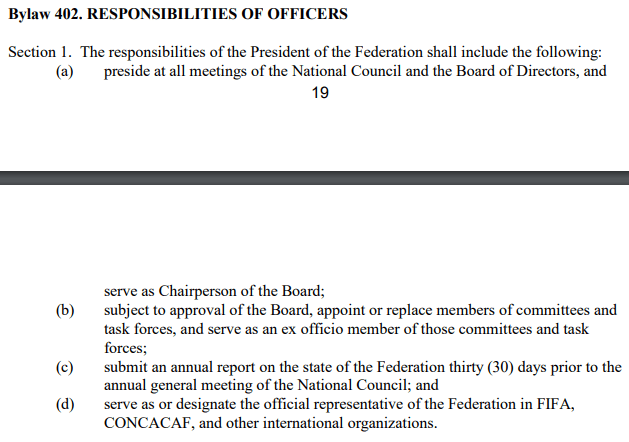
In any case, pro/rel may be the least of the next U.S. Soccer president’s concern. As mentioned many times in the past week or so, the NASL lawsuit calls into question U.S. Soccer’s legal authority to regulate professional soccer, and it’s not the first. But the bylaws clearly state U.S. Soccer’s firm belief that it can’t simply let someone else take over any aspect of the game.

ussf-autonomy

(Except, apparently, indoor soccer. The boarded version of the game is operating outside USSF right now. For a while, it was associated with an organization called the Federation Internacional de Futbol Rapido, whose acronym FIFRA was hilariously close to FIFA. And except, apparently, college and high school soccer, neither of which is governed by U.S. Soccer. But I digress …)

So the Federation, and its president, must walk some difficult political lines. Filip Bondy, a longtime soccer writer now contributing to Forbes, put it best when he described the presidency as “a job opening you might want to pass on.”

Summing up Bondy’s take — the president gets to:

  • Accept blame for national team downturns
  • Deal with men’s and women’s national team contract disputes and potential work stoppages
  • Deal with FIFA and other officials of potentially dubious credentials and ethics (to me, this might be the toughest — how long can you swim in the FIFA cesspool without starting to stink?)
  • Collect a salary of $0.

Oh, and you have to put up with the NASL and Stefan Szymanski. If you didn’t see my Twitter thread on Szymanski’s declaration in favor of the NASL tweaking U.S. Soccer, check it out. Allow some time.

And it’s not as if U.S. Soccer simply rubber-stamps everything the president wants. (Also in that link: Note that U.S. Soccer changed the way it runs election, asking candidates to declare in advance instead of just presenting themselves on the meeting floor, and it instituted term limits. If Gulati runs and wins re-election in 2018, he’s out in 2022.)

So who votes? Let’s see if we can sum up Bylaw 302:

  • State association reps, both youth and adult. Their votes are weighted by the number of people they represent. (In other words, New York East is going to have a more heavily weighted vote than Alaska.)
  • Athlete delegates. There’s usually only a few, but by U.S. law, their votes have to be weighted to count for 20 percent of the final tally.
  • Board members.
  • Past presidents.
  • Life members of U.S. Soccer (weighted so that they have no more than 12 total votes, which isn’t much)
  • Delegates from pro leagues, national associations, national affiliates, other affiliates, disabled service organizations, etc.
  • Adult Council and Youth Council administrative commissioners (I have no idea who this is)

Further weighting: The Youth, Adult and Professional Councils will all end up with equal votes.

Here’s how it broke down in 2015:

vote

You know what I don’t see in the bylaws? Is the election “first past the post” (top vote-getter is president, even without a majority) or a runoff system (top two hold a runoff)? In elections for the “at large” representative on the board (which is rarely of interest), the bylaws specify a runoff. I haven’t seen anything about a presidential race with more than two candidates.

And as I’ve been writing this, Eric Wynalda has jumped into the race. Maybe. His platform seems to be simple: Sunil Out. Yet even he suggests promotion/relegation needs to start in the lower divisions before going up to Division I.

So will any of this bring about pro/rel? I don’t know. How’s Trump doing on draining the swamp? Or building the wall? Or ending Obamacare while making sure everyone has access to health insurance?
president

Overthrowing a dictator is a fairly simple process. Overhauling a democratic organization is much more difficult.


pro soccer, women's soccer

Attendance check: Club over country?

Attendance at last five Atlanta United home games:

July 4: 44,974
July 29: 45,006
Sept. 10: 45,314 (first game in new stadium)
Sept. 13: 42,511
Sept. 16: 70,425

Attendance at last five Seattle Sounders home games:

July 23: 43,528
Aug. 12: 43,350
Aug. 20: 40,312
Aug. 27: 51,796
Sept. 10: 44,697

Attendance at last five U.S. men’s national team home games:

July 15: 27,934 (Gold Cup; Cleveland)
July 19: 31,615 (Gold Cup quarterfinal; Philadelphia)
July 22: 45,516 (Gold Cup semifinal; Arlington, Texas)
July 26: 63,032 (Gold Cup final; Santa Clara, Calif.)
Sept. 1: 26,500 (World Cup qualifier; Harrison, N.J. — sellout and a loss)

Attendance at last five U.S. men’s national team home friendlies:

Oct. 11: 9,012 (Washington)
Jan. 29: 20,079 (San Diego)
Feb. 3: 17,903 (Chattanooga, Tenn.)
June 3: 17,315 (Sandy, Utah)
July 1: 28,754 (Hartford, Ct.)

Attendance at last five FC Cincinnati (USL) home games:

July 29: 23,548
Aug. 5: 25,308
Aug. 23: 20,058
Sept. 2: 22,643
Sept. 16: 30,417

Attendance at last five U.S. women’s national team home games:

April 9: 11,347 (friendly; Houston)
July 27: 15,748 (Tournament of Nations; Seattle)
July 30: 21,096 (Tournament of Nations; San Diego)
Aug. 3: 23,161 (Tournament of Nations; Carson, Calif.)
Sept. 15: 17,301 (friendly; Commerce City, Colo.)

Attendance at last five Portland Thorns home games:

June 28: 16,199
July 15: 16,804
July 22: 18,478
Aug. 5: 18,243
Aug. 19: 19,672

What’s going on here? Do we officially care more about club soccer than international games? How can the Thorns outdraw the women’s national team? How can Atlanta, Seattle and Cincinnati outdraw men’s friendlies?


podcast, women's soccer, youth soccer

Podcast, Ep. 10 – Ronnie Woodard on women in coaching, youth soccer madness


Tennessee Soccer Club’s Ronnie Woodard is a legit women’s soccer pioneer — first scholarship player and goalkeeper at Duke, one of the first wave of women’s soccer players to move into the coaching ranks. She has coached college and elite youth teams, winning 2016 NSCAA Coach of the Year honors, while launching a consulting business for college prospects.

We talk about what’s keeping women out of coaching (10:20 mark) and what’s better or worse in youth soccer today (25:00). Then I rant about my youth soccer weekend (coach ejected!) and some upcoming Ranting Soccer Dad programming.


podcast, women's soccer, youth soccer

Podcast, Ep. 9 — Girls’ Development Academy with Travis Clark, plus a soccerpolitical rant

The podcast starts this week with a bit of a political rant. The news on DACA is hard to ignore, and we’ve had some ongoing overheated arguments in the soccer community.

The Travis Clark interview on the Development Academy starts around the 9:25 mark. A few landmarks:

  • Will the NWSL affiliates dominate? (19:45)
  • DA vs. high school (25:00)
  • Can we tame the chaos and still have multiple development pathways? (30:30)
  • A few clubs to watch in the DA (38:45)

podcast, women's soccer, youth soccer

Podcast, Ep. 8 — Youth development and women’s soccer with Kris Ward

Kris Ward has done a bit of everything in coaching at a relatively young age — high school, Development Academy, ODP, college, traditional clubs and NWSL. We talk about rec soccer, how the U.S. academy approach compares with other countries and what a curriculum really means.

Around the 40:30 mark, get ready for a detailed breakdown of all that isn’t working in U.S. women’s soccer.

women's soccer

Spirit-Red Stars: A mad night at the SoccerPlex

There’s just a lot of anger in the world right now.

Our president took a break from Twitter ranting to issue the most controversial presidential pardon since Gerald Ford fell on his sword for Richard Nixon, paving the way for a peanut farmer from Georgia to become president and then a truly outstanding ex-president. North Korea, apparently angry about being pushed off the front page by U.S. domestic shenanigans and a hurricane (and a preposterous fight), flung a few more missiles into the sea, which raises the question of how many North Koreans live in dangerous poverty while Kim Jong Un bombs the whales.

And in the ever-argumentative women’s soccer community, Backline Soccer had to deal with online threats after some woker-than-thou “fantasy” writer discovered an old op-ed about Jaelene Hinkle and deemed the entire staff homophobic, which would come as a great surprise to those who know the staff. (Should someone tell him about Orson Scott Card, who actually does work to deny gay rights and about whom he has said nothing on his site?)

cloud

So given all that, perhaps it’s little surprise that the Spirit-Red Stars game, which Chicago desperately needed to halt a skid out of the playoff positions, was a little on the aggressive side. The Red Stars, bringing a talented team against a makeshift Spirit backline, finished the first half with 11 fouls and one shot on goal. (Yes, one. Opta gave Washington keeper DiDi Haracic credit for a save when she pounced on a loose ball in a scramble.)

From the pressbox, it all seemed a little cynical. Time after time, a Chicago player would extend the arms on a shove while the ball was in the air, then turn to the ref in disbelief when the whistle blew.

But most of the physical play was rough but legal. The ref, like nearly every other ref we’ve seen in the NWSL this season, could’ve given out more yellow cards, but give him credit for calling the fouls.

And it worked. The Spirit players were rattled. Tori Huster, the Spirit’s most-fouled player, had a bad giveaway or two after hearing nearby footsteps from Julie Ertz or Kristie Mewis or Danielle Colaprico or anyone else who had knocked her around in the game. (The pressbox consensus seems to be that at least one foul attributed to Mewis actually belonged to Ertz.) Huster participated in a team-high 18 “duels” and only won six of them, a very un-Huster-like performance.

The Red Stars’ goals were the result of good old-fashioned hustle, with Colaprico keeping a ball alive to set up the recently traded Mewis for a goal against her old team and Christen Press finally beating the Spirit’s high line before rounding the keeper. But they were finished well. Things didn’t work for Mewis in Washington for whatever reason, but she can play.

It was a strange night in general. The medical crew carrying injured Spirit forward Arielle Ship off the field took the long way around and was nearly hit by a ball going out of play. (At least Ship was able to go past the Spirit Squadron, which roared for her and got a thumbs-up from the weeping Ship.) The fourth official decided it was cold (a surprise to the announcers who said it was hot and humid) and donned a black long-sleeve top, blending in with the game staff at the middle of the field.

Chicago coach Rory Dames started the postgame inquiries by repeating the first question he was asked.

“Thoughts on the game — it was pretty ugly at times,” Dames said with the expression of a dog that expected a piece of chicken but got tofu. “I would say that with the way they play — they’re very direct out of their end, and they try to get up into your end and press you, and they try to combine with their front players in your end. So there was no reason for us to try to play through their pressure, and nobody the last five games has tried to play through our pressure, so it was always going to be a first-ball, second-ball, ball winning-contest kind of game.”

He didn’t seem too frustrated with the Red Stars’ losing streak heading into the game. Neither did Ertz.

“I don’t think it was necessarily wrought-out frustrations in there,” Ertz said. “We really wanted to win, we really wanted three points. I think everyone does, but especially for us, the points these last few games really do matter for going to the playoffs or not. We wanted to make sure we won our tackles — first ball, second ball, that was a big thing for us — and when that’s your main focus, I think it does become a more aggressive game.”

And yes, the points matter more for Chicago at this point than they do for the Spirit, which was mathematically eliminated from playoff contention but was never really in it this season. In the long run, the Spirit would be better off losing and improving their draft position to make sure they get hometown hero Andi Sullivan, though possible league expansion could throw a wrinkle in that. My guess is that the Spirit will package the pick it received for Mewis with another pick and maybe a player to make sure Sullivan is at the SoccerPlex next season. Let’s be clear — they’re not tanking. They were pushing hard until the last second, spurred by Mallory Pugh, who grew into the game and played some actual soccer amidst the rugby/Aussie rules contest occupying much of the field.

Let’s also be fair to the Red Stars, always a class organization. They figured a choppy game would suit them and they’d be able to go Route 1 to Christen Press at some point. A better team than the Spirit would’ve punished them. A better ref would’ve showed some cards and put a stop to the midfield shenanigans.

Fans got their money’s worth. The weather was nice. The Spirit Squadron was in fine voice. The concession lines seemed to move at a decent speed. And Pugh and Press showed their national-team skills in flashes. They’ll see better games at some point.

The strange, surly night had a perfect capper. Throughout the week, Twitter was been abuzz with the possibility of Stephanie Labbe’s dog, Rio, going out on the field for National Dog Day. I was hoping to meet Rio because I’m a little silly about dogs. One thing I love about my house and my neighborhood is that I can sit in my living room or my bedroom and see dogs walking down the sidewalks. At my elementary school, I earned the nickname “The Dog Whisperer” when I wrangled a dog out of traffic, and all the dogs that turn out at departure time love me.

I met Rio on the way to the postgame interviews. He growled and barked at me. Before you think it’s just me, he did the same to Kevin Parker, one of the nicest guys on the planet.

So, yeah. It was that kind of night. It’s been that kind of week.

Here’s to a better month in September.

women's soccer

State of the Spirit, Mewis trade edition

You can’t fault the Washington Spirit for trading Kristie Mewis. She’s a strong attacking player who hasn’t been a full-time starter in recent weeks as the Spirit fully embrace their non-contender status and continue to develop a gaggle of young attackers who have been better than expected. She has trade value, and yet it’s reasonable to omit her from the current starting XI.

The question: What are they getting for her, and what does it say about the Spirit’s awareness of where this team really stands?

The early indication from coach Jim Gabarra on Lifetime’s broadcast is that they’re going for even more youth:

Here’s why I’m skeptical: Mark Parsons turned this team around in 2014 and 2015 by trading away a whole bunch of young players for those with more experience. He and fellow English coach Laura Harvey figured it out early on — this league devours rookies. Sometimes, it’s just for a year, and then they figure it out. (See Crystal Dunn, Kealia Ohai, Sarah Killion, etc.) Sometimes, a player whose ACC accomplishments gave Anson Dorrance nightmares simply can’t adjust to a higher level (or playing 90 minutes).

It’s easy to get attached to the 2017 Spirit underdogs. Their third-round draft picks (Arielle Ship, Megan Dougherty Howard) matched up just fine with Boston’s first-round picks in their last home game (to be fair, the Breakers were missing Rose Lavelle, who was resetting our expectations of rookies before her injury). Havana Solaun, all but forgotten in Seattle, has been solid. The Spirit touted Dougherty Howard’s passing acumen in the press release on today’s loss at North Carolina, where the 2-0 scoreline flattered the Courage. Their effort is rarely lacking.

But we saw this in 2013 as well. Some of the losses were unlucky. Injuries took a toll. Unheralded players had bright moments. I was told the passing stats, even more of a secret then than they are today with Opta, made a couple of rookies look fantastic.

Most of those players didn’t last. I count six players from the 2013 roster who are still in the NWSL. (Four of them in Orlando!) That includes three allocated players who had plenty of experience before arriving in Washington.

Several of the young Spirit players are doing better than expected — particularly on offense, which hasn’t been the problem this season. But there’s a difference between overachieving as a rookie or second-year player on a young team and being a true building block of a playoff-contending team in the future.

The Spirit have a glaring immediate need. It’s defense. They’ve conceded 32 goals, second-worst in the league, and goalkeeper Stephanie Labbe isn’t the problem.

That’s not a need that can easily be filled in a draft. Andi Sullivan has some national team experience and strong D.C.-area ties that might bring her to the Spirit even if they don’t get the No. 1 draft pick (if this were MLS, the Spirit would just slap a “homegrown” tag on her and rest easy), but she should really be a No. 6, not a center back.

Now perhaps the Spirit wouldn’t be able to get a starting center back for Kristie Mewis. Or perhaps they have plans to stockpile some younger players and draft picks, then package them together in a trade.

But Spirit fans have to be hoping the team isn’t expecting to take this year’s squad, add a few draft picks and make the playoffs. That’s simply not a realistic view of where this team stands.


women's soccer

Spirit-Breakers, before the deluge

Concentrating on soccer was rather difficult this afternoon. When we weren’t checking updates on Charlottesville, we were checking the weather. A couple of minutes after the final whistle, the SoccerPlex lightning-detection system kicked into gear, and we all had a wet drive home.

But the game deserves some mention, even if it was basically a showdown between two teams battling for eighth place in a 10-team league. It ended 2-2, which won’t propel either team to seventh place, let alone a playoff berth that’s surely unattainable by this point.

Even with only one team below them in the standings, I’d argue both teams have overachieved this season. They’re both young teams, and between them, their injury lists nearly comprise a strong starting 11. But today, the Spirit played inspired soccer in stretches, while the Breakers showed plenty of resilience.

Boston coach Matt Beard wasn’t quite pleased, though — at least, as far as we could tell while conducting interviews in a gym where several youth basketball games were in progress. (As Lloyd Yaxley once put it: Why would someone invent such a noisy game?) Beard’s view: Goalkeeper Abby Smith had a terrific performance, the team took advantage of its opportunities to score two goals, and the Breakers turned the ball over far too often.

Washington coach Jim Gabarra was also unhappy, though in his case, it was his ongoing concern that referees simply aren’t calling enough fouls to protect players. He had a point, in this game and through the season, though Breakers fans may rightly wonder why Caprice Dydasco wiped out Tiffany Weimer twice in the opening minutes. Maybe the Millennials really want anyone over 30 to disappear?

(The ref gave Dydasco a few stern words, which apparently helped. But other players are a little less receptive to the “Hi, could you please stop running over your opponent?” school of officiating.)

Other than that, it’s hard to draw any long-term conclusions from this game. I’d wanted to see if the Spirit’s youth movement was for real, but their younger attackers were a bit erratic today after a busy stretch of games. They were more dangerous when Cheyna Williams came in, and that’s not the first time I’ve said that this season.

I can’t judge the Breakers’ youth movement as long as Rose Lavelle is out. They’re a different team without her.

But both teams have a lot of potential to be better next season. Neither team has had much luck with injuries, and the Spirit could certainly feel they deserved better today.

And it was certainly entertaining. Best of all, they managed to squeeze in the whole game before the storms hit. We were told Lifetime would cut to a movie if the game was scrubbed, and the world doesn’t need that. Seeing a bunch of young athletes with skill and potential was a lot better than that, and it was a nice diversion on a day in which we really needed it.

podcast, women's soccer

Podcast: Episode 4— Are WoSo players role models? Guest: Jen Cooper

Charles Barkley said he isn’t a role model. Women’s soccer players, though, have typically embraced that role. But does being on a pedestal come with inevitable pitfalls? Jen Cooper, keeper of Keeper Notes and the Mixxed Zone podcast, joins the show to talk about it.

We cover (in rough order; see Podbean for the timestamps): four-letter words, arrests, fan worship, Christie Pearce on divorce and therapy, Abby Wambach’s memoir, collective bargaining propaganda, the fawning mainstream media, 99ers heteronormative “girl next door” marketing, soccer moms, and yes, Hope Solo.

(And here’s the Barkley ad …)

women's soccer

Jill Ellis, the U.S. women and whether a “wrong experiment” exists

Sometime last night, while the U.S. women were losing to Brazil (before the frenetic last 10 minutes yielded an improbable 4–3 win), WoSo Twitter was melting down.

And it wasn’t without reason. I found myself recalling that Tom Sermanni lost his job for far less experimentation than Jill Ellis has been doing in 2017.

But the consensus is that Sermanni was unjustly fired, isn’t it? Wouldn’t we (mostly) agree that it’s a good thing that no block of veteran players is going to grumble every time the lineup changes and force U.S. Soccer to start from scratch?

Some of the concern on Twitter was about this elusive “chemistry” that the team might lose by shifting things around. But we’re still two years from the next World Cup. As it stands now, the players in the best form are Megan Rapinoe and Christen Press. Who’s to say it won’t be Crystal Dunn and Tobin Heath in 2019?

National teams have to experiment at some point. Otherwise, we get situations in which, say, only one goalkeeper and two central defenders have any experience. That’s not good.

Now the question is whether Jill Ellis is choosing the right experiments. She has plenty of time right now, but it’s not unlimited. The team won’t play enough games to try every possible permutation of 40 or so players. The 3–5–2 formation trotted out earlier this year may be best saved for the time the USA would actually use it — trailing late in the game (like last night). We may also wonder why Lindsey Horan is getting a run at forward when we have plenty of evidence that says she’s best as a midfield playmaker, a position the USA has never had in abundance. (Arguably none since Aly Wagner.)

And yes, Becky Sauerbrunn at defensive mid was an odd call. I can see a bit of a case — she hasn’t been flawless in 2017, she could surely do the job, and moving her gives other players an opportunity. But there’s little doubt her best position and the team’s greatest need are in central defense.

Yet the experiments do yield some results. At this point, the clear choice for defensive mid — a position occupied by converted forwards all too often — is Sauerbrunn’s former partner, Julie Ertz. And if you had to pick one forward right now, you’d have to pick Christen Press. We can also conclude that Megan Rapinoe’s run of form in the NWSL is no fluke.

All that said, Ellis may still need to try other people in those positions this year. Players lose form and get hurt. That’s why the U.S. men rarely field a recognizable lineup from one game to the next in friendlies and the Gold Cup group stage.

It’s taken us nearly 20 years to realize a national team needs more than 15 players. Don’t spoil it now!

And let’s be clear — a lot of the failings you saw last night had nothing to do with unfamiliarity. Abby Dahlkemper isn’t sending weak passes back to the keeper because she’s not familiar with her defensive partner. Alex Morgan isn’t failing to spot her passing options because she doesn’t know Press or Dunn. (Maybe playing a bunch of blowouts in Lyon didn’t sharpen Morgan’s form. I’d be tempted to argue that playing in England might have hurt Dunn and Carli Lloyd, but it didn’t hurt the English national team!)

And still — the USA didn’t play that badly last night over the whole 90 minutes. The first Brazilian goal was a shot that Alyssa Naeher saves 99 times out of 100. After consulting with the Laws of the Game and a few refs, I’d say the ref erred in giving an indirect kick for dangerous play instead of a penalty kick when Sauerbrunn took a Holly Holm-style boot to the face — the intent may not have been there, but the Laws do mention “contact,” which obviously was.

Rewind to the 2008 Olympic final. The USA beat Brazil in that game because Hope Solo played out of her mind and Carli Lloyd took a shot that changed her life. The gap between the USA and Brazil has historically not been huge.

If you’d said before last night’s game that the USA would concede a goalkeeping howler, concede a goal on a world-class free kick, be robbed of a penalty kick and see Dunn, Morgan and Mallory Pugh squandering chances, would you have predicted a 4–3 win? Probably not.

So let’s not excuse everything. Maybe spread some of the blame to the players, some of whom are simply not at their best right now for whatever reason.

And we can hope Sauerbrunn stays on the back line from now on. Otherwise, on to the next experiment … (maybe Campbell at keeper? Or Krieger with Sauerbrunn in central defense?)