soccer, women's soccer

How a sprawling US Soccer investigation affects USA Curling

Some time ago, in the in-fighting between USA Curling and the GNCC, GNCC officials asked for USA Curling CEO Jeff Plush to be set aside from the proceedings while everyone awaited results of investigations into sexual misconduct allegations involving National Women’s Soccer League coaches during his tenure as that league’s commissioner.

At the time, that suggestion was a bit premature. There was little reason to think Plush did anything other than fail to investigate claims any more than he could at the time, given the lack of resources at an underfunded NWSL office. The US Center for SafeSport was officially launched, by complete coincidence, the month he left the NWSL (March 2017).

Now that a two-year investigation has yielded a 319-page report, is there anything in Plush’s tenure that should cause USA Curling any concern? Or maybe the hiring of CFO Eric Gleason, who is also mentioned a couple of times in this report?

Here are the 39 mentions of Plush in the report, with my annotations in italics …

p. 10: “Certain witnesses—including the former Commissioner of the NWSL, Jeff Plush—never responded to our outreach.”

I had figured Plush might not be willing to speak on advice on counsel. But I think this report would have said whether he had given them such a response. Instead, it says “never responded.”

The first case of note here

PAUL RILEY

p. 15: “The following year, in 2015, Meleana Shim emailed the Portland Thorns’ front office and Jeff Plush, NWSL Commissioner, reporting Riley’s persistent and unwanted advances and his retaliation against her when she asked him to stop. Plush shared Shim’s email with USSF leadership.”

Meleana Shim is also known as Mana Shim, and her accusations in a story in The Athletic were a bombshell that led to former Thorns coach Paul Riley — until then, one of the most respected coaches in youth and pro women’s soccer — being fired as coach of the North Carolina Courage.

These revelations led me to write a piece about whether those of us in the media at the time — primarily cis hetero men — should have known. The tl;dr — I wish players would have felt comfortable telling people like me rather than waiting a few years and speaking, but I fully understand if they were more comfortable speaking with people who weren’t middle-aged cis hetero men.

The Thorns let Riley go but said nothing about the charges at the time. His record with the team was mildly disappointing, so letting him go didn’t raise any eyebrows.

p. 15: “Within a few months of being terminated from the Thorns, in early 2016, Riley was coaching again in the NWSL, this time at the Western New York Flash (“WNY Flash” or “the Flash”). In an email to Gulati, Flynn, and Levine, Plush conveyed his understanding that Gavin Wilkinson (Thorns General Manager) told the Flash that Riley was “put in a bad position by the player,” and that Wilkinson would “hire [Riley] in a heartbeat.” Although Plush, Gulati, Flynn, and Levine all had received Shim’s detailed complaint—and Plush and Levine received the 2015 Thorns Report—none appeared to provide the Flash with additional information.”

The Flash would later move to North Carolina to become the Courage.

This seems to reflect more poorly on Wilkinson than it does on Plush, but it does raise a question of the role of a commissioner in making sure teams are apprised of such things.

p. 30: “Jeff Plush, former Commissioner of the League, and B.J. Snow, former Head Coach of the U-23 National Team and Director of Talent Identification for the National Team, did not respond to our repeated outreach.”

In case you missed it before.

p. 43: “In 2016, NWSL Commissioner Jeff Plush and Levine took initial steps to devise a set of workplace policies, including an anti-harassment policy, and engaged an external firm to provide initial drafts.”

The report goes on to state there’s no evidence this was ever distributed beyond the front office of the NWSL and NWSL Media in 2017. Reminder: Plush left in 2017. Lisa Levine, the longtime NWSL general counsel, left under pressure in 2021.

p. 71-72 (detailing the Shim complaint in September 2015): “Shim forwarded her email complaint to NWSL Commissioner Jeff Plush a few hours after sending. Within minutes of receiving the email, Plush forwarded it to Levine, commenting: “See below. Not good.” An hour later, Plush forwarded the complaint to Gulati and Flynn; the following day, he forwarded it to USSF CFO Eric Gleason. All agreed it was important to monitor the situation. Plush spoke with the Thorns (with Paulson) the evening he received the complaint, and the following morning (with Wilkinson). Plush emailed Paulson: ‘“Let’s stay in close communication going forward.'”

Gulati is longtime USSF president Sunil Gulati. Flynn is longtime USSF CEO Dan Flynn. They’re no longer in those positions. Flynn retired. Gulati left soon after the US men’s failure to qualify for the 2018 World Cup led to a plethora of candidates for the presidential election a few months later. Paulson is Merritt Paulson, owner of the Portland Timbers (MLS) and Thorns (NWSL). His father is former Secretary of the Treasury Hank Paulson.

p. 76: “On September 22, 2015, the day before Riley was terminated from Portland, Sky Blue expressed interest in hiring him. When Paulson informed Wilkinson that Sky Blue had reached out to Mike Golub to ask to interview Riley, Paulson responded: “Good and thanks.” That same day, Plush (NWSL) emailed Dan Flynn (USSF), Sunil Gulati (USSF), and Lisa Levine (USSF) regarding “Coaching Updates,” and noted that the Sky Blue General Manager, Tony Novo, had asked about approaching Riley. Plush noted, “[o]bviously [Riley’s] situation is [] complicated.” Gulati responded, “Let’s make sure we are up to speed on how the Portland situation is being handled/investigated.”

Sky Blue is now NJ/NY Gotham FC. I don’t make these names.

p. 77: “After Riley was terminated, Plush and Levine discussed the need to inform Sky Blue about the reasons for Riley’s termination. Levine’s notes from the call reflect that a player had “alleged sexual harassment against Riley,” as well as the investigation’s conclusion that Riley had “engaged in inappropriate conduct” and “violated [a] directive to maintain professional distance from players.” That day, Levine called Novo, and shared this “confidential” information. According to Levine’s notes, Novo stated that he “think[s] this changes direction for us,” and would not share this information beyond his club’s ownership.”

It’ll be interesting to see how this differs from Western New York’s hiring process.

p. 78: “On February 16, 2016, Plush emailed Gulati (USSF), Flynn (USSF) and Levine (USSF), stating, “Western New York will announce Paul Riley as head coach on Friday. Not good news.” Plush explained that he gave the Thorns President’s phone number to the WNY Flash General Manager (Rich Randall) and that his “guess is that Gavin [Wilkinson] helped Paul with Aaron [sic] Lines.” Gulati responded, “we need to discuss.”

Side note: Aaran (the correct spelling) Lines is the former Flash coach who moved into an executive job. While with the Flash, he coached his wife, Alex Sahlen, who is the daughter of then-Flash owner Joe Sahlen. It was an unusual situation but not THAT unusual — plenty of women’s soccer players married coaches. In this case, I know of no complaints from Flash players about the situation.

p. 78-79 (cont.): “On February 19, 2016, the WNY Flash publicly announced Riley as the newest Head Coach. That same day, Plush followed up with the group of USSF executives to report on his discussion with WNY Flash Vice President Lines. Plush explained that Lines had “spoken in depth” with Thorns General Manager Wilkinson who “specifically brought up the ‘human resource issue.’ Gavin [Wilkinson] told [Lines] that he felt Paul ‘was put in a bad position by the player’ and he ‘would hire him in a heartbeat.’” Plush further wrote that “Aaran [Lines] spoke directly with Paul about the situation and Paul said ‘I shouldn’t have put myself in that situation.’ Aaran specifically told him he can not [sic] allow that the of [sic] situation to happen again. They are very comfortable with the situation at this point.”

Wilkinson was suspended from his duties in the wake of the Riley allegations going public but was reinstated when an investigation by DLA Piper turned up no wrongdoing. We’ll see if he keeps his job now.

p. 79 (cont.) “Besides this conversation between Plush and Lines, it does not appear that anyone from the League or the Federation communicated directly with WNY Flash regarding their hire of Riley. Levine noted that she did not recall any requests to provide the 2015 Thorns Report to the WNY Flash, or any consideration that this might be important. (Indeed, she could not recall if it came up or crossed her mind to share the 2015 Thorns Report outside of USSF or NWSL at any point.) Levine did not believe NWSL Commissioner Plush shared the 2015 Thorns Report externally, which she stated was not the responsibility of the League or USSF. Gulati and Flynn both do not recall speaking with anyone at the WNY Flash regarding Riley.”

I’d like to see a definition of “externally.”

p. 79-80: “No further action was taken regarding Riley’s hire. As Levine recalled, the League’s and USSF’s collective view at that time was that their role in coach hiring was limited. (“Club staff was club staff.”) Dan Flynn (USSF CEO), however, responded to the chain: “didn’t we discuss the need for a league policy and training?” Plush confirmed there was a prior conversation, and later that month Levine began compiling anti-fraternization and anti-nepotism policies from other professional sports leagues for use in the NWSL.”

Here’s where your opinion of Plush’s actions or inactions may vary. Should he have taken a bolder stance at this point? Or, given his general counsel’s laissez-faire attitude and no further action from US Soccer, did he feel he had little power to act?

I’ll say, from my experience covering the league, that I don’t think the commissioner had a ton of power. The league was still under the USSF thumb at this point, and it wasn’t exactly swimming in sponsorship money that would help it build a more robust front office. (It has more money now, and still, the public relations staffs throughout the league aren’t really dynamos.)

p. 82: “Johnson also spoke to NWSL Commissioner Plush early in the process. According to Johnson, Plush (like Flynn) focused on an ongoing issue Riley had with referees that might lead to a “likely” suspension.”

Johnson is North Carolina Courage president Curt Johnson, a veteran soccer executive.

Plush focusing on referees is … certainly bad optics. Maybe he could have addressed that if he had spoken with the investigators.

p. 82: Passing mention of Plush passing along a phone number that shouldn’t be some sort of secret. Both of the people are NWSL team executives.

p. 83: “Malik stated he followed up with Plush to request a copy of the report that allegedly “cleared” Riley. Malik’s best recollection was that Plush either demurred that he would look into it or declined to share the 2015 Thorns Report in light of confidentiality issues.”

p. 83: “Duffy, too, recalled discussions in 2017 with Paulson, Flynn, Gulati, and
Plush about whether to share the 2015 Thorns Report with Malik.”

Duffy is Amanda Duffy, then the NWSL Managing Director of Operations and de facto boss after Plush left. She’s a highly respected veteran of several leagues and clubs.

p. 93: “In her interview with this investigation, Levine stated that she did not understand why these players were reaching out again about events from 2015. Specifically, Levine said that Shim and Farrelly had been given the opportunity then to speak with the Commissioner (then Plush).”

Again, Levine was forced out years later.

Second case …

RORY DAMES

Another coach who, until allegations were made public, was considered one of the best in the business. Players raved about him, as they did about Riley. In November 2021, a sports psychologist said Dames had “created a culture of fear and engaged in emotional and verbal abuse which is psychologically and emotionally harmful to players and staff.”

Some concerns had been raised years before.

p. 117: “A few months later, on February 25, 2015, Bailey forwarded internally at NWSL (to Jeff Plush, Commissioner) her October 2, 2014 email to Whisler.”

Not much context to add here.

p. 118: “On November 13, 2015, Jeff Plush (NWSL Commissioner) emailed Jay Berhalter (USSF CCO), Jill Ellis (National Team Head Coach), and Dan Flynn (USSF CEO) the 2015 NWSL Player Survey results. Plush stated, “The comments section provides the most specific information . . . some is quite disturbing . . . .””

And that’s about it. The other mentions are in a footnote.

So Plush knew about the accusations about Riley and Dames. He made sure other people knew. Should he have done more?

It’d be nice if he would address the question.

soccer, women's soccer

US Soccer money (and bylaws!), 2022 edition

With the settlement of the WNT lawsuit (pending CBA) and the upcoming AGM, it’s time to CYA and BYOB and too many abbreviations.

Let’s try that again …

The women’s lawsuit is over as long as they can finish up their contract. Also, the Annual General Meeting is coming up, where the big event will be the alliterative presidential election between Cindy Cone and Carlos Cordeiro, but other orders of business include some intriguing proposals.

How to digest this?

First: Read my Guardian story on the lawsuit settlement and why there’s still a lot to do it. I won’t rest easy until the CBA is signed.

Second: Check out the women’s pay resource page, which has a lot of analysis that gives the lawsuit’s history and an analysis of why the suit was doomed. I’ve added a tl;dr high-level summary.

Next: Dig through the updated financial numbers as best you can. They’ve completely changed the way they report the numbers in the AGM book this year, so I just punted on that part, but you can still compare 990s and Audited Financial Statements for the last … many years.

Observations on those numbers:

  • There’s a case to be made that the Cindy Cone/Will Wilson cuts were too drastic. Yes, revenues fell by more than 50%. But so did expenses. Funny how that happens when the national teams aren’t playing.
  • The answer to the “will sponsors pay less in the COVID year?” question is “Yes,” though not as much as you might think. SUM paid $22.2m, down from $30.25m. Nike paid $17.644m, down from $22.65m.
  • Jurgen Klinsmann is, at least, no longer on the federation’s books. But others such as former executive Brian Remedi got severance packages.
  • Former CEO Dan Flynn and former WNT coach Jill Ellis are now listed as “ambassadors” making considerable sums of money. Where’s the embassy?
  • The legal bill in FY 2021 was barely half of the FY 2020 bill. I’m guessing it’s because fewer things were filed. The WNT case had the summary judgment. The NASL case has been on hold like a caller trying to reach the cable company.
  • One massive line item cut in FY 2021: Travel dropped from $34.1m to $5.2m.
  • Aside from that, it’s the wrong year to draw any conclusions.

And some notes from the AGM book

  • The Athletes Council has put forward a bylaw proposal to pay the president $125,000 a year. That has pros and cons, but the primary rationale is that there are only so many people who can do the job for free. Maybe they don’t want to have so many economists running the fed now.
  • A couple of longtime board members/life members are pushing for stricter term limits.
  • The UPSL is applying for recognition as a National Affiliate. As far as I can tell, its peer organizations are not, but they might not be in enough states. The UPSL is now in 38 states.
  • I don’t see non-Para players on the Disability Soccer Committee. It’d be nice to see someone from the MNT or WNT take an interest.
  • Nicole Barnhart is on a couple of financial committees now.
  • Becky Sauerbrunn is on the Rules Committee, which reviews the bylaw and policy proposals and comes up with polite ways of saying “you seriously can’t expect this to be passed.”
  • John O’Brien continues to be the only member of the Sports Medicine committee without “Dr.” in front of his name.
  • Lori Lindsey and Oguchi Onyewu are co-chairs of the Technical Development committee.
soccer, women's soccer

Cordeiro, the states, sexism, the WNT, etc.

First order of business: It is vitally important that you read my story for The Guardian on Carlos Cordeiro’s surprising candidacy for US Soccer president.

Done? OK, let’s move on …

You read a lot about the Cordeiro record in that piece. To wit …

  1. Business relationships turned sour.
  2. He failed to assemble a management team and left a void, which may partially explain how the legal brief that forced him to resign got through. You could make a case that the USSF president, an unpaid volunteer, should be more focused on vision-setting than day-to-day work like reading legal briefs. But Cordeiro didn’t delegate well, according to many of my sources, and even if he wanted to, he didn’t have people in place to help out.
  3. His public statements were tone-deaf. When he was vice president, that wasn’t an issue. But the presidency is a public-facing job. Maybe the federation doesn’t want another outspoken person like Sunil Gulati, but the president has to be able to communicate with the masses.
  4. He didn’t settle any part of the lawsuit with the women’s national team. Cone did.
  5. According to the US Soccer Foundation, he picked an unnecessary fight with them that wound up in court. And he didn’t settle it. Cone did.

So you may still be wondering why state associations are supporting Cordeiro.

First, let’s give credit where it’s due. State associations train coaches and refs. They run player development programs. They run TOPSoccer for players with disabilities. They maintain lists of suspended coaches and players. All of this is important, and it’s only getting more complicated as other organizations come in with competing programs, the vast majority of which are designed for the “elite.” My experiences with Virginia’s youth association have been overwhelmingly positive, as have my conversations over the years with representatives from other states.

So when they complain that their needs aren’t being met, those complaints deserve a hearing. Whether Cone is hearing them is difficult to judge from afar.

But what I can tell you is that some misinformation is affecting some states’ judgment, and I’m a bit confused in some cases about what the states want.

The states

Grant programs: The Innovate to Grow program is relatively new. It started with $467,303 in FY 2018 and grew to $3m annually.

Dave Guthrie from Indiana Soccer says that program was cut. Cindy Cone says it was redirected to COVID relief and is now back in place.

Either way, one thing to consider is that if sponsors bail, programs like this will be more difficult to fund.

General programming: Spending on players, coaches and referees increased under Cordeiro. But this was planned before Cordeiro took office — in fact, he mentioned it during the 2018 campaign.

Development Academy: Guthrie also pointed to the DA as something that was cut with no warning and left states in a lurch. The communication angle of it is worth questioning. Cutting the program — to me, at least — was a no-brainer. It wasn’t working on the girls’ side because the ECNL was already so firmly entrenched, and having a big program for boys without a comparable program for girls … well, that’s not going to fly.

And the DA undercut a lot of other programs and added to a plethora of “national” leagues and tournaments — which, coincidentally, I just wrote about. (Not yet published.)

Voting power: This is a case of misinformation and mistrust, and Alan Rothenberg said he thinks Cordeiro is tapping into resentment over something that was forced by Congress via the US Olympic and Paralympic Committee.

Athletes need to have 33.3% of the vote. Congress still hasn’t updated archaic language referring to national team players as “amateur athletes,” and I have indeed encountered some people who think “amateur” means “over-30 player for the Milwaukee Bavarians” rather than “recently retired women’s national team player” or “Paralympian.” In any other context, yes. In Congress, no.

Let’s run through USOPC bylaws, shall we?

p. 4:

ee) “10 Year Athlete” means an athlete who has represented the United States in a Delegation Event, World Championships, or another event designated by the USOPC (together with the AAC) and the relevant NGB (together with that NGB’s athlete advisory council) as an elite-level event for purposes of this definition, within the previous 10 years; and

ff) “10 Year+ Athlete” means an athlete who has represented the United States in a Delegation Event, World Championships, or another event designated by the USOPC (together with the AAC) and the relevant NGB (together with that NGB’s athlete advisory council) as an elite-level event for purposes of this definition, but not within the previous 10 years.

p. 42

i) Athlete representatives will equal at least 33.3% of all NGB boards of directors, executive Boards, and other governing Boards.

a. At least 20% will be 10 Year Athlete representatives; the remaining will be either 10 Year or 10 Year+ Athlete representatives

p. 2

“Delegation Event” means, individually or collectively as applicable, the Olympic Games, the Olympic Winter Games, the Paralympic Games, the Paralympic Winter Games, the Pan American Games, and the Parapan Am Games;

So there’s no wiggle room to define an “athlete” as you or me (unless you’re a former national teamer, in which case, hi and thanks for reading).

Yes, there’s some squabbling over the remaining 66.7%. For the National Council, the main voting body, the Youth Council, Adult Council and Pro Council were equally whacked, down to 20% each.

Some states would be happy to cut the pros down a bit more. I think that’s a hard case, though you could (and the progressive association in West Virginia did) make a case that the men’s and women’s Division 1 leagues should have an equal share of that vote.

The elephant in the room, frankly, is the Adult Council vote. Barring a Vardy-esque ascension from the UPSL to the national team, no elite-level players will come from this group. Elite players come from the youth ranks, as do the lion’s share of recreational players. Registration revenue from the various youth associations runs roughly five to eight times that of the adult associations.

So why does the Adult Council have an equal vote to the Youth Council? Why don’t state associations have 40% of the vote, allocated to each association (whether youth, adult or combined) according to number of registrants?

But I digress. There are two more quotes from Guthrie I’d like to share:

On whether some issues were more of an issue with the CEO, or lack thereof: “The President of U.S. Soccer sets the vision, the strategy, the plan and the priorities. A lot of members are very frustrated with Cindy because she’s basically ignored us. We don’t seem to be part of her vision. She clearly doesn’t see us as a priority. Just look at how she cut the DA and gutted grants for youth and adults. Even worse, in the debate over the board structure, we were made to feel like we didn’t belong. We deserve a president that includes us, and that’s why we’re backing Carlos.”

On whether sponsors would bail if Cordeiro is elected: “Actually, we should thank Carlos. He was the one who created the Commercial Committee under an independent director, which ultimately recommended that the commercial rights be brought back in-house. That means 2026 will bring huge opportunities for the Federation. We believe that, given his business background, Carlos is the best person to drive our commercial strategy over the coming years. I haven’t heard of a single sponsor getting involved in this election and, frankly, I don’t think it would be appropriate for them to get involved. The decision of who is our president belongs to the voting members. Our Federation is bigger than any one person, and all of us—including Carlos—are focused on one thing: making sure 2026 is a huge success.”

Women’s national team and sexism

Is sexism playing a role here?

It’s difficult to dismiss, especially when states that supported Eric Wynalda and Kyle Martino are suddenly saying USSF needs someone with “business acumen.”

Is resentment toward the WNT playing a role here?

Obviously, no one’s going to say so publicly. Maybe some voters have done the math and are concerned that their programs will suffer more cuts if the federation has to shell out a massive settlement, or they’re concerned that they’re already being cut because the federation has to pay for lawyers to face off against the armada of lawyers the women have assembled.

But this much is clear: The WNT does not hold sway over the rank-and-file of US Soccer. If it did, no one would’ve called Carlos Cordeiro to come back.

The media

Cordeiro has never been at ease with the media. I’ve certainly seen it first-hand. I had to work pretty hard to get comments from him for my story, and I’ve seen complaints elsewhere that he hasn’t talked with other reporters.

That said, I got no response whatsoever from the women’s national team’s players association or a PR rep from an NWSL team. None. We’re talking about people whose job it is to respond to such queries. And this was an opportunity for these people to tee off on Cordeiro. (Or to surprise me and say they suddenly support him.)

Bottom line: People in soccer are getting more and more brazen about choosing sympathetic, unquestioning audiences. It’s one thing to do that when you have deeply personal stories to tell, and you’re more comfortable telling someone who can more directly empathize for reasons of age, gender or any other commonality. It’s another when it’s your job to be held accountable.

Finally, FIFA

Cordeiro touts his relationship with FIFA — he’s FIFA’s senior advisor for global strategy and governance — and how that would help with the World Cup. Rothenberg argues that Cordeiro is essentially FIFA president Gianni Infantino’s right-hand man, and that’s more of a conflict of interest than an asset.

Cone says her priority is wrapping up the selection of host cities, which she expects in the second quarter this year, and then working with those host cities on the goals of growing the game. FIFA is taking a more active role in overall organization of World Cups than it used to, regardless of the host.

us soccer, women's soccer

No, the WNT didn’t lose in court because the MNT lost in Couva

The court ruling that decimated the U.S. women’s soccer team’s lawsuit had a peculiar irony that didn’t escape the sharp eyes of many who read the case: The women’s earned more than the men, not just over the course of five years but per game, because the men failed to qualify for the World Cup and therefore missed out on a ton of bonus money. And that fact was Point No. 1 in the decision.

Image by Mdesigns from Pixabay

Yes, that could be another verse for Alanis Morissette to consider.

No, it didn’t cost the WNT the case. It just saved Judge R. Gary Klausner a bit of time. “The Court need not address the remaining elements of Plaintiffs’ prima facie case,” Klausner wrote, surely with a sigh of relief that he didn’t have to delve into anything more complex than that.

Both sides presented plenty of hypotheticals; e.g., whether the MNT would make more under the WNT deal or vice versa. This period of time just gave the judge a scenario that he couldn’t dismiss as implausible — because it actually happened.

In any case, a lot of analyses are overlooking the more damning part of Klausner’s ruling. The women willingly traded higher bonuses for greater stability. They can’t turn around and complain that they would have been paid more under a deal they didn’t actually want.

That fact also saved Klausner some time. He didn’t have to walk through the four-part test of the WNT’s legal burden that Elon professor Andrew Haile, a former Davidson soccer player, spelled out in an Oregon Law Review piece. Klausner only really addressed No. 2: Rate of Pay.

The judge didn’t deal with No. 1: The “Same Establishment,” on which U.S. Soccer had a legitimate argument that the MNT and WNT “effectively operate in different markets,” as Haile said. Nor did he address No. 3: “Equal Work,” on which Haile was more bullish on the WNT winning. The USSF had plenty of sound arguments on No. 4: Pay differences for reasons “Other Than Sex” — including revenue generation.

Here’s where we find another irony, one that acts as a bit of a counterweight to the first one. Yes, the men’s failure to qualify for the World Cup suppressed their pay. But it also suppressed the team’s revenue, which had been running well ahead of the WNT’s in the years before this all started in 2016. (The exception was a World Cup year, but that difference hardly made up the differences in 2011-15.)

So if the case had gone to court back when the EEOC complaint that became this lawsuit was filed in 2016, before the men’s disastrous World Cup qualifying campaign, U.S. Soccer would have had that much stronger of an argument that the disparity is due to reasons “other than sex”: Just look at the revenue.

That’s not necessarily fair. U.S. Soccer is a nonprofit charged with growing the game in the United States. That’s why it pays for things like Paralympic soccer and development programs that are guaranteed to lose money. They should be supporting women’s soccer even if they lose money. (In the strictest sense, they do, but the women’s team certainly helps bring in the sponsorship and marketing money that is by far the biggest revenue-driver in the USSF budget.)

Which brings us back to the point you’ve seen from so many knowledgeable people in women’s soccer such as Andrew Das, Kelsey Trainor and Julie Foudy: Any more progress the women make will be made at the negotiating table that they’ve avoided for a while. (It’s certainly possible that U.S. Soccer made that table unpleasant at times.)

So the suit may have served a purpose beyond any settlement the WNT may get on the remaining points on support for the team aside from paychecks. That’s the conclusion of Caitlin Murray, who literally wrote the book on the WNT and points out that the suit sparked a strong wave of public attention and pressure that has forced U.S. Soccer to address a few issues already.

Unless the women appeal, which would be an appalling decision akin to when MLS players — also represented by Jeff Kessler — dragged out their case two unnecessary years, everyone has a chance to avoid embarrassing situations.

The WNT can avoid having their case picked apart in court. They can avoid having Meghan Klingenberg, Kelley O’Hara and union chief Becca Roux called by the Federation, which found items in their depositions that they believe favored their side.

The Federation can avoid the optics of cross-examining beloved celebrities. Even if they’re not asking the insulting questions about skill and physical abilities that prompted USSF President Carlos Cordeiro’s resignation and an abrupt reshuffling of their legal team, USSF lawyers surely would love to avoid questioning Alex Morgan (pending pregnancy) and Megan Rapinoe while journalists who don’t know the details of the case sit with poised skewers.

And the Federation finally has the opportunity to wriggle out of a situation it created by accident — an MNT contract with World Cup bonuses they’ll never need to pay the men and can’t afford to pay the women.

The MNT won’t like hearing this, but World Cup bonus money is the whole reason the Federation is in this mess. When U.S. Soccer agreed to a deal that would pay the MNT north of $25 million if they won the Cup, a significant but not overwhelming chunk of FIFAs $38 million prize money, they didn’t anticipate that the women would see the same money, which would have given the Federation a loss of more than $20 million on FIFA’s laughable $4 million prize money for the Women’s World Cup.

In Australia and Norway, the federations have reached “equal pay” deals because women accepted equal percentages of prize money, not equal payouts. The USWNT certainly wouldn’t have accepted that calculation in their request for back pay. U.S. Soccer probably would have.

FIFA has pledged to double the prize money for the 2023 Women’s World Cup. But unless they double that figure and then double it again, we’ll still have a large disparity in the winnings available for the MNT and the WNT.

Everything outside the World Cup bonuses can and should be as equal as possible. U.S. Soccer might not accept the argument that the SheBelieves Cup would be as important as the Gold Cup or Copa America if only they asked FIFA to recognize it as such, but the details aren’t impossible to work out.

Seriously — the women made that argument about the SheBelieves Cup. If you want another bit of irony, just bear in mind that U.S. Soccer created that competition for the sole purpose of boosting the women’s game.

And that’ll give us one last opportunity to look at the women’s court filings and see the contortions their lawyers made. These are from the Plaintiffs’ Statement of Additional Genuine Disputes in Support of Their Motion for Partial Summary Judgment:

Disputed that the “results of friendly matches, such as those in the SheBelieves Cup or Tournament of Nations, are not as heavily weighted in FIFA’s team rankings as those in non-friendly competitions such as the Gold Cup, Copa America, or the FIFA Confederations Cup.” This purported “fact” is only Mr. Gulati’s opinion.

Sunil Gulati would need very little time to produce the documents backing up this “opinion.” Actually, the women also get more heavily weighted rankings from continental competitions than they do from the SheBelieves Cup.

Disputed that “in the world of international soccer there is more prestige involved in winning an official continental championship, such as the Gold Cup or Copa America, than winning a friendly tournament such as the SheBelieves Cup or Tournament of Nations. This additional prestige results from factors such as the number of participants in the tournaments, the fact that the continental championships are continental championships in the first place (and not friendly matches), the fact that they include knockout rounds and a final match, and the comparative age of the tournaments.” This purported “fact” is only Mr. Gulati’s opinion.

Good luck disputing that in court.

USSF has acknowledged that it has not attempted to register the SheBelieves Cup and the Tournament of Nations, tournaments it hosts, with FIFA, and that FIFA’s recognition may not be needed.

What does that even mean?

How much money did both sides have to pay their lawyers to come up and refute such ridiculous points? Billable hours aren’t cheap.

The women might not get as much back pay as they wanted. But we can turn to the future and figure out how to solve this.

Let’s go back to Julie Foudy again for her solution: Pool everything together and split it …

The arguments against:

  1. If the MNT made a decent World Cup run, they’d end up making less money than they would under their own deal.
  2. Each team, likely within each union, would need to figure out how to split their money.

The arguments for:

  1. Figuring out how to split that money within each team may be a good thing. In the WNT, we’d have to hope they do more to get money to more people in the talent pool. As it stands now, the difference between being the 23rd player and being the 27th player in the pool can be the difference between a solid six-figure payout and the need to find a side hustle.
  2. One Nation, One Team. While the MNT union has mastered the art of being performatively woke in its statements backing the WNT, even though a $66m payout to the WNT — especially given the COVID-19 budget cuts — would effectively kill any hope they have of getting a raise in the new deal to replace the one that expired 16 months ago, there’s a rift between some MNT fans and WNT fans. Shockingly, bashing the MNT apparently didn’t sit well with a lot of supporters. Split the pot equally, and then every MNT success helps the WNT and vice versa.
  3. No more lawsuits. Equal pay. Surely no more strike threats either. As revenue increases, player pay would increase as well.

So if you’re looking for a way to inspire the next generation of women’s players, make a deal that ensures labor peace and equal pay (however they can define it) now and down the road. And try to leave a bit of money to develop the younger players who’ll form the generation after that.

us soccer, women's soccer

U.S. women’s soccer case: Witness list

If the U.S. women’s team lawsuit proceeds to trial, it’ll take a while. The parties have just released their witness list, and it’s a nice 25 pages. (That means I spent $2.50 at PACER, so please buy one of my books as compensation. You can now read the details for free at RECAP.)

Here we go …

PLAINTIFFS

Plaintiffs reserve the right to call more. USSF is seeking to exclude Cook and Goldberg.

Asterisks are witnesses on both plaintiffs’ and USSF list. Time estimates are combined (in other words, when USSF says 1.25 hours, that should be total).

  • *Alex Morgan (live – time expected: 1.25 hours plantiffs, 1.25 USSF) — but due to pregnancy, Christen Press may be called in her place. If Press is called, USSF expects only 0.75 hours.
  • Megan Rapinoe (live – 1.25/1.25)
  • Carli Lloyd (live – 1.25/1.25)
  • Becky Sauerbrunn (live – 2.5/1.25)
  • Finnie Cook, economics expert witness (live – 3/2)
  • Caren Goldberg, human resources expert witness (live – 3/2)
  • Roger Noll, economics expert witness called for rebuttal to USSF experts Carlyn Irwin and Justin McCrary (live – 2/1.5)
  • “USSF through designees Jay Berhalter, Sunil Gulati and Tom King” (by deposition video — 5 hours plaintiffs, 3 hours USSF)
  • *Sunil Gulati (live or deposition video – 3/4)
  • Jay Berhalter (live or deposition video – 1/1.5)
  • Carlos Cordeiro (live or deposition video – 2/1.5)
  • *Tom King (USSF managing director of administration, live or deposition video – 3/4.5)
  • Pinky Raina (USSF’s relatively new chief financial officer, live or deposition video – 1/2)
  • Jill Ellis (live or deposition video – 1/1.5)
  • *Rich Nichols (Hope Solo’s lawyer, but more relevant to this case is his role as former WNTPA executive director, by deposition video – 0.75/2)
  • *John Langel (WNTPA executive director before Nichols, by deposition video – 1.25/2.5)
  • “The Coca-Cola Company through designee John Seiler” (by deposition video – 1/0.25)
  • “Visa U.S.A. through designee Ashley Fisher” (by deposition video – 0.75/0.25)

USSF

USSF reserves the right to add more. Plaintiffs are seeking to exclude Moses, Marsteller, Hopfinger and Levine.

Asterisks are different here — these are witnesses USSF will call “only if need arises.” Is USSF that confident?

  • *Kay Bradley (USSF brand director, live – 1.5 USSF/1 plaintiffs)
  • *Jill Ellis (see above)
  • Sunil Gulati (see above)
  • Amy Hopfinger (USSF director of events, live – 1.5/1)
  • Carlyn Irwin (forensic accounting expert, live – 3.0/1)
  • Tom King (see above)
  • Meghan Klingenberg (video deposition – 0.75/0.5)
  • John Langel (see above)
  • *Lisa Levine (former USSF general counsel, not the one involved with recent controversies, live – 1.5/1)
  • Paul Marstellar (USSF director of event revenue, live – 1.5/1)
  • Justin McCrary (economics expert witness, live – 3/2)
  • Philip Miscimarra (labor economics expert witness, live – 2/1)
  • Alex Morgan (see above)
  • Ross Moses (USSF director of analytics and research, live – 1.25/1)
  • Rich Nichols (see above)
  • Kelley O’Hara (deposition designation – 1.25/0.5)
  • Christen Press (see above – note that USSF doesn’t distinguish that she would be called only if Morgan can’t testify. “Her testimony includes her own admissions,” USSF says.)
  • Pinky Raina (see above)
  • Rebecca Roux (WNTPA executive director, live or video deposition – 1/1)
  • *Russ Sauer (retired lawyer who represented USSF in CBA talks – 1.5/1)

So a few thoughts:

Klingenberg, O’Hara and Roux – seems interesting that USSF is calling them and plaintiffs are not.

Coca-Cola and VISA – relevant because plaintiffs, in motion to exclude evidence of Soccer United Marketing revenue, make the case that these sponsors inquired about sponsoring only the WNT but were told SUM bundles MNT, WNT and everything else.

women's soccer

Revisiting ‘Enduring Spirit’

Enduring Spirit failed.

Not just because not many people read it and I lost money on it. I had another book, Single-Digit Soccer, that didn’t sell a lot, but I didn’t incur any real expenses — the cover photo was my kid’s untied shoe with the laces draped over a ball — and I had reasonable expectations. I also have reasonable expectations for my new mini-book, How the Hell Did I End Up Cageside?, which is just a fun look at how I ended up watching people kick, punch and choke each other.

For Enduring Spirit, I paid twice for the cover photo — once for the ebook, once for print. I also paid out of pocket for editing, and I racked up a lot of travel expenses. At least all of that was deductible.

But that’s not the main reason I call it a failure. Nor is the fact that, in the process of writing the book, I made a few enemies. More on that in a bit.

No, Enduring Spirit failed because I didn’t do what I set out to do.

The minimum salary in the first season of the NWSL was $6,000. (Granted, that’s infinity percent of my net proceeds on the book.) I figured I could get players to talk about the challenges of living on what was basically a stipend while they played professional soccer. For whatever reason, I never got much of a handle on that.

The players never seemed to mind my presence, but neither were they eager to share the tribulations they were willing to endure to chase their dreams. I was surprised at times how little interest they had in the fact that someone was writing a book about them. If I’d written about a men’s team, I think a lot of players would’ve been eager to chat me up, get a sense of what I was writing and give me good material for the book. (The only person who did that while I was writing this was Mark Parsons.)

So it didn’t deliver what I was hoping for, and it apparently didn’t deliver what many fans were hoping for. Readers raised complaints about a lack of insight / investigative skewering right away, to the point that I felt compelled to do a blog post in response. Some just wanted a bit more behind-the-scenes insight. Some wanted the pages to run red with the blood of owner Bill Lynch, general manager Chris Hummer and original coach Mike Jorden. The team only won three games, two of them near the end of the season after Jorden was replaced. But players weren’t confiding in me about some horrible secret I couldn’t see, and I doubt there’s anything scandalous beyond simply not doing that well.

In re-reading the book today, I realized one reason I might not have had more to tell. I was there for a practice just before the season opener, and players were a bit more candid during the session than in the midweek training. Lori Lindsey exploded at one point. Ashlyn Harris took issue with the height of the wall they were setting for free kicks — Diana Matheson (not tall) was giggling a little.

For the rest of the season, though, the Spirit laid down one rule: I was not to come to the final practice before a game. Who knows what else I missed?

The Spirit certainly whiffed a bit on free agents and discovery players. Aside from Chapman and eventually Toni Pressley, a good player upon whom the Spirit placed too many expectations, they had too many players who were young, local and overwhelmed. Aside from that, though, I didn’t have any dirt that people were seeking.

The front office’s personnel mistakes were compounded by some bad luck. Candace Chapman was a great defender who couldn’t get healthy, and she had plenty of company among the walking injured. The draft picks seemed pretty good with the available info at the time — if you’d told women’s soccer talent scouts that no one out of the trio of Tiffany McCarty, Caroline Miller and Stephanie Ochs would develop into a potent NWSL attacker, they would’ve scoffed.

But players loved the SoccerPlex, especially the majestic carpet of grass on which they played their games. I didn’t hear complaints about living arrangements. Putting Diana Matheson, Robyn Gayle and eventually Conny Pohlers in a retirement home was certainly unusual, but even a year later, Matheson seemed to have enjoyed it.

I did have one controversy to report, and unfortunately for a lot of fans, it wasn’t about the supposed evil overlords. It was the movement to have Ali Krieger’s father, Ken, to come out and “help” coach the team while Jorden was there. (Must be said, though, that Jorden missed some time with a back injury, so another coach wouldn’t have been a terrible idea — especially given German Peri’s frequent absences for reasons I still don’t understand.) As far as local coaches go, Ken Krieger had as good a resume as anyone — certainly a ton more experience than Parsons, who wound up taking over the team at an age when some people are still living in their parents’ basement but turned out to be such a good coach that the big-spending Thorns lured him away.

Which leads to one thing I hadn’t anticipated: The fan base was changing.

Sure, some fans have stuck around since Hamm, Foudy, Chastain and company introduced a lot of the country not just to women’s soccer but to soccer in general. But there’s also a new generation with different expectations. They’re more demanding. They’re not inclined to heed the counsel of people who experienced the Dark Ages. They’re more cynical. Whatever you write about Ashlyn Harris and Ali Krieger — good, bad or completely neutral — is going to make you a few best friends and a few sworn enemies.

Social media also has dramatically changed things. Amanda Vandervort’s effort to get WPS players on Twitter (Kati Jo Spisak!) has been superseded by players sharing much more of their lives on Instagram — and a lot of fans turning into voyeurs.

You can’t say these fans are worse than previous generations. They’re more devoted. That’s why the boom of 2019 looks stronger than the boom of 1999. Their passion may lead to a lack of perspective and some over-the-top vitriol, but that passion is going to make NWSL pretty strong whenever we can all venture out of our houses again. They’re not really looking for the amusing or mildly colorful anecdotes that I gathered over the course of the Spirit’s season.

And I think that’s fair. Some of the criticism was ridiculous. (“Fan fiction”? Really? What part of this was fiction?) But I really didn’t get much below the surface, scandalous or otherwise, and it’s frankly not my best writing. The game reports that I posted on my blog throughout the season were more entertaining and easier to read.

On Twitter and on my blog, I was accused of being too much of a Spirit apologist at times, and that’s understandable. Seeing a team train can skew someone’s perception of how good it is, and yes, some of the free agents and discovery players were expected to be much better than they were. But I still maintain that if any of the young attackers had panned out and Alina Garciamendez had some to Washington instead of Germany, the season would’ve been considerably better.

And yes — there was always at least one bad call per game involving Tori Huster. Ask anyone else who covered the team that year.

I’m more aggravated that more recent work of mine has been dismissed by large segments of the fan base and even fellow reporters — not just the bevy of younger reporters (some of them quite good) who’ve come from non-traditional backgrounds but also some people in the “mainstream” media. I’ve spent eons digging into financial documents, augmented with a couple of decades of experience and conversations with knowledgeable people, and I can tell you there are some dangers in the women’s team’s (and men’s team’s) pay demands. Someone has to stick up for future generations — it’s ironic that it’s the resident old guy in a women’s soccer community.

But I digress …

So is anything in Enduring Spirit worth reading? I think so …

  • Heather Cooke’s story, from The Real World to the Philippines
  • The aforementioned training session before the opening game
  • Chantel Jones on playing professionally in Iceland
  • Teresa “Lupita” Worbis adjusting to the U.S. at her first practice (and scoring both in practice and a game in front of her parents)
  • Players who turned up on trial
  • Mike Jorden’s insightful use of the word “lollygagging”
  • Several glimpses of the training methods of well-regarded goalkeeper coach Lloyd Yaxley (who, I just discovered, is now also coaching a high school team)
  • The mysterious Ingrid Wells waiver and pickup, which I still don’t understand to this day
  • The water balloon fight (some people found it frivolous, but I thought it was a good way to unwind after training)
  • Several takes on a couple of personnel changes
  • One of my favorite quotes, from Yaxley after being kept awake by some basketball players at the team hotel: “Why would anyone invent a sport so noisy?”
  • A look at the ridiculous postgame routine teams had to go through at Sky Blue

The other thing I noticed on re-reading: I had forgotten how long it took the team to turn around after the coaching change. Everyone loved Parsons from the get-go, and injuries didn’t help, but some of those games were as one-sided as you’ll see in an American professional league. The next year, when Parsons was able to make some personnel changes, the Spirit got a lot better.

And I found one reason why the book seems worse than it is. The last week or so just drags. I understand why I emphasized it so much — the team was finally winning, and it was my last chance to gather material — but that could’ve used some editing.

I’ve slashed the price to $2.99. Judge for yourself while you’re stuck at home.

us soccer, women's soccer

Will the U.S. women’s back pay demands hurt future women’s soccer players?

I’ve been covering women’s sports for about three decades now. Not as 100% of my job — through most of my employment, I’ve had a lot of editing and online responsibilities as well as reporting — but I’ve amassed a considerable amount of women’s soccer stories (and a book) and a lot of women’s coverage in my Olympic sports work.

Lately, that’s been less game coverage and more issue coverage. How can we keep young athletes safe from sexual predators like Larry Nassar? How do Olympic sports athletes support themselves? How can an athlete stay in a sport in which women have been denied a spot in the Games?

It hasn’t been good for my career. I lost money on my book, though I could’ve done a better job reporting it. An editor (a woman, and she was a great boss) once told me I should cut back on covering women’s soccer, and I didn’t.

I’ve also delved deeply into U.S. Soccer finances. Haven’t made a lot of money on that, either. The Guardian and Soccer America are good to me, but I’ve done so much extra work on this that my income is far under minimum wage.

I’ve also covered youth soccer. It’s a mess. That’s a big reason why I have a book out now called Why the U.S. Men Will Never Win the World Cup.

But it also has the potential to ensure that the 2019 Women’s World Cup win will be the USA’s last. The rest of the world is catching ahead, and staying ahead will require well-spent money.

So when I see that the U.S. women are looking for $66 million, I have to go back to the math.

U.S. Soccer, of course, has countered with a motion for a summary judgment of $0. I’m guessing negotiations aren’t going well.

And we should say at the outset that such motions, no matter how many volumes of documents are printed in support, still don’t force the court to play “all or nothing,” as the eminent sports law professor Steven Bank points out.

But if the women were seeking $10 million, we wouldn’t be having this conversation at all. $20 million? Possibly.

Here are a few points demonstrating that neither the Fed ($0) nor the players ($66 million) have taken a justifiable stance.

$66 million is more than even the most generous computation I can find.

I ran the numbers last summer, using the assumption that the U.S. women would ask for the same bonuses the U.S. men would have received had they won the World Cup. That wouldn’t meant the women, who under the current CBA get close to 100% of FIFA prize money if they win (once you include the Victory Tour bonus, which is paid on top of their regular pay for four friendlies), would have received more than 1,300% of FIFA prize money in 2015. (The winning country received $2 million. The men’s bonus for winning would’ve been more than $26 million.)

I came up with $50,365,524.

You can make your own calculations and run different scenarios if you like using this spreadsheet. You can also download from GitHub.

The Federation’s mandate is to grow the game, which will make it possible for the men to get better and the women to stay on top

A lot of people look at pay in a vacuum, as if U.S. Soccer is an NBA team and players should get a specific part of the revenue. But we’re not talking about billionaire owners here. (Yes, we’re talking about overpaid executives — we’ll get to that.) This is a nonprofit organization that is responsible for coaching education, referee education, Paralympic soccer, youth national teams, etc.

The Federation is way behind other federations in this respect

U.S. Soccer doesn’t have the scouting or coaching infrastructure that other countries have.

That’s one reason the men haven’t done as well as anyone would like.

That’s one reason the women’s youth national teams haven’t done well recently, either, and that bodes ill for the future.

The Federation is trying to address this by spending a pile of assets it accumulated, much of it by hosting the Copa America Centenario, on new programs

The initial idea was to spend it down to $50 million. Thanks to legal fees, that’s now $42 million.

Which is less than $66 million.

That said, we don’t know how well the Federation is spending that money

Take a look at the Federation’s budgets — not just in FY 2019 but in past years as well.

A couple of things seem sensible. They’re spending more on the U.S. Open Cup and much more on referee and coaching education. They’ve also spent a bit on technology so they can keep track of players and shore up the Fed’s awful web sites. They’ve launched a terrific Innovate to Grow grant program that was a big hit among state federations (who deserve none of the blame for the Federation’s spending or contract negotiations) at the Annual General Meeting.

But in the Annual General Meeting book (see AGM books tab on the spreadsheet linked above), they have a $3 million line item for “Various.” And executive pay is out of whack. Maybe they can go without replacing Jay Berhalter. (Not Gregg. They still need a men’s coach.) Maybe they don’t need to hire so many staffers and relocate them to Chicago.

Still, the new CEO will probably command a lot of money, maybe even more than Dan Flynn made. They need someone good.

It’d be cool if they hired a woman, right? Maybe a former Board of Directors member?

Historically, the Federation hasn’t treated the women as well as they should have

There’s a reason the women went on strike in 2000. There’s a reason they filed an EEOC complaint. And the new collective bargaining agreement should have equalized some things that could’ve been equalized. (You could argue that hiring lawyers who have lost multiple times to U.S. Soccer was a bad idea on the women’s part.)

Hank Steinbrecher is gone. Dan Flynn just left. Sunil Gulati is an ex officio member of the board.

And to be sure, they’ve invested more into women’s soccer than other federations. Yes, even Norway and Australia, with their much-hyped “equal pay” deals that (A) don’t account for the differences in prize money that the U.S. women clearly want to address and (B) don’t pay either team that well, especially in Norway.

But they left a mess. There’s no reason the women’s CBA shouldn’t have equal bonuses for friendlies at the very least.

One important myth to debunk here: Typically, the WNT’s revenue is not equal to the men. Not close. But the women can still make a case. Go back to the notion that the Federation is a nonprofit that’s supposed to grow the game. They’re not going to make a profit on beach soccer (which has a new women’s team), Para soccer and youth programs, but they have to do so anyway. They may not make a profit on women’s soccer, but it’s their mandate to support it equally anyway.

I’ll write more for various outlets on this at some point, but I hope everything above is helpful.

us soccer, women's soccer

AGM wrap: U.S. Soccer board obstructs and women’s soccer moves forward … but this one guy …

The U.S. Soccer Annual General Meeting provided expected drama at some points, unexpected non-drama at others, and unexpected drama at others.

I’ll get to the bit about the guy who called out the women’s national team for its sportsmanship.

Going bit by bit …

The Powers That Be may once again find themselves at war with the state reps.

U.S. Soccer’s National Council includes representatives from every state youth association (Youth Council), every state adult soccer association (Adult Council) and every pro league (Pro Council, dominated by MLS). Each group gets an equal share of the votes, a little more than 25% per Council. The Athletes Council, most consisting of those who played for a national team less than 10 years ago, is required by law to have 20% of the vote. The rest go to an assortment of associate organizations, individual board members, past presidents and Life Members (that’ll come up later).

Any organization can make a proposal to change the bylaws or policy manual. This year, the Metropolitan DC-Virginia Soccer Association (adult) had a policy proposal to slash registration fees across the board, except for pro leagues. Organizations would pay $5,000 rather than $10,000. Youth players’ fees would be 10 cents, down from $1. Adult fees would get a similar cut, from $2 to 20 cents. The goal was to erase barriers to participation for low-income families.

To get through all this, let’s go to the video …

At 38:45, when they’re about to vote to approve the budget, the MDCVSA rep stands up to get clarification on the procedure of the day. Can we approve the budget now, he asks, but then discuss the policy proposal later and, if it passes, get the staff to go back and adjust the budget? The answer is yes.

Fast forward to 53:15 for the big showdown between the MDCVSA rep and parliamentarian Michael Malamut, who says the board has decided not to recommend the dues changes, and that means the policy proposal is out of order.

Block out 10-15 minutes to watch what happens next. The MDCVSA rep was prepared, leading to a discussion of Roberts Rules of Order and such. Malamut, who’s been doing this forever, also knew his stuff.

No one raised his voice, though there was some interrupting. It was certainly tense. Under pressure, Malamut said the chair of the meeting has a decision to make, effectively punting to president Carlos Cordeiro to weigh in.

Eventually, Bylaw 212 is cited, supposedly to demonstrate that membership fees are recommended by the board and approved by the National Council by a majority vote. I don’t see that in the 2019-20 bylaws, but let’s assume for a minute that it’s correct. Does that means the only opportunity the National Council (again, all the members) had to question the membership fees was when the budget was discussed thirty minutes earlier? Or not at all?

Cordeiro agreed with Malamut but offered the olive branch of a task force. It may not be much, but it’s something.

I’ll get to the bit about the guy who called out the women’s national team for its sportsmanship.

The next policy proposal, essentially to require more detail in board and committee minutes, also caused some consternation between the representative (from Cal North), Malamut and Cordeiro. The Cal North man offered some concessions to exempt certain committees, at least for this year. That wore down the resistance, and the proposal was approved by a wide margin, to my surprise.

Earlier, West Virginia withdrew its proposal to require equal representation between men’s and women’s leagues in the same tier (in other words, MLS and NWSL). The Rules Committee had said it should be a bylaw rather than a policy. West Virginia’s Dave Laraba, who could probably be elected USSF president and Santa Claus in the same year if it was up to the states, said he respectfully disagree with the Rules Committee but would work toward re-submitting next year.

“We do urge the Pro Council to deal with this issue on their own, which they have the power to do,” Laraba said.

The weirdest state-related thing: Illinois’ adult association, which drew attention two years ago as one of Eric Wynalda’s most outspoken supporters in the presidential race, didn’t even speak on behalf of its proposals on Pro League Standards (punted because the Federation is being sued on that matter — feel free to contact the NASL about dropping that suit so the Fed can actually discuss this) and procurement (voted down rather heavily, in part because it was incomprehensible).

I’ll get to the bit about the guy who called out the women’s national team for its sportsmanship.

Cindy Cone was re-elected as vice president. This was contested but not contentious.

One year after being unanimously elected to fill the VP slot left empty when previous VP Carlos Cordeiro was elected president, the Hall of Famer won convincingly but far from unanimously over John Motta.

Worth remembering: The Athletes Council surely gave its 20% to Cone. The Pro Council probably gave all or most of its vote to her as well. Motta is the U.S. Adult Soccer Association president, so the Adult Council’s 25% and change surely went mostly to him. So the Youth Council and miscellaneous votes probably leaned toward Cone.

In any case, the candidates were gracious. Motta’s still on the board, and he’s anything but vindictive.

I’ll get to the bit about the guy who called out the women’s national team for its sportsmanship.

The good news: Everyone loves the Federation’s Innovate to Grow grant program, which is funding several initiatives on women’s coaching education.

Paired with the newly announced Jill Ellis Scholarship Fund, which has more than $200,000 in donations so far, the Federation is clearly taking steps to address a long-standing problem.

And let’s be clear — if national team pay is tripled, programs like this will be in serious jeopardy. Do the math. If you end up with a choice between training 200 female coaches and helping national teamers upgrade their cars, which would you choose?

I’ll get to the bit about the guy who called out the women’s national team for its sportsmanship.

Some members don’t understand legal obligations. An Athletes Council proposal to put athletes on grievance panels was a no-brainer. Literally. The Federation can’t afford to think about it because legal trends point rather heavily toward giving sports governing bodies no choice in the matter.

And yet some people voted against it. In an era in which legal fees are taking a big bite out of the Federation’s image and bottom line, they were happy to invite more lawsuits. Just to spite the Athletes Council?

OK, fine. Here you go …

Someone took issue with the women’s national team’s celebrations in the World Cup.

The man in question is Stephen Flamhaft, who’s been around forever. He is NOT on the board or in any other position of power. He’s one guy. Some people applauded, and they must have been near the microphones, because people at the AGM said they were sparse and that there were boos as well. Then several speakers took issue with him.

This isn’t the first time Flamhaft has made waves from the National Council floor. In 2005, he made a speech that reads like a plea to let board officers work until they drop. (See my 1998-2009 piece again.) In 2016, he rose to denounce Chuck Blazer, which was more controversial than you might think. See my 2010-2017 piece, then this thread.

This time, his comments were ill-timed and ill-stated. There’s no need to dredge this up again.

But, just like last summer, the Twitter reaction was so far overboard that it can’t be reached with a life preserver.

A little perspective — and yes, I know I’m speaking from male cis hetero financially comfortable privilege here. I’m also speaking from experience. While I sometimes agree with the “OK Boomer” sentiment, a lot of you whipper-snappers are just ageist. (Besides, I’m Gen X. We were handed Nirvana (good band) and Reality Bites (horrible movie) as our cultural touchstones, and we’ve been ignored ever since while the Millennials and Boomers …

So anyway …


Earlier this week, I watched the ESPN 30 for 30 documentary I Hate Christian Laettner, about the legendary Duke player (legendary for college play; in the NBA, he was a one-time All-Star, and that’s about it) and the fact that hating him was, and to some extent still is, a national pastime.

Did he commit a violent crime? No. He’s … arrogant. Overexuberant. A fierce competitor.

And people hate him.

That’s not surprising. A lot of people hate arrogant athletes.

And male athletes get pissed off when opponents celebrate too much. In baseball, if you flip your bat or do a slow home run trot, you may get a fastball to the ribs. Or the benches may clear. All part of baseball’s unwritten rules, much like the code (which is clear as mud, to be honest) in hockey.

The typical men’s sports controversy lasts for 24 hours. It feeds a cycle of talk radio and TV, then dies.

The WNT’s celebrations against Thailand stayed in the news because the women kept making reference to it and because of the rampant and grossly unfair accusations that anyone who questions the WNT’s behavior is sexist and misogynist.

Period.

Of course, there are some knuckle-dragging idiots out there. Always are. If you ever click a trending topic on Twitter and sort by “latest” instead of “top,” you’ll think civilization is speeding toward collapse. (It might be, which is another reason the U.S. men will never win the World Cup. I don’t cover that one in the book.)

But the defensiveness is over the top. It was last summer, and it was yesterday, where a lot of the ridiculous arguments popped up again.

They’re jealous because the men don’t win anything.

The Gender War is far from productive, and it’s unfair to current MNT players who face a much more difficult gauntlet of competition along with entrenched historical and cultural factors (see my book) that the women have never had to face.

I’ll argue that this can be fixed, though, by borrowing from Australia’s “equal pay” (it’s not) solution. The prize money for World Cups and other tournaments would still need to be addressed, but other money is put in one pool and evenly split between the men and women. That way, the men and women don’t just have a patriotic and cultural incentive to cheer for each other. They have have a financial incentive as well.

The women could beat the men

No.

The result making the rounds last year was a scrimmage between FC Dallas’ U15 team and the WNT, which ended 5-2 to the little guys. A fact check argued that the result was “decontextualized” because it was a “structured practice.” Perhaps, but the reason the WNT was playing a U15 team — and not even the full national team, just one very good club U15 team — was because it would be a comparable level of athleticism. It’s actually a common practice. They scrimmage youth teams because they would gain nothing by trying to match up with full-grown men.

And there’s nothing wrong with that.

We don’t build up Mikaela Shiffrin at the expense of Bode Miller. We can celebrate Allyson Felix even though her best time (21.69) in her best event (200 meters) was beaten by more than 70 male runners in the 2016 Olympics. We don’t fret about how Elena Delle Donne would fare in the post against … I don’t know. I don’t follow the NBA that closely.

Athletes are human.

They’re not people to be put on pedestals. Some of them are decent people. Some are even great. Even they make the occasional questionable decision.

A bigger issue in women’s soccer is coaching. It’s appropriate that Ellis is the namesake of a scholarship fund because she is the only woman among the 49 U.S. coaches to earn the new-ish Pro license. The United Soccer Coaches convention is so overwhelmingly male it makes a Star Trek convention look like Lilith Fair.

(For the record, I loved Lilith Fair.)

No one benefits from BS. No one benefits from misplaced priorities.

We need more women to stay in the game and coach. We need better youth development for men and women.

That’s why I point out the short-sighted and divisive arguments men’s and women’s senior national team advocates make in the pay debates. That’s why I think we need to find a way to get men’s and women’s fans and advocates on the same page.

One Nation One Team, indeed.

So we’re taunting the men’s national team over the women’s national team’s success, even while the men speak up for better pay for women. We’re touting proposals to pay the national teams at the expense of programs that grow the game, the opposite of what other (better) federations do.

So is Flamhaft a bit of a dinosaur? Sure.

But at some point, we should quit bashing the low-hanging fruit and climb a little higher on the tree.

(OK, Gen Xer.)

women's soccer

Harvard analysis shows deeply embedded misinformation on women’s soccer pay

It’s not their faults.

Harvard Business Publishing has made available — for a fee — a pair of articles designed to serve as a basis for classroom discussion. They’re thoroughly researched by four people (“Professors Christine Exley and John Beshears and Research Associates Manuela Collis and Davis Heniford prepared this case”) with roughly 100 citations. (The narcissist in me is a little miffed that they didn’t read The Guardian or Soccer America, but the footnotes have a mix of primary sources and reliable news reports, not the pundits’ polemics scribbled out without the slightest attempt to get accurate information or context.)

For the most part, they’re quite good. You wouldn’t guess this is academic writing. That’s a compliment. These pieces isn’t muddled by obfuscatory jargon. They duly include arguments from each party and facts that favor each side.

The problems aren’t a reflection on the work of the Harvard quartet. For the most part, they’re an indication of how the media haven’t been able to correct misinformation in the players’ messaging. They’re also the result of some clumsy language in a contract.

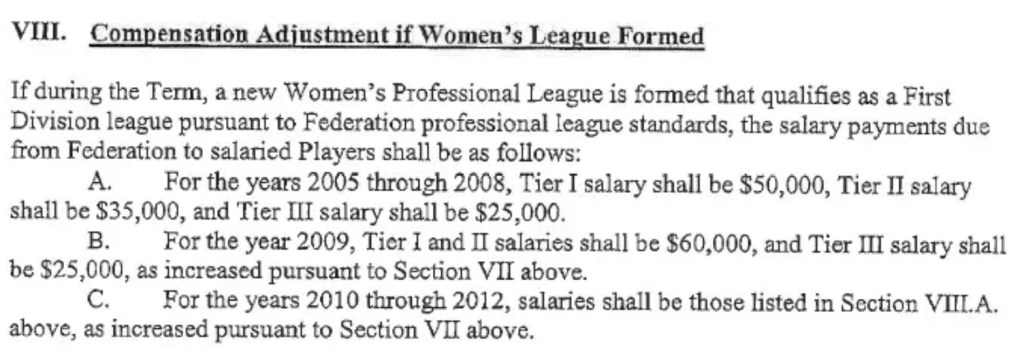
Let’s start with the mildest of the problems — a chart that refers to the “league salary” specified in the 2005-2012 collective bargaining agreement if a league should arise. The CBA doesn’t actually specify a “league salary” because no one had any inkling in 2005 that the federation would pay players’ club salaries. The salaries in question show how the players’ federation salaries would be reduced a bit if a league formed, giving them more income from elsewhere and less time to play national team games.

But the language in the CBA is so fuzzy that we can hardly blame the research team:

So unless you’re fully aware of the context, “from Federation to salaried Players” is ambiguous.

Another sentence is technically accurate but misleading: ““Furthermore, for each game played over the minimum of 20 games, the women would receive no additional pay for a tie or a loss and would receive $1,350 for a win, while the men would receive between $5,000 and $17,625.”

The word “additional” keeps the sentence from being false, but the implication is that the men’s pay is also “additional.” It is not.

The biggest problem, though, is also in that sentence. It’s stated by the women in their EEOC complaint, and it’s a fabrication.

“the minimum of 20 games”

And not just 20 games. Twenty friendlies.

The key sentences from the EEOC complaint:

  • “Specifically, the Federation pays top tier WNT players, such as each of us, $72,000 per year to play a minimum of 20 Friendlies that year.”
  • “MNT players are also required to play a minimum of 20 Friendlies per year.”

If I may borrow a phrase from the great Paul Riley (said in an entirely different context), this is complete poppycock.

The women’s CBA actually specifies a maximum of 92 games — all games — over a four-year span.

The Memorandum of Misunderstanding … er … Understanding completely wiped out any talk of required games. Explicitly.

I sometimes wonder if U.S. Soccer hasn’t settled this case because they just can’t wait to demonstrate this error in court. But they could always do it in the Hope Solo case, which surely won’t settle before we’re all dead from climate change.

Shall we look at how many games the teams actually played?

YearMenWomen
201918 (incl. Gold Cup and Nations League)24 (incl. World Cup)
20181120 (incl. qualifiers)
201719 (incl. Gold Cup and qualifiers)16
201619 (incl. Copa America and qualifiers)25 (incl. Olympics and qualifiers)
201520 (incl. Gold Cup)26 (incl. World Cup)
201415 (incl. World Cup)24 (incl. qualifiers)

They do not play 20 friendlies. Period.

But again — you’d have to be a hard-core soccer fan to know the EEOC complaint was wrong. And we in the media haven’t done enough to tell the truth.

If you already know all this stuff, the Harvard Business discussion won’t tell you much. If you don’t, it’s not a bad place to start.