After my interview with SiriusXM FC today (thanks, Dunny and Janusz), I headed over to the hotel where all the action is at the U.S. Soccer Annual General Meeting to grab a good meal and see who was hanging around.
I found more than I expected:
Hard-core HAO: I’ve been wrong about a few things in this election. One of them — I assumed that because Arsenal’s women play Sunday, Heather O’Reilly would not be at this meeting. As I walked through the lobby, someone from a table (not the table with Kathy Carter mentioned below) that also included Shannon Boxx and Lori Lindsey waved to me.
My brain: “That’s Heather O’Reilly. But it couldn’t be. She has a game on Sunday.”
Yes, she does. And she’s playing in it. On Saturday, she’ll go straight from the meeting to the airport and fly across the Atlantic for Sunday’s game.
That’s how important this meeting and election is to her. And to a lot of people.
I guess I shouldn’t complain about my flight. (Which was actually pretty good.)
“Hey, Eric! You’re on TV!”: I snagged the table in the hotel sports bar in front of the only TV tuned to beINSport, which was doing its election coverage. I looked up at the screen and saw … Eric Wynalda.
I looked back across the room and saw … Eric Wynalda.
He seemed a little puzzled when I insisted to him that he was on TV at the very moment. Safe to say the interview wasn’t live.
Carter holds court: I stumbled into a room where Kathy Carter had apparently just finished speaking. Quite a few dignitaries (voters) were on hand, including John Motta and Kevin Payne. Don’t read anything into that — I still don’t know who’s voting for whom. Motta is clearly one of the big winners in this election — he gets along with everyone, which is very impressive. When I saw him in Philly, he was at a Wynalda event.
I did get to speak with her and was a little surprised to find she has been reading my work. I hope that doesn’t mean she’s reading Twitter. (Motta is a big winner; a big loser in this election is clearly Soccer Twitter, a web of conspiracies and miscellaneous b.s. Seriously. You’ve heard that the non-Carter and Cordeiro candidates are talking about some sort of solidarity statement, and I can confirm that such conversation is taking place. I wouldn’t be surprised if all eight candidates agreed on a statement blasting selected anonymous jerks on Twitter who keep poisoning the conversation.)
Coincidentally, I had listened to the Total Soccer Show podcast on the plane, which I heartily recommend. (The podcast, not the plane, though American Airlines has more leg room on a flight to Orlando than British Airways has on a flight to London.) They pointed out that she has a lot of good ideas in her platform that haven’t gotten a lot of attention. Maybe we’re too focused on asking, “So, SUM is really evil, right?”
Her campaign has had a few missteps. I can’t argue that she’s the best choice, and I can’t argue against people who say they want more of a change in the Federation. But this whole “evil Wasserman/SUM cabal” talk is, to put it mildly, overblown. If she wins, please put down the torches and pitchforks. Work with her. You might be surprised.
I saw Carter a bit later at a table in the sports bar with a few members of the Athletes’ Council. And Sunil Gulati.
Martino’s army: I wandered down the hall after visiting the Carter room and found the room where Kyle Martino has been talking for … I don’t know how long.
I found a misconception worth correcting here. A lot of us have been viewing Martino as a sort of compromise candidate who may win out as everyone’s “anyone but (Candidate X)” second or third choice. What I found in that room: Many people who passionately support Martino. He’s not their second or third choice. He’s No. 1. They love him, and they’re ready to fight for every vote.
And several state reps in the room said they’re looking for change. No one mentioned promotion and relegation. They said they were glad that the Trinidad debacle has helped shed light on the many issues within U.S. Soccer.
I don’t think I’ve ever seen Sunil Gulati take a stage as quickly as he did at the U.S. Youth Soccer gala. It was as if he felt an internal clock ticking as he tried to unleash 20 years of institutional knowledge while a bunch of youth soccer families waited for their dinners.
His hourlong session in Philly was similar. Unfortunately, that’s not posted online. But his speech at the gala is available (see above).
How much of this is the mere venting of someone who’s furious about being attacked on his way out of a long (and, we have to say, accomplished) tenure in office, and how much of it is a reality check on the other candidates and their backers? I’d say roughly 33% of the former and 67% of the latter.
Let’s check out his claims.
The tone of this election: “disappointing and disgusting” (1:15)
You wouldn’t guess that if you saw all the candidate sessions and the U.S. Youth Soccer forum with all eight candidates. (Which, as you know from Twitter, I did.) Everything was civil. The most pointed attack was from Hope Solo, who said Kathy Carter and Carlos Cordeiro have had their opportunity to make change and they have not. Bare-knuckled politics, this is not.
But some of the discussion around the election has been nasty, and Gulati specifically referred to The Truck — somehow left in front of the Pennsylvania Convention Center with neither a demonstration permit nor a special parking permit, according to the helpful city officials I contacted. He says it’s disgraceful. It is, but my understanding is that it’s actually backfiring on some of the more strident candidates, even though they’ve either (A) not claimed credit or (B) actively said “no, I didn’t do that.”
“At the last (Annual General Meeting), things seemed to be pretty good.”
In his hourlong session, Gulati went overboard in talking about how smoothly everything has run for the last 12-20 years. (See my post about it and search “roundup of transcripts.”)
Here, his basic point is half-right. Some issues are bound to have more light shed on them when we have an election. A lot of people are frankly ignorant about USSF in general. But he has a point that some folks who are now suddenly experts on everything USSF should be doing better were awfully quiet a few months ago.
Transparency
Gulati seems shocked that this is suddenly an issue, and he’s happy to compare USSF to any other similar federation. How many have independent directors, he asks? (Not many, but the USSF search committee landed on far too many people who have some sort of tie to Gulati, Columbia, etc. You’d think they could at least get someone from the West Coast.)
He’s on slightly firmer ground when he talks about open board meetings (they have them, but they go into executive session far too often). He says they print every word of meetings, which is true for the National Council meeting (the big one, with everyone) at the AGM but not true for the board meetings, which have minutes that don’t really tell us much. He could’ve mentioned the AGM “book” with all the reports, which is usually released to the public at some point, though it’s a little hit-or-miss.
And they publish financial statements, as required by U.S. law but not required in many places elsewhere in the world. Yes, though we’re still waiting on the statements for the year ending March 31, 2017.
I think Gulati has a point here, but I’m willing to admit I’m a little biased because I’ve been frustrated by the sheer volume of people — mostly anonymous folks but also some candidates and their reps — who claim not to know something that’s right there in plain view on the USSF site.
Of course, the biggest transparency question is in regards to ….
Soccer United Marketing
“Everyone is conflicted in one way or another” may not be the best way to open this segment, but he’s absolutely right. By design, the National Council consists of representatives of all the state associations, and the board consists of representatives of the various councils.
He gives the history of SUM that we heard in a few other places in Philly — rewind to 2003, when IMG wanted out as the USSF marketing company, and SUM (formed in 2002 to save MLS) stepped in.
He says the agreement to renew SUM has been approved unanimously by the board three times. I’ve started to look into this. There’s an old trick — so old that I saw it in the very first board meeting (local hospital board) I ever attended as a journalist — in which the board has some debate but agrees to record the vote as unanimous. I have no evidence that USSF has done this, and I also haven’t heard from any disgruntled board members asking about SUM, and to my knowledge, no one else has. (There were reports that some board members wanted answers about how the Klinsmann contract was handled, a completely different issue, so it’s not as if the board is totally closed off to outside communication.)
Promotion/relegation: Changing the rules on people for undetermined benefit
This is at the 5:50 mark. And he’s right. I wish we’d have more discussion on potential ideas to phase into pro/rel, but I’m not sure how to make that happen. Maybe after the election, when we either have an open pro/rel advocate as president or the pro/rel-minded owners realize they’re going to need to work with the new “establishment” to make it happen.
No, the MLS summer schedule isn’t the reason Qatar is hosting the 2022 World Cup
Nor is it why Morocco could win the World Cup rights for 2026. He also points out near the end that whatever FIFA could complain about within U.S. Soccer can’t be fixed in the four months that remain in the World Cup bid campaign.
He’s right.
(I’ll skip the bits about whether to pay the president and what a “soccer person” is. He says little on the former, and he’s justifiably snarky about the latter.)
Now we’re getting to what he calls his fact check, starting at the 8:20 mark.
Gulati disputes claim: No one ever called Jonathan Gonzalez
He says Tab Ramos talked at the convention about how many times they talked, and he says Christian Pulisic called Gonzalez at Gulati’s request. He concedes USSF may not have done enough but blasts the idea that no one ever contacted Gonzalez.
He’s surely right by the letter of that statement, but most reasonable people aren’t saying USSF had no contact with Gonzalez.
Gulati disputes claim: We have “utter chaos in the states”
Gulati says USSF used to have a grievance or appeal every few weeks, and we haven’t had as many lately, which is a credit to the federation as a whole. From the available evidence, he’s right — if we’re defining “chaos” strictly as grievances and appeals. I’d make the case that “the states” are in chaos because youth soccer is in chaos.
Gulati disputes claim: In the Development Academy, we shouldn’t have the same restrictions on substitutions as we have in the rest of the world
This is an odd one in this list because it’s not a “fact.” That’s an opinion. He scoffs at the idea that the Development Academy should have more freedom of substitution than we have in pro-level games. I could frankly see an argument either way. North Carolina’s legendary women’s coach Anson Dorrance has pointed out that he has a lot of players who’ve made a commitment to play for him, and he thinks he should be able to spread out the playing time.
In any case, again — that’s not a “fact.”
Gulati disputes claim: USSF is out of compliance with 13 FIFA statutes
Wynalda actually said “bylaws or statutes.” In any case, Gulati says this is simply false, and in a few cases where we are out of compliance, it’s because we would be out of compliance with U.S. law.
“We’ve made it clear we’re not going to violate American law.”
The example he gives is training compensation and solidarity payments. “We’ve spent a lot of money with a lot of lawyers,” he says, and player reps have made it clear they will sue youth clubs who try to claim compensation.
This is one of those cases in which it’ll surely help to have new people at the table. Gulati’s surely correct on the facts here. But it doesn’t mean there’s no solution available.
Gulati disputes claim: “Heard from a self-confessed TV expert that 50% of our revenues come from TV.”
Easy to check, he says. It’s closer to 15-20%. “That’s only a several-million dollar error in the budget,” he quips.
No, it’s not easy to check, even if USSF’s accountants made every possible best-faith effort to explain it. How do you separate “sponsorship” money? How much sponsorship is predicated on TV appearances?
So I’m not sure I buy the notion that we can put a hard number on it. But I also have a hard time buying the notion that TV is “50%.” The Wynalda campaign is, as always, free to contact me to explain this figure.
Gulati disputes claim: “The board has little actual business acumen”
This one is also somewhat subjective, but I think Gulati makes a very strong point here. The independent directors in particular have plenty of business experience.
Side note: I’ve heard the claim that “business acumen” from Goldman Sachs and so forth is irrelevant because we’re talking about a nonprofit here. OK. But the board also includes, as Gulati points out, a former university president.
In fact, under Donna Shalala’s leadership, the University of Miami was ranked the most fiscally responsible nonprofit in the country, as I just learned. (Google is fun!) I wish I’d known that when someone talked my ear off about this topic.
Gulati disputes claim: “USSF needs a membership services department”
You may argue, but I’ve heard from several people within U.S. Soccer who aren’t necessarily Gulati loyalists than up to 90% of what candidates say USSF should be doing are things USSF is already doing.
Maybe that’s exaggerated. But I have little doubt that the next president will be surprised to learn that some of his or her campaign points have already been addressed.
Gulati disputes claim: “We need multiple pathways that we don’t have now”
He claims they’re still sending scouts to ODP. How effective they are is anyone’s guess.
The finish
Gulati finishes by asking people to ask questions of the candidates. Hard questions.
He’s right. And we’ve got a few more days. Send me your questions, and I’ll ask.
In one week, U.S. Soccer members — from big-shot board members to little-known delegates from far-flung state associations — will descend upon a hotel just outside Disney World and Sea World. They’ll have two days of preliminary meetings and a welcome event at Hollywood Studios. (I have not yet inquired about Fastpasses for Toy Story Mania.)
Then on Saturday, it’s the Big Vote. Eight candidates enter. One takes over the presidency from Sunil Gulati.
And we still have so many questions left unanswered. So many ideas that haven’t been fully vetted. So many vague statements.
So let’s come up with a list of questions — some for all candidates, some for specific candidates. Then I’ll see if I can get them answered.
You can leave them as comments here. You can email me. You can hit me up on Twitter.
Here are a few to get us started:
ALL CANDIDATES
Paralympics
What will you do to work with the 7-a-side program (for athletes with cerebral palsy or brain injury) while it’s not part of the Paralympic Games program?
Can anything be done to start a 5-a-side program for visually impaired athletes, a sport that is in the Paralympic Games? Have you already had conversations with athletes about doing this?
Futsal
Most conversations about futsal in this campaign have focused on using it as a youth development tool. But we have a men’s national team and a couple of budding pro leagues. What’s the next step for building out the game at the elite level?
NWSL
Name three things that can be done to improve the women’s league.
Women’s national team
Will you try to negotiate both the MNT and WNT collective bargaining agreements at the same time?
Hypothetical: You’re negotiating with the WNT. They ask for 24 players to be put on full-time salary with restrictions on the number of “floaters” who can come into camp. The coaching staff has warned that they need flexibility to call in players who are impressing in the NWSL and Europe. What’s your next move?
Youth soccer
Hypothetical: Let’s say the state associations, backed by a national movement of parents and coaches, ask USSF to standardize leagues throughout the country, folding the Development Academy and other elite leagues into a clearly defined pyramid with promotion/relegation and more local play (less travel). U.S. Club Soccer, predictably, gets very upset. What’s your next move?
Will you tell Development Academy clubs to let their players play high school soccer? Do you see any sort of compromise (say, letting kids play their junior and senior years)?
Open Cup
Hypothetical: You’re trying to sell the Open Cup as a separate TV property. The best bid you have is from an online streaming service that just launched a year ago. They’re offering four times as much as any traditional broadcaster. What’s your next move?
NEW! Should the Open Cup run a fall-to-spring schedule that isn’t tied to the summer leagues (NPSL, PDL). If so, would you favor a separate Summer Open Cup for those leagues?
Promotion/relegation
Would you be open to a modified promotion/relegation system in which clubs can’t be relegated below a specific floor (for “major” clubs, D2; for other fully professional clubs, D3)?
Hypothetical: You get a conglomeration of leagues to agree to set up a pyramid. MLS says it will not participate. The top league in your pyramid applies for D1. The task force recommends approval. MLS lawyers up. What’s your next move?
ERIC WYNALDA
Some lawyers and others with experience in the nonprofit world and with NGBs are skeptical of your idea to turn USSF into a lending bank. How would you respond?
Will you please, please stop saying “international calendar” in reference to the fall-to-spring calendar that isn’t used in half the world? (Sorry, pet peeve of mine.)
HOPE SOLO
Where did you hear the incorrect statement that U.S. Soccer coaching licenses are not age appropriate? (The purpose of this question is to find out where she’s getting misinformation like this and whether she has taken steps to find better sources of info.)
If you win the presidency, you will be in the position of defending the federation against a grievance you filed. What’s your next move?
KYLE MARTINO
In your Progress Plan, why would any club created after 2024 be “non-league”? What happens if we have major demographic and climate shifts?
Why move all of U.S. Soccer to New York and not just have a satellite office?
CARLOS CORDEIRO
You’ve demonstrated a reluctance to do interviews. How will you adapt to the role of president, when you be required to do many press conferences?
KATHY CARTER
Is it a conflict of interest to have the head of SUM, Don Garber, serving on the Board as long as it’s been in its current (15-member) configuration AND serving as the chairperson of the Nominating and Governance Committee? If not, why not?
What happened to SUM’s site? It’s now redirected to a page on the quasi-independent MLSSoccer.com.
Would MLS expansion fees be cheaper if new owners did not get a share of SUM? Is there any way to untangle that relationship?
Would MLS be in good shape, financially (either profitable or running a loss only because it’s investing in future growth), if it were separated from SUM?
Plenty of people who understand how SUM helped save professional soccer in 2002 question whether it’s still necessary in its current form (co-mingled with MLS) today. How would you respond?
With its callous attitude toward Columbus, MLS has already staked out a “thanks for getting us off the ground, now go away” attitude that Don Garber must fix before he either leaves office or renews his contract.
Are we seeing the same thing in pro women’s soccer? It’s complicated. We might not know a complete answer until we know the lineup of teams for 2019.
But it’s not looking good.
We might be able to absolve the NWSL of blame for the fact that 2018 will be the first season of pro women’s soccer in the USA without a team called the Boston Breakers. They weren’t the strongest club in WPS — see general manager Andy Crossley’s dissections of his handiwork for more details on that and yet another reason to add Curt Schilling to your list of the worst human beings in sports. And they never really found a good home ground in the NWSL — Dilboy Stadium was about as “track-and-field-specific” a venue as anyone could find, and Harvard’s Jordan Field was OK but tiny.
So when word spread that the owners were trying to sell, no one could really blame them. We may never know what happened with the new owners who, as of a few days ago, seemed set to buy the club and continue into the new season. Was the league completely blindsided? Or should they have done more to wrap up the deal or reject it in time to let others have a chance? Would the league have a more potent voice if it made up its mind as to whether Amanda Duffy is the interim or permanent commissioner, executive director, CEO or whatever they want to call their leader?
As we know now, others did indeed leap into the fray to try to save the team. I spoke with representatives of three different camps, some of whom are opposed to each other on other issues. They were confident that they had investors with enough money to keep the Breakers running. They were less confident that they had time for everyone to get through due diligence. After missteps of the past — Jeff Cooper’s mysterious money men bailing on St. Louis, Dan Borislow taking the Washington Freedom to Florida and butting heads with authority for a year until the league finally collapsed — “due diligence” is not something that can be skipped.
Whatever happened has happened. The question now: Is there any chance of reviving the Breakers in 2019?
What I’m hearing isn’t positive. Nor is the fact that the NWSL has not responded to my inquiries over the weekend about the Breakers situation, first to get comment on the last-ditch effort to save the team and then to get comment on what happens next.
The answer affects more than just Boston. Like the Crew in Columbus, the Breakers name means something to soccer fans. It’s an original.
And for all the bluster of MLS-affiliated women’s teams being better situated that everyone else, look who had the most extensive youth and reserves operations — the Boston Breakers, along with fellow independent Washington Spirit. (At least the Breakers Academy will continue. FC Kansas City also still has Academy games scheduled, resuming Feb. 10.)
Something dies every time a team folds or moves. MLS has lucked out so far that things have turned out well in the long run, but that streak could end very quickly if the Crew move. And if the NWSL can’t act on the obvious interest to restore the Breakers next year, the league’s credibility will suffer.
I’ve received a lot of pushback on the notion that Eric Wynalda is the front runner.
No, it’s not Sunil Gulati and Don Garber calling. These are people who are plugged into soccer politics, in some cases even moreso than I am, even after my obsessive coverage in the past few months.
I’m still not convinced Wynalda isn’t the front-runner. I understand that some people have an “anyone but Wynalda” attitude, just as some have “anyone but Carter” or “anyone but Carter and Cordeiro.” I still think that Carter has a very difficult road to 50%+1, and I think the opposition will eventually join forces behind one candidate, and the most likely candidate fitting that bill is Wynalda. But I could be wrong, and perhaps we’ll see a compromise between the “no Wynalda” and “no Carter” camps that gives us a President Martino or Gans or Winograd or I Have No Idea.
But one thing has become clear: Wynalda’s stock dropped in Philadelphia. The forum in which he promised solutions, truths and the gloves coming off, with none of them happening. Fairly or unfairly, some voters may resent the truck with the nasty protest, even though he disavowed it. (He did not, of course, disavow the statement implying Kathy Carter and Carlos Cordeiro are not “soccer people,” a message that didn’t sit well with a lot of people and tends to undermine his anti-elitist stance.)
Then consider this from the New York Times piece:
“Fine,” you might say. “He’s the insurgent attacking the status quo.”
But consider the voters. Adult Council. Youth Council. Pro Council. Athletes’ Council. All of whom combine for about 95% of the vote. All of whom also elect representatives to that board.
None of this means that Wynalda’s campaign is sunk. I still think he has a better chance of winning than any other candidate. But that chance is probably less than 50%. There are eight candidates, after all, and you can’t really rule many of them out.
So when we heard yesterday, when Wynalda called in to Jason Davis’ show to say he’d finally be releasing a plan of some sort, the stakes were raised. This could put him over the top or not. (And we have to wonder whether it’s too late — all the state reps with whom I spoke in Philly seemed to looking at the convention as the last bits of info they would take home to their boards before making decisions.)
PAGE 2: Inclusive. Consensus-building. Experience — player, coach, technical director, owner, TV. “Move toward future compliance with FIFA standards” — a point that really needs to be explained, especially when we keep hearing about this inaccurately named “international calendar.”
And this is not the comprehensive plan. Position papers are forthcoming. Clock is ticking. But let’s see what’s here …
PAGE 3: Table of contents
PAGE 4: A picture of a calculator. People still use those?
PAGE 5, PART 1: Registration Rewards Initiative. He wants to return the $1/youth and $2/adult fee back to the youth and adult organizations. He says there will be a $1 “bonus allocation” for meeting certain criteria. These fees, he says, can really help the youth/adult organizations, while USSF is no longer dependent on them. The numbers back him up on this.
PAGE 5/6: >$5 Million in Annual Support, Grants and Scholarships to Membership Groups. He’s really talking about 5% of “unrestricted investable assets,” saying this is in line with how nonprofits use their endowments. “Many candidates talk about funding new programs but have yet (sic) identify definitively how to develop funds for those purposes.” Someone who gets fund-raising and nonprofit finance better than me will have to explain how this works and how it will impress voters more than, say, Carlos Cordeiro saying the federation is already planning to spend its $150 million-ish reserves down to about $50 million. Wynalda’s plan might be more of a long-term cash stream, while Cordeiro may be talking about a set of one-time investments. I don’t know.
PAGE 6: Internal Loans. Wow, I really don’t understand this. Literally. He seems to be saying state organizations and other organizations could get loans from U.S. Soccer. Someone will need to do a study to see if that’s actually an improvement on just funding programs.
PAGE 7: Monetize the U.S. Open Cup. “Multiple media executives have asked why the US Open Cup has not yet been packaged and monetized in a meaningful way and have identified themselves that it is a grossly undervalued asset and represents an untapped source of funds for the USSF itself.”
Let’s get this straight — and this echoes something he said in Philly. Is he saying there are multiple media executives who, instead of contacting the people who actually run the U.S. Open Cup, decided to ask Eric Wynalda? Or are there people at U.S. Soccer who heard a pitch to monetize the U.S. Open Cup and said no? Did they ask the Open Cup Committee, which has actually done some pretty good work to build up the tournament? (Eric, I know you’re reading — please let me know what you mean here.)
PAGE 8: A picture of Soccer House
PAGE 9: Transparency starts here with Apply for a public credit rating with Moody’s or Standard and Poor’s, which would obligate USSF to another annual review on top of what’s required for the 990. Seems like an interesting idea, but again, I’ll need to hear from nonprofit econ experts.
Then …
The USSF should create a non-voting sub-committee of the Board that includes a diverse selection of membership that is expected to attend all USSF Board meetings and that would be encouraged and supported to share their opinions and voices on public matters. The USSF management team would be obligated to host a conference call with this subcommittee no less than two weeks ahead of each scheduled USSF Board meeting to update members, provide information on planned agenda for the Board meeting, and to share public materials that will be discussed at the Board meeting itself.
At the very least, the wording here is poor. A “sub-committee of the Board” would be composed of Board members. If he means some sort of group of non-Board members that would be like a shadow Board, I think he’d want to go back and see why the board (sorry to switch cases here) went from 40 to 15. That was following what the USOC and others were doing at the time.
I get what he’s saying, but I think there’s another way to do this. Why tell a subcommittee what’s on the board agenda and not the whole membership?
PAGE 10: Clearly Defined Competitive Bidding Policy. This will be popular, and probably with good reason.
PAGE 10: Develop Conflict of Interest and Risk Management Policies. The board has done and is doing this, but there’s certainly room to ask whether they’re doing enough.
PAGE 11: Office of Ethics, Integrity, and Inclusion. It’s the sort of idea that sounds good in a vacuum. The question is whether it’s really better than the mechanisms that are in place now. Do you need to replace the mechanisms or replace the people?
Included in this: Restart the Diversity Task Force, and I know no good argument against that.
PAGE 12: Picture of scarves.
PAGE 13: Establish Membership Services Team. Sounds kind of like what Steve Gans has been saying.
PAGE 13-14: Support Network for National Team Players. OK … I guess? The idea of having a group to guide players into a post-playing career sounds good, but why would we limit it to national team players? Why not help players who probably made a lot less money?
PAGE 14: Consulting. In conjunction with the internal bank.
And that’s it. Until the position papers come out.
So … I don’t know what to make of this. Some of the ideas are obvious (and good), some are less obvious and still good (the Registration Rewards Initiative is, at the very least, worthy of future discussion), others just seem arcane and off-the-wall. Do we really want the U.S. Soccer Federation to turn into a USAA for soccer? If someone more knowledgeable about nonprofits can tell me if this works, I’d be happy to hear it.
Then some of it seems surprisingly elitist. A subcommittee that shadows the board but just seems to be an unnecessary bulkhead between the board and the membership? Mysterious media executives who aren’t approaching the Open Cup Committee (Mike Edwards, Todd Durbin, USL’s Jake Edwards, USASA’s John Motta, NASL’s Rishi Sehgal and retired MNT player John O’Brien) with a plan to invest megamillions but are approaching Wynalda?
I don’t get it. Someone feel free to explain it to me.
This week’s guest, Charles Boehm, is a player, coach, referee and writer — check out his intro at the 2:45 mark and learned where he played alongside future non-U.S. national teamers. Like me, he was in Philadelphia for the United Soccer Coaches convention and attended many of the U.S. Soccer presidential candidates’ sessions.
We talk about what makes a soccer person and what makes an elitist (5:30), whether Eric Wynalda is the front-runner (8:00), the “anyone but (so-and-so)” approach to voting (9:45), what the candidates showed us in Philly (13:05), Kathy Carter and Soccer United Marketing (24:10), what’s changing in U.S. Soccer (30:00-ish), then youth soccer and the surprising focus on ODP (38:15).
I didn’t get around to finishing my thought on why I was once the best U12 center back in Athens, Ga. The answer is the same reason why I was once a competent over-30 coed indoor goalkeeper: Reckless disregard for my own safety. It surely had nothing to my skill. It also had a lot to do with the fact that not many kids played soccer and even fewer wanted to play defense.
Point 1: Why this weekend will be huge for the U.S. Soccer presidential election. (2:02)
Included in that: Why I’m skeptical of current election projections (including a NewsRadio reference), what the Number 1 issue in this election should be (8:10), a few surprising things on Paralympic soccer (8:30), a question of what we’re really saying about futsal — the next beach volleyball? (9:30), SUM and pro/rel (11:30), and finally back to the Number 1 issue and how it overlaps with other major issues (18:00).
Point 2: The new U.S. Soccer coaching curriculum, grassroots level (22:15)
Included in that: Welcome to Disney (25:55), introducing tactics at 4v4? (26:20), the painful irony of the chosen video clip (27:15), U6 parent coaches developing their own coaching philosophy? (28:00), the nice tone (32:25).
Point 3: Soccer discourse, Twitter (33:40)
Include in that: What we all have to offer (34:15), why dealing with crap for 15 years makes these discussions difficult (35:45), different types of people (36:45), the ideal outcome of the Kathy Carter candidacy (39:30).
Next up for Ranting Soccer Dad (40:00). Basically, I’ll get back to interviews at some point and quit soloing like this. (And yes, I finally bring it full circle.)
Did I say consternation? I meant confusion. Perhaps they shouldn’t make footnotes bigger than the headlines. (As an aside: Due to the collapse of the newspaper business model, hundreds or maybe thousands of people who worked in editing/page design have been displaced in the past decade and change. So, businesses and nonprofits? Hire them. Communication is good.)
So once you realize that the footnote is actually a footnote, it starts to become a little clearer. Chart 2 (which is the first chart in that screen capture) gives the numbers from all games and compares them in the last column to the same numbers from 2016. Chart 3 (the second chart) omits the numbers for the games outside USSF’s commercialization capabilities and compares those games to the same numbers from 2016.
But to put it in full context, you have to go back to the previous year’s book …
… which doesn’t have the same sort of figures. Oops.
We do have this …
And that tells us pretty much the same thing — 2016 was an outlier for both the MNT and WNT. The men had the Copa America Centenario. The women had the Olympics.
We can easily explain the women’s ratings here. Chart 2 is comparing the WNT games of 2017 to the WNT games of 2016. The latter would include the Olympics, so of course, the 2016 ratings are going to be considerably higher. Chart 3 would omit the Olympics from that comparison because USSF doesn’t have those rights. In 2017, USSF had the commercial rights to every WNT game, but in 2016, they did not.
So I have a couple of remaining questions:
What’s a “year”? The WNT played 16 games in 2017 — 13 in the USA, one in Canada, two in Europe. Were four not televised? Off the top of my head, I can’t recall that. If it’s a fiscal year, then it’s a partial year, isn’t it?
What’s included in the list of games USSF can’t commercialize? The Olympics, certainly, but that only affects the WNT. How were 10 of 18 MNT games not included? They played 19 games in 2017 (see ratings at World Soccer Talk, though those are English-only) — eight World Cup qualifiers (four home, four away), six Gold Cup, five friendlies. The away qualifiers are tricky, which is why the biggest debacle in U.S. Soccer history was only seen by those of us with beINSports. Does USSF get nothing from Gold Cup even with SUM in the mix?
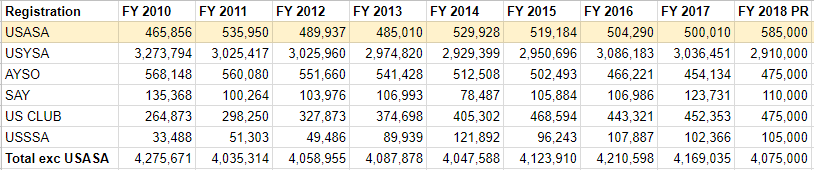
On another note, I’ve compiled registration-fee numbers from every organization from the last eight years. And they tell us … very little?
Quick reminder: USSF charges adults $2 each, so the USASA registration numbers are basically the USASA fees divided by two. (Unless there are some waivers somewhere.) The youth fee is $1 per player.
But we can’t quite equate that last line to the number of youth players registered. Here’s why:
U.S. Club, USSSA and maybe AYSO numbers might include some adults.
Some youth players may be registered in more than one organization (a point Eric Wynalda is making).
Yet this is an apples-to-apples comparison from year to year, for the most part. And … I can’t really detect a trend. I see fluctuations that could be accounting flukes as much as anything else. The numbers are basically flat.
And yet we keep hearing horror stories (and I keep repeating them — in several presentations and maybe even a book over the past few years) of participation dropping. Take a look at Project Play, which says the percentage of children aged 6 to 12 who participate in outdoor soccer plummeted from 10.9% in 2010 to 7.7% in 2016.
What’s going on here?
Consider the methodology. The Project Play numbers come from an online survey of 24,134 “individuals and households.” Could our changing online habits (less computer, more phone) be skewing the numbers? (I’d turn it over to a data scientist, but after the 2016 election, I’m starting to view “data” as applied to polling with a higher margin of error than the data scientists would care to admit.)
Could it be that there are indeed fewer people playing soccer but that USSF’s organizations are managing to register a higher percentage of those people? Isn’t that the opposite of what we’re hearing from the presidential candidates — that tons of kids (and adults) are playing in unaffiliated leagues?
Hard to say. But the evidence certainly doesn’t point to a sport on the rise. (Please don’t respond by saying the numbers are increasing in high schools. That’s generally a function of having more high schools. The number of soccer players at a high school of significant size equals the number of players they can take, not the number who are interested. My local high school could probably field 10 teams if they had the field space. They have four — boys and girls varsity and JV. A lot of travel soccer players won’t make the cut for either one.)
So whether this is an outright crisis or just a little hiccup, it’s worth addressing.
If you can derive any other conclusions or insights from this, please share.
Paul Caligiuri has kept a low profile through much of this election. He has a Twitter account but uses his tweets economically for things like his Open Letters, including one on NWSL representation.
My second Open Letter to USSF. This concerns the potential unequal voting structure in the upcoming election which… twitter.com/i/web/status/9…— Paul Caligiuri (@PaulCaligiuri20) December 30, 2017
But with a month to go, Caligiuri is stepping forward. He has launched a site with a platform that lists some of the same ideas as other candidates (with eight candidates and general consensus that we need better coaching education and lower costs, it’s hard to avoid overlap) but also some of his unique ideas, such as using high school coaches as additional scouts.
I followed up with a couple of his ideas by email. Here’s the exchange, unedited (he has some idiosyncratic punctuation and capitalization, but I felt he was doing so to emphasize certain points, so I didn’t want to assume I knew what he was intending):
You mention a new curriculum. How would this differ or improve upon the curriculum Claudio Reyna unveiled in 2011? (I never saw much implementation of that curriculum.)
A new curriculum would include new methods. i.e.Implementing a standard Pass and Receive program the moment a player joins soccer. Imagine what a player can do provided he or she is given the proper tools from the beginning. Far too often, a youth player has played 2-3 years, yes years of soccer and still cannot receive or pass the ball properly. If a player can effectively receive and pass a ball, they will begin to explore and do more on the ball. I believe that one implementation alone will help a youth player become more creative.
Standards for Scouting – Training and resources, etc… Working together and utilizing All of our resources.
You mention making men’s and women’s national team salaries equal. As it stands now, Women’s national team players are on salary, while the men’s national team only receives bonuses. Would you put a group of men on salary? Or take away the women’s salaries in favor of higher bonuses?
Firstly, I founded the United States National Team Players – I have a lot of experience in the area. From my recent talks with both the MNT and WNT the issues will be easy to fix, but only by someone that has the right mentality and sensibility to their issues and concerns. There in no other candidate has my talent in this area. It is not about negotiating billion dollar deals or sitting across a corporation in negotiation, these are our players, the product of US Soccer. I have been there, done that and relate to All their concerns and am 100% confident that everyone will be satisfied and our NT’s will be the best we have ever seen. This will never be a distraction again to our players. Period.
x x x
Also, he mentioned that he will be unveiling a full-fledged plan at the USC convention next week.
Caligiuri and the other three candidates who have not yet been on the podcast (Kathy Carter, Carlos Cordeiro and Hope Solo) are still invited to join me, but with time growing short, I would expect to do more email interviews. I might get a podcast out this week, but I don’t expect to be back on a regular schedule until after the Olympics.
My Dad was an intellectually rigorous man. He majored in philosophy, racing through college so he could lead a platoon in Korea, then returned from the war to get his doctorate in the emerging field of biochemistry. He remained in the Marine Reserves, rising to the rank of colonel, and was a stern but beloved faculty member at the University of Georgia for more than 40 years.
At one family holiday gathering, he demanded to know everyone’s views on abortion. The answers ranged from the biological (we had one doctor in the room) to the theological (one Episcopal priest) to the anecdotal. For the most part, he was impressed.
So what was his position? “Oh, I still don’t know,” he said.
Dad was certainly opinionated about some things. In other cases (abortion, Israel, etc.), he saw a difficult balance of legitimate views. The common thread was the process.
The point of the story: I was raised to believe in the Socratic method of asking questions, sometimes taking it to the extreme. Journalism was therefore a logical (but frustrating) career choice.
It’s also a misunderstood career, especially these days.
Seems like Soccer Twitter has become a place where lots of people expect, even demand, advocacy but are made confused & suspicious by analysis. "Pick a side or else."
Granted, objective journalism isn’t really in vogue these days. In sports, more journalists are embracing homerism. In journalism at large, Jay Rosen has raised pointed questions about the legitimacy of the “view from nowhere,” which is unrealistic. In my experience, blind adherence to airing “both sides” is ripe for abuse. Sometimes, one “side” is telling the truth and the other is lying, and it’s a journalist’s job to say so.
In my own work, I’ve certainly felt emboldened to be a little more opinionated in the last seven years or so. One reason: I think we’re in danger of losing the war on bullshit, so we need to be a bit more aggressive in challenging the liars. Another reason: I left USA TODAY, where the management of the time wanted to rock the boat as little as possible, and I found freelance clients (bless you, The Guardian and FourFourTwo) who offered a bit more freedom. And getting older gives everyone a bit more freedom to speak up.
But at heart, I’m still someone who likes to get to the truth. That sometimes means challenging people with whom I’d usually agree. I questioned the women’s soccer national team in their labor dispute over a few misrepresentations and lack of clarity — their lawyer refused to say anything beyond “equal pay for equal play” in comparison with the men’s team, even though the men don’t draw salaries and play different competitions.
A lot of people don’t get that. Anyone who asks questions must be the enemy. Scorn them. Mock them. Attack their credibility.
And, of course, some people are just jerks.
My default on Twitter is to engage. I do learn a lot from the discussions, and they help me get my thoughts in order, like an ongoing rough draft.
But I’ve spent too much time in the past year engaging with jerks. Or people who just don’t get it.
I’m actually going to do the opposite. I’m going to declare a Christmas amnesty and unblock a lot of people. Not all. I blocked an “Infowars” guy, and I’m not going down that road again.
We’ll see how long it lasts. If I had eternal patience, I’d run for a soccer board position.
 He’s on slightly firmer ground when he talks about open board meetings (they have them, but they go into executive session far too often). He says they print every word of meetings, which is true for the National Council meeting (the big one, with everyone) at the AGM but not true for the board meetings, which have minutes that don’t really tell us much. He could’ve mentioned the AGM “book” with all the reports, which is usually released to the public at some point, though it’s a little hit-or-miss.
 Then on Saturday, it’s the Big Vote. Eight candidates enter. One takes over the presidency from Sunil Gulati.

 Duresport.com