us soccer, women's soccer

Will the U.S. women’s back pay demands hurt future women’s soccer players?

I’ve been covering women’s sports for about three decades now. Not as 100% of my job — through most of my employment, I’ve had a lot of editing and online responsibilities as well as reporting — but I’ve amassed a considerable amount of women’s soccer stories (and a book) and a lot of women’s coverage in my Olympic sports work.

Lately, that’s been less game coverage and more issue coverage. How can we keep young athletes safe from sexual predators like Larry Nassar? How do Olympic sports athletes support themselves? How can an athlete stay in a sport in which women have been denied a spot in the Games?

It hasn’t been good for my career. I lost money on my book, though I could’ve done a better job reporting it. An editor (a woman, and she was a great boss) once told me I should cut back on covering women’s soccer, and I didn’t.

I’ve also delved deeply into U.S. Soccer finances. Haven’t made a lot of money on that, either. The Guardian and Soccer America are good to me, but I’ve done so much extra work on this that my income is far under minimum wage.

I’ve also covered youth soccer. It’s a mess. That’s a big reason why I have a book out now called Why the U.S. Men Will Never Win the World Cup.

But it also has the potential to ensure that the 2019 Women’s World Cup win will be the USA’s last. The rest of the world is catching ahead, and staying ahead will require well-spent money.

So when I see that the U.S. women are looking for $66 million, I have to go back to the math.

U.S. Soccer, of course, has countered with a motion for a summary judgment of $0. I’m guessing negotiations aren’t going well.

And we should say at the outset that such motions, no matter how many volumes of documents are printed in support, still don’t force the court to play “all or nothing,” as the eminent sports law professor Steven Bank points out.

But if the women were seeking $10 million, we wouldn’t be having this conversation at all. $20 million? Possibly.

Here are a few points demonstrating that neither the Fed ($0) nor the players ($66 million) have taken a justifiable stance.

$66 million is more than even the most generous computation I can find.

I ran the numbers last summer, using the assumption that the U.S. women would ask for the same bonuses the U.S. men would have received had they won the World Cup. That wouldn’t meant the women, who under the current CBA get close to 100% of FIFA prize money if they win (once you include the Victory Tour bonus, which is paid on top of their regular pay for four friendlies), would have received more than 1,300% of FIFA prize money in 2015. (The winning country received $2 million. The men’s bonus for winning would’ve been more than $26 million.)

I came up with $50,365,524.

You can make your own calculations and run different scenarios if you like using this spreadsheet. You can also download from GitHub.

The Federation’s mandate is to grow the game, which will make it possible for the men to get better and the women to stay on top

A lot of people look at pay in a vacuum, as if U.S. Soccer is an NBA team and players should get a specific part of the revenue. But we’re not talking about billionaire owners here. (Yes, we’re talking about overpaid executives — we’ll get to that.) This is a nonprofit organization that is responsible for coaching education, referee education, Paralympic soccer, youth national teams, etc.

The Federation is way behind other federations in this respect

U.S. Soccer doesn’t have the scouting or coaching infrastructure that other countries have.

That’s one reason the men haven’t done as well as anyone would like.

That’s one reason the women’s youth national teams haven’t done well recently, either, and that bodes ill for the future.

The Federation is trying to address this by spending a pile of assets it accumulated, much of it by hosting the Copa America Centenario, on new programs

The initial idea was to spend it down to $50 million. Thanks to legal fees, that’s now $42 million.

Which is less than $66 million.

That said, we don’t know how well the Federation is spending that money

Take a look at the Federation’s budgets — not just in FY 2019 but in past years as well.

A couple of things seem sensible. They’re spending more on the U.S. Open Cup and much more on referee and coaching education. They’ve also spent a bit on technology so they can keep track of players and shore up the Fed’s awful web sites. They’ve launched a terrific Innovate to Grow grant program that was a big hit among state federations (who deserve none of the blame for the Federation’s spending or contract negotiations) at the Annual General Meeting.

But in the Annual General Meeting book (see AGM books tab on the spreadsheet linked above), they have a $3 million line item for “Various.” And executive pay is out of whack. Maybe they can go without replacing Jay Berhalter. (Not Gregg. They still need a men’s coach.) Maybe they don’t need to hire so many staffers and relocate them to Chicago.

Still, the new CEO will probably command a lot of money, maybe even more than Dan Flynn made. They need someone good.

It’d be cool if they hired a woman, right? Maybe a former Board of Directors member?

Historically, the Federation hasn’t treated the women as well as they should have

There’s a reason the women went on strike in 2000. There’s a reason they filed an EEOC complaint. And the new collective bargaining agreement should have equalized some things that could’ve been equalized. (You could argue that hiring lawyers who have lost multiple times to U.S. Soccer was a bad idea on the women’s part.)

Hank Steinbrecher is gone. Dan Flynn just left. Sunil Gulati is an ex officio member of the board.

And to be sure, they’ve invested more into women’s soccer than other federations. Yes, even Norway and Australia, with their much-hyped “equal pay” deals that (A) don’t account for the differences in prize money that the U.S. women clearly want to address and (B) don’t pay either team that well, especially in Norway.

But they left a mess. There’s no reason the women’s CBA shouldn’t have equal bonuses for friendlies at the very least.

One important myth to debunk here: Typically, the WNT’s revenue is not equal to the men. Not close. But the women can still make a case. Go back to the notion that the Federation is a nonprofit that’s supposed to grow the game. They’re not going to make a profit on beach soccer (which has a new women’s team), Para soccer and youth programs, but they have to do so anyway. They may not make a profit on women’s soccer, but it’s their mandate to support it equally anyway.

I’ll write more for various outlets on this at some point, but I hope everything above is helpful.
us soccer, women's soccer

AGM wrap: U.S. Soccer board obstructs and women’s soccer moves forward … but this one guy …

The U.S. Soccer Annual General Meeting provided expected drama at some points, unexpected non-drama at others, and unexpected drama at others.

I’ll get to the bit about the guy who called out the women’s national team for its sportsmanship.

Going bit by bit …

The Powers That Be may once again find themselves at war with the state reps.

U.S. Soccer’s National Council includes representatives from every state youth association (Youth Council), every state adult soccer association (Adult Council) and every pro league (Pro Council, dominated by MLS). Each group gets an equal share of the votes, a little more than 25% per Council. The Athletes Council, most consisting of those who played for a national team less than 10 years ago, is required by law to have 20% of the vote. The rest go to an assortment of associate organizations, individual board members, past presidents and Life Members (that’ll come up later).

Any organization can make a proposal to change the bylaws or policy manual. This year, the Metropolitan DC-Virginia Soccer Association (adult) had a policy proposal to slash registration fees across the board, except for pro leagues. Organizations would pay $5,000 rather than $10,000. Youth players’ fees would be 10 cents, down from $1. Adult fees would get a similar cut, from $2 to 20 cents. The goal was to erase barriers to participation for low-income families.

To get through all this, let’s go to the video …

At 38:45, when they’re about to vote to approve the budget, the MDCVSA rep stands up to get clarification on the procedure of the day. Can we approve the budget now, he asks, but then discuss the policy proposal later and, if it passes, get the staff to go back and adjust the budget? The answer is yes.

Fast forward to 53:15 for the big showdown between the MDCVSA rep and parliamentarian Michael Malamut, who says the board has decided not to recommend the dues changes, and that means the policy proposal is out of order.

Block out 10-15 minutes to watch what happens next. The MDCVSA rep was prepared, leading to a discussion of Roberts Rules of Order and such. Malamut, who’s been doing this forever, also knew his stuff.

No one raised his voice, though there was some interrupting. It was certainly tense. Under pressure, Malamut said the chair of the meeting has a decision to make, effectively punting to president Carlos Cordeiro to weigh in.

Eventually, Bylaw 212 is cited, supposedly to demonstrate that membership fees are recommended by the board and approved by the National Council by a majority vote. I don’t see that in the 2019-20 bylaws, but let’s assume for a minute that it’s correct. Does that means the only opportunity the National Council (again, all the members) had to question the membership fees was when the budget was discussed thirty minutes earlier? Or not at all?

Cordeiro agreed with Malamut but offered the olive branch of a task force. It may not be much, but it’s something.

I’ll get to the bit about the guy who called out the women’s national team for its sportsmanship.

The next policy proposal, essentially to require more detail in board and committee minutes, also caused some consternation between the representative (from Cal North), Malamut and Cordeiro. The Cal North man offered some concessions to exempt certain committees, at least for this year. That wore down the resistance, and the proposal was approved by a wide margin, to my surprise.

Earlier, West Virginia withdrew its proposal to require equal representation between men’s and women’s leagues in the same tier (in other words, MLS and NWSL). The Rules Committee had said it should be a bylaw rather than a policy. West Virginia’s Dave Laraba, who could probably be elected USSF president and Santa Claus in the same year if it was up to the states, said he respectfully disagree with the Rules Committee but would work toward re-submitting next year.

“We do urge the Pro Council to deal with this issue on their own, which they have the power to do,” Laraba said.

The weirdest state-related thing: Illinois’ adult association, which drew attention two years ago as one of Eric Wynalda’s most outspoken supporters in the presidential race, didn’t even speak on behalf of its proposals on Pro League Standards (punted because the Federation is being sued on that matter — feel free to contact the NASL about dropping that suit so the Fed can actually discuss this) and procurement (voted down rather heavily, in part because it was incomprehensible).

I’ll get to the bit about the guy who called out the women’s national team for its sportsmanship.

Cindy Cone was re-elected as vice president. This was contested but not contentious.

One year after being unanimously elected to fill the VP slot left empty when previous VP Carlos Cordeiro was elected president, the Hall of Famer won convincingly but far from unanimously over John Motta.

Worth remembering: The Athletes Council surely gave its 20% to Cone. The Pro Council probably gave all or most of its vote to her as well. Motta is the U.S. Adult Soccer Association president, so the Adult Council’s 25% and change surely went mostly to him. So the Youth Council and miscellaneous votes probably leaned toward Cone.

In any case, the candidates were gracious. Motta’s still on the board, and he’s anything but vindictive.

I’ll get to the bit about the guy who called out the women’s national team for its sportsmanship.

The good news: Everyone loves the Federation’s Innovate to Grow grant program, which is funding several initiatives on women’s coaching education.

Paired with the newly announced Jill Ellis Scholarship Fund, which has more than $200,000 in donations so far, the Federation is clearly taking steps to address a long-standing problem.

And let’s be clear — if national team pay is tripled, programs like this will be in serious jeopardy. Do the math. If you end up with a choice between training 200 female coaches and helping national teamers upgrade their cars, which would you choose?

I’ll get to the bit about the guy who called out the women’s national team for its sportsmanship.

Some members don’t understand legal obligations. An Athletes Council proposal to put athletes on grievance panels was a no-brainer. Literally. The Federation can’t afford to think about it because legal trends point rather heavily toward giving sports governing bodies no choice in the matter.

And yet some people voted against it. In an era in which legal fees are taking a big bite out of the Federation’s image and bottom line, they were happy to invite more lawsuits. Just to spite the Athletes Council?

OK, fine. Here you go …

Someone took issue with the women’s national team’s celebrations in the World Cup.

The man in question is Stephen Flamhaft, who’s been around forever. He is NOT on the board or in any other position of power. He’s one guy. Some people applauded, and they must have been near the microphones, because people at the AGM said they were sparse and that there were boos as well. Then several speakers took issue with him.

This isn’t the first time Flamhaft has made waves from the National Council floor. In 2005, he made a speech that reads like a plea to let board officers work until they drop. (See my 1998-2009 piece again.) In 2016, he rose to denounce Chuck Blazer, which was more controversial than you might think. See my 2010-2017 piece, then this thread.

This time, his comments were ill-timed and ill-stated. There’s no need to dredge this up again.

But, just like last summer, the Twitter reaction was so far overboard that it can’t be reached with a life preserver.

A little perspective — and yes, I know I’m speaking from male cis hetero financially comfortable privilege here. I’m also speaking from experience. While I sometimes agree with the “OK Boomer” sentiment, a lot of you whipper-snappers are just ageist. (Besides, I’m Gen X. We were handed Nirvana (good band) and Reality Bites (horrible movie) as our cultural touchstones, and we’ve been ignored ever since while the Millennials and Boomers …

So anyway …


Earlier this week, I watched the ESPN 30 for 30 documentary I Hate Christian Laettner, about the legendary Duke player (legendary for college play; in the NBA, he was a one-time All-Star, and that’s about it) and the fact that hating him was, and to some extent still is, a national pastime.

Did he commit a violent crime? No. He’s … arrogant. Overexuberant. A fierce competitor.

And people hate him.

That’s not surprising. A lot of people hate arrogant athletes.

And male athletes get pissed off when opponents celebrate too much. In baseball, if you flip your bat or do a slow home run trot, you may get a fastball to the ribs. Or the benches may clear. All part of baseball’s unwritten rules, much like the code (which is clear as mud, to be honest) in hockey.

The typical men’s sports controversy lasts for 24 hours. It feeds a cycle of talk radio and TV, then dies.

The WNT’s celebrations against Thailand stayed in the news because the women kept making reference to it and because of the rampant and grossly unfair accusations that anyone who questions the WNT’s behavior is sexist and misogynist.

Period.

Of course, there are some knuckle-dragging idiots out there. Always are. If you ever click a trending topic on Twitter and sort by “latest” instead of “top,” you’ll think civilization is speeding toward collapse. (It might be, which is another reason the U.S. men will never win the World Cup. I don’t cover that one in the book.)

But the defensiveness is over the top. It was last summer, and it was yesterday, where a lot of the ridiculous arguments popped up again.

They’re jealous because the men don’t win anything.

The Gender War is far from productive, and it’s unfair to current MNT players who face a much more difficult gauntlet of competition along with entrenched historical and cultural factors (see my book) that the women have never had to face.

I’ll argue that this can be fixed, though, by borrowing from Australia’s “equal pay” (it’s not) solution. The prize money for World Cups and other tournaments would still need to be addressed, but other money is put in one pool and evenly split between the men and women. That way, the men and women don’t just have a patriotic and cultural incentive to cheer for each other. They have have a financial incentive as well.

The women could beat the men

No.

The result making the rounds last year was a scrimmage between FC Dallas’ U15 team and the WNT, which ended 5-2 to the little guys. A fact check argued that the result was “decontextualized” because it was a “structured practice.” Perhaps, but the reason the WNT was playing a U15 team — and not even the full national team, just one very good club U15 team — was because it would be a comparable level of athleticism. It’s actually a common practice. They scrimmage youth teams because they would gain nothing by trying to match up with full-grown men.

And there’s nothing wrong with that.

We don’t build up Mikaela Shiffrin at the expense of Bode Miller. We can celebrate Allyson Felix even though her best time (21.69) in her best event (200 meters) was beaten by more than 70 male runners in the 2016 Olympics. We don’t fret about how Elena Delle Donne would fare in the post against … I don’t know. I don’t follow the NBA that closely.

Athletes are human.

They’re not people to be put on pedestals. Some of them are decent people. Some are even great. Even they make the occasional questionable decision.

A bigger issue in women’s soccer is coaching. It’s appropriate that Ellis is the namesake of a scholarship fund because she is the only woman among the 49 U.S. coaches to earn the new-ish Pro license. The United Soccer Coaches convention is so overwhelmingly male it makes a Star Trek convention look like Lilith Fair.

(For the record, I loved Lilith Fair.)

No one benefits from BS. No one benefits from misplaced priorities.

We need more women to stay in the game and coach. We need better youth development for men and women.

That’s why I point out the short-sighted and divisive arguments men’s and women’s senior national team advocates make in the pay debates. That’s why I think we need to find a way to get men’s and women’s fans and advocates on the same page.

One Nation One Team, indeed.

So we’re taunting the men’s national team over the women’s national team’s success, even while the men speak up for better pay for women. We’re touting proposals to pay the national teams at the expense of programs that grow the game, the opposite of what other (better) federations do.

So is Flamhaft a bit of a dinosaur? Sure.

But at some point, we should quit bashing the low-hanging fruit and climb a little higher on the tree.

(OK, Gen Xer.)

women's soccer

Harvard analysis shows deeply embedded misinformation on women’s soccer pay

It’s not their faults.

Harvard Business Publishing has made available — for a fee — a pair of articles designed to serve as a basis for classroom discussion. They’re thoroughly researched by four people (“Professors Christine Exley and John Beshears and Research Associates Manuela Collis and Davis Heniford prepared this case”) with roughly 100 citations. (The narcissist in me is a little miffed that they didn’t read The Guardian or Soccer America, but the footnotes have a mix of primary sources and reliable news reports, not the pundits’ polemics scribbled out without the slightest attempt to get accurate information or context.)

For the most part, they’re quite good. You wouldn’t guess this is academic writing. That’s a compliment. These pieces isn’t muddled by obfuscatory jargon. They duly include arguments from each party and facts that favor each side.

The problems aren’t a reflection on the work of the Harvard quartet. For the most part, they’re an indication of how the media haven’t been able to correct misinformation in the players’ messaging. They’re also the result of some clumsy language in a contract.

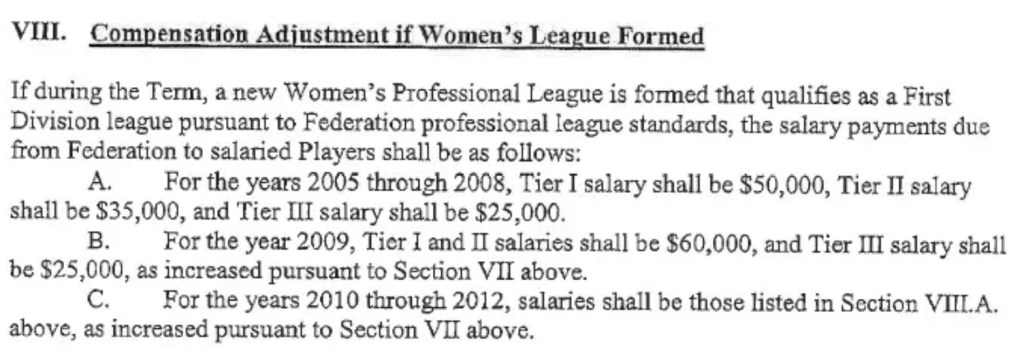
Let’s start with the mildest of the problems — a chart that refers to the “league salary” specified in the 2005-2012 collective bargaining agreement if a league should arise. The CBA doesn’t actually specify a “league salary” because no one had any inkling in 2005 that the federation would pay players’ club salaries. The salaries in question show how the players’ federation salaries would be reduced a bit if a league formed, giving them more income from elsewhere and less time to play national team games.

But the language in the CBA is so fuzzy that we can hardly blame the research team:

So unless you’re fully aware of the context, “from Federation to salaried Players” is ambiguous.

Another sentence is technically accurate but misleading: ““Furthermore, for each game played over the minimum of 20 games, the women would receive no additional pay for a tie or a loss and would receive $1,350 for a win, while the men would receive between $5,000 and $17,625.”

The word “additional” keeps the sentence from being false, but the implication is that the men’s pay is also “additional.” It is not.

The biggest problem, though, is also in that sentence. It’s stated by the women in their EEOC complaint, and it’s a fabrication.

“the minimum of 20 games”

And not just 20 games. Twenty friendlies.

The key sentences from the EEOC complaint:

  • “Specifically, the Federation pays top tier WNT players, such as each of us, $72,000 per year to play a minimum of 20 Friendlies that year.”
  • “MNT players are also required to play a minimum of 20 Friendlies per year.”

If I may borrow a phrase from the great Paul Riley (said in an entirely different context), this is complete poppycock.

The women’s CBA actually specifies a maximum of 92 games — all games — over a four-year span.

The Memorandum of Misunderstanding … er … Understanding completely wiped out any talk of required games. Explicitly.

I sometimes wonder if U.S. Soccer hasn’t settled this case because they just can’t wait to demonstrate this error in court. But they could always do it in the Hope Solo case, which surely won’t settle before we’re all dead from climate change.

Shall we look at how many games the teams actually played?

YearMenWomen
201918 (incl. Gold Cup and Nations League)24 (incl. World Cup)
20181120 (incl. qualifiers)
201719 (incl. Gold Cup and qualifiers)16
201619 (incl. Copa America and qualifiers)25 (incl. Olympics and qualifiers)
201520 (incl. Gold Cup)26 (incl. World Cup)
201415 (incl. World Cup)24 (incl. qualifiers)

They do not play 20 friendlies. Period.

But again — you’d have to be a hard-core soccer fan to know the EEOC complaint was wrong. And we in the media haven’t done enough to tell the truth.

If you already know all this stuff, the Harvard Business discussion won’t tell you much. If you don’t, it’s not a bad place to start.

us soccer, women's soccer

Women’s soccer: How about equal spending in general, not just equal pay?

Harvard Business Review had a piece on lessons to learn from the U.S. women’s soccer team’s “equal pay” push, which may be premature given that the lawsuit hasn’t proceeded yet (and, based solely on what’s going to end up presented in court, may not go well for the women).

Here’s how I responded:

I’ve covered women’s soccer for two decades, and I’ve covered the pay issue for several years. This piece makes a few assumptions:

  1. That the USSF data is incorrect and the data associated with the women’s team, such as the dubious “38 percent” claim, is correct.
  2. That the differences between the MLS and NWSL broadcast deals are somehow related to U.S. Soccer even though the federation has heavily subsidized the NWSL. (Yes, you could argue that the overlapping entities of U.S. Soccer, MLS and Soccer United Marketing have amounted to a subsidy for MLS, but that case isn’t made here and hasn’t been fully made elsewhere to my knowledge.)
  3. That the USSF is to blame for a lack of outside investment in the NWSL even though all the pundits and media personalities who jump on the “equal pay” bandwagon have failed to cover or invest in the last two women’s leagues.
  4. That “equal pay” is easily defined. The U.S. women play under a vastly different set of circumstances — no high-stakes trips to hostile venues in Central America and the Caribbean, scant competition for places — in addition to a salary structure that the women declined to go without when they agreed to the last collective bargaining agreement in 2017.
  5. That the women’s aggressive and often misleading stance in 2016, led by Hope Solo’s recommended lawyer Rich Nichols, didn’t hurt their bargaining position when they signed their deal in 2017.
  6. That the Manchin bill would help the U.S. women even though the men’s World Cup will be a money-maker for U.S. Soccer that can only help the women’s program.
  7. That the national teams, not youth programs where the USA is falling behind European countries, are the priority for additional spending.

Simply put, it’s not that simple.

In my work, I try to present the facts as they are, but I have a bias — I want to see women’s soccer succeed at ALL levels, especially because soccer success trickles up from the youth ranks, not down from the national team.

It’s easy to make a case that U.S. Soccer — which, it must be said, started investing in women’s soccer before nearly any other country in the world did — should spend more on development for women (and actually a bit more for the men as well). It’s not just “equal pay” for a handful of players who actually earn more than the men in many scenarios, including the real-world scenarios of the last several years. It’s equal spending.

us soccer, women's soccer

Equal-pay play: No friendly gap, narrowed Cup bonuses

Now that the national team pay calculator is done (more or less), we can run some scenarios.

Here’s one:

Assumed results:

  • Women win World Cup with 9 points in group stage, take Olympic bronze with 7 points in group stage.
  • Men reach World Cup quarterfinals (7 points in group) one year and take 3 points in group stage in another. 

Friendlies: Bonuses for women are now the men’s bonuses minus their game bonuses, so the pay per game should be equal.

Women’s World Cup qualifiers: Now paid at the same rate as Tier 2 friendlies.
 
Women’s World Cup qualifying bonus: Now roughly equal to what a mid-tier men’s player would make for World Cup qualifying bonus. (The men’s pool bonus is split, not equally, among a much larger group.)

Women’s World Cup bonuses:

  • $10.39 million possible team pay, up from $2.53 million
  • Bonus for the tour formerly known as the Victory Tour bonus is unchanged at $1.4 million after finishing first
  • $11.79 million total (prize + tour), up from $3.93 million
  • Reminder: FIFA prize money was $4 million for first place in 2019 but will rise, maybe not quite double. USSF will lose maybe $4-6 million.

Men’s World Cup bonuses:

  • $26.471 million possible team pay, down from to $20 million, with most of the cuts in later rounds
  • Reminder: FIFA prize money was $38 million for first place in 2018.

Women’s Olympic bonuses:

  • $3.8 million possible team pay, up from $1.8 million
  • Bonus for the tour formerly known as the Victory Tour bonus is unchanged at $1.2 million after finishing first  
  • Reminder: USOC prize money is $35,000 for each gold medalist

New for men: Likeness rights, which are convoluted in the current men’s CBA, are pooled into a $350,000 sum as in the women’s CBA.

Unchanged: Gold Cup, Copa America, SheBelieves Cup and Tournament of Nations bonuses. 

RESULTS

  • Total team compensation over 6 years: women $52,562,676, men $43,925,132
  • Maximum possible per player over 6 years: women $2,454,331, men $1,858,198

Full results

And more detail …

us soccer, women's soccer

Why do I question women’s soccer narratives?

I’m aggravated when people denigrate soccer because it’s my favorite sport — and because such sentiments are often rooted in a form of xenophobia in which generations have been expected to be culturally assimilated through our devotion to American sports like football, basketball and baseball.

I’m aggravated when people denigrate women’s sports because such sentiments are rooted in sexism. As with soccer, no one’s forcing you to play or watch, why put down anyone who makes a different choice?

I’m aggravated when people denigrate women’s soccer for any combination of the reasons above.

In case you don’t know my history covering women’s soccer, here are a few highlights:

So why did I write a piece for The Guardian talking about the U.S. women’s soccer team’s arrogance and their fans’ misguided hero worship?

Why have I written two pieces for Soccer America questioning the prevailing wisdom on equal pay in women’s soccer — not to question whether the women deserve to be paid more but to give people the information they need to make it happen?

Why have I spent a week creating a spreadsheet exploring how much the men’s and women’s national teams have made and would make, given different variables?

Because I’m more aggravated by misinformation.

It could be a bit of OCD, which I think most traditional journalists have. People with OCD are agitated when other people aren’t following the rules. And yes, I’m agitated with the scapegoating of the U.S. men’s team, as if it’s somehow Christian Pulisic’s fault that FIFA’s World Cup bonuses are out of whack.

But mostly, it’s because I think facts matter, and I think people make bad decisions when they aren’t telling the truth or putting it in perspective. (Yes, the current period of American history is hell for me.)

So a few things are difficult to accept …

Distorted equal pay arguments

It’s one thing to say women’s soccer players should be paid better. You can certainly use my spreadsheet above and highlight inequities.

The distortion is the notion that “the women who win the Cup should be paid more than the men who didn’t qualify.” It’s a distortion because they are paid more.

That’s difficult for some people to accept because the narrative is so powerful. We hear “38 cents to the dollar,” and we don’t understand that such comparisons are only one of the myriad scenarios you could create on my spreadsheet.

If the men and women each won the World Cup (I have a book coming out in November saying one of those will never happen), the men would be paid many times more. You can certainly argue that it’s not fair. Then you can argue about whether U.S. Soccer can fix it while FIFA drags its feet on prize money. You can argue about whether the bulk of prize money, men or women, should be going to the next generation of athletes as well as the current one. (Olympic prize money — in fact, the revenue U.S. Soccer gets from the Olympics — is basically nothing, and yet the U.S. women get bonuses.) You can come up with many different ways to rectify the situation, which is why I built the calculator, but there’s no denying the situation exists.

But when the men don’t qualify, they don’t get paid. In my calculations, I see few, if any, men’s players making six figures in 2018. They might make it in 2019, helped by Gold Cup bonuses that are surprisingly low given the attendance for those games.

In other words — the women’s base salary of $100,000, before any bonuses or game fees are paid, is more than what men will make.

So griping that the women should be paid more than men in years such as this is a bit like saying summer in Virginia should be hot. It is.

A “double standard” on behavior

It’s not the first time this has happened in women’s soccer. A women’s soccer player (say, Hope Solo) is criticized for her behavior. We immediately hear men wouldn’t be criticized for such things. That’s simply not true.

These conversations are, of course, far too polarized. On one side, you have people who’ll defend nearly anything the women do.

I’m very suspicious of any such devotion to anyone. Megan Rapinoe. Kanye West. Donald Trump. The Instagram influencers who got people to go to the Fyre Festival.

The good part of all this is that it’s at least an effective counterweight to the other side — the sexist dirtbags who don’t want the women to be paid well. They don’t even want us journalists to be writing about them at all. I actually had a female editor once tell me to quit writing so much about women’s soccer.

Make no mistake — I’d rather see a bunch of people making a statement for women’s rights and gay rights than a team of dumbasses pledging fealty to Brazil’s president or the worst elements of ICE and the Border Patrol. And women have to put up with a lot of things men don’t, from glass ceilings to horrific abuse on Twitter.

But facts and proper context won’t undo any progress fighting against these forces. It’ll just put the movement on a firmer foundation.

So what I’m doing isn’t a “build up and tear down” thing. It’s a “build up” that recognizes complexity and nuance while trying to avoid dead ends.

Because we’ve been through this before. Everyone remembers 1999. Maybe 1996. Less likely, 2004. Few remember the doldrums of the mid-2000s, when we had no professional league and little interest in women’s soccer.

The people who pop up for the majors (World Cup, Olympics) will yell about equal pay without addressing the specifics. They’ll decry the “double standards” of those who raise even the slightest questions about celebrations — an interesting accusation to lob at Hope Solo, and one that fed the fire that made Kaylyn Kyle respond to death threats — before moving on the next story. Maybe Tom Brady will injure Eric Trump while playfully tossing a dinner roll at a White House dinner. Maybe Grayson Allen will pick up a technical foul. Maybe Bryce Harper will take a fastball in the ribs.

You won’t see these people at NWSL games, writing about whether the Portland Thorns/Timbers relationship is a new model for dual-gender professional sports organizations. You won’t see them analyzing the games to see that Julie Ertz had a much bigger impact on the USA’s wins than Megan Rapinoe. (Golden Ball voters really dropped the ball on that one.)

Maybe at some point, we’ll actually cover women’s soccer for what it is. It’s a sport. It has some athletes who’ve made a fortune and some who have second jobs, and in the NWSL, you may see the latter outperforming the former.

Alex Morgan and Marta are on the same team. They’re in eighth place. Out of nine. They missed the playoffs last year, too.

Women’s soccer is interesting. It’s not just a platform for skewed cries of sexism.

Check it out.

us soccer, youth soccer

Freddy Adu’s next chapter will be worth reading

Remember when U.S. men’s soccer was so full of hope?

You don’t? Watch this …

That ad is so much better than the ads we see for the U.S. women’s team today. The field-level ad isn’t bad, but so much of it is over-the-top hero worship. If we keep putting the women on pedestals and exalt them as flawless, we can’t be too surprised when critics pounce on any crack in that facade. (And then we prolong the discussion by claiming that the criticism is sexist, even though it’s not the least bit inconsistent with what we see in men’s sports, and it’s painfully ironic that the knowledgeable women who question the narrative are bullied worse than people who speak up about women’s soccer pay. You’ve read this, right?)

(Also, the band that provided the soundtrack for that ad is an indie duo called Joy Zipper, and the NYT writeup of their wedding is cute.)

But this isn’t a rant about advertising. The focus here is the young man who pops up at the 44-second mark to do some stepovers, flip the ball up and smash a volley into the net.

He’s Freddy Adu, one of the most talented young players this country has ever seen.

No, really …

No, really …

No, really.

One of the disappointments in the soccer media of the last 10 years has been that no one ever quite captured the story of how Adu plummeted from such heights to where he stands today, unable to stick with a second-division U.S. team.

Until now. See the ESPN story by Bruce Schoenfeld, who not only landed a rare interview with Adu himself but chatted with people who’ve known him at the beginning and the (almost certain) end of his playing career.

For the latter point, the definitive comment comes from the ever-candid Eric Wynalda, who took over the USL’s Las Vegas Lights team and declined to invite Adu for another season with the team.

The reason that Freddy’s not here now, there are six or seven guys getting their first chance or their second chance. He’s on his fourth or fifth. It’s their turn, not his.

Wynalda and Isidro Sanchez, son of the legendary manager Chelis and temporary coach at Las Vegas last year, also put into words what others have not. Adu’s skill was as good as anyone’s. His work ethic was not. By this point in his career, he simply won’t be able to do the work he didn’t do when he was younger.

One problem is that, despite a couple of ludicrous scouting reports to the contrary, he was never fast. He could create space with a deft touch and beat a defender that way. He was never going to run past a typical professional defender.

What were the makers of Football Manager looking at?

Adu also suffered from bad advice and a string of bad luck with his club teams. At D.C. United, Peter Nowak was widely considered to be the perfect coach for a prodigy, but his mismanagement peaked in the 2006 playoffs. With United trailing New England 1-0, Adu was the best attacking force United had on the field. Nowak pulled him in the 65th minute in favor of Matias Donnet, who contributed absolutely nothing. A little while later, Christian Gomez cramped up — an accomplishment on a cool fall day — leaving only Ben Olsen to inspire the attack through sheer force of will. (Yes, this is all in my book. The first one.)

On Adu went to Real Salt Lake, which was always going to be a brief stop on his way to Europe. He wound up at storied Portuguese club Benfica, which turned out to be a mess.

Then it was Monaco’s turn to mess up, spurred by Franco-American club president Jerome de Bontin’s proclamation that Adu could represent U.S. soccer in France the way Greg LeMond represented U.S. cycling. That’s a lot of pressure to put on a player the coaches didn’t even seem to want. A whirlwind tour of Europe akin to something Chevy Chase did in the movies followed.

At this point, Adu got a lifeline. He came back to MLS to play for Philadelphia. And he wasn’t bad. Had he embraced the shot to be an above-average MLS starter at this point, he could have spent the rest of his 20s as a productive professional player.

Instead, he embarked on another round of globe-trotting and another return to the USA. The player who was a strong MLS player in his teens was a mediocre USL player in his 20s.

So why is this a story of optimism? Let’s go back to the ESPN story.

Adu believes that several of the players at Next Level have significant potential. He knows now, though, that potential only sets the starting line. “Growing up, I was always the best player,” he said. “Guys who were way below me at the time, you’d say right now had better careers than I did.”

If he’d had a Freddy Adu working with him, an elite-level player there to explain what it meant to succeed, he would have developed a different attitude. “So when I see a kid who’s really talented, clearly above the rest, and he’s just coasting, trying to get away with his talent, I say, ‘No, no, no. That can’t happen! You can’t let that happen! They will surpass you.’ Because I was that kid.”

He’s the perfect coach. He’s charismatic. He has good attacking vision.

And kids can learn so much from people who’ve failed. Many of the best coaches in the world are people who never panned out as players. They faced adversity, and they pass those lessons along to those players.

We’ll never see Freddy Adu representing the U.S. again. Not on the field.

But off the field? We’ll see.

It’s too late to take advantage of the potential he had as a player. Maybe he’ll take advantage of the potential he has now.

us soccer, women's soccer

A quick guide to the U.S. women’s soccer pay dispute

This World Cup is going to be quite competitive, today’s 13-0 rout notwithstanding. The bad news is that the USA’s chances of winning are less than 50-50, but the good news is that the reason is the growth of the game worldwide. No one who cares about women’s soccer would want the game in England, France, the Netherlands and elsewhere to make no progress.

And it raises a question that pops up on occasion: Why aren’t the U.S. women aren’t paid as much as the U.S. men?

You may be surprised here. Unless U.S. Soccer is outright lying on its 990 form for the fiscal year ending March 2018, the women are being paid more than the men.

Look at pages 7-9, the breakdown of what USSF pays its highest-paid employees. You’ll see that USSF spends ridiculous sums of money on its current and past men’s national team coaches, which we can refer to as The Klinsmann Boondoggle. Even aside from that, it’s hard to understand why the men’s Under-20 coach is paid more than women’s coach Jill Ellis.

The only players, from any team, on this list are …

  • Christen Press, $257,920
  • Becky Sauerbrunn, $256,720
  • Kell(e)y O’Hara, $256,695
  • Samantha Mewis, $247,497

It occurred to me that USSF could have listed the men as independent contractors. But the 990 lists any independent contractor making more than $100,000, and no U.S. men appear there. Also, for the fiscal year ending March 2010, Jozy Altidore and Brad Guzan are listed in the same “highest-compensated employees” that lists Press and company on the most recent 990. (Altidore and Guzan made a little more than $150K, if you’re curious.)

How is this possible? A couple of things:

  1. The men’s team rotates players often. In 2018, even though the men only played 11 games (shame about that World Cup), they used more than 50 different players. No one played 10 games. In 2017, when the men played 19 games, a few players reached double digits, led by Jorge Villafaña, of all people, with 15. (This is worth remembering when we see the “a man playing 20 games” argument — unless I’ve missed someone in the media guide, no man has played 20 national-team games in a year since Landon Donovan in 2002, the year the USA reached the World Cup quarterfinals.) The women might use 30 players in a year, with 8-12 of them getting only a couple of short appearances.
  2. The women (20-25 or so, at least) are on salary. The men are not.
  3. The men haven’t exactly collected that big World Cup bonus. In FY ending March 2018, they actually won a major tournament (the Gold Cup), and their bonuses still didn’t propel anyone into the Sauerbrunn/O’Hara $250K range.

All of this makes things complicated.

But it doesn’t necessarily make things right.

To my knowledge, no one has quantified what “equal pay” would look like. I tried …

It’s a long thread. The highlights are a women’s salary that equals what a man would make if he played 20 games, evening out “base pay” a bit, and comparable competitions get comparable bonuses. Oh, and I’d slash the men’s bonuses if they ever make a big World Cup run, instead investing that money in youth soccer. Please don’t tell them I said that. And I wonder if I’m just replicating the scenario in the Rush song The Trees, in which the trees are all kept equal by hatchet, axe and saw.

Even then, you’re faced with a question. When you say “equal pay,” does that mean the women get the same amount of money, divided 30 ways, that the men get divided 50 ways? Or does it mean Alex Morgan should be paid the same as Christian Pulisic?

So that’s the present. But it’s also worth knowing the past, and for that, you should really read Caitlin Murray’s book, which is excerpted in The Guardian.

And that all points to the weird duality of U.S. Soccer and the U.S. women:

  1. The USSF has done quite a lot to push women’s soccer forward.
  2. The USSF has, at times, treated the women’s players with negligence or even malice.

All of which makes it very difficult to assess the fairness of any CBAs, especially those we haven’t seen.

women's soccer

Women’s World Cup predictions (collated)

If you made predictions, feel free to share them. I’ll try to compile as best I can.

GROUP STAGE

Key: Third-place teams that qualify marked with asterisk.

The predictors …

  • BD: me
  • 538: from their rankings
  • AC: Avi Creditor, Sports Illustrated
  • LL: Laken Litman, Sports Illustrated (you’ll have to click to see the picks from Kellen Becoats, Luis Miguel Echegaray and Grant Wahl

GROUP A

  • BD: France, Norway, South Korea, Nigeria
  • 538: France, Norway, South Korea*, Nigeria
  • AC: France, Norway, Nigeria*, South Korea
  • LL: France, Norway, South Korea*, Nigeria

GROUP B

  • BD: Germany, Spain, China*, South Africa
  • 538: Germany, Spain, China*, South Africa
  • AC: Germany, Spain, China*, South Africa
  • LL: Germany, Spain, China*, South Africa

GROUP C

  • BD: Australia, Italy, Brazil*, Jamaica
  • 538: Australia, Brazil, Italy*, Jamaica
  • AC: Australia, Brazil, unknown
  • LL: Brazil, Australia, Italy*, Jamaica

GROUP D

  • BD: England, Japan, Scotland*, Argentina
  • 538: England, Japan, Scotland, Argentina
  • AC: England, Scotland, Japan, Argentina
  • LL: England, Japan, unknown

GROUP E

  • BD: Netherlands, Canada, New Zealand*, Cameroon
  • 538: Netherlands, Canada, New Zealand*, Cameroon
  • AC: Netherlands, Canada, New Zealand*, Cameroon
  • LL: Netherlands, Canada, New Zealand*, Cameroon

GROUP F

  • BD: USA, Sweden, Chile, Thailand
  • 538: USA, Sweden, Thailand, Chile
  • AC: USA, Sweden, unknown
  • LL: USA, Sweden, unknown

ROUND OF 16

2A vs. 2C (Nice, June 22)

  • BD: Norway over Italy
  • 538: Brazil over Norway
  • AC: Norway over Brazil
  • LL: Australia over Norway

1D vs. 3B/E/F (Valenciennes, June 23)

  • BD: England over New Zealand
  • 538: England over New Zealand
  • AC: England over New Zealand
  • LL: England over New Zealand

1A vs. 3C/D/E (Le Havre, June 23)

  • BD: France over Brazil
  • 538: France over Italy
  • AC: France over Japan
  • LL: France over Italy

1F vs. 2B (Reims, June 24)

  • BD: USA over Spain
  • 538: USA over Spain
  • AC: USA over Spain
  • LL: USA over Spain

1C vs. 3A/B/F (Montpellier, June 25)

  • BD: Australia over China
  • 538: Australia over China
  • AC: Australia over China
  • LL: Brazil over China

1E vs. 2D (Rennes, June 25)

  • BD: Netherlands over Japan
  • 538: Netherlands over Japan
  • AC: Netherlands over Scotland
  • LL: Netherlands over Japan

1B vs. 3A/C/D (Grenoble, June 22)

  • BD: Germany over Scotland
  • 538: Germany over South Korea
  • AC: Germany over Nigeria
  • LL: Germany over South Korea

2F vs. 2E (Paris, June 24)

  • BD: Sweden over Canada
  • 538: Sweden over Canada
  • AC: Canada over Sweden
  • LL: Sweden over Canada

QUARTERFINALS

June 27 (Nice winner vs. Valenciennes winner)

  • BD: England over Norway
  • 538: England over Brazil
  • AC: England over Norway
  • LL: England over Australia

June 28 (Le Havre vs. Reims)

  • BD: USA over France
  • 538: France over USA
  • AC: France over USA
  • LL: USA over France

June 29 (early; Montpellier vs. Rennes)

  • BD: Australia over Netherlands
  • 538: Australia over Netherlands
  • AC: Australia over Netherlands
  • LL: Brazil over Netherlands

June 29 (late; Grenoble vs. Paris)

  • BD: Germany over Sweden
  • 538: Germany over Sweden
  • AC: Germany over Canada
  • LL: Germany over Sweden

SEMIFINALS

July 2 (June 27 winner vs. June 28 winner)

  • BD: USA over England
  • 538: France over England
  • AC: England over France
  • LL: USA over England

July 3 (June 29 winners)

  • BD: Australia over Germany
  • 538: Germany over Australia
  • AC: Germany over Australia
  • LL: Germany over Brazil

MEDALISTS (1st- and 3rd-place games)

  • BD: USA, Australia, England
  • 538: France, Germany, England
  • AC: England, Germany, not picked
  • LL: USA, Germany, not picked
women's soccer, world soccer

Game-by-game guide to Women’s World Cup group stage

Three basic icons here:

  • 📺 ️- must-watch
  • ☠️ – must-win
  • 🏏- country also playing in Cricket World Cup on same day

Times Eastern

Friday, June 7

3 p.m., FS1: France vs South Korea. Traditional first-day favorable matchup for the hosts.

Saturday, June 8

📺 9 a.m., FS1: Germany vs China. Does China have anything to offer this time?

Noon, Fox: Spain vs South Africa. This probably won’t be a ratings winner on the main network.

3 p.m., Fox: Norway vs. Nigeria. The longtime African champions might be a surprise team. Or not. Several Nigerian players are based next to Norway in Sweden.

Sunday, June 9

📺 🏏 7 a.m., FS1: Australia vs. Italy. The Aussies, boasting the intergenerational attack of Sam Kerr and Lisa de Vanna, could seriously win this thing. Italy hasn’t been on this stage often but has a couple of interesting attackers from Juventus.

📺 ☠️ 9:30 a.m., FS1: Brazil vs. Jamaica. It’s Marta vs. Bunny Shaw. Samba vs. reggae. And we’ll either see Brazil break its losing streak or an upset they’ll be talking about in the Caribbean for a long time. I’m giving this one the skull-and-crossbones because Brazil will be in serious trouble if they can’t take this one.

📺 ️Noon, Fox: England vs. Scotland. Not quite the history we see on the men’s side, but it’ll be fun to see Kim Little and Rachel Corsie trying to pull off the upset.

Monday, June 10

Noon, FS1: Argentina vs. Japan. Meh. Japan should pass circles around an Argentina team lacking resources. It’ll be nice to see Estefania Banini, though.

3 p.m., FS1: Canada vs. Cameroon. I never thought I’d write the sentence “Can Estelle Johnson stop Christine Sinclair?” outside of an NWSL preview.

Tuesday, June 11

📺 ️9 a.m., FS1: New Zealand vs. Netherlands. The Football Ferns have a squad with plenty of World Cup and Olympic experience, and they’ve brought in Tom Sermanni as coach. They’re facing the shock Euro 2017 champions.

Noon, FS1: Chile vs. Sweden. This matchup within the USA’s group will provide an ideal opportunity to follow along with The Guardian‘s play-by-play.

3 p.m., Fox: USA vs. Thailand. Should be like watching one of those games from the 1990s in which opponents quaked in fear upon seeing Mia Hamm line up across from them.

Wednesday, June 12

☠️ 9 a.m., FS1: Nigeria vs. South Korea. Chelsea’s Ji So-yun will be the orchestrator for South Korea, but Nigeria counters with Barcelona’s Asisat Oshoala, who dominated at U20 level. In a group with France and Norway, this is the best chance for either team to get points. (Remember — the top four third-place teams advance to the Round of 16.)

📺 ️Noon, Fox: Germany vs. Spain. The team of the 2000s vs. the team of the 2020s?

📺 3 p.m., Fox: France vs. ️Norway. Call me Euro-centric if you like, but this is a pretty good doubleheader on Fox.

Thursday, June 13

📺 Noon, Fox: Australia vs. Brazil. Did you ever think Brazil would be the underdog in this matchup? Believe it.

☠️ 3 p.m., Fox: China vs. South Africa. Can’t rule out one of these teams taking a point off Spain, but this is probably a true elimination game.

Friday, June 14

9 a.m., FS1: Japan vs. Scotland. This Japanese team might be a shadow of the 2011 champions, but I’m not seeing a way they’ll drop points in either of these first two games.

📺 🏏 Noon, Fox: Italy vs. Jamaica. Second chance for Bunny Shaw and company to get a result.

🏏3 p.m., Fox: England vs. Argentina. Yeah.

Saturday, June 15

9 a.m., FS1: Netherlands vs. Cameroon. Yeah.

📺 3 p.m., FS2: Canada vs. New Zealand. Another game in which you can’t count out the islanders.

Sunday, June 16

9 a.m., FS1: Sweden vs. Thailand. Maybe they’ll both bunker.

📺 Noon, Fox: USA vs. Chile. This is the de facto final warmup for the Americans.

Monday, June 17 (concurrent games start)

📺 ️Noon, FS1: China vs. Spain. Looks like FS1 plans to carry the “Second-tier Euro team vs. partially unknown Asian team” games.

Noon, Fox: South Africa vs. Germany. Looks like Fox plans to carry the “European power takes easy matchup with upstart African team” games.

3 p.m., FS1: Norway vs. South Korea. Looks like FS1 plans to carry the “Second-tier Euro team vs. partially unknown Asian team” games.

3 p.m., Fox: France vs. Nigeria. Looks like Fox plans to carry the “European power takes easy matchup with upstart African team” games.

Tuesday, June 18

3 p.m., FS1: Italy vs. Brazil. Imagine if this matchup took place between these countries’ men.

3 p.m., FS2: Jamaica vs. Australia. This is asking a bit much of the Caribbean team.

Wednesday, June 19

📺 ️3 p.m., FS1: Japan vs. England. Now we’re talking. Surely a game for first place.

☠️ 3 p.m., FS2: Scotland vs. Argentina. Likely a “loser goes home” game. No guarantee that the winner stays. But it should be one of the more interesting second-tier games.

Thursday, June 20

📺 ️Noon, Fox: Netherlands vs. Canada. There’s a chance one of these teams will have dropped points and will be fighting to stay in the tournament. Also the first of our Europe-CONCACAF doubleheader duel on Fox.

☠️ Noon, FS1: Cameroon vs. New Zealand. Can New Zealand reach another knockout round?

📺 ️📺 ️📺 ️3 p.m., Fox: USA vs. Sweden. Both teams will surely advance, but do we need to tell you why this game is a big one?

☠️ 3 p.m., FS1: Thailand vs. Chile. We’ll feel like we know both of these teams by this point, and yet one or two of them will be out after this.