youth soccer

2017 NSCAA presentation: Parent coaches

I did a presentation at the 2017 NSCAA Convention in L.A. called “Confessions of a Parent Coach: How to Recruit and Train Us.” Several people were interested in seeing it again and sharing it, so I’ve roughly reproduced it here …

ABOUT ME

I got into youth soccer as a journalist first (not counting my experience as the best U14 center back in Athens, Ga., before anyone else in Athens started playing soccer). I would go to an NSCAA Convention to cover the MLS draft, and then I’d meander over to the meeting rooms to see what was going on.

Coincidentally, in 2010, I left USA TODAY, mostly so that I’d have more family time. Time to do things like … coach my kids in soccer. So I was getting multiple perspectives on the youth game. I was just learning how to be a parent coach, and I was starting to cover youth soccer issues. In 2011, I came to the convention on assignment with ESPN and saw Claudio Reyna unveil the new U.S. Soccer curriculum. Then I ran back over to the MLS draft and interviewed Bruce Arena, telling him I had just seen Claudio unveil the curriculum.

“Claudio who?” Arena said in that “I know who you mean, having coached him in college and on the national team, but I’m going to toy with you a little bit because I do that” tone of voice that he has.

Then he told me he believed the country was too big and too diverse for any single style.

So I’ve known for a while that this isn’t easy. We don’t all agree on what we’re supposed to be doing in youth soccer. And in this chaotic environment, you’re asking volunteers to give kids their introduction to the sport. Mostly parent coaches.

“Parent coach” is a broad term, of course. Sometimes you have pro coaches who have kids, and then they’re “parent coaches,” too. Some parent coaches go on to stick with it through older age groups, and we’ll talk a bit about those groups later. But for most of this presentation, we’ll be talking about the early age groups, where we have not yet split into “recreational” and “travel.” Some of these kids may have pro coaches with A or B licenses later on, but for now, it’s on us.

So first, let’s take a look at this age group.
slide2

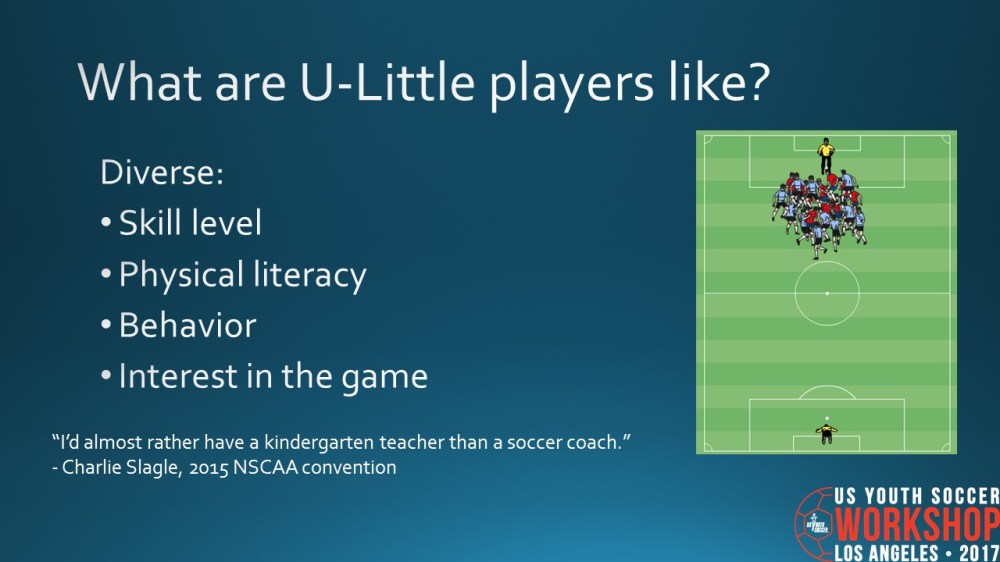
WHAT ARE U-LITTLE PLAYERS LIKE

The biggest difference between early-age rec and elite-level travel is diversity. If you’re coaching a U6 team, you may have some players who are already showing signs of being “elite” one day, and you may have some who look like they’re never going to understand the basic idea of the sport.

They’re diverse in these ways:

  • Skill level: Some are already juggling. Some can’t kick the ball.
  • Physical literacy: I don’t know what kids are learning in P.E. classes these days, but they’re not learning how to run. (I bumped into Sam Snow in the hallway and asked him how we’re supposed to teach that. I’m hoping it’ll be a topic at future conventions or maybe even part of the F license.) And even so, kids at this age are going to be all over the map, maybe changing from year to year or month to month. Kids will hit growth spurts and be unusually clumsy for a few months while they’re adjusting to their new bodies.
  • Behavior: Some really want to play soccer. Some … really don’t. Some do, but they’re easily distracted. Some do, but they’re easily distracted. Some are blissfully unaware that a soccer game or practice is in progress around them.
  • Interest in the game: Some kids get up on Saturday mornings to watch Premier League games, or they spend their Sundays watching Liga MX and MLS. Some go to games – MLS, college, anything. Others haven’t seen a soccer ball outside of practice.

So what do we need to lead these kids? The Charlie Slagle quote here about needing a kindergarten teacher is apt. So is this quote from Sam Snow: “At this age, think of yourself as a PE teacher of soccer more so than the manager of a soccer team.”
slide3

WHAT ARE PARENT COACHES LIKE

We’re also diverse. In some of the same ways.

  • Skill level: Some of us got great training growing up. Some didn’t. And for some of us, it may have been a long time.
  • Soccer experience: Some of us used to play at a high level. One of the parent coaches in my league the past few years played with Julie Foudy at Stanford. Some of us used to play at a not-so-high level. Some of us never played. The last group may be getting smaller, but it’s still there.
  • Fitness level. Some of us are triathletes. Some of us work at a desk 10 hours a day and can’t find the gym.
  • Fan interest: Some of us watch MLS, EPL, Liga MX, Champions League, El Clasico, the Old Firm Derby and anything else we can find. Some don’t know what channel those games are on. Some, particularly younger parents, have “cut the cord” on cable, and they’re not watching any live sports.

One thing we generally have in common: We’re eager to learn. We want to know what we’re doing. But there are limits. We don’t want to spend two weekends away from home to learn how to be a recreational coach for 13-year-olds. We DO want feedback and some easily digested advice.

slide4

I’d argue both of those quotes are valid. I’ve certainly run into some “BOOT IT!” parents. And I’ve run into some who are much better than the paid travel coaches I’ve seen screaming at kids in U9-U11 travel games. (And older, actually — I couldn’t believe how much “joystick coaching” I saw at the USYSA National Championships.)

slide5

WE HAVE SOMETHING TO OFFER

There’s a quote attributed to Bill Nye (the Science Guy, and also the comedian who created the legendary “Speed Walker” character on Almost Live): “Everyone you will ever meet knows something you don’t.” I’ve seen some NSCAA presentations that make similar points. Your parent coaches probably don’t have the soccer expertise you have. Some of them are great at building rapport with kids. Some of them are organizational geniuses. As you’re teaching them, see if they have something to teach you.

Charlie Slagle again: “A lot of coaches become much better coaches when they become parents.”

slide6

AND YOU NEED US

Here’s a hypothetical: How much would you need to charge if you had professional coaches for every recreational team in your club, no matter the age groups?

Some clubs get high school or college volunteers. Some don’t. But I really don’t know any full-service clubs (travel and rec) that don’t have parent coaches in some capacity. And even if your club is travel-only, you’re going to be recruiting kids who had parent coaches at their rec clubs first.

WHAT WE DON’T NEED

slide7Long licensing classes in how create a training plan. Most clubs these days have a curriculum or at least some training plans. We can also find training plans online.

slide8We also don’t need incomprehensible training plans. Please don’t overthink it. We’re supposed to avoid “laps, lines and lectures.” Then we get training plans with 3-4 new complicated exercises to teach every practice. So we’re spending 15 minutes out of an hour in lectures. And we have to get these kids in line while we’re lecturing them. Then they run out of patience and act up, so we have them run laps.

slide9

WHAT WE NEED

On-demand video is a great start. The online F license is a vast improvement over the old in-person F license. We can see Shannon MacMillan and Vince Ganzberg running sessions, on our own time.

And that takes away the excuse. You don’t like having unlicensed coaches in your club, and parent coaches don’t like dealing with unlicensed coaches. Put it online and on-demand, and you’re in a better position to require us to do it.

I’d love to finish my D license. I can’t. I needed to shoot video of myself coaching older kids, and that’s difficult to set up. Then I needed to go to an evaluation weekend. Couldn’t do it. (And I wrote about it.)

Technical tips are vital because, again, a lot of us didn’t just finish successful pro careers. At older age groups, it’s a safety issue – we need to know how to teach proper heading. In younger age groups, we just want instill good habits.

And just as nature abhors a vacuum, coaches will fill in gaps in our knowledge, sometimes with the strangest takes on things. I coached with someone who had been trained through AYSO, and somehow, he had it in his head that soccer players weren’t supposed to be creative. He decided all the kids had been improperly coached because they didn’t dribble in straight lines using their feet pointed downward like ballerinas, kicking only with the laces. The previous technical director in the club, who was from Brazil, had taught us to teach kids to use all surfaces of the feet. This guy berated the team all season for failing to do things one rigid way that they simply hadn’t been taught.

Disciplinary tips: I’m not going to berate my team for things like using the “wrong” surface for dribbling. But I am responsible for safety, which means getting the kids to quit grabbing the goal posts and so forth. And we don’t talk about it in licensing courses or most other coaching literature. The F license gives us a couple of ideas for getting kids’ attention – don’t make kids squint into the sun, take one knee to get on their level, etc. – but we don’t know what to do when kids are disruptive. On your U16 travel team, where you can threaten to bench someone who’s misbehaving in practice and you know their parents will take away their xBoxes, then you have some options. On my U8 rec team, I don’t have much.

slide10

MAYBE A SEPARATE LICENSING TRACK

It came to my attention at the 2017 Convention that U.S. Soccer is indeed revamping its coaching pathways. Again. And that’s good. The F license is a good building block for everyone. The E license is so-so. By the time we reach the D license, we need to recognize that my U14 rec training is going to be a little different than D.C. United Academy’s U14 training. I hope so, anyway.

And we really don’t need licensing courses in which the coaching candidates have to be demonstration guinea pigs. That’s fine for the kids straight out of college who are just starting out in their adult lives. Those of us in our mid-40s with Achilles tendinitis issues don’t need to spend a weekend chasing around people who are in much better shape than we are.

We might need an in-person session on teaching technique. That’s tough to get across in a video. Anything else that can be online really should be online.

And we don’t need to learn about periodization, no matter how much that topic is in vogue in NSCAA circles right now. I have some kids in rec who are getting no other exercise. I have some who are playing multiple sports. Talk to their track coaches about periodization.

slide11

WHAT CLUBS CAN DO

U.S. Soccer might not give us the recreational coaching program we all want. And even if they do, you as a club’s technical staff need to follow through at club level. Maybe you can do technical tips. Do something to meet your coaches face-to-face.

Then follow up with more conversation. Maybe everything makes sense in a preseason coaching clinic. Then after a few weeks, your new coaches have a few questions. Have a mailing list or some sort of discussion forum so you can talk about it.

Then listen to us. Remember, we’re coaching your future elite players. You have the edge when it comes to spotting soccer aptitude. But we’re working with these kids every week. We can tell you about their attitudes and their enthusiasm. We can tell you which kids are responding well to coaching and which ones think they know it all. Don’t be surprised when someone who stood out at U9 tryouts turns out to lack the attitude needed to learn the game.

slide12

RECRUIT AND RETAIN

A few ideas here, and the first two come from the same general area – please don’t make us spend a lot of money to be coaches. We need goals, we need pinnies, we need cones, we need ice packs.

The next two are also from the same general area – talk with us, give us some ideas.

And in that communication, try to get us all on the same page. It’s so frustrating to coach a U8 team the “right” way – emphasizing skill development over winning, rotating players through different positions, etc. – and then go up against a coach who didn’t get the message and has one big kid in front of his own goal booting the ball up to a fast player in front of the other goal. Balance the teams so the kids get challenges (and don’t get too discouraged). If you’re trying to instill a particular playing style, let us know what that is and how to get it.
slide13

OTHER CONSIDERATIONS

We’re going to have some special-needs kids. Some have been diagnosed, but the parents would prefer that they try general rec soccer instead of TOPSoccer. Some have NOT been diagnosed. Either way, we could use some advice.

Supplemental training: Hopefully, your club is offering something to let players with better-than-average aptitude and interest work with professional coaches and refine their technique.

Reimbursement: Again, please don’t make us pay out of pocket for something that’s supposed to benefit your club.

Refs at U8: This is controversial. But I had some bad experiences at this age coaching against self-styled General Pattons, whose players figured they’d win the game by fouling the bejeezus out of my players. One game was so bad that a parent on my team made a flimsy excuse to get her son off the field. She emailed me later to explain her anger at what was transpiring on that field.

Working with kids we know: I know it runs counter to AYSO principles. But you want to put your parent coaches in the best position to succeed, and it helps to have them NOT spend half the season just getting to know the players. And it makes us invested in these kids. I worked with a co-coach once who clearly didn’t care about any of the kids in his charge. That wasn’t healthy. If I had an attitude like that, the other parents would quite rightly have run me out of the neighborhood.
slide14

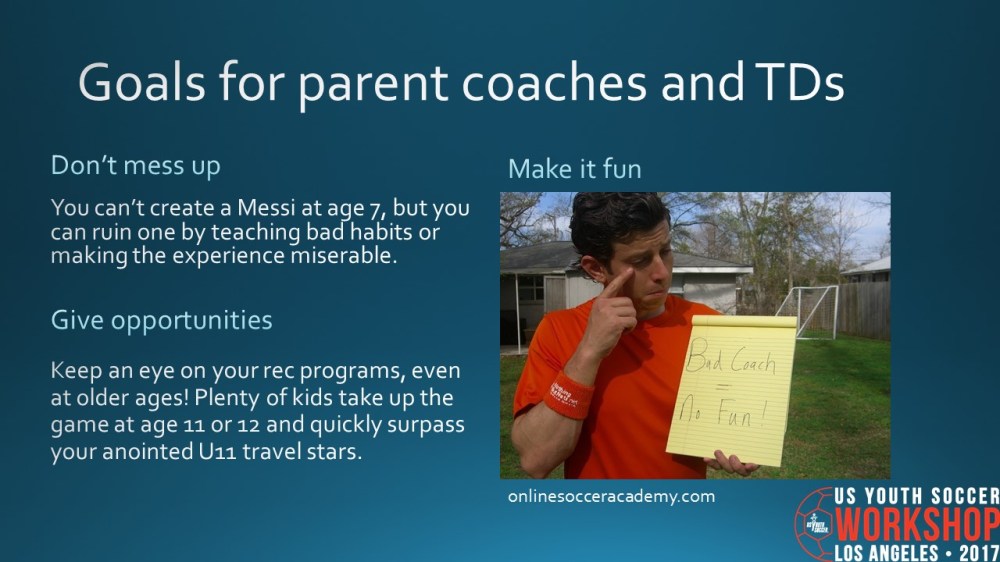
GOALS

We don’t want to instill bad habits. We also don’t want to make someone so miserable that he or she doesn’t come back and play. “Fun” is a loaded word, but remember – every kid we drive away from the game at U6 is a player you won’t have the chance to coach at U12.

And be sure that you haven’t cast the die on every player at age 8! Come on out and see how the players are doing at U11. We’ve all seen kids take up the game for the first time at U11 and make the A team by U14. We may not want to admit someone can do that without working 10,000 hours on the ball from age 4 to age 12, but it can happen. So come out and see the kids play. And while you’re at it, take a look at us coaching and let us know how we’re doing.

This presentation was well-received. I’d like to do it again, but I’d like to keep revising it to reflect what I hope will be an ongoing discussion. We can certainly do better with our youngest players, and that means better training for the coaches that will work with them. Got feedback? Fire away.

soccer

Division 2 soccer: Just get on with it!

Two months ago, would anyone have bet on the former Carolina Railhawks landing an NWSL team before the men’s team got out of divisional limbo?

The news that the Western New York Flash will be moving to the Triangle (reported overnight by FourFourTwo, with follow-ups from local soccer-media veterans in Rochester and the Triangle) has shocked the women’s soccer world. Many of us are struggling for coherent responses. The NWSL has been stable through four seasons, adding two teams and moving/losing none. Now the defending champions, a holdover from previous WoSo leagues, have skipped town.

But it also puts some focus on the current turmoil in the lower divisions of men’s professional soccer, which has dragged on and on and on …

In fact, both ends of the Flash-to-Carolina move are still awaiting news on divisional sanctioning. The USL, which includes the Rochester Rhinos, seemed all but set to move up to the second division while the NASL, which includes NCFC (for now — they’re bidding for MLS expansion), was all but dead.

Thanks to the indomitable Peter Wilt, the NASL may no longer be dead. It also may no longer be the NASL, but something with six or seven or 20 teams may continue to occupy the second tier of the U.S. soccer’s pyramid next year.

Now that it’s January, it’s pretty clear whatever happens with D2 and D3 men’s soccer next year will be a stopgap. NASL 3.1 will need to follow through on those expansion plans if it wants to keep fending off the USL for D2 status, and I’m under no illusions that the USA will suddenly go to pro/rel in lower divisions, as much as I think the plans are getting more and more realistic.

And there are some legitimate issues that confuse things here — business models, league ownership groups, etc.

But the longer the divisional-sanctioning and NASL-Walking Dead sagas drag out, the absurd it looks.

Attendance isn’t the only measure of a soccer club’s health, but when you look at Kenn Tomasch’s diligently gathered attendance tables, it’s easy to spot the clubs that really ought to be playing each other at the D2 level:

  • FC Cincinnati (USL)
  • Sacramento Republic (USL)
  • Indy Eleven (NASL)
  • Louisville City (USL)
  • San Antonio FC (USL)
  • Tampa Bay Rowdies (leaving NASL for USL)
  • Ottawa Fury FC (leaving NASL for USL)
  • Miami FC (NASL, though wild spending may be an issue)
  • North Carolina FC (NASL, formerly Carolina Railhawks)
  • Oklahoma City Energy FC (USL)
  • Saint Louis FC (USL)

Add the San Francisco Deltas, the NASL expansion team, and that’s 12. Then pick from a few more possibilities:

  • Richmond Kickers (USL, two decades and counting, just made a facility deal to make roots even stronger but has had pragmatic approach counter to, say, the New York Cosmos)
  • New York Cosmos (NASL, with an apparent white knight bidding to save the team and perhaps with it the entire league)
  • Rochester Rhinos (USL, which once averaged more than 10,000 fans and now has its name on the stadium it has been sharing with the Flash)
  • Charleston Battery (USL — like the Rhinos and Kickers, a staple of lower-division soccer with a good place to play)

That’s 12-16 teams. That’s a viable league out of the gate, and it should attract more teams.

So the message here should be clear:

Just get it done.

Whatever you have to do — give USL’s league owners a stake in D2 revenues, drop the twice-poisoned NASL name, keep the strangely alluring NASL name, pay lip service to promotion/relegation as the NASL has done for a few years … whatever.

Because if there’s one coherent lesson from U.S. soccer history, it’s this: Soccer Wars are not a good thing.

Someone needs to play peacemaker and dealmaker. The sooner, the better.

soccer

The 2017 pyramid plan (and pro/rel myths)

In many ways, 2016 was the year the promotion/relegation movement grew up. The shifting landscape, with MLS pushing its expansion plans and the lower divisions getting a makeover, could make such a system more feasible. And some rational folks made a serious effort to wrest control of the movement from the conspiracy theorists and random hate-mongers who have dominated the discussion for too long, like so:

https://twitter.com/DanLoney36/status/813771705801998340

(I’m less skeptical than Dan, having had some decent conversations with some people this year. And yes, a few random dudes who seem to be into soccer more for the feeling of geek superiority than any actual enjoyment of the sport.)

We even have people who have decided concrete steps toward a traditional pyramid might be something other than just yelling at people like me who are nowhere near the decision-makers. Check tech entrepreneur/NPSL team owner Dennis Crowley or the UPSL, which intends to take pro/rel beyond local amateur leagues to a regional semi-pro league. And you can find a few earnest attempts to suggest modified pro/rel, at least as a transition to a more traditional approach down the road.

Of course, that’s not enough for the most zealous pro/rel advocates — or “pro/relouts,” in Steve Holroyd’s terms.

But I’ll offer up a guide for newbies, explaining why those people deserve no attention, a little later in this post.

What I’ll offer up here is an idea for, say, 2020. It includes promotion/relegation at several levels, eventually leading to a pyramid that’s at least as “open” as the one in the Netherlands.

First, let’s define some goals: 

  1. Stability. We don’t want to lose more clubs. We want clubs to have the confidence to build new facilities and invest in youth academies. We want fans to be assured their local club will be there in some form.
  2. Good competition with meaningful games. Exciting and demanding. Those are sometimes mutually exclusive, as anyone who’s ever watched a dour late-season slugfest between two relegation-threatened bus-parkers can attest. (Or a very tentative Cup final, which isn’t just an MLS thing.) But the good usually outweighs the bad.
  3. Fans’ dreams. One of the allures of pro/rel is the notion that a smaller club may one day work its way up the pyramid. The drawback in a lot of leagues around the world is that only a couple of clubs have a reasonable shot at the championship. Ideally, we’d let fans dream about both. (Yes, I know — Leicester City. A classic case of the exception proving the rule.)
  4. Simplicity. My previous attempts at this have been too complicated.

Now here’s an unusual premise, at least in terms of U.S. soccer history:

  1. Distinct “league” and “Cup” events. This gives us a chance to do some intradivisional matches in Cup play, mitigating risk by making it more likely that a “D2” club’s fans will still get a chance to see Giovinco, Morris, etc., in meaningful games.

THE PLAN

League structure:

Division 1: 16 teams, single-table, double round-robin.  League champion crowned in late May/early June (depending on World Cup, Copa America or Gold Cup timing). No playoffs. Bottom three relegated to Division 2.

Division 2: Initially 14-16 teams, mimicking Division 1, but might expand and break into regions — perhaps a 20- or 22-team league in which teams play each team in their region twice and every other team once. Then minimal playoffs — maybe two regional champions play for league title while two regional runners-up play for promotion place.

Divisions 3, 4, maybe 5: Regional pyramids. D1/D2 reserve teams are eligible to play. Structure can vary by region depending on travel needs, climate and other logistics. (Just see how often England has reconfigured leagues at D6-D10 level, and in that case, we’re talking about “travel” that U.S. workers would consider “commutes.”) Promotion and relegation is common, but Division 3 clubs must meet professional standards. Clubs that wish to remain amateur can still go as high as Division 4.

U.S. Open Cup structure:

The biggest change would be condensing much of it to the summer. Early rounds would be played during whatever major international tournament is going on. Late rounds would be played before college season starts, giving PDL and NPSL teams a chance to make runs. Condensing it may also drive up interest — the current Cup suffers from its long dormant periods between rounds.

MLS or U.S. Pro or Anschutz or Wilt or Garber … actually, let’s make it the Eddie Pope Cup:

First round overlaps with regular-season play in October/November. Two-leg aggregate until neutral-site warm-weather final on Dec. 24.

Twelve (12) qualifiers:

  • Top four teams from Division 1 get byes. (Side benefit: At least two of them will also be in CONCACAF play, so the byes will limit fixture congestion. A little.)
  • The next four teams from Division 1 qualify.
  • The top three teams from Division 2 (each of whom has also been promoted) also qualify.
  • The remaining spot goes to whichever professional team advanced the farthest in the Open Cup. (Clubs may opt to pass, in which case the spot goes to the next-best Open Cup team.)

The calendar

January: Winter break, secondary transfer window.

Early/mid-February: Friendlies in warm-weather venues.

March-May: D1 plays 15 league games. D2 roughly the same. D1/D2 champions crowned. Regional leagues play some league games and some Open Cup qualifying rounds.

June-July: International break and several Open Cup rounds. Also potential here for friendlies or mini-Cups within regions — maybe three D1/D2 clubs and the reigning champion of the nearest D3 region, for example.

July-August: Primary transfer window.

August: Open Cup final and start of D1/D2 league play.

August-November: D1 plays 15 league games along with any CONCACAF or early-round Pope Cup games.

December: Pope Cup semifinals and final.

The rules

Sounds almost like England, doesn’t it? The exceptions are that the League Cup analogue should draw a bit more attention, while the FA Cup analogue bows to the reality of amateur teams dependent on college players.

But we’re going to add a few policies that should ease the transition from the MLS single entity and mitigate risk.

  1. Salaries are limited by a “luxury tax” akin to baseball. This gives clubs the freedom to keep together a “superclub” but forces revenue-sharing so other clubs have a chance of keeping up.
  2. Division 1 and Division 2 clubs have shares in SUM.
  3. Clubs own their own trademarks. If a club is no longer capable of competing at the Division 2 level, it is permitted to self-relegate to Division 3.

So that’s the plan. Enjoy. Modify. Debate. It’s a trial balloon. And I plan to do some reporting in the next year to see how much of it is feasible.

THE REALITY CHECK

I like this plan. I really do.

But if it doesn’t come to pass, you know what I’m not going to do? I’m not going to accuse everyone who speaks up against it of being part of some shadowy conspiracy. I’m not going to hold my breath until my face turns blue or sneer at supporters of MLS clubs, Liga MX clubs or whomever.

Because I’m not one of the people — MLS club owners, sponsors, etc. — who has invested millions of dollars into the sport and is looking at the books while bearing responsibility not just for my own investment but for the livelihoods of employees and the credibility of the sport.

It’s really easy to spend other people’s money. It’s a little more difficult to risk your own. That’s why MLS is structured the way it is, and it’s why the NASL never got anywhere close to its goal of attracting so much investment that it would become a de facto top-flight league with so many clubs that it would simply have to do pro/rel.

The NASL had several years to build its sought-after fan base of U.S. soccer supporters hungry for an alternative to MLS. Those fans didn’t care that MLS had the “D1” tag and the NASL did not. And the NASL was free to find sponsors who believed in its model.

It failed.

A few clubs like Indy and Carolina (along with a handful of USL clubs) figured out how to fit their markets well, and one of my goals with the plan I’ve put forth is to give those clubs a clear path to follow Seattle, Portland, Montreal and other “promoted” clubs into Division 1 and all it entails.

Most people understand this reality. Some don’t — at least not yet. Some are beyond hope — they’re clinging to the age-old claim to hipster superiority for loving a sport that the people around them are too stupid to comprehend, like the tedious people we all knew in college who insisted R.E.M. recorded nothing worthwhile after Fables of the Reconstruction. (Coincidentally, Leaving New York just popped up on my Spotify shuffle. Beautiful song.)

But some people are well-intentioned. Some are newer to the conversation — younger, or perhaps new to the sport or to the USA.

And rather than repeat and rehash the myths that have long driven pro/rel talk in this country in 140-character bites on Twitter, I’m going to summarize them here. (Again.)


THE MYTHS

Lack of pro/rel is the only thing keeping us from overhauling England, Mexico, etc.

Sounds silly, doesn’t it? And no one directly says it that way. It’s generally more like “Why do you think Manchester United is more popular than Columbus?”

I can think of many reasons:

  1. History. The recovery from Munich.  Decades of brilliance under Busby and Ferguson.
  2. Three European championships.
  3. Twenty top-tier championships.
  4. Global brand-building. Their shirts are all over the world. They get money from that and from global television.
  5. Good players, many bought with the money they’ve accumulated from 1-4.
  6. The name “Nobby Stiles.”

It’s not because they were relegated in 1974.

But promotion and relegation make clubs better because they have to compete to avoid the drop!

It’s more incentive for the yo-yo clubs, sure. But even that has pros and cons. In MLS, a team playing out the string with no hope of making the playoffs (which rarely happens until the last month) can try out young players and give veterans one last shot to prove they should come back. In the EPL, you have Aston Villa last season and Swansea this year. Just wretched.

In any case, this assumption would be stronger if I saw the occasional Sunderland shirt. U.S. supporters love Liverpool, Manchester United, Real Madrid, Barcelona, Celtic and other clubs that aren’t going to get relegated unless they financially implode (Rangers). Those clubs are historical powers that are difficult to dislodge because they have the confidence to spend freely, knowing they ain’t dropping from the money leagues. (Which is actually why you sometimes hear calls for a two-tier Premier League to spread the TV money a little more broadly.)

I do enjoy the Eric Wynalda story about an angry player throwing a boot in a German locker room. Then again, I’ve seen a whiteboard with a freshly punched hole in it in an MLS locker room after an early-season game.

MLS, SUM and U.S. Soccer are conspiring to keep down promotion and relegation!

MLS was founded because FIFA demanded a legitimate First Division league as a condition for hosting the World Cup. Hosting the World Cup is an odd thing to do for a country that doesn’t want anything to threaten the NFL.

If they thought pro/rel was the best business model moving forward, they’d do it. They’ve yet to be convinced, despite all those years of … people yelling at journalists on Twitter. Gee, I thought that would’ve worked.

But they’re all NFL owners

Only a few, and you’d be hard-pressed to argue that Seattle’s partnership with the Seahawks has been a worse deal than Chicago’s partnership with nobody. And a lot of these owners just love sports. Stan Kroenke has ownership interest in MLS, the NBA, the NHL, the NLL, the NFL … and Arsenal. Lamar Hunt is in three Halls of Fame — soccer, American football and tennis.

Soccer United Marketing is … evil

Hey, the U.S. women’s soccer team has some questions about SUM as well. It’s an easy target. Its books are private, and there’s little question that the goal is to get a piece of the action of any soccer in the USA, televised and/or at U.S. venues.

That said, MLS would have collapsed in 2002 without it, and it has helped lure tons of new investors. And if you think U.S. pro soccer would’ve somehow been better off if MLS had gone under in 2002, I don’t think you’ll find many people who know the facts and agree with you. Soccer was a risky investment in the USA for a long time. Still is, to some extent.

SUM, like MLS itself, was designed to mitigate risk. That’s because everything that had come before it had died before it even had enough clubs to think about pro/rel.

You’re just a paid MLS shill 

A sample:

https://twitter.com/againstMLS/status/815249625934417920

https://twitter.com/againstMLS/status/815241130203815937

https://twitter.com/stevesharptonfc/status/815373967997353985

(I didn’t know I was supposed to finish my D license and then coach a U10 travel team as a prerequisite to writing.)

I’m not sure what else I can do to prove otherwise. Maybe I should take pictures of all my mail every day to show that there’s no paycheck from MLS or SUM? Shall I release my bank records?

I hardly even write about MLS any more. Since I left USA TODAY (where I was already writing far more about UFC than MLS) in 2010, my freelance work has been much more in women’s soccer than men’s. It wasn’t a conscious choice. It’s just that if ESPN emails and asks if you want to go to Germany for the Women’s World Cup, you’re not likely to say, “But I’ll miss three D.C. United games.”

My Twitter feed is diverse. I do much more unpaid shilling for curling and biathlon than I do for MLS. I haven’t counted tweets, but I probably tweeted more in the past three years about Liverpool than I have about any MLS club.

I haven’t been in an MLS pressbox or interviewed an MLS player in a couple of years, so you can’t even raise the “access” argument.

As for others — even TV personalities who are paid to talk about MLS don’t shut down controversy. Alexi Lalas loves debate. Eric Wynalda pushes the fall/spring schedule every chance he gets. Taylor Twellman spends about half of each game broadcast griping about the refs.

You may find a lot of people in journalism or just randomly on Twitter who happen to think soccer in the USA is better with MLS than it would be without it. It’s fair to say MLS isn’t paying all of them.

For the record — I wrote a few fantasy soccer columns for MLSNet (the forerunner of MLSSoccer.com) about 15 years ago. I believe they were run by MLB Advanced Media at the time, and that hasn’t stopped me from saying mean things about baseball. I also wrote a book on MLS history that probably would’ve sold a lot more if it had been more controversial. Maybe we’ll get pro/rel in my lifetime and I can write a sequel.

Or maybe the whole pro/rel controversy is good for my sales? So says a fellow soccer historian who has worked for the Cosmos:

(I love this tweet, David.) 

And here’s the funny thing: I’ve written many posts suggesting ways for pro/rel advocates to move forward and others suggesting actual transition plans (and so on).

U.S. journalists know nothing about the global game

Sports Illustrated and ESPN have gone global in a big way. Fox’s main analysts — Lalas, Wynalda, Brad Friedel — all played in major European leagues, so they just might know a little more than your typical pedantic youth soccer coach on Twitter.

Personally, I grew up with Soccer Made In Germany on PBS. Then I listened to shortwave radio and fussed with my antenna to see if Coventry City had managed to escape again — or I browsed the league tables in Soccer America.

These days, we can just wake up and flip on the TV to watch the Premier League or the Bundesliga. If we have the right cable package, we can watch any live game from the Premier League or the Champions League. (Which is not as easy to do in a lot of other countries.)

We get the concept of promotion/relegation. We just have access to a lot of other facts that point out why it hasn’t happened … yet. (Well, it did a little in the late 90s with the USISL, and it’s part of many amateur leagues.)

There’s no reason the USA should be different from the rest of the world

But it is. Read whatever history book you like — Soccer in a Football World by the late, great Dave Wangerin is the gold standard, Offside: Soccer and American Exceptionalism is also insightful, and a few other books have noted the cultural forces that held back soccer for generations.

The short version: The USA has always been a little insecure about a national identity. We still see it today in our fights over immigration, and those have deep roots. As Dave Chappelle once said (yes, I know I’ve cited this before): “I saw two Irish guys beating an Italian guy — these people are specific.”

So we invent new sports like basketball. Or we invent creation myths like Abner Doubleday’s “invention” of baseball. Anything to avoid doing things associated with the old country.

As someone who worked in journalism in the 1990s and had to fight for every bit of soccer coverage, I can tell you how ingrained that cultural antipathy really is.

It’s changing, yes. Millennials, generally (but not always) more enlightened about race and ethnicity, have embraced soccer. Kids at my sons’ schools wear plenty of Messi and EPL shirts.

But it has taken a long time. And when you’re evaluating decisions made in 1993 or 2002, you have to bear that in mind.

If we had pro/rel, tons of people would invest in small clubs

This happens on occasion overseas. A tycoon buys a favorite club (say, Hoffenheim) and climbs the ladder. Or a club like AFC Wimbledon replaces a club that moved elsewhere. But it’s not frequent (in part because sagas like Wimbledon-to-Milton Keynes are infrequent, at least outside of Mexico).

Besides, England barely had any clubs move from the fifth tier to the fourth for generations. The Netherlands has barely eased into pro/rel between the two pro divisions and the amateur ranks in the past decade.

Actually, if you want someone to take over your local club and move it up, the current U.S. system works pretty well for that. A lot of current MLS success stories were in lower divisions over the years. But at the same time, a lot of clubs have dropped from the professional ranks to go amateur. It’s cheaper. It’s less risk. They’re not interested in being “promoted” to a professional league in which their teams would be overmatched and they would play a longer schedule in which they couldn’t use college players.

If we can get new leadership at U.S. Soccer, we can make it happen

I’m looking into this. I’ve pored over thousands of pages of U.S. Soccer governance documents. I found nothing about pro/rel discussions and a whole lot about mundane issues like referee certifications.

Whatever you do, though, you can’t simply impose a system that immediately devalues investments that have been built up over the last 20 years. You have to come up with something that works for everyone, which is what I’ve tried to do above. Otherwise, you’re going to be in court for a very long time, and U.S. soccer history shows such battles don’t result in something better.

You also can’t sanction a league that has never been proposed. U.S. Soccer can’t make the NASL and USL play nicely together as is. They’re not in a position to make one relegate to the other. But perhaps, given the current turmoil in lower divisions, there’s an opportunity for the federation to take a leadership role and encourage clubs to come together and try something different.

THE GOOD NEWS

I think pro/rel is much closer to reality than it was 10 years ago. The soccer audience in this country has grown exponentially. MLS may soon have nearly 30 clubs with the infrastructure to play Division 1 soccer, and a handful of lower-division clubs may also be ready to make the leap. And the notion of having national “lower divisions” is proving less and less feasible — better to have regional pyramids.

So my plan is designed to get us partway there. If you think it’s too incremental, may I once again point you to the Netherlands and other countries that have only recently opened the pyramid in full (and even now have some limits and modifications)?

If I had all-encompassing power over soccer in the USA, I’d make my plan happen and then see how it goes. Maybe in a few years, we’d partially open the gate between Division 2 and Division 3, as they did in the Netherlands in the late 2000s. Maybe a few years after that, we could have the system England fully implemented in the last couple of decades.

But it doesn’t happen overnight. It doesn’t happen without a lot of capital that has to be raised with sound business plans. And it doesn’t happen by being obnoxious on social media. If it did, we’d surely have a nine-tier pyramid by now with hundreds of fully professional club, and the last I checked, we didn’t.

soccer

Garbage in, garbage out: Soccer analytics and economics

Academia and sports each have a tension between number-crunchers and those who believe the numbers simply can’t capture the real world.

We in the media are ill-equipped to cover this dispute. We’re generally not good at math. Twice, I’ve had to explain to a fellow journalist that 1/4=0.25. (“Do you have a quarter in your pocket?! How many cents is it worth?!!!”)

When I say I’m farther along in math than probably 95% of journalists, I’m not bragging. I’m highlighting a problem. I did really well in AP Calculus in high school. That got me one semester of math credit at Duke, and I took a second semester of calculus. (In which I did not do really well, though in my defense, my teacher wasn’t so good at communication.)

In retrospect, I would’ve taken a statistics course. Or two or three. That’s about all anyone can take without taking linear algebra, for which that second semester of calculus is a prerequisite. (Yeah, I passed, but I wouldn’t have been very comfortable.)

screenshot-2016-12-07-at-1-47-50-pm
There’s an app for that.

I’ve actually enrolled in a series of Data Science courses from Johns Hopkins via Coursera. So far, I’ve learned how to download the programs that I can use to do data science.


So I am not capable of saying much about this analysis of the MLS Audi Player Index by sports analytics student Kevin Shank other than to say I wholeheartedly agree with a saying mentioned herein that I always heard in my computer science class (now otherwise totally outdated) and other endeavors involving numbers and programming:

Garbage in, garbage out.

A lot of soccer journalists would go farther than that and say numbers can never, ever fully describe the impact of a soccer player. They might lack the mathematical background to critique anyone’s linear algebra and mathematical modeling, but they’re not necessarily wrong.

To give another college story, I was in a class called Symbolic Logic, which I took because (A) I was a philosophy major, and this was a philosophy class and (B) I had done so well in Logic. But the way it was taught at Duke at the time, this was no philosophy class. This was an advanced math class. The professor was startled to learn that a couple of us hadn’t done mathematical induction before. To which I was tempted to reply, “Then make the relevant math class a freaking prerequisite so we won’t sign up for this thing and torpedo our GPAs with a class that will take all of our efforts just to pass.”

I mention it because the professor did mention that Immanuel Kant was skeptical of some of the tools we were learning. So it was awfully tempting to sit down for the final exam and write “Kant was right,” then get on with the rest of my exams.

So a lot of journalists would say the equivalent of “Kant was right.” And with good reason. We can argue how well or how poorly numbers can tell the story of a soccer player’s success. One school of thought insists that the amount a soccer player runs in a game, a new metric you’ll see on sophisticated broadcasts, is less of a measure of a player’s work ethic and more a measure of tactical naivete. In other words, maybe that player is running so much because he/she doesn’t know how to play the danged position and is always in the wrong spot.

I would say analytics are useful — to a point. I don’t get too excited about the Audi Player Index because I have no idea what it’s supposed to measure. Telling me a player completed only 50% of her passes from midfield — OK, that I can understand. And yet that player may still be valuable for reasons that can only be described subjectively. Until someone can quantify the impact of Abby Wambach dropping the f-bomb in the locker room (new stat idea: Carli Lloyd goals per Wambach curse words), we’re going to face limits to what numbers can describe.

And that brings us to a field I have long disparaged: Sports economics.

It’s not that economists have nothing to offer the sports world. Frankly, someone should’ve sat down with the people who bought the UFC and explained to them what will happen to TV rights fees as ESPN, Fox Sports and company try to adapt to cord-cutting.

But we’re more likely to hear from sports economists in the context of players wanting more money. Nothing inherently wrong with that, but these economists tend to rely on the same assumptions as the players.

Soccer America columnist Paul Gardner had the classic retort as he watched an economist testify in the MLS players’ lawsuit at the turn of the millennium: “For an entire session, this totally fictitious exercise dragged on, as the good Professor Zimbalist revealed charts and calculations to ‘prove’ what must have happened had a whole series of improbable conditions existed. They never did exist.” (See the original column as a PDF, which also features MLS players absurdly testifying that they don’t know whether the “First Division” in England was the equal of the Premier League, and check out a free excerpt of my book in which this quote plays a key role.)

Gardner, to my knowledge, has no economics degree. But he had significantly less faith in the APSL’s ability to rev up a price war with MLS than Andrew Zimbalist had. And Gardner knew quite a bit more about the APSL than Zimbalist did.

“History simply trumps economics” is an argument I’ve made before. I made it in a discussion with Soccernomics’ Stefan Szymanski a couple of years ago. I appreciate his willingness to engage on the topic, but I stand by my objections. The tools he’s using to analyze U.S. soccer’s growth and potential are simply insufficient, no matter how sound the math may be. (Example: He argues that U.S. soccer resources will not grow much faster than Belgium’s because the U.S. economy won’t grow much faster than Belgium’s. But Belgium is a mature soccer nation and the USA is not. And the USA has a unique capacity to lure players — I can’t quantify the numbers that lead a Giovinco, a Bradley or a David Villa to play in North America instead of Europe, but lo and behold, they’re here.)

But the Soccernomics folks have a lot to add to our soccer discourse in this country, and this week, their blog offered up a terrific piece: “US Soccer and Conflicts of Interest.” And I’m not just saying that because it coincides with my deep dive into U.S. Soccer Federation governance.

Colorado academic Roger Pielke raises some good questions. The soccer community at large won’t spend much time discussing whether the “Risk, Audit and Compliance Committee” can suffice as an “Ethics Committee.” But we have plenty of talk on this one: Should U.S. Soccer’s officers and board members have fewer ties to Soccer United Marketing, the MLS-affiliated company that has rights to so many soccer broadcast properties, both domestic and foreign?

Here’s the part that tripped me up: “The business and non-profit functions currently under the umbrella of US Soccer should be clearly separated into completely separate organizations.”

I initially read this as suggesting USSF should split into separate federations, one business and one non-profit. I can’t imagine how that would work, and I think FIFA’s reaction would be a multilingual “Huh?” But another way to look at it is simply separating SUM from USSF as much as possible. I don’t think you could do it entirely — I can’t imagine the USSF board operating with no MLS representation, and MLS representation means having an implicit tie to SUM. Yet some sort of firewall, like the one newspapers traditionally have between its business and news operations, might make sense. The devil would be in the details.

Pielke says USSF president Sunil Gulati and others with the federation have been receptive to his ideas. That’s good. Because I’m going to have a lot of follow-up questions.

Featured image is from Kevin Stark’s Tableau page. I have little idea what that means, but I hope I’ll know in a few months.

soccer

Hey hey, ho ho, U.S. Soccer Bylaw 109(7) has got to go

The U.S. Soccer Federation is many things to many people. And you can’t please all of the people all the time. (Mitch Hedberg: “And last night, all those people were at my show.”)

When U.S. men’s coach Jurgen Klinsmann was dismissed last month, The New York Times felt compelled to point out that the man most responsible for hiring and firing him, Sunil Gulati, did not occupy a position from which he could be easily “fired.” He’s an elected official, like a school board chair or a member of Congress.

Sam Borden writes:

Because U.S. Soccer is a nonprofit body that oversees all facets of the sport in the United States — as opposed to a for-profit professional sports team or league — its most senior positions are elected posts held on a volunteer basis. Gulati’s primary job is being an economics lecturer at Columbia; on Sunday, in addition to weighing Klinsmann’s fate, he taught a makeup class.

Yes, there are procedures by which Gulati could be removed by U.S. Soccer’s board of directors, but such impeachments are highly unlikely and generally designed for situations in which a board member has done something illegal.

So that should make everything perfectly clear, right? “Stand Down Sunil” would be a much more apt rallying cry than … oh …

https://twitter.com/ChicagoNASLFans/status/805192597178318848

Yes, the Nutmeg News satirical piece this week (“Man Pretty Certain His Two Bedsheets Are Going To Change The US Soccer Federation”) was based on something that actually happened.

This display was, of course, not motivated by Klinsmann’s hiring or firing. Or the ongoing labor dispute with the U.S. women’s soccer team, for which I’ve been tempted to hang a couple of sheets saying “Someone answer my danged emails!” Or even the tension between the long-standing youth and adult state associations and these newbie professionals who have increased their power within the organization in the 20 years of Major League Soccer’s existence.

The second bedsheet gives the simple agenda: “PRORELFORUSA,” or promotion and relegation.

And the pro/rel folks are trying to get that issue higher up on the USSF to-do list, though “pay current and former coaches” and “figure out how to counter the 60 Minutes piece on the women’s team” are going to be pretty tough to top for the next few weeks, at least.

The current agitation over pro/rel is a result of the decline or possibly even demise of the NASL, the league that managed to pitch itself to pro/rel zealots even while (A) never taking any tangible steps toward even thinking about working in such a system and (B) reviving brand names of the least traditional professional league for which we have any records. The New York Cosmos of 2016 were the improbable banner behind which pro/rel fans marched. The New York Cosmos of 1978 played on thin artificial turf covering narrow fields, with ties decided by alternating 35-yard shootout attempts, little to no interest in traditional cup competitions (which today’s NASL fans ironically accuse MLS of neglecting), and league standings riddled with “bonus points.”

Yes, it’s a bit like Garth Brooks doing an album of disco covers. We’re not dealing with the most-informed set of protesters here.

All that said, with all the issues facing U.S. Soccer today — the women’s pay, support for the NWSL, the chaos of the men’s lower divisions, the Girls Development Academy vs. the ECNL, the shocking performances by U.S. youth teams, the poorly received youth soccer mandates, etc. — perhaps it’s time for a broader discussion?

To that end, I’m immersing myself in all sorts of U.S. Soccer arcania such as Annual General Meeting transcripts, which are mostly discussions of Robert’s Rules of Order, bylaw revisions, and long roll calls.

I did not attempt a screen capture of the 2003-04 showdown in which youth groups accused the pro representatives and the athletes (who are required to have at least 20% of any vote, per U.S. Olympic Committee rules) of voting as a bloc to deny them any ability to challenge anything. That went on for many pages, and that’s just in the approved minutes and transcripts of the meetings.

Here’s what I hope to find out:

  1. What can change within U.S. Soccer?
  2. What should change?
  3. How can that change be made?

I hope the final results will shed some light on an organization shrouded in mythology. The conspiracy theories are a bit silly; the issues are not.

In fact, we may on the verge of a real opportunity for pro/rel. If the USL takes Division 2 status, then maybe what’s left of the NASL teams can join a few others and start proposing Division 3 leagues that include pro/rel. Some people think the federation should simply impose pro/rel on all the existing leagues, which would be a good way to make sure every dollar spent on U.S. soccer in the next 10 years goes to someone’s law firm. Much better to come up with an actual, feasible proposal and force the federation to either support it or oppose it. (The USL did limited pro/rel way back when, but the league standards and the process for gaining the federation’s sanction have certainly changed since then.) And we’re starting to see reasonable people trying to find a way to make pro/rel work instead of just collecting funds for no defined purpose or shouting at people on Twitter all day.

Make no mistake — U.S. Soccer might be a difficult boat to rock, and perhaps some people should be careful what they wish for. Over the past 10 years, a lot of line items in the budget have roughly tripled — sponsorship, national team revenue and national team expenses. That’s a robust organization, quite a change from the days of irrelevance in the 60s, 70s and 80s. (Not coincidentally, the USA did not qualify for a World Cup in those decades.)

But this seems as good a time as any to peek into USSF governance. If you have any questions (or better yet, some answers), just holler. Please don’t hang any sheets outside my house, though — I like my neighbors.


women's soccer, work portfolio

U.S. women and 60 Minutes: What we still don’t know

Yes, Carli Lloyd actually said the women’s team deserves to be paid more than the men.

We still don’t know what that means.

So my Guardian piece on the matter covers some familiar ground. But we do have some news, and it’s probably not good. This labor dispute has no signs of progress. The next round of talks has been delayed, and we don’t know why. The EEOC doesn’t seem to be close to issuing any sort of guidance.

The women are willing to talk about the issues. But only on their terms.

A few other thoughts:

  • I’m not comfortable calling the women’s soccer team the greatest team in women’s sports history. Not when the USA had to catch up to other countries in basketball and is now overwhelmingly No. 1 in a sense that the women’s soccer team never was.
  • The piece wasn’t bad, especially given its generalist audience, but some of the editing made little sense. Rich Nichols made a point about the similarities (or differences?) between the U.S. soccer dispute and the NBA/WNBA, and the context of his point wasn’t at all clear. Hope Solo made a point about the men getting paid “win or lose” — in the context of U.S. women’s salaries that are paid, you guessed, win or lose. (Or sit out entirely.)
  • The points raised on travel are misleading if not outright false. The men travel business class when they’re flying to camp from their European club teams and on a charter when they’re going some place like San Pedro Sula. They’ve sometimes been in coach in other situations, though I don’t know how recently. The women’s Memorandum of Understanding says flights over three hours are business class or charter. If USSF is violating that deal, then that’s a point worth mentioning. (That said, the sides are trying to negotiate what happens in the future.)
  • We still don’t know how any of this affects the NWSL. Some people who chatted with me say it’s not fair to expect the U.S. women’s deal to have any NWSL ramifications. Maybe it’s not. But if U.S. Soccer is going to continue subsidizing salaries for its players in the NWSL, then it’ll be difficult to write a labor deal that doesn’t address that fact.

Here’s the story, which has a surprising number of comments considering that the U.S. soccer community has been preoccupied with the Klinsmann matter: The USA women’s national team are demanding equal pay. Is it realistic? | Football | The Guardian

culture, women's soccer

To my LGBTQ friends, colleagues and readers …

I’m not going to lie. I grew up with a backwards attitude. Yeah, Athens is a college town, but it’s still in Georgia. At both my rough-and-tumble public school and my vaguely Christian-ish (and generally wonderful) private school, homophobia reigned. “Gay” meant “weak.”

It took me a few years to realize that I knew gay people. Those guys we knew in Savannah who lived together with their bulldogs? Yeah. My relative who only married a woman as a business deal of sorts? Yeah.

In college, I met plenty of people who were out. And my attitude changed.

College will do that to you if you go to the right place. My perceptions on Muslims changed. I had known a couple of Jewish neighbors at home, but now I was seeing observances of all the holidays and learning much more about the religion and the culture. And I met gay people, some of whom didn’t conform to any stereotype that had been instilled in me in Athens.

I don’t think I actively hated anyone growing up. But I was ignorant. Surely insensitive at times.

And my attitude on sexual identity was still framed by my church and the “muscular Christianity” youth groups that had taught me to play football very well and soccer very badly. I needed a few years out in the real world to see that things weren’t always what a hyper-literal and biased interpretation of the Bible could make them seem.

At the same time, I’d always been open to women’s sports. I went to women’s basketball games at Duke when maybe 200 people would show up. I had friends on the volleyball team and soccer team. I nearly got in a fight at N.C. State during a volleyball match. (Those guys were jerks.)

So whenever I’ve been in sports journalism, in and out over the last 25 years, I’ve covered women’s sports, ranging from UNC Wilmington basketball games that no one saw and Women’s World Cup games that packed stadiums in Germany.

And through the years, acceptance of gay players and fans has grown. At UNC Wilmington, there were occasional whispers. Now I cover soccer teams with multiple lesbian players and a large LGBTQ fan base.

Why am I talking about this now?

Because we just had an election, and I see a lot of people who are scared. I think the gay-bashing rhetoric we saw in the election has little change of becoming law, but a lot of hateful people now feel empowered, and that’s legitimately frightening.

So I’m writing now to say this …

I’ve got your back.

Maybe 30 years ago, when I was a naive high school kid in Georgia, I wouldn’t have said that. I wouldn’t have understood why it was important to say it.

And even today, I have to limit my political statements for a variety of reasons. I’m not going to argue federal income tax with anyone.

But today I understand that basic human decency means treating people with dignity. So if anyone tries to invalidate the lives and loves of their fellow human beings, I will speak up.

Yell at me about my women’s soccer coverage. That’s fine. We have controversies. But just know that when it comes to what’s really important, I’m on your side.

My favorite tweet of the past two days:

Joanna Lohman is a lot stronger than most of us. She’s certainly stronger than I am, so I doubt she really needs my help.

But I’ve got her back. And yours. And yours.


youth soccer

Youth soccer and credible voices (or, should parents shut up?)

I’m generally no fan of postmodernism. On matters like climate change, vaccines and economics, I think we should listen to experts, not just whoever’s shouting the loudest or is deemed to be the most disenfranchised.

But it’s always good to get a variety of perspectives, as long as we take them for what they are.

In youth soccer, we have a variety of credible voices. The trick is getting them to listen to each other.

The most obvious credible voices are coaches with a track record of helping players get better. They’re the experts on practice plans and training tips. And we should certainly listen to them when they point to systemic problems that keep them from doing what they do.

Then we have the groups studying the big picture, expressing different but overlapping concerns. These include Project Play, which is mostly concerned with keeping sports accessible for all so kids get exercise and positive experiences. Then we have the Changing the Game Project, started by a soccer coach who has done some deep-diving on psychology to challenge the old-school ways on sports from rec level to elite level. Then there’s the U.S. Olympic Committee, which is certainly interested in the elite level but whose American Development Model has some conclusions that coincide with Project Play’s concerns.

An example of the overlap: Project Play’s home page currently highlights an American Academy of Pediatrics study warning against early specialization in sports. That study points to the trend toward “long-term athlete development,” which is an underpinning of … the American Development Model.

single-digit-soccer1My book, Single-Digit Soccer, is a synthesis of these trends in youth soccer discourse as they apply to the youngest players. Hopefully, it’s not quite that dry. It’s leavened with plenty of anecdotes to illustrate the situations and keep the reader awake.

And there are some things for which I only have anecdotal evidence. Not perfect, but in some cases, studies either don’t exist or would be impossible to conduct.

One of those anecdotal items: I’m finding that many parents are catching on to the modern ways while many coaches are not.

That’s surprising. If you’ve ever reffed a youth game, you’ve probably come away rolling your eyes at the nonsense you hear from parents, often contradicting what the coach is trying to get them to do. It takes some restraint not to turn around and yell, “The next parent who yells BOOT IT will be watching from the parking lot!”

But consider this situation: A U9 game in which one team was having a lot of trouble with goal kicks. That’s common — it’s why U.S. Soccer has mandated a new “buildout” line to let teams work it out of the back. The other team eagerly swarmed around hapless defenders waiting for slow-rolling goal kicks to get there, and they scored goal after goal.

The coach was perfectly happy with the proceedings. The parents were yelling at their kids to play actual soccer. So which group was properly emphasizing “development” over “winning”? Maybe the parents aren’t always wrong.

On a larger scale, I find a lot of resistance from soccer coaches to Single-Digit Soccer ideas. They’d like to dismiss them as the foolish rantings of a journalist-turned-parent coach who is never going to develop a player for anything beyond second-tier travel soccer.

So it gets back to credible voices and assessing their expertise and experience. When it comes to drawing up a practice plan for a U16 elite team, go with the experienced coach.

When it comes to the bigger picture, we have a lot of credible voices. They might be Project Play researchers finding pediatricians and sport scientists whose work challenges the old ways of doing things. They might be parents who aren’t soccer experts but are unwilling to have their kids sacrifice a normal childhood so their chances of being professional soccer players rise from 0.01% to 0.1%. And yes, they might be coaches who see obstacles toward proper development.

We need all these voices. My work has sought to amplify them.

But we also need to listen to them. Don’t just shoot the messenger and walk away.

women's soccer, work portfolio

Turmoil in U.S. women’s soccer and NWSL player pool

My latest for The Guardian looks at the start of a possible player exodus from the NWSL while the U.S. women’s national team negotiations — which directly affect the league — race toward the year-end deadline.

How turmoil in US women’s soccer could drive players to Europe | Football | The Guardian

Related: Yesterday’s post about Hope Solo’s court case showing no signs of ending any time soon.

women's soccer

A brief Hope Solo court update

On Thursday, Hope Solo’s assault case will be officially remanded to the trial court, Kirkland Municipal Court … unless Solo’s counsel decides to appeal again.

That’s the upshot of the stack of paper I managed to procure and have shipped cross-country to me in an effort to figure out the status of her case. Two words, court system: Electronic records. Please.

I reached out to Solo’s two listed lawyers to ask whether they would once again seek a review in the state’s Court of Appeals. They did not answer.

But barring a successful review of the review of the appeal of the case being reinstated, Solo will be in court sometime in … 2017? Maybe?

The irony here is that Solo’s counsel got the case thrown out at one point because a judge sympathized with the argument that she shouldn’t have to choose between due process (adequately questioning all the witnesses) and a speedy trial, and now the case has dragged out far longer than it should have. The primary delaying force, though, is simple bad luck. Solo’s lawyers have had several valid reasons to delay the case — you’d have to be rather heartless to deny a motion for an extension to a lawyer whose wife was just diagnosed with breast cancer.

Here’s how we reached this point.

June 21, 2014: Solo is arrested on charges of fourth-degree assault after an incident with her half-sister, Teresa Obert, and nephew, identified in court papers as C.O. because he was a minor at the time. ESPN reports in October 2015 that she was belligerent toward arresting officers.

December 2014-January 2015: Several delays in the defense’s attempts to get depositions from Obert and C.O. One delay is procedural — do you need a subpoena or just a “notice of deposition” to compel someone to appear? When they are deposed, C.O. cites doctor-patient privilege in response to a couple of questions about his medical history and medication. On Dec. 30, the court orders Obert and C.O. to appear on Jan. 2; the response is “I don’t know if we can make that.” And they don’t. The court tries again Jan. 6 to get them to appear Jan. 8, but Obert’s husband says they’re out of the state. (All of this is reconstructed from the Court of Appeals ruling of July 7, 2016.)

Jan. 13, 2015: Kirkland Municipal Court judge dismisses charges against Solo. The factors are “pattern of the City’s witnesses’ failure to cooperate with defense interviews” and an amended witness list of Dec. 29. Solo’s counsel had said the new witnesses on the list had refused to talk.

Feb. 9, 2015: Kirkland lawyers file in King County Superior Court to reconsider the case. Again from the 7-7-2016 ruling: “The City argued that the trial court improperly conflated the City’s obligations with the witnesses’ conduct.”

The docket showing how the case proceeded in King County Superior Court has been intermittently available online.

Oct. 2, 2015: Superior Court Judge Douglass North reverses lower court’s decision, sends case back to lower court. The ruling, included as an appendix to an Oct. 29 filing I obtained, says North heard motion from Kirkland “to remand this case back to the trial court for an abuse of discretion under 8.3 and 4.7. IT IS HEREBY ORDERED that this case be remanded back to the trial court for a trial. Court finds there was an abuse of discretion.” More detail from the 7-7-16 filing: “The court reasoned that dismissal ‘requires willful or arbitrary action on the part of the government, not on the basis of the witnesses.’”

Oct. 29, 2015: Solo’s counsel asks state Court of Appeals for a discretionary review of North’s Oct. 2 decision. This docket report is online.

Nov. 6, 2015: Solo gets extension on filing full motion until Dec. 28. Reasons given: Todd Maybrown, Solo’s lawyer throughout this case, is prepping for the murder-for-hire trial of James Perry Henrikson. The legal team has added James Lobsenz, but he was not present at trial and is getting up to speed while he has six other appellate briefs due.

January 2016: Solo gets another extension to Jan. 15, but “no further extensions.” Three documents were filed through the month — presumably Solo’s motion (Jan. 12), then definitely Kirkland’s response to her motion (Jan. 22), then Solo’s response to Kirkland (Jan. 29). I don’t have these documents, but I have a Feb. 1 document about the dates in which they were all due.

March-May 2016: After some back and forth about whether the motion should be heard by oral argument, the motion was indeed heard May 27.

June 7, 2016: Solo’s motion for review is denied by Court of Appeals Commissioner Masako Kanazawa, whose ruling is “essentially upholding the superior court’s ruling,” according to the Seattle Post-Intelligencer.

The last paragraph of Kanazawa’s ruling (note: Solo is using her married name, Stevens, in this case):

solo-appeals-ruling

July 7: Kanazawa grants motion for extension of time to file a motion to modify until August 8. Counsel’s wife just learned she had breast cancer and needed surgery.

August 5: Solo’s motion to modify is filed. The basic idea: Please “modify” the ruling denying my discretionary review by entering a ruling granting discretionary review. Quite a modification — legalese is fun!

Solo’s counsel reiterates the delays in Obert and C.O.’s deposition but also hits the prosecution for adding four witnesses late in the process — two doctors, Jeffrey Obert and a Corey (or Cori, depending on the document) Parks, who lives in Florida. The motion says these witnesses have refused to be interviewed by defense.

Kirkland’s response, if it chose to file one, would be due August 15. The city decided not to respond. That’s confidence.

Oct. 4: Motion denied — there will be no modification of the ruling denying the motion for discretionary review. The order has three signatures with last names matching Court of Appeals judges Michael Spearman, Ronald Cox and Stephen Dwyer.

The cover letter sending the order to Kirkland and Solo counsel reads, “The order will become final unless counsel files a motion for discretionary review within thirty days from the date of this order.”

Nov. 3: The Court of Appeals docket says “Certificate of Finality: Due.”

Though, in this case, it would really be the beginning, sending the case back to trial court just as Solo makes plans to go to North Carolina (as stated in her Fullscreen documentary) or even overseas, as she recently hinted.