home, ranting soccer dad, soccer

The best post-T&T pro-promotion/relegation argument

Predictably, Soccerocalypse has brought out the usual arguments from the promotion/relegation crowd:

  1. Youth development will be so much better!
  2. Players will be under constant pressure!

If anyone could turn their attention away from Twitter long enough to read something longer than 280 characters at a time, they would have seen this addressed in the pro/rel series — both pros (and alleged pros) and cons.

The short versions:

Youth development: European clubs that have good academies have them so they can sell players (and yes, solidarity payments/training compensation is a legitimate issue with legal potholes I can’t fully comprehend). Chelsea’s inability to develop a first-team player from within is legendary, just one example of a “broken” academy system in the birthplace of soccer.

MLS has actually made progress in youth development because its clubs know they can avoid the boom and bust of pro/rel. They feel confident spending millions to create what wasn’t there before. Then they have a pathway, via their oft-derided relationship with USL, to send promising 17-year-old players to the first team via the USL bridge.

And then MLS teams can play their youngsters because they know they’re not going to be relegated. That’s one reason why MLS has developed so many players who turn around and beat the USA in CONCACAF. (I have heard arguments that MLS needs to impose stricter limits on international players. Then I’ve heard arguments saying MLS needs to spend more on international players to raise the level so that any U.S. players who make that first team will be more appropriately challenged.)

Pressure: Yes, we know. Someone in a German locker room threw a shoe at Eric Wynalda.
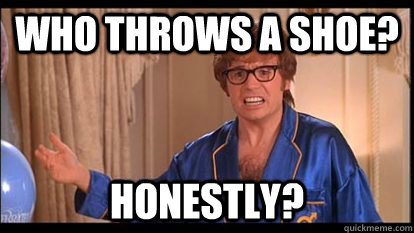
shoe

First of all, the idea that you’re “playing for your job” at every training session in Europe but not in MLS is inflated. European clubs aren’t going to cut people mid-contract. You can lose a starting spot, sure, and then you can regain it the next week. That’s not unique. If you want to see job insecurity, watch the NFL, where a kicker can miss once or twice on Sunday and be unemployed on Monday.

Second: Bobby Warshaw tells a different story of playing for a relegation-threatened team. His teammates in Scandinavia all just wanted to wash their hands of it and be gone.

And it’s not as if pressure always makes diamonds. Sometimes, it makes dust. In this clip, Woody Harrelson is Trinidad and Tobago. Wesley Snipes is the USA.

The USA didn’t lose because the media and supporters are too nice to them. They played tense. Cautious. Trinidad and Tobago did not.

After Prince died, Saturday Night Live ran a tribute. Jimmy Fallon told a story of being at a party where he was on stage wondering if he could get Prince to come up and play. Then he saw the crowd parting and Prince basically floating to the stage. Prince came up to Fallon and gave him a look that said, “Yeah, I got this.”

That’s what the USA needed. Not overconfidence. But that sweet spot between confidence and complacency in which they say, “I got this.” Only Christian Pulisic, who’s too young to have been through the same CONCACAF wars (or relegation battles — see Altidore, Jozy) as his teammates, played with that attitude.

But let’s say there’s a benefit to playing in a league that’s more intense than MLS — though, if you were ever in a locker room with Taylor Twellman or Dom Kinnear after a game, you know things can get pretty intense. Why is Germany more intense than the USA? Why is Germany more intense than Scandinavia?

It’s because Germany has a deeper soccer culture.

Same reason Mexico and the big Euro leagues are more intense than MLS or Scandinavia. For all the progress made in the USA since Paul Caligiuri took a wild shot in Trinidad in 1989, this country is still a good bit behind everyone else. Youth soccer participation plateaued and then started dropping, and while a lot of those kids turn up wearing Messi or Rooney jerseys, a lot more never watch soccer on TV or in person.

So if you want to make a good argument for promotion/relegation, try this:

Pro/rel will help deepen the soccer culture in this country.

And I believe that. Most of what I’m saying here on pro/rel is the same stuff I’ve been saying for 15 years, no matter how much it’s been misrepresented by the PRZ on Twitter. But this is an argument that I can’t remember hearing before. Maybe some people made it, but it was drowned out in all the “PRO/REL WILL OBVIOUSLY MAKE EVERYTHING BETTER BUT MLS/SUM/USSF/STEVE BANNON ARE CONSPIRING TO KEEP THE NFL BIG” nonsense.

This is your argument. This is something you can present to people who have money on the table — not the Monopoly money Silva and company threw at MLS so they could create the narrative that MLS turned down a gazillion bucks to institute pro/rel now.

Is it enough? I don’t know. The other realities still exist. We have a Division I soccer league now where we didn’t in 1992, and it’s because people were enticed to invest in a scheme that reduced the risk from “might as well burn your money” to “there’s a small chance this might work.” If you’d told people in 1992 we’d have a soccer league that consistently drew 40,000 people in Atlanta and Seattle, people would’ve laughed at you. (Especially Atlanta. I grew up in Georgia, and I’m astounded.)

But if the pro/rel crowd is willing to drop the nonsense, along with the conspiracy talk and nonsensical legal actions, maybe there’s a chance to win the argument.

If I were elected USSF president (no, I’m not running — there’s a reason a lot of sane, qualified people from Peter Wilt to Julie Foudy aren’t interested), I’d do the following:

  1. Divisions 2 and 3 go pro/rel next year. I’m torn on whether the USL brand name should stay. The NASL brand name should not. It has a history of incompetence, and even the glory days of the late 70s were built on non-traditional glitzy Americanized soccer. Besides, given the existence of Mexico, the “North American” part of the brand name never rang true. Keep the clubs — to start, put the clubs on the soundest financial foundation in D2 and the others in D3.
  2. Division 4 becomes the top amateur division (semipro clubs are allowed to compete, but it’ll be mostly amateur, as these leagues are now) for the top tiers of the major amateur leagues — PDL, NPSL, UPSL, Cosmopolitan, GCPL, other USASA Elite Amateur Leagues. Clubs that finish in the top three of these leagues can apply for D3 status — for the foreseeable future, only a few clubs will do that. (At this point, I don’t think we can or should relegate clubs from pro D3 to amateur D4. If D3 gets too big, start a pro D4, more or less mimicking what England has recently done with its fifth tier.) Have a D4 national championship if it’s feasible, replacing some of the existing and sort of redundant national amateur cups.

Two reasons to this. First, it’ll make the lower divisions much more interesting.

And it just might demonstrate to the powers- and purseholders-that-be that there’s a benefit to expanding the pyramid and building a soccer culture.

Or, you know, just yell and scream and sue. That’s working so far, right? And competition between uncooperative leagues worked so well that we’re about to celebrate the 100th anniversary of the ASL, right?


ranting soccer dad, women's soccer

Alex Morgan’s ejection from Epcot: Not a big deal, not not newsworthy

Let’s first get rid of the notion that male athletes or public figures would not make the news if they were tossed from a bar — let alone tossed from Epcot Center, where hundreds of people may have seen the incident — or some similar things:

Ric Flair tossed out of bar (pro wrestler)

Deshaun Watson kicked out of bar (football player)

Something about a hat (also football)

Something about paying with bubble gum (also football)

Noooo! Harry Potter himself tossed from bar! (male actor)

Underage college drinking (football)

Underage college drinking (basketball)

More college drinking (football)

Remember Freddy Adu? (soccer)

Jimmy Buffett tossed from NBA game (laid-back rock)

Politician pees on himself (Kenya)

In fact, see how this story was reported in the UK, which might not know Alex Morgan as well as Americans do and instead focused on “Ex Derby County star Giles Barnes.”

You may note that a couple of the players listed above were arrested. I’d suggest reading the stories and asking if a white woman would be arrested for the same crimes. (Yes, Giles Barnes, who was escorted from Epcot along with Morgan and Donny Toia, is Jamaican/English. Just a hunch, and I do have a relative who works elsewhere in the Disney megaplex, but I think Epcot security might be a little less arrest-happy than a lot of police officers in this country.)

Notice one other thing from this NFL arrest database: Many players arrested on DUI charges were immediately released. Not so in women’s soccer, where we have seen a couple of players arrested and quickly forgiven.

So is Alex Morgan’s ejection from Epcot newsworthy, bearing in mind the precedent in other sports? Yes.

Would a male soccer player of note — say, Michael Bradley or Jozy Altidore — get the same sort of treatment? Probably. The fact that Morgan is also a published children’s author might make her a little more noteworthy than Bradley or Altidore, as might the fact that Morgan has won international championships. Maybe we should be comparing with Neymar or someone, and I think it’s fair to say Neymar would make headlines if he got tossed out of Epcot.

Is Morgan’s offense worthy of suspension? No. Other internal punishment? Meh.

Would I expect Portland fans to bring it up this weekend, just as college sports fans would pounce all over a player who got in a mild bit of trouble? Yes.


ranting soccer dad, soccer

An analysis of the ramifications of the NASL’s antitrust suit

You know that scene in Airplane that’s always cut from the TV broadcast? When Ted Striker says something’s going to hit the fan, the camera cuts to the airport office, and said something does indeed hit the fan?

Yeah. That’s my analysis of the ramifications of the NASL’s antitrust suit. But, because this is how we roll, we’re going to dig deeper.

The lawsuit might not be a bad thing. From the youth soccer mandates to the national team ticket prices, the U.S. soccer (lowercase) community has one major complaint against U.S. Soccer (uppercase):

The Federation has become unspeakably arrogant. 

So this is a shot across the bow of U.S. Soccer, and perhaps it’s well-deserved. Maybe this will force the Federation to take a good hard look at the state of the lower divisions, listen to the people involved and take more of an enlightened leadership role. It’s certainly an ominous sign that at least three of the four current members (and the two USSF staff liaisons) of the Professional League Standards Task Force are lawyers — one of them an attorney for the Federation from 2001 to 2009.

That said … are the people filing this suit really the people who should be leading the revolution?

The NASL (see Part 2 of my pro/rel series, which will resume this week) has always been an oddball. It revived the brand name of a dead league that still holds unofficial world records for rule changes and Bugs Bunny appearances, then posited itself as the paragon of traditional soccer. Among the many ironies at play here — the old NASL never bothered with the U.S. Open Cup, which the current NASL touts as proof of its competitiveness:

I’d like to see a breakdown of that 42%. In any case, the Open Cup semifinals (for that matter, most of the quarterfinals) tend to proceed without NASL involvement.

The last two sentences here are classic Jeffrey Kessler, the lawyer who has been wildly successful in every manner of sports litigation except soccer. (See my entry from when the NASL first floated the antitrust warning two years ago.) They may seem convincing to people who don’t know the U.S. soccer landscape. They’re easily refuted by those who do.

And those who do tend to point out inconvenient facts like this:

And here’s a final concern: Court cases have generally been very, very bad for soccer. The MLS players lawsuit (again, Kessler involved) drained a lot of resources from a developing league that could’ve been used to put the league on firmer ground, and it was hardly the first time …

Steve also made the point that league-vs.-league competition has been good in many U.S. sports. But it hasn’t been so good in U.S. soccer. Indoor soccer never recovered from the alphabet soup of the 1990s — though it’s still hanging in there (and might take off if someone added an ambitious team like, say, the Cosmos?). The “Soccer Wars” of the late 1920s threw a wrench into the progress of the American Soccer League.

All that said, U.S. Soccer surely could’ve stopped all this. Look back on the Professional League Standards helpfully published by Neil Morris, whose digging on lower-division soccer is invaluable. (Try PDF from Neil’s old site or non-PDF from Kenn Tomasch.) They’re a little overboard. It’s one thing to make sure teams don’t pop up and blow away like dandelion seeds. It’s another to say you can have multiple Division 2 leagues and then make it nearly impossible for two leagues to meet the standards.

To remain in Division 2, the NASL is supposed to have 12 teams. (Someone, probably Neil, pointed out that a Division 1 women’s league has to have at least 10 teams by year four, which means the NWSL currently has no margin for error.) They’re all supposed to have an owner (at least 35% of the club) with an individual net worth of at least $20 million. They have to be in the Eastern, Central and Pacific time zones.

Why? What’s the harm in having a second division that’s 10 teams in the East and Central? Or eight teams in the Pacific? Why one principal owner with at least $20 million to throw around?

Yes, you can get waivers. Expect Kessler to paint those waivers as purely arbitrary. And he may have a point.

In short: This whole mess really could’ve been avoided. Maybe it’s unrealistic to relaunch the NASL and the Cosmos with pretenses of glory. Maybe it’s unrealistic for the Federation to try to solve the problem with implausible standards.

Maybe everyone involved deserves to be involved.


ranting soccer dad, soccer

Youth soccer survey: Happy with your area’s leagues?

Parents, coaches, technical directors, administrators, whoever … please let me know what you think. I’ll likely do a story on the results.

(function(t,e,s,c){var n,o,i;t.SMCX=t.SMCX||[],e.getElementById(c)||(n=e.getElementsByTagName(s),o=n[n.length-1],i=e.createElement(s),i.type=”text/javascript”,i.async=!0,i.id=c,i.src=[“https:”===location.protocol?”https://”:”http://”,”widget.surveymonkey.com/collect/website/js/uFF4fQzUbK4fZsqFBqGAy_2BxG70Oc_2F0sddFbNF4hLS8y8cpZ14T8tJgHmpqqLijEw.js”].join(“”),o.parentNode.insertBefore(i,o))})(window,document,”script”,”smcx-sdk”); Create your own user feedback survey

ranting soccer dad, soccer, work portfolio

About this story: How this weekend could shape US Soccer’s long-term future

Reminder: I’m off Twitter for a while aside from automated stuff like this. And the next one. And the next one. So if you want to chat with me about this story, why not chat here?

And this one has a bit of a back story, anyway. I’ve been working on this for months. One reason it took so much time is the staggering number of documents I read — financial reports, transcripts from annual general meetings (“Alabama … here … Alaska … here … OK, now the adult associations … Alabama … Alabama … Alaska … here …”) and so on.

Another reason might surprise you: A lot of people weren’t interested in talking. But I didn’t sense that they felt intimidated. They simply didn’t know anything.

I’m grateful that they admitted it. They’re not the Twitter pundits who think they have all the answers on reforming U.S. Soccer but have never even peeked at any of the information the federation puts online. A couple of people had nothing to add to this story but were looking forward to seeing it published.

So there’s a “put up or shut up” element to this story. Sure. If you really want to see some new people in charge, speak up now and over the next four years, because a lot of people may soon be term-limited off the board.

But I also hope it gives people a bit of a peek behind the curtain. Sure, anyone can read the same documents I did and maybe even talk to some of the same people I did, but it takes some time. If you understand U.S. Soccer a little better after reading this, I’ve done my job.

And if you have anything to add now, please do.

It’s an exciting time for soccer. The sport’s profile in this country has completely changed in the past 15 years. So what’s next?

Story: How this weekend could shape US Soccer’s long-term future | Football | The Guardian