pro soccer

How the NASL can bring down Sunil Gulati (maybe)

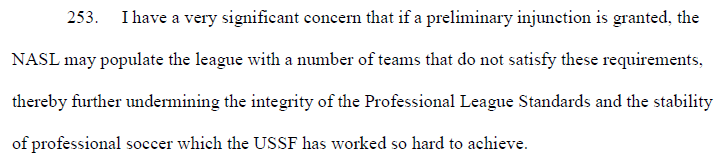
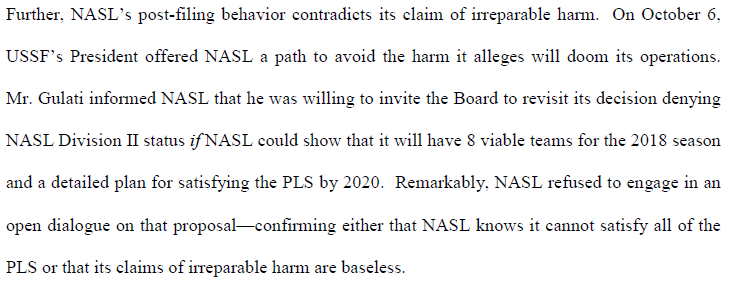
After reading the main text of U.S. Soccer’s response to the NASL complaint, I sat down to read Sunil Gulati’s “declaration.” Most of the 78 pages are dedicated to restating the main text, just in more detail, and stating much of the U.S. Soccer bylaws.

Add it all up, and Gulati makes a convincing case — on paper, at least — that the decisions on sanctioning leagues are made by Board members and Task Force members who are not affiliated with any pro leagues. They even disagree at times. In 2017, the Professional League Task Force (currently VP Carlos Cordeiro, CEO Dan Flynn and Paralympian Chris Ahrens, but I’m not sure that was the same group that voted) recommended against provisional Division 2 sanction for the NASL (and the USL) but that the Board (with Gulati, MLS commissioner Don Garber and anyone else associated with a current pro league recusing themselves) voted to grant those sanctions.

(The minutes for this Board meeting — Jan. 6, 2017 — are not currently on the USSF site. I’m inquiring.)

So — again, on paper — Gulati, Garber and company can’t just do whatever they want.

The task before NASL is to prove that Gulati pulls all the strings.

That’s much easier said than done.

The NASL could hammer away at Gulati for his role in bringing in independent directors for the Board. He’s on the Nominating and Governance Committee, along with Garber (chair), Youth Council rep Tim Turney, Athlete rep Angela Hucles and independent director Donna Shalala. Board minutes over the years show him giving reports on searches for independent directors.

Gulati has sought to diversify the Board in several ways — gender, ethnicity, background, etc. As far as I can find, no white man has ever been an independent director, though it’s a new-ish position. Is he also seeking people who’ll do what they think he wants? Hard to say, especially given this …

(Yes, Shalala stands accused of falling asleep when the NASL made its big presentation Sept. 1. But, again, Lamar Hunt fell asleep when Doug Logan interviewed to be the first MLS commissioner, and Logan still got the job.)

On the other hand, the most recent Board addition is a banker named Lisa Carnoy, a trustee and board member at Columbia, where Gulati teaches. (But also where the soccer stadium is named for Rocco Commisso, someone Gulati was happy to welcome into the pro game as the Cosmos’ savior but is now calling for Gulati to step down every couple of days.)

But even if Gulati has managed to install three puppets as independent directors, along with an ally (Garber) as a Pro Council rep, it’ll be much more difficult to demonstrate how Gulati is somehow manipulating the Youth Council, Adult Council, Athlete Council and National Council to do exactly what he wants. A current Adult Council rep, John Motta, defeated Gulati in a VP election in 1998 and has made noise about running for the presidency.

The Legal Steves (Bank and Holroyd) will need to weigh in to tell me whether all this evidence is enough to fend off accusations of a USSF/MLS/SUM conspiracy from a legal point of view. The practical point of view might be another story. But this is going to court, and to me, the NASL will have a difficult time explaining to a judge that this is a conspiracy.

The other legal argument the NASL has in its pocket: Under U.S. law, U.S. Soccer (and by extension, FIFA) have no authority to regulate the pro game at all, even though we the NASL have said for years that they do. If this argument works, everything short of frogs and locusts rampaging down Fifth Avenue is possible. Maybe the USA would even get kicked out of the next World Cu- … oh, right. OK, the next Women’s World Cup.

A few other odds and ends from the USSF massive document dump:

Gulati depicts himself as someone who constantly tried to help the NASL. He makes several references to Brian Helmick of the San Francisco Deltas expressing his gratitude, which gives me an excuse to play the Beastie Boys:

The exhibits pile on the examples of Gulati personally intervening to help NASL, along with several restatements of intent to help NASL get to D1 status someday. Make of that what you will.

For much of the balance of the year, and into January 2017, I and other USSF representatives invested a lot of time and energy trying to save the NASL – not destroy it as the NASL would now have the Court believe. We helped the NASL explore a merger possibility with the USL, and when that option failed to materialize, I discussed with Mr. Commisso the possible transfer of ownership of the New York Cosmos – which, if it had not occurred, would have almost assuredly led to the demise of the NASL.

gulati-nasl-hist


The first few exhibits are copies of documents from the 1910s and 1920s. Funny how lawsuits provide such a windfall for historians.

What about indoor? Gulati’s declaration cites FIFA statutes requiring national associations to govern football in all its forms. So what about the MASL, which isn’t in the USSF umbrella?

Deloitte is everywhere. The Pro League Standards Task Force includes one Alex Phillips, formerly of UEFA. Also formerly of Deloitte, which produced an easily dissected report in favor of promotion and relegation at the behest of Riccardo Silva (NASL’s Miami FC).

So dangerous you’ll have to sign a waiver. Gulati says he has been pushing for a while for fewer waivers in all leagues — MLS, NASL, USL, NWSL.

On SUM: Gulati says SUM was able to make a great deal by bundling. “As a consequence, SUM was able to negotiate sponsorship and broadcast deals which generated more money for both MLS and the USSF than either had previously been able to negotiate.

The revenues generated from USSF’s relationship with SUM benefit all stakeholders in the sport of soccer in that it allows the USSF to devote additional resources for, among other things, player, coach and referee development, safety education and the development of training centers.

On the standards: “Without a credible threat to deny non-compliant leagues a sanction for a particular division, the USSF would have almost no leverage to enforce its standards.”

gulati-why-pls

On what the NASL might do next:

gulati-harm

Today, Midfield Press reported that a couple of NASL owners plan to “help several ambitious NPSL clubs make the leap to the pros by temporarily financing them until long term investors can be found.”

I should mention I’ll have an NPSL-related podcast next week.

On my citation: You may have seen this on Twitter yesterday …

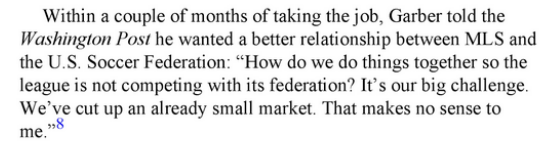
Here’s the funny part — that was NOT a quote I got directly from Don Garber.

Check out Exhibit 12 from the NASL filing / Rizik Declaration:
post-cite

Notice the “8” footnote? Or the “told the Washington Post“?

That footnote goes to a Steven Goff story from Oct. 22, 1999.

I don’t think I’ll be subpoenaed.

Next up: Reconstructing the timeline of how everything fell apart from the multitude of USSF exhibits. This could take a while.

pro soccer

Quick read of the longggggg U.S. Soccer reply in the NASL suit

U.S. Soccer deserves blame for many things. The organization is fundamentally arrogant and stubborn, and that may have played a role in the men’s national team’s failure to qualify for the World Cup — along with recent failures in the Olympics and a plateau or decline (depending on whose numbers you use) in youth soccer that threatens to undo decades of progress.

But are they really obliged to do any more than they already have for the NASL?

A few questions I’ll have as I go through this:

  • What does U.S. Soccer have to say about the 2015 Pro League Standards (PLS) proposal that the NASL seems to regard as the last straw?
  • How much info will U.S. Soccer spill about all the NASL’s missteps?
  • Does U.S. Soccer present a viable case that it can legally determine who’s a FIFA-sanctioned league under U.S. law (Stevens Act), and if not, are we headed toward U.S. Professional Soccer Armageddon (USPSA)?

Here we go …

SUMMARY

Literally the bullet points …

ussf-sum

INTRO, translated to English

“Look, what do you want from us? We created PLS in 1995, when the NASL was still as much a synonym of 70s excess as Pele and Mick Jagger stumbling out of Studio 54. Then you guys decided to revive the brand name in 2009, and we held your hand through endless turnover and a racketeering scandal that engulfed your biggest owner?

“And it’s not as if Don Garber and a bunch of MLS/SUM guys are sitting here revising the PLS to sabotage you. It’s an independent task force, and directors affiliated with pro leagues can’t vote on whether to change the standards or let you guys have your precious D2 status or your more precious (ha!) D1 status. You really want to tell us Goldman Sachs alum Carlos Cordeiro, Clinton administration alum Donna Shalala and WNBA/Big East exec Val Ackerman are conspiring against you?

“Oh, and they’ve based all their “showing of harm” on the declaration of an owner (NY Cosmos’ Rocco Commisso) who just joined this sinking ship a few months ago. Now they’re crying about how impossible life would be in D3, to which we offer three letters: USL.

“Your Honor, if you grant this, you’ve undermined our entire organization, and you should get ready to serve as the de facto decider of divisional structures for the foreseeable future because everyone’s just going to sue.”

INTRO, crux of the legal argument (verbatim)

The preliminary relief NASL seeks—an injunction requiring USSF to sanction it as a Division II league for 2018—conflicts with the ultimate relief NASL seeks: an order striking down the PLS altogether. Indeed, NASL asks this Court to order something that it argues violates the antitrust laws. And in doing so, it wants the Court to reengineer the core activity of a legitimate sports governing body—something the antitrust laws and abundant precedent do not permit.

INTRO, recurring grammatical error

The commas are not needed here …

ussf-commas

INTRO, new-ish stuff

ussf-new

ABOUT USSF GOVERNANCE

A bit of history we all know but is necessary for the legal record — World Cup in 1994, MLS in 1996, etc. Highlights:

  • Yes, USSF is willing to have multiple leagues in the same division. Just meet the standards.
  • Many references to Professor (Steven) Solomon, a governance expert at Berkeley who got his law degree from … Columbia! Is it hidden in the bylaws somewhere that everyone involved in U.S. Soccer must have passed through there at some point? My brother did a medical residency there — can he join the board?
  • The process for new PLS: The Task Force includes no reps from leagues or the USSF Board of Directors, the proposed revisions go out to all pro leagues (including NWSL, for the record) for comment, the revised revisions go to the Board, and the Board (with any pro league people recused) votes. Footnote: The NASL didn’t object to the “time zone” standard in 2014. When it (and other leagues) objected to the 2015 proposal, the task force withdrew it, and the Board never even voted. (I think the NASL reply may hammer at the claims of independence of this task force. If not — that would be a major omission.)

“HEY, YOU USED TO LIKE US!”

Parts F and G of the Statement of Facts run through the USSF/NASL relationship over the years. As stated:

  • 2011: The league nearly fell apart before it started, but the USSF kindly helped the NASL to its feet and gave it D2 status with a bunch of waivers, and CEO Aaron Davidson said he took the standards seriously.
  • 2012-15: The NASL still didn’t meet D2 standards, but the league assured us it was progressing, and nobody complained.
  • 2015-16: The NASL, still not meeting D2 standards, applied for D1 and started complaining about the standards. “In ensuing discussions,” the USSF asked pointed questions about Traffic Sports, which owned several teams and was the league’s marketing agency … until it pleaded guilty to racketeering in May 2015. NASL said it was dissociated from Traffic, so the USSF gave it another year as D2 in 2016.

Then USSF drops the bomb:

ussf-2016

The Task Force advised the Board not to grant the NASL a D2 sanction for 2017. The Board (again, minus recused members) gave it anyway.

The application for 2018: NASL had “at best” commitments from seven teams and no detailed plan for complying with the PLS.

MORE LEGAL ARGUMENTS

Roughly translated, but I think the two Legal Steves — Bank and Holroyd — can do a much better job dissecting this part:

  • Given the USL’s success as a D3 league, there’s no evidence of “irreparable harm” if the NASL plays D3.
  • There’s some hair-splitting about what a mandatory injunction can or cannot do.
  • There’s no conspiracy among USSF, MLS and SUM because:
    • Recusals on votes
    • The PLS existed waaaay before the NASL
    • “MLS’s participation in USSF does not evidence conspiracy as a matter of law.” (Several precedents cited)

“Put simply, unless the Court is willing to conclude that decisions made by the disinterested members of the USSF Board (directors such as Ms. Ackerman, Mr. Cordeiro, Ms. Shalala, and directors affiliated with youth soccer) are somehow part of a supposedly decades-long conspiracy aimed at driving the NASL out of business, there is no evidence of any unlawful agreement.”

  • A 1988 suit against NASCAR is cited as precedent that a lawsuit cannot “reengineer the core activity of a legitimate sports governing body.”
    • “Here, the NASL asks the Court to decide the right structure for professional soccer in the United States, and to reject the successful framework established by USSF decades ago.”

DEFENDING THE PLS

USSF argues that the standards are “pro-competitive” because they make sure leagues are credible.

Is it too easy to take a shot at the NASL griping that other major soccer leagues don’t have time-zone requirements, when it’s quite obvious that the countries in question have only one time zone? No, it’s not. USSF does just that. The time-zone standard is certainly ripe for debate — I see no reason for a second-division league to be national — but the NASL tossed the USSF lawyers a slow-pitch softball here.

Then comes an interesting argument: According to precedent (at least, USSF’s interpretation of that precedent), the plaintiff has the burden of proving that the PLS have an adverse effect on competition and that the same pro-competitive effect can be attained some other way.

(To which the counterargument would be “pro/rel,” and the counter-counterargument would be “you really think this is about pro/rel now?” and “that doesn’t address the USSF’s right or responsibility to set standards that could easily render pro/rel moot.”)

Oh, and Japan and Spain have minimum stadium-size requirements, so the NASL can’t say the USSF is unique.

Then the argument turns to the “greater good” realm: “NASL screams about supposed harm to itself, but never explains how the PLS harm U.S. sports fans, who have enjoyed an unprecedented growth in the sport of soccer under USSF’s watchful eye.” Is that legally relevant?

BALANCE OF HARDSHIPS: This will hurt me more than it’ll hurt you

In short: “NASL seeks an order that would eviscerate USSF’s standing as the governing body for soccer and seriously harm its relationship with FIFA.”

And that’s the main document. Tune in tomorrow when I make it through the rest of the … whoa … let’s make it next month …


podcast, pro soccer, youth soccer

RSD15: The clogged youth-to-pro pipeline, with Brian Dunseth and Chris Keem

Was Nik Besagno a warning sign?

The top pick in the 2005 MLS Draft — ahead of Brad Guzan, Michael Parkhurst, Will John, Chris Rolfe, Bobby Boswell, Chris Wondolowski and Jeff Larentowicz — had a very short MLS career. Perhaps not coincidentally, that’s when people started to wonder if the U17 residency in Bradenton was producing soft, coddled players.

Yes, the youth-to-pro pipeline is at the core of our national wailing and gnashing of teeth after the U.S. men failed to qualify for the World Cup. It’s a topic so big, we need two guests.

First up, player-turned-commentator Brian Dunseth talks about what happened in Trinidad (3:30), Olympic soccer and how much it hurt the men to miss out (5:00), losing players from youth soccer (9:40), the parental perspective when clubs start demanding your money (11:20), the importance of failure (17:00), whether players are too soft or coddled (20:15), MLS (27:15 and 33:10), coaching education (28:15), relegation from a player’s perspective (35:45), the Development Academy (39:45), and an easy solution to all of this (40:10). Then concussions (44:30).

Then it’s Chris Keem, a veteran youth soccer coach and administrator with experience in college and the NPSL as well, joins us around the 50-minute mark. We start out talking about turf wars and how they drive up prices in youth soccer, then move into dealing with the Development Academy when you’re running another youth club (53:45), addressing “pay to play” and how it works in other countries (58:00), getting a club’s coaches on the same page and poaching vs. development (1:04:30), what the NPSL was and what it wants to be (1:06:00), and why youth players may opt for other sports (1:17:30).


pro soccer

The best post-T&T pro-promotion/relegation argument

Predictably, Soccerocalypse has brought out the usual arguments from the promotion/relegation crowd:

  1. Youth development will be so much better!
  2. Players will be under constant pressure!

If anyone could turn their attention away from Twitter long enough to read something longer than 280 characters at a time, they would have seen this addressed in the pro/rel series — both pros (and alleged pros) and cons.

The short versions:

Youth development: European clubs that have good academies have them so they can sell players (and yes, solidarity payments/training compensation is a legitimate issue with legal potholes I can’t fully comprehend). Chelsea’s inability to develop a first-team player from within is legendary, just one example of a “broken” academy system in the birthplace of soccer.

MLS has actually made progress in youth development because its clubs know they can avoid the boom and bust of pro/rel. They feel confident spending millions to create what wasn’t there before. Then they have a pathway, via their oft-derided relationship with USL, to send promising 17-year-old players to the first team via the USL bridge.

And then MLS teams can play their youngsters because they know they’re not going to be relegated. That’s one reason why MLS has developed so many players who turn around and beat the USA in CONCACAF. (I have heard arguments that MLS needs to impose stricter limits on international players. Then I’ve heard arguments saying MLS needs to spend more on international players to raise the level so that any U.S. players who make that first team will be more appropriately challenged.)

Pressure: Yes, we know. Someone in a German locker room threw a shoe at Eric Wynalda.

shoe

First of all, the idea that you’re “playing for your job” at every training session in Europe but not in MLS is inflated. European clubs aren’t going to cut people mid-contract. You can lose a starting spot, sure, and then you can regain it the next week. That’s not unique. If you want to see job insecurity, watch the NFL, where a kicker can miss once or twice on Sunday and be unemployed on Monday.

Second: Bobby Warshaw tells a different story of playing for a relegation-threatened team. His teammates in Scandinavia all just wanted to wash their hands of it and be gone.

And it’s not as if pressure always makes diamonds. Sometimes, it makes dust. In this clip, Woody Harrelson is Trinidad and Tobago. Wesley Snipes is the USA.

The USA didn’t lose because the media and supporters are too nice to them. They played tense. Cautious. Trinidad and Tobago did not.

After Prince died, Saturday Night Live ran a tribute. Jimmy Fallon told a story of being at a party where he was on stage wondering if he could get Prince to come up and play. Then he saw the crowd parting and Prince basically floating to the stage. Prince came up to Fallon and gave him a look that said, “Yeah, I got this.”

That’s what the USA needed. Not overconfidence. But that sweet spot between confidence and complacency in which they say, “I got this.” Only Christian Pulisic, who’s too young to have been through the same CONCACAF wars (or relegation battles — see Altidore, Jozy) as his teammates, played with that attitude.

But let’s say there’s a benefit to playing in a league that’s more intense than MLS — though, if you were ever in a locker room with Taylor Twellman or Dom Kinnear after a game, you know things can get pretty intense. Why is Germany more intense than the USA? Why is Germany more intense than Scandinavia?

It’s because Germany has a deeper soccer culture.

Same reason Mexico and the big Euro leagues are more intense than MLS or Scandinavia. For all the progress made in the USA since Paul Caligiuri took a wild shot in Trinidad in 1989, this country is still a good bit behind everyone else. Youth soccer participation plateaued and then started dropping, and while a lot of those kids turn up wearing Messi or Rooney jerseys, a lot more never watch soccer on TV or in person.

So if you want to make a good argument for promotion/relegation, try this:

Pro/rel will help deepen the soccer culture in this country.

And I believe that. Most of what I’m saying here on pro/rel is the same stuff I’ve been saying for 15 years, no matter how much it’s been misrepresented by the PRZ on Twitter. But this is an argument that I can’t remember hearing before. Maybe some people made it, but it was drowned out in all the “PRO/REL WILL OBVIOUSLY MAKE EVERYTHING BETTER BUT MLS/SUM/USSF/STEVE BANNON ARE CONSPIRING TO KEEP THE NFL BIG” nonsense.

This is your argument. This is something you can present to people who have money on the table — not the Monopoly money Silva and company threw at MLS so they could create the narrative that MLS turned down a gazillion bucks to institute pro/rel now.

Is it enough? I don’t know. The other realities still exist. We have a Division I soccer league now where we didn’t in 1992, and it’s because people were enticed to invest in a scheme that reduced the risk from “might as well burn your money” to “there’s a small chance this might work.” If you’d told people in 1992 we’d have a soccer league that consistently drew 40,000 people in Atlanta and Seattle, people would’ve laughed at you. (Especially Atlanta. I grew up in Georgia, and I’m astounded.)

But if the pro/rel crowd is willing to drop the nonsense, along with the conspiracy talk and nonsensical legal actions, maybe there’s a chance to win the argument.

If I were elected USSF president (no, I’m not running — there’s a reason a lot of sane, qualified people from Peter Wilt to Julie Foudy aren’t interested), I’d do the following:

  1. Divisions 2 and 3 go pro/rel next year. I’m torn on whether the USL brand name should stay. The NASL brand name should not. It has a history of incompetence, and even the glory days of the late 70s were built on non-traditional glitzy Americanized soccer. Besides, given the existence of Mexico, the “North American” part of the brand name never rang true. Keep the clubs — to start, put the clubs on the soundest financial foundation in D2 and the others in D3.
  2. Division 4 becomes the top amateur division (semipro clubs are allowed to compete, but it’ll be mostly amateur, as these leagues are now) for the top tiers of the major amateur leagues — PDL, NPSL, UPSL, Cosmopolitan, GCPL, other USASA Elite Amateur Leagues. Clubs that finish in the top three of these leagues can apply for D3 status — for the foreseeable future, only a few clubs will do that. (At this point, I don’t think we can or should relegate clubs from pro D3 to amateur D4. If D3 gets too big, start a pro D4, more or less mimicking what England has recently done with its fifth tier.) Have a D4 national championship if it’s feasible, replacing some of the existing and sort of redundant national amateur cups.

Two reasons to this. First, it’ll make the lower divisions much more interesting.

And it just might demonstrate to the powers- and purseholders-that-be that there’s a benefit to expanding the pyramid and building a soccer culture.

Or, you know, just yell and scream and sue. That’s working so far, right? And competition between uncooperative leagues worked so well that we’re about to celebrate the 100th anniversary of the ASL, right?


pro soccer, youth soccer

Here’s what WON’T help U.S. Soccer

snake-oil“That’s right, folks! Step right up and get your miracle elixir! Cures everything from chronic flatulence to an inability to qualify for the World Cup or Olympics from CONCACAF!”

Doesn’t work that way. The problems have deeper roots. A dash of snake oil isn’t going to make the U.S. men’s team (or women’s, which has some similar issues and some very different) magically better.

Among the pet programs that won’t make the USA follow France’s path from qualifying failure to World Cup champion in four years:

Ramping up “pressure”: Consider how Trinidad and Tobago played in their cozy, bumpy stadium with the soothing hum of generators or pumps or whatever created what little “atmosphere” existed last night. They were loose. They were having fun. Only Christian Pulisic, who’s too young to have been through the battles of his teammates, played with any flair to match what the home side brought to the marshland of Ato Boldon Stadium.

If anything, the U.S. players seemed too tightly wound. Michael Bradley, the captain, was raised in a family that lives for competitive pressure. Jozy Altidore has dealt with the wrath of the global soccer media in the midst of a relegation fight, and yet he was probably a lot better before all that, back in the 2009 Confederations Cup and World Cup qualifying that year.

Which brings us to this …

Promotion/relegation: I dealt with this in the pro/rel series. Pro/rel doesn’t magically turn every club into Barcelona. It doesn’t make clubs run awesome academies — in fact, you might end up with some major gaps as major cities’ clubs lose Division 1 status and have to cut funding.

And can we cut the nonsense that players in MLS clubs aren’t playing for their jobs? North America is littered with MLS washouts. (Some of whom turn around and score against the USA in CONCACAF play.)

Dismantling MLS: The league needs improvement, sure. But it’s worth noting that the goals that eliminated the USA — from Panama and Honduras — came from guys with plenty of MLS experience.

Costa Rica is going back to the World Cup. MLS players scored 11 of their 14 goals in the Hexagonal.

And the oft-derided MLS-USL partnership has created an alternate pathway to the oft-derided college game. Go to an MLS academy. If you’re ready to go pro at age 17 or 18 but not quite ready for the first team, play for the reserves in USL. Then up to MLS.

Clubs have made these investments because they’re financially secure. They feel confident that they’ll be in the top division for the foreseeable future. Any change to that structure needs to be made very carefully.

Let’s put it this way: If you dismantle MLS, you’re also dismantling most of the free academies that exist in this country. How is that supposed to help?

Having the “passion” to hurl rotten fruit at players when they return: Sure, let’s make the notion of being a professional and international soccer player less attractive in a country that has a ton of sports options. That’ll work.

Along those lines …

Telling people how to live their lives: Remember when everyone was telling Landon Donovan to abandon his family and move to Europe for our own satisfaction?

Two issues with that:

  1. That’s not going to inspire future athletes to devote themselves to soccer and international play.
  2. Couldn’t the U.S. men have used a Landon Donovan last night, no matter how many years he spent in MLS instead of the Bundesliga?

Hiring a savior: One guy isn’t going to turn around the men’s national team, let alone change the entire culture in this country. Jurgen Klinsmann had no idea how to change youth soccer other than the vague imposition of things he knew as a child in Germany.

The people working to change the culture are working at the U.S. Soccer Foundation (different from the federation) and other organizations trying to make the sport more accessible.

Turning the sport into a job for which only the elites may apply: Eastern Europe in the Cold War had a bunch of sports machines that culled the top sports talent at an early age and herded them into camps. Brazil and other countries thrive on street soccer. Which group has had more success?

Reading too much into one World Cup, either 2002 or 2018: Was Bruce Arena a genius in 2002? Somewhat, but it helped that Portugal collapsed and the ref didn’t notice John O’Brien’s handball against Mexico. Was he suddenly an idiot in 2018? Somewhat, but it helped that Panama scored a phantom goal and Honduras (and T&T) got a couple of flukes.

Wins amplify good decisions. Losses amplify bad ones.

* * * *

Here’s what WILL help:

“Incremental changes at multiple levels”:

Reducing the “travel” in travel soccer: Even if you have tons of scholarship money, explain to me how a kid with two working parents who don’t control their own schedule are going to get that kid to every practice and game all over a five-state region?

Related to that …

Ending the turf wars: We have an arms race. Club A is in the Development Academy, so Club B has to be in the ECNL. Then Club C has to travel to multiple showcases everywhere from Disney World to that massive soccerplex in Indiana that’s hosting everything these days.

Remembering that we’re still competing for players and fans: Quit telling 9-year-olds that the stuff they’re doing now will pay off when they’re 16-year-old pros. Quit pretending we can drive people out of the sport as children and expect them to be paying customers when they grow up.

If soccer was so deeply ingrained in the USA that we would put up with all this, fine. The truth is that we’re still fighting attitudes like this:

And that is a Democratic Congressman. His voters surely include a lot of immigrants and a lot of soccer fans. And yet he feels secure in bashing soccer. In 2017.

Education: I’ve had the chance to see more than 100 paid coaches at the U9-U12 level. Maybe 20 of them are people I’d be happy to have coaching my kids. Another 20 or so seemed OK. The rest are screamers, joystick coaches and assorted cretins.

I’ve also worked with about 100 parent coaches. Some of them are trying to learn what they can and apply what they’ve learned. Some can’t be bothered to do the two-hour online F license.

Listen: Everyone’s talking and no one’s listening. Not just on Twitter. Also in Chicago, where the most basic questions about the Development Academy or anything else get brushed off and ridiculed.

The USA has a lot of smart people. Not just one, not just a small group. And as Steve Gans found on his “listening tour” before declaring his candidacy for the U.S. Soccer presidency, they’re not being heard.

Maybe we should all do a listening tour.

And then keep some perspective. No one died here. That’s happening in Puerto Rico, Las Vegas and California. We’re talking about a sport, one in which the better team doesn’t always win. The USA probably wasn’t one of the top eight teams in 2002, and they probably aren’t outside the top 32 right now.

Let’s not set up an East German-style sports machine. Let’s not take the fun out of this sport and assume good athletes are going to want to play anyway.

Embrace diversity — in all senses. Embrace accessibility. Calm down and think.

And then we can do the same thing next year when the women don’t qualify for France 2019.

pro soccer

Promotion/relegation propaganda/reality, Part 5: Cons

You’ve read about the pro/rel pros, the history of the U.S./Canada debate, and the major players in the U.S. (including U.S. Soccer).

Now it’s time to read about why promotion/relegation can be a bad idea.

Yes, promotion/relegation has pros and cons. That’s heresy in some quarters.

But what doesn’t have pros and cons? The U.S. sports system has pros and cons. Capitalism has pros and cons. Representative democracy has pros and cons. Going outside has pros and cons. We simply have to weigh them and decide what’s best.

Pretending that pro/rel makes everything better is simply dishonest. If you read all this and decide pro/rel is the best system in Europe (probable), the best system for U.S. amateur leagues (also probable), the best system for U.S. lower divisions (quite plausible) and the best system for the entire U.S. pyramid (more problematic, but not easily dismissed), that’s your prerogative.

So let’s take a look …

PRO/REL CONS: GLOBAL

Con #1: Can’t count on division status when planning long-term investment.

See Reading, which will expand … or not … well, maybe … if they can win their way into the Premier League.

“But smaller clubs will invest in their academies to produce players to compete,” we hear. Wrong. And if you’ve read Raphael Honigstein’s Das Reboot: How German Soccer Reinvented Itself and Conquered the World, you know the federation had to force the 36 Bundesliga clubs (well, not all of them, but they felt compelled to impose the rule) to run academies. They weren’t all happy about it.

* * * *

Con #2: “Pure” pro/rel based on “sporting merit” usually takes a back seat to “other criteria,” anyway.

England is the birthplace of soccer and the birthplace of pro/rel. So take a look at what they’re doing with their women’s leagues: Top tier will go pro-only, second tier for semipros. And that’s perfectly legal under FIFA Statutes, Article 9, which a lot of PRZ (Pro/Rel Zealots) incorrectly cite as proof that the U.S. system violates FIFA’s holy word.

This isn’t something new. Consider how England did pro/rel between its amateur (“non-League”) and professional leagues for generations. The last-place team in the last League division stood for re-election against everyone who wanted in. Usually, that last-place team stayed in.

Then there’s the Netherlands. If someone can explain the contortions they’ve gone through in the last few years to try to institute pro/rel between the amateurs and pros better than Wikipedia has, please tell me.

And if you want to go back a ways, join Dan Loney for a deep dive into the erratic history of pro/rel in Brazil, which rather thoroughly refutes the Deloitte claim that no country with a “closed league” has won the World Cup. I’ll add one thing: Before you complain that Dan focused only on the state leagues, bear in mind that Brazil’s national league didn’t start until 1959.

* * * *

Con #3: People who have nothing to do with the soccer side of the business can lose their jobs.

Farewell, Aston Villa employees. Goodbye, Newcastle backroom staff. Have fun collecting unemployment, locals who sell food, merchandise, tickets, etc.

Sometimes it’s years of mismanagement than lead to relegation. Sometimes it’s a couple of injuries and one bad bounce. The flip side of that wonderful moment when the ball fell to the foot of Carlisle United goalkeeper Jimmy Glass is that Scarborough went out of the League, which in those days was a horrifying drop.

“But that’s capitalism,” the PRZ have argued over the years. Sure. And it’s why capitalism is regulated and constantly reformed. Look, we all went through our libertarian phase in high school or college, but at some point, you have to grow up and realize we aren’t in ancient Rome giving thumbs-ups and thumbs-downs for our morbid entertainment.

* * * *

Con #4: Pressure creates ugly soccer.

How do you make someone miss a shot in basketball? You ramp up the pressure. Even Woody Harrelson knows that …

What do you think of when you think of do-or-die situations in knockout tournaments and relegation battles? Beautiful plays? Or “grit”?

The latter. And yet the PRZ tell us over and over that the USA will suddenly learn how to play with skill and verve.

* * * *

Con #5: Clubs make “survival” their only goal.

Self-explanatory.

* * * *

Con #6: Clubs in relegation danger have little incentive to give young players a chance.

Again, the PRZ insist that pro/rel is the key factor in player development. But in which country are you more likely to see young players thrown into the fray and given a chance? England, where clubs live in constant fear of relegation? Or in the USA, where clubs near the bottom of the table can start building for next year?

* * * *

PRO/REL CONS: SPECIFIC TO THE USA/CANADA

Con #1: Lawsuits, lawsuits, lawsuits!

You think MLS owners who’ve made nine-figure investments (add up expansion fees for newer owners, capital calls for older owners, stadiums, academies, etc.) are going to go quietly if they’re told their investments are going to be at risk of being devalued?

* * * *

Con #2: The PRZ have poisoned the well.

Take a look, if you happen to be unfamiliar with the last 15 years or so of public discourse on the topic.

* * * *

Con #3: The USA and Canada have unique challenges with soccer fans spread over a giant land mass.

I’ll wholeheartedly agree with one thing in the NASL lawsuit — the notion that a second division has to be in three time zones is ridiculous. (The way they’ve argued it is hilarious — gee, you mean England doesn’t require teams in three time zones? — but that’s another rant.)

The USA was hostile to soccer for generations. Read … well, anything — David Wangerin’s booksOffside: Soccer and American ExceptionalismSoccer Against the Enemy, etc.

In some ways, it might be easier to build up pro leagues if we built them around pockets of soccer fans — Cascadia, California, the mid-Atlantic, etc. But then those leagues would struggle to get TV deals, and we’d leave nothing for fans in the rest of the country. If Kansas City can fill its stadium for MLS games, then Kansas City should have a danged team.

Pro/rel would put us in danger of removing a major market from the top division — Chicago, Los Angeles, Portland, Washington, etc. That’s not the case in England, where it’s virtually impossible to be more than 150 miles from a Premier League club unless you’re in Cornwall or unless you’re at the very fringe of East Anglia during a down period for Norwich and Ipswich.

* * * *

CONCLUSION

So do the pros outweigh the cons?

I’m on record as saying yes, with a whole lot of asterisks. I’m disappointed when MLS commissioner Don Garber — who is surely speaking for a strong majority of MLS owners — brushes it aside.

But any good system is going to have to account for as many of these issues as possible. Figure out a way to mitigate the financial risks, not just for unsympathetic oligarchs (not all of whom are horrible people) but also for people who work in MLS club offices. Come up with a format that adds excitement without leaving us with a bunch of grim, grinding soccer games.

Piece of cake, right? Especially when we’re having such rational discussions about it.

pro soccer

Promotion/relegation propaganda/reality, Part 4: Pros (positives)

Saturday night, the Washington Spirit will host the Boston Breakers. It should be a beautiful night at the Maryland SoccerPlex, and the team is celebrating a “Night of Kindness.”

Also, both teams will have incentive to lose.

Not that they’ll try to lose. Both teams are honorable. Both teams have a lot of injured starters and a lot of players hoping to make an impression and stick around next year. But at the club level, the incentive is there.

The Spirit is ninth place in the 10-team NWSL. The Breakers are 10th. If Boston wins, they’ll switch places in the standings with one game left.

The last-place team in the NWSL gets the top pick in the draft. That’s expected to be Andi Sullivan, a Northern Virginian who has played for the Spirit Reserves and its predecessor team, D.C. United Women. If the NWSL had a “homegrown” rule like MLS does, the Spirit would happily claim Sullivan no matter who finishes where in the draft order.

Frankly, the Spirit will probably move heaven and earth to get Sullivan home anyway. But if Boston has that top pick, they can extort a nice reward for finishing last.

You may object to this not-so-hypothetical scenario being listed as a “pro” of promotion and relegation. It’s really the draft system, which is becoming less and less relevant in MLS, and we will eventually talk about the “cons” of how pro/rel affects last-place teams in the next entry. But we’re going to use a generous definition here. If something is better with promotion/relegation, it’s a “pro.”

Pro #1: No tanking for draft picks.

* * * *

glassPro #2: Folklore.

One of my favorite books is the Rough Guide to English Football. I have the 1999-2000 edition, so it’s hopelessly outdated by now. But I hang on to it because the club histories are so colorful. And every once in a while, I have to remind my self how Preki and Robert Warzycha fared at Everton.

The cover photo is of Carlisle goalkeeper Jimmy Glass, who had just scored a goal at the other end when he raced forward in desperation. Glass was on loan to the fourth-tier side from Swindon Town.

A few years later, Carlisle United did indeed drop out of the Football League. But by then, the fifth division had been shored up — a process that took decades. And they immediately went back into the League, where they’ve spent some time in the fourth tier and some in the third.

* * * *

Pro #3: The lower divisions become much more interesting.

The appeal of the NASL, USL and any other league right now is that it gives people a local team to follow. I enjoyed being an idiot supporter of the A-League’s Carolina Dynamo back in the day.

On a national level, despite the NASL’s delusions of grandeur, there’s no reason to follow the league. It’s like living in England and watching the Belgian league without any ties to Belgium.

Put an MLS berth on the line, and you suddenly have national interest.

* * * *

Pro #4: Parity.

This is why most amateur leagues that have more than 10 teams have multiple divisions. The really good teams loaded with former college players can all play each other. The teams scraping to grab a few officemates to fill out the roster on Sunday can play each other without getting crushed 15-0 by the really good teams.

In pro leagues, of course, this only works from the second division on down. Pro/rel isn’t going to make anyone competitive with Barcelona or Bayern Munich. That’s another issue. But the lower tiers should work as well as the amateur leagues.

* * * *

Questionable pro #1: Academy investment. A couple of EPL clubs have cut or are thinking about cutting their academies. German clubs are forced to have them by the federation, in the interest of developing German players. A lot of the top clubs in the world don’t turn out good youth prospects.

A lower-tier club may have a good academy for reasons other than pro/rel. Maybe a club in an isolated area wants to give its local players a shot at playing, and they sell their best prospects to other clubs for the money to keep the lights on and the grass mowed. As long as you have training compensation and solidarity payments (yes, that’s another rant in U.S. soccer), you can benefit.

* * * *

Questionable pro #2: Incentive for the players. We all know the story of Eric Wynalda having a shoe thrown at him for being insufficiently miserable in a German locker room. But now we also know the story of Bobby Warshaw seeing his relegation-threatened teammates in Scandinavia keeping an eye on the door and trying to get out without taking any of the blame. There’s a difference between those two experiences that pro/rel cannot explain.

And if you saw Aston Villa play last year, you know those players weren’t motivated.

That brings us back to the Spirit-Breakers game. These teams are reloading for next year. They’re evaluating players. Those players, like players at D.C. United, Colorado and any other lowly MLS club this year, are playing for future employment. That’s more motivation than anything else.

That said, it would be cool to be Jimmy Glass, wouldn’t it?

So the pros and cons aren’t so simple. In the next entry, we’ll look at the cons.


pro soccer

NASL, U.S. Soccer cannot agree on court timeline

U.S. Soccer has responded to the NASL’s antitrust lawsuit — not a full-scale rebuttal of the charges, but a complaint about the NASL’s desire to get to court as quickly as possible.

The USSF response goes on to say:

  • USSF was served with the NASL complaint two days ago. (They underline it in the complaint.)
  • That complaint is really long — 71 pages, plus three declarations totaling 113 pages (Stefan Szymanski’s is 80)

NASL asked for this schedule, the USSF response says:

  • Oct. 4: USSF response to the suit
  • Oct. 11: NASL response to the response
  • Oct. 18: Hearing
  • Before all that: If USSF doesn’t agree to that schedule, then both parties should submit their proposed schedules by 10 a.m. Friday (Sept. 22, today). U.S. Soccer responded, “Dude, it’s Rosh Hashanah” (not in those specific words), and suggested Tuesday, Sept. 26.
  • And yet, USSF came up with a briefing schedule by Thursday night. NASL didn’t respond to USSF, says the response, instead sending a letter to the court.

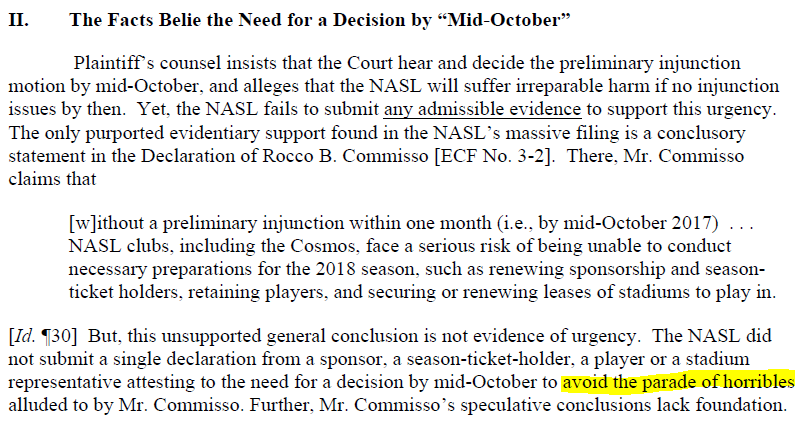
Next up: USSF claims no decision is necessary by mid-October. Here’s another excerpt, with an amusing turn of phrase highlighted:

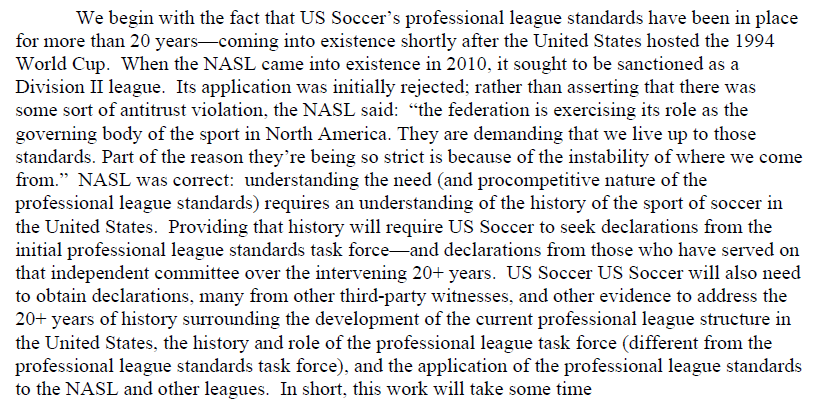
The next part: USSF points out that the sanctioning process usually doesn’t even begin until fall, with decisions in December. And this past year, Commisso bought the Cosmos from the scrap heap in January and managed to get the team on the field two months later.

(Yes, you could argue that such a timeline is less than ideal. Of course, USSF could also argue that they did the NASL a favor by saying “no” to Division II sanctioning in September rather than December.)

Next up: The “We can’t possibly do this in two weeks” argument.

Which leads to a paragraph that is incoherent and yet interesting.

Having played the “Hey, you guys used to be reasonable” card, USSF now plays the “If you wanted a speedy resolution, why’d you include 80 pages from Stefan Szymanski?” card:

I hope this case continues because I would really like to see declarations from the past and present members of these mysterious task forces. Many task forces and committees have reports in the Annual General Meeting report, in case you want to see what the Audit Committee or Open Cup Committee has been up to, but usually not the Professional League Task Force (which currently consists of U.S. Soccer staff, U.S. Soccer’s VP and a Paralympian from the Athletes Council) or the Professional League Standards Task Force (Lawyers R Us).

The proposed USSF timeline is basically an invitation for Jeffrey Kessler and company to skip Thanksgiving this year.

I’m no lawyer, but I think it’s safe to say the court isn’t going to buy a 13-day window there. My guess would be the USSF Opposition would be due before Nov. 17.

Exhibit A is Jeff Carlisle’s ESPN story about Commisso bringing the Cosmos back from the dead. Exhibit B is Brian Straus’ SI story on the same topic.

pro soccer

A complete fact/reality check of the NASL lawsuit (abridged)

Apologies to Reduced Shakespeare Company for the headline.

let-it-rot
“In the midst of all this public bickering, Let It Rot was released as a film, an album, and a lawsuit.”

I went line-by-line through the NASL lawsuit and was intending to come back to anything that has yet to be covered in the Pro League Standards (story with PDF / standards sans PDF). After 3,000 words, I realized I was repeating myself. Or nit-picking. (In paragraph 16, the suit refers to “USFF,” and I quipped that this had nothing to do with U.S. Futsal.)

Let’s just hit the generalities:

This is a direct challenge of U.S. Soccer’s power to regulate pro soccer.

Paragraph 4: “The USSF is a private organization and has no legal authority to confer immunity from competition to anyone.”

This is where we’ll find some of the interesting questions. Around the world, of course, the national federation governs the game in that nation, and that’s not disputed. You could argue that the FA has unfairly promoted the Premier League at the expense of other leagues, and I wonder if any lawyers in England have ever considered challenging the EPL’s money-making machine as a repression of “sporting merit.”

In the USA, the legal authority for U.S. Soccer comes from the Stevens Act, which poses some problems …

And, both implicitly and explicitly, the suit challenges FIFA.

Paragraph 57: “FIFA is a private international body that has assumed the role of organizing men’s and women’s soccer on a global basis. Its rules and regulations are privately derived and formulated, and do not have any governmental source of authority over professional soccer in the U.S.”

That’s a necessary challenge because FIFA expects the national federation to govern soccer in its country. In fact, it demanded that U.S. Soccer get moving on a Division I league as part of the deal to host World Cup 1994.

(In other words, if MLS didn’t exist, you might not have had a chance to see the World Cup, though I suppose only those of us over 30 — at least — actually had that chance. I wonder how this lawsuit will affect the next U.S. bid.)

I wonder if it’s theoretically impossible to meet Stevens Act and FIFA’s expectations at the same time.

lovejoy

Everything U.S. Soccer did to try to stabilize the lower divisions over the past 10 years is now being touted as “anticompetitive.”

d2Here’s one reading of the U.S. Soccer’s decision to step into the rift within the USL, then operating in Division II and Division III: The Federation wanted to buy time for the two factions — neither of which had attained critical mass — to either work things out or solidify their own interests. So it agreed to take over and run an ad hoc Division II league for one year, during which the teams that would become the NASL managed to get their ships in relative order. The Federation also wrote stringent Division II standards that the NASL teams — but not the USL teams — could meet, all in the interest of trying to make sure teams wouldn’t fold midseason any more. (Yes, I hear you, disgruntled St. Louis Athletica fans.)

(And let’s be clear: The USL isn’t blameless here. The USL’s centralized model is the stumbling block to any possible merger between it and the NASL, NISA, NPSL, etc., and that is looking more and more like a liability at this point.)

Here’s the NASL lawsuit’s reading, repeated several times in the suit: The league was all set to go Division II and then Division I, but U.S. Soccer was in the way.

And the process of granting waivers to the Standards is deemed suspicious, even though that kept the NASL going at Division II for a few years.

Everything is part of a conspiracy.

The word “conspiracy” appears 31 times in the document.

We’ve heard these arguments for years. MLS and the USSF want to monopolize soccer in the United States. I can’t imagine a country in which that’s not the case. Granted, you can get into the top tier through promotion/relegation in other countries, but the system is still set up so that you need vast amounts of capital to do so.

The USL, which got the same provisional Division II status as the NASL this year, is considered part of the conspiracy because it’s not interested in challenging MLS and cooperates with it, allowing MLS reserve teams to compete therein. But USL-MLS relations weren’t always so great, and the NASL was close to lining up the same partnership before abruptly backing away.

The NASL seems convinced MLS was terrified of it.

Paragraph 10: “Driven in part by “concern[s] that the new NASL … would import players from South America and in essence become the anti-M.L.S. by allowing teams to sign players without worrying about a salary cap or a single-entity setup,” (citing a 2010 Bleacher Report piece) and thereby create a more attractive product for fans, the USSF has conspired with MLS and other USSF members to block the NASL from effectively competing with MLS.

As with a lot of things in Jeffrey Kessler’s lawsuits against U.S. Soccer, such as the time his side tried to convince the court that the “Premier League” and “First Division” were both “Division I” leagues in England, this is a more persuasive argument if you assume no one with any soccer knowledge will enter the courtroom. USSF lawyers will undoubtedly respond that MLS has signed plenty of players from South America and loosened its salary cap so that teams like Toronto can spend like the Sept. 23 Doomsday prediction is accurate.

Twice, the suit touts the NASL’s Open Cup record vs. MLS teams. But it’s a bit selective, spanning only the years 2012-14. THAT is when the NASL had a 42 percent win record against MLS, as claimed in the suit. And it doesn’t mention that the NASL has not yet had a team make the semifinals, much less win it. Most of those wins were against MLS reserves in the early rounds.

Also difficult to explain away from an NASL perspective: The USL, playing at a lower division, didn’t seem to have any problem staying competitive with the higher-tier NASL. If the USL could be competitive as a third-division league, why is Division II status so important to the NASL?

The NASL believes the Professional League Standards are unfair.

I’ve questioned the divisional standards before. I don’t think a Division II league, for example, should be forced to operate in three time zones. Division I? Probably.

The suit adds a fun twist on the time-zone requirement, pointing out that top leagues in England, Germany, Spain, France and Italy have no such requirement. A look at a map should explain why.

Also, the suit complains that the USA’s standard of needing 15,000 seats in every Division I stadium would mean England’s Premier League is out of compliance. Bournemouth’s inability to renovate its stadium has far-reaching consequences, doesn’t it?

But it’s not as if the NASL is close to this requirement. Its median stadium capacity is 10,000.

Other countries have standards, too. In Germany, if you want to be in the top two tiers, you need a youth academy with a jacuzzi. To reach “Step 1” (the fifth division) in England, you have to be able to separate home and visiting fans in your ground.

Still, the suit raises a few legitimate objections. Why are Division I clubs required to have a “principal owner” with an Individual Net Worth of at least $40 million, when there’s a separate requirement for an ownership group to have a combined net worth of $70 million (to which the NASL apparently does not object) and a $1 million performance bond each season? Why did a 2015 proposal to raise the standards further — itself an ill-timed idea — propose that a Division I league must have 75% of its teams in metro areas of more than 2 million people, of which there are barely 30 in the USA?

Who made the Professional League Standards so stringent in the first place?

Hat tip to BigSoccer’s Knave, who pointed out that some of the owners who split from the USL to form the NASL in the first place were pushing for tougher standards in 2010. Are any of those owners still involved?

On Jason Davis’ SiriusXM show today, Steven Bank noted that some “anticompetitive” standards may actually be procompetitive because they help clubs stay in business, which would be a change from lower divisions of the past.

But this is a recurring argument in the suit. There’s no other reason for the standards to be the way they are except to keep the NASL down. I’m not sure history backs up that claim.

Hey, what about promotion/relegation?

Paragraph 11: U.S. Soccer doesn’t do pro/rel, so there.

Paragraph 12: NASL seeks to strike down all rules on divisions.

It’s a mixed message.

Paragraph 69 repeats the dubious claim that the FIFA statutes require divisional assignment primarily on sporting merit. We’ve covered this.

Antitrust depends on defining a market that is being claimed as exclusive territory by the defendant. What’s the market here?

Steven Bank addressed this issue this afternoon on Jason Davis’ SiriusXM show:

Steve Holroyd’s response:

Why do I know so many legal people?

The suit (Paragraph 35) actually says U.S. Soccer is restraining competition in the USA AND Canada, which may come as a surprise to the people launching a new league in Canada.

Is U.S. Soccer’s structure inherently flawed?

MLS has 57.1% of the votes on the Pro Council, which means it can pretty much select the two representatives to the U.S. Soccer Board. (Though one of them now is actually Steve Malik of North Carolina FC, which is in the NASL (and NWSL) but perhaps not totally down with what’s happened this week, reports Neil Morris.)

Is that just the natural order of things, though? How many federations have multiple organizations like this? Even in U.S. Soccer, the Adult Council has one organization — the USASA, whose president, John Motta, will announce within 30 days whether he’s running for the U.S. Soccer presidency. (Breaking news, I suppose, but it’s been discussed on Twitter.)

Is U.S. Soccer obligated to have more than one Division I soccer league?

No one else does, unless you count the oddball Indian Super League, which is a weird cross between a league and a tournament.

If so, is U.S. Soccer obligated to make that second league the NASL?

In Paragraph 198, U.S. Soccer President Sunil Gulati is quoted as saying in 2007 that he figured we would have two Division I leagues in a few years.

Let’s assume for sake of argument this isn’t ripped out of context (I haven’t had a chance to check). That would mean Gulati — and apparently U.S. Soccer, since the suit alleges he and his conspirators have near-omnipotent power over it — have no objection to having a second D1 league.

So why the objection to the NASL?

Is it because the league muddled through under the guidance of since-disgraced Traffic Sports, among other troubles pointed out in an excellent overview by Soccer America’s Paul Kennedy?

Is it because the NASL brand name harkens back to the days of a popular but ill-managed league that broke every rule it could find?

Is it because the league is down to eight existing teams, some of which have their eye on the door?

Is it because, as Kartik Krishnaiyer points out in a piece that doesn’t spare the Federation, the NASL “dug its own grave“?

Or is it because U.S. Soccer has come to realize a second Division I league would muddy the waters, poison relationships with sponsors and broadcasters and result in a replay of the “Soccer Wars” that killed the American Soccer League after its 1920s heyday?


pro soccer

An analysis of the ramifications of the NASL's antitrust suit

You know that scene in Airplane that’s always cut from the TV broadcast? When Ted Striker says something’s going to hit the fan, the camera cuts to the airport office, and said something does indeed hit the fan?

Yeah. That’s my analysis of the ramifications of the NASL’s antitrust suit. But, because this is how we roll, we’re going to dig deeper.

The lawsuit might not be a bad thing. From the youth soccer mandates to the national team ticket prices, the U.S. soccer (lowercase) community has one major complaint against U.S. Soccer (uppercase):

The Federation has become unspeakably arrogant. 

So this is a shot across the bow of U.S. Soccer, and perhaps it’s well-deserved. Maybe this will force the Federation to take a good hard look at the state of the lower divisions, listen to the people involved and take more of an enlightened leadership role. It’s certainly an ominous sign that at least three of the four current members (and the two USSF staff liaisons) of the Professional League Standards Task Force are lawyers — one of them an attorney for the Federation from 2001 to 2009.

That said … are the people filing this suit really the people who should be leading the revolution?

The NASL (see Part 2 of my pro/rel series, which will resume this week) has always been an oddball. It revived the brand name of a dead league that still holds unofficial world records for rule changes and Bugs Bunny appearances, then posited itself as the paragon of traditional soccer. Among the many ironies at play here — the old NASL never bothered with the U.S. Open Cup, which the current NASL touts as proof of its competitiveness:

I’d like to see a breakdown of that 42%. In any case, the Open Cup semifinals (for that matter, most of the quarterfinals) tend to proceed without NASL involvement.

The last two sentences here are classic Jeffrey Kessler, the lawyer who has been wildly successful in every manner of sports litigation except soccer. (See my entry from when the NASL first floated the antitrust warning two years ago.) They may seem convincing to people who don’t know the U.S. soccer landscape. They’re easily refuted by those who do.

And those who do tend to point out inconvenient facts like this:

https://twitter.com/ktchamberlin/status/910251802754519040

And here’s a final concern: Court cases have generally been very, very bad for soccer. The MLS players lawsuit (again, Kessler involved) drained a lot of resources from a developing league that could’ve been used to put the league on firmer ground, and it was hardly the first time …

Steve also made the point that league-vs.-league competition has been good in many U.S. sports. But it hasn’t been so good in U.S. soccer. Indoor soccer never recovered from the alphabet soup of the 1990s — though it’s still hanging in there (and might take off if someone added an ambitious team like, say, the Cosmos?). The “Soccer Wars” of the late 1920s threw a wrench into the progress of the American Soccer League.

All that said, U.S. Soccer surely could’ve stopped all this. Look back on the Professional League Standards helpfully published by Neil Morris, whose digging on lower-division soccer is invaluable. (Try PDF from Neil’s old site or non-PDF from Kenn Tomasch.) They’re a little overboard. It’s one thing to make sure teams don’t pop up and blow away like dandelion seeds. It’s another to say you can have multiple Division 2 leagues and then make it nearly impossible for two leagues to meet the standards.

To remain in Division 2, the NASL is supposed to have 12 teams. (Someone, probably Neil, pointed out that a Division 1 women’s league has to have at least 10 teams by year four, which means the NWSL currently has no margin for error.) They’re all supposed to have an owner (at least 35% of the club) with an individual net worth of at least $20 million. They have to be in the Eastern, Central and Pacific time zones.

Why? What’s the harm in having a second division that’s 10 teams in the East and Central? Or eight teams in the Pacific? Why one principal owner with at least $20 million to throw around?

Yes, you can get waivers. Expect Kessler to paint those waivers as purely arbitrary. And he may have a point.

In short: This whole mess really could’ve been avoided. Maybe it’s unrealistic to relaunch the NASL and the Cosmos with pretenses of glory. Maybe it’s unrealistic for the Federation to try to solve the problem with implausible standards.

Maybe everyone involved deserves to be involved.