olympic sports

2016-17 curling preview and power rankings

My vacation is over (great, thanks), just in time for the new curling season.

I’m going to track U.S. curlers on a couple of shared spreadsheets this season. But first, a quick offseason roundup:

Men’s High Performance shuffling: The High Performance program, which brings together some of the nation’s top curlers to train with national coaches, has expanded to five teams per gender (three full, two junior).

The men’s side returns two teams mostly intact. John Shuster took bronze at the World Championships with Tyler George, Matt Hamilton and John Landsteiner. The only change on that team is the addition of alternate Joe Polo. A second skip, Craig Brown, still has Kroy Nernberger and Sean Beighton, but Jason Smith replaces Jared Zezel, and Quinn Evenson has been added as alternate.

The third men’s team is a Frankenstein. Heath McCormick returns to the HP program as skip, with occasional skip Chris Plys as vice. Then add Korey Dropkin, who skipped an HP junior team last year, with fellow graduating junior Tom Howell.

One of the men’s junior teams, skipped by Hunter Clawson, has moved intact from Maryland after making a solid run at the U.S. Championships last year. The other junior team is new and far-flung, with New Yorker Andrew Stopera as skip with a couple of teammates from Washington (not D.C.) and Minnesota.

Women’s retirements and High Performance reassembly: The top U.S. team was NOT a High Performance team. Veteran Erika Brown assembled an all-star team with Allison Pottinger, Nicole Joraanstad and Natalie Nicholson. Brown retired in June; Joraanstad soon followed.

Meanwhile, the HP teams got a heavy-duty changeover, especially with promising skip Cory Christensen and several teammates graduating from the junior ranks.

Jamie Sinclair and Nina Roth are still HP skips, but their teams are almost totally different. Sinclair still has alternate Tara Peterson and adds Alex Carlson, who skipped her own team last season, and former Roth players Vicky Persinger and Monica Walker. The only returning player on the Roth team, Aileen Sormunen, is now Aileen Geving. Roth also gets Tabitha Peterson and Becca Hamilton from Sinclair’s team.

Christensen moves up from juniors with two of her teammates, Sarah and Taylor Anderson. Her new lead is Jenna Haag, who played with Sinclair last year.

Madison Bear, the other member of Christensen’s 2015-16 team, is still a junior, and she’ll skip one of the HP junior teams. AnnMarie Dubberstein skips the other one.

Got it? Good. Now prepare for more confusion …

They’re back: Remember the “Curl Girls” of the 2006 Olympics? Cassie and Jamie Johnson led the popular team of young, enthusiastic players along with Jessica Schultz, Maureen Brunt and alternate Courtney George.

Cassie Johnson is now Cassie Potter, and she hasn’t played much in recent years, though she has been active as an athlete representative within USA Curling. She’s back with a new crew this year.

Schultz never really took time off — she returned to the Olympics with Brown in 2014 and has played in four World Championships. Still only 31, she played mostly mixed doubles last year but returns this year as a skip with Courtney George, who had been plugging away as a skip in her own right, as vice.

Also still around — 2006 medalist Pete Fenson, who picks up former HP player Zezel and two recent juniors, including Alex Fenson.

Who’s playing? There’s still time, but so far on the World Curling Tour team list, I only count three of the seven skips who played in last year’s U.S. Women’s Championships: Sinclair, Roth and Christensen. Brown retired, Emily Anderson has moved to vice with skip Cristin Clark’s Seattle-based team, and I don’t see any listings for Abigayle Lindgren or Joyance Meechai. U.S. senior champion Norma O’Leary also isn’t listed, though she didn’t play many WCT events last year. I’m also not sure of veteran Patti Lank’s status.

The calendar: In addition to the weekly World Curling Tour events, the top curlers will have a gauntlet of national and international championships:

  • Jan. 4-8: Challenge Rounds, where teams try to qualify for nationals. Men will be in Blaine, Minn. Women will be in Waupaca, Wis.
  • Jan. 12-15: Continental Cup, Las Vegas. This is a made-for-TV event that uses a couple of different formats, a bit like the Ryder Cup. Team World has been named, and it’s very, very good.
  • Jan. 27-29: USA vs. Brazil, World Championship qualifier. The USA has been going to the World Championships in most years by default, but this time, Brazil decided to challenge, and it has thrown the calendar into chaos, mostly because several players likely to be involved are also chasing Olympic berths in the new discipline of mixed doubles.
  • Feb. 11-18: U.S. Championships, Everett, Wash.
  • Feb. 16-26: World Junior Championships, PyeongChang, South Korea. This might take a top team out of each gender’s national championships. Juniors did well last year and have been revved up this year.
  • March 1-5: U.S. Mixed Doubles Championships, Blaine, Minn.
  • March 18-26: Women’s World Championships, Beijing. Get ready for 2022!
  • April 1-9: Men’s World Championships, Edmonton.
  • April 22-29: World Mixed Doubles Championships, Lethbridge, Alberta.

Olympic chase (traditional four-player teams): If you enjoy reading official federation selection criteria, go for it. Here’s the short version and why we’re talking about it now …

The Olympic trials will be in Omaha Nov. 12-19, 2017. Each competition (men’s, women’s) will have 3-5 teams. There are three ways a team can automatically qualify:

  • Finish in the top five in the World Championships. (THIS year, so John Shuster’s bronze medal last year doesn’t count.)
  • Be ranked in the top 15 of the Order of Merit (men’s | women’s) at the end of the season. Shuster is currently 10th. Brown was 19th before retiring. In the unlikely event that two teams would qualify this way, only the higher-ranked team qualifies (but the other would surely be a discretionary pick).
  • Be ranked in the top 15 of the Year-to-Date Order of Merit (same links, same one-team limit).

Olympic chase (mixed doubles): Trials will be in late December 2017, site and date tba. We don’t yet know the criteria, and there aren’t many mixed doubles competitions aside from the U.S. and World Championships.

THE POWER RANKING SPREADSHEETS

Here’s how this works:

  • “Rank” is subjective. I won’t deviate too far from the Order of Merit rankings, but I’m also taking last year’s U.S. Championships into consideration, and I’m ranking McCormick’s new team as the sum of its parts. (They did very well in their first competition this season, too.)
  • “Base” is the home state as listed at the WCT for some teams. High Performance teams are either “HighPer” or “HPJr.”
  • “Wk3” gives a rounded Order of Merit score for whatever tournament that team played that week. Beneath the ranking, I’ll list tournaments and give some details on the performances. For example, McCormick picked up 30.7 OOM points for reaching the final of the Oakville Fall Classic, while U.S. champion Brady Clark picked up 0.8 after going 1-3.
  • As the season goes on, I may add more teams to the listing. I’m especially curious to see if Alex Leichter returns, and Bill Stopera has entered without former skip McCormick (but not a full team). I did count four more women’s teams and more than 10 additional men’s teams, and I’ll add them if they post at least one solid WCT performance OR qualify for the U.S. Championships.

Enjoy:
 

olympic sports, work portfolio

Guardian writing: Rio Olympics

Two women’s soccer analyses, two gymnastics live blogs, one examination of how rare Michael Phelps’ accomplishments this year are, and one look at the next generation of U.S. Olympians.

Aug. 9: U.S. women win gold in gymnastics team final (live coverage)

Aug. 10: U.S. women’s soccer team has improved, really (group stage analysis)

Aug. 11: Biles, Raisman medal in all-around (live coverage)

Aug. 12: Why Phelps is still great at an age when most swimmers have faded

Aug. 13: USA’s women lost. Blaming it on “cowards” misses the point

Aug. 20: USA have a wealth of young talent for 2020

I also wrote for Bleacher Report and will have another post summing up my work there.


general sports, olympic sports

Doping: It’s complicated

“Ban the Russians!”

Like “Equal Play, Equal Pay” or “Don’t Worry, Be Happy,” it’s a catchy slogan, but it merits further investigation.

Plenty of columnists have ripped the IOC for allowing any Russian athletes into the 2016 Olympics, arguing that the organizers should’ve issued a blanket ban in the wake of the McLaren report, which unveiled a shadowy state-sanctioned doping and concealment program not seen since the bad old days of East Germany.

The ruling forced each sport’s federation to decide on Russian participation. All track and field athletes, all weightlifters and a handful of others were tossed out.

But others were allowed, and the issue came to the forefront in the Western media not when two Russian men won judo gold, not when three fencers and two shooters won medals for Russia, not even when a Russian in the historically doping-heavy sport of cycling took silver (granted, that just happened this morning), but when American swimmer Lilly King wagged a finger at Russian swimmer Yulia Efimova, who trains in Southern California but has served one doping suspension and avoided a second in the muddy realm of meldonium tests.

King won their showdown in the pool, a nice feel-good moment for Americans and anti-doping authorities. And that led to this awkward press conference, in which Efimova was asked whether she should be in Rio and King was asked whether Team USA should expel athletes such as Justin Gatlin, who has been twice punished in doping regulations.

The vilification of Efimova didn’t sit well with columnist Alan Abrahamson, one of the few Olympic writers who pays attention to Olympic sports outside the Olympics.

Efimova, now 24, is a four-time breaststroke world champion. She is the 2012 bronze medalist in the women’s 200m breast. She has trained at the University of Southern California; indeed, she moved to Southern California in her late teens. This means many things, among them: She has submitted to American drug testing.

Abrahamson goes on to compare Efimova’s suspension to that of U.S. swimmer Jessica Hardy, who used the “tainted supplement” defense to get a reduced suspension, come back to win medals and appear in chocolate milk ads. But Efimova, he says, is somehow beyond redemption.

You have someone whose English was — and remains — not great, who when she bought a tainted supplement at GNC was in her early 20s, who relied on a friendly American clerk to help her — and now she’s depicted as a world-class villain?

AP columnist John Leicester also saw the gray areas.

Foolish, then, but not Lance Armstrong.

The arbitrators noted that Efimova impressed them “as sincere and honest and appropriately remorseful for her mistake. She did not seek to blame others for her rule violation and she accepted responsibility for her actions.”

These all-important nuances got drowned in the Olympic pool.

Meldonium is tricky. It was added to the banned substance list Jan. 1. Then a lot of Russians and a handful of people from other countries — including one American (see below) — tested positive. WADA ruled that trace amounts lingering from pre-Jan. 1 usage would not be punished, and that’s why Efimova is in the Games.

You can make a counterargument on Efimova. You can say she was reckless with supplements a few years ago. You can also argue that all these meldonium users knew they were cheating before WADA banned the substance, and you can argue that’s a second strike that should keep Efimova out of the Games. Legally, I doubt that argument would stand up (in fact, it didn’t — Efimova appealed and was ruled eligible).

Morally? Ethically? Up to you.

How about banning everyone who’s ever run afoul of doping authorities? Tricky.

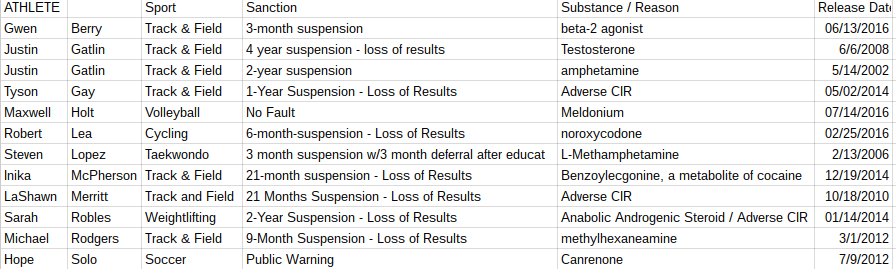
The Wall Street Journal looked into the issue and counted 11 U.S. athletes who have positive tests in their past. I compared spreadsheets and came up with 11 names:

Screenshot 2016-08-10 at 10.58.34 AM

The first pattern you’ll notice is that there is no pattern. That brings us to the moral of the story:

Every case is different.

You have LaShawn Merritt, suspended because he failed to realize a “male-enhancement product” included something he can’t take. Most likely not intentional cheating, but not smart by anyone’s account.

Weightlifter Sarah Robles has insisted she was using medication to treat polycystic ovary syndrome. Her suspension ended in time for her to make the team for Rio.

Did you forget about Hope Solo? She received a warning when her medication was flagged.

And notice recreational drugs on the list — if you look at the whole USADA list, you’ll see enough “cannabis” to wonder how many athletes you’ll bump into at a Snoop Dogg or Phish concert.

Do you ban Merritt? Robles? Solo? How about Abby Wambach, who has admitted using recreational drugs during her playing career?

Opinions may vary. These aren’t easy decisions.

But you know damn well that a lot of the people speaking out about Efimova and every Russian judo athlete, sailor or gymnast would scream bloody murder if a U.S. sports hero like Wambach or Robles was banned. (They might concede Gatlin or Merritt because track and field somehow isn’t as inspirational to many in the media.)

And in that sense, Efimova is right. We’re still fighting the Cold War. Because we’re too lazy to get into the nuances or find a new narrative.


olympic sports, work portfolio

Your Rio 2016 meta-medal guide

I did tell you Ginny Thrasher (Springfield) would be someone to watch. Sure enough, she’s in the shooting final.

What else have I written to preview these Games? Glad you asked …

In addition to my analysis of Olympic odds, projections and TV offerings, I have a few general overviews up at Bleacher Report

Thrasher was mentioned in my look at teen phenoms of the Games, which includes a few players soccer fans will recognize.

I’ve given a guide of everything to watch in men’s swimming. (Not just Phelps.)

Will Usain Bolt lose? I said yes, as one of my Bold Predictions for the Games.

And if you read just one thing to get the broad overview, flip through my broad overview.

Because Samuel L. said so.


olympic sports

Rio 2016 Olympics: Prediction analysis, schedule notes and rants

The USA will win 88 medals this summer. Or maybe 136.

Hey, the Olympics were totally predictable, they wouldn’t be any fun, right?

Prediction analysis

No, I didn’t do event-by-event predictions this year. I hope to revive them at some point in the future, but I need to do it in a way that is (A) unique and (B) not a total back-breaker.

This time around, I figured I would see what others are picking. In the interest of not burying the lead, here’s the summary …

Screenshot 2016-08-05 at 2.01.46 PM

Let’s explain what these sources are:

1. Gracenote. Formerly Infostrada, this is the gold standard in number-crunching. They feed in results from every competition under the sun and push out projections. They release a summary called the Virtual Medal Table (a name I actually used in compiling World Championship medals back in 2004 for USA TODAY, which should really copyright things like that, Prep Rally and Ever Wonder).

They don’t give event-by-event projections — at least, not for free — but they are thorough and perhaps the most objective (least biased, if you prefer) projection out there.

So that might be bad news for those hoping the USA will win 100 medals.

2. Odds. Oddschecker rounds up several betting sites and highlights the best odds for many athletes. But they’re not complete. To fill in the gaps, I went to Skybet, William Hill, Bovada and Sportsbet (Australia).

Depending on the site, these odds might be based on substantial research as well. But then you may still have a bit of a bias toward English-speaking countries. It’s hard to set odds on athletes who are beyond our familiarity. Sometimes, bettors might recognize a name of someone who isn’t statistically favored but has a compelling story that leads us to think they might outperform the Gracenote projections. The USA certainly does have some athletes who only turn up the jets for the Olympics. But so do a few other countries.

The numbers given above are my summary of all the odds I could find. There were no odds for six events, including the three tennis doubles competitions, where the withdrawals of Roger Federer and the Bryan brothers have thrown things for a loop.

3. The Wall Street Journal does something similar to Gracenote (or, for political junkies, FiveThirtyEight, which doesn’t have any substantial projections that I can see). They take a ton of data and run a bunch of statistical simulations. Then they just give us the summary, not the event-by-event count. Spoilsports.

4. Sports Illustrated’s Brian Cazeneuve does the old-school heavy lifting to go through each event. His picks were published before some of the Russian athletes’ fates were decided and before a couple of people (Roger Federer, the Bryan brothers) withdrew from tennis. But they’ve comprehensive, and they offer interesting notes on each event. Take a look.

5. The Associated Press compiled picks from its staff. I couldn’t find a file that included women’s wrestling for some reason, but the rest are posted.

The AP picks seem rather sentimental. Sure, no one wants to be the guy who picks against the American hopefuls, and perhaps each reporter who contributed predictions felt compelled to go with the best-case scenarios for athletes on their beats. But some of the picks seemed like longshots. Some outliers: women’s archery, men’s high jump, women’s steeplechase (Emma Coburn has a chance to make a big breakthrough for U.S. runners, but she’s not a favorite), women’s shot put, men’s canoe doubles slalom (kayak singles, maybe), women’s field hockey (again, possible but not probable), men’s 81kg judo, women’s 50-meter rifle 3-position (Ginny Thrasher is a great dark-horse pick), men’s 80kg taekwondo (Steven Lopez to turn back time?), men’s 86kg freestyle wrestling, and women’s weightlifting (three athletes, three medals).

If you want to see the U.S. contenders’ actual odds (sort of — I’ll explain), check this spreadsheet:

Disclaimer: Those are simply the lowest odds I could find, either through Oddschecker or whatever source I used to fill in events that Oddschecker didn’t cover. They’re not all from the same source, so don’t think of them as an apples-to-apples comparison. Also, if a U.S. athlete simply wasn’t listed, I assigned the number 200 or 500 depending on the circumstances.

Also, I took the three event-by-event picks into a spreadsheet and did some crunching to figure out who’s a unanimous gold-medal pick, who’s a majority gold-medal pick, and who is the next most likely medalist. The summaries are on the two spreadsheets here:


About the TV coverage (info and rant)

That last spreadsheet has schedule and TV info as well. But …

There’s little guarantee that a network will be broadcasting an entire event. They might pick up the finals, they might hop around between a couple of events. For an actual game, especially in soccer and basketball, you’re likely to see all the action.

But not always. For example: On Day 1 (Aug. 6), CNBC is scheduled to show Germany-Australia women’s soccer and USA-Colombia women’s rugby. Both start at 5 p.m. EDT. The Olympic Soccer Channel will be busy (USA-France women), so if you want to ensure seeing the soccer and/or the rugby live in its entirety (rugby games are roughly 20 minutes), you’ll need to be ready to go online.

And they’re fluid. The official listings may have a block that says “Archery, Rugby, Water Polo.” Now suppose the U.S. women reach the rugby quarterfinals and play in the middle of that block. You’ll likely see more rugby in that block that you would have otherwise. If something completely unexpected comes up, one of the networks might cut away to it.

And you could always have weather issues and other delays. Sailing has a “reserve day” as well as other mechanisms to deal with rescheduling. You might also recall the Korean fencer who was forced to sit on the piste for an hour, holding up the rest of the day’s action, while judges sorted out a protest.

And because discrepancies and incomplete data are facts of Olympic scheduling, I’ve double-sourced and triple-sourced the schedule as much as possible. Sports Media Watch did a good job compiling day-by-day listings, and I checked them against NBC’s vague listings. I’ve also checked the sport-by-sport schedule at NBC’s site. And to get a rough guess of when events will end (soccer games will always be a hair under two hours, barring extra time in the knockout rounds, but sailing and cycling could end up all over the place), I went to the BBC’s site and did a lot of time conversions in my head.

Other things to bear in mind: In elimination tournaments like boxing and beach volleyball, you may have an interesting matchup that just pops up on the schedule. And speaking of boxing, I didn’t do Spanish-language listings here, but Telemundo will show more live pugilism than the English networks.

My priorities here: Medal events, U.S. team events, early rounds of daylong events with U.S. contenders, other random items of interest.

So take the TV listings with a grain of salt and bear rough priorities in mind. NBC is going to show the swimming relay finals live, no matter what. Other events are more malleable. Let’s say a network is planning to show a judo final live because Kayla Harrison or Marti Malloy might be involved, and they’re not planning to show an archery final live. But then (just hypothetically, not a prediction) Harrison or Malloy doesn’t make that final, but Mackenzie Brown is shooting for gold. If you’re an NBC producer, your choice is pretty obvious.

Sure, some of NBC’s decisions are baffling. Their selection of sports has modernized — more offbeat, hipster stuff will be live, and a lot of traditional Olympic fare (gymnastics, diving) will be reserved for prime time. At the same time, they seem stuck in some dated thinking about viewer demand for live events, as if gymnastics and diving fans are walking around with their hands over their ears until prime time.

Consider Aug. 9. Live events at 3 p.m. EDT that day include the women’s team gymnastics, expected to be a U.S. rout, and women’s synchronized platform, not a U.S. strength but still one of the traditional Olympic favorites. They won’t be broadcast live. At 3 p.m. EDT, you can watch basketball, soccer, tennis, table tennis, handball, sailing, beach volleyball, rugby, and taped canoe/kayak.

The prime-time NBC show, giving a good overview of the major events of the day, makes sense. For a lot of people, that’s all of the Olympics they need. It only makes sense to show the best action from the afternoon’s gymnastics, editing out the lulls in the action. But the idea that showing the event live on MSNBC at 3 p.m. will spoil the viewing experience, especially in an era in which your friends will all share the results as soon as they happen, makes no sense today.

But that’s why we have the live streams. In high-speed Internet we trust.

Last point: Let’s ditch the cynicism for a bit. If you don’t care about synchronized swimming or shooting, fine. But these people have devoted much of their lives to being the best synchronized swimmers and shooters they can be, often without any real financial reward. And they’re drawn to international competition in a spirit of goodwill that is sorely lacking in today’s geopolitics. Choose what you want to watch, and cheer.

You can still make fun of the boxing judges.

My hope is that we actually get so interested in these athletes that we follow them outside the Olympics. Not just in the NWSL (women’s soccer). I’m going to track World Championships over the next Olympiad. Then maybe I can do my own projections next time. Or just punch holes in everyone else’s, which seems a lot easier.

olympic sports, women's soccer

Olympic schedule for WoSo fans looking to branch out

I’ve been tinkering with schedule spreadsheets and decided to try one for women’s soccer fans who also want to sample the rest of the Games, with an emphasis on soccer and women’s sports.

Check Aug. 3-9:

Women’s 2016 preview – 3-9

And Aug. 10-14:

Women’s 2016 preview – 10-14

Disclaimer: Everything is subject to change, and I’ve hit the occasional discrepancy in a few times. And if it’s on NBC or NBCSN, you may be hopping between events and not catching things quite live. The best place to check for the latest info and live streaming is the NBC live stream schedule, which is going to be your best friend for the next three weeks.

olympic sports, work portfolio

Olympic coverage at Bleacher Report

I’ve returned to Bleacher Report to help out with Rio coverage, with three pieces so far …

  1. Preview slideshow of the top events to watch at the track and field trials.
  2. When will the next generation of men’s 100m sprinters arrive?
  3. Top storylines to follow from now to the start of the Games.

I was also happy to see the last thing I wrote for B/R in 2012 is still valid: 10 Bridesmaids from London Who Will Medal in Rio. A quick check shows nine of the 10 are indeed in contention.

olympic sports

2016 Tour de France meta-preview: Get off my lawn!

The first few days of the Tour are really about funny previews, the scenery and the dark art of peloton survival:

The latter is important, because massive sprinter Peter Sagan thinks all these noobs are ruining things (VeloNews):

Now in the group everybody is riding like they don’t care about their life — it’s unbelievable! … Before there was respect. When someone did something stupid, everybody throws their [water] bottle on him or beats him with [tire] pumps.

But VeloNews has already prepped us for these quotes with a handy cliche translator:

There’s no respect in the peloton — I’m not as young as I used to be / Get off my lawn.

And save the rough stuff for the peloton and not, say, a random punch-up with some drunk people, as Podium Cafe reminds us.

VeloNews also has a fun read on the so-unsung-they’re-actually-overrated men of the Tour, the “lead-out men” who get their team’s top sprinter in position for a Tour win.


Want to watch but don’t have cable or a dish any more? NBC has a package of the Tour and a lot of other races for $29.99.

I did promise funny previews. Take your pick (or read both):

NYVelocity: The “Tour de Schmalz” isn’t the daily riot it used to be, but he’ll still chime in from time to time. He explains why Chris Froome is the overwhelming favorite:

The 2013 and 2015 Tour Champion is coming off a win at the Dauphiné and is looking like a wobbly-elbowed juggernaut backed by a team of Rahpa-clad robots hellbent on delivering victory via a panache-smothering, soul crushing stomp through France. Ladies and gentlemen, the 2016 Tour de France, brought to you by Skynet.

Don’t worry — you’ll catch up to the lingo quickly, and it’s worth the effort. He’ll help you put a human funny face on an unfamiliar group of names.

Podium Cafe offers a day-by-day approach, weighing whether to catch the day’s action live or go play cricket, which sounds like a pair of options I wish I had. Today, I believe he’s out at the wicket:

There’s nothing like a long, boring, flat stage to bring the Tour de France south to the mountains.

And don’t forget, you may see some of these same people in Rio later this summer, where the velodrome is done … sort of (VeloNews again).

olympic sports

On covering women’s sports … and more

What happened to Missy Franklin last night? How did the reigning Olympic 100-meter backstroke champion, just hitting her athletic peak at age 21, finish seventh in the U.S. Olympic Trials in that event?

I found no answers at Excelle Sports, where the writer who covered Monday night’s action in the pool has a story today on a Dartmouth grad who’s training to represent Greece in the Olympic distance running events. The lead stories at Excelle this morning: More on the death of Pat Summitt, a first-person Wimbledon memory by Rennae Stubbs, a feature on the Seattle Reign’s Havana Solaun, and Brittney Griner’s thoughts on the media.

wps
The great @vandey01 got this picture of the cozy crowd with WPS CEO Anne-Marie Eileraas in 2011. Bottom left: Jeff Kassouf shooting video.

How about espnW? Wimbledon leads. The Olympic swim trials are high on the home page, but it’s from Monday’s competition, focusing on Katie Ledecky. The next story on the page is on American Ninja Warrior. Further down the page, we see Maria Sharapova going to Harvard Business School and a feature on Allyson Felix’s musical favorites.

Oddly enough, the mainstream media produced plenty of coverage on Missy Franklin. USA TODAY’s Nicole Auerbach has quotes from the swim star on dealing with pressure. ESPN’s Wayne Drehs goes into a bit more depth, chronicling Franklin’s struggles with back spasms and World Championship disappointment over the past couple of years. At The New York Times, Karen Crouse adds context of other swimmers who had one big Olympics and then either stepped away or faded.

None of this is to fault the coverage of the dedicated women’s sports sites, though I have to think someone has simply forgotten to update espnW’s home page with Drehs’ report from Tuesday night. Their lead stories are worthwhile reads in their own right.

The point is that covering the undercovered sports, whether it’s women’s basketball or men’s track and field, is a complex task. Or maybe I’m just feeling schizophrenic because I’m working up a piece on The Year of the Woman (Again) at the Olympics and wondering why few people have heard of Christian Taylor or even Ashton Eaton, and at the same time, I’m listening to a thoughtful Mixxed Zone podcast with Jen Cooper discussing women’s sports coverage with Excelle’s Howard Megdal.

I’ve been where Howard is, quite literally. I’ve been the lone reporter getting postgame quotes, and I’ve made an effort to write about a game with 200 people in attendance as if it were attended by 2,000. I got to know several Duke women’s basketball players back in the days before Duke hired Gail Goestenkors and gave her a real budget that paid off with Final Four runs and much bigger crowds.

I’d like to think that, more than 25 years after rattling around in Cameron Indoor Stadium with a handful of people watching my classmates battle All-Americans Dawn Staley, Andrea Stinson and Vicky Bullett, I’d have some answers about how to get people to pay attention where they aren’t.

I do not.

When I left USA TODAY, I launched a blog called SportsMyriad. The idea was to write about sports in an inverse ratio of how much they were covered elsewhere. I’d write about men’s soccer, which was still undercovered at the time, but I’d write more about women’s soccer. And I’d produce a steady stream of coverage on Olympic sports, because I wouldn’t have editors telling me to cut it out and work up that Belmont Stakes graphic.

What I found is that it’s impossible for one person to do that. One reason is the simple tyranny of time. Another is that it’s difficult to turn down freelance work that pays actual money so I can focus on a blog that might get enough Google ad money to pay for its own hosting.

Another is this, and it applies to journalists as well as fans:

We all have our favorites.

I can’t make women’s soccer fans pay attention to Allyson Felix or Marti Malloy. Just as I can’t make NFL fans pay attention to Aries Merritt or David Boudia.

Nor can I claim to be an expert on everything. I’ve seen Olympic diving and fencing live, and I have no idea how judges can figure out what’s going on. I’ve watched more curling than 99.9% of the U.S. population, but I still struggle to understand the tactics at times.

So SportsMyriad essentially became a clearinghouse for the sports I knew in at least a little bit of detail. Soccer, particularly women’s and youth soccer. MMA. Curling.

Then within those sports, we have some questions to ask, including the elephant in the room:

Are we willing to take negative coverage as well as positive? Is it OK to point out Marta’s gamesmanship? Or to ask whether the U.S. women’s soccer team is taking a counterproductive stance in labor talks that may hurt the sport in the long run?

It’s not an easy question, and my experience is that athletes in undercovered sports — women or men — tend to be a little more guarded in speaking with reporters. If you ask about a confrontation in the midst of an NWSL game, you’re likely to hear that the players are content to leave it on the field. In investigating the mysterious magicJack team in WPS, I spoke separately with a couple of players and got the same scripted response. Verbatim. It was like talking to robots.

Sometimes, they’ll go off script and have colorful conversations. I did an interview series for USA TODAY that tried to go beyond the typical questions. In speaking with a biathlete/cross-country skier: “The first paper you’re credited with publishing, according to your bio at Wyoming, is ‘Multiple Neoglacial Advances Recognized in Sierra Nevada Rock Glaciers.’ Did that paper help with your cross-country training?” A water polo player talked with me about the nasty stuff that happens under water. (In this case, it’s a pretty significant difference between the men’s and women’s game.)

I think the stories are there, in women’s sports and Olympic sports. It’s a nice change of pace from the daily speculation on whether Kevin Love wants to remain in Cleveland as a rebounding role player or go to a lesser team where he’s the “star.”

But part of it is far out of my hands, or Howard’s, or Jen’s. It’s TV production.

U.S. broadcasters have always treated the Olympics as a Very Big Deal. Doesn’t matter if the athletes are men or women. Sometimes, it doesn’t even matter if the athletes are American — Nadia Comeneci captured the USA’s imagination long before she married U.S. gymnast Bart Conner.

Look at the English Premier League. A few years ago, it was just tossed on TV for the benefit of hard-core soccer fans. Fox Soccer Channel made an effort to make it bigger. NBC went even bigger than that, with clever advertising and professional studio shows that turned even the most humdrum midtable clashes into events.

How would the NWSL fare if a network put that sort of emphasis into a Dash-Flash game?

So we need Excelle Sports. We need SwimSwam.com, which has detailed coverage of the winners and losers in the Olympic trials as well as the unfortunate news that a coach was fired after his arrest on charges of soliciting prostitution. We need NBC, which brings its quality TV production and bloggers to the fore.

And we have to accept that we can’t all support everything. I simply can’t devote as much attention to the WNBA that I devote to the NWSL. I have to remind myself that I can’t make everyone read my story on the woman who is fighting for the right to walk 50 kilometers. (But seriously — read it. It’s a good story.)

It’s going to take group efforts. Maybe someone will actually pounce on the idea of an Excelle Sports for Olympic sports. (Believe me, I’ve pitched it.)

And it’ll take mutual respect along with frank talk. We can’t just yell at journalists who aren’t covering our favorite undercovered sports. Most of them are just trying to cling to jobs at the moment, given the sea changes in the newspaper and cable industries.

We have to create the communities so fans and journalists can engage. We have to have the confidence that these communities can grow even when we disagree.

And we have to make it fun! The people trying to turn soccer into a dour experience may kill the sport in this country. Let’s not make that mistake with women’s sports or Olympic sports.

Especially curling.

bd-curling
Honestly, I don’t even know if this is me. But it is indeed from my one night of curling (so far).