At SoccerWire, RSD podcast guest Charles Boehm chats with U.S. Soccer Director of Coaching Education Programs Frank Tschan and Manager of Coaching Education Dan Russell about coaching education and rondos.
One comment from Russell about the former, specifically whether the Federation can reach everyone:
It’s not just U.S. Soccer, it’s not just those within these walls, it’s coaching education reaching out to our state associations, reaching out to US Club, US Youth, United Soccer Coaches, to be a part of this program, this movement as we like to refer to it, to offer more grassroots education opportunities, get more people into the pathway and offer them opportunities to progress within the pathway.
The answer here seems obvious. If U.S. Soccer can’t reach everyone, then maybe it needs to give more respect to training programs from United Soccer Coaches and AYSO.
On the “war on rondos,” something Charlie has already addressed, Tschan gives an answer that’s far too long to quote. I’ll attempt to summarize and translate:
But he did not say “leverage our core competencies” or “monetize our assets,” at least.
To try a bit more seriously, it appears Tschan is saying pro coaches could maybe use things that grassroots coaches shouldn’t. And grassroots coaches need to listen up and do “reality-based” exercises that include going in a direction.
Objections:
At the littlest level, we’re trying to get players to touch the ball. Period. For years, we’ve been taught games that just encourage kids to dribble — ideally with different surfaces of the feet, with changes of direction and with their heads up. That’s fine, at least to a point. And no one told us they all had to be dribbling in one direction.
We did, though, stick with “one player, one ball” a bit too long, thinking little kids can never pass the ball. Then we’re surprised when we see a bunch of U12s who have no first touch and can’t receive the ball to save their lives. (How was your Memorial Day tournament?)
Playing the ball backwards to an open teammate is “reality-based.” I doubt a lot of people watching U10 soccer in the USA think, “Gee, these kids really need to spend more effort passing the ball forward.”
It’s one thing to point out that you might not want to do rondos to the exclusion of everything else. You really don’t want to do anything to the exclusion of everything else. The U12s who can’t receive a pass also can’t shoot or play a long pass to switch the point of attack. If you spend the first six years of player development dribbling and juggling, you’ll have a bunch of kids who can dribble and juggle, but they can’t play soccer.
With that rant over, let’s switch to another problem that isn’t directly related but also demonstrates what can happen when youth soccer is in the hands of stubborn bureaucrats — the sobering overemphasis on academy recruitment in England. From When Saturday Comes:
The academy of a current Premier League club – renowned for bringing young “local” boys through their system – used [a loophole] to bring in players from distances of 120 miles away. This meant two-hour round trips just for training on school nights, four-hour round journeys for children for “home” matches and longer for away games.
Aside from the travelling involved, many young hopefuls don’t realise that academies only really pinpoint one or two players from each cohort that are likely to make the grade but they need a team of other players around them. As such, the attrition rate for academy players is eye-watering, with less than one per cent becoming professional players. …
[T]here are more serious consequences – a research study carried out by Teesside University in 2015 found that over half of the players released were suffering “psychological distress”. There have been stories of players committing suicide and others turning to drug dealing after being dropped from academies.
As with the rondos, perhaps letting kids see there’s more one direction to go isn’t a bad thing.
While Shoeless Soccer (see previous post) touts hard surfaces as a great teaching tool for younger players, especially as an alternative to thick grass, it’s unlikely that all of the families in your local club are going to sign up their kids to play on pavement instead of the local elementary school field.
But would it be an interesting option for some players? And would everyone benefit if hard-surface soccer (we’re going to skip the “shoeless” and “shin guard-less” recommendations, which clubs aren’t going to sanction in a modern litigious environment) as a year-round option, not just in winter futsal?
I’m still a little skeptical that a typical random assortment of 6-year-olds will stop playing magnetball and magically start spreading out and controlling the ball just because they’re on a faster surface than grass. But a self-selected group of 6-year-olds with a bit more aptitude for the game just might.
I once coached a player from Argentina. He turned up at our first practice in a Messi shirt and impressed everyone at practice with his footskills. Then he was a non-factor in games because he could never get the ball out of the mob that chased it around the field. I didn’t see him again after that season.
Another player on my U-Little teams had a knack for running into open space, where he would wait for a pass that would set him up for an easy goal. That pass never came. He plays baseball now.
Maybe if the club offered an alternative soccer experience, it would attract like-minded players who could grasp the concept of using all the available space, not just the space around the ball.
So here’s an idea for your local club: Offer futsal not just in the winter but in other seasons as well. Kids could sign up for this instead of or in addition to the traditional outdoor league.
And you can make the financial argument that you’ll have more “field” space! One reason so many kids play on bad grass fields is because clubs are desperate. If some kids are playing in gyms, which are mostly vacant when it’s not basketball season, fewer kids need outdoor fields.
Surely some clubs are already doing this. How’s it working?
Today at The Guardian, I have a provocative piece suggesting the U.S. men simply aren’t going to win the World Cup.
At all. Ever.
Coincidentally, I recently read a book (and will be talking with one of the authors) that unintentionally demonstrates why.
The basic idea of Shoeless Soccer: Fixing the System and Winning the World Cupis intriguing — we need less formal travel soccer and training, and we need to build up informal play on harder surfaces, preferably without shoes and shin guards. The authors are a couple of Bowling Green faculty members — one of whom (Nathan Richardson) has spent a lot of time coaching and running soccer clubs, one of whom (Carlo Celli) has spent a lot of time in Italy. It’s not just a facile comparison between Italy and the USA — the authors correctly diagnose many problems in U.S. soccer and offer interesting solutions to some of them.
Given the academic background, the number of careless, sloppy errors in the book is startling. First, there’s a logical/philosophical issue — the authors condemn a method of training by associating it with one Friedrich Frobel, saying he was “a disciple of Johann Heinrich Pestalozzi, who in turn was a follower of Jean Jacques Rousseau,” and Bertrand Russell later claimed Rousseau influenced totalitarianism. I believe my logic professor would call that “guilt by association” — and a faint association at that.
Perhaps the Rousseau-bashing is to be expected, though, because the book is as much of an entry in the long-running “mommy wars” as it is a soccer polemic. It was featured prominently on a blog called Let Grow, which is firmly in the “free-range” parenting camp as opposed to the “helicopter” method. That’s a legitimate point of view — we parents certainly should fight our instincts to stifle our kids’ development by shielding them from failure — but it sometimes leads to messy politics and just a bit of tedious dogmatism.
And some of this book reads like your neighborhood populist’s screed against pointy-headed intellectualism, eschewing research and even history. They say the USA hasn’t won a war since Eisenhower was president, which I’m sure will surprise veterans of the first Gulf War in 1991. (I did mention “messy politics.”) The aforementioned Bertrand Russell was a utilitarian at first and then evolved to the next level of trying to attain as much knowledge as possible, so it’s hard to imagine he’d scoff at the latest centrally planned training methods from Germany.
(Thus ends my longest philosophical digression since college, though I did cite Plato and the film Real Genius in my take on Jesus Christ Superstar. Yes, I majored in philosophy (and music), but we mostly read Plato, Descartes and Hume. Ask me about the cave sometime.)
Then we have the basic errors. The “Herman” Trophy. “Demarcus” Beasley — who, incidentally, is going along with the book’s underlying ideals by building futsal courts in his hometown. Author Lewis Carroll is spelled two different incorrect ways — “Carrol” and “Carol.”
And some of the soccer takes are simply incorrect. The authors say MLS tried to introduce the shootout, forgetting the old NASL. (We’ve all seen Once in a Lifetime — some of the Cosmos’ foreign stars actually liked lining up from 35 yards out for a one-on-one tiebreaker!)
(Hello, Mr. Eskandarian! And the upside-down clock is a nice touch.)
They say the 2002 World Cup team had a “nucleus” of players from Bruce Arena’s Virginia and D.C. United teams, which is a bit of a stretch — Carlos Llamosa and Tony Meola were barely involved, and Claudio Reyna was nearly a decade removed from his college days. U.S. Club Soccer becomes “the US Soccer Club Association,” which has “courageously imported coaching expertise from La Liga.” (Wasn’t every NSCAA session a couple of years ago some variant of learning to play like Barcelona?) They say the USA has produced only “second-tier stars in second-tier leagues,” which will come as a surprise to Reyna, Beasley, Brian McBride, Brad Friedel, Steve Cherundolo, John Harkes, Alexi Lalas, Clint Dempsey, Geoff Cameron, Stuart Holden, Tim Howard, Eric Wynalda, Christian Pulisic and Kasey Keller, let alone Mia Hamm, Abby Wambach, Alex Morgan, Becky Sauerbrunn …
Then the interesting ideas are often taken to the point of absurdity and beyond. They start with the notion that playing without shoes can teach players proper technique because it hurts a bit to kick the ball the wrong way. Then they proceed to suggest players lose their shin guards because they’ll steer clear of shin-to-shin contact. Unfortunately, that does little good when it comes to foot-to-shin contact — I’m still wincing from the moment I stepped in to demonstrate something in practice a few weeks ago and got whacked.
They end up almost like the footballing Amish, shunning anything that can’t be hand-crafted on a farm. The words “shiny” and “new” are tossed out as frequent insults (isn’t everything shiny and new at some point in its life cycle?), and one of the notes I scribbled on my Kindle is, “What do these guys have against water bottles?” (Or “smart boards” in school classrooms, another of the unwelcome sociopolitical digressions here. Smart boards rock.)
But the book rewards the patient reader. They aren’t the first writers to use the derogatory term “soccer-industrial complex” — I used it last year, and a search for the term turned up many references in the past decade — but they do well to expound upon its ills. We’re spending a lot of time and money on travel and gizmos (check out the obscene prices on soccer goals sometime) that could be going to actual soccer.
They clearly see a lot of the problems, some of which aren’t obvious to all youth coaches. Our participation rates are down. Coaching education is expensive and incoherent (as I write this, I’m still trying to figure out why U.S. Soccer changed its license courses again this spring). High schools and colleges have the infrastructure, and instead of trying to work with schools to reform their soccer programming, we’re turning away from it. A lot of kids turn up for rec soccer because their parents just want an hour of baby-sitting with exercise, a challenge for all of us who’ve coached U6 soccer. Then kids get to travel soccer, where their parents complain if the kids who torched the Pugg goals at U7 have to play a few minutes on defense. And the more “elite” you get, the more likely you are to be traveling to another state for a game of dubious quality when you could just as easily have a good game across town.
They even give credit where it’s due — sometimes. They see clubs starting pickup soccer sessions. They see U.S. Soccer coaching gurus encouraging individual ball skills at early ages, and the fed is admirably moving to a good mix of online and in-person coaching education.
Their own ideas aren’t bad. Having an older kid join a younger group’s practice to teach by doing sounds great — that mix of age and experience is actually one of the things I love about School of Rock as a children’s activity that we don’t get in youth soccer.
And if the “shoeless soccer” motif seems a little too off-kilter or unrealistic, consider the “street soccer” ideas they present. They’re not the only people pushing street soccer, of course — look back at Kyle Martino’s emphasis on hybrid basketball/futsal courts during the presidential campaign and Martino’s subsequent role with Street Soccer USA — but they build a strong case for some of the lessons that can be learned from playing on a small, hard surface. If you’ve coached young kids who are determined to play magnetball and clump around the ball no matter what, you might be a little skeptical that a fast surface will work wonders as opposed to your local grass (dirt) field, but it’s worth a try.
Nor are they the only advocates of free play. Apparently, in their local schools, kids aren’t playing soccer at recess, which is unfortunate. When I volunteered for the day at my local elementary school, I found myself in an entertaining 10v10 game in an enclosed space. It wasn’t perfect, but they were playing.
Playing shoeless or on pavement probably isn’t for everyone. I can’t imagine many of my old U6 rec players taking to the idea or learning anything from it. The highly motivated player, though, might love it and develop more quickly than he or she would in weekly rec soccer activities alone.
But for all these good ideas, which could indeed push U.S. soccer forward, the book demonstrates so many American traits that will hold us back:
The obsession with the “quick fix” instead of an honest assessment of the generations of American exceptionalism (which doesn’t make us “exceptional” — it just makes us the “exception” to the rule) that have led us to fall behind in soccer.
Sloppiness in developing those quick fixes (see the errors above).
Offhand dismissal of relevant objections. The authors smirk at the injuries that can be sustained if we let our kids play rough on any surface they can find, an odd assertion given the injury (read: ACL) concerns we’re seeing these days, particularly in women’s soccer. They note an Italian club that has no mechanism for informing players of cancellations because they never cancel, which perhaps struck me at the wrong time because, just this week, I was in a basement riding out a tornado warning after informing my team that we would not spend the evening on an open turf field volunteering for a reenactment of The Wizard of Oz.
Straw men that give the appearance that the speaker alone is wiser than the mob. They seem to think no one else in the USA has noticed the emergence of Iceland or its coaching education. “We fret about the wrong things in US soccer,” they say at one stage. “And our players suffer.” No, we fret about everything in U.S. soccer. Not all of it is wrong. Mathematically speaking, that would be impossible.
Everything is someone else’s fault. When one of the good professors fails to reserve space on an indoor turf field, and the international soccer club must yield to the local Quidditch team, he blames Quidditch rather than his own organizational skills.
Near the end of Shoeless Soccer, we find a passage that says it all. The authors say “the grassroots proposals in this book require nothing more than a bit of humility.”
We’re Americans. We don’t do humility. We do things our own way, and if that doesn’t work out, we take our ball and go home.
But we can always use ideas, and this book has several worth discussing. Look for a podcast down the road.
Dennis Crowley didn’t just start a soccer team. He created a laboratory for “open-source soccer.”
He shares business and financial info on his NPSL club, the Kingston Stockade, on Medium. And though Kingston might not be the likeliest market to have a club that would climb an open pyramid to Division I, he has become one of the most thoughtful (or reasonable, if you like) advocates of promotion/relegation.
In this conversation, we talk about the challenges of putting together a pyramid in the lower divisions. Yes, there’s more than “U.S. Soccer stinks,” though he argues the federation could be doing more to facilitate change and stability. And at the end, he shares his experience of seeing the Stockade make their Open Cup debut.
Every once in a while, Soccer Twitter goes into media-bashing mode. It falls into a few strains:
Frustration at an inability to find work that questions authority. (I’m going to argue here that such work exists but isn’t always amplified.)
Knee-jerk snark.
People who are trying to amplify themselves by discrediting the work of others. One of the oldest propaganda tricks in the book. Sometimes done subconsciously.
People who are utterly convinced that MLS and U.S. Soccer have buried bodies or trunks of money somewhere.
Now let’s be clear here. There’s an institutional reason to be frustrated with the media in general. The media are weaker today than they have been, for the following reasons:
Print advertising has dried up. (Local newspapers in particular used to rely on classified advertising, which is now free on Craigslist, Facebook, etc.)
Online advertising doesn’t pay enough to support large newsrooms.
Even the ESPN model (money from cable subscriptions) is collapsing. ESPN has had waves of layoffs. Fox laid off its entire writing staff and just has videos of its talking heads who do little to no research.
And yet, there are plenty of soccer reporters who do not take what authorities say “at face value.” First of all, a lot of us aren’t taking Silva’s $4 billion “offer” or Commisso’s posturing at face value. But a lot of people also scrutinize things in the USSF/MLS/SUM power structure as well.
To be sure, most soccer writing is about the game. If you’re a beat writer covering a team, you’re going to spend the bulk of your time writing about games, injuries, transfers, etc. Maybe the occasional feature on an interesting player. Investigating MLS isn’t going to be the bulk of your output. (That’s also the bulk of MLSSoccer.com’s output, just as Barca TV and Liverpool’s Twitter feed are going to tell you more about the U23 team’s latest win and not as much about whether Barca should’ve done better in Europe or Liverpool should’ve done better in England. That’s OK. There’s a value to slickly produced game highlights.)
But what I’m highlighting here is journalism that goes beyond taking things “at face value.” It’s out there. It deserves more amplification than it gets.
These pieces aren’t 60-minute documentaries on the ills of U.S. Soccer. But they flesh out the discussion beyond what we see in games and press releases. Some simply point to a world beyond MLS and NWSL. Some raise questions, sometimes pointed, about what the league and federation are doing. And some are indeed the elusive “deep dive.”
Add it all up, and you can certainly get more than game stories and press releases.
Enjoy.
Stuff MLS and USSF aren’t putting in press releases
Some soccer TV ratings info from @beINSPORTSUSA: Barcelona-Real Madrid drew 1,057,992 viewers in Spanish and 342,372 in English. Combined total is 1,400,364 viewers.
— Jonathan Tannenwald (@thegoalkeeper) May 15, 2018
Goff: D.C. United in danger of not filling 5,000-capacity venue.
Soccer America speaks with Steve Gans (in May, not pre-election) about what still needs fixing (a lot)
I remember Doug Roberson’s interview with Eric Wynalda being interesting, but I can’t see it now because I’ve hit my paywall limit. Come on, Doug — put your stuff out there for free! (I’m teasing. Doug and I worked together back in the Stone Age, where soccer content was maybe 0.1% of our work.)
KC Star’s Sam McDowell with good questions for Garber: The irony is that this piece started some of the conversation. Yes, it’s merely a Q-and-A. But the questions are good. They keep pro/rel, winter/spring schedule and “what the heck is TAM?” in the conversation. And then we can discuss Garber’s answers (which aren’t fully satisfactory to me, either).
American Joe Gyau @36finest has taken his physical and signed with @MSVDuisburg in German 2nd flight, a step up for 25-year-old winger after 18 months at 3rd-tier Sonnenhof. Resurgence continues after long-term knee injury in 2014-16. Scored 5 goals this season. #dmv
Official World Cup notebook from Argentine soccer federation: “What to do to have a chance with a Russian woman.” And you wonder why women’s soccer doesn’t get much support in Argentina? https://t.co/L7Mx3LKJHF
— Subscribe to GrantWahl.com (@GrantWahl) May 16, 2018
This is a starter. I spent a couple of hours doing this, not because the stories aren’t there but because you have to scroll past a lot of game highlights and other coverage (which is fine) on unnavigable sites (which is not — ATTENTION SPORTS ILLUSTRATED!!!! TURN DOWN YOUR AUTOPLAY ADS!!). Please leave more nominations in the comments.
The guest is Daryl Grove of the popular Total Soccer Show podcast. The topic is his hometown club, the Richmond Kickers, which has a couple of decades of history as a youth soccer club with a professional team on top of and integrated into its internal pyramid.
Yes, really. It’s not just a pro team that started up some half-assed youth programs. It’s not an MLS team that has Development Academy teams and little else. See its tryout page to see how many levels of travel soccer it offers, and then look at its “Little Kicks” page to see former pro player Luke Vercollone’s programs for preschoolers. The Kickers also join forces with the rival Richmond Strikers for the Richmond United Development Academy program.
We talk about the USL, the impact of MLS reserve teams in the USL, facilities, etc. Yes, we do talk about promotion and relegation around the 33:30 mark. Most importantly, we have a suggestion for the Virginia Department of Transportation to institute HOTS lanes that would help soccer people get from D.C. to Richmond and vice versa.
And for a great example of what Daryl does with the Total Soccer Show, check out his conversation on soccer and international black culture with Aaron Dolores of Black Arrow FC.
If you want some background on the NASL stuff mentioned in the intro, check out the Twitter thread from Steven Bank and a post from fellow lawyer Miki Turner. My quick take: I still see no case whatsoever to maintain the NASL. If the discovery process kicks up things in U.S. Soccer that need to be revised or excised, so be it.
The 1995 U.S. Open Cup final is available on YouTube. Note Richmond captain Richie Williams. Yes, that Richie Williams, later of D.C. United and various U.S. Soccer coaching gigs.
The literal big deal in sports media yesterday: In January, ESPN will start paying the UFC $150 million a year for a package including:
15 live events on ESPN+, the new $49.99/year subscription service
Other shows, including Dana White’s Contenders series and some new untitled program, on ESPN+
Weigh-ins, preview shows and press conferences on ESPN+ (yes, MMA fans watch that)
Archives, archives, archives! (Again, yes, MMA fans watch this. Every once in a while, someone thinks, “Hey, I really need to check out the first St. Pierre-Serra fight” and checks out Fight Pass (see below), even though FS1 and FS2 currently show hours and hours of repackaged UFC replays each week.
On ESPN’s cable networks, as opposed to ESPN+, a 30-minute preview show and the aforementioned UFC “library programming” (replays).
For MMA fans (and former MMA writers like me), this seems too good to be true. The UFC currently offers something called Fight Pass for twice as much ($9.99/month), and it sounds like ESPN+ will have most of that content. But we’re not sure. As Ben Fowlkes points out at MMAJunkie (the blog of USA TODAY Sports, where I was the first MMA beat writer), we don’t yet know what happens to some oddball programming such as the Eddie Bravo Invitational (grappling), overseas MMA promotions and Invicta FC, which is not a soccer organization but actually a compelling all-female MMA promotion. We know Fight Pass and pay-per-view events will be available through ESPN+, but you have to pay a bit more.
So what does this mean for MLS, which has also shut down its in-house subscription service to put games on ESPN+?
(To clarify/expand — as you’ll see above, it’s much more than just those events.)
Consider this: The UFC currently has a deal with Fox networks for $120 million per year, starting in 2012. WME/IMG bought the UFC itself in 2016 for a ludicrous $4 billion, hoping for bigger deals down the road.
And that seemed to be a dumb investment. As industry insider Dave Meltzer points out at MMA Fighting, the UFC is down by so many metrics — pay-per-view buys, TV ratings, box office, etc. My lukewarm take: MMA has peaked. It’s not going away, but neither is it likely to grow. As Deadspin asked in a very-un-Deadspin deep analysis of the UFC’s rights: “Who Cares About The UFC in 2018?”
In fairness to the UFC, the promotion has had some rotten luck recently. Ronda Rousey lost, then lost worse and raced over to pro wrestling. Jon Jones has shown a catastrophic inability to get his life together, and Conor McGregor has outright flipped out. Those are the biggest stars. The people who actually hold UFC belts are sometimes anonymous, thanks to the convoluted manner in which they win the championships. Consider Robert Whittaker, who won the interim middleweight title in July, watched as UFC legend Georges St. Pierre returned to the cage to win the non-interim belt from Michael Bisping, was promoted to full champion when St. Pierre fell ill, and hasn’t fought since. It’s a rare fight card these days in which the top fights proceed as planned, thanks to injuries, illnesses or botched weight cuts.
But this downturn shows the UFC’s base level when it doesn’t have A-list stars like Rousey, McGregor or Chuck Liddell on fight cards. As with golf or tennis, a big crossover star might give it a temporary boost, but it’s unrealistic to think it’s going to be bigger on any long-lasting level.
And yet, the UFC is getting a raise as its Fox deal runs out at the end of the year. The ESPN deal doesn’t cover everything. Someone’s still going to pay good money for the rest of the UFC’s events (excluding pay-per-views) each year.
That bodes well for everything else in sports. Bloomberg’s headline: “UFC-ESPN Deal Suggests Endless Appetite, Money for Sports Rights.”
So if the declining UFC can command a raise, what will happen to the stagnant Major League Soccer when its deals expire?
As you’ll recall from the Riccardo Silva unvitation to buy the rights for $4 billion, MLS renegotiation is a few years off. To be precise: 2022. Combined pay between ESPN, Fox and Univision: $90 million.
(That’s solely in the USA. I haven’t seen the rights fees for Canadian deals with TSN and TVA, which run through 2021. Overseas, as noted in the post on the NASL’s unvitations to MLS, the league seems to have improved its distribution since switching from Silva, who’s mentioned above, to IMG, which is also mentioned above because apparently only three companies control everything in sports.)
Perhaps that’s unfortunate. The current climate — prodded by new ventures from ESPN, YouTubeTV, Amazon, Twitter, Facebook, etc. — might not last four years.
But maybe it will. And maybe MLS, no matter what comes of this year’s lawsuits, will emerge with a much better deal than it has now. (And perhaps these shadowy TV execs — not media-bundling companies — who claim they’ll offer eleventy billion dollars for rights fees if MLS goes pro/rel will emerge from the woodwork in 2021.)
The Georgia area guide has been updated with the official confirmation — long rumored at GASoccerForum.com — that five big Atlanta clubs have joined with two Alabama clubs and one South Carolina club to form the Southeastern Clubs Champions League.
Like a lot of other “Champions” Leagues, it’s hard to figure out what they’re doing. Most of these clubs have DA and ECNL teams, so we’re talking about B teams here. A couple are also in South Atlantic Premier League, so that league will have … C teams? Why is this essential?
Or … will SCCL have the C teams? Check out SSA’s take:
And we don’t yet know the ramifications of what the Cherokee Impact posted a few weeks ago, which was that the rest of the clubs in Georgia were banding together and saying, “Fine — you can’t play in U.S. Youth Soccer’s regional and national league any more.”
Everyone loves to talk about promotion/relegation.
No one likes to talk about actual ideas (like this one) that would make it palatable to all parties in this country, including the people who’ve been building stadiums and youth academies, among other long-term investments.
Fine. Let’s go really radical …
Presenting the Total Madness Cup, which will determine the professional champion of the United States and Canada.
Basically, it’s an NCAA tournament (think basketball if you like, but you could also think soccer or most other team sports) involving all the Division I* leagues in the USA and Canada.
* Yes, we’re going to redefine “Division I” here. Think of it as the college basketball Division I, which has more than 350 teams. We won’t go that crazy, and we will have some standards, but they won’t be nearly as onerous as the current Division I criteria in the Pro League Standards. Within 10 years, maybe we could have 100 clubs?
If you don’t like borrowing ideas from U.S. college sports, fine. Consider it a Champions League of sorts.
Here’s how it works:
MLS divides into three regional conferences of 10 clubs each. They can keep all their marketing deals (though selling Soccer United Marketing to a third party might be a good idea at this point — go ahead and cash in on the investment, but then cut the intertwined links with the federation). They’ll be the equivalent of the “Power Five” conferences in football — the SEC, the ACC, the numerically incorrect “Big” conferences and the geographically incorrect Pac-12.
The NPSL absorbs the remnants of the NASL and forms a couple of regional fully professional conferences of its own. If they want to have pro/rel to determine their top teams, go for it.
The USL forms a couple of regional conferences as well. They can also have pro/rel — in fact, they need to have multiple tiers so the MLS reserve teams are not D1.
Maybe we’ll even have 1-2 more. NISA, if it gets enough teams? Sure, why not?
The requirements for these conferences (revised Pro League Standards):
Performance bond.
Ownership group wealth. Not one primary decamillionaire. Rational decamillionaires are in short supply.
Stadium requirements of some sort. Not going to get into details here because if I do, that’s all you’ll talk about.
A youth academy. Because isn’t one of the major points of all this to make sure we have opportunities for youth?
A women’s team. Yeah, we’re going to end up with a pretty substantial women’s league system out of this, too.
Single-table, double round-robin to determine the champion.
No more than 12 teams (22 games).
At least 10 inter-conference games, with at least five of those outside your league. In other words, an MLS East team can play a few games against MLS West and MLS Central teams, but it also must play at least five games against teams from the NPSL, USL, CPL and any other league that pops up. These aren’t really “friendlies” — they’re the equivalent of nonconference games in football and basketball, like Notre Dame playing Southern Cal. Lose too many of them, and you’re not making the tournament.
Here’s how it could look:
And then … the tournament.
All conference champions are automatically in. Fill the rest of the bracket (yes, bracket) with at-large teams, just like an NCAA tournament. If you like, you can have some mathematical coefficient like they use to determine how many teams from each country reach the Champions League.
I’m not going to specify whether this tournament is 16 teams or 24 or 32, or whether it should be two-leg aggregate or single-elimination or whatever.
Nor am I going to specify whether this tournament takes place in December (would have unique place in calendar and could be a neutral warm or domed sites, but we’d still have our transfer window issue until the Gulf Stream forces England to go March-November) or May-June (good weather and transfer window, but there’s just a bit of competition in the sports landsCAPe).
I’m simply going to toss out this idea and let people have at it.
Initially, I was thinking this would be kind of a joke. But the more I think about it, the more I like it. It provides the following advantages that people are seeking from pro/rel:
Opportunity for clubs and investors. Want to buy your local club, invest in it and chase national glory? Fine. Nothing’s stopping you from being the Gonzaga or Butler of this system. Over time, just as some college conferences have risen and fallen, some pro conferences might get stronger. Maybe in 10-15 years, the NPSL is stronger than MLS. Again, nothing’s stopping you. (And, again, that’s another reason why we’d have to break up the SUM/MLS/USSF relationship in some fashion to make this fair. MLS owners’ divesting/cashing in seems like the simplest solution to me.)
Jump-starting investment in academies. We want to develop domestic players, right? Something about not missing the World Cup again?
Now if you have a better idea, fine. I’ll tell you up front that having four full national divisions in an English-style ladder is not a better idea. No one wants to see the Wilmington Hammerheads fly to face the Spokane Shadow for a fourth-division league game. Your idea needs to have two things:
A pyramid rather than a ladder.
Some way of mitigating all the things the Deloitte report told us we need to mitigate. (Yeah, sorry, pro/rel zealots — some of us read past the “I Can Haz Pro/Rel?” headline.)
But I honestly think if we start talking about ideas rather than suing and slandering each other, we might make progress.
Or not. As Ron Swanson said, “Add ketchup if you want. I couldn’t care less.”
If you want a revolution, fine. We’d all love to see the plan.
Until then, I’ll cringe over Liverpool’s collapse, watch a few MLS games, watch a few NWSL games and slowly die on youth soccer fields.
 For MMA fans (and former MMA writers like me), this seems too good to be true. The UFC currently offers something called Fight Pass for twice as much ($9.99/month), and it sounds like ESPN+ will have most of that content. But we’re not sure. As Ben Fowlkes points out at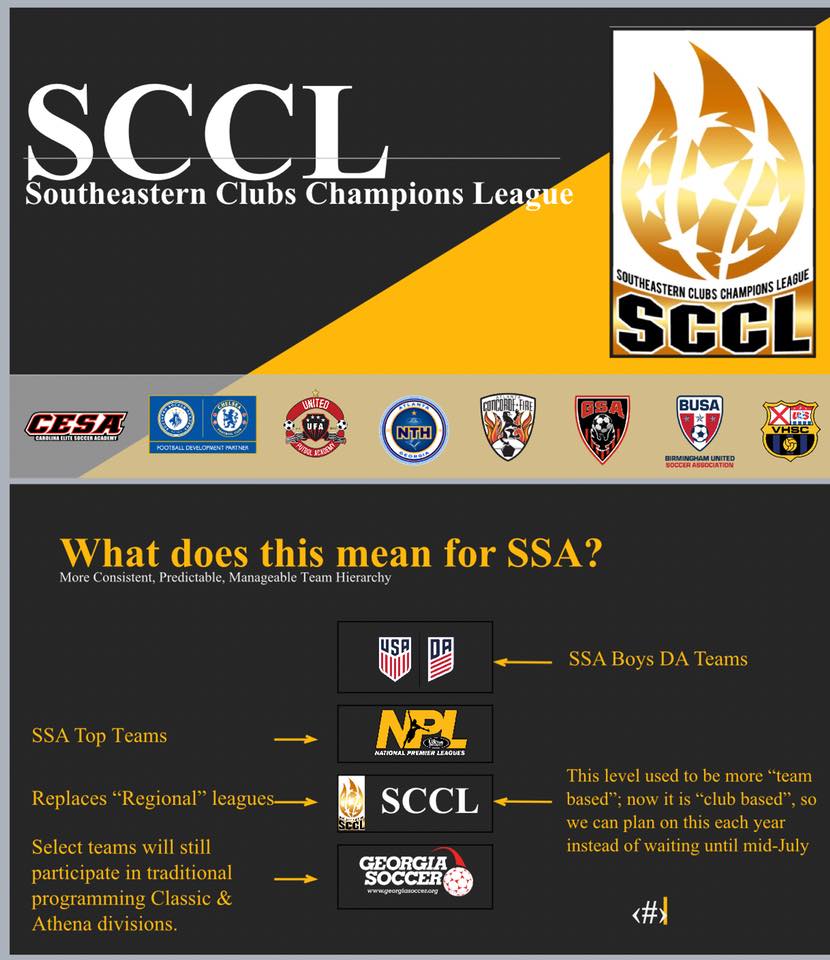
 Duresport.com