pro soccer, us soccer

Will Commisso’s money and bluster lure the grownups to the table?

I’m not going to devote a lot of my own time to reporting on and analyzing today’s revelation that New York Cosmos owner Rocco Commisso is pledging $250 million to, in essence, prop up the NASL as Phil Anschutz, Lamar Hunt and Robert Kraft propped up MLS in the early oughts. The ratio of “important stuff going on” to “number of people reporting on it” is higher in youth soccer than it is in pro soccer, so I’m sticking with youth stuff in the near future.

But you should check out the two big pieces on this today …

  1. In The Guardian, Graham Parker spoke with Commisso to follow up.
  2. At SI, Brian Straus has some additional reporting as well.

And Jason Davis will be chatting with Commisso at 1 p.m. ET on SiriusXM FC.

I received the letters at the heart of the matter this morning, just as they were tweeted out.

https://twitter.com/nathenmcvittie/status/990938195289366529

So you can read all that and get up to speed yourself. And you can draw your own conclusions.

And your conclusion will probably veer toward one or the other extreme, because I can’t help thinking this is political grandstanding that assumes the two calcified opposing stances on the NASL will remain intact. Most reactions will either be “See, there’s money to be made if USSF will just do what the NASL and pro/rel people want!” or “Great, yet another vaporware offer by a bunch of people who don’t even really want change but just want to inflate their own egos.”

One reason for that — as I peek through my email and sort through these attachments, I see Commisso included the danged “Fricker Plan,” which Steve Holroyd put in proper context nearly three years ago but is still trotted out every few months like some long-lost piece of Scripture uncovered in the dust of Bethlehem. (“And verily did Bethlehem Steel trot forth upon the pitch …”) Commisso is either unaware that we’ve all already discussed all this or just doesn’t care.

But while a certain amount of jaded pessimism is justified here, we shouldn’t be completely cynical and dismissive. Can anything good come of this communication?

Maybe.

Several managements ago, the NASL’s goal was to forge its own path. Former commissioner Bill Peterson often used a golf analogy, saying the NASL was focusing not on enmity with MLS but was intent on “playing its own ball.” And that path was to build a new way forward, eventually creeping toward a pro/rel pyramid, attracting investment regardless of divisional sanctioning.

Commisso is more or less offering to restart that process here. He says he’ll invest $250 million of his own money and is confident he’ll have a group putting forth $500 million. Forbes pegs Commisso’s “real-time net worth” at just shy of $4 billion, and other estimates have it higher than that, so he can indeed deliver on that.

Forming a pyramid in the “lower” divisions and seeing if that catches fire isn’t the worst idea in the world. It could eventually make MLS take notice and make a deal to join forces.

Now, in addition, Commisso pledges to buy USSF media rights for a higher sum than Soccer United Marketing is paying. I’m a bit more skeptical of that.

As The Guardian notes, this might be a PR stunt. “Like fellow NASL owner Riccardo Silva’s offer of $4bn to MLS provided they adopt a model of promotion and relegation, this tactic could feel like an offer made to be refused. This latest sum targeting NASL is more modest, but just as pointed a symbolic challenge to the existing ecology of soccer in the US.” (My original headline here, before I went in a more productive direction — “Rocco Commisso offers to give the NASL the most expensive Viking funeral in history.”)

And Commisso insists upon promotion/relegation “no later than the 2020 season.” Even a lot of the more obstinate, factually impaired Twitterati call for a 10-year plan. Silva commissioned a much-ballyhooed report from Deloitte that pro/rel zealots have held up as the definitive study despite a couple of flaws, and even that report says the following:

The opening of the US club soccer pyramid could present a number of significant risks. However, through careful consideration these could be effectively mitigated. …

(S)occer is now full of examples of effective regulation controlling costs (as is
common in US sports), such as UEFA’s Financial Fair Play regulations. The
implementation of cost control measures would be critical considerations for any
league. …

Clearly those who have invested in a league over time and/or through the payment of a franchise fee may feel that relegation represents a major new risk which would
undermine and unnecessarily jeopardise this investment. A managed transition with properly structured promotion and relegation could have upsides that could offset this loss and more importantly be of benefit to all stakeholders in the longer term. Equally the implementation of new equity structures and revenue distribution models for leagues may further offset and protect against any perceived or real losses.

Does Commisso’s plan address such concerns? (Jason, could you ask him?)

Carlos Cordeiro’s response is, as you’d expect, quite formal but also accommodating. Cordeiro himself is tied up with a World Cup bid that is anything but a slam dunk at this point, but he does want to open discussion. He’d like to know more about Commisso’s consortium, of course.

Commisso responds that he’s disappointed that Cordeiro can’t find time to meet, suggesting this proposal is really important and all that World Cup stuff can wait. (Is that too harsh a summary? It’s all linked above — read as you like and make up your own mind.)

So let’s consider a few things:

1. Commisso basically wants the same opportunity as MLS had to build itself up. One problem with that: Any soccer federation has a compelling interest in making sure its country has one substantive men’s professional league. What soccer federation has a compelling interest in bringing about two substantive men’s professional leagues?

2. Commisso, like many a politician, continues to make pronouncements that simply are not based in reality. One such comment to The Guardian: “I think of the rich investors in this country, I’m pretty unique in the sense that, besides the mind that I have, I’m the only one that played soccer.” Wrong. Meet Clark Hunt. The LAFC ownership group includes one of the best players of all time. (She surely doesn’t have as much money as Commisso, but wouldn’t it be nice if accomplished soccer players made as much as media moguls?) The Vancouver Whitecaps group includes Steve Nash, who’s better known for basketball but I’d bet was a better player than Commisso in his day. I haven’t done the research to know whether the owners in KC, Houston or New York ever played, but do you think Commisso has done it?

3. Would Jacksonville’s Robert Palmer be one of the investors in a Commisso consortium? I wonder how that would fit with Palmer’s current plans on the lower end of the pyramid.

4. We want to move forward, right? Why are we propping up the twice-tarnished NASL brand name?

So we have some interesting conversations. But I’m not sure Commisso, having shown a tendency to sue everyone short of MLS mascots when he doesn’t get his way, is someone USSF really wants to deal with at this point.

Here’s what I’m going to suggest. Start with this tweet:

So step forward, Mr. TV Exec. Maybe MLS would rather deal with you than Commisso. Maybe you can get MLS and Robert Palmer together to build a pyramid that’s based in reality, with a logical transition plan that addresses the concerns of the Deloitte report.

As cynical as this post may sound, I’m an optimist. I think we’re getting closer to having an open-ish system that would include all the benefits of a pro/rel pyramid — primarily opportunity for all. But you’re not going to get it by storming into Soccer House waving around your wallet and a half-baked plan while insisting upon firing everyone who ever worked with the NFL. You’re going to get it by getting everyone on the same page and talking.

And listening.
youth soccer

The devil went down to Georgia … and other youth soccer maneuvers

I guess you didn’t know it, but I’m a soccer admin too …
I’ll bet an Umbro of gold against your soul to think we’re better than you 

This is probably my fault. I did the Area Guide for Georgia a couple of weeks ago. Nice and simple. Big statewide traditional league. Big DA and ECNL clusters in and around Atlanta and a couple of scattered teams in U.S. Club Soccer NPLs, but generally easy to digest. Right?

Couple of quick things about the video for The Devil Went Down to Georgia: 

  1. Playing keyboards with one arm in a sling is impressive dedication. I once did a recital with a finger in a splint, but I’ve got nothing on that guy.
  2. The devil won, right? Does anyone really think Johnny’s tune was better?

I got an inkling a few things were in motion from the friendly and informative GaSoccerForum, as mentioned on the Georgia Area Guide:

“There is some rumbling on GaSoccerForum.com that several clubs are considering a “Champions League.” Those same clubs already have their A teams in the DA or the ECNL or the SAPL.”

So a handful of clubs were going to figure that if their A and B teams were already playing in other leagues, they might as well pull their C teams as well or something like that. (And yes, we need a moratorium on calling something a “Champions League” if it’s not full of actual champions. Europe’s Champions League is bad enough, with a bunch of third- and fourth-place teams contending for the title. It’s worse when it’s a bunch of youth soccer clubs, some of whom aren’t champions of anything and some of whom have the “Champions League” as their second or third priority behind the DA, ECNL or U.S. Youth Soccer National League. But that’s another rant.)

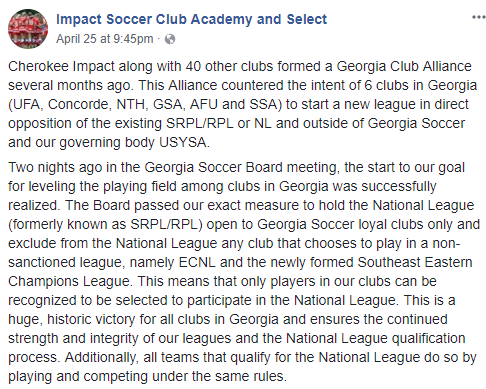
Little did I realize how intense this would get. Check out the Cherokee Impact Facebook page (HT to GaSoccerForum post) …

impact

To translate all this …

  1. Those six clubs are United Futbol Academy, Concorde Fire, NTH (the umbrella term for North Atlanta Soccer Association (NASA) and Tophat), Gwinnett Soccer Association, Atlanta Fire United and Southern Soccer Academy. They’re big Atlanta-area clubs, though UFA and SSA have operations elsewhere in the state as well.
  2. “SRPL/RPL” is the soon-to-be-defunct U.S. Youth Soccer regional league, which will be replaced by a new conference, as I’ve already mentioned in a post with an even funkier musical tie-in.

This may or may not be meaningful. If the Big 6 weren’t interested in playing SRPLNLIOU anyway, maybe it doesn’t. Perhaps it’s simply a symbolic gesture — “you can’t quit; you’re fired!”

Here’s the fun part for parents and players — imagine you’re trying out for one of these clubs or just about any club in Georgia with regional potential this spring. At this point, you really have no idea where you’re going to end up playing in the fall.

PARENT: So if my daughter makes this team, will we be playing mostly around Atlanta? Or Alabama, as rumored to flesh out the Champions League? Or Idaho?

COACH: We won’t know until the lawyers sort it out. That’ll be $3,000 and a commitment for the year, please. It’ll be another $2,000 if we make the Mega Premier Elite Champions League. 

Yes, I said “lawyers.” U.S. Soccer has a principle called “interplay,” and those who violate it often end up defending themselves against grievances.

(I did try to contact most of the Big 6 clubs a few weeks ago. You’re still welcome to respond.)

In other “giant game of Risk” news from recent days …

  • Also overlapping with Georgia but taking place in the years before the statewide Athena/Classic league, it’s the Carolinas Premier League! It’s for U9 through U12 only, so “Developmental” seems like a better term than “Premier.”
  • Seven Arkansas clubs are forming the U.S. Club Soccer (but not NPL?) Arkansas Premier Clubs.
  • The Virginia NPL is adding two clubs. (Disclaimer: The VPL or VNPL includes my hometown club, Vienna. At least, that’s the last I’ve heard.)


youth soccer

How hard is it to make your local high school team? Take the survey

Your soccer club’s site is so upbeat, talking up the programs it offers to help kids play in college. Maybe even beyond!

So you spend a couple thousand a year for your child to play travel soccer, starting in third grade. You congratulate and console your child through all the wins, losses and long trips as you watch him or her grow.

Before you know it, your child is in high school. And if you’re not in the Development Academy, your child tries out for the high school team.

And might not make it.

Not talking here about the Michael Jordan mythology in which he was “cut” from his high school basketball team his sophomore year. He was on the JV. (He also grew quite a bit after that.) We’re talking about not making any team — varsity, JV, anything.

In some cases, maybe parents already knew the deal. In others, maybe not.

The point of Ranting Soccer Dad is to help parents get information. Ideally, we won’t see any families paying thousands of dollars in the expectation of college soccer careers, only to see their kids not even play in high school.

That’s why I’m rolling out two surveys — one for parents, one for coaches. Share your experiences. Can every travel player make a team at your high school? Would a rec player stand a chance?

Parents survey …

Coaches survey …

podcast

RSD32: Christian Lavers on ECNL/DA, U.S. Club/U.S. Youth competition

Maybe they’re not turf wars. Maybe it’s just healthy competition.

Christian Lavers is fully immersed in the complicated landscape of U.S. youth soccer. He’s a technical director with FC Wisconsin and an executive with the ECNL and U.S. Club Soccer. And miraculously, he still sounds optimistic. Even “nice.” If you’re looking for mud-slinging, you’re not going to find it here. Instead, you’re going to hear a candid but polite take on why we have multiple national championships and other stuff that those of us who cover youth soccer complain about.

He’s aware of the travel requirements these days — “not every game should require a hotel stay or flight,” he says. But he sees different organizations filling different legitimate needs.

Leading into the interview, I have an announcement about the Ranting Soccer Dad Guide to Youth Soccer and the Patreon page.

pro soccer, us soccer, youth soccer

Why are soccer clubs obsessed with going nationwide?

Well I was rolling down the road in a minivan
I had a keeper in the back and a guest player at the wheel
We going cross-country and we’re skipping school
We tired and I’m lost – I wonder why this is cool

Oh I’m bad … I’m nationwide

We know we’re not supposed to do this, right?

At the youth level, we have six national championship-ish events despite legitimate concerns that all we’re doing is rewarding families that can spend a lot of money on travel. And despite the legendary Horst Bertl (Dallas Comets, now FC Dallas) quote: “National youth championships in the USA are the most ludicrous thing I’ve ever heard in my life. Whoever thinks these up should be stoned.”

At the adult level, we fret over the costs a team like Christos FC incurs when it advances in the Open Cup. Then we see teams fall all over themselves to enter national leagues on top of national tournaments.

And the trend is only accelerating. Consider the news from the past week …

    1. U.S. Youth Soccer is revamping the regional pyramid that forms the base of its national league system, which is really a series of national showcases because no one really expects Tennessee Soccer Club to schedule a U15 league game against Greater Seattle Surf.
    2. The UPSL, the first league to institute promotion/relegation besides all the other adult (and youth) leagues that have had it for generations, is rapidly expanding — Columbia, S.C.; Silver Spring, Md.; Alton, N.H.; Hollywood, Fla.; Perris, Calif.; Aurora, Colo.; Dallas; Wake Forest, N.C.; etc. I count just north of 170 teams in the league now.


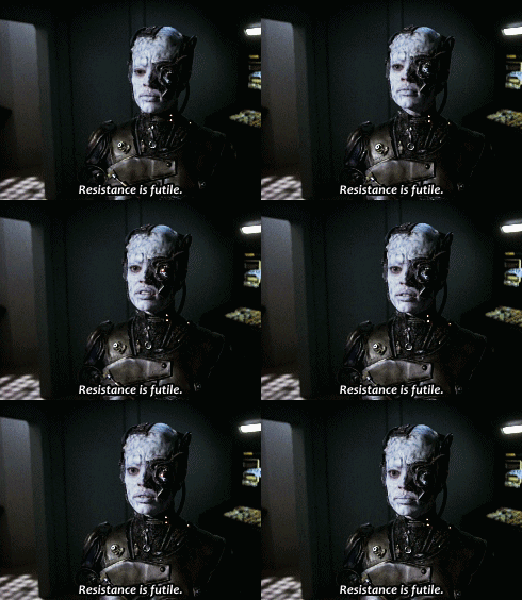
borgLike the Borg, the UPSL has grown in part through assimilation. The Premier League of America (which, despite the name, covers a relatively compact area around Lake Michigan) simply merged into the UPSL and became the Midwest Conference. A few other teams have moved over from existing amateur leagues such as the Colorado Premier League (a U.S. Specialty Sports Association affiliate), Texas Premier Soccer League (U.S. Club Soccer), the nominally professional American Soccer League, the apparently defunct American Champions League, the apparently defunct Champions Soccer League USA, the People’s Front of Judea (OK, that one’s fictional), and elsewhere. They also have a partnership with the traditionally strong Maryland Major Soccer League (home of the aforementioned Christos FC), one of the USASA’s Elite Amateur Leagues.

To some extent, the UPSL is a loose network of regional leagues. It’s much bigger in California than it is elsewhere. But it does have a national playoff and advertises a separate Cup competition called the Admiral Cup, though that doesn’t appear to have been contested recently.

A national playoff of this sort is a little curious. If you’re one of the many people annoyed with the USA for doing things that other countries don’t do, well, this is something other countries don’t do. I don’t see a national Regionalliga championship in Germany — just playoff games to determine the promoted sides, with no overall winner. Nor do I know of any English divisional championships after the fifth tier, which is the last nationwide league. (England does have the FA Trophy, a cup competition for those in tiers 5-8, and the FA Vase for anyone lower than that. But the U.S. counterpart to that would be the U.S. Amateur Cup, which many UPSL teams enter, and that winner can play in the supercup-ish Hank Steinbrecher Cup.) European clubs in regional leagues try to win that league and progress as far as they can in their cups.

But that playoff is, in the words of Douglas Adams, mostly harmless. It’s the summer leagues, PDL and NPSL, that have counterproductive national playoffs. These clubs serve a valuable purpose — giving college players a few more competitive games in the summers. Then they cut their regular seasons short to race through a set of playoffs that no one really cares about. (Seriously — lower-division fans can all remember U.S. Open Cup upsets such as Reading United over the New York Cosmos, Michigan Bucks over everyone, Des Moines Menace over a couple of pro teams, Chattanooga FC over Wilmington, etc. Name the last PDL champion. Or try to remember anything from the NPSL playoffs other than Midland-Odessa scraping together a team to play the final after the bulk of its roster went back to school for the fall.)

That’s the state of adult soccer. What about youth soccer?

Maybe the new U.S. Youth Soccer leagues will be an oasis of sanity. Unlike the Development Academy and the ECNL, they should have enough entries to split into sensible regional divisions. (The DA has a few good clusters at U12 but hits peak absurdity by U15, while ECNL travel budgets are rather excessive even in the long-established girls’ divisions.)

And somewhere in the ashes of the 2018 U.S. Soccer presidential race lies an interesting idea — a national Youth Cup. This exists in England, where the FA Youth Cup draws hundreds of U18 entries (and note that the age range is not by birth year) and Broxbourne Borough of the Spartan South Midlands League Division One (unfortunately, the senior team is facing relegation down to England’s 11th tier) was one game away from the quarterfinals last year.

One national championship. (OK, maybe two — England has a national U18 league with north and south divisions that face off in a national playoff, but that’s about it for national travel, even in a country that requires no airplanes for away fixtures.) That seems sensible. And the top academies might have to face off with a Broxbourne Borough in a meaningful game instead of sitting in a silo.

Basically, if you’re going to have a national championship, maybe it should include everyone in the nation — at least those meeting a certain criteria like “amateur” or “Division 3 or below” or “Division I college teams.” Otherwise, why spend time flying when you could be playing?

us soccer, youth soccer

Turf war! Huuuh! What is it good for?

Absolutely nothing … say it again!*

So I’m making a good bit of progress on the next Area Guide — Southern California this time. Should be ready in a day or two. Hey, what’s this in the inbox?

US YOUTH SOCCER ANNOUNCES NEW LEAGUES STRUCTURE – THE US YOUTH SOCCER NATIONAL LEAGUES

(Alternate take from SCTV.)

But that’s just the journalist’s take. It’s the equivalent of an 89th-minute goal that forces us to tear up the stories our editors are expecting in five minutes. How does everyone else feel about it?

https://twitter.com/Sweeney_Sean/status/986932995868282881

OK, that sounds good. Anyone else?

Oh dear. (Disclaimer: Ranting Soccer Dad is an NCSL parent.)

What does this mean?

1. Instead of four regional leagues, we’re about to have a lot of conferences. They’ve named eight so far, but that just covers the East Coast, the Southeast and Texas.

conf

Will this format include more teams? Seems that way, but we’ll wait for clarification. In the current format, the Eastern Regional League has 16 teams in the Elite Division. The lower Premier and Championship divisions can theoretically take more teams but do not. The Midwest Regional League looks a bit bigger, as do the Southern Regional Premier League and the three-pronged Far West Regional League.

Through the current regional leagues, teams can qualify for the National League, which uses the hashtag #EarnYourPlace to establish its intent and perhaps throw some shade on the invitation-only DA and ECNL. And through the National League, teams can earn a place in the regional championships (an alternate path: State Cup) and then the National Championships.

Those pathways will continue. But will they be more crowded?

2. EDP, which currently has its top levels (out of many levels) in U.S. Club Soccer’s National Premier League, has apparently switched over to U.S. Youth Soccer. (I’m asking to have that point clarified.)

3. The press release mentions “newly formed club vs. club brackets may be offered.” That raises two questions. How, given the team-by-team #EarnYourPlace qualification for these leagues? And why, given the objections raised by … OK, maybe just me? See “Club-centric scheduling” on my “About the Area Guides/National Info” page.

4. With these leagues being more localized than the current league system, is the expectation that each team will enter only these leagues? In the current system, some teams play in both the U.S. Youth Soccer regional league and their “home” leagues.

Perhaps it’s unfair to think of these changes mostly in terms of the Turf Wars — U.S. Club Soccer vs. U.S. Youth Soccer in general, then the proxy war of the Development Academy (U.S. Soccer) vs. ECNL (U.S. Club Soccer) vs. traditional league/tournament play (U.S. Youth Soccer) at the elite level. But it’s really impossible to think about it otherwise.

So you may be asking: How does this affect me, especially if I don’t have a kid in the top 1-5% of youth soccer players who might be involved with these programs? 

My tentative answer: We may be hitting a tipping point of trickle-down “elite” soccer.

Here’s how …

1. Clubs in your area scramble to get their top teams in the DA, ECNL or U.S. Youth Soccer conferences. (We’re already seeing this for the DA and ECNL; the current U.S. Youth setup is more complimentary.)

2. Clubs that don’t get into these programs (or want their B teams to be in something “elite”) scramble to form “elite” leagues, some of which are pretty good and some of which are demonstrably worse than the old traditional leagues’ top divisions. (Already seeing this, too, in some areas.)

3. Your traditional league needs to recruit more teams to fill the holes in their divisions. Suddenly your big local club has six travel teams in one age group. Suddenly your local “development” league consists of a couple of teams in one place and a couple more 100 miles away.

In short, we can sum it up with one word …

Chaos.

Whether your kids are in the top 5% or the middle 50%, you may find yourself in leagues that are unsettled, with clubs and teams coming and going. Maybe a new team comes in that blows out all its opponents 10-0 or loses all its games 10-0. Maybe a league that used to have all its games within a 45-minute drive now has its games scattered all over your state.

Or not. We just don’t know. So when you sign up your kid for a full year (because heaven forbid a club lets you sign up for one season at a time) of “travel” soccer, you have little idea what you’re getting into.

So it’d be nice if the powers that be would get together and explain to us why this is necessary.

* Don’t get the headline reference? Check out Edwin Starr, Bruce Springsteen and Seinfeld.

The Ranting Soccer Dad Guide to Youth Soccer is underway. It includes a guide to national programs and, in progress, an area-by-area guide across the USA. Check out the Patreon page for full access and updates.

basketball, college sports, sports culture

Review: “Last Days of Knight” is flawed but essential

Cross-posting at mostlymodernmedia.com 

ESPN is gambling these days.

The new “30 for 30” documentary, Last Days of Knight, gambles on three levels:

  1. It’s being shown exclusively on ESPN+, the company’s new pay service, a good way to draw attention to it but not the best way to get this film the wide audience that many previous 30 for 30 entries have found.
  2. It tells the story of a journalist, CNN’s Robert Abbott, who pursued the story for months. As an Awful Announcing review says, the film attempts to tell Abbott’s story and Knight’s, and it sometimes falls between the two stools.
  3. A lot of people still maintain loyalty to Bobby Knight after all these years.

Others can debate No. 1. The questions here are No. 2 and No. 3, and the disappointment of Last Days of Knight is that we get too much of No. 2 and not enough exploration of No. 3.

Like all 30 for 30 films, LDON is a slick presentation. And the story is compelling, even with the unusual focus on Abbott. CNN’s reporting became part of the story itself, for better or for worse, and you don’t have to be a journalism junkie to appreciate the insights on how everyone involved interacted with the media — Knight as one of several bullies, players and staffers afraid to speak, administrators being weasels, etc. Abbott’s reflections and the nitty-gritty at CNN, including some clumsy threats by people working on Knight’s behalf, provide a new angle to an old story.

But that story bogs down with an extended, guilt-ridden take on the post-scandal life and death of Neil Reed, the player Knight assaulted in a video that hastened his downfall. It’s a sad and yet sweet story of someone who reclaimed his own life and was clearly loved before his untimely death from a heart attack, but its placement in this film is odd, as if it’s suggesting Reed’s death was somehow collateral damage from Knight’s antics and/or the media coverage. Abbott regrets making Reed uncomfortable in his pursuit of the story, but it seems a bit much for him to interpose himself in the family’s mourning process.

And we’re left wanting something more. Abbott and some of his colleagues are seeing the old story in a new light. Anyone else?

Perhaps it’s me — I wrote about irrational mobs in my review of Jesus Christ Superstar — but I really wanted to see some reflection from the people who defended Knight when he was quite clearly indefensible. Knight, predictably, wasn’t interested in participating. But what about the students? Former players? Now that the heat has died down, what would they do differently?

But even if we don’t see such reflection on camera, we have to hope it’s happening elsewhere. It’s not happening in this dismissive review from The Daily Hoosier.

The value of a story like Knight’s is that it holds up a mirror to us. How much are we willing to excuse if a guy wins some basketball games? Can a man impart military-style discipline and behavioral values if he doesn’t live up to it himself or hold himself accountable?

We see hints of these questions in Last Days of Knight. Just not quite enough.


pro soccer, us soccer

Things about U.S. pro soccer that are still true

A quick interlude in my youth soccer work to reiterate some things that, based on discussions I’m seeing, need reiterating:

1. Before MLS, the USA had two substantial pro men’s leagues. The ASL of the 1920s and early 30s was successful for several years and provided the bulk of the players who helped the USA take third in the 1930 World Cup (don’t get too excited — only 13 countries entered) before falling apart in a series of stubborn arguments with national and international federations. (Sound familiar?) The NASL started in the late 60s and peaked in the late 70s before collapsing in the mid-80s, having done little to put down solid roots. In the rest of those decades — 40s, 50s, most of the 60s, late 80s, early 90s — U.S. pro soccer was a wasteland.

2. At times, the USA has been outright hostile to soccer, even if Jack Kemp walked back his complaint that the sport is “socialist.” Sort of. Newspapers often refused to cover it seriously. Academics have spilled boatloads of ink explaining why soccer faced an uphill cultural battle in this country until a few things changed the scene (say — 1994, 1999, 2002, etc.)

3. If big events on TV were any indicator of interest in regular professional competition, the highest-rated shows would be the NWSL and the Diamond League. (I’m betting a lot of you are opening a new tab and Googling “Diamond League.”)

4. Since 2001, MLS has grown substantially by every metric except TV ratings, which is indeed an issue and may be explained by any mix of three factors: substandard games, substandard TV production, the growth of EPL and other leagues on U.S. TV. Every other metric — number of teams, number of teams doing well at the gate, overall attendance, number of committed ownership groups, investment in facilities, investment in youth academies — is trending strongly upward.

5. MLS is not part of a conspiracy to keep soccer from getting as big as the NFL. There’s no record of MLS turning away substantial investment aside from the vaporware media rights “offer” Riccardo Silva made, knowing MLS couldn’t accept. Indeed, several MLS owners today — Stan Kroenke, City Football Group, Jason Levien — also have ownership stakes overseas, so they directly profit from the EPL and MLS chipping away at the U.S. sports marketplace. And if Anschutz, Hunt and Kraft wanted soccer to fail, they would’ve let MLS fail in 2001 instead of digging far deeper into their pockets to keep it going.

6. While the USSF Pro League Standards have some criteria worth arguing, U.S. Soccer is not unique in having standards. Check out what you need to be in the Football League in England — 2,000 seats under cover, a closed-circuit surveillance system, an external boundary wall of 2.2 meters, individual seats with back rests (sorry, no high school stadia with bleacher seating), a computerized turnstile monitoring system, directors’ boxes with guest rooms, press seating with 20 desktops and 10 power points, etc.

7. Plenty of soccer clubs in the USA have meticulously chosen their level — amateur summer leagues, amateur fall-spring leagues, USL, etc. — and don’t want to change.

8. If you subscribe to the notion that the U.S. men’s national team has gotten worse (not that the competition has gotten better), you have to account for the fact that more players in the old days were produced through pay-to-play clubs and college soccer.

9. The NASL (the new one) made its own bed and now, thanks to constant turnover and the quiet disappearance of a lot of big-talking backers, lacks the institutional knowledge to remember that it did so.

10. Just as the NY Cosmos argued that their investment was based on retaining Division 2 status, a lot of investment in academies and infrastructure over the past 20-plus years has been predicated on retaining Division 1 status.

11. The USA is huge. Like, really huge. Yes, Russia’s bigger, but the area hosting the 2018 World Cup is smaller than the USA, even including that little hop over Belarus to Kalinigrad, and the Premier League just has the occasional team from the Pacific Coast. (Besides, do we want to copy Russia?) Ensuring a national footprint is a worthwhile goal.

12. You can make a good case for promotion/relegation (or, at the very least, for other reforms) in U.S. soccer without denying the truths listed above and accusing the people who remind you of those truths of being paid shills setting up Twitterbots on behalf of the MLS illuminati. So why not give it a try?

youth soccer

Rec soccer and “development”: At what point can we just stop?

Preseason coaches’ meeting. It’s always more of a lecture than a “meeting.” There’s absolutely no reason an email wouldn’t suffice. The in-person “meeting” would be much better reserved for a training session with a lot of small breakout groups.

But anyway …

The Important Person In Charge (IPIC, as in “I pick what we’re doing”) reminds us of the importance of “development” instead of “winning.”

In U19 recreational soccer.

I would’ve asked what we were “developing” these players for at this point, but I didn’t want to prolong the meeting. So I’ll ask here …

What are the developmental goals of recreational soccer for kids who are never going to play at a higher level? 

These kids aren’t going to make their high school teams — most of the travel kids won’t make the high school teams. Simple math. This year, I’ve seen a lot of kids from “A” teams who don’t make the JVs at their local high schools. The sweet spot for high school play in our region is the level immediately below the Development Academy — and bear in mind that a lot of kids may ditch the DA their senior years to get in that one season of playing with their classmates.

(Quick aside: I’d love to see youth clubs list the players from their clubs who make local high school teams. Or I’d love to see parents crowd-source it so we can see which clubs really are getting kids to their high school teams. Let’s fact-check the coaches who insist their players can go play wherever they want. We’ll get back to that.)

At U14, rec kids can still make the transition to travel. They might even be raw talents who play a lot of pickup soccer and can still “develop.” It’s rare at this age, but it can happen.

By U19? Aren’t we basically “developing” the next generation of adult rec players?

They may turn into parent coaches one day. They might even sign up to be referees. Great. Let’s keep them in the game.

IMLeagues

But the next level as a player is basically adult league and/or college intramurals, where I really wish I’d seen the matchup of Christian Pu-LAW-sic vs. Game of Throw-Ins.

So why aren’t we letting high school kids do the same thing? Why are we running high school rec soccer through parent commissioners and coaches who oversee practices at which they might get 3-4 players on a given night? Why are we trying to “balance” these teams instead of letting a group of friends play together and figure out which level to enter?

If some of those friends want to practice once or twice a week and have a coach, fine. They can enter the “Open A” division and play only with or against people who are just as interested in soccer as they are. That’s frankly a better option at that age than lower-level “travel.”

The kids playing U19 rec soccer have survived a decade or more of adults telling them what to do. Why not give them a little reward and let them make a fun transition to adult soccer instead of treating them like U9s?

youth soccer

Can you learn anything about youth soccer from message boards?

In 1999, I was hired at USA TODAY.

Not as a soccer writer, though they agreed to let me write a weekly column online. That’s how the site went in those days — a lot of us would spend 30-40 hours a week doing the nuts-and-bolts work of posting and maintaining content, then 10-20 hours a week doing the fun stuff that made the site unique.

I was hired as a community content developer. At first, my primary job was to moderate message boards.

nation-talksWhich was hell. I had to kick people off the boards (though one of my Facebook friends today is someone I kicked off the boards twice, so there’s a certain amount of respect built up over time in some cases), and I spent my 30th birthday exchanging email with Rush Limbaugh, whose lobbying to host Monday Night Football was crashing our servers.

But I still believe message boards and similar forums can be useful. It all depends on the context and the people involved. The reader comments at Deadspin are usually better than the stories. Bloody Elbow has painstakingly cultivated a lively but mostly reasonable community of readers and commenters. BigSoccer is hit or miss — some arguments in the indoor soccer forum have been ongoing since maybe 2001, but there’s some useful information exchanged. And if you’ve been kicked off BigSoccer, you probably deserved. (That’s why all the slander specialists are on Twitter, still griping about how they got kicked off BigSoccer.)

Anonymous message boards should be a valuable source of information for youth soccer parents. You can share candid information without fear of reprisal from coaches and clubs. But you can also share unsubstantiated accusations. Maybe little Johnny isn’t quite good enough for the megaclub’s A team, so the parent goes on the board to tell everyone the coach is clueless or corrupt or whatever.

The worst boards are the ones that aren’t just anonymous but require no sign-on. The conversation generally runs like this:

Anonymous: We’re thinking of moving my 9-year-old son from FC United to United FC. Any thoughts?

Anonymous: Oh, you’re probably one of those moms who thinks your kid is the next Messi.

Anonymous: United FC is falling apart. All the coaches are terrible, and the board members are rec-league parents who want their kids to be on the A teams.

Anonymous: We get it, you’re upset that you were fired from United FC.

Anonymous: Oh, shut up. You’re on the board, aren’t you? You’re the one whose kid made the U10 A team in 2010.

Anonymous: Um … I don’t think anyone’s been on the board that long.

Anonymous: You’re not fooling anyone. You’re the same person.

Anonymous: The same person as who?

Anonymous: We KNOW who you are.

Anonymous: Yeah, you’re mad because your kid had to go to another club in 2012 because none of the parents liked you.

That could be 10 people. It could be two.

I’ve been on one such board for a while, and I’ve finally started using a unique sign-on. I’m RantingSoccerDad. So it’s pretty easy to put two and two together and figure out who I am. That means I’m not going to share much information about my sons’ clubs, but that’s a fair trade to me. And I’m hoping to start a movement where people create unique sign-ons so we can actually see how many people are in these conversations.

Flawed as they are, these message boards can be helpful. I like Georgia Soccer Forum, where I’ve learned a bit about a potential “Champions League” and reminisced about the Athens Applejacks.

All facts need to be checked elsewhere, of course. But it’s nice to get some impressions from people on the ground. On the whole, we probably need more of these boards. Maybe multiple boards in one area, so we can promote and relegate them.

If you have any favorites anywhere in the USA, please share.