(Part 1 covered 1998-2009)
Repeating our links of documents:
(In Part 1, there’s also an external 2004 report on governance. I also had a quick side note comparing the USSF structure to what I’ve found elsewhere, but it’s not much so far.)
I’ve read, at one time or another, pretty much all of this information. That doesn’t mean I understood it. That doesn’t mean the records are complete — the Board seems to go into executive session over piddly details, while other boards with which I’ve dealt tend to do so only for personnel matters. But I’ve read it.
The other big-picture item: The organization is turning over much, much more money than it used to.
|
2006 |
2016 |
| Sponsorship |
$14,720,385 |
$49,498,623 |
| Program revenue |
$28,365,806 |
$122,655,465 |
| Gross receipts |
$39,102,876 |
$126,747,525 |
| Total expenses |
$35,047,107 |
$110,011,376 |
I certainly have some questions left. Many. I hope to get some of them answered in 2018, preferably before the election.
One clarification here: I’ve been sloppy in my usage of “AGM” (Annual General Meeting). The AGM has meetings of all the Councils (Youth, Adult, Athletes, Pro) as well as the Board, then has the big show — the National Council, in which everyone is represented and all the big, binding votes are held. We get transcripts for the National Council, not the other meetings.
So with that in mind, here’s a full history (abridged) as constructed from the minutes, transcripts and the occasional other document, picking up where I left off in Part 1 …
2010
A year of big decisions that passed quietly:
- Sunil Gulati is re-elected without opposition.
- Claudio Reyna is hired as technical director (a few months after the election).
- Some sort of resolution between U.S. Youth Soccer and U.S. Club Soccer, but I don’t have details.
Also, this bizarre democratic twist from the Board minutes:
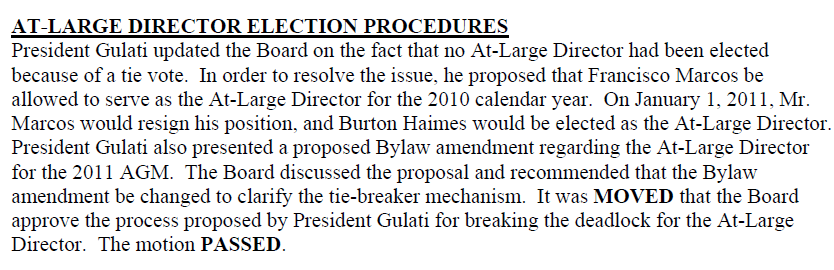
More typical Board business from May:
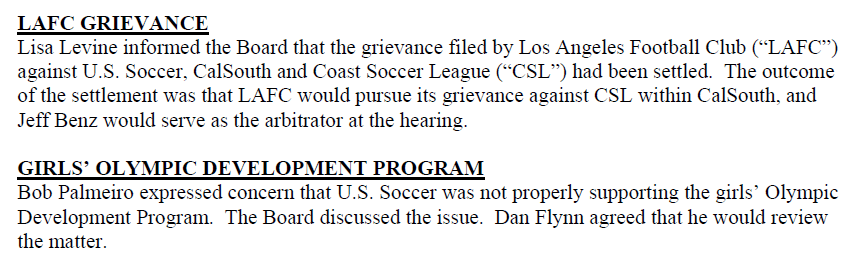
(That is, of course, not the LAFC entering MLS this year.)
The biggest news for the future — U.S. Soccer stepped into the mess that was lower-division soccer, where teams were breaking away from the USL but neither faction had the critical mass to play D2, and agreed to run a temporary second-division league with teams from both factions included. Also that year, a new task force came up with Pro League Standards. I remember thinking at the time that the D2 standards were ridiculous, but the leadership of the group that would become the NASL (none of whom are still involved with the league) signed on.
This from the President’s Report: “In 2010, U.S. Soccer successfully oversaw the Division 2 Professional League. Twelve teams went through a highly competitive 30‐game season, with the Puerto Rico Islanders claiming the championship after defeating the Carolina RailHawks 3‐1 in aggregate in a two‐game series. For 2011, the NASL has provided a plan that we are hopeful will provide a long‐term solution for Division 2 soccer, while the USL Pro League will also contribute to create a strong base of men’s professional soccer in the U.S.”
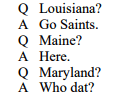
And back at the National Council, they were still doing manual roll calls, leading to this from the youth ranks:
2011
A few odds and ends:
- April Heinrichs and Jill Ellis hired for women’s technical roles. At the AGM, Heinrichs gave a speech that went on for 11 1/2 pages of the transcript.
- In case you forgot, FIFA didn’t give the USA a World Cup to host. Russia and Qatar seem like great choices though, don’t they?
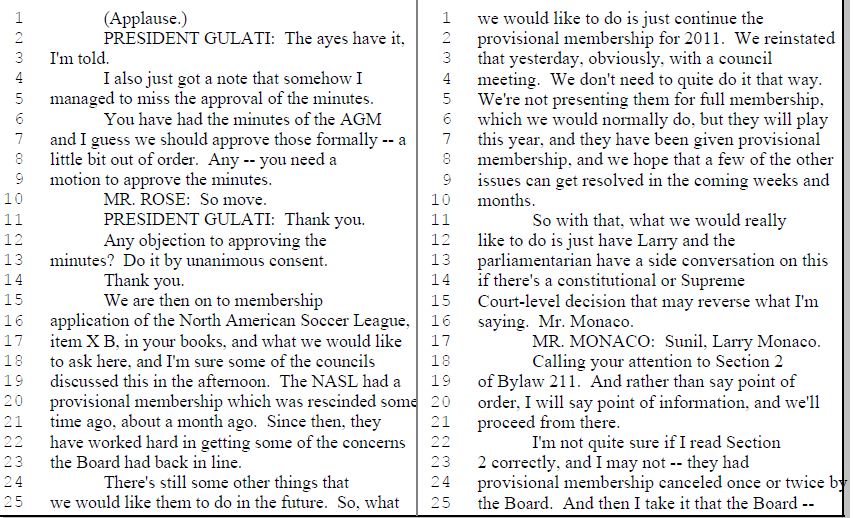
And some interesting business on leagues, first from the National Council, where it seems everyone was combing the bylaws to make sure it was OK to give the NASL provisional membership for 2011:
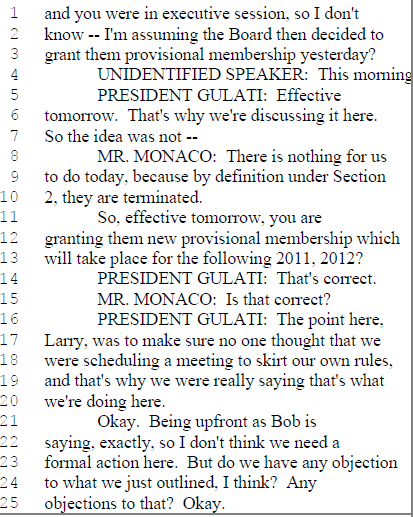
Then from a May Board meeting:

Also — this is the earliest AGM “book” currently available online. There, you can see all the committee reports, bylaw changes, policy changes, etc., along with the transcript of the previous National Council (which is also available under AGM transcripts on the site). So your homework now is to tell me which committee(s) John Harkes and Amanda Cromwell served on that year.
That’s also where we learn things like this:
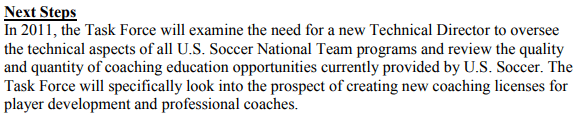
That task force had 16 people, including chairman Kevin Payne, Bob Bradley, former USSF president Dr. Bob Contiguglia, Dan Flynn, Sunil Gulati, Tab Ramos, Thomas Rongen, Claudio Reyna and Jerome de Bontin.
And note this from, of all places, the budget report:
WoSo folks might be interested in seeing the game-by-game budget summary for the WNT in the fiscal year.
The book also has the NASL’s application for full membership, which notes the average monthly salary would be approximately $2,700.
And it’s bylaws, bylaws, bylaws! The proposals this year …
Amendment to Bylaw 213 by Board member Jim Hamilton (Adult Council): Speeds up the response time when someone bids to replace a state association. PASSED
Amendment to Bylaw 302 by Board member Richard Groff (Adult Council): “This proposed amendment is meant to formalize the customary practice of the Adult Council’s National Association to delegate votes in the National Council to subsidiary affiliates that register adult players directly through the National Association and not through a State Association.” PASSED
Amendment to Bylaw 412 by the Board as a whole: Intended to prevent having another tie for the At-Large spot. PASSED
Amendment to Bylaw 801 by Louisiana Soccer Association: Gives Life Members (and, as amended from the AGM floor, past presidents) the right to propose amendments to bylaws, policies and the articles of incorporation. PASSED
Then policies (some of which the Board enacts, but then the National Council must ratify):

Amendment to Policy 102(3)-1 by Sunil Gulati: It’s about coaching education, and it seems to be little more than some punctuation changes. PASSED
Amendment to Policy 214-2 by U.S. Youth Soccer: Membership fees! Cutting them in half. Literally. Every category — associate member from $1,000 to $500, adult player from $2 to $1, youth player from $1 to 50 cents, etc. WITHDRAWN without a vote.
Amendment to Policy 214-2 by Richard Groff: Adds a U20 player category and charges them the youth ($1) rate rather than the adult ($2) rate. Saves some bookkeeping for U20 teams that have both youths and adults. PASSED
2012
A moment of silence for the full-fledged roll call. They automated it this year.
The National Council votes the NASL into full membership. Commissioner David Downs is present to give a brief word of thanks.
Also welcomed as a member: North Dakota Soccer Association. The transcript has one of my favorite typos ever:

VP: Mike Edwards is elected to a second full term over Juergen Sommer.
But it wasn’t all bad news for Jurgens. Hello, Coach Klinsmann. He spoke at the National Council meeting for a long time.
The not-yet-recovered economy took a toll on the budget, with a projected deficit of $6.1 million.
The AGM book has a substantial presentation by the NASL. The “youth development” page shows a wide range of approaches — Edmonton has an actual academy, Carolina has an affiliation with giant club CASL, Tampa Bay has invested $65,000 in Maine (?!), and other clubs have players out coaching somewhere. Among the interested expansion markets — Austin, Las Vegas, New York, Sacramento.
Colorado’s state adult association shuts down. The youth association is provisionally accepted as a joint association.
Not as much activity on the bylaw front except for a couple of bylaws about bylaws:
Amendment to Bylaw 802(3) by Life Member Stephen Flamhaft: Suggests requiring that bylaw amendments must be distributed 60 days (not 30) before the AGM. The Rules Committee notes that another bylaw says 30, so the CEO would have to distribute them twice. FAILED (got 58 percent but needed two-thirds).
Amendment to Bylaw 802(4) by Flamhaft: The Rules Committee MUST make a recommendation of whether or not to recommend a bylaw (and may include a minority dissent if applicable). The Rules Committee responds by saying that could be problematic because it might politicize the committee, but hey, if you really want us to do that, go for it. WITHDRAWN without a vote.
Policies:
Amendments to Policies 241-2, 601-2, 601-8 by the Professional Player Registration Task Force (remember that from last year?): Basically, $50 per professional player in a non-pro league, but $10 of that goes back to the organization member and another $10 to the state association up to a very odd total of $1,333 per team in a calendar year.
Amendment to Policy 411-1 by Sunil Gulati: Just gives the CEO a bit more freedom to sign financial agreements.
New Policy 531-1 by USSF Referee Committee: Something about a point of contact.
Amendment to Policy 601-6 by Dan Flynn: International clearance for youth players, to bring USSF into compliance with FIFA requirements.
Then there’s a fifth one the Board approved too late for inclusion on the book. It’s from Richard Groff on Policy 214-1, and Washington State Adult Soccer’s Tim Busch has some pointed questions:
BUSCH: So what we’re talking about in Section 10 is if a state association chooses to leave one or the other youth or adult parent bodies and chooses to affiliate directly with the Federation, there’s a $10,000 one-time fee or a $10,000 annual fee.
PRESIDENT GULATI: Annual.
BUSCH: Let me understand this. The Federation needs $10,000 to be able to accept our player fees? I mean, I understand a reasonable administrative fee. But $10,000?
Groff joins the conversation here:
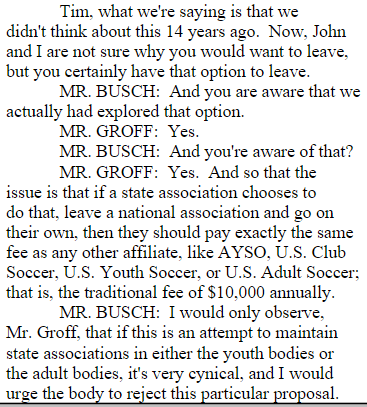
It still PASSED, though they had to go to the keypads rather than a simple voice vote.
2013
Big year for the Federation: It launched the NWSL. Initially, the Fed staff was the league staff, but the league slowly grew its own office from an initial group of three into something that could stand on its own. Also, USSF subsidized the league, most directly by paying salaries for U.S. national team players.
Also, it’s the Centennial. 1913-2013.
The Athletes Council formed three internal divisions: Governance, Visibility and Outreach. Angela Hucles took the lead on Visibility; Cindy Parlow Cone took the lead on Outreach.
The Open Cup Committee report hails the increase in prize money — champion will get $250,000, up from $100,000 — and the Cal FC run:

The AGM book includes a report from the Diversity Task Force, opening with its mission statement: “We believe that the under-served soccer community deserves opportunities to succeed. We will identify the challenges, create the road map to success, forge partnerships with corporations, non-profit organizations and individuals who will help us develop the programs and services that allow the under-served soccer players from all backgrounds to reach their full potential in soccer, education, work, health and life.”
A few members of the 20-strong Diversity Task Force: Tiffany Roberts-Sahaydak, Chris Armas, Lynn Berling-Manuel, Luis Montoya, Dante Washington, David Testo. How’d that turn out?
American Amputee Soccer Association was welcomed as a member. U.S. Futsal returned “after a brief absence,” according to the letter from President/CEO Alex Para.
One unusually frank item in the AGM book: Some background, including minutes of a testy meeting and one angry email, of the dispute in Wisconsin.
The AGM itself, held in June, was relatively uneventful. Since-departed CONCACAF president Jeffrey Webb addressed the crowd. So did Dr. Reinhard Rauball of the German federation, who has a gift for U.S. Soccer. Gulati jokes that the plaque’s inscriptions accepts that it was a handball during the 2002 World Cup, then talks about seeing the men’s and women’s Champions League finals. The latter was won by Wolfsburg despite Megan Rapinoe’s presence for Lyon.
Let’s hit the bylaws:
Amendments to Bylaws 202, 232, 241 and 543 by Dan Flynn: All designed to remove the Individual Sustaining Member designation. Once upon a time, individuals could pay some fee and become a member, earning the right to attend any game. But, Flynn says, they hadn’t used this option in years, so it was time to delete it. The Rules Committee agreed, calling these bylaws “vestigial.” The change on 543 was WITHDRAWN for some reason, but everything else PASSED by voice vote.
(Remember the preceding paragraph.)
Amendment to Bylaw 213 by Richard Groff: Adds a mediation process to disputes between an existing State Association and a would-be replacement. It’s referreed to on the floor as “the Wisconsin bylaw amendment.” PASSED with applause.
Amendment to Bylaw 322 by Jon McCullough (Athletes Council chair who sadly passed away the next year): Changes the way the Athletes name reps to the Board and the USOC, going to staggered four-year terms. PASSED
Amendment to Bylaw 412 by Richard Groff: Simple update on Adult Council’s representation on the Board — the Adult Council chairperson would automatically get one of the two slots. PASSED
Amendment to Bylaw 603 by Eastern New York Youth (no, NOT Sal Rapaglia’s organization): Adding a section on how youth tournament organizers must advertise tournaments, taking into account all the different youth organizations and how their insurances differ and good grief, why do we have so many youth organizations? Rules Committee suggested tweaking and did in fact convince ENY to take on an amendment. They used the keypads for the vote, but it PASSED.
New Bylaw 805 by Dan Flynn: Can we please send notices to the National Council electronically? PASSED with slight amendment from the ever-vigilant Larry Monaco.
Phew! How about policies (reminder: Board usually enacts, but National Council must ratify):
Amendment to Policy 102(4)-1 by Open Cup Committee: Sets field standards starting with the first round, not third.
Amendment to Policy 214-2 by Disability Committee: Changes membership fee for Disabled Service Organizations. No longer $1,000. Now a minimum of $500, stepping up $1 per player if the group has more than 500, then a maximum of $1,000. If you have 300 players, $500. If you have 501 players, $501. If you have 999, $999. If you have 1,003 players, $1,000. If you have 10,000 players, good for you — and it’s still $1,000.
Amendment to Policy 601-5 by Transgender Task Force: Adds a new section saying amateur players “may register with the gender team with which the player identifies.” Not applicable to national teams or pros, pending FIFA action.
All three passed in one vote, as did the re-election of independent directors Carlos Cordeiro and Fabian Nunez.
By December, the budgetary news was steeped in black ink — revised projection on FY2015 was a surplus of $7M.
2014
Back to a winter AGM — Feb. 28-March 2 in New York. The 2013 meeting had been in June.
In February, the Board said its sponsorship deal with Nike had been renewed. Still working on renewing the deal with Soccer United Marketing.
Also in February, revised pro league standards were approved.
Diversity Task Force reports that it’s going to launch a leadership program at a May event with the U.S. Soccer Foundation and the Urban Soccer Collaborative Symposium.
Winning the Gold Cup and holding a qualifier in a large stadium (Seattle) boosted the budget to a projected FY 14 surplus of $3.17M. (Indeed, the National Team revenue line item was $8,223,350 better than budgeted.)
Not much on the bylaw front:
Amendments to Bylaws 231, 301, 302 and 303 by Mike Edwards: These refer to Life Members, which have heretofore been nominated (in excruciating detail — a lot of the 2014 AGM book consists of every sort of supplementary evidence you can imagine in support of one nomination) to the National Council and then voted in. Edwards (still the VP at this point) wants to shift that from the National Council to the Board. Would that give too much power to the Board to stack the National Council? No problem — Edwards’ amendments would also cap the voting strength of Life Members on the Board. After a few tweaks from Larry Monaco, including (seriously) changing some periods to semicolons, all of this PASSED sans opposition.
Amendment to Bylaw 707 by Mike Edwards: Oh boy. They’re trying to make it more difficult to sue the Fed.
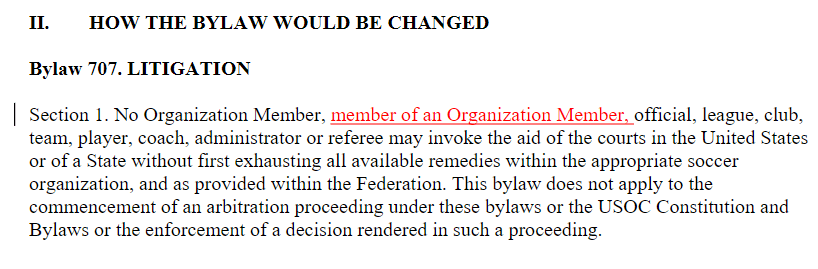
And the Bylaw would have a few other tweaks as well, all trying to define the path by which anyone can challenge the Fed (or a Fed member).
To which the Rules Committee says, “Good luck with that.”

This was WITHDRAWN.
The only Policy up for a vote has not been approved by the Board and is predicated on the Life Member amendments passing. It just updates the Policies to match the Bylaws. PASSED.
Oh, and Sunil Gulati was re-elected to a third term without opposition. And Donna Shalala was re-elected.
Longtime Board members Richard Groff and Kevin Payne wrap up their terms. Groff was stepping down as USASA chairperson.
Later in the year, the Board considered the application of the US-AFL, agreeing to hold off until the group addressed some concerns from the Rules Committee.
And as mentioned above, sad news — Jon McCullough, a Paralympian and longtime Athletes Council rep to the USSF Board, passed away at age 48.
2015
The 2015 AGM Book isn’t available online right now, which is a pity because I need some details about this first policy discussion.
In any case, there were no bylaw proposals this year. The policies …
Amendment to Policy 102(3)-1 by Mike Edwards: Something about a national coaching policy. Without the book, I don’t know what it said.
But the transcript tells us we had a battle between the state associations and the big national organizations — U.S. Club Soccer (Kevin Payne speaking) and AYSO (John Collins). It wasn’t about Edwards’ change per se; instead, it was about an amendment offered from the floor that would shift approval of something from the “state secretary general” (I suspect this is a typo or a misstatement, and they actually mean the national secretary general — Dan Flynn, in other words) to the state associations. Here’s Collins:
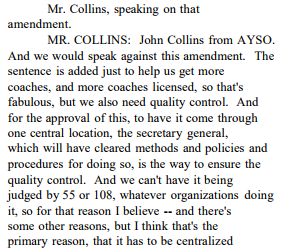
So that’s why I think they didn’t mean state secretary general. Collins seems to be arguing that this should be centrally run. Whatever this is.
Several states stood up in favor of the amendment — a New Jersey rep actually said the current national F license is not valid in New Jersey for some reason. USSSA’s Craig Scriven had the last word, siding with Payne and Collins.
Payne, Collins and Scriven won. The amendment (to the amendment) failed. Then Edwards’ original amendment PASSED.
Amendment to Policy 213, something about mandatory liability insurance by prolific amendment-writer Richard Groff, PASSED without objection.
Amendments to Policy 531, proposed by the Referee Committee, PASSED without objection.
Carlos Cordeiro and Fabian Nunez were rubber-stamped for another term as independent director.
The National Council meeting ended with the “Good of the Game” free-form section as always, and it included an eloquent letter Jon McCullough sent before his death.
The whole meeting wrapped up in a tidy 83 minutes. That won’t happen in 2018.
At the Board meetings: It’s independent governance review time! McKinsey’s report was due in January 2016.
2016
The 2016 AGM Book is up, so we get all the reports hailing a big year in 2015 — the WNT winning the World Cup (VP Mike Edwards went to eight of the 10 Victory Tour games), the MNT beating the Netherlands in Amsterdam (pity CONCACAF qualifying couldn’t be held there), MLS’s growth, the NASL contributing a player to the MNT and having its final on ESPN3, etc.
The U.S. Open Cup Committee was pleased that 63 games were live-streamed and available via the USSF site. They were also pretty pumped with the Cosmos’ comeback win over NYCFC. They’re also expanding USSF’s management of the Open Cup’s qualifying rounds — if you follow TheCup.us, you may notice that the qualifying rounds have a bit more pizzazz than they used to. Mike Edwards is the chairman of that committee and the Referee Committee.
The Rules Committee has gone all-male for some reason. It wasn’t like that in years past (Heather Mitts just finished her tenure).
Two bylaw proposals were withdrawn — USASA wanted to amend Bylaw 213 to make it a little more difficult to challenge a State Association so the states wouldn’t face costly, frivolous legal action, and the ever-present Steve Framhaft wanted to amend Bylaw 802 to make the Rules Committee send out its recommendations 60 days before the National Council meeting, not 30.
The proposed policy amendments passed with little fuss. That’s 601-6, a further tweak to youth players and international clearances (undoubtedly FIFA-driven), and 102(4)-1 from the U.S. Open Cup Committee, changing the “Adult Council division” to “Open Division.”
FY2016 was projected to have a six-figure surplus. It ballooned to $18.1M. Winning a World Cup and having a Victory Tour helps. The next fiscal year is projected to be huge because of the Copa America Centenario.
But we have a contested election! Incumbent VP Mike Edwards faces two challengers — longtime Board member Kevin Payne and longtime Board independent director Carlos Cordeiro. All three give speeches, all hailing each other as great people. And the winner is … Cordeiro.
This was also the AGM in which Flamhaft (see policy above, see presidency discussion in Part 1) rose in the Good of the Game section to denounce Chuck Blazer. Anger ensued. (First tweet of a thread below.)
https://twitter.com/duresport/status/944365333456019456
Also, the Board discussed a policy on standing for the national anthem, devoting an entire (though brief) teleconference to the matter in October.
At the December meeting, the last two items in the “Good of the Game” segment are noteworthy, but I’d be especially interested in some further explanation of the first:

2017
In February, the Board approved the national anthem policy (604-1).
Also, Gulati gave an update on filling the vacant independent director position, with Heidrick & Struggles becoming more involved in the search for candidates. (So, no, Gulati doesn’t just wander around Columbia looking for people. I looked up that firm to see who they are, and I discovered that they just announced layoffs.)
At the March meeting, Big East commissioner and former WNBA president Val Ackerman attended and was nominated to fill Cordeiro’s spot as an independent director. That was confirmed the next day at the National Council meeting.
There was also some discussion of conflict of interest:
 I’m sure people who remember that Alan Rothenberg and Mark Abbott, the latter of whom has been with MLS since the beginning, were both from Latham & Watkins, will find some irony in that.
At the National Council meeting …
The long speech this year went to Canadian federation president Victor Montagliani.
Applause for the NWSL’s deal with A&E Networks.
The online F license has been taken by 120,000 people already. Not bad. (I’ve taken it. It’s quite good.)
McKinsey’s consulting has led the Board to institute a few “committees of the Board,” so if you see that on the site and think it’s an odd power grab, just remember that an outside firm recommended it. They’re also evaluating the staff to see who might replace Dan Flynn one day.
How much money did USSF make from the Copa America Centenario? About $46 million, which is why the projected budget surplus is $44 million.
One year after being (politely) ousted as VP, Mike Edwards isn’t present, but he is approved as a Life Member.
U.S. Deaf Soccer is approved as a member.
The national anthem policy passes to applause. Two other policy amendments also pass, but I have no idea what those are because the 2017 AGM book isn’t online. Argh.
Then a major bylaws overhaul, led by Paul Burke of the Rules Committee:
- Bylaw 213: Replaces the process for replacing State Associations. Voice vote, PASSED
- Bylaw 232: Reinstates Individual Sustaining Members, just a few years after they were deemed “vestigial.” Fan organizations would be able to get a total of six votes. Voice vote, PASSED.
- Bylaw 401: Requires candidates for president and VP to declare in advance. (Yes, we’re talking very recent history here.) Voice vote, PASSED
- Bylaw 413: Term limits, background checks. Voice vote, PASSED
The details are complicated. Fortunately, I’ve written about this.
Also, changes to Bylaws 531 and 532 FAILED by electronic vote. Something about referees? Put the damn book online!
Are we done? Well, we’ve got minutes from three more Board meetings here …
In June, some spending:
- A $100,000 grant ($50,000 subject to finding sponsors) for the Power Soccer World Cup.
- $8 million for development of a centralized data integration platform.
- $3.3 million for further work with soccer consultants Double PASS.
- An additional $3 million (on top of the existing $1 million) for development of the Hall of Fame.
In July, Chris Ahrens (Athletes Council) inquired about the status of the pro league standards review. There was an update. And Lisa Carnoy was named the next independent director. (Theoretically, could someone else run for that spot at the AGM? It’s never been contested before, but these days, it seems like all bets are off.)
In September, Carnoy was added to the Risk, Audit and Compliance Committee.
And finally, from the September meeting, make of this what you will.
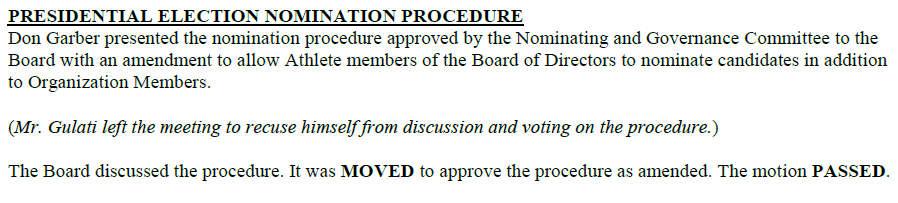
And that’s all we have. For now. At some point, I might go back through the financial documents AGAIN so I can find all the disclosures involving Garber and SUM, or maybe some of you can put down Twitter long enough to do it your own damn selves.
(Sorry, getting punchy. This is 4,145 words. Labor of love or something.)
 Duresport.com