pro soccer, women's soccer

Time for U.S. pro leagues to treat their cornerstones a bit better

With its callous attitude toward Columbus, MLS has already staked out a “thanks for getting us off the ground, now go away” attitude that Don Garber must fix before he either leaves office or renews his contract.

Are we seeing the same thing in pro women’s soccer? It’s complicated. We might not know a complete answer until we know the lineup of teams for 2019.

But it’s not looking good.

We might be able to absolve the NWSL of blame for the fact that 2018 will be the first season of pro women’s soccer in the USA without a team called the Boston Breakers. They weren’t the strongest club in WPS — see general manager Andy Crossley’s dissections of his handiwork for more details on that and yet another reason to add Curt Schilling to your list of the worst human beings in sports. And they never really found a good home ground in the NWSL — Dilboy Stadium was about as “track-and-field-specific” a venue as anyone could find, and Harvard’s Jordan Field was OK but tiny.

So when word spread that the owners were trying to sell, no one could really blame them. We may never know what happened with the new owners who, as of a few days ago, seemed set to buy the club and continue into the new season. Was the league completely blindsided? Or should they have done more to wrap up the deal or reject it in time to let others have a chance? Would the league have a more potent voice if it made up its mind as to whether Amanda Duffy is the interim or permanent commissioner, executive director, CEO or whatever they want to call their leader?

As we know now, others did indeed leap into the fray to try to save the team. I spoke with representatives of three different camps, some of whom are opposed to each other on other issues. They were confident that they had investors with enough money to keep the Breakers running. They were less confident that they had time for everyone to get through due diligence. After missteps of the past — Jeff Cooper’s mysterious money men bailing on St. Louis, Dan Borislow taking the Washington Freedom to Florida and butting heads with authority for a year until the league finally collapsed — “due diligence” is not something that can be skipped.

Whatever happened has happened. The question now: Is there any chance of reviving the Breakers in 2019?

What I’m hearing isn’t positive. Nor is the fact that the NWSL has not responded to my inquiries over the weekend about the Breakers situation, first to get comment on the last-ditch effort to save the team and then to get comment on what happens next.

The answer affects more than just Boston. Like the Crew in Columbus, the Breakers name means something to soccer fans. It’s an original.

And for all the bluster of MLS-affiliated women’s teams being better situated that everyone else, look who had the most extensive youth and reserves operations — the Boston Breakers, along with fellow independent Washington Spirit. (At least the Breakers Academy will continue. FC Kansas City also still has Academy games scheduled, resuming Feb. 10.)

Something dies every time a team folds or moves. MLS has lucked out so far that things have turned out well in the long run, but that streak could end very quickly if the Crew move. And if the NWSL can’t act on the obvious interest to restore the Breakers next year, the league’s credibility will suffer.


pro soccer, us soccer

An older plan: Soccer United Marketing from a few years ago

Found something interesting while cleaning out the basement. Pictures below.

Coincidentally, Grant Wahl has a crucial interview with MLS commissioner and SUM CEO Don Garber.

Garber says that from the time the first agreement was done (2002?) to 2022, SUM will have paid the Federation $300 million. That’s a cool $15 million per year.

But Garber cites those numbers in response to USSF VP and presidential candidate Carlos Cordeiro calling for a “commercial committee” headed by an independent director to oversee such deals. He also cites the USSF board minutes that show Garber and anyone else affiliated with SUM (say, an Athletes’ Council member currently employed with an MLS club somehow) recuses himself from any vote on SUM. (Even so, Sunil Gulati said the SUM deal has been approved and renewed by a unanimous vote of the non-recused members of the Board.)

That probably doesn’t completely absolve SUM and others of all conflict-of-interest questions. What additional steps need to be taken are in the eye of the beholder. Should Garber simply remove himself from the Board after roughly 18 years? Do we need an accounting of what SUM has done for the women’s national team? Do we simply need to give non-MLS clubs a shot at Division 1 somehow, whether they get a piece of SUM or not?

In any case, the book below is obviously taken from early in SUM’s life. Superliga will never die …


pro soccer, us soccer, youth soccer

Another man, another plan: Reviewing Eric Wynalda’s long-awaited manifesto

In less than 48 hours between my sprawling recap of the week in Philadelphia and my podcast on the week and the election (with Charles Boehm), one interesting thing has happened …

I’ve received a lot of pushback on the notion that Eric Wynalda is the front runner.

No, it’s not Sunil Gulati and Don Garber calling. These are people who are plugged into soccer politics, in some cases even moreso than I am, even after my obsessive coverage in the past few months.

I’m still not convinced Wynalda isn’t the front-runner. I understand that some people have an “anyone but Wynalda” attitude, just as some have “anyone but Carter” or “anyone but Carter and Cordeiro.” I still think that Carter has a very difficult road to 50%+1, and I think the opposition will eventually join forces behind one candidate, and the most likely candidate fitting that bill is Wynalda. But I could be wrong, and perhaps we’ll see a compromise between the “no Wynalda” and “no Carter” camps that gives us a President Martino or Gans or Winograd or I Have No Idea.

But one thing has become clear: Wynalda’s stock dropped in Philadelphia. The forum in which he promised solutions, truths and the gloves coming off, with none of them happening. Fairly or unfairly, some voters may resent the truck with the nasty protest, even though he disavowed it.  (He did not, of course, disavow the statement implying Kathy Carter and Carlos Cordeiro are not “soccer people,” a message that didn’t sit well with a lot of people and tends to undermine his anti-elitist stance.)

Then consider this from the New York Times piece:

ew-board

“Fine,” you might say. “He’s the insurgent attacking the status quo.”

But consider the voters. Adult Council. Youth Council. Pro Council. Athletes’ Council. All of whom combine for about 95% of the vote. All of whom also elect representatives to that board.

None of this means that Wynalda’s campaign is sunk. I still think he has a better chance of winning than any other candidate. But that chance is probably less than 50%. There are eight candidates, after all, and you can’t really rule many of them out.

So when we heard yesterday, when Wynalda called in to Jason Davis’ show to say he’d finally be releasing a plan of some sort, the stakes were raised. This could put him over the top or not. (And we have to wonder whether it’s too late — all the state reps with whom I spoke in Philly seemed to looking at the convention as the last bits of info they would take home to their boards before making decisions.)

He released the plan today. It’s 14 pages and seems to be a little more digestible than the massive Kyle Martino plan. Let’s take a look.

PAGE 1: Cover sheet.

PAGE 2: Inclusive. Consensus-building. Experience — player, coach, technical director, owner, TV. “Move toward future compliance with FIFA standards” — a point that really needs to be explained, especially when we keep hearing about this inaccurately named “international calendar.”

And this is not the comprehensive plan. Position papers are forthcoming. Clock is ticking. But let’s see what’s here …

PAGE 3: Table of contents

PAGE 4: A picture of a calculator. People still use those?

PAGE 5, PART 1: Registration Rewards Initiative. He wants to return the $1/youth and $2/adult fee back to the youth and adult organizations. He says there will be a $1 “bonus allocation” for meeting certain criteria. These fees, he says, can really help the youth/adult organizations, while USSF is no longer dependent on them. The numbers back him up on this.

PAGE 5/6: >$5 Million in Annual Support, Grants and Scholarships to Membership Groups. He’s really talking about 5% of “unrestricted investable assets,” saying this is in line with how nonprofits use their endowments. “Many candidates talk about funding new programs but have yet (sic) identify definitively how to develop funds for those purposes.” Someone who gets fund-raising and nonprofit finance better than me will have to explain how this works and how it will impress voters more than, say, Carlos Cordeiro saying the federation is already planning to spend its $150 million-ish reserves down to about $50 million. Wynalda’s plan might be more of a long-term cash stream, while Cordeiro may be talking about a set of one-time investments. I don’t know.

PAGE 6: Internal Loans. Wow, I really don’t understand this. Literally. He seems to be saying state organizations and other organizations could get loans from U.S. Soccer. Someone will need to do a study to see if that’s actually an improvement on just funding programs.

PAGE 7: Monetize the U.S. Open Cup. “Multiple media executives have asked why the US Open Cup has not yet been packaged and monetized in a meaningful way and have identified themselves that it is a grossly undervalued asset and represents an untapped source of funds for the USSF itself.”

Let’s get this straight — and this echoes something he said in Philly. Is he saying there are multiple media executives who, instead of contacting the people who actually run the U.S. Open Cup, decided to ask Eric Wynalda? Or are there people at U.S. Soccer who heard a pitch to monetize the U.S. Open Cup and said no? Did they ask the Open Cup Committee, which has actually done some pretty good work to build up the tournament? (Eric, I know you’re reading — please let me know what you mean here.)

PAGE 8: A picture of Soccer House

PAGE 9: Transparency starts here with Apply for a public credit rating with Moody’s or Standard and Poor’s, which would obligate USSF to another annual review on top of what’s required for the 990. Seems like an interesting idea, but again, I’ll need to hear from nonprofit econ experts.

Then …

The USSF should create a non-voting sub-committee of the Board that includes a diverse selection of membership that is expected to attend all USSF Board meetings and that would be encouraged and supported to share their opinions and voices on public matters. The USSF management team would be obligated to host a conference call with this subcommittee no less than two weeks ahead of each scheduled USSF Board meeting to update members, provide information on planned agenda for the Board meeting, and to share public materials that will be discussed at the Board meeting itself.

At the very least, the wording here is poor. A “sub-committee of the Board” would be composed of Board members. If he means some sort of group of non-Board members that would be like a shadow Board, I think he’d want to go back and see why the board (sorry to switch cases here) went from 40 to 15. That was following what the USOC and others were doing at the time.

I get what he’s saying, but I think there’s another way to do this. Why tell a subcommittee what’s on the board agenda and not the whole membership?

PAGE 10: Clearly Defined Competitive Bidding Policy. This will be popular, and probably with good reason.

PAGE 10: Develop Conflict of Interest and Risk Management Policies. The board has done and is doing this, but there’s certainly room to ask whether they’re doing enough.

PAGE 11: Office of Ethics, Integrity, and Inclusion. It’s the sort of idea that sounds good in a vacuum. The question is whether it’s really better than the mechanisms that are in place now. Do you need to replace the mechanisms or replace the people?

Included in this: Restart the Diversity Task Force, and I know no good argument against that.

PAGE 12: Picture of scarves.

PAGE 13: Establish Membership Services Team. Sounds kind of like what Steve Gans has been saying.

PAGE 13-14: Support Network for National Team Players. OK … I guess? The idea of having a group to guide players into a post-playing career sounds good, but why would we limit it to national team players? Why not help players who probably made a lot less money?

PAGE 14: Consulting. In conjunction with the internal bank.

And that’s it. Until the position papers come out.

So … I don’t know what to make of this. Some of the ideas are obvious (and good), some are less obvious and still good (the Registration Rewards Initiative is, at the very least, worthy of future discussion), others just seem arcane and off-the-wall. Do we really want the U.S. Soccer Federation to turn into a USAA for soccer? If someone more knowledgeable about nonprofits can tell me if this works, I’d be happy to hear it.

Then some of it seems surprisingly elitist. A subcommittee that shadows the board but just seems to be an unnecessary bulkhead between the board and the membership? Mysterious media executives who aren’t approaching the Open Cup Committee (Mike Edwards, Todd Durbin, USL’s Jake Edwards, USASA’s John Motta, NASL’s Rishi Sehgal and retired MNT player John O’Brien) with a plan to invest megamillions but are approaching Wynalda?

I don’t get it. Someone feel free to explain it to me.


podcast, us soccer, youth soccer

RSD26: Charles Boehm on the U.S. Soccer election and youth soccer

This week’s guest, Charles Boehm, is a player, coach, referee and writer — check out his intro at the 2:45 mark and learned where he played alongside future non-U.S. national teamers. Like me, he was in Philadelphia for the United Soccer Coaches convention and attended many of the U.S. Soccer presidential candidates’ sessions.

We talk about what makes a soccer person and what makes an elitist (5:30), whether Eric Wynalda is the front-runner (8:00), the “anyone but (so-and-so)” approach to voting (9:45), what the candidates showed us in Philly (13:05), Kathy Carter and Soccer United Marketing (24:10), what’s changing in U.S. Soccer (30:00-ish), then youth soccer and the surprising focus on ODP (38:15).

I didn’t get around to finishing my thought on why I was once the best U12 center back in Athens, Ga. The answer is the same reason why I was once a competent over-30 coed indoor goalkeeper: Reckless disregard for my own safety. It surely had nothing to my skill. It also had a lot to do with the fact that not many kids played soccer and even fewer wanted to play defense.

us soccer

The big winner in Philly’s U.S. Soccer presidential conversation is guaranteed to lose

Out of all the speakers I saw in Philadelphia, the person who looked best-suited to be U.S. Soccer president is …

OK, I should warn you. Some of you are going to hate this.

But bear with me. I’m not saying this person should be president on Feb. 11. I bring this up to point out the daunting challenges the next president will have not just in reforming the things U.S. Soccer is doing poorly but also in building upon the things U.S. Soccer has done well.

Some of you don’t want to hear that, I know. Again, not saying this is a vote for the status quo. I went into Philadelphia with severe reservations about Kathy Carter and Carlos Cordeiro, and if you read my FourFourTwo recap of the week’s campaign events, you’ll see they were not adequately addressed.

(And thanks to everyone for your kind words about that recap and about my hundreds of live tweets over those three days. I really appreciate it. And please bear it mind when you read this thing you’re going to hate.)

So, again, the big “winner” of the week was …

(Please don’t shoot the messenger.)

… Sunil Gulati.

Again, again — that’s not a voice of regret that his presidency is about to end. It might be a sign that a lame-duck Gulati, freed from the need to appease various voting blocs, is an entertaining interview. He and Alexi Lalas had a candid, searing and occasionally hilarious discussion. I know a youth soccer organization plans to post the candidate sessions, and I hope someone does the same with Gulati’s session.

You may have read the Soccer America and ESPN recaps. Here are a few comments you might not have expected:

https://twitter.com/duresport/status/954066954351992833

https://twitter.com/duresport/status/954058849279008769

He gave the most pointed defense (or perhaps the only pointed defense) of Soccer United Marketing that I’ve heard. It started in 2002 out of necessity, filling a vacuum IMG was leaving. Since then, they’ve renewed it three times. He insisted they’ve looked at alternatives but says there’s an advantage to renewing the deal before it expires, like a player having leverage before a contract expires. And the deal is always voted on by the non-recused (non-SUM-or-MLS-affiliated) members of the Board, and it has been renewed unanimously.

And then we had a few good zingers:

  • “Winning Twitter polls is not getting elected.”
  • In response to Alexi Lalas asking if he considered resigning after the Trinidad loss: “Did you quit after the 1998 World Cup?”
  • Anyone who thinks the Federation can legislate promotion/relegation “is going to end up in front of nine judges.” Lalas: What if FIFA pushes it? Gulati: “Then they’ll end up in front of nine judges.”
  • He says a lot of candidates are promising things they can’t deliver, something he refused to do even when it would help. He said a Central American FIFA voter once asked him for some sort of promise, and he declined. The response: “I like you, Sunil, but you’re a lousy politician.”

Some of it didn’t ring true. He said he’s not supporting a candidate but has recently given two candidates some solicited advice and one candidate some unsolicited advice. He finds a lot of the electoral discourse “depressing and disgusting” and claims all his past NSCAA Conventions and USSF Annual General Meetings have been positive — for a refutation of that, check out 2003 in my roundup of transcripts.

But is there more to this than just an entertaining session? Is it unfair to dump on the Gulati era?

A good take on that:

https://twitter.com/DiCiccoMethod/status/955808177521610753

And how about Soccer United Marketing, which has been intertwined with the Federation throughout Gulati’s tenure as president? Merritt Paulson is an MLS (and NWSL) owner and former Board member, so feel free to consider all that, but he makes a few interesting points:

https://twitter.com/MerrittPaulson/status/955250512948965376

But what about transparency?

https://twitter.com/MerrittPaulson/status/955253543564275712

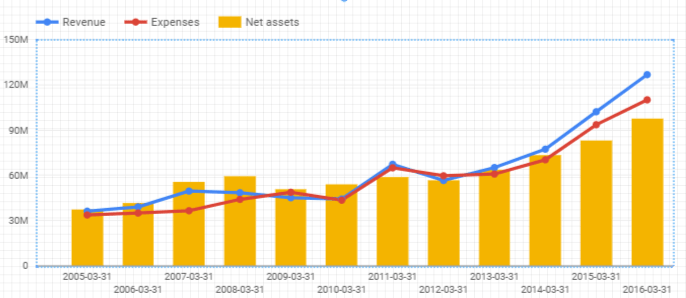
Want to dismiss Paulson? OK. Let’s look at the numbers from the Form 990s on the USSF site and ProPublica.

ussf-money

Here’s the funny thing: If I could extend this chart on each side, you’d see an even more dramatic increase. I didn’t include the numbers from the years four years before this because USSF changed its fiscal year from Aug. 31 to March 31, so it’s not a valid comparison. The annual revenue and expenses weren’t sharply different, but the net assets were far lower. The 2001 statement shows net assets of $14,054,712, and it lists the previous year’s assets at $6,683,668.

And though the March 31, 2017 numbers aren’t available yet, we’ve seen information that net assets will be up in the $140-$150 million realm, thanks in large part to the Copa America Centenario.

So it’s no exaggeration to say that, in 18 years, USSF has gone from a seven-figure organization to a nine-figure organization.

And they’re not just accumulating that money. (They did in the early 2000s, which I gather from Board minutes was a business strategy at the time to make sure they didn’t run into serious problems.) I included “expenses” here for a reason. The Federation spends a lot more than it used to.

(Note: Eric Wynalda claims to have $1 billion sitting on the table for the Open Cup, then says we’re leaving $120-$150 million out there through various mismanagements. I’d love to know details.)

So are we being unfair to the Gulati era and to Soccer United Marketing — and, perhaps, to Kathy Carter? Or Carlos Cordeiro, who also has played a role?

No. Because for better or for worse — and in this case, we’re looking at the “worse” — neither Carter nor Cordeiro is Sunil Gulati.

Gulati’s session probably hurt Carter by contrast. Carter comes off as corporate, speaking in vague business terms. Gulati doesn’t. You may hate what he says at times, but you know what he’s saying, which isn’t always true for Carter.

Then there’s Cordeiro. He didn’t do a one-on-one session, and he has done few interviews at all. He did pretty well in his 15-20 minutes on stage at the forum. Then he stepped off the stage and balked at a recorded interview. He did finally chat with the reporter, but he wouldn’t be recorded unless he had questions in advance. Compare that with Gulati, who knows facing the firing line is part of the job.

So does it matter to this election that Gulati knows his stuff and is a strong voice with more openness to change than one might think?

No. It doesn’t. No matter who wins, Gulati will be on the Board as a non-voting immediate past president. No one wants to dump him off the World Cup bid committee. Even supposed nemesis Eric Wynalda led a round of applause for the good he has done, and Wynalda knows the next president will need to work with Gulati in many capacities.

But they can all do it. Gulati can work with his supposed enemies. So he doesn’t need Kathy Carter to take his place. Nor will it matter if Cordeiro is elected, no matter the state of their relationship.

So the takeaway here is that the next president, no matter how ideologically or personally tied to Gulati, has a steep learning curve.

Now that might be a good thing. For 12 years, Gulati has run U.S. Soccer with little opposition — none in the elections, perhaps not enough on the Board or within the membership. The next president, who probably won’t have a majority on the first ballot, will be forced to build bridges that Gulati had no incentive to maintain.

And that’s a good thing. So is the fact that Gulati isn’t completely going away. Maybe we’ll get that one-vs.-eight debate one of these days.


us soccer

Futsal: The next beach volleyball?

“What about Paralympic, futsal and beach soccer?”

That’s a popular question in the presidential race, where every topic is being thrown onto the table. And we get passionate but vague answers — mostly because no one really knows what to do differently other than “be responsive,” “fill vacancies more quickly” and “make sure we’re paying athletes’ expenses.”

It’s especially difficult with Paralympic soccer. The 7-a-side competition for those who’ve had a stroke, traumatic brain injury or cerebral palsy has been dropped from the Paralympic program. The USA has never qualified for the 5-a-side competition for blind athletes.

Beach soccer actually overlaps with futsal a bit, drawing some players from professional indoor soccer. (Fortunately, FIFA doesn’t seem to mind that the USA’s indoor league, the MASL, isn’t sanctioned through U.S. Soccer.)

So what about futsal?

Everyone speaks passionately about it — as a training tool. It’s something kids should be playing.

But how does that translate to a national team? And what’s the ceiling for a pro futsal league in this country? (Major League Futsal exists under the auspices of the non-FIFA Asociacion Mundial de Futsal and North American Futsal Federation; the Professional Futsal League has the backing of Mark Cuban and others from the NBA but hasn’t done anything since 2016.)

When I was in Barcelona recently, the only live soccer I could watch on the cable package in our apartment was Barcelona academy soccer and some of the UEFA Futsal Cup. The latter had some nice skill and a handful of fans.

Clearly, you’re not going to convince Messi and anyone else worth $100 million-plus in the outdoor game to come in and play pro futsal. At least not year-round.

So is futsal — not for kids, but for pros — condemned to be a game for people who don’t make it outdoors? Or could it possibly be like beach volleyball, a sport that attracts as much attention and talent as the outdoor game?


podcast, pro soccer, us soccer, youth soccer

RSD25: Phillypalooza election preview, the disappointing USSF coaching education overhaul, and being nice

Point 1: Why this weekend will be huge for the U.S. Soccer presidential election. (2:02)

Included in that: Why I’m skeptical of current election projections (including a NewsRadio reference), what the Number 1 issue in this election should be (8:10), a few surprising things on Paralympic soccer (8:30), a question of what we’re really saying about futsal — the next beach volleyball? (9:30), SUM and pro/rel (11:30), and finally back to the Number 1 issue and how it overlaps with other major issues (18:00).

Point 2: The new U.S. Soccer coaching curriculum, grassroots level (22:15)

Included in that: Welcome to Disney (25:55), introducing tactics at 4v4? (26:20), the painful irony of the chosen video clip (27:15), U6 parent coaches developing their own coaching philosophy? (28:00), the nice tone (32:25).

Point 3: Soccer discourse, Twitter (33:40)

Include in that: What we all have to offer (34:15), why dealing with crap for 15 years makes these discussions difficult (35:45), different types of people (36:45), the ideal outcome of the Kathy Carter candidacy (39:30).

Next up for Ranting Soccer Dad (40:00). Basically, I’ll get back to interviews at some point and quit soloing like this. (And yes, I finally bring it full circle.)

us soccer

Man with a plan: A quick review of Martino’s Progress Plan

How specific is too specific?

U.S. Soccer presidential candidate Kyle Martino convened a group of people to come up with some ideas for moving the Federation forward, and he has summarized all of these ideas in a lengthy “Progress Plan.” Doing so is a risk, as he acknowledges:

“I also realize that many of these proposals are significantly more detailed than any yet offered by other candidates and that, in getting more specific, I’m opening myself to criticism. That’s the point. Anyone who can’t handle such an open dialogue isn’t, in my view, qualified for the job.”

And indeed — we can’t view anyone’s proposals as a list of campaign promises. The next USSF president isn’t going to have that kind of power. Such proposals only provide insight into a candidate’s priorities and state of mind. Some of our complaints about candidates being vague are overstated — after 12 years of Sunil Gulati, there’s a significant movement to have U.S. Soccer be a little less top-down. A lot, actually.

So, bearing all that in mind, here’s a quick evaluation of the Martino plan:

TRANSPARENCY

Another audit! Martino mentions the fed’s 2016 McKinsey study and points out that he hasn’t been released to the general membership. But he calls for another independent audit. Maybe the fed should release the McKinsey study and have a general discussion of it before investing more time and money in another study?

Pay the president. He’s not the only candidate (or non-candidate) to say so. The idea is to attract candidates who don’t need a day job (or a supportive spouse) and to increase accountability.

New hires. Technical Director, Grassroot Director, Chief Diversity Officer. Not sure why these are under “transparency.” The diversity officer is an idea he has in common with other candidates (which, as with many common ideas among the candidates, is far from a bad thing). He also wants to revive the Diversity Task Force that quietly disappeared in the last year or two.

Domestic Resolution Committee (DRC). Not sure how this would differ from the existing Appeals Committee, though he specifically mentions solidarity/training compensation fees here. And the DRC will come up later.

Much more financial disclosure. Several specific ideas, including an anti-gift policy and records continually posted online. Not sure the latter is practical, and it seems redundant with other items that would disclosed, such as all salaries over $75,000, which would involve significantly more people than the 990 form requires. And if I’m reading this correctly, all Board members would post their tax returns?

EQUALITY

50/50 Board/executive staff by 2022. Not sure this is really possible — on the executive side, it would entail firing a bunch of people, and the Board membership is determined mostly be various Councils (Youth, Adult, Pro, Athletes). But this will definitely ramp up the pressure on those constituents to quit sending two men to the Board, over and over and over.

Renegotiate MNT/WNT CBAs. Nothing too specific here, in part because he acknowledges (which some candidates do not) that each negotiation has “unique aspects.” (To give two examples — the men play many more qualifiers while the women play more friendlies, and the women get salaries while the men do not.) The principles are fairness and equality.

Latino outreach. Marketing firm, 10% of budget earmarked toward Latino initiatives such as fields and adult league insurance (how would we determine which fields and leagues are “Latino” enough?), social media. The latter exists but could surely be beefed up.

Equal access to facilities. I’m bringing this one up because of the odd combination of overseers — the DRC (see above) and three independent directors from minority organizations. What is the DRC’s role?

Devote 25% of the USSF budget to bottom of the pyramid — low-income areas and recreation. Like the Latino earmarking proposal, I’m not sure how to distinguish what helps low-income areas and what doesn’t. He touts the “Over/Under” initiative to add futsal goals to basketball courts, but is that something the Federation should be funding directly instead of working with the Foundation and sponsors to do it? Would the goals have to be in underserved areas only?

2026 Fund. Take $1 from every USSF, MLS, USL, NWSL and NASL ticket sold to offset the cost of play in underprivileged communities. That seems quite harsh on the NWSL in particular, but I don’t think people would object to U.S. national team ticket sales being used for this.

PROGRESS

Join the Youth Technical Group meetings. These are the meetings between U.S. Youth Soccer, U.S. Club Soccer, AYSO and SAY — a coalition that sprang up in response to the Federation’s heavy-handed youth mandates. The Progress Plan would require the Technical Director to attend every meeting (by phone if needed), and at least once a year, the president and CEO must be there as well. This is a promising idea. I know this group exists, but I have no idea if anyone from the Federation is actually listening.

Hire a Recreation Director within U.S. Soccer. I hear proposals like this from time to time, but I’m not sure what it entails. I did hear someone was working on a coaching curriculum for parent coaches who aren’t going into the pro-coaching pipeline, but I haven’t seen it come to pass.

Eliminate birth chart at U13 Recreation and below. This surely refers to the birth-year age group chart, which a lot of rec leagues are frankly ignoring, anyway. With good reason.

Youth leagues? I don’t quite get where he’s going here. He says he wants to reduce travel costs and have an agreed-upon hierarchy (democratically enforced by the DRC), but his chart includes the same muddled mix of elite leagues we already have.

Support the USASA’s three-tier adult league proposal. The DRC, again, would step in to determine this structure.

Create youth/adult leagues. Not a bad idea to make things a bit more holistic.

NWSL. A couple of points here are unclear, but the gist seems to be that new MLS clubs should either have an NWSL team or participate in a profit-sharing plan that benefits the women’s league.

Professional Paralympics. He says eight of the 10 top nations pay their players. I honestly had no idea. He also wants a national championship to build a “pro pathway.”

Futsal. Get everyone to the table to clear up market confusion. This is a terrific idea. I honestly can’t keep track of the different organizations.

Expand beach soccer calendar. More games.

Promotion/relegation by 2030 (full six-tier system by 2038). He has an extensive timeline that includes steps such as dismantling the single-entity MLS structure by 2024. It’ll be a bit too slow for some tastes, but the steps involved are logical. Except this one — any club created after 2024 will be “non-league” and can’t be promoted into the pro pyramid, which seems odd. What happens when climate change makes North Dakota the country’s top relocation destination? No pro soccer in Fargo?

Succession plan for CEO Dan Flynn. Hard to argue with that.

Open bidding. For all branding/licensing deals and partnerships. This surely seems aimed at SUM.

Build two national “home stadiums.” I can’t stand this idea, frankly. It’s a big country. Spread out the games.

Discuss moving USSF HQ to New York. The rationale is that it’s easier to make business deals there. Perhaps, though I could see the membership balking. Maybe compromise by having a satellite office?

So on the whole — some of these ideas aren’t fully developed, and some may be non-starters. But it’s a strong effort at moving the conversation into specifics beyond the vague platitudes everyone says — reduce costs, focus on coaching education, etc. That’s what this election should be.

Just ditch the stadium idea.


us soccer, women's soccer, youth soccer

Yes, it’s possible to understand the U.S. Soccer WoSo and YoSo numbers — maybe

This tweet, with a screenshot from the 2018 U.S. Soccer Annual General Meeting book, created some consternation:

https://twitter.com/duresport/status/951622431663448064

Did I say consternation? I meant confusion. Perhaps they shouldn’t make footnotes bigger than the headlines. (As an aside: Due to the collapse of the newspaper business model, hundreds or maybe thousands of people who worked in editing/page design have been displaced in the past decade and change. So, businesses and nonprofits? Hire them. Communication is good.)

So once you realize that the footnote is actually a footnote, it starts to become a little clearer. Chart 2 (which is the first chart in that screen capture) gives the numbers from all games and compares them in the last column to the same numbers from 2016. Chart 3 (the second chart) omits the numbers for the games outside USSF’s commercialization capabilities and compares those games to the same numbers from 2016.

But to put it in full context, you have to go back to the previous year’s book …

… which doesn’t have the same sort of figures. Oops.

We do have this …

ratings 2016

And that tells us pretty much the same thing — 2016 was an outlier for both the MNT and WNT. The men had the Copa America Centenario. The women had the Olympics.

We can easily explain the women’s ratings here. Chart 2 is comparing the WNT games of 2017 to the WNT games of 2016. The latter would include the Olympics, so of course, the 2016 ratings are going to be considerably higher. Chart 3 would omit the Olympics from that comparison because USSF doesn’t have those rights. In 2017, USSF had the commercial rights to every WNT game, but in 2016, they did not.

So I have a couple of remaining questions:

  1. What’s a “year”? The WNT played 16 games in 2017 — 13 in the USA, one in Canada, two in Europe. Were four not televised? Off the top of my head, I can’t recall that. If it’s a fiscal year, then it’s a partial year, isn’t it?
  2. What’s included in the list of games USSF can’t commercialize? The Olympics, certainly, but that only affects the WNT. How were 10 of 18 MNT games not included? They played 19 games in 2017 (see ratings at World Soccer Talk, though those are English-only) — eight World Cup qualifiers (four home, four away), six Gold Cup, five friendlies. The away qualifiers are tricky, which is why the biggest debacle in U.S. Soccer history was only seen by those of us with beINSports. Does USSF get nothing from Gold Cup even with SUM in the mix?

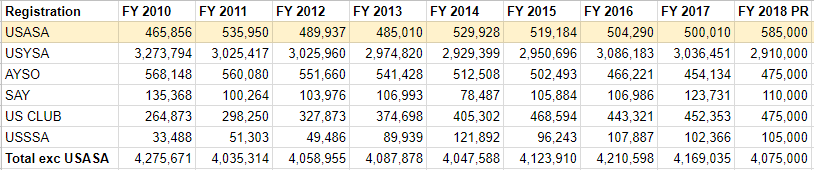
On another note, I’ve compiled registration-fee numbers from every organization from the last eight years. And they tell us … very little?

regstat

Quick reminder: USSF charges adults $2 each, so the USASA registration numbers are basically the USASA fees divided by two. (Unless there are some waivers somewhere.) The youth fee is $1 per player.

But we can’t quite equate that last line to the number of youth players registered. Here’s why:

  • U.S. Club, USSSA and maybe AYSO numbers might include some adults.
  • Some youth players may be registered in more than one organization (a point Eric Wynalda is making).

Yet this is an apples-to-apples comparison from year to year, for the most part. And … I can’t really detect a trend. I see fluctuations that could be accounting flukes as much as anything else. The numbers are basically flat.

And yet we keep hearing horror stories (and I keep repeating them — in several presentations and maybe even a book over the past few years) of participation dropping. Take a look at Project Play, which says the percentage of children aged 6 to 12 who participate in outdoor soccer plummeted from 10.9% in 2010 to 7.7% in 2016.

What’s going on here?

  1. Consider the methodology. The Project Play numbers come from an online survey of 24,134 “individuals and households.” Could our changing online habits (less computer, more phone) be skewing the numbers? (I’d turn it over to a data scientist, but after the 2016 election, I’m starting to view “data” as applied to polling with a higher margin of error than the data scientists would care to admit.)
  2. Could it be that there are indeed fewer people playing soccer but that USSF’s organizations are managing to register a higher percentage of those people? Isn’t that the opposite of what we’re hearing from the presidential candidates — that tons of kids (and adults) are playing in unaffiliated leagues?

Hard to say. But the evidence certainly doesn’t point to a sport on the rise. (Please don’t respond by saying the numbers are increasing in high schools. That’s generally a function of having more high schools. The number of soccer players at a high school of significant size equals the number of players they can take, not the number who are interested. My local high school could probably field 10 teams if they had the field space. They have four — boys and girls varsity and JV. A lot of travel soccer players won’t make the cut for either one.)

So whether this is an outright crisis or just a little hiccup, it’s worth addressing.

If you can derive any other conclusions or insights from this, please share.

us soccer

USSF projecting eight-figure loss for next fiscal year and other AGM notes …

The “book” is out. Let’s take a look:

DISCLAIMER: This is my very quick look at highlights that I think will interest readers. Please do not assume a report didn’t address your pet topic if I don’t mention it here. Eventually, the whole damn book will be online, and you can read it for yourself. I’m just giving a glimpse here. I especially wanted to see the budget — we still don’t have FY 2017 statements online.

Agenda: 

  • No bylaw proposals this year
  • Policies to ratify include more restrictions on MLS reserves participating in the Open Cup and some numbering changes. That should be a quick voice vote.
  • The presidential election is the last item on the list before the traditional “Good of the Game” (open comment) segment. That’s probably for the best. Hard to imagine doing much business after that.

President’s Report

  • Second graf is hand-wringing.

agm-1

  • Then more positive fare about the World Cup bid and enhanced programs, including $1.2 million in subsidizing B, A, Pro and Academy Director licenses, plus this note on scholarships and development.

agm-2

  • Roundup of pro leagues includes NWSL and, more surprisingly, the NASL final. That is the only mention of the NASL in the AGM book.

Vice President’s Report (Carlos Cordeiro, presidential candidate – short report)

  • Budget extends those enhanced programs, including the Innovate to Grow Fun.
  • Governance improvement, including the Risk Management, Audit and Compliance (RAC) Committee

CEO/Secretary General’s report (Dan Flynn, the appointed executive)

  • Federation employees up from 147 full-timers to 172
  • 43% of new hires are women; 26% of those women are from underrepresented minority
  • Sponsorships, sponsorships, sponsorships
  • Full paragraph on NWSL, hailing Amanda Duffy as Managing Director, sponsors, Lifetime deal, total attendance increase
  • New High Performance Department headed by former EPL man James Bunch
  • National Development Center in Kansas City (also mentioned in other reports)
  • Hall of Fame is back!

Committee Reports (I’m not going in much detail here) 

  • Athletes’ Council: New site
  • Budget and Finance Committee (Cordeiro, John Collins, Chris Ahrens, Steve Malik, Val Ackerman):
    • FY 18 budget (year ends in March 2018): Projected for net operating deficit of $2.3 million and net “non-operating” surplus of $27 million, mostly from 2016 Copa Centenario and donor funds, for overall surplus of $24.6 million.
    • FY 19 budget: Net operating deficit of $13.9 million, net non-operating surplus $714,000, overall deficit of $13.2 million.
    • Innovate to Grow Fund gets $1.5 million.
  • Open Cup Committee (former VP Mike Edwards, MLS’ Todd Durbin, NASL’s Rishi Sehgal, USL’s Jake Edwards, USASA’s John Motta, athlete rep John O’Brien): Modern-era record 99 teams, 78 streamed live and accessible through ussoccer.com.
  • Nominating and Governance Committee (chair Don Garber): Mostly worked on 2018 election and search for new independent directors, but it’s also charged with monitoring Board conflicts of interest in association with Risk, Audit, Compliance (RAC) committee.
  • RAC committee (All three independent directors — Donna Shalala chair, Val Ackerman, Lisa Carnoy — plus athlete rep Chris Ahrens and youth rep Jesse Harrell): Will focus in 2018 on an internal risk assessment and an RFP (Request For Proposal) for the Federation’s financial audit services.
  • Sports Medicine Committee: A busy group of doctors (plus John O’Brien) working on the Recognize to Recover (R2R) program and many other medical initiatives.

Budget details

agm-3

  • Preparing for down year: Men’s national team off because of World Cup qualification failure, but also, women’s national team off slightly after Olympics.
  • That said, in 2017, WNT average attendance was up 10% (average 17,731), MNT average attendance up 14% (32,545, though only 21,596 for “U.S. Soccer-controlled matches”)
  • Strategic technical decisions on where we play our World Cup Qualifying matches on the Men’s side limits our U.S. Soccer controlled match attendance.
  • NWSL investment — NOT including USWNT salaries, which are in separate line item — slight decrease from $992,765 to $868,300. My guess would be that this reflects sponsors (and Lifetime) putting more money into the league.
    • Under National Team expenses: NWSL is projected at $868,300 in FY 2019, down from FY 2018 and WAY down from FY 2017 ($2,390,703). I need to investigate this. Is it salaries only? (Hard to tell, given the Open Cup line item under National Team expenses — what does the Cup have to do with any National Team?) Further investigation required.
  • Coaching education: FY 2019 projected expenses $7.63 million, revenue $3.43 million, deficit $4.2 million. That’s more than double the projected loss (investment) from FY 2018.
  • Player development (youth national teams): In FY 2016, the men’s budget was about 2.5 times the women’s ($9.380 million to $3.662 million). By FY 2018, this had swung to where the women got more ($5.064 million to $4.841 million — both far over the original budget). In FY 2019, men get slightly more ($5.545 million to $5 million).

Some figures of note:

agm-4

agm-5

agm-6

The budget also includes a breakdown of registration fees, which gives us a snapshot of how many players are registered. Youth fees are $1/player; adult fees are $2/player; pro fees are higher. As Eric Wynalda has been pointed out, youth may sometimes be registered in multiple organizations (USYSA and U.S. Club). Also, U.S. Club might include some adult registrations — I’d have to ask about that.

In any case, we’re seeing some red numbers and declines here, so if you’ve been scoffing at the Project Play numbers, well …

agm-7

So that’s a very quick read. I’ll do some follow-up reporting — let me know if there’s something that jumps out to you as well. (I know you will!)