us soccer

What I learned reading tons of USSF minutes and transcripts, Part 1 (1998-2009) …

For all the fuss, sometimes justified, over U.S. Soccer Federation transparency, the fed’s site has a treasure trove of information online. That includes:

(Quick note: If you want to skip ahead to 2010, see Part 2)

Not on the site (I think) is an external 2004 report on structure, governance and ethics by the Consensus Management Group. In the wake of this report, USSF followed the lead of other sports organizations and slashed the size of its board from an awkward 40 people to the current size of 15 voting members and two non-voting (the CEO/Secretary General and the immediate past president).

I’ve read, at one time or another, pretty much all of this information. That doesn’t mean I understood it. That doesn’t mean the records are complete — the Board seems to go into executive session over piddly details, while other boards with which I’ve dealt tend to do so only for personnel matters. But I’ve read it.

Quick side note: At one time, I started to compare the USSF structure to similar organizations, both international football feds and other sports federations in the USA. It’s difficult to get apples-to-apples information. The most similar U.S. organization is probably USA Basketball — it’s a substantial participatory sport with a major pro league. USA Basketball is descended from an amateur-only organization that added the NBA when pro players were cleared to play in international competition, and the NBA now appoints three of the 11 voting board members. In England, the Football Association’s board has representatives from the Premier League and Football League, and very few of the board members’ bios mention any significant playing experience. (Also, the CEO came to the FA from United Biscuits, which is so wonderfully English it makes me want to watch some Monty Python videos.)

The other big-picture item: The organization is turning over much, much more money than it used to.

2006 2016
Sponsorship $14,720,385 $49,498,623
Program revenue $28,365,806 $122,655,465
Gross receipts $39,102,876 $126,747,525
Total expenses $35,047,107 $110,011,376

I certainly have some questions left. Many. I hope to get some of them answered in 2018, preferably before the election.

So with that in mind, here’s a full history (abridged) as constructed from the minutes, transcripts and the occasional other document …

1998

Close elections (reported by Soccer America):

  • President: Dr. Bob Contiguglia 57.6%, Larry Monaco 42.4%
  • Vice president: John Motta 50.8% (372 votes), Sunil Gulati 49.2% (361)

Gulati was MLS deputy commissioner at the time. He was pushed out in early 1999 and became managing director of Kraft Soccer (owners of the New England Revolution and briefly the San Jose Earthquakes) later that year.

Also, new bylaws went into effect in September.

2000

A bylaw change put the VP election in Summer Olympic years and left the presidential election in Winter Olympic years. That set the stage for a Motta-Gulati rematch, and Gulati won. Motta would return to the Board in 2013 via the Adult Council; he’s the current president of U.S. Adult Soccer and is a must-follow on Twitter.

Secretary General/CEO Hank Steinbrecher retires and is replaced by Dan Flynn, who still has the job.

The fed begins a five-year sequence of business plans.

2001

Flynn’s first order of business is to freeze 34 open positions and cut travel to turn a projected $2.2 million deficit to a $300,000 surplus.

Other issues at the AGM sound familiar to a 2017 audience: 75% of players drop out by the time they’re 13, grassroots coaches and players will be a priority.

2002 

President: Dr. Bob re-elected to second term without opposition.

2003

All hell breaks loose.

The AGM has 38 proposed bylaw changes. Several people rise from the floor to complain that the pro leagues and athletes are voting as a bloc and outweighing the votes of the state associations, whose combined votes are just short of a majority. Alabama delegate Dan Mikos, also a member of the important Credentials Committee, compares the situation to the American Revolution and predicts “anarchy and revolution” down the road if changes aren’t made.

New York West Youth Soccer had a pointed opinion of the proceedings on its site a year ago, but alas, the link is dead. Some highlights from my notes:

  • The state youth associations, representing roughly 80% of the membership, have only 20% of the vote. (I think it’s closer to 25% today, but it’s hard to put a precise percentage on this group because some are also represented (somewhat) by other organizations such as U.S. Club Soccer.)
  • Among the bylaws that didn’t pass: an audit committee, a new appeals process, a requirement to give 30 days notice of any new policy being put in place.
  • Many state youth association delegates boycotted the President’s Dinner, and U.S. Youth Soccer passed a grievance to go to the U.S. Olympic Committee.

2004

The big governance report mentioned above is commissioned, researched and released. Among the observations:

  • A lot is going well: Finances, staff, etc. Especially finances, with the Fed moving from a $2.5 million deficit to a $28 million surplus in less than six years.
  • “While politics is always a factor in decision-making bodies, the level of vitriol in
    USSF politics is extreme. The amount of talent and energy consumed in
    internecine strife and finger pointing is destructive. There is little tolerance or
    respect for differing points of view, and few venues for addressing differences
    without rancor. Organizational sectors are increasingly isolated from each other.”

    • The Youth Council barely meets to discuss common issues.
    • The Adult Council is just USASA chatting with itself.
    • Some think MLS shouldn’t vote. (Well, the EPL does in England.) Some think the adults should just shut up. Some think the athletes should just go away, though that would violate federal law.
    • The 40-person Board doesn’t work, in part because people think decisions are just in advance. There’s also an executive committee (not any more) that’s poorly defined.
  • “In 1986, 43.14% of Federation revenue came from dues. By 2000, that percentage went down to 9.05%. Because of the recent dues increase, it is estimated that in 2005, 12% of revenues will come from dues. For some constituents, this dues increase, coupled with a real or perceived decrease in Federation services while it enjoys a 70% fund balance (based on a $40 million budget) is an irritant that migrates into the USSF political arena.”
  • There’s also a suggestion for how to find and nominate candidates for officer positions. That has not been implemented.
  • Bloc voting, bloc voting, bloc voting!

cmg

All that said, no bylaws passed because Larry Monaco (remember him from 1998) says they weren’t disseminated on time. Part of the issue is whether they’ve been distributed in writing as opposed to on a disk. This really happened.

monaco

(Bear in mind, this meeting was in March. Previous years’ meetings were in the summer, so they had a shorter turnaround.)

Also, perhaps in response to the bloc-voting accusation of the past year, Peter Vermes gave an impassioned speech on behalf of the Athletes Council, saying all the athletes wanted to be approachable and they all started out as rec players. He was greeted with applause.

Then Steve Flamhaft (remember that name) rose to castigate Monaco for being such a stickler for the rules.

VP: Gulati re-elected to second term without opposition.

2005

A less eventful year, with some governance tweaking in the wake of all that happened in 2003-04:

  • Dr. Bob mentions that, in addition to the governance report USSF commissioned, they’re expecting a report from the U.S. Olympic Committee recommending a smaller board, greater transparency and a few ethics guidelines. Task forces are assigned to working on the governance of the Board and the Youth Council.
  • Failed: A bylaw change (not sure of number) requiring a Soccer Summit to be held every four years.
  • Failed: A term limits bylaw change limiting officers to two terms. Also something having to do with Bylaw 401.
  • Passed: Something having to do with grievances (I really wish the full “book” from these AGMs was available online). Also changes to Bylaws 212 and 213 and some sort of change on referees.

What’s the president’s role? Flamhaft (whose father, Jack, was president from 1959 to 1961) rises to oppose a change to Bylaws 402 (Responsibilities of Officers) and 501 (Appointment of Secretary General) that he says would “dilute and emasculate” the office of the president. Then a curious argument — former VP Walter Giesler died during an AGM (in Flamhaft’s words; a couple of online sources say he collapsed while the 1950 MNT was being inducted into the Hall of Fame, which may well have taken place concurrently in 1976) and Flamhaft’s father was once carried on a stretcher from a FIFA meeting in Zurich, so we need to remember their sacrifices.

Dr. Bob passes the chair to VP Gulati so he can respond, saying it’s simply a reality of the modern world. Other soccer and other sports organizations are relying on CEOs who aren’t subject to election.

Also this from Dr. Bob: “the authority of the organization is not the president. The authority of the organization is the Board of Directors. And so we’re trying to legalize that and make it the way everyone else is doing it in the world.”

It passed.

Most Board policies were quietly affirmed. The exception was a policy on referee assignments and unaffiliated games (such as high school games) that sparked a discussion that went on for pages and pages. Something was finally passed.

Also, the AGM took place during a USWNT Algarve Cup game vs. Denmark, so they periodically got updates. Kristine Lilly had a monster game, as usual, and the WNT advanced to the final, where they would beat Germany 1-0 on a Christie Welsh goal.

Later in the year, the Board:

  • Approved a grant (later matched by the U.S. Soccer Foundation) for the Hall of Fame.
  • Approved Toronto for membership in MLS. (Cross-border applications have to be approved by the Board; in other years, similar applications are heard in various lower-division men’s and women’s leagues.)

2006 

The Sunil Gulati era begins. He’s elected without opposition.

Dr. Bob does not preside over the election itself.
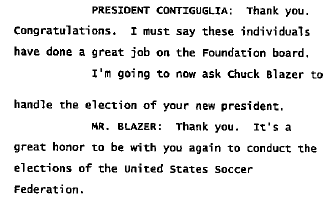
blazer

(Much later in the meeting, Blazer announces that Mike Edwards will be the next vice president, replacing Gulati. Standing ovation.)

Don Garber nominates Gulati. No one opposes him. Then Gulati thanks scores of people, including Sal Rapaglia (12 years before he stepped into a major controversy), Kevin Payne, Soccer America‘s Paul Gardner (!?) and former U.S. coach Bora Milutinovic.

Gulati also talks about how to get better, alluding to what Germany is doing (which would become “Das Reboot”).

He closes with a joke:
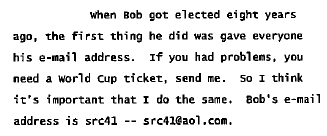
bob

And another big change: The Board is trimmed from 40 people to 15. Much self-congratulation ensues — as Gulati points out, people are basically voting to get themselves less power, and the U.S. Olympic Committee only did it “because Sen. McCain was calling fairly regularly.”

They managed to do all that even after lengthy discussions on whether a particular amendment would promote “interplay” between youth leagues and whether USSF should be allowed to file an amicus brief in an arbitration. They even had a few “Wait, what are we voting on?” moments.

Also, Bob Abbott from Louisiana thanks the rest of the Federation for its support after Katrina.

The streamlined Board doesn’t have too much to deal with, though Bob Bradley is named interim MNT coach, and U.S. Futsal runs into trouble and is eventually removed from membership. (A U.S. Futsal group is an affiliate today; I don’t know how much restructuring they did before getting back into the Fed.)

2007

The first independent director — Carlos Cordeiro — is recruited by the Board and officially elected at the AGM.

The other interesting item at the AGM — in the “Good of the Game” segment (just speeches, no votes), there’s a discussion about compensating the president so they can attract a bigger pool of candidates. Sounds familiar, doesn’t it?

The Board is busy with the launch of the Development Academy and the delayed launch of WPS. A motion to establish a USSF nominating committee fails. Meanwhile, Gulati asks AYSO’s Burton Haimes to start a task force on pro league standards.

(Quick side note: Paul Caligiuri was on the Board this year.)

2008 

Unopposed elections: Mike Edwards (first full term as VP), independent director Fabian Nunez.

The Board votes, at Gulati’s urging, to recommend rejection of a proposed bylaw amendment to pay the president.

WPS gets provisional membership.

CalSouth Adult Soccer goes under criminal investigation. CalSouth Youth Soccer applies to take over adult soccer in the state, and the Board approves a task force to investigate. CalSouth is indeed a joint association today.

Other membership issues: MISL dissolves, Missouri Youth Soccer faces a lawsuit, XSL and NISL get provisional membership. Also: WPS requires some waivers to the new pro league standards.

And promotion/relegation is mentioned in the Board minutes! In the president’s report: “There were also discussions at a recent FIFA Congress regarding promotion/relegation and limiting the number of foreign players starting on domestic professional teams.”

2009

Unopposed election: New independent director Donna Shalala, at least filling the third slot, and re-elections for Nunez and Cordeiro.

More foreshadowing: The Pro Council had been unable to agree on how to split votes due to a disagreement between MLS and USL. The final word: 62.5% MLS, 25% WPS, 12.5% USL.

The AGM is pretty quiet, though there’s some conversation about youth soccer mandates, including the age-old question: “So are you just going to stop kids from playing un-mandated soccer?”

The budget had a surplus of $218,000. International games helped pull it out of a projected deficit.

More conflicts: Dueling associations in Wisconsin (this would go on for a while), U.S. Youth Soccer vs. U.S. Club Soccer.

The Pro League Task Force appears. MLS is sanctioned. WPS and the new MISL are approved with some waivers.

We’ll pick up from there in Part 2.

pro soccer

A few thoughts on Football Manager

After listening to Jason Davis’ interview with one of the developers of Football Manager, I figured it was time to give the full-fledged game a chance.

I did the demo version for a while, then used a gift card and a sale price to snag the full version for a low price.

“Addictive” isn’t the right word. Maybe “immersive.” It’s like a Vegas casino — it’s easy to lose track of time. I’m certainly playing it more now than I’ll be able to play it when I get back in my work routine Jan. 2.

A few things I’d like to see improved:

I hated losing my progress when I switched from the demo to the full version. Perhaps there was a way to preserve my progress, but I didn’t see it. And that was a pity. I was really looking forward to clearing some deadwood out of Tranmere Rovers and then buying the 1-2 players that could get us out of the Vanarama (Bananarama wasn’t available?) relegation zone.

Need more warnings of time passing. With the full version, I’ve started two careers — one with Real Salt Lake so I can try to figure out GAM and TAM, another with Cork City in Ireland. With the latter, I knew I had some work to do on deadline day — I have too many defenders for the 3-5-2 I want to run, and I was trying to shift some payroll with a couple of loans. Apparently, one club was willing to finalize terms, but I made the mistake of hitting “Continue” and watching the time skip 15 hours into the future. “Deadline passed” and “Deals canceled” popped into my inbox. Now I’m stuck paying full contracts for these guys.

Need more communication. I can’t seem to get across to my coaching staff that we’re running a 3-5-2 here. Quit telling me we should switch to a 4-1-4-1 or something else. There’s also no back-and-forth — they can recommend things, but we can’t discuss them the same way I can with a player or the board.

Let me search internationally. Yes, I know, scouting internationally costs money. But can’t I just find one specific person and make an offer? How do you know Clint Dempsey doesn’t want to play his final season in Cork?

Little hiccups in timing and communication. An assistant coach recommended that I name a promising forward as the U19 captain. So I did. Then I got another recommendation — that same player should be promoted to the senior squad. So I did. Now one of his teammates is mad at me for “stripping the captaincy” from that player. Also — multiple times, I’ve flipped back and forth between FM and my browser, returning to the game to find that, say, I missed the pregame talk. What?

You can *see* things that you can’t fix. I just saw Dundalk play a long ball up and over my central defender. The left back kept him onside. But I can’t specifically point that out to him.

You can’t *ask* things. The U19 coach took my prize defensive prospect and started him at striker, where he did well. I wish I could ask if he wanted to be re-trained there.

Can’t I sync to mobile? I have the mobile version of this, and it has maybe one-third of the functionality. That’s fine. But sometimes, I’d like to just check in and get through a couple of days. I don’t need to do a full-fledged squad analysis every day. It’d be great to load a game on my phone, make a bit of progress, and then return to fix up the squad on my laptop.

And a few awesome things:

Details, details. I love the fact that we can change almost anything. I got a note from the groundskeeper asking if I wanted to keep our home field at a reasonable 114×80 or switch it to something more amusing, like 95×90. Didn’t even think that was legal.

Customizable views. If I want to compare the fitness levels, form, age, potential level and something random like “key passes,” I can create a table to do that.

Tinker with my lineup all day. Seriously. You could lose hours just picking a lineup for one match. Note to self: Start saving them, or 2018 will not be productive.

tactics


soccer, sports culture

On Twitter, advocacy, hostility and objectivity

My Dad was an intellectually rigorous man. He majored in philosophy, racing through college so he could lead a platoon in Korea, then returned from the war to get his doctorate in the emerging field of biochemistry. He remained in the Marine Reserves, rising to the rank of colonel, and was a stern but beloved faculty member at the University of Georgia for more than 40 years.

At one family holiday gathering, he demanded to know everyone’s views on abortion. The answers ranged from the biological (we had one doctor in the room) to the theological (one Episcopal priest) to the anecdotal. For the most part, he was impressed.

So what was his position? “Oh, I still don’t know,” he said.

Dad was certainly opinionated about some things. In other cases (abortion, Israel, etc.), he saw a difficult balance of legitimate views. The common thread was the process.

The point of the story: I was raised to believe in the Socratic method of asking questions, sometimes taking it to the extreme. Journalism was therefore a logical (but frustrating) career choice.

It’s also a misunderstood career, especially these days.

Granted, objective journalism isn’t really in vogue these days. In sports, more journalists are embracing homerism. In journalism at large, Jay Rosen has raised pointed questions about the legitimacy of the “view from nowhere,” which is unrealistic. In my experience, blind adherence to airing “both sides” is ripe for abuse. Sometimes, one “side” is telling the truth and the other is lying, and it’s a journalist’s job to say so.

In my own work, I’ve certainly felt emboldened to be a little more opinionated in the last seven years or so. One reason: I think we’re in danger of losing the war on bullshit, so we need to be a bit more aggressive in challenging the liars. Another reason: I left USA TODAY, where the management of the time wanted to rock the boat as little as possible, and I found freelance clients (bless you, The Guardian and FourFourTwo) who offered a bit more freedom. And getting older gives everyone a bit more freedom to speak up.

But at heart, I’m still someone who likes to get to the truth. That sometimes means challenging people with whom I’d usually agree. I questioned the women’s soccer national team in their labor dispute over a few misrepresentations and lack of clarity — their lawyer refused to say anything beyond “equal pay for equal play” in comparison with the men’s team, even though the men don’t draw salaries and play different competitions.

A lot of people don’t get that. Anyone who asks questions must be the enemy. Scorn them. Mock them. Attack their credibility.

And, of course, some people are just jerks.

My default on Twitter is to engage. I do learn a lot from the discussions, and they help me get my thoughts in order, like an ongoing rough draft.

But I’ve spent too much time in the past year engaging with jerks. Or people who just don’t get it.

I’m actually going to do the opposite. I’m going to declare a Christmas amnesty and unblock a lot of people. Not all. I blocked an “Infowars” guy, and I’m not going down that road again.

We’ll see how long it lasts. If I had eternal patience, I’d run for a soccer board position.

pro soccer, us soccer

On SUM, Twitter and the media

First off: I’m working on two pieces that raises questions about Soccer United Marketing and the continuing evolution of Major League Soccer. One analytical, one modestly investigative. The latter, basically, is just getting some answers from Kathy Carter about SUM as it currently operates.

SUM is, of course, mentioned in my book Long-Range Goals: The Subtitle I Didn’t Like in the First Place and Dislike Today Because “Success” Can and Should Be Redefined as Time Goes By. It was crucial to MLS’ survival when the whole thing nearly went under in 2002. Don Garber, still relatively new in the job of MLS commissioner, surmised from the history of U.S. pro soccer that it too often competes with itself, and that led to the suggestion to create a marketing company that bundled things together. It worked, and no matter how you slice it, MLS and SUM are valuable properties today that have helped usher in a landscape of pro clubs with academies.

But …

  1. As they say about the stock market, past performance does not guarantee future results.
  2. What was necessary in 2002 could be a hindrance in 2017.

So yes, there are questions to be asked. And if we get through this entire presidential campaign without asking them, we’ve failed.

That said … could people on Twitter be a little more patient, perhaps?

2017 has been a rough year in the media business. More layoffs at ESPN. Fox Sports cast off a great crew of writers so they could “pivot to video,” along with a few other organizations. FourFourTwo laid off most of its U.S. staff. Other organizations have trimmed their freelance budgets, sometimes in addition to layoffs. If you think that’s a function of all of these writers doing something “wrong,” you’re about as ignorant as the people who think newspapers’ print circulation is declining solely because of “liberal bias.” The way in which we get our news has changed and continues to change, and we still haven’t figured out a good way to pay professionals when so many places are cranking out content for free or for pennies.

So when the reporters who still have a travel budget gather for MLS Cup and spend most of the State of the League press conference haranguing Garber about the Columbus-to-Austin shenanigans, is it really necessary to spend the rest of the holiday month yelling at reporters to investigate everything from why Kathy Carter is running for president (a legitimate question that should be asked in more detail in January) to whether MLS strong-armed national team coaches to play more MLS players even though Jozy Altidore, Michael Bradley and Tim Howard have been fixtures on the national team since they were playing in Europe and, if anything, the fact that half the national team is from MLS today is more of a reflection that MLS has convinced these players to come home and how the hell do you expect reporters to get Garber or Sunil Gulati to admit they threatened to kneecap a coach unless they included a player from every MLS franchise and how would that work anyway when MLS has 22 teams and when the hell did Danny Williams become Busquets and Iniesta rolled into one, anyway?

Sorry. Where was I? Right …

I can’t speak for all of the “mainstream media” — especially now that I’ve been informed I’m no longer in it. (Whew! That takes the pressure off.) If you think particular reporters are reticent to challenge MLS and SUM leaders, fine. There are actually some plausible reasons for that — everything from simply getting along on a personal level to being unwilling to upset a source who leaks information. That’s why you should always check out a variety of sources (on anything). And when you notice someone always tends to get certain bits of information “first,” you might ask why that is. (Fortunately, the race to get the latest roster for a meaningless friendly 20 minutes before USSF announces it seems to have dissipated, as we’ve all found better things to do.)

The idea that MLS and SUM are strong-arming journalists, frankly, gets a bit silly. If you think MLS is going to yank credentials away from a Grant Wahl or a Steven Goff (who, incidentally, was way out in front in saying Gulati shouldn’t run for another term), you should really think before you tweet. Even in MMA, where the UFC exerts power on a global scale, Dana White had to backtrack when he kicked out Ariel Helwani. If you run a small blog and no longer have the credentials you once had, maybe someone unjustly kicked you out on a power trip — or, just maybe, you need to take a look at how you were operating.

Yes, a lot of journalists write or have written for MLSSoccer.com. Personally, I wrote a fantasy column for MLSNet back in the early 21st century, then gave it up when I started doing more soccer work as one of my myriad jobs at USA TODAY. You know who else wrote a column for MLSNet back in the day? Eric Wynalda. You think he’s afraid to speak up on MLS and SUM issues?

I mentioned at the outset that I’m working on two things that I hope will shed more light on SUM and MLS. They’re not going to be done before the holidays. That’s life. Some people have one. (Not just me — also the people I would need to interview and the editors who would need to look at and publish my work.)

So keep up the feedback. Let me know some questions you’d like to ask. In some cases, they’re unreasonable and pointless, and don’t be shocked if I let you know. In other cases, they’re interesting things that might not have occurred to me. That’s why I haven’t quit Twitter, and it’s why I block and mute only when people veer into outright harassment.

Have a happy Festivus or whatever you celebrate.

pro soccer, us soccer, youth soccer

Soccer Parenting Summit: We need joy and collaboration … and maybe pro/rel

One of the earliest Ranting Soccer Dad podcast guests was Skye Eddy Bruce, who played overseas back before pro women’s soccer was widespread and has gone on to coach and, most importantly for all of us, formed the Soccer Parenting Association. (If I were branding it, I might have called it “Polite Soccer Mom,” but her name gets to the point pretty well.)

This weekend, she hosted the Soccer Parenting Summit, which included a staggering 21 guests from diverse backgrounds — current and former pro players, coaches, soccer executives and academics.

It’s a lot to take in. I’ve made it through more than half the sessions, and I plan to go back to listen to a couple more topics.

I say “made it through” not because it’s some sort of ordeal to listen to all of this. These are great discussions. It’s just that it’s a lot to digest, like an all-you-can-eat barbecue buffet. You might need to pace yourself.

At some point, I’ll revisit these sessions. But here are a few takeaways I discussed on Wednesday’s pod:

Where’s the JOY?! (16:30) 

Julie Foudy was the first guest at the Summit, and this was her question as a soccer parent. Bruce brought it up again with many of the guests, and one session was devoted to discussing “fun” with a sports scientist:

(Before you write off this Summit as something stuck in a “rec mentality,” bear in mind there’s a session with Gary Kleiban, the coaching guru who frequently laments such a mindset. We’ll get to it. His session was a good conversation-starter, along with many of the other sessions here. And another session that stressed “fun,” “laughter” and “not shutting out players there for social and recreational reasons” was the session with Johan Cruyff’s son-in-law. Read on.)

“Joy” shouldn’t be controversial, but in the echo chamber of Soccer Twitter, it sometimes is. Soccer is supposed to be a deadly serious pathway for kids to get out of poverty and make something of themselves. I find that more than a little condescending. If we want people to get out of poverty, we need to be investing in STEM programs, not soccer. We have hundreds or thousands of wanna-be soccer pros for every current soccer pro. The supply of U.S. tech talent is debated in the immigration context (in other words: Do we really need to be granting tons of visa to fill open programming jobs?), but the bottom line is that your odds of finding a job as a hard-working dedicated programmer or network specialist are just a bit better than finding a job as a soccer pro. A bit. Say, a few thousandfold.

And in any case — if having a booming economy means we have fewer poor kids who see sports as the only way out, that’s a trade I’m more than willing to make. Besides, the way things are going, the much-derided habit of sitting around playing video games will soon be a better pathway to pro “sports” fame and fortune than soccer is.

So economic incentives aren’t enough. You need to make 6-year-olds fall in love with the game.

John O’Sullivan, of the Changing the Game Project, sees no contradiction between loving the sport and chasing excellence in it. “Find me an elite athlete, and I’ll find you someone who loves what they’re doing,” he said.

Play multiple sports (19:20) 

Oh, you don’t want to take my word for it or O’Sullivan’s word for it or any stack of academic papers you can find? How about Jay DeMerit, who believes his rise from obscurity to the Premier League would not have been possible had he not played basketball. He hadn’t played much defense on a soccer field before college, but he found that the ball-hawking he did on the basketball court helped him adjust to the role that put him on the national team and at the highest levels of the game.

DeMerit has been doing some coaching at the elite youth level, and he’s borrowing techniques from improv. Yes, improv. Comedy. Drew Carey’s influence knows no bounds.

(You could also ask Costa Rican Paulo Wanchope, who scored 50 goals in the EPL. Yes, 50.)

On a more basic level, a lot of learned folks believe we’re so obsessed with sports specialization that we’re failing to teach basic athletic movement. “You’re building an athletic foundation in sand, and eventually, it’s going to crumble,” he said.

I know. This is heresy. The philosophy du jour says soccer is all about skill, like golf or music. We’ll repeat the 10,000-hour myth even after David Epstein’s research blew it up, at least as it applies to most sports. We Americans are the only ones who think it’s athletic. Just look at Xavi or Iniesta!

OK, I’ve looked at Xavi and Iniesta. They’re not Usain Bolt or Kevin Durant. But they’re athletes. On the podcast, I tell a story about Messi’s athleticism playing a vital role in a terrific goal. (Counterargument: Freddy Adu had plenty of skill but not a lot of speed and strength.)

Sure, the USA has typically had more athleticism than skill. “Shot putters,” they said of the 1930 World Cup semifinalists. Anson Dorrance built his North Carolina dynasty and the U.S. women’s program on athleticism and determination, though he has since brought in wonderfully skilled players like Crystal Dunn, Tobin Heath and Summit guest Yael Averbuch.

But are we overcorrecting on the skill/athleticism scale? Probably. I’ve seen plenty of signs of this, particularly a terrific NSCAA session on “Kindersoccer” that showed how counterproductive it was to coach a U6 team like they’re teenagers at Barcelona.

Winning vs. development (or Players First vs. Team First) (26:30) 

US Club Soccer’s Kevin Payne, another RSD podcast guest (I’ve piled up the audio players at the bottom of this post), joined the Summit and talked about his organization’s Players First initiative, which will soon be morphing into a program that certifies clubs. Meet the criteria (and work with US Club to do so), and your club can be a “Players First” club. That includes some criteria dealing with safety, something we don’t often talk about but was mentioned a few times at the Summit.

The basic idea is that the focus needs to be on player development, not winning as a team. I get it, but I have some misgivings. The vast majority of players who play youth soccer will not have a professional career. They’re in it for fun and life lessons — chief among them, playing as a team.

“Winning vs. development” is another area in which I wonder if we’re overcorrecting. Sure, we’ve all seen examples of coaches with misplaced priorities — my least favorite was the guy whose U9 team was still pressing the terrified defenders on goal kicks when his team was up by 15-20 goals, and managing playing time should be a bit different for a U12 team that it would be for a pro team. But the lesson we’re trying to teach, whether a player is going to play professionally or go on to something a little less interesting, is working as a team to overcome adversity.

But Payne and Bruce were careful not to say teams shouldn’t be trying to win. Payne says Barcelona’s academy teams are always trying to win. (I did have a chance to see a Barca academy game on TV while I was in the city last month — they certainly seemed happy to take the lead.) Bruce mentioned that her daughter played with far more intensity for her high school team than she saw in the ECNL.

We’re also sending mixed messages here. US Club can preach “Players First.” Then they set up their own leagues and their own State Cup competitions. Why?

Pay-to-play (31:00) 

One session indirectly talked about pay-to-play, and that’s the Anthony DiCicco session on artificial turf. He has worked in the industry and sees progress being made to get turf — a “necessary evil” for those of us in the youth game who would rather practice on something other than gravelly dirt — a lot better, more shock-absorbent, less prone to heating up like a rubbery frying pan. Maybe even with fewer black pellets in your clothes, car, house, etc. But it’ll cost you. We’re talking about fields that are more expensive to install and maintain, and someone has to pay for that.

For a more typical talk on soccer costs, check the session with Payne. Bruce asked: If we can’t eliminate pay to play, can we at least pay less? Payne sees the issue as the race to get in front of college coaches. There’s an unspoken contract, he says, in which a coach will try to get a player into Duke. (Yes, he said Duke. I’m not sure why he picked my alma mater, though the women’s team just had an awesome season and the men finally made it back to the tournament.) Maybe it’s not Duke, maybe it’s not Division 1, but maybe it’s admission to a good school in Division 3. So parents think that if they go to a lot of tournaments, they’ll get in front of a lot of college coaches.

I posted this thought elsewhere: Way back in 1980, everyone knew the best high school football player was a kid from a tiny Georgia school named Herschel Walker. There was no Internet. No sophisticated recruiting systems. But everyone knew how good this guy was. Then he had what is still widely regarded as the best college football career by any running back. Pretty decent pro, too, aside from Donald Trump’s influence and his unfortunate role in a trade that posited him as Superman.

So why can’t we do that in soccer? Why are we asking players to travel to be seen by scouts and coaches? (One of the more intriguing, if possibly unrealistic, ideas in the USSF presidential race comes from Paul Caligiuri, who posits college and high school coaches as part of a giant network of scouts.)

Regardless, no matter what the next U.S. Soccer president is able to achieve in cutting back youth soccer costs, there’s one thing he or she won’t be able to control:

Parents. Parents who want their kids to go to Duke or some other good school that happens to have a soccer team. Parents who will pay good money for their kid to get the “right” coach or the “right” club or the “right” set of tournaments.

Until Skye Eddy Bruce and I (and a bunch of other people) figure out how to educate parents to make better choices.

Topics I didn’t cover on the podcast …

The USSF election matters

Payne ran for vice president two years ago, when Carlos Cordeiro won it. His buzzword is inclusion. He doesn’t believe in a top-down approach — not even at D.C. United, where he said everyone had a voice and they did a lot of things by consensus. USSF hasn’t been doing that on things like the Player Development Initiatives. (Just ask me or any other parent pissed off about the age-group changes.)

Should USSF pay the president? Payne is torn. Yes, that might encourage more people to run (though, given the NINE candidates this year, perhaps that’s not an issue). But would people run just to get paid? (My thought: Maybe don’t pay them that much?) He has advised candidates not to talk about it during the election, but I think that’s unavoidable. You’re going to have people asking about it. People like me. Sorry. I have to.

DiCicco, who wrote the definitive guide to who votes, did a short Summit session on the election, and he offered a good response to Bruce’s fretting over the existence of independent directors who don’t have soccer backgrounds (something you’re seeing from a lot of other boards as well): The Board have a couple of valuable voices in Val Ackerman (a hyperexperienced sports executive) and Donna Shalala, pointing out especially Shalala’s background with health issues from her time in the Clinton cabinet. DiCicco also hits upon the fact that most of the women on the Board are independent directors — what he doesn’t go on to expound upon is that the Board has used independent director slots to bring aboard Hispanics and women.

And DiCicco sums up Sunil Gulati’s tenure, making a point that especially interesting in the wake of today’s Jeff Carlisle report that the Board is talking about hiring a general manager and thereby limiting the president’s influence: “We’ve benefited from Sunil taking it 24/7, but it doesn’t have to be done that way,” DiCicco said.

Payne also would go along with less of a top-down approach, saying the D.C. United teams that were so successful in his time did a lot of things by consensus, giving everyone a voice.

Along those lines …

Teach your parents well 

Several speakers fretted over a lack of communication between coaches and parents. While Bruce has been working to get parents to talk with coaches at appropriate times, no one’s advocating yelling from the sideline. Learn more, then talk more.

“Silent Saturday” (or Sunday) — a special day many clubs (including mine) use to tell parents to do nothing but the occasional polite cheer or clap — got mixed reviews. United Soccer Coaches staffer Ian Barker thinks it impacts the wrong people. 

Teach your coaches well

Coaching education is a big emphasis for Payne and US Club. They might do it a bit differently than other organizations, just as AYSO has its own curriculum. What Payne wants from U.S. Soccer is a set of guidelines, not something more specific than that.

And US Club, like USSF, is starting to put more information online. Good.

Also one novel idea from Barker: Sure, we should still pay coaches (a point Kleiban also made), but maybe coaches could do 4-8 hours of volunteer work every month to reach players outside the expensive clubs. (I’m sure some already do that, but it’d be interesting to see it become a movement.)

This is also where Bruce brought in some people whose resumes are impeccable. Frank Tschan spent 15 years working with the German federation. Todd Beane is an educator who went to work at Barcelona and married Johan Cruyff’s daughter, so it’s fair to say his family dinner-table soccer discussion was a bit more advanced than most of ours.

One bit of consensus here: A bit of national guidance is good, but you can’t be too overbearing about it. Tschan points out the difference between states — some rural areas can’t really get on the “club-centric” bandwagon because their clubs are too small, and they need other programs.

Finally: Promotion/relegation

I had some trepidation when I saw Gary Kleiban’s name on the list of guests for the Summit, but I decided to listen to his session in the hopes that a conversation with the affable Bruce would be more constructive than the typical Twitter interaction with him. And it was.

But while the conversation was friendlier, the points weren’t any sounder. A few stereotypes of people who refuse to see things his way — a claim that MLS owners came from other sports (some yes, some no, and some of today’s owners also own clubs elsewhere in the world), and a finger pointed at the mainstream media that stands in the way.

I don’t know if I qualify as “mainstream” these days, but I’ve been coming up with pro/rel ideas for years. The reason I’ve been the punching bag for the Twitter fringe is that I think it’s impractical, to put it mildly, to simply throw open the pyramid and let the chips fall where they may. Actually, Kleiban sounded conciliatory on that front as well, suggesting there could be a transitional time so MLS owners can adjust. (I’d add that it would really stink if the Los Angeles Galaxy were relegated after a wayward season in which they were trying to get their once-hyped young players into the mix.)

My thoughts, which I’m now giving the hashtag #ModProRelforUSA, have only been strengthened by speaking with Bobby Warshaw and Brian Dunseth. More importantly for purposes of this Summit, I’m far less worried about the effects relegation would have on MLS/NASL/USL owners and far more concerned about the effects it would have on their academies. 

In short — if the goal is to have a couple hundred pro academies scattered throughout the country, why would you relegate their clubs to a level at which the academy is no longer sustainable? If it happens in England, why wouldn’t it happen here, leaving kids with no academy for hundreds of miles around?

DeMerit also touted the argument that pro/rel ramps up the pressure on players, something I’ve discussed several times recently. But he went on to cite another motivating factor — bonuses. Start, get more money. Win, get more money. Fine. But that has nothing to do with pro/rel. (A salary cap, maybe — that’s an issue for the next CBA.)

In any case, I said more about pro/rel in a reply to Kleiban’s session. With that, I’ll give it a rest. It’s Christmas. And we have an election coming up in which the issues farther up this page are far more important than whether D.C. United gets relegated in 2021.


podcast, us soccer

All the USSF president’s men (part 1 of RSD23 podcast)

The nomination deadline has passed, and we still don’t really know how many candidates will officially run for U.S. Soccer president. Current educated guess is eight, but at least three are unconfirmed.

This morning, I chatted with Jason Davis on SiriusXM’s United States of Soccer. The interview is now available on demand on the SiriusXM site. Highlights:

  • 1:30 – How many nominees? We go through individually.
  • 5:00 – Who can nominate, anyway?
  • 6:25 – Conspiracy theories — separating the ludicrous from the rational, especially in terms of Soccer United Marketing and Major League Soccer.
  • 8:33 – The Nominating and Governance Committee: Too much influence for Garber and Gulati?
  • 14:00 – Has SUM lost control of things?
  • 15:30 – The Steven Gans letter

And the election accounts for the first 15 minutes of the Dec. 13 podcast …

  • 4:30 – Why it’s important that the rest of the election is in the hands of the Credentials Committee, not the Nomination and Governance Committee. No, really. It’s about SUM.
  • 6:00 – The positives of SUM (historically), segueing quickly into what looks quite bad right now.
  • 8:10 – The establishment candidate (Kathy Carter)
  • 9:15 – Why the delay in USSF announcing the final field?
  • 10:10 – The adult soccer associations are leaning toward …
  • 12:30 – Yeah, somehow this segued into pro/rel and how we can do it better than Europe
  • 13:10 – Summing up the field and how they all have something to say.

The second part of the podcast is on the Soccer Parenting Summit. See the next post tonight or tomorrow or whenever I thaw out from another trek outside. Listen:


podcast

RSD23: The convoluted U.S. Soccer presidential race and the educational Soccer Parenting Summit

Beau flies solo for the likely 2017 RSD finale and talks about the magnificent seven or the elite eight to reach this stage of the USSF presidential race. At the 15-minute mark, he tries to sum up 20-some hours of the Soccer Parenting Summit. Happy holidays, and get more details on this pod later this week at RantingSoccerDad.com

us soccer

Gans calls USSF election process unfair — any truth to it?

Go ahead, close all your browser windows, adjust your autoplay settings or whatever you need to do to keep SI’s atrociously designed site from crashing your computer, because this story is worth it: Candidate Steve Gans calls on U.S. Soccer to bring in independent management for the rest of the election.

Let’s recap: The deadline for securing three nominations for the presidency is just a few hours away. Gans himself, Eric Wynalda and Kyle Martino say they’ve cleared the three-nomination bar. Carlos Cordeiro, not a big name among fans but the runaway winner of a three-way race for VP just two years ago, shouldn’t have too much trouble getting his three. Kathy Carter surely has hers, given this:

https://twitter.com/duresport/status/940586615096922112

And Paul Caligiuri, the quietest candidate in this race, issued this cryptic tweet today:

https://twitter.com/PaulCaligiuri20/status/940396893586075650

So … he has all three?

No word from Mike Winograd. UPDATE: It appears Winograd got his nominations.

Plenty of words from Paul Lapointe, most of them bitter and suggestive of someone who’s not going to make it. The status of Hope Solo’s late entry is up in the air — I can confirm Julie Foudy’s report from a couple of days ago that she did not have all three, but she’s not giving up until the clock sounds midnight Central time.

In other words, we’re going to have a lot of candidates.

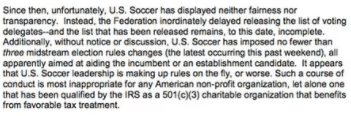
Now, let’s go over the letter from Gans representative Robert Bertsche and the response from U.S. Soccer general counsel Lydia Wahlke …

On the face of it, the Bertsche letter is a little flimsy. Wahlke takes note:

wahlke-1

So this is apparently not the first such communication.

The meat of the Gans allegations is in the third paragraph:

gans-1

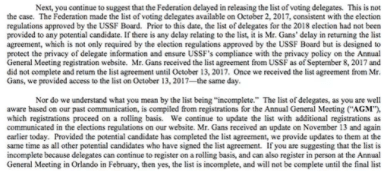
Allegation 1: Delaying the release of the delegate lists. Let’s check back to the election procedures to see what this means:

ncm-delegates

“NCM” is National Council Meeting, where everyone gathers in Orlando and conducts business including but not limited to electing the next president.

Here’s the Wahlke response:

wahlke-delegates

And yes, the list of delegates is going to keep changing. We know each state association will be there, but life happens — maybe Delegate X has a family thing come up and Delegate Y goes instead.

As far as the timeline goes, bear in mind that Gans has been in this race for months. He had already been in the race for months when I interviewed him for the podcast two months ago. The letter doesn’t state when Gans started asking.

In any case, not a big deal in the long run. The next part, though, puts USSF on shakier ground. Here’s Wahlke …

wahlke-procedures

In fairness to Wahlke, the Gans letter doesn’t specify what has been changed. The SI story mentions three things:

  1. The first change was on Sept. 1, requiring candidates to obtain three official letters of support. That was the initial election procedure, which has never been in place before because we’ve never had an election like this before. The bylaws changed last year, and it seemed uncontroversial at the time.
  2. The decision on Nov. 8 to let nominators withdraw their nominations by Nov. 27 so they could nominate someone else.
  3. Last week’s Sunil-nominator-palooza, when USSF abruptly said all 24 (24??!!!) organizations that had nominated him were free to nominate someone else.

No. 3 really contradicts No. 2. Perhaps USSF should’ve just told nominators they should’ve withdrawn their Gulati nominations before the Nov. 27 deadline, when Gulati was still playing Hamlet staring at a skull and trying to decide what to do before Laertes comes storming back.

So we can consider that a legitimate complaint. Moot point now, but it does establish that the Nominating and Governance Committee has been playing a bit of Calvinball. But they’re not in charge of the vote itself. As far as I know, their role is hereby done.

One more complaint from the Gans team:

gans-pop

Wahlke’s response:

wahlke-pop

Seems reasonable. If Illinois’ adult association wants to praise Eric Wynalda to the high heavens on Twitter, how is that U.S. Soccer’s fault?

That said, at least Wahlke is on the record saying the nomination letters won’t be shared publicly. So if anyone needed assurance that we’re not going to see a press release from USSF saying Kathy Carter has 90 nominations or whatever, we’ve got it. (Now, a press release from SUM, on the other hand, would still be legal. And would probably go over like a lead zeppelin, to paraphrase Keith Moon or possibly John Entwistle giving Jimmy Page the idea for a band name. Then again, Carter’s not getting 90 nominations. Maybe not even nine, despite Gulati hanging on to 24 of them like he’s trying to get on Hoarders.)

And for the record, organizations are by no means obligated to vote for the candidate they nominated.

Two other things that have come out of the exchange:

  • Wahlke mentions “108 Organization Members.” By my count, it’s 110 — 41 state youth associations, 40 state adult associations, 14 joint state associations, 4 pro leagues and 11 national affiliates. I’m not completely sure of the count on state associations because some state associations don’t have websites, as if it’s 1992 or something, and I just found out this evening that Maine has only a youth association, not adult (and not joint). The national affiliates are tricky. A page on the USSF site lists nine, but that doesn’t include a couple of national youth soccer organizations have nominated someone at one point in this process. I’ve asked for clarification, and I’ve been directed to the site. Make of that what you will. Moot point now, but next time, could USSF just print a dadgum list?
  • The SI piece names one of the nominators — Angela Hucles. I’ve had the last few lists of nominators and have decided not to name any of them beyond the identifiers in my previous posts. I’m still wrestling with it from an ethical and practical level. This information probably should be made public, but should I be revealing nominations that a bunch of state associations — many of them small operations run by people who aren’t used to dealing with the media — made with a semi-reasonable expectation of privacy? (Or am I just cowed by the guy who responded to my off-the-record queries about the election with “I DON’T SEE HOW IT ANY OF YOUR BUSINESS”?)

But here’s the kicker, and I apologize for burying the lead …

Gans’ letter is asking for independent oversight. Wahlke responds …

wahlke-indy

That’s certainly not the last word here. We’ll need to know who’s been hired. Maybe some enterprising people will even vet that outside firm.

The Credentials Committee’s membership is listed online. Before the election, I’ll check to see if it’s changed at all.

For now, though, Gans seems pleased.

I can’t remember from past general meetings whether this is new. In any case, perhaps we’ll see a few new bylaws clarifying such practices from now on.


us soccer

U.S. Soccer presidential race: Nomination check

Yesterday, I saw a list of 44 nominations (43 organizations, 1 athlete) who had nominated someone for the U.S. Soccer presidency.

Today, it’s down to 20. I’m going to reproduce here an email I obtained whose veracity I have confirmed with multiple sources:

U.S. Soccer has received confirmation that Sunil Gulati has officially withdrawn from the presidential nomination and election process. The Nominating & Governance Committee has determined that the 24 Organization Members that nominated Mr. Gulati are therefore eligible to nominate another candidate by December 12, 2017.

We want to remind you that the three (3) letters of support/nomination from Organization Members, or the Athlete members of the Board of Directors is due by 11:59 p.m. on December 12, 2017. If you believe that an Organization Member or Athlete member of the Board of Directors has nominated you and they are not on the list below, please contact me as soon as possible by replying to this email.

I’m not going to reproduce the list to protect the innocent. Or the guilty, in some cases. Depends on your point of view.

I’ve broken it down by type of organization, lumping together the various national affiliates (including national youth organizations, disability sports organizations) as “national.” The numbers might be off by 1-2 — I’m unsure whether one state association is adult or joint (combined youth and adult), and there are a couple of unusual national affiliates that I’m not sure can actually nominate anyone (say, the Hall of Fame). With that disclaimer in mind, here’s the breakdown of how many organizations exist and how many had nominated someone as of Nov. 29, Dec. 8 and Dec. 9:

TYPE No. Nov. 29 Dec. 8 Dec. 9
Adult state association 36 13 16 9
Youth state association 37 12 15 6
Joint (adult/youth) state 18 5 5 3
Pro league 4 0 1 1
National affiliates/orgs 13 6 6 0
Athlete Board members 3 0 1 1
TOTAL 111 36 44 20

UPDATE: The “No.” (or “number” since we don’t have to abbreviate here) column has been corrected now that USSF has released a complete list of affiliates. I’m assuming “Orlando” should be “Oregon.” The incorrect figures were 41 adult, 41 youth, 14 joint, 11 national affiliates/organizations.

One announced nomination is not included here because it’s not on the emails I’ve seen. That’s the South Carolina youth association, which has declared for Kyle Martino.

From that, we can deduce the 24 organizations that had endorsed Gulati but are now in play. Here’s a breakdown with names changed to regions (“res” means “rescinded”):

ORGANIZATION TYPE Mid-Nov Nov. 29 Dec. 8 Dec. 9 NOTES
Midwest Adult yes yes yes res Gulati: Confirmed by email
Midwest Adult yes yes yes res Gulati: Deduced from lists
Northeast Adult yes yes yes res Gulati: Deduced from lists
Southeast Adult yes yes yes res Gulati: Deduced from lists
Northeast Adult yes res NEW yes
Northeast Adult NEW yes
West Adult NEW yes
Southeast Adult NEW yes yes
West Adult NEW yes yes
Illinois Adult Adult yes yes yes yes Wynalda: Announced
Midwest Adult yes yes yes yes
West Adult yes yes yes yes
Athlete Athlete NEW yes
Northeast Joint yes yes yes res Gulati: Deduced from lists
Southwest Joint yes yes yes res Gulati: Deduced from lists
Northeast Joint NEW yes yes
New Hampshire Joint yes yes yes yes Wynalda: Announced
Northeast Joint yes yes yes yes
National National yes yes yes res Gulati: Deduced from lists
National National yes res
Major League Soccer Pro NEW yes Carter: Announced
Midwest Youth yes yes yes res Gulati: Deduced from lists
Northeast Youth yes yes yes res Gulati: Deduced from lists
Northwest Youth yes yes yes res Gulati: Deduced from lists
Southeast Youth yes yes yes res Gulati: Deduced from lists
West Youth yes yes yes res Gulati: Deduced from lists
Northeast Youth yes res NEW yes
Northeast Youth NEW yes
West Youth NEW yes
West Youth NEW yes yes
Northeast Youth yes yes yes yes
West Youth yes yes yes yes
South Carolina Youth Youth Martino: Not on list but announced

If you have any corrections or comments (including claiming your nomination if you are one of these organizations), speak up!

podcast

RSD22: U.S. Soccer presidential candidate Paul Lapointe

If you want to skip Beau’s rant on the good and bad of US Club Soccer, Sunil Gulati and Twitter, skip to the 15-minute mark. That’s where you’ll find the interview with Paul Lapointe, one of the first candidates to declare his intent to run for the U.S. Soccer presidency.

We talk about promotion/relegation, the role of the president, equal pay for the U.S. women’s team, women’s soccer promotion/relegation/Open Cup, the fragmented world of futsal, the fragmented world of indoor “balls and walls” soccer, youth soccer and coaching. All in less than 45 minutes.