pro soccer

Not Another Soccer Lawsuit: NASL-USSF, Halloween hearing edition

I’m not going to try to write something coherent out of all the accounts of today’s NASLpalooza in a New York courtroom.

First, I’m going to send my hopes for speedy recoveries for those injured and comfort for those who mourn after today’s senseless attack in Manhattan. I’m going to suggest we look into simple ways to make public spaces safer — bollards would help in this case — without resorting to outrageous racial and religious scapegoating or some sick fantasy that “good guys with guns” can stop this sort of thing from happening.

Then, I’m going to direct you to some first-hand accounts:

  • Michael Lewis, who has covered all leagues called NASL, has a summary.
  • Chris Kivlehan, writing for Midfield Press, has what you might call a play-by-play.

And you’ll want to follow Miki Turner, who has an advantage over most of us in that he’s an attorney. Another advantage: He has the transcript.

So what I’m really doing here is leaving a few breadcrumbs to find our way back through the Labyrinth. Or something like that. In simpler terms, I want to capture a few thoughts before the day is done.

1. The “USSF has no right to regulate squat” apocalyptic vision is probably moot.

And that’s good because I think USSF lawyers may have missed an opportunity to point out that there’s a difference between “amateur” as defined in most of the world (someone who is not paid to play) and “amateur” as clumsily redefined in the USA’s Stevens Act when someone realized a lot of Olympians are now raking in the dough.

Another thought on that topic (“they” here refers to NASL legal team):

So legal nerds hoping for The Ultimate Answer to Life, the Universe and Whether the Stevens Act Covers Professional Leagues might have to wait until the inevitable suit against some other National Governing Body. (If I were making odds, I’d say it’ll happen in rugby. Or volleyball.)

If you want a bit more on this, here’s Midfield Press: “Judge Brodie asks for clarification on whether Sauer (USSF lawyer) is taking the position that Congress has given USSF the authority to regulate professional soccer.  Sauer clarifies that the Stevens Act does not limit their authority.  Sauer traces the USSF’s authority from the Olympic charter, from which FIFA draws its authority.  USSF is recognized by FIFA.  “Bottom line” is that USSF believes it has the authority to govern pro soccer and the Stevens Act does not limit it.”

And finally …

2. I’ll never understand why Jeffrey Kessler gets into soccer lawsuits and tosses out things that are easily refuted by anyone with a shred of outside knowledge (such an opposing counsel).

In Fraser v MLS, we actually had people arguing about whether the Premier League and The Division Now Known As The Championship are equal or whether the bottom three teams in the Premier League are sent down. (See pages 318-321 here, then pages 421-425 here. It actually reached a point of absurdity — page 2190 onward — at which Kessler was forced to backtrack from an assault on the credibility of one Sunil Gulati, who is once again involved in this case and seems to be Kessler’s white whale.)

Today, he brought up the sad story of a family upset over the prospect of losing the San Francisco Deltas. It didn’t take USSF lawyers long to point out that the Deltas’ survival ain’t at stake in this courtroom.

3. Judge Margo K. Brodie has done a remarkable job getting up to speed on soccer.

From the Midfield Press account: “(Kessler) suggests that no other FIFA affiliated federation in the world has standards like USSF’s PLS.  Judge Brodie suggests that is because soccer in those other countries is the number one sport, which is not the case here in the United States.”

Do you hear that, Soccer Twitter?

And she seems like one of those stereotypical New York judges from Law & Order who makes the lawyers behave.

4. I still don’t have a good handle on when this case will discuss whether the NASL can reasonably have D2 status.

We know from earlier filings — and from the reporting by Midfield Press and Nipun Chopra — that the NASL is grabbing some NPSL teams and flinging them up the pyramid to bolster their numbers. Follow-up info on that front is redacted, but it was discussed in court today:

Coincidentally, the Ranting Soccer Dad podcast posting tomorrow morning is an interview with NPSL Managing Director Jef Thiffault. We refer to the clubs considering an NASL move, but given the pending legal action, don’t expect a ton of detail.

5. I have no idea who’s going to win.

Or at what stage. Would the judge grant an injunction, giving the NASL a stay of execution, only to grant the USSF’s Motion to Dismiss, which is following a separate schedule and will take a few more weeks to discuss? I’ve heard convincing arguments either way, and I can’t pretend to be a lawyer.

I can tell you from a journalist/historian’s point of view, the NASL side has piled on more arguments that set off my b.s. detectors. They have eight teams — no, wait, make that 14, even though it’s well-established that a couple of these teams aren’t likely to return, and several others are currently playing before crowds of hundreds (when reported) in the NPSL with amateur players. They made bold claims about competing with MLS well before they were ready to do so, and now that they’ve declined, they’re blaming the system. They could’ve differentiated themselves from MLS by creating the promotion/relegation system they claimed to support, and not long ago, NPSL was interested in doing that. NASL pushed them away, only to latch onto a few NPSL clubs now.

If I were an NASL fan — and if I lived in Indianapolis or Puerto Rico right now, I would be — I’d be embarrassed by this insistence on propping up a brand name instead of joining up with NISA or regrouping some other way in Division III and working back up.

But that doesn’t mean they’re wrong, legally. It doesn’t mean they can’t convince a judge who appears to be quite reasonable that they should be given, like Delta House after the Faber parade, just one more chance.

pro soccer

No, HERE’S how you re-organize the MLS playoffs

Here are the problems with the MLS playoffs, in no particular order:

  1. Too much randomness, making the “league champion” whoever’s hottest for a few games rather than the whole season.
  2. Not enough advantage for the higher seed.
  3. The first leg of a two-leg series is often excruciating.

I’ve seen suggestions for a single-elimination tournament, but that just steps up the randomness. I’ve seen suggestions to bring back the “first-to-five” series, which means each series could be two or three games. And Brian Straus has preserved the group-stage idea he first floated at AOL in 2010.

My proposal remains: Use the Page Playoff system that works so well in curling, Australian football and a few other competitions.

In each conference:

FIRST ROUND:

  • 1 vs. 2 — winner to final, loser to semifinal
  • 3 vs. 4 — winner to semifinal, loser out

CONFERENCE SEMIFINAL: 1-2 loser vs. 3-4 winner

CONFERENCE FINAL: 1-2 winner vs. semifinal winner

Then you can have MLS Cup. Maybe it’s a single game, or maybe it’s the two-leg series I floated at The Guardian last year with one game at the higher seed’s home ground and one at a neutral site. (I’m a little less wedded to that idea in a 28-team MLS in which the schedules will be even less balanced than they are now.)

If you want to get fancy, you could mix the conferences for the conference finals — the East 1-2 winner plays the West semifinal winner and vice versa. That avoids a repeat matchup.

So you get:

  • Serious incentive for every place in the top four.
    • First place gets home field in the 1-2 game and gets a second chance if it loses round.
    • Second place gets a second chance if it loses in the first round, and it will host either the semifinal or the final.
    • Third place hosts the 3-4 game.
    • Fourth place just makes the playoffs.
  • A little less randomness than a straight single-elimination tournament.
  • No games like the game we won’t mention from last night.
  • It all goes relatively quickly. If it’s a one-leg MLS Cup, it’s four gamedays — first round, conference semis, conference finals, MLS Cup. If it’s two legs, just add one game.

So that’s solved. Next, we’ll figure out fun ways to keep the middle of the table engaged …

pro soccer

Can the NASL take a free ride on what MLS has built?

Hold your horses, MLS haters. This is an actual question in NASL v USSF.

Steven Peterson, an economist who specializes in part in antitrust issues, is a U.S. Soccer expert witness in this case. He bases part of his response (p. 22-26) to NASL expert witness Stefan Szymanski on the concept of “free riding” — basically, having one entity take advantage of resources created by another, thus diminishing those resources. Investopedia ties that concept to the “tragedy of the commons,” something we all slept through in grad school.

Szymanski argues that U.S. Soccer can’t accuse anyone of “free riding” because their mission as a nonprofit is to create that rising tide that lifts all boats.

szy-free-ride

On first glance, I thought Szymanski had a good point. But now I see two problems with it:

  1. It’s not U.S. Soccer’s job to allow one commercial entity to free-ride off another. In fact, it’s USSF’s job to prevent that. (Peterson actually explains all that.)
  2. The “tragedy of the commons” analogy holds true here. The classic example is green space overgrazed by livestock until there’s nothing left. In soccer terms, that would be having too many entities dividing up the same small market.

Whether that’s enough of an argument to outweigh other antitrust concerns, I don’t know. I’m starting to wonder if USSF really wants one and only Division I league — call it a conspiracy if you like, or call it a legitimate “tragedy of the commons” concern — but can’t say so because of antitrust law.

pro soccer

Home sweet home: Keep the Crew in Columbus

Photos courtesy Steve Sirk unless otherwise noted. He wrote the book on the Crew.

Dear MLS owners, especially the one in Columbus (I mean, Austin or San Francisco) …

You may be asked in the next year to decide whether to put an MLS club in Austin. That’s a great town, of course. From Austin City Limits to SXSW, Austin has long been right up alongside Nashville, New York and Los Angeles as one of the country’s music capitals. I’d even have to rank it ahead of my hometown, Athens.

So if you want to figure out how to expand to Austin, that’s great. Find ownership. Find land for a stadium. Easier said than done, sure, but it couldn’t hurt to ask.

The problem is this — the club that you may be asked to place in Austin already has a home.

Lamar hard hat

See the man in the hard hat? That’s Lamar Hunt. He built that club. He paid for their stadium to be built. When one location was shot down, he stopped by a local McDonald’s and stared at a map, figuring out the next place to try until they found it. Read Steve Sirk’s account.

Yes, the club is the Columbus Crew. Note the first word: Columbus.

Maybe you didn’t know Lamar Hunt. He passed away 11 years ago. MLS has seen rapid expansion since then.

And so maybe you don’t understand why MLS is in Columbus in the first place. It’s a smallish city with a giant university known for American football, American football, and a marching band that dots the “i” before each American football game.

MLS is in Columbus because the club’s founders sold 12,000 season-ticket deposits before the league existed. It’s in Columbus because they built the first stadium whose primary tenant would be an MLS club.

And it’s not the only soccer team that has proudly made that stadium its home stadium …


Mapfre-stadium-hosts-USA-Mexico 11-11-2016
Rick Dikeman, Wikipedia Commons: USA-Mexico, Nov. 11, 2016


Dos a cero. Dos a cero. Dos a cero. Dos a cero. USA over Mexico. Four World Cup qualifiers. No, it didn’t happen again this time around, but blame Jurgen Klinsmann and his disorganized team, not the fans.

And this stadium hasn’t just hosted World Cup qualifiers. It hosted an actual World Cup.

So how, exactly, has this stadium suddenly become obsolete for MLS games? This isn’t RFK Stadium in Washington, which has plenty of history but looks like it’s about to collapse at any moment.

The reviews of this place are, in fact, quite positive. So is the atmosphere. Check out the “mini-Nordecke,” where kids are literally learning how to grow up and be the supporters MLS craves.

Mini Nordecke

Oh, it’s not downtown, like your wonderful Cascadian paradises? For a lot of Crew fans, that doesn’t matter — they’ll gladly pay $15 to park and tailgate. If you prefer English traditions, allow me to share one from my travels: If you go to a match at Reading’s Madejski Stadium — like Mapfre Stadium, not downtown, a couple of miles from a university — all you need to do is take the train to Reading Station and hop on the F1 bus. We stayed in London (near Arsenal, actually) and had enough time to grab a nice snack as we worked our way back through bus and trains back to our Airbnb place.

Which is cheaper — running a few buses from favorite downtown watering holes or relocating a team to a city that seems a little ambivalent about finding a stadium for it?

Not convinced you can have a competitive team in a town that might not attract the best Designated Players? You may have missed out on Guillermo Barros Schelotto, one of the most skillful players ever to grace an MLS field. He came to Columbus in 2007 and … didn’t hate it.

A lot of players love Columbus. See the mini-Nordecke above? The guy who started it is Frankie Hejduk. He’s the walking embodiment of a California surfer dude. But when he came back to MLS after a stint in Germany, he went to Columbus, and it’s fair to say he liked it.

If you really, really want a downtown stadium, fine. Keep working with the folks in Columbus. Maybe it’ll happen at some point.

In the meantime, may I remind you that the Columbus Crew have a stadium? The team, which just upset Atlanta in the MLS playoffs, seems happy. The fans are happy. If you can provide a few more amenities to make them happier, great.

No, you might not get 40,000 people to each game or 70,000 to the occasional big one. It’s not Seattle or Atlanta. Guess what. Neither is Austin.

And if you want to go to Austin down the road — or San Antonio or even Miami — what message do you think it sends to abandon the first stadium built by and for an MLS club? You think they’re going to bulldoze a few blocks downtown and chip in a few million to help you build it?

The most convincing argument you can make on behalf of Major League Soccer is that it’s stable. That’s an accomplishment in a country where the history and sociology are not on your side. You’ve made it through 21 years with only three teams going under, and few people shed tears at the demise of Chivas USA. Leaving San Jose was controversial, but that team was in dire need of a stadium and local investment, and now you have it.

If we were talking about a club that averaged less than 10,000 fans by any reasonable attendance count, had no stadium that looked like it could survive until 2020 and was generally unloved by anyone, fine. Move that club to Austin. But you’re a victim of your own success here. You don’t have any clubs meeting that description. Not even Colorado, where fans sometimes wonder if the owner even remembers that he owns the team. (Hey, I don’t know the name of every investment I own. Some sort of mutual fund?)

If you move the Crew, you undermine Major League Soccer’s major achievement — building a fan base for the long term.

And that’s what you signed up for. This isn’t the old NASL, where a bunch of rock stars thought it’d be cool to have a team and go party with Pele at Studio 54. This is a league that’s built to last. It’s why the dude who wrote the book about you called that book Long-Range Goals. (Honestly, he was never wild about the subtitle.)

You want to toss all that away and leave one of the most important cities in U.S. soccer history? Fine. You’re going to create a lot of EPL fans. Maybe even some fans of NASL or NISA or whatever survives the legal system and U.S. Soccer’s sanctioning process.

I haven’t been to many MLS games in recent years. Nothing personal. It’s youth soccer and women’s soccer, in that order. D.C. United only has a couple of home games each year I can attend.

But maybe I’ll spring for a “flex pass” or something. I empathize with the nice guy who’s been calling me from the front office. Cold-calling is one of the worst parts of being a journalist, and we’re actually offering people a chance to speak. Gotta be tough when you’re asking people to hand over money.

It’s about time D.C. United got its own stadium. I still refuse to set foot in Nationals Park because Major League Baseball extorted more than $600 million out of Washington’s government. I can go to Audi Field with little hesitation.

But while the Crew’s owner flirts with Austin, I find myself having a bit of trouble finding my wallet.

I’m guessing I’m not the only one.

Think about it.

Cheers,

Beau


podcast, pro soccer, youth soccer

RSD16: Kevin Payne (U.S. Club Soccer) shatters simplistic suggestions

Fix the pay-to-play system! Make U.S. clubs pay and receive solidarity payments and training compensation! Get Sunil Gulati out of U.S. Soccer!

Not so fast.

Today’s guest is Kevin Payne, currently the U.S. Club Soccer CEO and previously an executive with D.C. United, AEG, and Toronto FC. He also has plenty of experience within U.S. Soccer in a variety of roles, including membership on the Board of Directors.

He’s here to tell you the pet solutions we toss around on Twitter are either (A) not so simple or (B) totally missing the boat. The interview starts at the 7:20 mark, after a brief rant on the state of MLS, the NASL, USL, NWSL and maybe even QSL. (Yes, I miss shortwave radio.)

pro soccer

Timeline: How did NASL-USSF dispute come to this?

(This WILL be revised and updated. Suggestions welcome.)

I’ve read many of the court filings in the NASL-USSF lawsuit and U.S. Soccer Board of Directors minutes dating back to 2011. A few other sources are mentioned here and there.

So here’s a timeline of what I was able to reconstruct, plus a few explainers:

WHO’S WHO:

Sunil Gulati: Seriously? Google. USSF president since 2006, VP for six years before that, former Kraft Soccer (New England Revolution) employee, one of the founders of Major League Soccer but dismissed by original commissioner Doug Logan.

Dan Flynn: USSF CEO/Secretary General. Basically, top paid employee on the org chart. Had a heart transplant in April 2016.

Carlos Cordeiro: Retired from Goldman Sachs in the early 2000s. Elected as an independent director (someone not affiliated with youth, adult or pro) to the USSF Board of Directors in 2007, then unseated Mike Edwards to become vice president in 2016.

Linda Cardenas: Executive assistant at USSF since 2011.

Mike Edwards: Long-serving USSF vice president (replaced Gulati when he became president in until election loss in 2016.

John Motta: Former USSF vice president (defeated Gulati in 1998, then lost rematch in 2000). Adult Council rep to USSF Board since 2013. President of U.S. Adult Soccer, which governs soccer in the USA that is neither youth nor pro. (Though a few pro teams play in USASA-affiliated leagues.)

Alec Papadakis: USL CEO since 2009. Pro Council rep to USSF Board in 2015 and 2016.

Aaron Davidson: Former chairman of NASL and former president of Traffic Sports. Pleaded guilty to racketeering conspiracy and wire-fraud conspiracy charges in October 2016.

Bill Peterson: NASL commissioner from 2012 to January 2017. One of the key figures in repositioning NASL as unlikely standard-bearer of traditional soccer, including promotion/relegation (though never making concrete proposal), and insisting upon NASL’s Division I ambitions.

Rishi Sehgal: NASL executive now serving as interim commissioner.

Jeffrey Kessler: High-powered sports lawyer who has been very successful in landmark cases in other sports. In soccer, he represented the U.S. women for a short period in their labor dispute with the USSF and unsuccessfully led MLS players in lawsuit challenging league’s single-entity model from 1997 to 2002.

Mark Frisch: Former Jacksonville Armada (NASL) owner

Brian Helmick: San Francisco Deltas (NASL) CEO

Rocco Commisso: Bought New York Cosmos in early 2017. Had promising relationship with Gulati (both tied to Columbia University) but is now leading figure in several actions against USSF.

WHAT’S WHAT:

BOD: U.S. Soccer Board of Directors

D1, D2, D3: Division I, Division II and Division III

PLS: Pro League Standards, developed and administered by U.S. Soccer, voted on by BOD (those affected generally recuse themselves from vote). See the 2014 (current) version; a 2015 draft revision was not approved.

PLS Task Force: Meets to discuss PLS. Current composition.

Pro League Task Force: Examines each pro league and recommends to the BOD whether or not to renew their annual sanctions as D1, D2, D3. The BOD doesn’t always take their recommendations. Current composition.

USSF D2: A stopgap league in 2010, when teams were splitting from the USL and forming NASL.

Traffic Sports: Marketing firm that once ran four NASL teams and was later at epicenter of FIFA/CONCACAF investigation. See Aaron Davidson.

CITATIONS

Gulati Dec: Sunil Gulati’s declaration in support of U.S. Soccer’s reply to NASL lawsuit. This is cited a lot because so much of it establishes a timeline.

Ex (1, 2, 3 …): Exhibits from U.S. Soccer’s reply. Some of these are also in the NASL’s filing and are noted as such.

BOD Minutes: U.S. Soccer Board of Directors Minutes

TIMELINE

Pre-history: In 1993, the USSF awarded Division I sanctioning to the group that devised Major League Soccer. That group includes then-USSF president Alan Rothenberg, who was elected with the mandate of solidifying the USA’s 1994 World Cup organizing efforts and forming a Division I league. The vote was not unanimous — MLS got 18 votes, the existing second-division APSL got five, the rule-changing League One America got zero.

In 1995, the USSF came up with a set of Professional League Standards that would remain in place until 2008.

The APSL remained Division II and eventually merged with the USISL, a fast-expanding league that operated two tiers of pro soccer (D2 and D3) along with an amateur league now called the PDL. The USISL later simplified its name to the USL. The league briefly experiments with promotion and relegation but backed away because more teams were “self-relegating” for economic reasons. Founder Francisco Marcos sells shares in the league to Umbro, which ends up with 94% of the league before Umbro itself is sold to Nike, which inherits ownership of the league in early 2008.

Full histories of the USISL/USL: Philly Soccer Page, Inside MN Soccer.
2008

Sept. 24, 2008 – BOD Minutes: BOD approves new PLS.

Throughout 2008 – The Team Owners Association (TOA) forms among several disgruntled team owners in the USL. The leaders include Aaron Davidson (Miami FC and Traffic Sports) and Jeff Cooper, a St. Louis attorney who had been trying to bring MLS to St. Louis, was on the board at English club Brentford and was launching St. Louis Athletica in Women’s Professional Soccer.

2009

Aug. 27, 2009 – (See sources above): Nike sells the USL to NuRock Soccer Holdings, led by Rob Hoskins and Alec Papadakis. The move is a shocker — the league had seemed all but sold to Cooper.

Nov. 10, 2009 – Goal.com report: Atlanta Silverbacks, Carolina RailHawks, Miami FC, Minnesota Thunder, Montreal Impact, a not-yet-playing St. Louis team and Vancouver Whitecaps announce plans to split from USL. The new league applies for D2 status.

Nov. 21, 2009 – BOD Minutes: Nothing is mentioned about the league split, though the BOD did have an executive session. MLS’ D1 status is renewed, WPS’ women’s D1 status is renewed with conditions, and the BOD hears updates on the Major Indoor Soccer League (not yet part of USL), USL1 (D2) and USL2 (D3).
2010

Jan. 8, 2010 – Soccer America: With neither the NASL or the remaining USL clubs convincing USSF to award them D2 status, the Federation takes the unusual step of running its own league, brokering a one-year deal to take the nine NASL-leaning clubs and three USL-leaning clubs into the short-lived-by-design USSF D2 league. The breakaway teams have already seen some changes — Atlanta is on hiatus, Minnesota is under new management, and FC Tampa Bay and Crystal Palace Baltimore have joined in.

Feb. 5, 2010 – BOD Minutes: USSF update on plans for the USSF D2 league AND plans to appoint a blue-ribbon panel to review the PLS. The plan: In May through July, visit teams to make sure they’re meeting D2 minimum standards AND publish new standards. At August BOD meeting, evaluate new applicants for D2.

May 20, 2010 – Brian Quarstad (IMS): Crystal Palace Baltimore in deep trouble. St. Louis, with former NASL interim commissioner Jeff Cooper at the helm, in deeper.

May 27, 2010 – Soccer America: Saint Louis Athletica, sister team to AC St. Louis, folds midseason, sending players like Hope Solo and Shannon Boxx into a dispersal draft.

Aug. 10, 2010: BOD Minutes: “President Gulati updated the Board on a meeting with all of the D2 team owners and the proposal to change the D2 Professional League Standards. President Gulati informed the Board that the proposed D2 Professional League Standards had been proposed by the Blue Ribbon Professional League Standards Task Force and that the proposed standards had been reviewed with the D2 owners. It was MOVED to adopt the revised D2 Professional League Standards. The motion PASSED.”

See the standards. At the time, I thought they were designed to keep anyone from playing D2. But the NASL embraced them.

Nov. 21, 2010: BOD Minutes: MLS renewed as D1, WPS renewed as D1 with conditions. USL PRO accepted as D3. NASL not mentioned (executive session?) but received provisional D2 sanction. (See Brian Quarstad story below — Jan. 25.)

2011

Jan. 19, 2011 – St. Louis Post Dispatch: AC St. Louis officially folds.

Jan. 20, 2011 – NASL statement: USSF BOD withdraws provisional D2 sanctioning because of failures to comply with standards. Losing St. Louis probably didn’t help. (No minutes posted for BOD meeting, which likely means entire meeting was executive session.)

Jan. 25, 2011 – Ex 13: Brian Quarstad (IMSoccer News) talks with Aaron Davidson after USSF withdrew D2 sanction (for now.)

February 2011 – Ex 14: NASL D2 application.

Feb. 11, 2011 – BOD Minutes: USL Pro gets a waiver because four of its 15 teams will be outside USA. No mention of NASL, but see next day.

Feb. 12, 2011 – Brian Quarstad confirms: NASL gets provisional D2 sanctioning for 2011.

March 28, 2011 – David Downs, an industry veteran with ABC, Univision and the USA World Cup Bid Committee, named NASL commissioner. (Aaron Davidson is CEO.)

April 2011 – NASL begins first season as an independent D2 league. Continuing from USSF D2: Carolina RailHawks, NSC Minnesota Stars, Fort Lauderdale Strikers (formerly Miami FC), Montreal Impact, Puerto Rico Islanders, FC Tampa Bay. New: FC Edmonton. Returning from one-year hiatus: Atlanta Silverbacks. Gone: Austin Aztex (moved to Orlando), Vancouver Whitecaps (moved to MLS along with fellow D2 club Portland Timbers), Crystal Palace Baltimore, AC St. Louis.

2012

March 3, 2012 – Brian Quarstad: NASL gets full Division II sanctioning at USSF Annual General Meeting. Only one change for 2012 season: Montreal moves to MLS, replaced by San Antonio Scorpions. Minnesota is renamed Minnesota United. FC Tampa Bay reclaims the Rowdies name.

June 10, 2012 – Neil Morris (2015 story, WRAL Sports Fan): With half its clubs either owned by Traffic Sports or propped up by the league, Downs and NASL owners sit down for a meeting with MLS officials, with whom they had been negotiating for months for an affiliation partnership. NASL chairman Davidson says NASL is walking away from negotiations.

June 12, 2012 – New York Cosmos join NASL for 2013. The brand name had been dormant from 1985 until 2010, property of one Peppe Pinton. When Pinton sold the club name, it relaunched and played an exhibition game with a team of guest players. Saudi company Sela Sport bought the team in 2011 and negotiated with MLS but opted instead for the NASL.

Oct. 5, 2012 – Downs resigns as NASL commissioner.

Nov. 27, 2012 – Brian Quarstad: Bill Peterson — like MLS commissioner Don Garber, a veteran of NFL Europe and then a member of the MLS Board of Governors — officially announced as NASL commissioner.

Dec. 1, 2012 – BOD Minutes: MLS, NASL, USL all get renewals at D1/D2/D3 without incident. Minutes say MLS had “waiver,” NASL had “waivers.” USL waivers not mentioned. PLS also being reviewed because USSF is trying to launch women’s league (NWSL).
2013

Feb. 17, 2013: BOD Minutes: NASL gets waiver on number of teams for 2013 spring season only. Puerto Rico was taking a one-year hiatus, dropping the league to seven teams until the Cosmos started for the fall season.

Nov. 18, 2013 – Ex 9: Flynn memo to leagues on PLS (includes draft standards) – also NASL Ex 34.

Nov. 27, 2013 – Ex 10: NASL response to Flynn letter. Peterson’s four points are: Letters of Credit (says the dollar figure is too high), Roster Limitations (unclear what he’s asking), Reserve Leagues (seeking clarification), Pro/Rel (can we talk about it?). Gulati notes Peterson did NOT challenge time-zone standard.

Dec. 8, 2013 – BOD Minutes: Gulati says PLS Task Force has sent new draft to teams for review. Also, all four pro leagues’ sanctions renewed. MLS gets waivers on field size and coaching licenses. NWSL gets waivers on field size and stadium seating. USL gets waiver on field size. No NASL waiver mentioned.
2014

Feb. 28, 2014 – BOD Minutes: USSF Board approves new PLS. Also, BOD resolves dispute between MLS and NASL on apportionment of Pro Council votes. MLS gets 9, NWSL 3, NASL 1, USL 1. This resolution good for only one year.

April 12, 2014 – NASL season kicks off with 10 teams. Indy Eleven (with former Chicago Fire GM and USSF Board member Peter Wilt as president) and Ottawa Fury are the new teams.

December 7, 2014 – BOD Minutes: Little discussion at annual renewal — all four leagues renewed, subject to waivers. Also, Gulati asks Pro Council to meet again to discuss voting apportionment.
2015

Feb. 13, 2015 – BOD Minutes: Garber presents unspecified allocation of Pro Council votes. Board accepts.

Feb. 23, 2015 – Ex 15: Peterson letter to Gulati thanking him for meeting and expressing desire for more pub from USSF PR department, also saying he wants NASL to play at highest level

Feb. 24, 2015 – Ex 16: Gulati response – thanks Bill, talk soon

April 4, 2015 – NASL goes to 11. New season includes 10 returning teams plus Jacksonville Armada.

May 20, 2015 – Ex 20-21: USA indicts a whole lot of people, including several from Traffic (and Traffic itself). Among them: Aaron Davidson.

May 31, 2015 – Ex 17: NASL glossy presentation for D1 (BOD meeting that day, but not mentioned in minutes)

June 24, 2015 – Ex 12: Flynn memo to leagues on PLS (includes draft of 2015 standards). This is controversial one. It would’ve raised minimum number of teams at inception from 12 to 16 (D1) and 8 to 12 (D2).

July 23, 2015 – Ex 18: Kessler warning shot to Gulati, Flynn and PLS Task Force

July 27, 2015 – Ex 19: USSF counsel Lisa Levine rips Kessler but still offers to move forward and talk.

Sept. 30, 2015 – Gulati Dec: USSF meets Kessler and NASL. Much reiteration of positions. Also, USSF presses NASL on Traffic.

Oct. 29-30, 2015 – Ex 22-23: Back and forth traffic between USSF to NASL about Traffic

Oct. 30, 2015 – Ex 24: Peterson to USSF with a plan to get D1 status now and comply with D1 standards by 2026, and oh by the way, antitrust.

Nov. 6, 2015 – Ex 25: USSF to NASL – OK, we’ll call that an application for waivers, and by the way, Traffic.

Nov. 10, 2015 – Ex 26: Peterson re: Traffic — we’re on it! Really! Get off our backs! And why didn’t USSF tell us Aaron Davidson was suspended by FIFA!

Nov. 11, 2015 – Ex 27: USSF to Peterson: You needed US to tell you about Davidson?

Nov. 15, 2015 – Ex 28: Rishi Sehgal, then the NASL director of business development and legal affairs, on Traffic

Nov. 20, 2015 – Ex 29: NASL provides 2015 annual report. Requests waivers from D2 standards while also applying for D1

Nov. 23, 2015 – Ex 30: Peterson to Flynn, demanding to press D1 case to Board and Task Force

Nov. 24-Dec. 1, 2015 – Ex 31-33: Some wrangling over a USSF/NASL meeting because the threat of litigation is looming

Dec. 5, 2015 – Gulati Dec: Pro League Task Force of Cordeiro, Mike Edwards and Dan Flynn meets with NASL and counsel

Dec. 6, 2015 – BOD Minutes: All four pro leagues approved, subject to waivers.

Dec. 8, 2015 – Ex 34: Pro League Task Force to NASL: Thanks for meeting with us Dec. 5. Look, we’re still concerned about Traffic and your stadia.

Dec. 21, 2015 – Ex 35: Kessler to Pro League Task Force: Quit whining about Traffic. Footnote: Hey, you don’t want us to talk about Gulati’s relationships with Jack Warner  and everyone else, do you? Here’s your requested info about Traffic, and you’d better discuss our D1 application at the next Board meeting in January.
2016

Jan. 5, 2016 – Ex 36: Russell Sauer of Latham and Watkins to Kessler: Thanks for the info about Traffic. Where’s the rest of the league info you promised? If you want to make a presentation to the Board on Jan. 13, fine — let us know who’s coming by Jan. 7.

Jan. 13, 2016 – Gulati Dec: Board meeting. NASL states D1 case. Must be executive session, because there’s no mention of NASL on the BOD Minutes.

Jan. 15, 2016 – Gulati Dec: USSF asks NASL for more info

Jan. 21, 2016 – Ex 37: Rishi Sehgal on behalf of Peterson, to Flynn and everyone else: OK, we met — now can we move this along and get D1? The delay is unlawful.

Jan. 25, 2016 – Gulati Dec: USSF tells NASL the Board will talk about D1 application at next meeting in March

Feb. 29, 2016 – USSF Annual General Meeting, notable for independent director Carlos Cordeiro winning three-way race for VP.

March 3, 2016 – Ex 38: Peterson to Cordeiro: Congratulations! Now will you please either quit making divisional assignments or give us D1?

March 8, 2016 – Gulati Dec: USSF Board meets and rejects D1 status for NASL. BOD Minutes again have no mention of this, though they mention an update on USL’s application for D2 status. Also, Flynn gives update on pro futsal league.

March 9, 2016 – Ex 39: Cordeiro to Sehgal (please forward to Peterson): Thanks, but I don’t appreciate this sort of lobbying.

March 10, 2016 – Ex 40: Cardenas to Peterson: Non-recused members of the Board (non-recused) have non-recusedly agreed to non-recusedly not give your league D1 sanction, non-recusedly. USSF is still willing to help NASL get to D1 someday, non-recusedly. (Also NASL Ex 41)

April 2, 2016 – NASL kicks off spring season, still with 11 teams. San Antonio and Atlanta were out. A new Miami FC and Rayo OKC, affiliated with Spanish club Rayo Vallecano, join. Puerto Rico FC joins for the fall season to round it up to 12.

April 28, 2016 – BOD Minutes: Short teleconference with two orders of business, the second being to replace Flynn on the Pro League Task Force “because of a pending application.” Brian Remedi is named to replace him, and Cordeiro is named chair.

May 19, 2016 – BOD Minutes: Application to have Puerto Rico play NASL is approved.

July 8, 2016 – Gulati Dec: USSF again asks NASL about Traffic

July 13, 2016 – Ex 41: Sehgal to Levine: Still working on separating Traffic’s investment

Summer 2016 – Gulati Dec 173-174: “Contrary to the intimation in the Complaint that the USSF was looking to destroy the NASL, I expended a lot of time and energy over the balance of 2016 in an effort to save the NASL — which was beginning to fall apart. // During the summer of 2016 I had several discussion with Bill Peterson, the NASL’s Commissioner, during which he sought to engage, not on the elimination of professional league classifications or the denial of Division I status, but rather on developing a path for the NASL to come into compliance with the existing Division I standards.”

Aug. 23, 2016 – Nipun Chopra/Four Four Two and NewsOK: Rayo OKC minority owner Sean Jones removes half of the team’s artificial turf. Suffice to say things weren’t going well.

Sept. 8, 2016 – Ex. 42: Peterson emails Cordeiro and Motta, copying Gulati, asking to engage with the Pro League Task Force in connection with the USSF Board meeting scheduled for Sept. 23.

Sept. 8, 2016 – Ex. 43: Cordeiro tells Peterson the next Board agenda is quite full, but if you’ve made progress, please let us know. Peterson’s response: “So, dialogue is not an option for NASL and soccer progression in usa, clearly pass/ fail? Disappointing. Same for everyone?” Gulati is not amused.

Sept. 21, 2016 – Gulati Dec: Gulati meets with reps from MLS, NASL and USL to sort out “issues and disagreements.” Then Tampa and Ottawa jump to USL.

Sept. 22, 2016 – Ex 44: Jacksonville owner Mark Frisch seeks meeting with Gulati, who agrees. Peterson was not copied on the email.

Sept. 23, 2016 – Gulati Dec: USSF Board meets. Talks about USL but no decision. This isn’t mentioned in BOD Minutes — must have been executive session.

Sept. 23-24, 2016 – Ex 45: Peterson emails Gulati to say “I believe this group of NASL owners will deliver what you’re looking for. We’re a long way removed from the breakaway and Aaron Davidson days.” Gulati: “Thanks Bill. Hopefully we can find a sensible way through the current situation.”

Sept. 26, 2016 – Did Frisch and Gulati meet? Frisch said he would bring other owners.

Fall 2016 – NASL in crisis. Gulati 181-182: Some teams going to USL (D3 pushing for D2), others stopped operating due to financial losses (which, Gulati says, would likely have been worse in D1). Gulati and others push to save the NASL and explore merger with USL. Then he helped bring in Commisso.

Oct. 25, 2016 – ESPN FC: Tampa Bay and Ottawa move from NASL to USL.

Nov. 2, 2016 – Gulati Dec: Gulati meets with a group of NASL owners.

Nov. 23, 2016 – Gulati Dec: Gulati in conference call with NASL owners to discuss expansion

Nov. 30, 2016 – Gulati Dec: Gulati meets with reps from NASL and USL, possibly to do another USSF D2 league. USL declines, “but not for my lack of trying.”

November 2016 – Ex 47: NASL provides Annual Report as part of application for D2 (not D1). Gulati Dec: Gulati says they acknowledged issues in Fort Lauderdale but not in New York.

Dec. 4, 2016 – Ex. 46: USL sends term sheet to NASL clubs — actually a response to one sent by Carolina, Jacksonville, Indianapolis, Miami, Puerto Rico and San Francisco.

Dec. 5, 2016 – Gulati Dec: Pro League Task Force meets to consider all leagues. USL withdraws D2 request. NASL can’t nail down number of teams posting performance bonds, so Task Force holds D2 application in abeyance

Dec. 6, 2016 – Gulati Dec: USSF Board delays NASL discussion at NASL’s request. Also tables USL’s D2 application. Again, not mentioned in BOD Minutes, which only make vague reference to updates on MLS and NWSL.

Dec. 14, 2016 – Ex. 48: USSF to NASL, asking league to provide Pro League Task Force with a list of teams participating in 2017 and confirmation that they have posted performance bond.

Dec. 14, 2016 – Brian Straus (SI): Cosmos on the verge of accepting a private investor’s offer to buy brand and shut down the club.

Dec. 15, 2016 – NASL reply: SUM bids $5 million for Cosmos brand, rights to likenesses, etc., with agreement to shut it down for at least 10 years.

Dec. 18, 2016 – Ex. 49: NASL says they have six. Maybe nine. And more than six talking for 2018!
– Gulati Dec: NASL asked for extension of Dec. 19 deadline to provide info; USSF pushes back to Dec. 28

Dec. 28, 2016 – Ex. 50: Helmick (SF Deltas) texts with Gulati and suggests collaborating and combining schedule with USL.

Dec. 28, 2016 – Ex. 51: NASL responds to inquiry. They have eight teams, including league-owned Jacksonville (what happened to Frisch?) and the Cosmos. Many waivers needed. (Gulati Dec also notes news reports saying Peterson likely out as commissioner.)

Dec. 29, 2016 – Gulati Dec: Pro League Task Force conference call. Gulati listens but doesn’t participate. Task Force tentatively decides not to recommend NASL for D2 for 2017.

Dec. 29, 2016 – Gulati Dec: USL files revised D2 application.
2017

Dec. 30, 2016-Jan. 1, 2017 – Gulati Dec: Bunch of Pro League Task Force conference calls. Dec. 30 just USL, and Task Force tentatively decides not to recommend USL for D2. But then separate conference calls with both USL and NASL on the 31st. Gulati again listens in but doesn’t participate, as he also does Jan. 1, when the Task Force again recommends against D2 for either league.

Jan. 2, 2017 – Ex. 52: Gulati emails only the non-conflicted members of the Board (NOT Garber, Papadakis, Collins or Agoos, BUT Mattsson, Dr. Bob, Cordeiro, Ahrens, Cone, Flynn, Nunez, Harrell, Motta, Turney, Shalala) to tell them Task Force has unanimously recommended against D2 but reminding them it’s the Board’s call. Board meeting set for Jan. 6; meanwhile, Gulati and Flynn will keep working with leagues toward “our goal of promoting — in a stable way — the professional development of the sport below Division 1.”

Jan. 3, 2017 – Ex. 53: NASL (Sehgal) confirms it has finally terminated all relationships with Traffic.

Jan. 4, 2017 – Gulati Dec: NASL reps meet Gulati in NYC (some by phone). “(T)he NASL owners focused their energies on trying to convince me that, absent a Division II sanction, the league would disappear which would be bad for the sport.”

Jan. 5, 2017 – Gulati Dec: USL’s Papadakis meets (whom? Gulati?).

Jan. 6, 2017 – Gulati Dec: Pivotal Board meeting. Commisso, Brian Helmick (San Francisco Deltas), Steve Malik (North Carolina), Riccardo Silva (Miami) and others join call. Helmick, Gulati says, began presentation by saying Gulati has gone “above and beyond the call of duty” in trying to save the league. Then the vote in favor of D2 for USL and NASL, despite Task Force recommendation
– NASL has a separate exhibit (Ex 46)

Jan. 18, 2017 – Ex 54: USSF (Flynn) to NASL (Sehgal) reiterating what was discussed Jan. 13 — conditions under which NASL has received its D2, including a plan for moving forward, due March 15. (It does NOT include what Gulati Dec mentions from Board meeting, which is the requirement to meet D2 standards in 2018 unless specifically agreed to by USSF.)

Feb. 9, 2017 – BOD Minutes: Nothing mentioned on pro leagues aside from USL application for Canadian team (Ottawa) approved.

March 3, 2017 – BOD Minutes: Nothing on pro leagues other than NWSL describing A&E deal

March 25, 2017 – NASL season starts with eight teams. San Francisco is new. Minnesota is in MLS. Tampa Bay and Ottawa are in USL. Fort Lauderdale and Rayo OKC are gone.

June 8, 2017 – BOD Minutes: Again, nothing on pro leagues, though new committee assignments were approved in accordance with new bylaws requiring 3-5 people per committee.

July 26, 2017 – BOD Minutes: “Mr. Ahrens inquired as to the status of professional league standards review for the year and Mr. Gulati provided an update.”

Sometime in 2017 – Gulati Dec: USSF retains consultant Jeff L’Hote to verify info on USL and NASL meeting D2 standards.

Aug. 15, 2017 – Ex 55: Sehgal to USSF, application for 2018 divisional status. Notes two teams expected to be out (Edmonton, San Francisco), but the two California teams make it eight.
– Gulati Dec: USL’s application includes waivers for individual teams but NOT for the league as a whole — “Even if it dropped the teams needing waivers, it would still have more than enough teams to satisfy all Division II standards.”
– Also NASL Ex 49

Aug. 24, 2017 – Gulati Dec: Gulati and a staff member mediate dispute between NASL and ex-teams Tampa Bay and Ottawa.

Sept. 1, 2017 – Gulati Dec: Board meeting, with Board members currently affiliated with one of the professional leagues out of the room (so that’s Garber, Bocanegra?, Malik?). Sehgal says league is “reformulating a strategic plan.” Gulati’s words: “In other words, the NASL was working on a plan, but did not yet have one even though that was one of the conditions of the provisional Division II grant in January.”

Also of interest from Sept. 1 (Gulati Dec): “Mr. Commisso raised an issue of inter-league poaching (the USL recruiting teams from the NASL). In requesting the USSF’s assistance, and in direct contradiction to the NASL’s claims now, Mr. Commisso stated “We think you have the authority to change how each league operates, okay.”

Sept. 3, 2017: Ex 56: Flynn to Sehgal, confirming Board’s vote not to give NASL a 2018 D2 sanction (NASL neither met the standards nor had a definitive plan for getting there) but inviting league to reapply for D3 by Oct. 2. (Also Ex 57: Flynn to USL’s Papadakis saying Board has delayed decision on USL’s D2 application until Oct. 2, asking league to present plan for reducing the number of team waivers, currently 21 — presumably not 21 teams but 21 waivers)
– NASL has Flynn letter as Ex 50

NASL motion describes it as such: “On September 3, 2017, the anticompetitive plan was carried out. The USSF informed the NASL that it was being denied Division II status for the 2018 season, and that if it wanted to continue to play as a USSF-sanctioned league, it would have to apply for status as a Division III league. In contrast, the USSF has given USL a month to provide additional assurances to the USSF so it can obtain provisional sanctioning as the sole Division II league in 2018. While USL would have to receive a number of waivers from the Division II Professional League Standards to receive a Division II sanction—possibly as many as twenty—the NASL was denied the mere two waivers that it requested. There was thus no doubt that the transparent motive for the USSF’s actions was to eliminate the NASL as a viable competitor.”

Sept. 19, 2017: We go to court

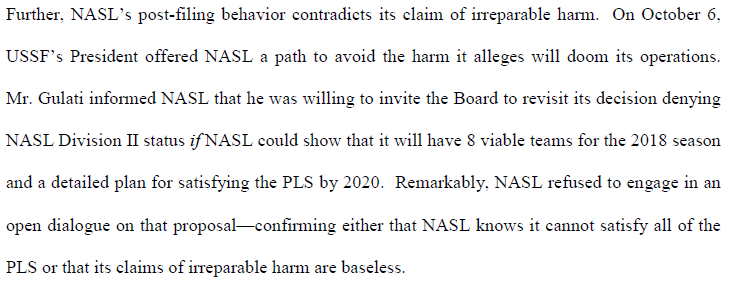
Oct. 6-8, 2017: Ex 57: Email (no true copy presented) to Commisso and Sehgal offering to ask Board to reconsider D2 if it can demonstrate by Oct. 20 that it has eight economically viable, separately owned teams and provide by Nov. 20 a plan for getting to 12 by 2020. Commisso basically says, “Not interested in talking unless it’s part of a confidential settlement communication. Gulati responds by playing the Columbia card: “If you’d rather send me another email drafted by your lawyers, that’s up to you. If on the other hand, you want to see if two guys who love Columbia and the sport can address the NASL’s current needs, then I’m willing.”

OTHER USSF EXHIBITS

Exhibit 1: Minutes of first USSF (USAFA) meeting: April 15, 1913
Ex 2: First articles of incorporation of USSF (USAFA), 1914
Ex 3: FIFA Rules on Amateurism and Professionalism, 1924 (included to demonstrate FIFA mandate that federation should govern both)
Ex 4: FIFA statutes, 1958
Ex 5: FIFA statutes, 2016
Ex 6: USSF bylaws, 2017
Ex 7: U.S. Olympic Committee bylaws, 2017
Ex 8: Pro League Standards, 1995
Ex 11: PLS, 2014
Ex 58: FIFA statement, 2008 (presented to show Statute 9 isn’t addressing closed leagues)
Ex 60: PLS, 2008
Ex 61: PLS, 2010
Ex 62: Chart summarizing PLS changes from 1995 to 2014


pro soccer

How the NASL can bring down Sunil Gulati (maybe)

After reading the main text of U.S. Soccer’s response to the NASL complaint, I sat down to read Sunil Gulati’s “declaration.” Most of the 78 pages are dedicated to restating the main text, just in more detail, and stating much of the U.S. Soccer bylaws.

Add it all up, and Gulati makes a convincing case — on paper, at least — that the decisions on sanctioning leagues are made by Board members and Task Force members who are not affiliated with any pro leagues. They even disagree at times. In 2017, the Professional League Task Force (currently VP Carlos Cordeiro, CEO Dan Flynn and Paralympian Chris Ahrens, but I’m not sure that was the same group that voted) recommended against provisional Division 2 sanction for the NASL (and the USL) but that the Board (with Gulati, MLS commissioner Don Garber and anyone else associated with a current pro league recusing themselves) voted to grant those sanctions.

(The minutes for this Board meeting — Jan. 6, 2017 — are not currently on the USSF site. I’m inquiring.)

So — again, on paper — Gulati, Garber and company can’t just do whatever they want.

The task before NASL is to prove that Gulati pulls all the strings.

That’s much easier said than done.

The NASL could hammer away at Gulati for his role in bringing in independent directors for the Board. He’s on the Nominating and Governance Committee, along with Garber (chair), Youth Council rep Tim Turney, Athlete rep Angela Hucles and independent director Donna Shalala. Board minutes over the years show him giving reports on searches for independent directors.

Gulati has sought to diversify the Board in several ways — gender, ethnicity, background, etc. As far as I can find, no white man has ever been an independent director, though it’s a new-ish position. Is he also seeking people who’ll do what they think he wants? Hard to say, especially given this …

(Yes, Shalala stands accused of falling asleep when the NASL made its big presentation Sept. 1. But, again, Lamar Hunt fell asleep when Doug Logan interviewed to be the first MLS commissioner, and Logan still got the job.)

On the other hand, the most recent Board addition is a banker named Lisa Carnoy, a trustee and board member at Columbia, where Gulati teaches. (But also where the soccer stadium is named for Rocco Commisso, someone Gulati was happy to welcome into the pro game as the Cosmos’ savior but is now calling for Gulati to step down every couple of days.)

But even if Gulati has managed to install three puppets as independent directors, along with an ally (Garber) as a Pro Council rep, it’ll be much more difficult to demonstrate how Gulati is somehow manipulating the Youth Council, Adult Council, Athlete Council and National Council to do exactly what he wants. A current Adult Council rep, John Motta, defeated Gulati in a VP election in 1998 and has made noise about running for the presidency.

The Legal Steves (Bank and Holroyd) will need to weigh in to tell me whether all this evidence is enough to fend off accusations of a USSF/MLS/SUM conspiracy from a legal point of view. The practical point of view might be another story. But this is going to court, and to me, the NASL will have a difficult time explaining to a judge that this is a conspiracy.

The other legal argument the NASL has in its pocket: Under U.S. law, U.S. Soccer (and by extension, FIFA) have no authority to regulate the pro game at all, even though we the NASL have said for years that they do. If this argument works, everything short of frogs and locusts rampaging down Fifth Avenue is possible. Maybe the USA would even get kicked out of the next World Cu- … oh, right. OK, the next Women’s World Cup.

A few other odds and ends from the USSF massive document dump:

Gulati depicts himself as someone who constantly tried to help the NASL. He makes several references to Brian Helmick of the San Francisco Deltas expressing his gratitude, which gives me an excuse to play the Beastie Boys:

The exhibits pile on the examples of Gulati personally intervening to help NASL, along with several restatements of intent to help NASL get to D1 status someday. Make of that what you will.

For much of the balance of the year, and into January 2017, I and other USSF representatives invested a lot of time and energy trying to save the NASL – not destroy it as the NASL would now have the Court believe. We helped the NASL explore a merger possibility with the USL, and when that option failed to materialize, I discussed with Mr. Commisso the possible transfer of ownership of the New York Cosmos – which, if it had not occurred, would have almost assuredly led to the demise of the NASL.

gulati-nasl-hist


The first few exhibits are copies of documents from the 1910s and 1920s. Funny how lawsuits provide such a windfall for historians.

What about indoor? Gulati’s declaration cites FIFA statutes requiring national associations to govern football in all its forms. So what about the MASL, which isn’t in the USSF umbrella?

Deloitte is everywhere. The Pro League Standards Task Force includes one Alex Phillips, formerly of UEFA. Also formerly of Deloitte, which produced an easily dissected report in favor of promotion and relegation at the behest of Riccardo Silva (NASL’s Miami FC).

So dangerous you’ll have to sign a waiver. Gulati says he has been pushing for a while for fewer waivers in all leagues — MLS, NASL, USL, NWSL.

On SUM: Gulati says SUM was able to make a great deal by bundling. “As a consequence, SUM was able to negotiate sponsorship and broadcast deals which generated more money for both MLS and the USSF than either had previously been able to negotiate.

The revenues generated from USSF’s relationship with SUM benefit all stakeholders in the sport of soccer in that it allows the USSF to devote additional resources for, among other things, player, coach and referee development, safety education and the development of training centers.

On the standards: “Without a credible threat to deny non-compliant leagues a sanction for a particular division, the USSF would have almost no leverage to enforce its standards.”

gulati-why-pls

On what the NASL might do next:

gulati-harm

Today, Midfield Press reported that a couple of NASL owners plan to “help several ambitious NPSL clubs make the leap to the pros by temporarily financing them until long term investors can be found.”

I should mention I’ll have an NPSL-related podcast next week.

On my citation: You may have seen this on Twitter yesterday …

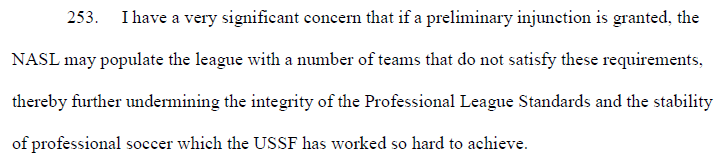
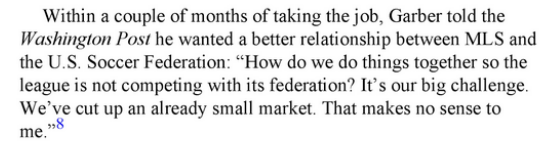
Here’s the funny part — that was NOT a quote I got directly from Don Garber.

Check out Exhibit 12 from the NASL filing / Rizik Declaration:

post-cite

Notice the “8” footnote? Or the “told the Washington Post“?

That footnote goes to a Steven Goff story from Oct. 22, 1999.

I don’t think I’ll be subpoenaed.

Next up: Reconstructing the timeline of how everything fell apart from the multitude of USSF exhibits. This could take a while.

pro soccer

Quick read of the longggggg U.S. Soccer reply in the NASL suit

U.S. Soccer deserves blame for many things. The organization is fundamentally arrogant and stubborn, and that may have played a role in the men’s national team’s failure to qualify for the World Cup — along with recent failures in the Olympics and a plateau or decline (depending on whose numbers you use) in youth soccer that threatens to undo decades of progress.

But are they really obliged to do any more than they already have for the NASL?

A few questions I’ll have as I go through this:

  • What does U.S. Soccer have to say about the 2015 Pro League Standards (PLS) proposal that the NASL seems to regard as the last straw?
  • How much info will U.S. Soccer spill about all the NASL’s missteps?
  • Does U.S. Soccer present a viable case that it can legally determine who’s a FIFA-sanctioned league under U.S. law (Stevens Act), and if not, are we headed toward U.S. Professional Soccer Armageddon (USPSA)?

Here we go …

SUMMARY

Literally the bullet points …

ussf-sum

INTRO, translated to English

“Look, what do you want from us? We created PLS in 1995, when the NASL was still as much a synonym of 70s excess as Pele and Mick Jagger stumbling out of Studio 54. Then you guys decided to revive the brand name in 2009, and we held your hand through endless turnover and a racketeering scandal that engulfed your biggest owner?

“And it’s not as if Don Garber and a bunch of MLS/SUM guys are sitting here revising the PLS to sabotage you. It’s an independent task force, and directors affiliated with pro leagues can’t vote on whether to change the standards or let you guys have your precious D2 status or your more precious (ha!) D1 status. You really want to tell us Goldman Sachs alum Carlos Cordeiro, Clinton administration alum Donna Shalala and WNBA/Big East exec Val Ackerman are conspiring against you?

“Oh, and they’ve based all their “showing of harm” on the declaration of an owner (NY Cosmos’ Rocco Commisso) who just joined this sinking ship a few months ago. Now they’re crying about how impossible life would be in D3, to which we offer three letters: USL.

“Your Honor, if you grant this, you’ve undermined our entire organization, and you should get ready to serve as the de facto decider of divisional structures for the foreseeable future because everyone’s just going to sue.”

INTRO, crux of the legal argument (verbatim)

The preliminary relief NASL seeks—an injunction requiring USSF to sanction it as a Division II league for 2018—conflicts with the ultimate relief NASL seeks: an order striking down the PLS altogether. Indeed, NASL asks this Court to order something that it argues violates the antitrust laws. And in doing so, it wants the Court to reengineer the core activity of a legitimate sports governing body—something the antitrust laws and abundant precedent do not permit.

INTRO, recurring grammatical error

The commas are not needed here …

ussf-commas

INTRO, new-ish stuff

ussf-new

ABOUT USSF GOVERNANCE

A bit of history we all know but is necessary for the legal record — World Cup in 1994, MLS in 1996, etc. Highlights:

  • Yes, USSF is willing to have multiple leagues in the same division. Just meet the standards.
  • Many references to Professor (Steven) Solomon, a governance expert at Berkeley who got his law degree from … Columbia! Is it hidden in the bylaws somewhere that everyone involved in U.S. Soccer must have passed through there at some point? My brother did a medical residency there — can he join the board?
  • The process for new PLS: The Task Force includes no reps from leagues or the USSF Board of Directors, the proposed revisions go out to all pro leagues (including NWSL, for the record) for comment, the revised revisions go to the Board, and the Board (with any pro league people recused) votes. Footnote: The NASL didn’t object to the “time zone” standard in 2014. When it (and other leagues) objected to the 2015 proposal, the task force withdrew it, and the Board never even voted. (I think the NASL reply may hammer at the claims of independence of this task force. If not — that would be a major omission.)

“HEY, YOU USED TO LIKE US!”

Parts F and G of the Statement of Facts run through the USSF/NASL relationship over the years. As stated:

  • 2011: The league nearly fell apart before it started, but the USSF kindly helped the NASL to its feet and gave it D2 status with a bunch of waivers, and CEO Aaron Davidson said he took the standards seriously.
  • 2012-15: The NASL still didn’t meet D2 standards, but the league assured us it was progressing, and nobody complained.
  • 2015-16: The NASL, still not meeting D2 standards, applied for D1 and started complaining about the standards. “In ensuing discussions,” the USSF asked pointed questions about Traffic Sports, which owned several teams and was the league’s marketing agency … until it pleaded guilty to racketeering in May 2015. NASL said it was dissociated from Traffic, so the USSF gave it another year as D2 in 2016.

Then USSF drops the bomb:

ussf-2016

The Task Force advised the Board not to grant the NASL a D2 sanction for 2017. The Board (again, minus recused members) gave it anyway.

The application for 2018: NASL had “at best” commitments from seven teams and no detailed plan for complying with the PLS.

MORE LEGAL ARGUMENTS

Roughly translated, but I think the two Legal Steves — Bank and Holroyd — can do a much better job dissecting this part:

  • Given the USL’s success as a D3 league, there’s no evidence of “irreparable harm” if the NASL plays D3.
  • There’s some hair-splitting about what a mandatory injunction can or cannot do.
  • There’s no conspiracy among USSF, MLS and SUM because:
    • Recusals on votes
    • The PLS existed waaaay before the NASL
    • “MLS’s participation in USSF does not evidence conspiracy as a matter of law.” (Several precedents cited)

“Put simply, unless the Court is willing to conclude that decisions made by the disinterested members of the USSF Board (directors such as Ms. Ackerman, Mr. Cordeiro, Ms. Shalala, and directors affiliated with youth soccer) are somehow part of a supposedly decades-long conspiracy aimed at driving the NASL out of business, there is no evidence of any unlawful agreement.”

  • A 1988 suit against NASCAR is cited as precedent that a lawsuit cannot “reengineer the core activity of a legitimate sports governing body.”
    • “Here, the NASL asks the Court to decide the right structure for professional soccer in the United States, and to reject the successful framework established by USSF decades ago.”

DEFENDING THE PLS

USSF argues that the standards are “pro-competitive” because they make sure leagues are credible.

Is it too easy to take a shot at the NASL griping that other major soccer leagues don’t have time-zone requirements, when it’s quite obvious that the countries in question have only one time zone? No, it’s not. USSF does just that. The time-zone standard is certainly ripe for debate — I see no reason for a second-division league to be national — but the NASL tossed the USSF lawyers a slow-pitch softball here.

Then comes an interesting argument: According to precedent (at least, USSF’s interpretation of that precedent), the plaintiff has the burden of proving that the PLS have an adverse effect on competition and that the same pro-competitive effect can be attained some other way.

(To which the counterargument would be “pro/rel,” and the counter-counterargument would be “you really think this is about pro/rel now?” and “that doesn’t address the USSF’s right or responsibility to set standards that could easily render pro/rel moot.”)

Oh, and Japan and Spain have minimum stadium-size requirements, so the NASL can’t say the USSF is unique.

Then the argument turns to the “greater good” realm: “NASL screams about supposed harm to itself, but never explains how the PLS harm U.S. sports fans, who have enjoyed an unprecedented growth in the sport of soccer under USSF’s watchful eye.” Is that legally relevant?

BALANCE OF HARDSHIPS: This will hurt me more than it’ll hurt you

In short: “NASL seeks an order that would eviscerate USSF’s standing as the governing body for soccer and seriously harm its relationship with FIFA.”

And that’s the main document. Tune in tomorrow when I make it through the rest of the … whoa … let’s make it next month …


soccer, women's soccer, youth soccer

Upcoming coverage/career plans

Mid-major announcement to start with: Ranting Soccer Dad now has its own site. I’m not married to the design yet, but it should stabilize in the next few days. This site and podcast will be my top work priority for some time to come. I’m even planning a related book. Stay tuned.

Ranting Soccer Dad deals primarily with youth soccer, but it ties into everything in the soccer world — U.S. Soccer politics, the national teams, the pro leagues (men and women), etc. Even if you think you’re not interested in youth soccer, check it out. You’ll find some interesting guests.

I’ll still be freelancing on occasion for The Guardian and Four Four Two, and I’m open to other suggestions. You may be a little less likely to get random pitches from me for the foreseeable future.

What about women’s soccer? 

These days, there’s less of a place for me in terms of NWSL and WNT coverage. Part of that is simply where my reporting has carried me (huge stories elsewhere), part of it is the ongoing decline of the news media (it’s nice to get paid every once in a while).

But I’ll still want to have a lot of female guests on the podcast, and we’ll certainly talk about every level of the women’s game. When I see youth soccer leagues in our area, I see a lot more boys than girls, and that concerns me. Farther up the ladder, I frankly was not impressed with the quality of play in the NWSL this year, and I’m not sure whether that’s a coaching preference for a “physical” style of play or a lack of quality coaching in clubs and college. (Probably a bit of both.) We’re going to address that at Ranting Soccer Dad, and I’d love to talk with a lot of people who can diagnose the problem better than I can.

I’m also going to be a bit of an agitator for more and better coverage. Equalizer Soccer is a great resource, and SB Nation’s various blogs are generally great at giving the women their due. Elsewhere, coverage is lacking, and I’m not just talking about the News & Observer‘s inexplicable decision to ignore an NWSL semifinal that took place in its backyard. ESPNW ramped up a bit for the NWSL playoffs, but I wouldn’t say they were a vital WoSo news source throughout the year. Other large sports sites give irregular coverage.

On all the politics around WoSo — I had good advice yesterday to “amplify” good reporting and analysis. I think I can do that. I’m going to avoid rehashing old debates. In the past 18 months or so, I’ve dealt with three primary groups of people — people who’ve made good points and engaged in actual discussion, people who may mean well but come across as condescending know-it-alls who don’t listen, and people who are simply reprehensible. If the last group takes over WoSo fandom without challenge, the sport will suffer.

But I’ve learned a lot from the discussion, and I intend to keep learning without being as active a participant as I have been. This is a starting point:

And yes, learning is a lifelong process. Even if most of us think we know everything at age 21. (Hey, I did too!)

So I’m not quite giving up WoSo. But I can’t really justify taking up a season credential at Spirit games and coming home to write about it without a significant outlet, and I’m not really shopping myself around to find a significant outlet. You’re probably more likely to find me on Spirit Hill next season than in the pressbox.

I’m very happy with what I’ve done in WoSo — everything from covering W-League games in the mid-2000s with maybe 200 people in the stands to the 2008 Olympic final and the 2011 Women’s World Cup opener. I’ve covered labor disputes and the WPS implosion, and I’ve covered a lot of good soccer and good soccer players. I hope someone coming out of college today gets to have all those experiences. (Maybe not the WPS implosion.)

What about MMA? 

I enjoyed writing for Bloody Elbow this year, and I really should finish my Cageside memoir at some point. There’s just too much going on in soccer right now.

What about Olympic sports?

I’ll update the Perpetual Medal Count at some point, and I’ll do one for winter sports as well. And I’ll do the occasional post. Most likely on curling.

What about music?

Once a month at Popdose and occasionally at Mostly Modern Media, where I’ll also periodically skewer political bullshit in all forms. And economists.

What about everything?

Good song to end this:

podcast, pro soccer, youth soccer

RSD15: The clogged youth-to-pro pipeline, with Brian Dunseth and Chris Keem

Was Nik Besagno a warning sign?

The top pick in the 2005 MLS Draft — ahead of Brad Guzan, Michael Parkhurst, Will John, Chris Rolfe, Bobby Boswell, Chris Wondolowski and Jeff Larentowicz — had a very short MLS career. Perhaps not coincidentally, that’s when people started to wonder if the U17 residency in Bradenton was producing soft, coddled players.

Yes, the youth-to-pro pipeline is at the core of our national wailing and gnashing of teeth after the U.S. men failed to qualify for the World Cup. It’s a topic so big, we need two guests.

First up, player-turned-commentator Brian Dunseth talks about what happened in Trinidad (3:30), Olympic soccer and how much it hurt the men to miss out (5:00), losing players from youth soccer (9:40), the parental perspective when clubs start demanding your money (11:20), the importance of failure (17:00), whether players are too soft or coddled (20:15), MLS (27:15 and 33:10), coaching education (28:15), relegation from a player’s perspective (35:45), the Development Academy (39:45), and an easy solution to all of this (40:10). Then concussions (44:30).

Then it’s Chris Keem, a veteran youth soccer coach and administrator with experience in college and the NPSL as well, joins us around the 50-minute mark. We start out talking about turf wars and how they drive up prices in youth soccer, then move into dealing with the Development Academy when you’re running another youth club (53:45), addressing “pay to play” and how it works in other countries (58:00), getting a club’s coaches on the same page and poaching vs. development (1:04:30), what the NPSL was and what it wants to be (1:06:00), and why youth players may opt for other sports (1:17:30).