youth soccer

2017 NSCAA presentation: Parent coaches

I did a presentation at the 2017 NSCAA Convention in L.A. called “Confessions of a Parent Coach: How to Recruit and Train Us.” Several people were interested in seeing it again and sharing it, so I’ve roughly reproduced it here …

ABOUT ME

I got into youth soccer as a journalist first (not counting my experience as the best U14 center back in Athens, Ga., before anyone else in Athens started playing soccer). I would go to an NSCAA Convention to cover the MLS draft, and then I’d meander over to the meeting rooms to see what was going on.

Coincidentally, in 2010, I left USA TODAY, mostly so that I’d have more family time. Time to do things like … coach my kids in soccer. So I was getting multiple perspectives on the youth game. I was just learning how to be a parent coach, and I was starting to cover youth soccer issues. In 2011, I came to the convention on assignment with ESPN and saw Claudio Reyna unveil the new U.S. Soccer curriculum. Then I ran back over to the MLS draft and interviewed Bruce Arena, telling him I had just seen Claudio unveil the curriculum.

“Claudio who?” Arena said in that “I know who you mean, having coached him in college and on the national team, but I’m going to toy with you a little bit because I do that” tone of voice that he has.

Then he told me he believed the country was too big and too diverse for any single style.

So I’ve known for a while that this isn’t easy. We don’t all agree on what we’re supposed to be doing in youth soccer. And in this chaotic environment, you’re asking volunteers to give kids their introduction to the sport. Mostly parent coaches.

“Parent coach” is a broad term, of course. Sometimes you have pro coaches who have kids, and then they’re “parent coaches,” too. Some parent coaches go on to stick with it through older age groups, and we’ll talk a bit about those groups later. But for most of this presentation, we’ll be talking about the early age groups, where we have not yet split into “recreational” and “travel.” Some of these kids may have pro coaches with A or B licenses later on, but for now, it’s on us.

So first, let’s take a look at this age group.
slide2

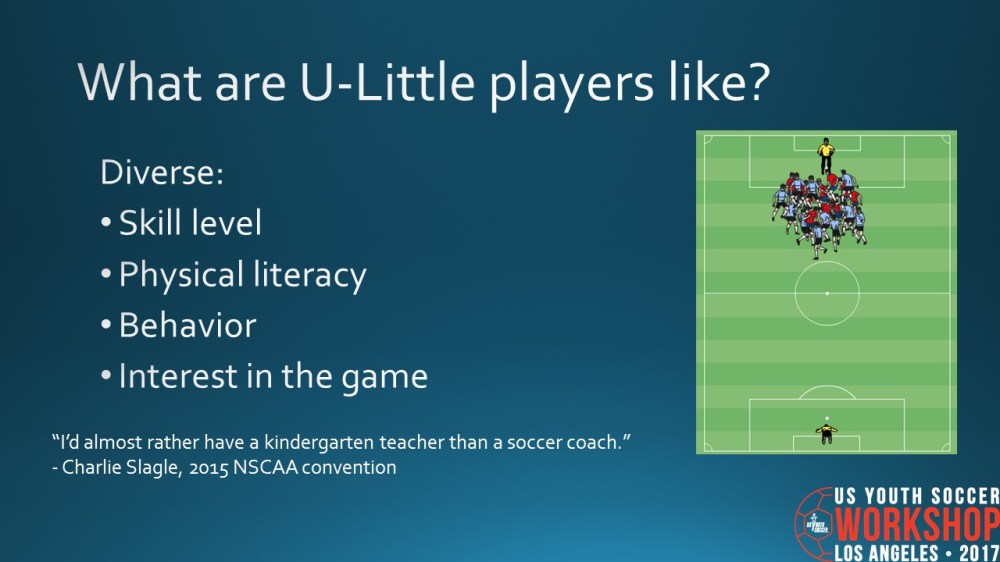
WHAT ARE U-LITTLE PLAYERS LIKE

The biggest difference between early-age rec and elite-level travel is diversity. If you’re coaching a U6 team, you may have some players who are already showing signs of being “elite” one day, and you may have some who look like they’re never going to understand the basic idea of the sport.

They’re diverse in these ways:

  • Skill level: Some are already juggling. Some can’t kick the ball.
  • Physical literacy: I don’t know what kids are learning in P.E. classes these days, but they’re not learning how to run. (I bumped into Sam Snow in the hallway and asked him how we’re supposed to teach that. I’m hoping it’ll be a topic at future conventions or maybe even part of the F license.) And even so, kids at this age are going to be all over the map, maybe changing from year to year or month to month. Kids will hit growth spurts and be unusually clumsy for a few months while they’re adjusting to their new bodies.
  • Behavior: Some really want to play soccer. Some … really don’t. Some do, but they’re easily distracted. Some do, but they’re easily distracted. Some are blissfully unaware that a soccer game or practice is in progress around them.
  • Interest in the game: Some kids get up on Saturday mornings to watch Premier League games, or they spend their Sundays watching Liga MX and MLS. Some go to games – MLS, college, anything. Others haven’t seen a soccer ball outside of practice.

So what do we need to lead these kids? The Charlie Slagle quote here about needing a kindergarten teacher is apt. So is this quote from Sam Snow: “At this age, think of yourself as a PE teacher of soccer more so than the manager of a soccer team.”
slide3

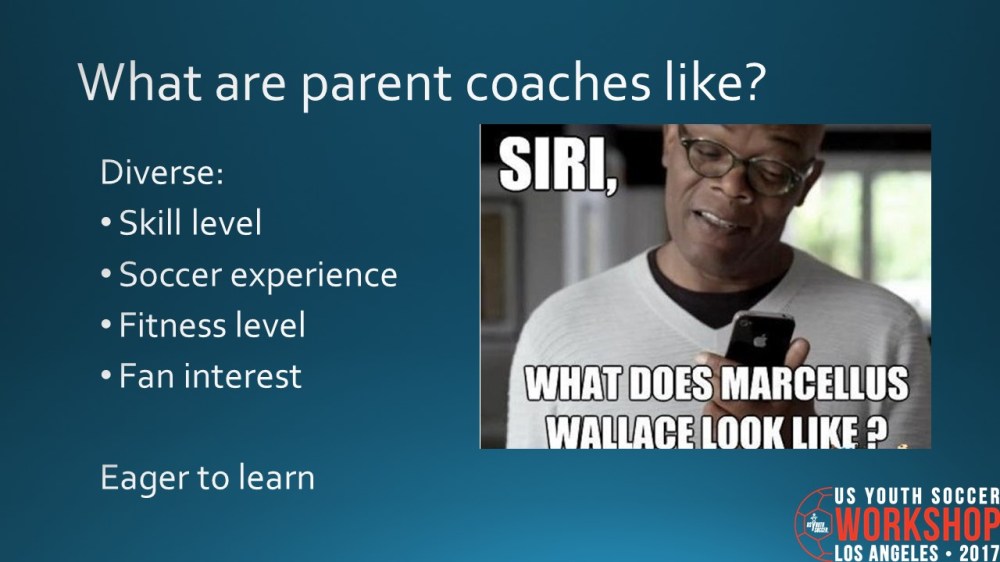
WHAT ARE PARENT COACHES LIKE

We’re also diverse. In some of the same ways.

  • Skill level: Some of us got great training growing up. Some didn’t. And for some of us, it may have been a long time.
  • Soccer experience: Some of us used to play at a high level. One of the parent coaches in my league the past few years played with Julie Foudy at Stanford. Some of us used to play at a not-so-high level. Some of us never played. The last group may be getting smaller, but it’s still there.
  • Fitness level. Some of us are triathletes. Some of us work at a desk 10 hours a day and can’t find the gym.
  • Fan interest: Some of us watch MLS, EPL, Liga MX, Champions League, El Clasico, the Old Firm Derby and anything else we can find. Some don’t know what channel those games are on. Some, particularly younger parents, have “cut the cord” on cable, and they’re not watching any live sports.

One thing we generally have in common: We’re eager to learn. We want to know what we’re doing. But there are limits. We don’t want to spend two weekends away from home to learn how to be a recreational coach for 13-year-olds. We DO want feedback and some easily digested advice.

slide4

I’d argue both of those quotes are valid. I’ve certainly run into some “BOOT IT!” parents. And I’ve run into some who are much better than the paid travel coaches I’ve seen screaming at kids in U9-U11 travel games. (And older, actually — I couldn’t believe how much “joystick coaching” I saw at the USYSA National Championships.)

slide5

WE HAVE SOMETHING TO OFFER

There’s a quote attributed to Bill Nye (the Science Guy, and also the comedian who created the legendary “Speed Walker” character on Almost Live): “Everyone you will ever meet knows something you don’t.” I’ve seen some NSCAA presentations that make similar points. Your parent coaches probably don’t have the soccer expertise you have. Some of them are great at building rapport with kids. Some of them are organizational geniuses. As you’re teaching them, see if they have something to teach you.

Charlie Slagle again: “A lot of coaches become much better coaches when they become parents.”

slide6

AND YOU NEED US

Here’s a hypothetical: How much would you need to charge if you had professional coaches for every recreational team in your club, no matter the age groups?

Some clubs get high school or college volunteers. Some don’t. But I really don’t know any full-service clubs (travel and rec) that don’t have parent coaches in some capacity. And even if your club is travel-only, you’re going to be recruiting kids who had parent coaches at their rec clubs first.

WHAT WE DON’T NEED

slide7Long licensing classes in how create a training plan. Most clubs these days have a curriculum or at least some training plans. We can also find training plans online.

slide8We also don’t need incomprehensible training plans. Please don’t overthink it. We’re supposed to avoid “laps, lines and lectures.” Then we get training plans with 3-4 new complicated exercises to teach every practice. So we’re spending 15 minutes out of an hour in lectures. And we have to get these kids in line while we’re lecturing them. Then they run out of patience and act up, so we have them run laps.

slide9

WHAT WE NEED

On-demand video is a great start. The online F license is a vast improvement over the old in-person F license. We can see Shannon MacMillan and Vince Ganzberg running sessions, on our own time.

And that takes away the excuse. You don’t like having unlicensed coaches in your club, and parent coaches don’t like dealing with unlicensed coaches. Put it online and on-demand, and you’re in a better position to require us to do it.

I’d love to finish my D license. I can’t. I needed to shoot video of myself coaching older kids, and that’s difficult to set up. Then I needed to go to an evaluation weekend. Couldn’t do it. (And I wrote about it.)

Technical tips are vital because, again, a lot of us didn’t just finish successful pro careers. At older age groups, it’s a safety issue – we need to know how to teach proper heading. In younger age groups, we just want instill good habits.

And just as nature abhors a vacuum, coaches will fill in gaps in our knowledge, sometimes with the strangest takes on things. I coached with someone who had been trained through AYSO, and somehow, he had it in his head that soccer players weren’t supposed to be creative. He decided all the kids had been improperly coached because they didn’t dribble in straight lines using their feet pointed downward like ballerinas, kicking only with the laces. The previous technical director in the club, who was from Brazil, had taught us to teach kids to use all surfaces of the feet. This guy berated the team all season for failing to do things one rigid way that they simply hadn’t been taught.

Disciplinary tips: I’m not going to berate my team for things like using the “wrong” surface for dribbling. But I am responsible for safety, which means getting the kids to quit grabbing the goal posts and so forth. And we don’t talk about it in licensing courses or most other coaching literature. The F license gives us a couple of ideas for getting kids’ attention – don’t make kids squint into the sun, take one knee to get on their level, etc. – but we don’t know what to do when kids are disruptive. On your U16 travel team, where you can threaten to bench someone who’s misbehaving in practice and you know their parents will take away their xBoxes, then you have some options. On my U8 rec team, I don’t have much.

slide10

MAYBE A SEPARATE LICENSING TRACK

It came to my attention at the 2017 Convention that U.S. Soccer is indeed revamping its coaching pathways. Again. And that’s good. The F license is a good building block for everyone. The E license is so-so. By the time we reach the D license, we need to recognize that my U14 rec training is going to be a little different than D.C. United Academy’s U14 training. I hope so, anyway.

And we really don’t need licensing courses in which the coaching candidates have to be demonstration guinea pigs. That’s fine for the kids straight out of college who are just starting out in their adult lives. Those of us in our mid-40s with Achilles tendinitis issues don’t need to spend a weekend chasing around people who are in much better shape than we are.

We might need an in-person session on teaching technique. That’s tough to get across in a video. Anything else that can be online really should be online.

And we don’t need to learn about periodization, no matter how much that topic is in vogue in NSCAA circles right now. I have some kids in rec who are getting no other exercise. I have some who are playing multiple sports. Talk to their track coaches about periodization.

slide11

WHAT CLUBS CAN DO

U.S. Soccer might not give us the recreational coaching program we all want. And even if they do, you as a club’s technical staff need to follow through at club level. Maybe you can do technical tips. Do something to meet your coaches face-to-face.

Then follow up with more conversation. Maybe everything makes sense in a preseason coaching clinic. Then after a few weeks, your new coaches have a few questions. Have a mailing list or some sort of discussion forum so you can talk about it.

Then listen to us. Remember, we’re coaching your future elite players. You have the edge when it comes to spotting soccer aptitude. But we’re working with these kids every week. We can tell you about their attitudes and their enthusiasm. We can tell you which kids are responding well to coaching and which ones think they know it all. Don’t be surprised when someone who stood out at U9 tryouts turns out to lack the attitude needed to learn the game.

slide12

RECRUIT AND RETAIN

A few ideas here, and the first two come from the same general area – please don’t make us spend a lot of money to be coaches. We need goals, we need pinnies, we need cones, we need ice packs.

The next two are also from the same general area – talk with us, give us some ideas.

And in that communication, try to get us all on the same page. It’s so frustrating to coach a U8 team the “right” way – emphasizing skill development over winning, rotating players through different positions, etc. – and then go up against a coach who didn’t get the message and has one big kid in front of his own goal booting the ball up to a fast player in front of the other goal. Balance the teams so the kids get challenges (and don’t get too discouraged). If you’re trying to instill a particular playing style, let us know what that is and how to get it.
slide13

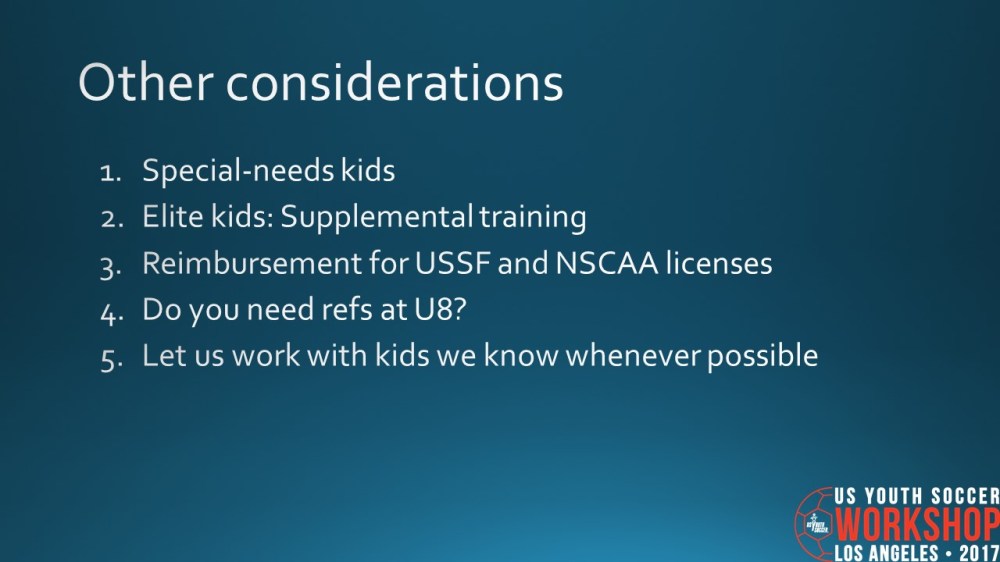
OTHER CONSIDERATIONS

We’re going to have some special-needs kids. Some have been diagnosed, but the parents would prefer that they try general rec soccer instead of TOPSoccer. Some have NOT been diagnosed. Either way, we could use some advice.

Supplemental training: Hopefully, your club is offering something to let players with better-than-average aptitude and interest work with professional coaches and refine their technique.

Reimbursement: Again, please don’t make us pay out of pocket for something that’s supposed to benefit your club.

Refs at U8: This is controversial. But I had some bad experiences at this age coaching against self-styled General Pattons, whose players figured they’d win the game by fouling the bejeezus out of my players. One game was so bad that a parent on my team made a flimsy excuse to get her son off the field. She emailed me later to explain her anger at what was transpiring on that field.

Working with kids we know: I know it runs counter to AYSO principles. But you want to put your parent coaches in the best position to succeed, and it helps to have them NOT spend half the season just getting to know the players. And it makes us invested in these kids. I worked with a co-coach once who clearly didn’t care about any of the kids in his charge. That wasn’t healthy. If I had an attitude like that, the other parents would quite rightly have run me out of the neighborhood.
slide14

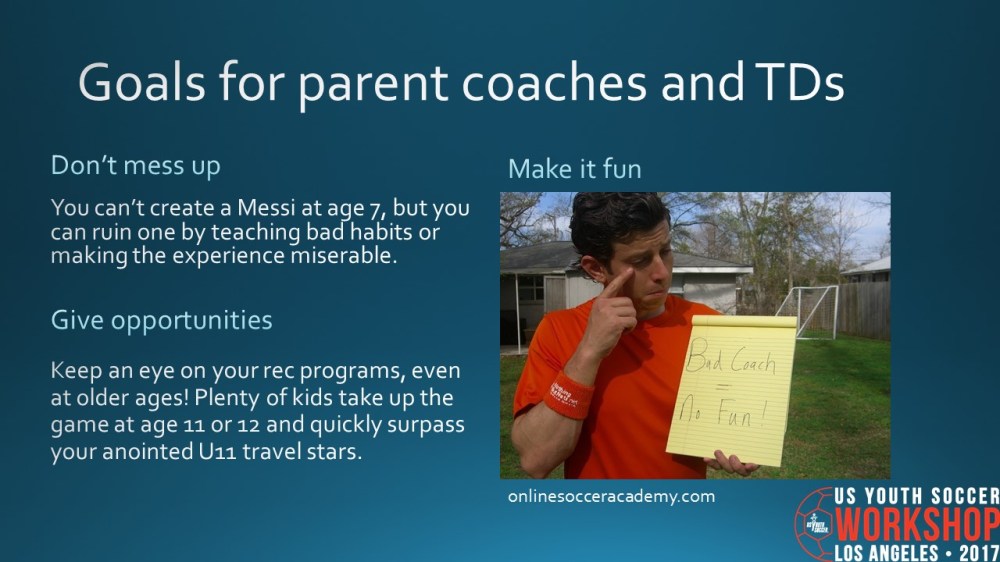
GOALS

We don’t want to instill bad habits. We also don’t want to make someone so miserable that he or she doesn’t come back and play. “Fun” is a loaded word, but remember – every kid we drive away from the game at U6 is a player you won’t have the chance to coach at U12.

And be sure that you haven’t cast the die on every player at age 8! Come on out and see how the players are doing at U11. We’ve all seen kids take up the game for the first time at U11 and make the A team by U14. We may not want to admit someone can do that without working 10,000 hours on the ball from age 4 to age 12, but it can happen. So come out and see the kids play. And while you’re at it, take a look at us coaching and let us know how we’re doing.

This presentation was well-received. I’d like to do it again, but I’d like to keep revising it to reflect what I hope will be an ongoing discussion. We can certainly do better with our youngest players, and that means better training for the coaches that will work with them. Got feedback? Fire away.

soccer

Division 2 soccer: Just get on with it!

Two months ago, would anyone have bet on the former Carolina Railhawks landing an NWSL team before the men’s team got out of divisional limbo?

The news that the Western New York Flash will be moving to the Triangle (reported overnight by FourFourTwo, with follow-ups from local soccer-media veterans in Rochester and the Triangle) has shocked the women’s soccer world. Many of us are struggling for coherent responses. The NWSL has been stable through four seasons, adding two teams and moving/losing none. Now the defending champions, a holdover from previous WoSo leagues, have skipped town.

But it also puts some focus on the current turmoil in the lower divisions of men’s professional soccer, which has dragged on and on and on …

In fact, both ends of the Flash-to-Carolina move are still awaiting news on divisional sanctioning. The USL, which includes the Rochester Rhinos, seemed all but set to move up to the second division while the NASL, which includes NCFC (for now — they’re bidding for MLS expansion), was all but dead.

Thanks to the indomitable Peter Wilt, the NASL may no longer be dead. It also may no longer be the NASL, but something with six or seven or 20 teams may continue to occupy the second tier of the U.S. soccer’s pyramid next year.

Now that it’s January, it’s pretty clear whatever happens with D2 and D3 men’s soccer next year will be a stopgap. NASL 3.1 will need to follow through on those expansion plans if it wants to keep fending off the USL for D2 status, and I’m under no illusions that the USA will suddenly go to pro/rel in lower divisions, as much as I think the plans are getting more and more realistic.

And there are some legitimate issues that confuse things here — business models, league ownership groups, etc.

But the longer the divisional-sanctioning and NASL-Walking Dead sagas drag out, the absurd it looks.

Attendance isn’t the only measure of a soccer club’s health, but when you look at Kenn Tomasch’s diligently gathered attendance tables, it’s easy to spot the clubs that really ought to be playing each other at the D2 level:

  • FC Cincinnati (USL)
  • Sacramento Republic (USL)
  • Indy Eleven (NASL)
  • Louisville City (USL)
  • San Antonio FC (USL)
  • Tampa Bay Rowdies (leaving NASL for USL)
  • Ottawa Fury FC (leaving NASL for USL)
  • Miami FC (NASL, though wild spending may be an issue)
  • North Carolina FC (NASL, formerly Carolina Railhawks)
  • Oklahoma City Energy FC (USL)
  • Saint Louis FC (USL)

Add the San Francisco Deltas, the NASL expansion team, and that’s 12. Then pick from a few more possibilities:

  • Richmond Kickers (USL, two decades and counting, just made a facility deal to make roots even stronger but has had pragmatic approach counter to, say, the New York Cosmos)
  • New York Cosmos (NASL, with an apparent white knight bidding to save the team and perhaps with it the entire league)
  • Rochester Rhinos (USL, which once averaged more than 10,000 fans and now has its name on the stadium it has been sharing with the Flash)
  • Charleston Battery (USL — like the Rhinos and Kickers, a staple of lower-division soccer with a good place to play)

That’s 12-16 teams. That’s a viable league out of the gate, and it should attract more teams.

So the message here should be clear:

Just get it done.

Whatever you have to do — give USL’s league owners a stake in D2 revenues, drop the twice-poisoned NASL name, keep the strangely alluring NASL name, pay lip service to promotion/relegation as the NASL has done for a few years … whatever.

Because if there’s one coherent lesson from U.S. soccer history, it’s this: Soccer Wars are not a good thing.

Someone needs to play peacemaker and dealmaker. The sooner, the better.

soccer

The 2017 pyramid plan (and pro/rel myths)

In many ways, 2016 was the year the promotion/relegation movement grew up. The shifting landscape, with MLS pushing its expansion plans and the lower divisions getting a makeover, could make such a system more feasible. And some rational folks made a serious effort to wrest control of the movement from the conspiracy theorists and random hate-mongers who have dominated the discussion for too long, like so:

https://twitter.com/DanLoney36/status/813771705801998340

(I’m less skeptical than Dan, having had some decent conversations with some people this year. And yes, a few random dudes who seem to be into soccer more for the feeling of geek superiority than any actual enjoyment of the sport.)

We even have people who have decided concrete steps toward a traditional pyramid might be something other than just yelling at people like me who are nowhere near the decision-makers. Check tech entrepreneur/NPSL team owner Dennis Crowley or the UPSL, which intends to take pro/rel beyond local amateur leagues to a regional semi-pro league. And you can find a few earnest attempts to suggest modified pro/rel, at least as a transition to a more traditional approach down the road.

Of course, that’s not enough for the most zealous pro/rel advocates — or “pro/relouts,” in Steve Holroyd’s terms.

But I’ll offer up a guide for newbies, explaining why those people deserve no attention, a little later in this post.

What I’ll offer up here is an idea for, say, 2020. It includes promotion/relegation at several levels, eventually leading to a pyramid that’s at least as “open” as the one in the Netherlands.

First, let’s define some goals: 

  1. Stability. We don’t want to lose more clubs. We want clubs to have the confidence to build new facilities and invest in youth academies. We want fans to be assured their local club will be there in some form.
  2. Good competition with meaningful games. Exciting and demanding. Those are sometimes mutually exclusive, as anyone who’s ever watched a dour late-season slugfest between two relegation-threatened bus-parkers can attest. (Or a very tentative Cup final, which isn’t just an MLS thing.) But the good usually outweighs the bad.
  3. Fans’ dreams. One of the allures of pro/rel is the notion that a smaller club may one day work its way up the pyramid. The drawback in a lot of leagues around the world is that only a couple of clubs have a reasonable shot at the championship. Ideally, we’d let fans dream about both. (Yes, I know — Leicester City. A classic case of the exception proving the rule.)
  4. Simplicity. My previous attempts at this have been too complicated.

Now here’s an unusual premise, at least in terms of U.S. soccer history:

  1. Distinct “league” and “Cup” events. This gives us a chance to do some intradivisional matches in Cup play, mitigating risk by making it more likely that a “D2” club’s fans will still get a chance to see Giovinco, Morris, etc., in meaningful games.

THE PLAN

League structure:

Division 1: 16 teams, single-table, double round-robin.  League champion crowned in late May/early June (depending on World Cup, Copa America or Gold Cup timing). No playoffs. Bottom three relegated to Division 2.

Division 2: Initially 14-16 teams, mimicking Division 1, but might expand and break into regions — perhaps a 20- or 22-team league in which teams play each team in their region twice and every other team once. Then minimal playoffs — maybe two regional champions play for league title while two regional runners-up play for promotion place.

Divisions 3, 4, maybe 5: Regional pyramids. D1/D2 reserve teams are eligible to play. Structure can vary by region depending on travel needs, climate and other logistics. (Just see how often England has reconfigured leagues at D6-D10 level, and in that case, we’re talking about “travel” that U.S. workers would consider “commutes.”) Promotion and relegation is common, but Division 3 clubs must meet professional standards. Clubs that wish to remain amateur can still go as high as Division 4.

U.S. Open Cup structure:

The biggest change would be condensing much of it to the summer. Early rounds would be played during whatever major international tournament is going on. Late rounds would be played before college season starts, giving PDL and NPSL teams a chance to make runs. Condensing it may also drive up interest — the current Cup suffers from its long dormant periods between rounds.

MLS or U.S. Pro or Anschutz or Wilt or Garber … actually, let’s make it the Eddie Pope Cup:

First round overlaps with regular-season play in October/November. Two-leg aggregate until neutral-site warm-weather final on Dec. 24.

Twelve (12) qualifiers:

  • Top four teams from Division 1 get byes. (Side benefit: At least two of them will also be in CONCACAF play, so the byes will limit fixture congestion. A little.)
  • The next four teams from Division 1 qualify.
  • The top three teams from Division 2 (each of whom has also been promoted) also qualify.
  • The remaining spot goes to whichever professional team advanced the farthest in the Open Cup. (Clubs may opt to pass, in which case the spot goes to the next-best Open Cup team.)

The calendar

January: Winter break, secondary transfer window.

Early/mid-February: Friendlies in warm-weather venues.

March-May: D1 plays 15 league games. D2 roughly the same. D1/D2 champions crowned. Regional leagues play some league games and some Open Cup qualifying rounds.

June-July: International break and several Open Cup rounds. Also potential here for friendlies or mini-Cups within regions — maybe three D1/D2 clubs and the reigning champion of the nearest D3 region, for example.

July-August: Primary transfer window.

August: Open Cup final and start of D1/D2 league play.

August-November: D1 plays 15 league games along with any CONCACAF or early-round Pope Cup games.

December: Pope Cup semifinals and final.

The rules

Sounds almost like England, doesn’t it? The exceptions are that the League Cup analogue should draw a bit more attention, while the FA Cup analogue bows to the reality of amateur teams dependent on college players.

But we’re going to add a few policies that should ease the transition from the MLS single entity and mitigate risk.

  1. Salaries are limited by a “luxury tax” akin to baseball. This gives clubs the freedom to keep together a “superclub” but forces revenue-sharing so other clubs have a chance of keeping up.
  2. Division 1 and Division 2 clubs have shares in SUM.
  3. Clubs own their own trademarks. If a club is no longer capable of competing at the Division 2 level, it is permitted to self-relegate to Division 3.

So that’s the plan. Enjoy. Modify. Debate. It’s a trial balloon. And I plan to do some reporting in the next year to see how much of it is feasible.

THE REALITY CHECK

I like this plan. I really do.

But if it doesn’t come to pass, you know what I’m not going to do? I’m not going to accuse everyone who speaks up against it of being part of some shadowy conspiracy. I’m not going to hold my breath until my face turns blue or sneer at supporters of MLS clubs, Liga MX clubs or whomever.

Because I’m not one of the people — MLS club owners, sponsors, etc. — who has invested millions of dollars into the sport and is looking at the books while bearing responsibility not just for my own investment but for the livelihoods of employees and the credibility of the sport.

It’s really easy to spend other people’s money. It’s a little more difficult to risk your own. That’s why MLS is structured the way it is, and it’s why the NASL never got anywhere close to its goal of attracting so much investment that it would become a de facto top-flight league with so many clubs that it would simply have to do pro/rel.

The NASL had several years to build its sought-after fan base of U.S. soccer supporters hungry for an alternative to MLS. Those fans didn’t care that MLS had the “D1” tag and the NASL did not. And the NASL was free to find sponsors who believed in its model.

It failed.

A few clubs like Indy and Carolina (along with a handful of USL clubs) figured out how to fit their markets well, and one of my goals with the plan I’ve put forth is to give those clubs a clear path to follow Seattle, Portland, Montreal and other “promoted” clubs into Division 1 and all it entails.

Most people understand this reality. Some don’t — at least not yet. Some are beyond hope — they’re clinging to the age-old claim to hipster superiority for loving a sport that the people around them are too stupid to comprehend, like the tedious people we all knew in college who insisted R.E.M. recorded nothing worthwhile after Fables of the Reconstruction. (Coincidentally, Leaving New York just popped up on my Spotify shuffle. Beautiful song.)

But some people are well-intentioned. Some are newer to the conversation — younger, or perhaps new to the sport or to the USA.

And rather than repeat and rehash the myths that have long driven pro/rel talk in this country in 140-character bites on Twitter, I’m going to summarize them here. (Again.)


THE MYTHS

Lack of pro/rel is the only thing keeping us from overhauling England, Mexico, etc.

Sounds silly, doesn’t it? And no one directly says it that way. It’s generally more like “Why do you think Manchester United is more popular than Columbus?”

I can think of many reasons:

  1. History. The recovery from Munich.  Decades of brilliance under Busby and Ferguson.
  2. Three European championships.
  3. Twenty top-tier championships.
  4. Global brand-building. Their shirts are all over the world. They get money from that and from global television.
  5. Good players, many bought with the money they’ve accumulated from 1-4.
  6. The name “Nobby Stiles.”

It’s not because they were relegated in 1974.

But promotion and relegation make clubs better because they have to compete to avoid the drop!

It’s more incentive for the yo-yo clubs, sure. But even that has pros and cons. In MLS, a team playing out the string with no hope of making the playoffs (which rarely happens until the last month) can try out young players and give veterans one last shot to prove they should come back. In the EPL, you have Aston Villa last season and Swansea this year. Just wretched.

In any case, this assumption would be stronger if I saw the occasional Sunderland shirt. U.S. supporters love Liverpool, Manchester United, Real Madrid, Barcelona, Celtic and other clubs that aren’t going to get relegated unless they financially implode (Rangers). Those clubs are historical powers that are difficult to dislodge because they have the confidence to spend freely, knowing they ain’t dropping from the money leagues. (Which is actually why you sometimes hear calls for a two-tier Premier League to spread the TV money a little more broadly.)

I do enjoy the Eric Wynalda story about an angry player throwing a boot in a German locker room. Then again, I’ve seen a whiteboard with a freshly punched hole in it in an MLS locker room after an early-season game.

MLS, SUM and U.S. Soccer are conspiring to keep down promotion and relegation!

MLS was founded because FIFA demanded a legitimate First Division league as a condition for hosting the World Cup. Hosting the World Cup is an odd thing to do for a country that doesn’t want anything to threaten the NFL.

If they thought pro/rel was the best business model moving forward, they’d do it. They’ve yet to be convinced, despite all those years of … people yelling at journalists on Twitter. Gee, I thought that would’ve worked.

But they’re all NFL owners

Only a few, and you’d be hard-pressed to argue that Seattle’s partnership with the Seahawks has been a worse deal than Chicago’s partnership with nobody. And a lot of these owners just love sports. Stan Kroenke has ownership interest in MLS, the NBA, the NHL, the NLL, the NFL … and Arsenal. Lamar Hunt is in three Halls of Fame — soccer, American football and tennis.

Soccer United Marketing is … evil

Hey, the U.S. women’s soccer team has some questions about SUM as well. It’s an easy target. Its books are private, and there’s little question that the goal is to get a piece of the action of any soccer in the USA, televised and/or at U.S. venues.

That said, MLS would have collapsed in 2002 without it, and it has helped lure tons of new investors. And if you think U.S. pro soccer would’ve somehow been better off if MLS had gone under in 2002, I don’t think you’ll find many people who know the facts and agree with you. Soccer was a risky investment in the USA for a long time. Still is, to some extent.

SUM, like MLS itself, was designed to mitigate risk. That’s because everything that had come before it had died before it even had enough clubs to think about pro/rel.

You’re just a paid MLS shill 

A sample:

https://twitter.com/againstMLS/status/815249625934417920

https://twitter.com/againstMLS/status/815241130203815937

https://twitter.com/stevesharptonfc/status/815373967997353985

(I didn’t know I was supposed to finish my D license and then coach a U10 travel team as a prerequisite to writing.)

I’m not sure what else I can do to prove otherwise. Maybe I should take pictures of all my mail every day to show that there’s no paycheck from MLS or SUM? Shall I release my bank records?

I hardly even write about MLS any more. Since I left USA TODAY (where I was already writing far more about UFC than MLS) in 2010, my freelance work has been much more in women’s soccer than men’s. It wasn’t a conscious choice. It’s just that if ESPN emails and asks if you want to go to Germany for the Women’s World Cup, you’re not likely to say, “But I’ll miss three D.C. United games.”

My Twitter feed is diverse. I do much more unpaid shilling for curling and biathlon than I do for MLS. I haven’t counted tweets, but I probably tweeted more in the past three years about Liverpool than I have about any MLS club.

I haven’t been in an MLS pressbox or interviewed an MLS player in a couple of years, so you can’t even raise the “access” argument.

As for others — even TV personalities who are paid to talk about MLS don’t shut down controversy. Alexi Lalas loves debate. Eric Wynalda pushes the fall/spring schedule every chance he gets. Taylor Twellman spends about half of each game broadcast griping about the refs.

You may find a lot of people in journalism or just randomly on Twitter who happen to think soccer in the USA is better with MLS than it would be without it. It’s fair to say MLS isn’t paying all of them.

For the record — I wrote a few fantasy soccer columns for MLSNet (the forerunner of MLSSoccer.com) about 15 years ago. I believe they were run by MLB Advanced Media at the time, and that hasn’t stopped me from saying mean things about baseball. I also wrote a book on MLS history that probably would’ve sold a lot more if it had been more controversial. Maybe we’ll get pro/rel in my lifetime and I can write a sequel.

Or maybe the whole pro/rel controversy is good for my sales? So says a fellow soccer historian who has worked for the Cosmos:

(I love this tweet, David.) 

And here’s the funny thing: I’ve written many posts suggesting ways for pro/rel advocates to move forward and others suggesting actual transition plans (and so on).

U.S. journalists know nothing about the global game

Sports Illustrated and ESPN have gone global in a big way. Fox’s main analysts — Lalas, Wynalda, Brad Friedel — all played in major European leagues, so they just might know a little more than your typical pedantic youth soccer coach on Twitter.

Personally, I grew up with Soccer Made In Germany on PBS. Then I listened to shortwave radio and fussed with my antenna to see if Coventry City had managed to escape again — or I browsed the league tables in Soccer America.

These days, we can just wake up and flip on the TV to watch the Premier League or the Bundesliga. If we have the right cable package, we can watch any live game from the Premier League or the Champions League. (Which is not as easy to do in a lot of other countries.)

We get the concept of promotion/relegation. We just have access to a lot of other facts that point out why it hasn’t happened … yet. (Well, it did a little in the late 90s with the USISL, and it’s part of many amateur leagues.)

There’s no reason the USA should be different from the rest of the world

But it is. Read whatever history book you like — Soccer in a Football World by the late, great Dave Wangerin is the gold standard, Offside: Soccer and American Exceptionalism is also insightful, and a few other books have noted the cultural forces that held back soccer for generations.

The short version: The USA has always been a little insecure about a national identity. We still see it today in our fights over immigration, and those have deep roots. As Dave Chappelle once said (yes, I know I’ve cited this before): “I saw two Irish guys beating an Italian guy — these people are specific.”

So we invent new sports like basketball. Or we invent creation myths like Abner Doubleday’s “invention” of baseball. Anything to avoid doing things associated with the old country.

As someone who worked in journalism in the 1990s and had to fight for every bit of soccer coverage, I can tell you how ingrained that cultural antipathy really is.

It’s changing, yes. Millennials, generally (but not always) more enlightened about race and ethnicity, have embraced soccer. Kids at my sons’ schools wear plenty of Messi and EPL shirts.

But it has taken a long time. And when you’re evaluating decisions made in 1993 or 2002, you have to bear that in mind.

If we had pro/rel, tons of people would invest in small clubs

This happens on occasion overseas. A tycoon buys a favorite club (say, Hoffenheim) and climbs the ladder. Or a club like AFC Wimbledon replaces a club that moved elsewhere. But it’s not frequent (in part because sagas like Wimbledon-to-Milton Keynes are infrequent, at least outside of Mexico).

Besides, England barely had any clubs move from the fifth tier to the fourth for generations. The Netherlands has barely eased into pro/rel between the two pro divisions and the amateur ranks in the past decade.

Actually, if you want someone to take over your local club and move it up, the current U.S. system works pretty well for that. A lot of current MLS success stories were in lower divisions over the years. But at the same time, a lot of clubs have dropped from the professional ranks to go amateur. It’s cheaper. It’s less risk. They’re not interested in being “promoted” to a professional league in which their teams would be overmatched and they would play a longer schedule in which they couldn’t use college players.

If we can get new leadership at U.S. Soccer, we can make it happen

I’m looking into this. I’ve pored over thousands of pages of U.S. Soccer governance documents. I found nothing about pro/rel discussions and a whole lot about mundane issues like referee certifications.

Whatever you do, though, you can’t simply impose a system that immediately devalues investments that have been built up over the last 20 years. You have to come up with something that works for everyone, which is what I’ve tried to do above. Otherwise, you’re going to be in court for a very long time, and U.S. soccer history shows such battles don’t result in something better.

You also can’t sanction a league that has never been proposed. U.S. Soccer can’t make the NASL and USL play nicely together as is. They’re not in a position to make one relegate to the other. But perhaps, given the current turmoil in lower divisions, there’s an opportunity for the federation to take a leadership role and encourage clubs to come together and try something different.

THE GOOD NEWS

I think pro/rel is much closer to reality than it was 10 years ago. The soccer audience in this country has grown exponentially. MLS may soon have nearly 30 clubs with the infrastructure to play Division 1 soccer, and a handful of lower-division clubs may also be ready to make the leap. And the notion of having national “lower divisions” is proving less and less feasible — better to have regional pyramids.

So my plan is designed to get us partway there. If you think it’s too incremental, may I once again point you to the Netherlands and other countries that have only recently opened the pyramid in full (and even now have some limits and modifications)?

If I had all-encompassing power over soccer in the USA, I’d make my plan happen and then see how it goes. Maybe in a few years, we’d partially open the gate between Division 2 and Division 3, as they did in the Netherlands in the late 2000s. Maybe a few years after that, we could have the system England fully implemented in the last couple of decades.

But it doesn’t happen overnight. It doesn’t happen without a lot of capital that has to be raised with sound business plans. And it doesn’t happen by being obnoxious on social media. If it did, we’d surely have a nine-tier pyramid by now with hundreds of fully professional club, and the last I checked, we didn’t.